
November 19, 2026

What Makes Custom Application Development in Miami Unique?

Blog Image

Key takeaways from the blog

Custom Application Development in Miami: What to Look For

Looking for custom application development in Miami? Start with the problem your app must solve, then ask potential partners for a clear scope, timeline, price, and plan for handing over the code. Most custom builds cost $30,000 to $250,000+ and take 8 to 20+ weeks, depending on the features, platforms, and security needs.

Miami businesses may also need apps that serve customers across languages and borders. Bolder Apps, founded in 2019, builds mobile and web products with US leadership and senior distributed engineers. This guide covers the choices that matter before you commit: cost, technology, security, and how to spot a team that can deliver.
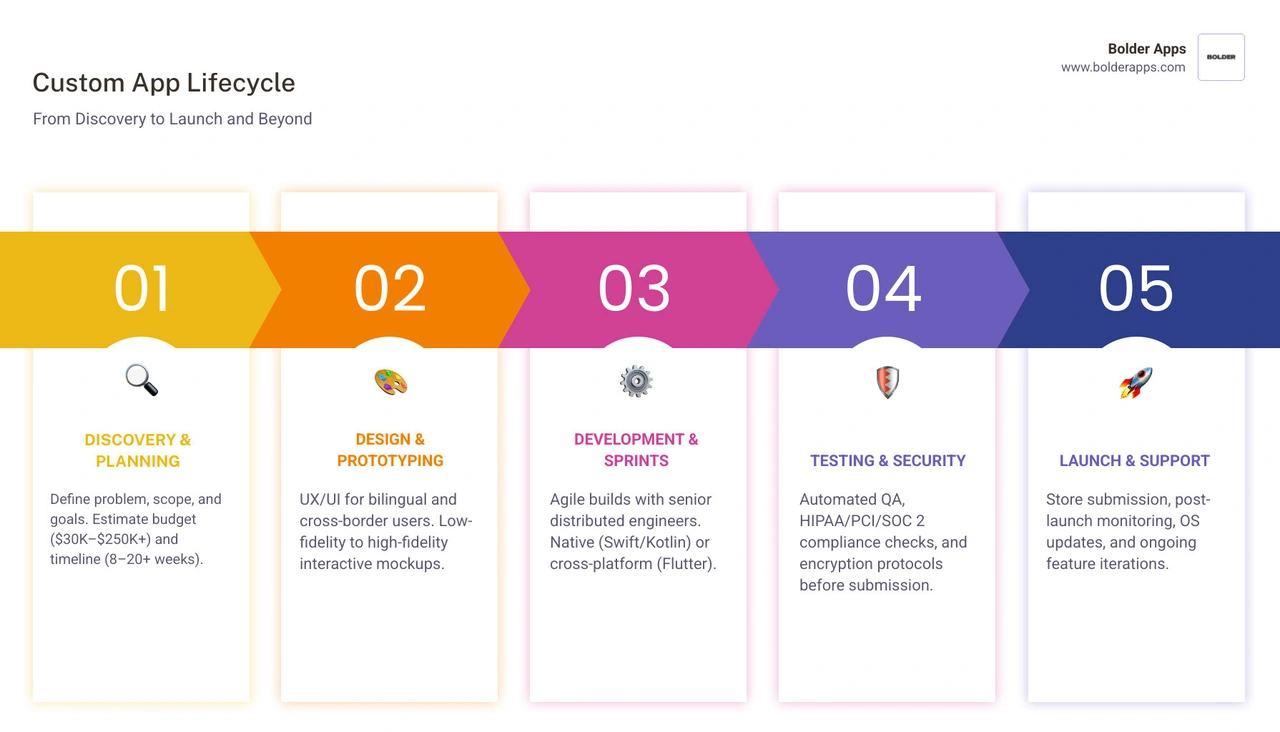
Custom app lifecycle from discovery and design through development, testing, launch, and support infographic

Custom application development miami word roundup:

The Core Drivers of Custom Application Development in Miami

Miami's evolution into a premier technological gateway has redefined how software products are conceived, engineered, and scaled. Rather than relying on rigid, off-the-shelf templates, modern enterprises and emerging founders across South Florida leverage bespoke engineering to capture rapid market opportunities. Tailored software provides an adaptable foundation, allowing organizations to maintain full control over feature development, data governance, and long-term operating costs.

The dynamic nature of the regional economy demands high execution velocity. Operating at the commercial crossroads of North America and Latin America, companies in South Florida build applications engineered for multi-regional utility from day one. This requires intuitive internationalization, multi-currency payment workflows, and real-time backend synchronization capable of handling fluctuating cross-border data loads. Selecting dedicated custom software development ensures your technical architecture supports international scalability without accumulating technical debt.

Frosted glass compass representing discovery and strategic product roadmapping

Key Industries Transforming with Custom Application Development in Miami

Specialized software development in South Florida addresses distinctive business challenges across high-growth industry sectors:

  • Financial Services and Fintech: Rapidly evolving capital markets require custom digital wallets, asset tokenization engines, and low-latency algorithmic trading portals designed for security, automated ledger balancing, and real-time account settlements.
  • Healthcare and Telehealth: Regional clinical networks, specialty wellness providers, and digital health startups implement custom patient portals, automated appointment triage pipelines, and encrypted messaging networks that protect sensitive diagnostic data.
  • Hospitality, Leisure, and On-Demand Services: Luxury concierge services, restaurant collectives, and boutique hospitality brands require omnichannel guest apps featuring biometric check-ins, custom inventory dispatch systems, and loyalty reward tracking.
  • Logistics and Supply Chain: Maritime freight operators and regional transport carriers rely on bespoke tracking dashboards, fleet optimization algorithms, and automated customs documentation portals to clear supply bottlenecks.
  • Commercial Real Estate Tech: Brokerages, asset managers, and property developers deploy custom virtual leasing tours, tenant communication portals, automated maintenance routing systems, and integrated investor transaction management pipelines.

For an extensive review of sector-specific development standards, read our detailed Miami Software Development Guide 2026.

Modern Tech Stacks: Native Platforms vs. Cross-Platform Flutter

Choosing the appropriate software foundation directly influences your budget, build duration, and architectural lifespan. When structuring your engineering roadmap, we assess whether pure native environments or modern cross-platform frameworks deliver optimal performance for your business objectives.

  1. Native iOS (Swift) and Native Android (Kotlin): Native execution provides deep hardware integration, processing complex computational tasks such as advanced augmented reality, intensive real-time video rendering, and low-level peripheral Bluetooth management. While native engineering guarantees platform-specific compliance and responsive UI performance, it requires separate codebases, effectively doubling your long-term maintenance footprint.
  2. Cross-Platform Engineering (Flutter & FlutterFlow): Flutter enables developers to compile native-grade binary code for iOS, Android, and web from a single codebase. By sharing business logic and rendering components across platforms, cross-platform engineering cuts total build hours by roughly 40% to 50% without sacrificing 60fps UI fluidity. For most business workflows, Flutter is an exceptionally cost-effective option for achieving multi-platform coverage.
  3. Modern Backend Infrastructure (Node.js, Laravel, React): Scalable client-facing apps rely on resilient backend engines. Deploying Node.js or Laravel structured around RESTful or GraphQL endpoints ensures seamless data exchange, robust access control, and elastic cloud scaling during sudden traffic spikes.

Discover how we construct these multi-platform systems across our full suite of mobile app development services.

Custom App Development Costs and Timelines in 2026

Custom app development costs in Miami typically run between $30,000 and $250,000+, dictated by interface complexity, user roles, API integrations, and regulatory compliance standards.

Transparent cost breakdown across minimum viable products standard dual-platform apps and enterprise systems

Understanding common pricing tiers helps teams budget accurately:

  • Minimum Viable Product (MVP) Tier ($30,000 – $60,000): Built for focused early-stage validation, an MVP centers around 1 to 2 core user personas, basic user authentication, essential database schemas, standard payment integration, and a refined core workflow. MVPs are engineered to reach market testing rapidly within an 8- to 10-week development cycle.
  • Standard Dual-Platform Tier ($60,000 – $150,000): Designed for scaling ventures and established businesses, this tier delivers fully branded custom designs across iOS and Android via Flutter, multi-tier user role management, custom administrative dashboards, third-party analytics instrumentation, automated email/SMS pipelines, and sophisticated API integrations. Timelines generally span 10 to 16 weeks.
  • Complex Enterprise Tier ($150,000 – $250,000+): Engineered for organizations with high security requirements, legacy technical stacks, or large concurrent user volumes. Deliverables include real-time distributed data synchronization, proprietary AI/ML microservice integrations, custom automated logic pipelines, enterprise database warehousing, and end-to-end regulatory compliance frameworks. Timelines range from 16 to 20+ weeks.

For an exhaustive evaluation of regional cost variables, consult our breakdown on App Development Cost Miami 2026.

Fixed-Scope Pricing vs. Hourly Billing Models

The contract framework you select directly impacts both your delivery schedule and final capital expenditure:

Open-ended hourly billing can introduce conflicting incentives: the more engineering challenges an agency encounters, the more hours they bill, leaving the client to shoulder financial risks and unexpected budget expansions.

Conversely, fixed-scope pricing aligns accountability. Before any code is committed, engineering leadership defines every screen, data schema, user flow, and API dependency within a comprehensive Functional Specification Document. The project cost, scope boundary, and milestone dates are locked upfront. Capital releases occur exclusively when working, testable product increments are verified against the defined functional acceptance criteria.
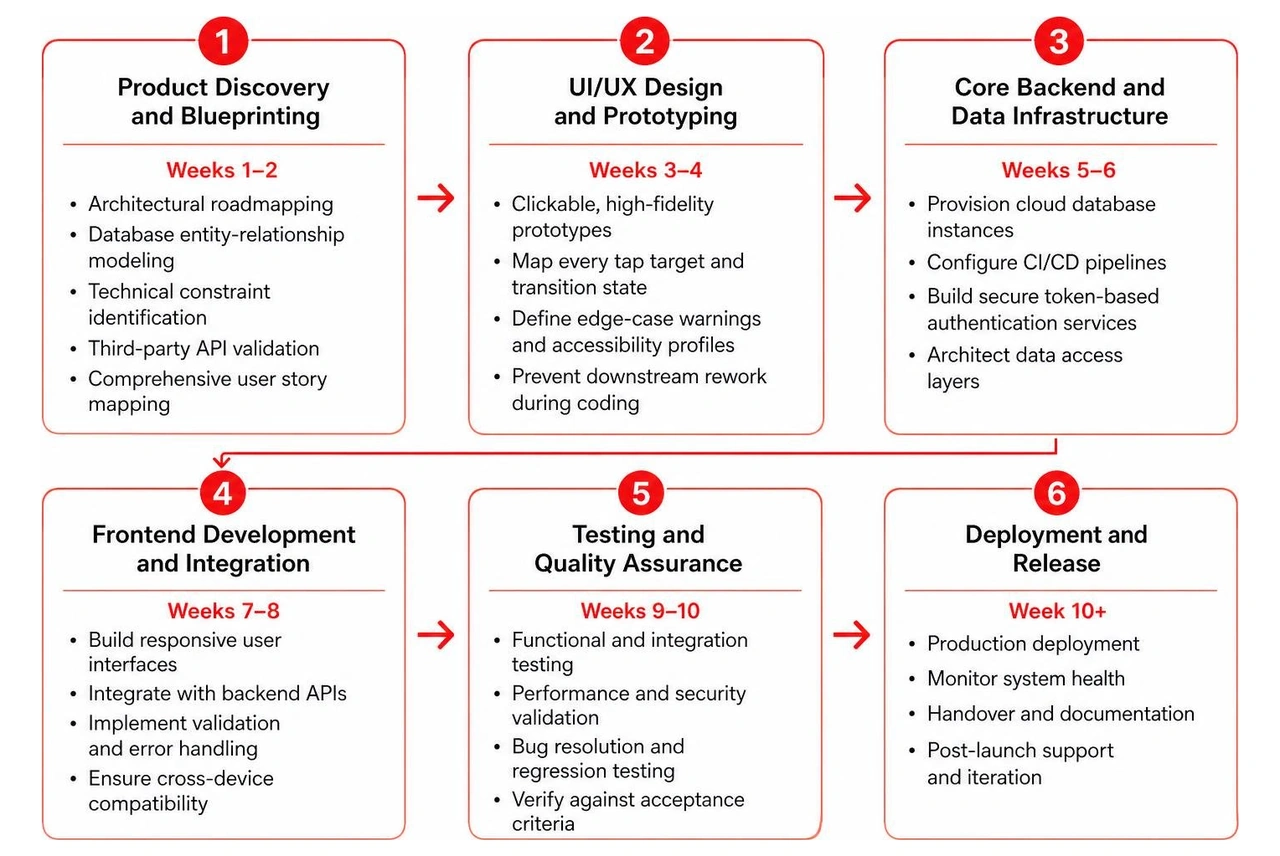
Development Timelines: From Discovery to 10-Week MVPs

Structured step-by-step product development lifecycle across six distinct execution phases

A disciplined engineering lifecycle ensures predictable timelines without cutting corners on software quality:

  1. Product Discovery and Blueprinting (Weeks 1–2): Architectural roadmapping, database entity-relationship modeling, technical constraint identification, third-party API validation, and comprehensive user story mapping.
  2. UI/UX Design and Prototyping (Weeks 3–4): Translating user stories into clickable, high-fidelity prototypes. Every tap target, transition state, edge-case warning, and accessibility profile is mapped to prevent downstream rework during active coding.
  3. Core Backend and Data Infrastructure (Weeks 5–6): Provisioning cloud database instances, configuring continuous integration and automated deployment (CI/CD) pipelines, building secure token-based authentication services, and architecting data access layers.
  4. Frontend Feature Engineering (Weeks 7–8): Connecting client-side interfaces to backend APIs, implementing client caching mechanisms, building responsive screen layouts, and establishing local device state management systems.
  5. Quality Assurance and Penetration Testing (Weeks 9–10): Executing end-to-end automated testing suites, identifying UI rendering edge cases, performing vulnerability audits, and running cross-device load tests.
  6. Production Deployment and Store Submission (Weeks 10+): Deploying containerized services to production cloud hosting environments, managing Apple App Store and Google Play compliance reviews, and establishing 24/7 server monitoring.

Building custom applications in competitive markets requires a strong focus on data privacy, system integrity, and operational efficiency. Custom applications must protect user trust through resilient infrastructure while taking advantage of modern automation capabilities.

Under the legal frameworks governing commercial consumer operations, including the Chapter 501 Section 171 - 2026 Florida Statutes - The Florida Senate, organizations holding personal identifying information must maintain reasonable technical safeguards to protect digital assets against data breaches.

Regulatory Standards: HIPAA, PCI DSS, and SOC 2

Regulated sectors must address strict operational and data compliance requirements during system design:

  • HIPAA (Health Insurance Portability and Accountability Act): For digital health platforms managing Protected Health Information (PHI), all data in transit must utilize TLS 1.3 encryption, and data at rest must use AES-256 ciphers. Backends require strict access logging, zero-trust role-based authorization, signed Business Associate Agreements (BAAs) with cloud hosting providers, and cryptographically isolated database partitions.
  • PCI DSS (Payment Card Industry Data Security Standard): To reduce PCI scope, modern platforms offload direct card data handling to tokenized payment processors like Stripe. Customer credit card information never touches your application database, mitigating compliance liability while enabling automated recurring subscriptions and secure checkouts.
  • SOC 2 Type II Compliance: Enterprise B2B software solutions must demonstrate secure operating processes across system availability, data integrity, and user confidentiality. Engineering workflows require automated vulnerability scans, enforced two-factor authentication on all administrative dashboards, and continuous cloud infrastructure auditing.

Integrating Next-Generation AI Features and Automation

Modern applications leverage intelligent automation to eliminate repetitive workflows, optimize resource allocation, and enhance real-time decision-making:

  • Custom Retrieval-Augmented Generation (RAG): By grounding Large Language Models (LLMs) in your organization's internal databases, apps can generate contextually accurate responses for private customer service queries, policy interpretations, or contract analyses without data leakage.
  • Intelligent Document Extraction: Applications can automatically process scanned receipts, invoices, or medical forms using vision-based models, extracting unstructured data into normalized database records in milliseconds.
  • Predictive Maintenance and Behavioral Logic: Analyzing real-time operational feeds enables custom software to forecast supply chain delays, flag fraudulent payment attempts, and personalize user experiences on the fly.

As an official OpenAI partner with direct access to specialized API credits for qualifying development engagements, Bolder Apps embeds advanced AI microservices directly into scalable web and mobile backends.

How to Choose the Right Local App Development Partner

Finding the right technology partner requires looking past polished sales decks to evaluate an agency's technical depth, development processes, and business alignment.

For practical guidance on evaluating software firms, review our App Development Company Miami Guide.

Critical Vetting Criteria for Custom Application Development in Miami

When evaluating potential development agencies, make sure their operational standards protect your business interests:

  • Complete Intellectual Property Ownership: Ensure your contract explicitly states that all custom source code, API keys, design files, deployment pipelines, and database assets transfer 100% to your company upon milestone completion. You should retain complete control without proprietary platform lock-in.
  • Senior Technical Leadership: Verify that your day-to-day point of contact is a senior technical strategist capable of architectural decisions, not a junior project manager routing support tickets across time zones.
  • Weekly Clickable Demonstrations: Require your agency to deliver working, interactive software builds every week. Avoid partners who work in isolation for months before revealing an untested product.
  • Code Transparency: Insist on direct access to the GitHub or GitLab repository from day one so your team can verify daily commit histories, test coverage, and documentation quality.

To understand the operational benefits of working with local product strategists, read our article on Hiring an App Development Company in Miami What Local Actually Gets You.

Red Flags to Avoid When Evaluating Agencies

Protect your budget and project timeline by watching for these early warning signs:

  • Vague, Non-Binding Estimates: Be cautious of agencies offering low ballpark quotes without defining screen states, API endpoints, or database structures. These usually lead to costly change orders mid-project.
  • Refusal of Direct Repository Access: If a partner claims you can only view the code after final invoice settlement, walk away. Legitimate development partners provide transparent repository access throughout the build.
  • No Post-Launch Warranty: Launching an application in production inevitably exposes unanticipated edge cases. Reliable agencies include at least a 30-day warranty window in their standard contracts to resolve production bugs promptly.

Frequently Asked Questions About Custom App Development in Miami

How much does custom application development typically cost in Miami?

Custom application projects range from $30,000 for focused MVPs to over $250,000 for enterprise, multi-platform software systems. Final costs reflect technical complexity, backend integrations, regulatory compliance needs, and user interface depth.

How long does it take to build and launch a custom application?

Most custom application projects take 8 to 20+ weeks. Focused single-platform MVPs launch in 8 to 10 weeks, while standard dual-platform apps require 10 to 16 weeks. Highly complex enterprise systems typically require 16 to 20+ weeks to complete development, security auditing, and production launch.

What post-launch support and maintenance is required?

Following deployment, custom applications require ongoing server monitoring, cloud dependency updates, database optimizations, and mobile OS compatibility adjustments as Apple and Google release annual platform updates. We provide a complimentary 4-week warranty on all fixed-scope builds, with flexible ongoing retainer support available for feature updates and scaling.

Launching Your Custom Software Vision

Transforming an operational bottleneck or market opportunity into a scalable custom application requires the right architectural choices, experienced engineering leadership, and a transparent development partnership. Building bespoke software should be an organized, predictable process focused on clear business results—not an open-ended financial gamble.

Named the top software and app development agency in 2026 by DesignRush, Bolder Apps combines strategic, US-based technical leadership with senior distributed engineers. Our model gives you high-level product strategy and execution without paying for junior developers to learn on your dime. We operate under a predictable fixed-budget model tied to verified milestone deliverables, providing absolute transparency from initial product discovery to final App Store deployment.

Explore our dedicated custom application development in Miami services to discuss your product architecture, or browse our other regional hubs at our locations directory. Contact our senior leadership team today for a comprehensive, fixed-scope proposal delivered in 1 to 2 business days.

Custom Application Development in Miami: What to Look For

Looking for custom application development in Miami? Start with the problem your app must solve, then ask potential partners for a clear scope, timeline, price, and plan for handing over the code. Most custom builds cost $30,000 to $250,000+ and take 8 to 20+ weeks, depending on the features, platforms, and security needs.

Miami businesses may also need apps that serve customers across languages and borders. Bolder Apps, founded in 2019, builds mobile and web products with US leadership and senior distributed engineers. This guide covers the choices that matter before you commit: cost, technology, security, and how to spot a team that can deliver.

Custom app lifecycle from discovery and design through development, testing, launch, and support infographic

Custom application development miami word roundup:

The Core Drivers of Custom Application Development in Miami

Miami's evolution into a premier technological gateway has redefined how software products are conceived, engineered, and scaled. Rather than relying on rigid, off-the-shelf templates, modern enterprises and emerging founders across South Florida leverage bespoke engineering to capture rapid market opportunities. Tailored software provides an adaptable foundation, allowing organizations to maintain full control over feature development, data governance, and long-term operating costs.

The dynamic nature of the regional economy demands high execution velocity. Operating at the commercial crossroads of North America and Latin America, companies in South Florida build applications engineered for multi-regional utility from day one. This requires intuitive internationalization, multi-currency payment workflows, and real-time backend synchronization capable of handling fluctuating cross-border data loads. Selecting dedicated custom software development ensures your technical architecture supports international scalability without accumulating technical debt.

Frosted glass compass representing discovery and strategic product roadmapping

Key Industries Transforming with Custom Application Development in Miami

Specialized software development in South Florida addresses distinctive business challenges across high-growth industry sectors:

  • Financial Services and Fintech: Rapidly evolving capital markets require custom digital wallets, asset tokenization engines, and low-latency algorithmic trading portals designed for security, automated ledger balancing, and real-time account settlements.
  • Healthcare and Telehealth: Regional clinical networks, specialty wellness providers, and digital health startups implement custom patient portals, automated appointment triage pipelines, and encrypted messaging networks that protect sensitive diagnostic data.
  • Hospitality, Leisure, and On-Demand Services: Luxury concierge services, restaurant collectives, and boutique hospitality brands require omnichannel guest apps featuring biometric check-ins, custom inventory dispatch systems, and loyalty reward tracking.
  • Logistics and Supply Chain: Maritime freight operators and regional transport carriers rely on bespoke tracking dashboards, fleet optimization algorithms, and automated customs documentation portals to clear supply bottlenecks.
  • Commercial Real Estate Tech: Brokerages, asset managers, and property developers deploy custom virtual leasing tours, tenant communication portals, automated maintenance routing systems, and integrated investor transaction management pipelines.

For an extensive review of sector-specific development standards, read our detailed Miami Software Development Guide 2026.

Modern Tech Stacks: Native Platforms vs. Cross-Platform Flutter

Choosing the appropriate software foundation directly influences your budget, build duration, and architectural lifespan. When structuring your engineering roadmap, we assess whether pure native environments or modern cross-platform frameworks deliver optimal performance for your business objectives.

  1. Native iOS (Swift) and Native Android (Kotlin): Native execution provides deep hardware integration, processing complex computational tasks such as advanced augmented reality, intensive real-time video rendering, and low-level peripheral Bluetooth management. While native engineering guarantees platform-specific compliance and responsive UI performance, it requires separate codebases, effectively doubling your long-term maintenance footprint.
  2. Cross-Platform Engineering (Flutter & FlutterFlow): Flutter enables developers to compile native-grade binary code for iOS, Android, and web from a single codebase. By sharing business logic and rendering components across platforms, cross-platform engineering cuts total build hours by roughly 40% to 50% without sacrificing 60fps UI fluidity. For most business workflows, Flutter is an exceptionally cost-effective option for achieving multi-platform coverage.
  3. Modern Backend Infrastructure (Node.js, Laravel, React): Scalable client-facing apps rely on resilient backend engines. Deploying Node.js or Laravel structured around RESTful or GraphQL endpoints ensures seamless data exchange, robust access control, and elastic cloud scaling during sudden traffic spikes.

Discover how we construct these multi-platform systems across our full suite of mobile app development services.

Custom App Development Costs and Timelines in 2026

Custom app development costs in Miami typically run between $30,000 and $250,000+, dictated by interface complexity, user roles, API integrations, and regulatory compliance standards.

Transparent cost breakdown across minimum viable products standard dual-platform apps and enterprise systems

Understanding common pricing tiers helps teams budget accurately:

  • Minimum Viable Product (MVP) Tier ($30,000 – $60,000): Built for focused early-stage validation, an MVP centers around 1 to 2 core user personas, basic user authentication, essential database schemas, standard payment integration, and a refined core workflow. MVPs are engineered to reach market testing rapidly within an 8- to 10-week development cycle.
  • Standard Dual-Platform Tier ($60,000 – $150,000): Designed for scaling ventures and established businesses, this tier delivers fully branded custom designs across iOS and Android via Flutter, multi-tier user role management, custom administrative dashboards, third-party analytics instrumentation, automated email/SMS pipelines, and sophisticated API integrations. Timelines generally span 10 to 16 weeks.
  • Complex Enterprise Tier ($150,000 – $250,000+): Engineered for organizations with high security requirements, legacy technical stacks, or large concurrent user volumes. Deliverables include real-time distributed data synchronization, proprietary AI/ML microservice integrations, custom automated logic pipelines, enterprise database warehousing, and end-to-end regulatory compliance frameworks. Timelines range from 16 to 20+ weeks.

For an exhaustive evaluation of regional cost variables, consult our breakdown on App Development Cost Miami 2026.

Fixed-Scope Pricing vs. Hourly Billing Models

The contract framework you select directly impacts both your delivery schedule and final capital expenditure:

Open-ended hourly billing can introduce conflicting incentives: the more engineering challenges an agency encounters, the more hours they bill, leaving the client to shoulder financial risks and unexpected budget expansions.

Conversely, fixed-scope pricing aligns accountability. Before any code is committed, engineering leadership defines every screen, data schema, user flow, and API dependency within a comprehensive Functional Specification Document. The project cost, scope boundary, and milestone dates are locked upfront. Capital releases occur exclusively when working, testable product increments are verified against the defined functional acceptance criteria.

Development Timelines: From Discovery to 10-Week MVPs

Structured step-by-step product development lifecycle across six distinct execution phases

A disciplined engineering lifecycle ensures predictable timelines without cutting corners on software quality:

  1. Product Discovery and Blueprinting (Weeks 1–2): Architectural roadmapping, database entity-relationship modeling, technical constraint identification, third-party API validation, and comprehensive user story mapping.
  2. UI/UX Design and Prototyping (Weeks 3–4): Translating user stories into clickable, high-fidelity prototypes. Every tap target, transition state, edge-case warning, and accessibility profile is mapped to prevent downstream rework during active coding.
  3. Core Backend and Data Infrastructure (Weeks 5–6): Provisioning cloud database instances, configuring continuous integration and automated deployment (CI/CD) pipelines, building secure token-based authentication services, and architecting data access layers.
  4. Frontend Feature Engineering (Weeks 7–8): Connecting client-side interfaces to backend APIs, implementing client caching mechanisms, building responsive screen layouts, and establishing local device state management systems.
  5. Quality Assurance and Penetration Testing (Weeks 9–10): Executing end-to-end automated testing suites, identifying UI rendering edge cases, performing vulnerability audits, and running cross-device load tests.
  6. Production Deployment and Store Submission (Weeks 10+): Deploying containerized services to production cloud hosting environments, managing Apple App Store and Google Play compliance reviews, and establishing 24/7 server monitoring.

Building custom applications in competitive markets requires a strong focus on data privacy, system integrity, and operational efficiency. Custom applications must protect user trust through resilient infrastructure while taking advantage of modern automation capabilities.

Under the legal frameworks governing commercial consumer operations, including the Chapter 501 Section 171 - 2026 Florida Statutes - The Florida Senate, organizations holding personal identifying information must maintain reasonable technical safeguards to protect digital assets against data breaches.

Regulatory Standards: HIPAA, PCI DSS, and SOC 2

Regulated sectors must address strict operational and data compliance requirements during system design:

  • HIPAA (Health Insurance Portability and Accountability Act): For digital health platforms managing Protected Health Information (PHI), all data in transit must utilize TLS 1.3 encryption, and data at rest must use AES-256 ciphers. Backends require strict access logging, zero-trust role-based authorization, signed Business Associate Agreements (BAAs) with cloud hosting providers, and cryptographically isolated database partitions.
  • PCI DSS (Payment Card Industry Data Security Standard): To reduce PCI scope, modern platforms offload direct card data handling to tokenized payment processors like Stripe. Customer credit card information never touches your application database, mitigating compliance liability while enabling automated recurring subscriptions and secure checkouts.
  • SOC 2 Type II Compliance: Enterprise B2B software solutions must demonstrate secure operating processes across system availability, data integrity, and user confidentiality. Engineering workflows require automated vulnerability scans, enforced two-factor authentication on all administrative dashboards, and continuous cloud infrastructure auditing.

Integrating Next-Generation AI Features and Automation

Modern applications leverage intelligent automation to eliminate repetitive workflows, optimize resource allocation, and enhance real-time decision-making:

  • Custom Retrieval-Augmented Generation (RAG): By grounding Large Language Models (LLMs) in your organization's internal databases, apps can generate contextually accurate responses for private customer service queries, policy interpretations, or contract analyses without data leakage.
  • Intelligent Document Extraction: Applications can automatically process scanned receipts, invoices, or medical forms using vision-based models, extracting unstructured data into normalized database records in milliseconds.
  • Predictive Maintenance and Behavioral Logic: Analyzing real-time operational feeds enables custom software to forecast supply chain delays, flag fraudulent payment attempts, and personalize user experiences on the fly.

As an official OpenAI partner with direct access to specialized API credits for qualifying development engagements, Bolder Apps embeds advanced AI microservices directly into scalable web and mobile backends.

How to Choose the Right Local App Development Partner

Finding the right technology partner requires looking past polished sales decks to evaluate an agency's technical depth, development processes, and business alignment.

For practical guidance on evaluating software firms, review our App Development Company Miami Guide.

Critical Vetting Criteria for Custom Application Development in Miami

When evaluating potential development agencies, make sure their operational standards protect your business interests:

  • Complete Intellectual Property Ownership: Ensure your contract explicitly states that all custom source code, API keys, design files, deployment pipelines, and database assets transfer 100% to your company upon milestone completion. You should retain complete control without proprietary platform lock-in.
  • Senior Technical Leadership: Verify that your day-to-day point of contact is a senior technical strategist capable of architectural decisions, not a junior project manager routing support tickets across time zones.
  • Weekly Clickable Demonstrations: Require your agency to deliver working, interactive software builds every week. Avoid partners who work in isolation for months before revealing an untested product.
  • Code Transparency: Insist on direct access to the GitHub or GitLab repository from day one so your team can verify daily commit histories, test coverage, and documentation quality.

To understand the operational benefits of working with local product strategists, read our article on Hiring an App Development Company in Miami What Local Actually Gets You.

Red Flags to Avoid When Evaluating Agencies

Protect your budget and project timeline by watching for these early warning signs:

  • Vague, Non-Binding Estimates: Be cautious of agencies offering low ballpark quotes without defining screen states, API endpoints, or database structures. These usually lead to costly change orders mid-project.
  • Refusal of Direct Repository Access: If a partner claims you can only view the code after final invoice settlement, walk away. Legitimate development partners provide transparent repository access throughout the build.
  • No Post-Launch Warranty: Launching an application in production inevitably exposes unanticipated edge cases. Reliable agencies include at least a 30-day warranty window in their standard contracts to resolve production bugs promptly.

Frequently Asked Questions About Custom App Development in Miami

How much does custom application development typically cost in Miami?

Custom application projects range from $30,000 for focused MVPs to over $250,000 for enterprise, multi-platform software systems. Final costs reflect technical complexity, backend integrations, regulatory compliance needs, and user interface depth.

How long does it take to build and launch a custom application?

Most custom application projects take 8 to 20+ weeks. Focused single-platform MVPs launch in 8 to 10 weeks, while standard dual-platform apps require 10 to 16 weeks. Highly complex enterprise systems typically require 16 to 20+ weeks to complete development, security auditing, and production launch.

What post-launch support and maintenance is required?

Following deployment, custom applications require ongoing server monitoring, cloud dependency updates, database optimizations, and mobile OS compatibility adjustments as Apple and Google release annual platform updates. We provide a complimentary 4-week warranty on all fixed-scope builds, with flexible ongoing retainer support available for feature updates and scaling.

Launching Your Custom Software Vision

Transforming an operational bottleneck or market opportunity into a scalable custom application requires the right architectural choices, experienced engineering leadership, and a transparent development partnership. Building bespoke software should be an organized, predictable process focused on clear business results—not an open-ended financial gamble.

Named the top software and app development agency in 2026 by DesignRush, Bolder Apps combines strategic, US-based technical leadership with senior distributed engineers. Our model gives you high-level product strategy and execution without paying for junior developers to learn on your dime. We operate under a predictable fixed-budget model tied to verified milestone deliverables, providing absolute transparency from initial product discovery to final App Store deployment.

Explore our dedicated custom application development in Miami services to discuss your product architecture, or browse our other regional hubs at our locations directory. Contact our senior leadership team today for a comprehensive, fixed-scope proposal delivered in 1 to 2 business days.
Quick answers

Frequently Asked Questions.

Custom Application Development in Miami: What to Look For

Looking for custom application development in Miami? Start with the problem your app must solve, then ask potential partners for a clear scope, timeline, price, and plan for handing over the code. Most custom builds cost $30,000 to $250,000+ and take 8 to 20+ weeks, depending on the features, platforms, and security needs.

Miami businesses may also need apps that serve customers across languages and borders. Bolder Apps, founded in 2019, builds mobile and web products with US leadership and senior distributed engineers. This guide covers the choices that matter before you commit: cost, technology, security, and how to spot a team that can deliver.

Custom app lifecycle from discovery and design through development, testing, launch, and support infographic

Custom application development miami word roundup:

The Core Drivers of Custom Application Development in Miami

Miami's evolution into a premier technological gateway has redefined how software products are conceived, engineered, and scaled. Rather than relying on rigid, off-the-shelf templates, modern enterprises and emerging founders across South Florida leverage bespoke engineering to capture rapid market opportunities. Tailored software provides an adaptable foundation, allowing organizations to maintain full control over feature development, data governance, and long-term operating costs.

The dynamic nature of the regional economy demands high execution velocity. Operating at the commercial crossroads of North America and Latin America, companies in South Florida build applications engineered for multi-regional utility from day one. This requires intuitive internationalization, multi-currency payment workflows, and real-time backend synchronization capable of handling fluctuating cross-border data loads. Selecting dedicated custom software development ensures your technical architecture supports international scalability without accumulating technical debt.

Frosted glass compass representing discovery and strategic product roadmapping

Key Industries Transforming with Custom Application Development in Miami

Specialized software development in South Florida addresses distinctive business challenges across high-growth industry sectors:

  • Financial Services and Fintech: Rapidly evolving capital markets require custom digital wallets, asset tokenization engines, and low-latency algorithmic trading portals designed for security, automated ledger balancing, and real-time account settlements.
  • Healthcare and Telehealth: Regional clinical networks, specialty wellness providers, and digital health startups implement custom patient portals, automated appointment triage pipelines, and encrypted messaging networks that protect sensitive diagnostic data.
  • Hospitality, Leisure, and On-Demand Services: Luxury concierge services, restaurant collectives, and boutique hospitality brands require omnichannel guest apps featuring biometric check-ins, custom inventory dispatch systems, and loyalty reward tracking.
  • Logistics and Supply Chain: Maritime freight operators and regional transport carriers rely on bespoke tracking dashboards, fleet optimization algorithms, and automated customs documentation portals to clear supply bottlenecks.
  • Commercial Real Estate Tech: Brokerages, asset managers, and property developers deploy custom virtual leasing tours, tenant communication portals, automated maintenance routing systems, and integrated investor transaction management pipelines.

For an extensive review of sector-specific development standards, read our detailed Miami Software Development Guide 2026.

Modern Tech Stacks: Native Platforms vs. Cross-Platform Flutter

Choosing the appropriate software foundation directly influences your budget, build duration, and architectural lifespan. When structuring your engineering roadmap, we assess whether pure native environments or modern cross-platform frameworks deliver optimal performance for your business objectives.

  1. Native iOS (Swift) and Native Android (Kotlin): Native execution provides deep hardware integration, processing complex computational tasks such as advanced augmented reality, intensive real-time video rendering, and low-level peripheral Bluetooth management. While native engineering guarantees platform-specific compliance and responsive UI performance, it requires separate codebases, effectively doubling your long-term maintenance footprint.
  2. Cross-Platform Engineering (Flutter & FlutterFlow): Flutter enables developers to compile native-grade binary code for iOS, Android, and web from a single codebase. By sharing business logic and rendering components across platforms, cross-platform engineering cuts total build hours by roughly 40% to 50% without sacrificing 60fps UI fluidity. For most business workflows, Flutter is an exceptionally cost-effective option for achieving multi-platform coverage.
  3. Modern Backend Infrastructure (Node.js, Laravel, React): Scalable client-facing apps rely on resilient backend engines. Deploying Node.js or Laravel structured around RESTful or GraphQL endpoints ensures seamless data exchange, robust access control, and elastic cloud scaling during sudden traffic spikes.

Discover how we construct these multi-platform systems across our full suite of mobile app development services.

Custom App Development Costs and Timelines in 2026

Custom app development costs in Miami typically run between $30,000 and $250,000+, dictated by interface complexity, user roles, API integrations, and regulatory compliance standards.

Transparent cost breakdown across minimum viable products standard dual-platform apps and enterprise systems

Understanding common pricing tiers helps teams budget accurately:

  • Minimum Viable Product (MVP) Tier ($30,000 – $60,000): Built for focused early-stage validation, an MVP centers around 1 to 2 core user personas, basic user authentication, essential database schemas, standard payment integration, and a refined core workflow. MVPs are engineered to reach market testing rapidly within an 8- to 10-week development cycle.
  • Standard Dual-Platform Tier ($60,000 – $150,000): Designed for scaling ventures and established businesses, this tier delivers fully branded custom designs across iOS and Android via Flutter, multi-tier user role management, custom administrative dashboards, third-party analytics instrumentation, automated email/SMS pipelines, and sophisticated API integrations. Timelines generally span 10 to 16 weeks.
  • Complex Enterprise Tier ($150,000 – $250,000+): Engineered for organizations with high security requirements, legacy technical stacks, or large concurrent user volumes. Deliverables include real-time distributed data synchronization, proprietary AI/ML microservice integrations, custom automated logic pipelines, enterprise database warehousing, and end-to-end regulatory compliance frameworks. Timelines range from 16 to 20+ weeks.

For an exhaustive evaluation of regional cost variables, consult our breakdown on App Development Cost Miami 2026.

Fixed-Scope Pricing vs. Hourly Billing Models

The contract framework you select directly impacts both your delivery schedule and final capital expenditure:

Open-ended hourly billing can introduce conflicting incentives: the more engineering challenges an agency encounters, the more hours they bill, leaving the client to shoulder financial risks and unexpected budget expansions.

Conversely, fixed-scope pricing aligns accountability. Before any code is committed, engineering leadership defines every screen, data schema, user flow, and API dependency within a comprehensive Functional Specification Document. The project cost, scope boundary, and milestone dates are locked upfront. Capital releases occur exclusively when working, testable product increments are verified against the defined functional acceptance criteria.

Development Timelines: From Discovery to 10-Week MVPs

Structured step-by-step product development lifecycle across six distinct execution phases

A disciplined engineering lifecycle ensures predictable timelines without cutting corners on software quality:

  1. Product Discovery and Blueprinting (Weeks 1–2): Architectural roadmapping, database entity-relationship modeling, technical constraint identification, third-party API validation, and comprehensive user story mapping.
  2. UI/UX Design and Prototyping (Weeks 3–4): Translating user stories into clickable, high-fidelity prototypes. Every tap target, transition state, edge-case warning, and accessibility profile is mapped to prevent downstream rework during active coding.
  3. Core Backend and Data Infrastructure (Weeks 5–6): Provisioning cloud database instances, configuring continuous integration and automated deployment (CI/CD) pipelines, building secure token-based authentication services, and architecting data access layers.
  4. Frontend Feature Engineering (Weeks 7–8): Connecting client-side interfaces to backend APIs, implementing client caching mechanisms, building responsive screen layouts, and establishing local device state management systems.
  5. Quality Assurance and Penetration Testing (Weeks 9–10): Executing end-to-end automated testing suites, identifying UI rendering edge cases, performing vulnerability audits, and running cross-device load tests.
  6. Production Deployment and Store Submission (Weeks 10+): Deploying containerized services to production cloud hosting environments, managing Apple App Store and Google Play compliance reviews, and establishing 24/7 server monitoring.

Building custom applications in competitive markets requires a strong focus on data privacy, system integrity, and operational efficiency. Custom applications must protect user trust through resilient infrastructure while taking advantage of modern automation capabilities.

Under the legal frameworks governing commercial consumer operations, including the Chapter 501 Section 171 - 2026 Florida Statutes - The Florida Senate, organizations holding personal identifying information must maintain reasonable technical safeguards to protect digital assets against data breaches.

Regulatory Standards: HIPAA, PCI DSS, and SOC 2

Regulated sectors must address strict operational and data compliance requirements during system design:

  • HIPAA (Health Insurance Portability and Accountability Act): For digital health platforms managing Protected Health Information (PHI), all data in transit must utilize TLS 1.3 encryption, and data at rest must use AES-256 ciphers. Backends require strict access logging, zero-trust role-based authorization, signed Business Associate Agreements (BAAs) with cloud hosting providers, and cryptographically isolated database partitions.
  • PCI DSS (Payment Card Industry Data Security Standard): To reduce PCI scope, modern platforms offload direct card data handling to tokenized payment processors like Stripe. Customer credit card information never touches your application database, mitigating compliance liability while enabling automated recurring subscriptions and secure checkouts.
  • SOC 2 Type II Compliance: Enterprise B2B software solutions must demonstrate secure operating processes across system availability, data integrity, and user confidentiality. Engineering workflows require automated vulnerability scans, enforced two-factor authentication on all administrative dashboards, and continuous cloud infrastructure auditing.

Integrating Next-Generation AI Features and Automation

Modern applications leverage intelligent automation to eliminate repetitive workflows, optimize resource allocation, and enhance real-time decision-making:

  • Custom Retrieval-Augmented Generation (RAG): By grounding Large Language Models (LLMs) in your organization's internal databases, apps can generate contextually accurate responses for private customer service queries, policy interpretations, or contract analyses without data leakage.
  • Intelligent Document Extraction: Applications can automatically process scanned receipts, invoices, or medical forms using vision-based models, extracting unstructured data into normalized database records in milliseconds.
  • Predictive Maintenance and Behavioral Logic: Analyzing real-time operational feeds enables custom software to forecast supply chain delays, flag fraudulent payment attempts, and personalize user experiences on the fly.

As an official OpenAI partner with direct access to specialized API credits for qualifying development engagements, Bolder Apps embeds advanced AI microservices directly into scalable web and mobile backends.

How to Choose the Right Local App Development Partner

Finding the right technology partner requires looking past polished sales decks to evaluate an agency's technical depth, development processes, and business alignment.

For practical guidance on evaluating software firms, review our App Development Company Miami Guide.

Critical Vetting Criteria for Custom Application Development in Miami

When evaluating potential development agencies, make sure their operational standards protect your business interests:

  • Complete Intellectual Property Ownership: Ensure your contract explicitly states that all custom source code, API keys, design files, deployment pipelines, and database assets transfer 100% to your company upon milestone completion. You should retain complete control without proprietary platform lock-in.
  • Senior Technical Leadership: Verify that your day-to-day point of contact is a senior technical strategist capable of architectural decisions, not a junior project manager routing support tickets across time zones.
  • Weekly Clickable Demonstrations: Require your agency to deliver working, interactive software builds every week. Avoid partners who work in isolation for months before revealing an untested product.
  • Code Transparency: Insist on direct access to the GitHub or GitLab repository from day one so your team can verify daily commit histories, test coverage, and documentation quality.

To understand the operational benefits of working with local product strategists, read our article on Hiring an App Development Company in Miami What Local Actually Gets You.

Red Flags to Avoid When Evaluating Agencies

Protect your budget and project timeline by watching for these early warning signs:

  • Vague, Non-Binding Estimates: Be cautious of agencies offering low ballpark quotes without defining screen states, API endpoints, or database structures. These usually lead to costly change orders mid-project.
  • Refusal of Direct Repository Access: If a partner claims you can only view the code after final invoice settlement, walk away. Legitimate development partners provide transparent repository access throughout the build.
  • No Post-Launch Warranty: Launching an application in production inevitably exposes unanticipated edge cases. Reliable agencies include at least a 30-day warranty window in their standard contracts to resolve production bugs promptly.

Frequently Asked Questions About Custom App Development in Miami

How much does custom application development typically cost in Miami?

Custom application projects range from $30,000 for focused MVPs to over $250,000 for enterprise, multi-platform software systems. Final costs reflect technical complexity, backend integrations, regulatory compliance needs, and user interface depth.

How long does it take to build and launch a custom application?

Most custom application projects take 8 to 20+ weeks. Focused single-platform MVPs launch in 8 to 10 weeks, while standard dual-platform apps require 10 to 16 weeks. Highly complex enterprise systems typically require 16 to 20+ weeks to complete development, security auditing, and production launch.

What post-launch support and maintenance is required?

Following deployment, custom applications require ongoing server monitoring, cloud dependency updates, database optimizations, and mobile OS compatibility adjustments as Apple and Google release annual platform updates. We provide a complimentary 4-week warranty on all fixed-scope builds, with flexible ongoing retainer support available for feature updates and scaling.

Launching Your Custom Software Vision

Transforming an operational bottleneck or market opportunity into a scalable custom application requires the right architectural choices, experienced engineering leadership, and a transparent development partnership. Building bespoke software should be an organized, predictable process focused on clear business results—not an open-ended financial gamble.

Named the top software and app development agency in 2026 by DesignRush, Bolder Apps combines strategic, US-based technical leadership with senior distributed engineers. Our model gives you high-level product strategy and execution without paying for junior developers to learn on your dime. We operate under a predictable fixed-budget model tied to verified milestone deliverables, providing absolute transparency from initial product discovery to final App Store deployment.

Explore our dedicated custom application development in Miami services to discuss your product architecture, or browse our other regional hubs at our locations directory. Contact our senior leadership team today for a comprehensive, fixed-scope proposal delivered in 1 to 2 business days.

Get in touch

Let's discuss your goals

Schedule a meeting via the form here and we’ll connect you directly with our director of product—no salespeople involved.

What happens next?

Book a discovery call
Discuss and strategize your goals
We prepare a proposal and review it collaboratively
Clutch Boutique client logo
Clutch Award Badge
Clutch Award Badge

Bolder Starts Here

Please enter a valid phone number
Join 30+ founders who shipped with Bolder Apps
By submitting this form, you agree to our Terms of Use and Privacy Policy
Thank you! Your submission has been received!
Oops! Something went wrong while submitting the form.