August 6, 2026

A Comprehensive Guide to Comparing Code Audit Services

Blog Image

Key takeaways from the blog

Why Code Audit Services Are Critical for Modern Software Success

Code audit services provide a comprehensive, expert-driven review of your application's source code to identify security vulnerabilities, quality issues, performance bottlenecks, and compliance gaps before they become costly problems.

What You Get from Code Audit Services:

  • Security Assessment - Identification of vulnerabilities like SQL injection, XSS, and authentication flaws
  • Quality Review - Analysis of code maintainability, architectural patterns, and technical debt
  • Compliance Validation - Verification against standards like HIPAA, GDPR, and PCI DSS
  • Performance Analysis - Detection of inefficiencies that slow systems or strain infrastructure
  • Risk Prioritization - Clear roadmap of issues ranked by business impact and severity
  • Remediation Guidance - Actionable recommendations with implementation support

In large enterprises, software risk rarely announces itself through failure. It shows up quietly—rising operational costs, stalled releases, security exceptions, or last-minute compliance escalations that derail strategic initiatives.

Technical debt alone can consume 20% to 40% of an enterprise's IT budget. That's not just a financial drain. It's lost opportunity, delayed innovation, and mounting risk that compounds with every sprint.

Code audit services have evolved from periodic IT hygiene checks into strategic decision-enabling mechanisms. Whether you're preparing for an acquisition, modernizing legacy systems, migrating to the cloud, or facing recurring security incidents, a professional code audit provides the clarity and confidence needed to move forward.

The difference between a reactive fire drill and proactive governance often comes down to one question: Do you actually know what's running in production?

Most organizations don't. Architecture diagrams drift from reality. Dependencies go undocumented. Security controls exist on paper but fail in practice. What was built by one team gets inherited by another, and the knowledge gap widens.

A comprehensive code audit closes that gap. It validates what's real, surfaces what's hidden, and translates technical complexity into business-level risk assessment that executives can act on.
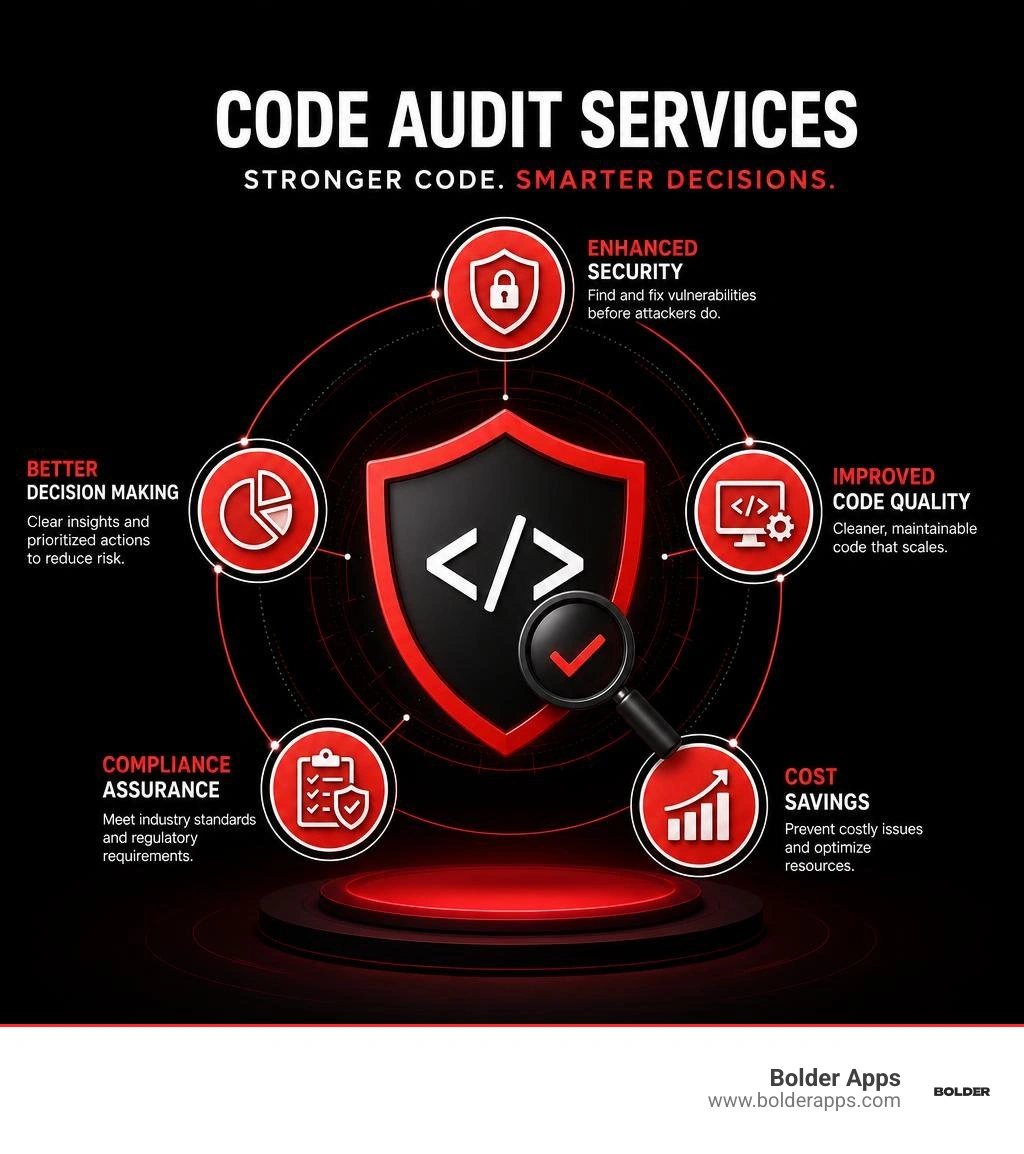
Infographic showing the core benefits of code audit services: Enhanced Security through vulnerability identification and penetration testing; Improved Code Quality via maintainability analysis and technical debt reduction; Cost Savings from preventing expensive post-deployment fixes and optimizing infrastructure; Compliance Assurance through validation against GDPR HIPAA PCI DSS and industry standards; Better Decision Making with clear risk prioritization and actionable remediation roadmaps - code audit services infographic

The What and Why: Understanding the Core Value of a Code Audit

At its heart, a code audit is a meticulous, systematic examination of a software application's source code. It's not just about finding bugs; it's about uncovering the underlying health of your digital product. Think of it as a thorough medical check-up for your software, designed to ensure its longevity, performance, and security.

Why is this so crucial for businesses today? Because our applications are the lifeblood of our operations. Poor code quality, unaddressed security vulnerabilities, or performance bottlenecks can lead to devastating consequences. Imagine your mission-critical application crashing during peak hours, sensitive customer data being exposed, or your development team spending endless hours wrestling with "technical debt"—the cost of rework required due to suboptimal coding practices. As research by McKinsey & Company highlights, technical debt can consume a staggering 20% to 40% of an enterprise's IT budget, limiting innovation and increasing exposure to outages and security gaps.

A professional code audit service helps us identify these issues proactively, allowing us to address them before they escalate into costly problems. It's an integral part of what we call "defensive programming," where we strive to reduce errors and strengthen security before a software release. For a deeper dive into how foundational architectural decisions impact your software, consider exploring our insights on Software Architecture Design.

shield protecting a server rack - code audit services

Key Benefits of a Comprehensive Code Audit

Engaging in code audit services offers a multitude of benefits that extend far beyond simply finding and fixing bugs. It's a strategic investment in the future of your software, ensuring it's robust, efficient, and compliant.

  1. Improved Security: This is often the primary driver for many audits. We carefully scan for common vulnerabilities like SQL injection, Cross-Site Scripting (XSS), buffer overflows, and authentication flaws. Identifying these weaknesses before malicious actors do can save your business from reputational damage, financial losses, and legal repercussions. For instance, staying ahead of vulnerabilities is critical, as evidenced by news like Google Patches 107 Android Vulnerabilities: What It Means for App Security in 2026.
  2. Improved Code Quality: A good audit reviews your codebase for readability, consistency in coding style, and adherence to best practices. This leads to cleaner, more maintainable code that is easier for current and future development teams to understand and modify. It also helps in identifying and reducing technical debt, making your software more agile and adaptable.
  3. Increased Compliance: Many industries, especially healthcare and finance, operate under strict regulatory frameworks. Code audit services ensure your software adheres to these industry standards and regulations, such as HIPAA, GDPR, and PCI DSS. This is vital for avoiding hefty fines and maintaining trust with your customers.
  4. Better Development Practices: An audit can foster a culture of quality and accountability within your development team. By providing objective feedback and recommendations, it encourages developers to adopt more secure and efficient coding practices, leading to continuous improvement.
  5. Reduced Long-Term Costs: Proactive identification and remediation of issues are far less expensive than fixing problems post-deployment. By optimizing performance, reducing resource usage, and preventing security breaches, audits can significantly lower infrastructure costs and maintenance expenses over the software's lifespan.
  6. Improved Scalability: Audits pinpoint inefficiencies and architectural weaknesses that could hinder your application's ability to handle growth. By addressing these bottlenecks, we help ensure your software is ready to scale with your business demands.

When Should You Consider a Code Audit?

Knowing when to conduct a code audit is almost as important as understanding what it entails. While regular code reviews are part of a healthy development cycle, a comprehensive code audit service is typically warranted during specific, high-stakes scenarios:

  • Pre-Merger or Acquisition Technical Due Diligence: Before investing in or acquiring another company's software, you need a clear picture of its technical health. An audit uncovers hidden risks, technical debt, and integration challenges, providing critical insights for informed decision-making.
  • Legacy System Modernization and Platform Re-Architecture: If you're planning to update or rebuild an aging system, an audit helps identify undocumented dependencies, technical debt, and scalability limits. This prevents guesswork from driving architectural decisions and ensures a smoother transition.
  • Cloud Migration Readiness and Post-Migration Validation: Moving to the cloud is a big step. An audit can map dependencies and data flows before migration, identify systems needing refactoring, and validate controls post-migration to prevent inheriting legacy risks in your new environment.
  • Recurring Security Incidents or Performance Degradation: If your application experiences frequent bugs, crashes, slow performance, or persistent security breaches, an audit can identify the underlying structural weaknesses, rather than just patching symptoms.
  • Preparing for Regulatory and Customer-Driven Compliance Reviews: For industries with strict regulations (like HIPAA, GDPR, PCI DSS), an audit validates that your controls are implemented correctly and that audit trails are reliable. This helps avoid last-minute remediation and strengthens your defensibility during formal reviews.
  • Onboarding a New Development Team or Inheriting a Codebase: When a new team takes over a project, or you acquire an existing codebase, an audit provides an objective assessment of its quality, security, and maintainability. This helps the new team get up to speed quickly and avoid costly surprises.
  • Before a Major Product Launch or Update: Prior to releasing a significant update or a brand-new product, an audit offers peace of mind. It's a final, critical check to ensure your software is robust, secure, and ready for prime time.
  • When Development Velocity Slows: If your team is spending too much time fixing issues rather than building new features, it's a strong indicator of accumulating technical debt that a code audit can help address.

A Deep Dive into Code Audit Services and Methodologies

A comprehensive code audit service isn't a one-size-fits-all solution. It combines various methodologies and expertise to provide a holistic view of your software. Whether it's a Mobile App Development project or a complex Web App Development platform, the approach needs to be custom. We blend automated tools with the irreplaceable insight of human experts, ensuring nothing falls through the cracks.

flowchart showing the audit process - code audit services

The Different Types of Code Audits

Understanding the various types of code audit services available helps you select the right approach for your specific needs:

  1. Security Audits: These are laser-focused on identifying vulnerabilities that could be exploited by malicious actors.
    • Static Application Security Testing (SAST): This 'inside-out' approach involves automated tools scanning your source code without executing it. It's excellent for finding common vulnerabilities like SQL injection, XSS, and buffer overflows, often guided by standards like the OWASP Top 10. However, automated tools can have false positives, which is why expert review is essential.
    • Dynamic Analysis: This 'outside-in' method analyzes your running code to identify runtime vulnerabilities and logic errors. It simulates attacks to see how the application behaves under stress.
    • Penetration Testing (Pen Testing): This is an ethical hacking exercise where security experts attempt to bypass security controls and exploit vulnerabilities in a running application, much like a real attacker would. It reveals how robust your defenses truly are.
  2. Quality Audits: These audits focus on the internal health and maintainability of the codebase.
    • Code Quality and Architecture Review: This assesses the readability, consistency, reusability, and extensibility of your code. It looks for bloated logic, anti-patterns, and ensures alignment with modern software architecture principles. It also includes Design Quality Audits, which evaluate the overall architecture for modularity and hierarchy.
    • Performance Audits: These aim to identify performance bottlenecks and inefficient code that could slow down your application or strain server resources, ensuring optimal efficiency.
  3. Compliance Audits: These verify that your software adheres to specific industry standards and regulatory requirements.
    • Regulatory Compliance: Ensures adherence to standards like HIPAA, GDPR, PCI DSS, NIST CSF, and other industry-specific regulations, particularly concerning data handling, encryption, and privacy.
    • Open-Source License Review & Software Bill of Materials (SBoM): This involves identifying all open-source and third-party components in your codebase, analyzing their license obligations, and checking for potential conflicts or known vulnerabilities within those components. This provides a clear Software Bill of Materials (SBoM) for better risk management.

While automated tools offer significant coverage for tasks like Software Composition Analysis (SCA), SAST, Infrastructure as Code (IaC) scanning, and secrets detection, human expertise remains paramount. Experts review automated processes, identify critical focus areas, and dig deeply into novel issues within large codebases. Manual code review, adhering closely to the OWASP Code Review Guide, uncovers multifaceted vulnerabilities and design flaws that automated tools may miss.

The Typical Code Audit Process Explained

While the specifics can vary based on the type and scope of the audit, a typical code audit service follows a well-defined process to ensure thoroughness and actionable outcomes:

  1. Scoping and Planning: This initial phase is crucial. We begin with a findy call to understand your business goals, the application's history, its critical functions, and any specific concerns you might have. Based on this, we define the audit's scope, objectives, and deliverables. We'll outline which parts of the codebase will be reviewed, the types of audits to be performed (security, quality, compliance), and the expected timeline.
  2. Automated Analysis: Once the scope is set, we deploy a suite of advanced automated tools. These tools perform static code analysis, identifying common vulnerabilities, coding standard violations, and potential performance issues. This includes SCA for third-party dependencies, SAST for your proprietary code, IaC scanning for cloud configurations, and secrets detection.
  3. Manual Code Review: This is where our senior engineers and security experts come in. They carefully review the codebase line-by-line, scrutinizing areas flagged by automated tools, as well as critical business logic, architectural patterns, and design decisions. This human-led approach is vital for uncovering complex vulnerabilities, design flaws, and contextual issues that automation alone cannot detect.
  4. Vulnerability Identification and Prioritization: As findings emerge, they are carefully documented. We don't just list problems; we prioritize them based on severity (critical, high, medium, low) and their potential business impact. This helps you understand which issues need immediate attention versus those that can be addressed in future development cycles.
  5. Report Generation: Once the audit is complete, we compile a comprehensive report. This document details all identified issues, their potential impact, and clear, actionable recommendations for remediation. The report often includes an executive summary, technical findings, and a roadmap for improvement.
  6. Remediation Support (Optional): Our engagement doesn't necessarily end with the report. We can provide ongoing support as your team implements the recommended fixes, clarify findings, and help verify that the vulnerabilities have been successfully resolved.
  7. Verification: In some cases, a follow-up audit or specific verification steps are performed to ensure that all identified issues have been adequately addressed and that the fixes haven't introduced new problems.

What Programming Languages and Technologies Can Be Audited?

The beauty of professional code audit services is their versatility. Our experts are proficient in auditing virtually any programming language or technology stack commonly used in modern software development. If it's code, we can audit it.

This includes, but is not limited to:

  • Backend Languages: Java, Python, JavaScript (Node.js), PHP, Ruby, Go, C#, C++, and .NET frameworks.
  • Frontend Technologies: JavaScript (React, Angular, Vue.js), HTML, CSS, and various frontend frameworks.
  • Mobile Development: Native iOS (Swift, Objective-C) and Android (Kotlin, Java) applications, as well as cross-platform frameworks like React Native and Flutter.
  • Smart Contracts: For the burgeoning blockchain space, we audit Solidity, Cairo, Rust, and Go used in decentralized applications and blockchain infrastructure.
  • Cloud Infrastructure: Infrastructure as Code (IaC) configurations written in Terraform, CloudFormation, Ansible, etc., to ensure secure and efficient cloud deployments.
  • Databases: SQL databases (e.g., PostgreSQL, MySQL, MS SQL Server) and NoSQL databases (e.g., MongoDB, Cassandra, Redis) for security configurations and query optimization.
  • Legacy Systems: Our expertise extends to older languages and frameworks, providing vital insights for modernization efforts.

Our ability to audit such a wide array of technologies ensures that no matter your project's stack, we can provide the in-depth analysis you need.

How to Choose the Right Partner for Your Code Audit Services

Selecting the right provider for your code audit services is a critical decision that can significantly impact the outcome and value you receive. It’s not just about technical expertise; it’s about a partnership that aligns with your business objectives and provides actionable insights. Just as understanding the true cost to make an app in 2026 requires careful consideration, so does choosing an audit partner.

What to Look for in a Code Audit Service Provider

When evaluating potential partners for code audit services, consider these key factors:

  1. Proven Experience and Track Record: Look for a provider with a long history in software development and cybersecurity. Experience often translates to efficiency and a deeper understanding of complex issues. Some firms boast over 30 years in software development and 20+ years in cybersecurity, with thousands of successful projects. Ask for case studies or testimonials relevant to your industry or technology stack.
  2. Senior-Level Engineers and Experts: Ensure the team conducting the audit consists of seasoned professionals, not junior developers learning on your dime. Look for individuals with deep expertise in security, architecture, and specific programming languages. Experienced leadership, such as a CTO Pete Callaghan or a Technical Director Joakim Ohlander, indicates a strong technical foundation.
  3. Ability to Translate Technical Risk to Business Impact: A good audit report doesn't just list technical jargon; it clearly explains the business consequences of each finding (e.g., "this vulnerability could lead to data breach and regulatory fines"). The provider should be able to communicate effectively with both technical and non-technical stakeholders.
  4. Clear, Structured Methodology: A transparent and well-defined audit process is crucial. Understand their approach to scoping, automated and manual analysis, vulnerability prioritization, and reporting. This ensures consistency and thoroughness.
  5. Strong Communication and Collaborative Approach: The best audit partners engage directly with your development team, ask insightful questions, and maintain an open dialogue throughout the process. They should be seen as an extension of your team, not an external entity.
  6. Post-Audit Support and Remediation Guidance: The audit report is just the beginning. A valuable partner will offer support in prioritizing fixes, clarifying recommendations, and even assisting with the remediation process itself.
  7. Independence and Objectivity: An external audit provides a fresh perspective and objective analysis, free from internal biases or blind spots that might affect an internal review.
  8. Confidentiality Protocols: Given the sensitive nature of source code, ensure the provider has strict protocols and comprehensive Non-Disclosure Agreements (NDAs) in place to safeguard your intellectual property and proprietary processes.

Understanding the Costs of Code Audit Services

The cost of code audit services is not fixed; it varies widely based on several factors. Understanding these elements will help you budget effectively and choose a service that provides the best value for your investment.

  • Codebase Size and Complexity: This is perhaps the most significant factor. A small application with a few thousand lines of code (LoC) will naturally cost less to audit than a large enterprise system with millions of LoC and intricate dependencies. The complexity of the architecture, the number of integrations, and the use of cutting-edge or niche technologies can also increase the cost.
  • Scope of the Audit: A basic security scan will be less expensive than a comprehensive all-around audit that covers security, quality, performance, and compliance. Audits focused on specific modules or functionalities will also differ in cost from a full system review.
  • Provider's Experience and Reputation: Highly experienced firms with a proven track record and senior-level experts typically command higher rates, but they often deliver more thorough results and actionable insights. You're paying for their expertise and the depth of their analysis.
  • Required Deliverables: The level of detail in the audit report, the number of consultations, and whether the provider offers executive summaries or technical deep dives will influence the price.
  • Remediation Involvement: Some providers offer optional post-audit support, where they help your team fix the identified issues or verify the implemented solutions. This additional service will, of course, add to the overall cost.
  • Timeframe: While some simple audits might take 1-2 weeks, most comprehensive audits for moderately sized applications typically take 2-4 weeks. Larger enterprise systems can require 4-6 weeks or more.

Many providers offer transparent, fixed-price quotes after an initial consultation to understand your specific needs. This allows you to budget accurately without surprises.

How Audits Help Meet Compliance and Regulatory Standards

In today's highly regulated environment, compliance is non-negotiable. Code audit services play a pivotal role in helping businesses meet stringent compliance and regulatory standards, mitigating legal risks and building customer trust.

  • Validating Controls: Audits carefully check if your software's controls related to data handling, access management, encryption, and logging are not only present but also correctly implemented and operating as intended. This is crucial for standards like GDPR (General Data Protection Regulation), HIPAA (Health Insurance Portability and Accountability Act), and PCI DSS (Payment Card Industry Data Security Standard).
  • Ensuring Data Handling Best Practices: For regulations focusing on data privacy, audits verify that sensitive data is processed, stored, and transmitted securely, with proper encryption, input validation, and access controls to prevent unauthorized access or manipulation.
  • Generating Evidence for Regulators: During compliance reviews, auditors often require proof that your systems meet specific standards. A detailed code audit report serves as valuable evidence, demonstrating your commitment to security and compliance. It helps identify gaps in evidence readiness before formal reviews.
  • Reducing Risk of Compliance-Related Fines: Non-compliance can lead to severe penalties, including hefty fines and legal action. By proactively identifying and remediating compliance gaps, code audit services significantly reduce your exposure to these risks.
  • Adhering to Industry-Specific Regulations: Beyond broad regulations, many industries have their unique standards (e.g., ISO13485 and IEC62304 for healthcare applications). Audits ensure your software aligns with these specific requirements, preventing costly rework or market entry delays.

By integrating code audit services into your development lifecycle, you transform compliance from a reactive burden into a proactive, integral part of your software strategy.

Fortify Your Foundation: Turning Audit Insights into Action

A code audit is more than just a technical report; it's a strategic compass that guides your software's future. It provides the clarity and confidence needed to make informed decisions, whether you're scaling operations, fending off cyber threats, or navigating complex regulatory landscapes. Embracing a proactive approach to code health isn't a luxury—it's a necessity for sustained success in the digital age.

At Bolder Apps, we understand that an audit's true value lies in actionable insights. We combine the strategic oversight of US-based leadership with the robust capabilities of our senior distributed engineers. This means when you partner with us, you're not just getting a report; you're getting a clear path forward, crafted by experts who never learn on your dime. Our fixed-budget model and milestone-based payments ensure that your project progresses efficiently, delivering high-impact results without unexpected costs. We're here to help you move beyond merely identifying issues to truly fortifying your software's foundation.

Ready to uncover the hidden potential and address the critical vulnerabilities in your codebase?

Get a professional code audit for your project

Why Code Audit Services Are Critical for Modern Software Success

Code audit services provide a comprehensive, expert-driven review of your application's source code to identify security vulnerabilities, quality issues, performance bottlenecks, and compliance gaps before they become costly problems.

What You Get from Code Audit Services:

  • Security Assessment - Identification of vulnerabilities like SQL injection, XSS, and authentication flaws
  • Quality Review - Analysis of code maintainability, architectural patterns, and technical debt
  • Compliance Validation - Verification against standards like HIPAA, GDPR, and PCI DSS
  • Performance Analysis - Detection of inefficiencies that slow systems or strain infrastructure
  • Risk Prioritization - Clear roadmap of issues ranked by business impact and severity
  • Remediation Guidance - Actionable recommendations with implementation support

In large enterprises, software risk rarely announces itself through failure. It shows up quietly—rising operational costs, stalled releases, security exceptions, or last-minute compliance escalations that derail strategic initiatives.

Technical debt alone can consume 20% to 40% of an enterprise's IT budget. That's not just a financial drain. It's lost opportunity, delayed innovation, and mounting risk that compounds with every sprint.

Code audit services have evolved from periodic IT hygiene checks into strategic decision-enabling mechanisms. Whether you're preparing for an acquisition, modernizing legacy systems, migrating to the cloud, or facing recurring security incidents, a professional code audit provides the clarity and confidence needed to move forward.

The difference between a reactive fire drill and proactive governance often comes down to one question: Do you actually know what's running in production?

Most organizations don't. Architecture diagrams drift from reality. Dependencies go undocumented. Security controls exist on paper but fail in practice. What was built by one team gets inherited by another, and the knowledge gap widens.

A comprehensive code audit closes that gap. It validates what's real, surfaces what's hidden, and translates technical complexity into business-level risk assessment that executives can act on.

Infographic showing the core benefits of code audit services: Enhanced Security through vulnerability identification and penetration testing; Improved Code Quality via maintainability analysis and technical debt reduction; Cost Savings from preventing expensive post-deployment fixes and optimizing infrastructure; Compliance Assurance through validation against GDPR HIPAA PCI DSS and industry standards; Better Decision Making with clear risk prioritization and actionable remediation roadmaps - code audit services infographic

The What and Why: Understanding the Core Value of a Code Audit

At its heart, a code audit is a meticulous, systematic examination of a software application's source code. It's not just about finding bugs; it's about uncovering the underlying health of your digital product. Think of it as a thorough medical check-up for your software, designed to ensure its longevity, performance, and security.

Why is this so crucial for businesses today? Because our applications are the lifeblood of our operations. Poor code quality, unaddressed security vulnerabilities, or performance bottlenecks can lead to devastating consequences. Imagine your mission-critical application crashing during peak hours, sensitive customer data being exposed, or your development team spending endless hours wrestling with "technical debt"—the cost of rework required due to suboptimal coding practices. As research by McKinsey & Company highlights, technical debt can consume a staggering 20% to 40% of an enterprise's IT budget, limiting innovation and increasing exposure to outages and security gaps.

A professional code audit service helps us identify these issues proactively, allowing us to address them before they escalate into costly problems. It's an integral part of what we call "defensive programming," where we strive to reduce errors and strengthen security before a software release. For a deeper dive into how foundational architectural decisions impact your software, consider exploring our insights on Software Architecture Design.

shield protecting a server rack - code audit services

Key Benefits of a Comprehensive Code Audit

Engaging in code audit services offers a multitude of benefits that extend far beyond simply finding and fixing bugs. It's a strategic investment in the future of your software, ensuring it's robust, efficient, and compliant.

  1. Improved Security: This is often the primary driver for many audits. We carefully scan for common vulnerabilities like SQL injection, Cross-Site Scripting (XSS), buffer overflows, and authentication flaws. Identifying these weaknesses before malicious actors do can save your business from reputational damage, financial losses, and legal repercussions. For instance, staying ahead of vulnerabilities is critical, as evidenced by news like Google Patches 107 Android Vulnerabilities: What It Means for App Security in 2026.
  2. Improved Code Quality: A good audit reviews your codebase for readability, consistency in coding style, and adherence to best practices. This leads to cleaner, more maintainable code that is easier for current and future development teams to understand and modify. It also helps in identifying and reducing technical debt, making your software more agile and adaptable.
  3. Increased Compliance: Many industries, especially healthcare and finance, operate under strict regulatory frameworks. Code audit services ensure your software adheres to these industry standards and regulations, such as HIPAA, GDPR, and PCI DSS. This is vital for avoiding hefty fines and maintaining trust with your customers.
  4. Better Development Practices: An audit can foster a culture of quality and accountability within your development team. By providing objective feedback and recommendations, it encourages developers to adopt more secure and efficient coding practices, leading to continuous improvement.
  5. Reduced Long-Term Costs: Proactive identification and remediation of issues are far less expensive than fixing problems post-deployment. By optimizing performance, reducing resource usage, and preventing security breaches, audits can significantly lower infrastructure costs and maintenance expenses over the software's lifespan.
  6. Improved Scalability: Audits pinpoint inefficiencies and architectural weaknesses that could hinder your application's ability to handle growth. By addressing these bottlenecks, we help ensure your software is ready to scale with your business demands.

When Should You Consider a Code Audit?

Knowing when to conduct a code audit is almost as important as understanding what it entails. While regular code reviews are part of a healthy development cycle, a comprehensive code audit service is typically warranted during specific, high-stakes scenarios:

  • Pre-Merger or Acquisition Technical Due Diligence: Before investing in or acquiring another company's software, you need a clear picture of its technical health. An audit uncovers hidden risks, technical debt, and integration challenges, providing critical insights for informed decision-making.
  • Legacy System Modernization and Platform Re-Architecture: If you're planning to update or rebuild an aging system, an audit helps identify undocumented dependencies, technical debt, and scalability limits. This prevents guesswork from driving architectural decisions and ensures a smoother transition.
  • Cloud Migration Readiness and Post-Migration Validation: Moving to the cloud is a big step. An audit can map dependencies and data flows before migration, identify systems needing refactoring, and validate controls post-migration to prevent inheriting legacy risks in your new environment.
  • Recurring Security Incidents or Performance Degradation: If your application experiences frequent bugs, crashes, slow performance, or persistent security breaches, an audit can identify the underlying structural weaknesses, rather than just patching symptoms.
  • Preparing for Regulatory and Customer-Driven Compliance Reviews: For industries with strict regulations (like HIPAA, GDPR, PCI DSS), an audit validates that your controls are implemented correctly and that audit trails are reliable. This helps avoid last-minute remediation and strengthens your defensibility during formal reviews.
  • Onboarding a New Development Team or Inheriting a Codebase: When a new team takes over a project, or you acquire an existing codebase, an audit provides an objective assessment of its quality, security, and maintainability. This helps the new team get up to speed quickly and avoid costly surprises.
  • Before a Major Product Launch or Update: Prior to releasing a significant update or a brand-new product, an audit offers peace of mind. It's a final, critical check to ensure your software is robust, secure, and ready for prime time.
  • When Development Velocity Slows: If your team is spending too much time fixing issues rather than building new features, it's a strong indicator of accumulating technical debt that a code audit can help address.

A Deep Dive into Code Audit Services and Methodologies

A comprehensive code audit service isn't a one-size-fits-all solution. It combines various methodologies and expertise to provide a holistic view of your software. Whether it's a Mobile App Development project or a complex Web App Development platform, the approach needs to be custom. We blend automated tools with the irreplaceable insight of human experts, ensuring nothing falls through the cracks.

flowchart showing the audit process - code audit services

The Different Types of Code Audits

Understanding the various types of code audit services available helps you select the right approach for your specific needs:

  1. Security Audits: These are laser-focused on identifying vulnerabilities that could be exploited by malicious actors.
    • Static Application Security Testing (SAST): This 'inside-out' approach involves automated tools scanning your source code without executing it. It's excellent for finding common vulnerabilities like SQL injection, XSS, and buffer overflows, often guided by standards like the OWASP Top 10. However, automated tools can have false positives, which is why expert review is essential.
    • Dynamic Analysis: This 'outside-in' method analyzes your running code to identify runtime vulnerabilities and logic errors. It simulates attacks to see how the application behaves under stress.
    • Penetration Testing (Pen Testing): This is an ethical hacking exercise where security experts attempt to bypass security controls and exploit vulnerabilities in a running application, much like a real attacker would. It reveals how robust your defenses truly are.
  2. Quality Audits: These audits focus on the internal health and maintainability of the codebase.
    • Code Quality and Architecture Review: This assesses the readability, consistency, reusability, and extensibility of your code. It looks for bloated logic, anti-patterns, and ensures alignment with modern software architecture principles. It also includes Design Quality Audits, which evaluate the overall architecture for modularity and hierarchy.
    • Performance Audits: These aim to identify performance bottlenecks and inefficient code that could slow down your application or strain server resources, ensuring optimal efficiency.
  3. Compliance Audits: These verify that your software adheres to specific industry standards and regulatory requirements.
    • Regulatory Compliance: Ensures adherence to standards like HIPAA, GDPR, PCI DSS, NIST CSF, and other industry-specific regulations, particularly concerning data handling, encryption, and privacy.
    • Open-Source License Review & Software Bill of Materials (SBoM): This involves identifying all open-source and third-party components in your codebase, analyzing their license obligations, and checking for potential conflicts or known vulnerabilities within those components. This provides a clear Software Bill of Materials (SBoM) for better risk management.

While automated tools offer significant coverage for tasks like Software Composition Analysis (SCA), SAST, Infrastructure as Code (IaC) scanning, and secrets detection, human expertise remains paramount. Experts review automated processes, identify critical focus areas, and dig deeply into novel issues within large codebases. Manual code review, adhering closely to the OWASP Code Review Guide, uncovers multifaceted vulnerabilities and design flaws that automated tools may miss.

The Typical Code Audit Process Explained

While the specifics can vary based on the type and scope of the audit, a typical code audit service follows a well-defined process to ensure thoroughness and actionable outcomes:

  1. Scoping and Planning: This initial phase is crucial. We begin with a findy call to understand your business goals, the application's history, its critical functions, and any specific concerns you might have. Based on this, we define the audit's scope, objectives, and deliverables. We'll outline which parts of the codebase will be reviewed, the types of audits to be performed (security, quality, compliance), and the expected timeline.
  2. Automated Analysis: Once the scope is set, we deploy a suite of advanced automated tools. These tools perform static code analysis, identifying common vulnerabilities, coding standard violations, and potential performance issues. This includes SCA for third-party dependencies, SAST for your proprietary code, IaC scanning for cloud configurations, and secrets detection.
  3. Manual Code Review: This is where our senior engineers and security experts come in. They carefully review the codebase line-by-line, scrutinizing areas flagged by automated tools, as well as critical business logic, architectural patterns, and design decisions. This human-led approach is vital for uncovering complex vulnerabilities, design flaws, and contextual issues that automation alone cannot detect.
  4. Vulnerability Identification and Prioritization: As findings emerge, they are carefully documented. We don't just list problems; we prioritize them based on severity (critical, high, medium, low) and their potential business impact. This helps you understand which issues need immediate attention versus those that can be addressed in future development cycles.
  5. Report Generation: Once the audit is complete, we compile a comprehensive report. This document details all identified issues, their potential impact, and clear, actionable recommendations for remediation. The report often includes an executive summary, technical findings, and a roadmap for improvement.
  6. Remediation Support (Optional): Our engagement doesn't necessarily end with the report. We can provide ongoing support as your team implements the recommended fixes, clarify findings, and help verify that the vulnerabilities have been successfully resolved.
  7. Verification: In some cases, a follow-up audit or specific verification steps are performed to ensure that all identified issues have been adequately addressed and that the fixes haven't introduced new problems.

What Programming Languages and Technologies Can Be Audited?

The beauty of professional code audit services is their versatility. Our experts are proficient in auditing virtually any programming language or technology stack commonly used in modern software development. If it's code, we can audit it.

This includes, but is not limited to:

  • Backend Languages: Java, Python, JavaScript (Node.js), PHP, Ruby, Go, C#, C++, and .NET frameworks.
  • Frontend Technologies: JavaScript (React, Angular, Vue.js), HTML, CSS, and various frontend frameworks.
  • Mobile Development: Native iOS (Swift, Objective-C) and Android (Kotlin, Java) applications, as well as cross-platform frameworks like React Native and Flutter.
  • Smart Contracts: For the burgeoning blockchain space, we audit Solidity, Cairo, Rust, and Go used in decentralized applications and blockchain infrastructure.
  • Cloud Infrastructure: Infrastructure as Code (IaC) configurations written in Terraform, CloudFormation, Ansible, etc., to ensure secure and efficient cloud deployments.
  • Databases: SQL databases (e.g., PostgreSQL, MySQL, MS SQL Server) and NoSQL databases (e.g., MongoDB, Cassandra, Redis) for security configurations and query optimization.
  • Legacy Systems: Our expertise extends to older languages and frameworks, providing vital insights for modernization efforts.

Our ability to audit such a wide array of technologies ensures that no matter your project's stack, we can provide the in-depth analysis you need.

How to Choose the Right Partner for Your Code Audit Services

Selecting the right provider for your code audit services is a critical decision that can significantly impact the outcome and value you receive. It’s not just about technical expertise; it’s about a partnership that aligns with your business objectives and provides actionable insights. Just as understanding the true cost to make an app in 2026 requires careful consideration, so does choosing an audit partner.

What to Look for in a Code Audit Service Provider

When evaluating potential partners for code audit services, consider these key factors:

  1. Proven Experience and Track Record: Look for a provider with a long history in software development and cybersecurity. Experience often translates to efficiency and a deeper understanding of complex issues. Some firms boast over 30 years in software development and 20+ years in cybersecurity, with thousands of successful projects. Ask for case studies or testimonials relevant to your industry or technology stack.
  2. Senior-Level Engineers and Experts: Ensure the team conducting the audit consists of seasoned professionals, not junior developers learning on your dime. Look for individuals with deep expertise in security, architecture, and specific programming languages. Experienced leadership, such as a CTO Pete Callaghan or a Technical Director Joakim Ohlander, indicates a strong technical foundation.
  3. Ability to Translate Technical Risk to Business Impact: A good audit report doesn't just list technical jargon; it clearly explains the business consequences of each finding (e.g., "this vulnerability could lead to data breach and regulatory fines"). The provider should be able to communicate effectively with both technical and non-technical stakeholders.
  4. Clear, Structured Methodology: A transparent and well-defined audit process is crucial. Understand their approach to scoping, automated and manual analysis, vulnerability prioritization, and reporting. This ensures consistency and thoroughness.
  5. Strong Communication and Collaborative Approach: The best audit partners engage directly with your development team, ask insightful questions, and maintain an open dialogue throughout the process. They should be seen as an extension of your team, not an external entity.
  6. Post-Audit Support and Remediation Guidance: The audit report is just the beginning. A valuable partner will offer support in prioritizing fixes, clarifying recommendations, and even assisting with the remediation process itself.
  7. Independence and Objectivity: An external audit provides a fresh perspective and objective analysis, free from internal biases or blind spots that might affect an internal review.
  8. Confidentiality Protocols: Given the sensitive nature of source code, ensure the provider has strict protocols and comprehensive Non-Disclosure Agreements (NDAs) in place to safeguard your intellectual property and proprietary processes.

Understanding the Costs of Code Audit Services

The cost of code audit services is not fixed; it varies widely based on several factors. Understanding these elements will help you budget effectively and choose a service that provides the best value for your investment.

  • Codebase Size and Complexity: This is perhaps the most significant factor. A small application with a few thousand lines of code (LoC) will naturally cost less to audit than a large enterprise system with millions of LoC and intricate dependencies. The complexity of the architecture, the number of integrations, and the use of cutting-edge or niche technologies can also increase the cost.
  • Scope of the Audit: A basic security scan will be less expensive than a comprehensive all-around audit that covers security, quality, performance, and compliance. Audits focused on specific modules or functionalities will also differ in cost from a full system review.
  • Provider's Experience and Reputation: Highly experienced firms with a proven track record and senior-level experts typically command higher rates, but they often deliver more thorough results and actionable insights. You're paying for their expertise and the depth of their analysis.
  • Required Deliverables: The level of detail in the audit report, the number of consultations, and whether the provider offers executive summaries or technical deep dives will influence the price.
  • Remediation Involvement: Some providers offer optional post-audit support, where they help your team fix the identified issues or verify the implemented solutions. This additional service will, of course, add to the overall cost.
  • Timeframe: While some simple audits might take 1-2 weeks, most comprehensive audits for moderately sized applications typically take 2-4 weeks. Larger enterprise systems can require 4-6 weeks or more.

Many providers offer transparent, fixed-price quotes after an initial consultation to understand your specific needs. This allows you to budget accurately without surprises.

How Audits Help Meet Compliance and Regulatory Standards

In today's highly regulated environment, compliance is non-negotiable. Code audit services play a pivotal role in helping businesses meet stringent compliance and regulatory standards, mitigating legal risks and building customer trust.

  • Validating Controls: Audits carefully check if your software's controls related to data handling, access management, encryption, and logging are not only present but also correctly implemented and operating as intended. This is crucial for standards like GDPR (General Data Protection Regulation), HIPAA (Health Insurance Portability and Accountability Act), and PCI DSS (Payment Card Industry Data Security Standard).
  • Ensuring Data Handling Best Practices: For regulations focusing on data privacy, audits verify that sensitive data is processed, stored, and transmitted securely, with proper encryption, input validation, and access controls to prevent unauthorized access or manipulation.
  • Generating Evidence for Regulators: During compliance reviews, auditors often require proof that your systems meet specific standards. A detailed code audit report serves as valuable evidence, demonstrating your commitment to security and compliance. It helps identify gaps in evidence readiness before formal reviews.
  • Reducing Risk of Compliance-Related Fines: Non-compliance can lead to severe penalties, including hefty fines and legal action. By proactively identifying and remediating compliance gaps, code audit services significantly reduce your exposure to these risks.
  • Adhering to Industry-Specific Regulations: Beyond broad regulations, many industries have their unique standards (e.g., ISO13485 and IEC62304 for healthcare applications). Audits ensure your software aligns with these specific requirements, preventing costly rework or market entry delays.

By integrating code audit services into your development lifecycle, you transform compliance from a reactive burden into a proactive, integral part of your software strategy.

Fortify Your Foundation: Turning Audit Insights into Action

A code audit is more than just a technical report; it's a strategic compass that guides your software's future. It provides the clarity and confidence needed to make informed decisions, whether you're scaling operations, fending off cyber threats, or navigating complex regulatory landscapes. Embracing a proactive approach to code health isn't a luxury—it's a necessity for sustained success in the digital age.

At Bolder Apps, we understand that an audit's true value lies in actionable insights. We combine the strategic oversight of US-based leadership with the robust capabilities of our senior distributed engineers. This means when you partner with us, you're not just getting a report; you're getting a clear path forward, crafted by experts who never learn on your dime. Our fixed-budget model and milestone-based payments ensure that your project progresses efficiently, delivering high-impact results without unexpected costs. We're here to help you move beyond merely identifying issues to truly fortifying your software's foundation.

Ready to uncover the hidden potential and address the critical vulnerabilities in your codebase?

Get a professional code audit for your project

Quick answers

Frequently Asked Questions.

Why Code Audit Services Are Critical for Modern Software Success

Code audit services provide a comprehensive, expert-driven review of your application's source code to identify security vulnerabilities, quality issues, performance bottlenecks, and compliance gaps before they become costly problems.

What You Get from Code Audit Services:

  • Security Assessment - Identification of vulnerabilities like SQL injection, XSS, and authentication flaws
  • Quality Review - Analysis of code maintainability, architectural patterns, and technical debt
  • Compliance Validation - Verification against standards like HIPAA, GDPR, and PCI DSS
  • Performance Analysis - Detection of inefficiencies that slow systems or strain infrastructure
  • Risk Prioritization - Clear roadmap of issues ranked by business impact and severity
  • Remediation Guidance - Actionable recommendations with implementation support

In large enterprises, software risk rarely announces itself through failure. It shows up quietly—rising operational costs, stalled releases, security exceptions, or last-minute compliance escalations that derail strategic initiatives.

Technical debt alone can consume 20% to 40% of an enterprise's IT budget. That's not just a financial drain. It's lost opportunity, delayed innovation, and mounting risk that compounds with every sprint.

Code audit services have evolved from periodic IT hygiene checks into strategic decision-enabling mechanisms. Whether you're preparing for an acquisition, modernizing legacy systems, migrating to the cloud, or facing recurring security incidents, a professional code audit provides the clarity and confidence needed to move forward.

The difference between a reactive fire drill and proactive governance often comes down to one question: Do you actually know what's running in production?

Most organizations don't. Architecture diagrams drift from reality. Dependencies go undocumented. Security controls exist on paper but fail in practice. What was built by one team gets inherited by another, and the knowledge gap widens.

A comprehensive code audit closes that gap. It validates what's real, surfaces what's hidden, and translates technical complexity into business-level risk assessment that executives can act on.

Infographic showing the core benefits of code audit services: Enhanced Security through vulnerability identification and penetration testing; Improved Code Quality via maintainability analysis and technical debt reduction; Cost Savings from preventing expensive post-deployment fixes and optimizing infrastructure; Compliance Assurance through validation against GDPR HIPAA PCI DSS and industry standards; Better Decision Making with clear risk prioritization and actionable remediation roadmaps - code audit services infographic

The What and Why: Understanding the Core Value of a Code Audit

At its heart, a code audit is a meticulous, systematic examination of a software application's source code. It's not just about finding bugs; it's about uncovering the underlying health of your digital product. Think of it as a thorough medical check-up for your software, designed to ensure its longevity, performance, and security.

Why is this so crucial for businesses today? Because our applications are the lifeblood of our operations. Poor code quality, unaddressed security vulnerabilities, or performance bottlenecks can lead to devastating consequences. Imagine your mission-critical application crashing during peak hours, sensitive customer data being exposed, or your development team spending endless hours wrestling with "technical debt"—the cost of rework required due to suboptimal coding practices. As research by McKinsey & Company highlights, technical debt can consume a staggering 20% to 40% of an enterprise's IT budget, limiting innovation and increasing exposure to outages and security gaps.

A professional code audit service helps us identify these issues proactively, allowing us to address them before they escalate into costly problems. It's an integral part of what we call "defensive programming," where we strive to reduce errors and strengthen security before a software release. For a deeper dive into how foundational architectural decisions impact your software, consider exploring our insights on Software Architecture Design.

shield protecting a server rack - code audit services

Key Benefits of a Comprehensive Code Audit

Engaging in code audit services offers a multitude of benefits that extend far beyond simply finding and fixing bugs. It's a strategic investment in the future of your software, ensuring it's robust, efficient, and compliant.

  1. Improved Security: This is often the primary driver for many audits. We carefully scan for common vulnerabilities like SQL injection, Cross-Site Scripting (XSS), buffer overflows, and authentication flaws. Identifying these weaknesses before malicious actors do can save your business from reputational damage, financial losses, and legal repercussions. For instance, staying ahead of vulnerabilities is critical, as evidenced by news like Google Patches 107 Android Vulnerabilities: What It Means for App Security in 2026.
  2. Improved Code Quality: A good audit reviews your codebase for readability, consistency in coding style, and adherence to best practices. This leads to cleaner, more maintainable code that is easier for current and future development teams to understand and modify. It also helps in identifying and reducing technical debt, making your software more agile and adaptable.
  3. Increased Compliance: Many industries, especially healthcare and finance, operate under strict regulatory frameworks. Code audit services ensure your software adheres to these industry standards and regulations, such as HIPAA, GDPR, and PCI DSS. This is vital for avoiding hefty fines and maintaining trust with your customers.
  4. Better Development Practices: An audit can foster a culture of quality and accountability within your development team. By providing objective feedback and recommendations, it encourages developers to adopt more secure and efficient coding practices, leading to continuous improvement.
  5. Reduced Long-Term Costs: Proactive identification and remediation of issues are far less expensive than fixing problems post-deployment. By optimizing performance, reducing resource usage, and preventing security breaches, audits can significantly lower infrastructure costs and maintenance expenses over the software's lifespan.
  6. Improved Scalability: Audits pinpoint inefficiencies and architectural weaknesses that could hinder your application's ability to handle growth. By addressing these bottlenecks, we help ensure your software is ready to scale with your business demands.

When Should You Consider a Code Audit?

Knowing when to conduct a code audit is almost as important as understanding what it entails. While regular code reviews are part of a healthy development cycle, a comprehensive code audit service is typically warranted during specific, high-stakes scenarios:

  • Pre-Merger or Acquisition Technical Due Diligence: Before investing in or acquiring another company's software, you need a clear picture of its technical health. An audit uncovers hidden risks, technical debt, and integration challenges, providing critical insights for informed decision-making.
  • Legacy System Modernization and Platform Re-Architecture: If you're planning to update or rebuild an aging system, an audit helps identify undocumented dependencies, technical debt, and scalability limits. This prevents guesswork from driving architectural decisions and ensures a smoother transition.
  • Cloud Migration Readiness and Post-Migration Validation: Moving to the cloud is a big step. An audit can map dependencies and data flows before migration, identify systems needing refactoring, and validate controls post-migration to prevent inheriting legacy risks in your new environment.
  • Recurring Security Incidents or Performance Degradation: If your application experiences frequent bugs, crashes, slow performance, or persistent security breaches, an audit can identify the underlying structural weaknesses, rather than just patching symptoms.
  • Preparing for Regulatory and Customer-Driven Compliance Reviews: For industries with strict regulations (like HIPAA, GDPR, PCI DSS), an audit validates that your controls are implemented correctly and that audit trails are reliable. This helps avoid last-minute remediation and strengthens your defensibility during formal reviews.
  • Onboarding a New Development Team or Inheriting a Codebase: When a new team takes over a project, or you acquire an existing codebase, an audit provides an objective assessment of its quality, security, and maintainability. This helps the new team get up to speed quickly and avoid costly surprises.
  • Before a Major Product Launch or Update: Prior to releasing a significant update or a brand-new product, an audit offers peace of mind. It's a final, critical check to ensure your software is robust, secure, and ready for prime time.
  • When Development Velocity Slows: If your team is spending too much time fixing issues rather than building new features, it's a strong indicator of accumulating technical debt that a code audit can help address.

A Deep Dive into Code Audit Services and Methodologies

A comprehensive code audit service isn't a one-size-fits-all solution. It combines various methodologies and expertise to provide a holistic view of your software. Whether it's a Mobile App Development project or a complex Web App Development platform, the approach needs to be custom. We blend automated tools with the irreplaceable insight of human experts, ensuring nothing falls through the cracks.

flowchart showing the audit process - code audit services

The Different Types of Code Audits

Understanding the various types of code audit services available helps you select the right approach for your specific needs:

  1. Security Audits: These are laser-focused on identifying vulnerabilities that could be exploited by malicious actors.
    • Static Application Security Testing (SAST): This 'inside-out' approach involves automated tools scanning your source code without executing it. It's excellent for finding common vulnerabilities like SQL injection, XSS, and buffer overflows, often guided by standards like the OWASP Top 10. However, automated tools can have false positives, which is why expert review is essential.
    • Dynamic Analysis: This 'outside-in' method analyzes your running code to identify runtime vulnerabilities and logic errors. It simulates attacks to see how the application behaves under stress.
    • Penetration Testing (Pen Testing): This is an ethical hacking exercise where security experts attempt to bypass security controls and exploit vulnerabilities in a running application, much like a real attacker would. It reveals how robust your defenses truly are.
  2. Quality Audits: These audits focus on the internal health and maintainability of the codebase.
    • Code Quality and Architecture Review: This assesses the readability, consistency, reusability, and extensibility of your code. It looks for bloated logic, anti-patterns, and ensures alignment with modern software architecture principles. It also includes Design Quality Audits, which evaluate the overall architecture for modularity and hierarchy.
    • Performance Audits: These aim to identify performance bottlenecks and inefficient code that could slow down your application or strain server resources, ensuring optimal efficiency.
  3. Compliance Audits: These verify that your software adheres to specific industry standards and regulatory requirements.
    • Regulatory Compliance: Ensures adherence to standards like HIPAA, GDPR, PCI DSS, NIST CSF, and other industry-specific regulations, particularly concerning data handling, encryption, and privacy.
    • Open-Source License Review & Software Bill of Materials (SBoM): This involves identifying all open-source and third-party components in your codebase, analyzing their license obligations, and checking for potential conflicts or known vulnerabilities within those components. This provides a clear Software Bill of Materials (SBoM) for better risk management.

While automated tools offer significant coverage for tasks like Software Composition Analysis (SCA), SAST, Infrastructure as Code (IaC) scanning, and secrets detection, human expertise remains paramount. Experts review automated processes, identify critical focus areas, and dig deeply into novel issues within large codebases. Manual code review, adhering closely to the OWASP Code Review Guide, uncovers multifaceted vulnerabilities and design flaws that automated tools may miss.

The Typical Code Audit Process Explained

While the specifics can vary based on the type and scope of the audit, a typical code audit service follows a well-defined process to ensure thoroughness and actionable outcomes:

  1. Scoping and Planning: This initial phase is crucial. We begin with a findy call to understand your business goals, the application's history, its critical functions, and any specific concerns you might have. Based on this, we define the audit's scope, objectives, and deliverables. We'll outline which parts of the codebase will be reviewed, the types of audits to be performed (security, quality, compliance), and the expected timeline.
  2. Automated Analysis: Once the scope is set, we deploy a suite of advanced automated tools. These tools perform static code analysis, identifying common vulnerabilities, coding standard violations, and potential performance issues. This includes SCA for third-party dependencies, SAST for your proprietary code, IaC scanning for cloud configurations, and secrets detection.
  3. Manual Code Review: This is where our senior engineers and security experts come in. They carefully review the codebase line-by-line, scrutinizing areas flagged by automated tools, as well as critical business logic, architectural patterns, and design decisions. This human-led approach is vital for uncovering complex vulnerabilities, design flaws, and contextual issues that automation alone cannot detect.
  4. Vulnerability Identification and Prioritization: As findings emerge, they are carefully documented. We don't just list problems; we prioritize them based on severity (critical, high, medium, low) and their potential business impact. This helps you understand which issues need immediate attention versus those that can be addressed in future development cycles.
  5. Report Generation: Once the audit is complete, we compile a comprehensive report. This document details all identified issues, their potential impact, and clear, actionable recommendations for remediation. The report often includes an executive summary, technical findings, and a roadmap for improvement.
  6. Remediation Support (Optional): Our engagement doesn't necessarily end with the report. We can provide ongoing support as your team implements the recommended fixes, clarify findings, and help verify that the vulnerabilities have been successfully resolved.
  7. Verification: In some cases, a follow-up audit or specific verification steps are performed to ensure that all identified issues have been adequately addressed and that the fixes haven't introduced new problems.

What Programming Languages and Technologies Can Be Audited?

The beauty of professional code audit services is their versatility. Our experts are proficient in auditing virtually any programming language or technology stack commonly used in modern software development. If it's code, we can audit it.

This includes, but is not limited to:

  • Backend Languages: Java, Python, JavaScript (Node.js), PHP, Ruby, Go, C#, C++, and .NET frameworks.
  • Frontend Technologies: JavaScript (React, Angular, Vue.js), HTML, CSS, and various frontend frameworks.
  • Mobile Development: Native iOS (Swift, Objective-C) and Android (Kotlin, Java) applications, as well as cross-platform frameworks like React Native and Flutter.
  • Smart Contracts: For the burgeoning blockchain space, we audit Solidity, Cairo, Rust, and Go used in decentralized applications and blockchain infrastructure.
  • Cloud Infrastructure: Infrastructure as Code (IaC) configurations written in Terraform, CloudFormation, Ansible, etc., to ensure secure and efficient cloud deployments.
  • Databases: SQL databases (e.g., PostgreSQL, MySQL, MS SQL Server) and NoSQL databases (e.g., MongoDB, Cassandra, Redis) for security configurations and query optimization.
  • Legacy Systems: Our expertise extends to older languages and frameworks, providing vital insights for modernization efforts.

Our ability to audit such a wide array of technologies ensures that no matter your project's stack, we can provide the in-depth analysis you need.

How to Choose the Right Partner for Your Code Audit Services

Selecting the right provider for your code audit services is a critical decision that can significantly impact the outcome and value you receive. It’s not just about technical expertise; it’s about a partnership that aligns with your business objectives and provides actionable insights. Just as understanding the true cost to make an app in 2026 requires careful consideration, so does choosing an audit partner.

What to Look for in a Code Audit Service Provider

When evaluating potential partners for code audit services, consider these key factors:

  1. Proven Experience and Track Record: Look for a provider with a long history in software development and cybersecurity. Experience often translates to efficiency and a deeper understanding of complex issues. Some firms boast over 30 years in software development and 20+ years in cybersecurity, with thousands of successful projects. Ask for case studies or testimonials relevant to your industry or technology stack.
  2. Senior-Level Engineers and Experts: Ensure the team conducting the audit consists of seasoned professionals, not junior developers learning on your dime. Look for individuals with deep expertise in security, architecture, and specific programming languages. Experienced leadership, such as a CTO Pete Callaghan or a Technical Director Joakim Ohlander, indicates a strong technical foundation.
  3. Ability to Translate Technical Risk to Business Impact: A good audit report doesn't just list technical jargon; it clearly explains the business consequences of each finding (e.g., "this vulnerability could lead to data breach and regulatory fines"). The provider should be able to communicate effectively with both technical and non-technical stakeholders.
  4. Clear, Structured Methodology: A transparent and well-defined audit process is crucial. Understand their approach to scoping, automated and manual analysis, vulnerability prioritization, and reporting. This ensures consistency and thoroughness.
  5. Strong Communication and Collaborative Approach: The best audit partners engage directly with your development team, ask insightful questions, and maintain an open dialogue throughout the process. They should be seen as an extension of your team, not an external entity.
  6. Post-Audit Support and Remediation Guidance: The audit report is just the beginning. A valuable partner will offer support in prioritizing fixes, clarifying recommendations, and even assisting with the remediation process itself.
  7. Independence and Objectivity: An external audit provides a fresh perspective and objective analysis, free from internal biases or blind spots that might affect an internal review.
  8. Confidentiality Protocols: Given the sensitive nature of source code, ensure the provider has strict protocols and comprehensive Non-Disclosure Agreements (NDAs) in place to safeguard your intellectual property and proprietary processes.

Understanding the Costs of Code Audit Services

The cost of code audit services is not fixed; it varies widely based on several factors. Understanding these elements will help you budget effectively and choose a service that provides the best value for your investment.

  • Codebase Size and Complexity: This is perhaps the most significant factor. A small application with a few thousand lines of code (LoC) will naturally cost less to audit than a large enterprise system with millions of LoC and intricate dependencies. The complexity of the architecture, the number of integrations, and the use of cutting-edge or niche technologies can also increase the cost.
  • Scope of the Audit: A basic security scan will be less expensive than a comprehensive all-around audit that covers security, quality, performance, and compliance. Audits focused on specific modules or functionalities will also differ in cost from a full system review.
  • Provider's Experience and Reputation: Highly experienced firms with a proven track record and senior-level experts typically command higher rates, but they often deliver more thorough results and actionable insights. You're paying for their expertise and the depth of their analysis.
  • Required Deliverables: The level of detail in the audit report, the number of consultations, and whether the provider offers executive summaries or technical deep dives will influence the price.
  • Remediation Involvement: Some providers offer optional post-audit support, where they help your team fix the identified issues or verify the implemented solutions. This additional service will, of course, add to the overall cost.
  • Timeframe: While some simple audits might take 1-2 weeks, most comprehensive audits for moderately sized applications typically take 2-4 weeks. Larger enterprise systems can require 4-6 weeks or more.

Many providers offer transparent, fixed-price quotes after an initial consultation to understand your specific needs. This allows you to budget accurately without surprises.

How Audits Help Meet Compliance and Regulatory Standards

In today's highly regulated environment, compliance is non-negotiable. Code audit services play a pivotal role in helping businesses meet stringent compliance and regulatory standards, mitigating legal risks and building customer trust.

  • Validating Controls: Audits carefully check if your software's controls related to data handling, access management, encryption, and logging are not only present but also correctly implemented and operating as intended. This is crucial for standards like GDPR (General Data Protection Regulation), HIPAA (Health Insurance Portability and Accountability Act), and PCI DSS (Payment Card Industry Data Security Standard).
  • Ensuring Data Handling Best Practices: For regulations focusing on data privacy, audits verify that sensitive data is processed, stored, and transmitted securely, with proper encryption, input validation, and access controls to prevent unauthorized access or manipulation.
  • Generating Evidence for Regulators: During compliance reviews, auditors often require proof that your systems meet specific standards. A detailed code audit report serves as valuable evidence, demonstrating your commitment to security and compliance. It helps identify gaps in evidence readiness before formal reviews.
  • Reducing Risk of Compliance-Related Fines: Non-compliance can lead to severe penalties, including hefty fines and legal action. By proactively identifying and remediating compliance gaps, code audit services significantly reduce your exposure to these risks.
  • Adhering to Industry-Specific Regulations: Beyond broad regulations, many industries have their unique standards (e.g., ISO13485 and IEC62304 for healthcare applications). Audits ensure your software aligns with these specific requirements, preventing costly rework or market entry delays.

By integrating code audit services into your development lifecycle, you transform compliance from a reactive burden into a proactive, integral part of your software strategy.

Fortify Your Foundation: Turning Audit Insights into Action

A code audit is more than just a technical report; it's a strategic compass that guides your software's future. It provides the clarity and confidence needed to make informed decisions, whether you're scaling operations, fending off cyber threats, or navigating complex regulatory landscapes. Embracing a proactive approach to code health isn't a luxury—it's a necessity for sustained success in the digital age.

At Bolder Apps, we understand that an audit's true value lies in actionable insights. We combine the strategic oversight of US-based leadership with the robust capabilities of our senior distributed engineers. This means when you partner with us, you're not just getting a report; you're getting a clear path forward, crafted by experts who never learn on your dime. Our fixed-budget model and milestone-based payments ensure that your project progresses efficiently, delivering high-impact results without unexpected costs. We're here to help you move beyond merely identifying issues to truly fortifying your software's foundation.

Ready to uncover the hidden potential and address the critical vulnerabilities in your codebase?

Get a professional code audit for your project

Get in touch

Let's discuss your goals

Schedule a meeting via the form here and we’ll connect you directly with our director of product—no salespeople involved.

What happens next?

Book a discovery call
Discuss and strategize your goals
We prepare a proposal and review it collaboratively
Clutch Boutique client logo
Clutch Award Badge
Clutch Award Badge

Bolder Starts Here

Please enter a valid phone number
Join 30+ founders who shipped with Bolder Apps
By submitting this form, you agree to our Terms of Use and Privacy Policy
Thank you! Your submission has been received!
Oops! Something went wrong while submitting the form.