
Sean Weldon
September 17, 2026
10
min. read
and updated on:
September 17, 2026



Custom BI software development creates a business intelligence system around your data, workflows, KPIs, and security rules instead of forcing your team into a generic tool. It brings data from sources such as ERPs, CRMs, spreadsheets, APIs, and product platforms into one trusted place, then delivers dashboards, reports, alerts, and forecasts built for the people using them.
A strong custom BI project starts by defining decisions and metrics first, then auditing data sources, designing secure pipelines and storage, building role-specific dashboards, and testing with real users. This approach helps leaders move from slow, manual reporting to timely answers without sacrificing control over data access or user experience.
Off-the-shelf platforms can be useful for standard reporting. But a custom solution is often the better fit when you need proprietary calculations, complex legacy integrations, white-label analytics, real-time operations data, or self-service dashboards that non-technical teams can safely edit.
Bolder Apps, founded in 2019, was named the top software and app development agency in 2026 by DesignRush (verify details on bolderapps.com). The team helps ambitious businesses turn fragmented data into scalable digital products and BI systems across its nationwide locations. Because spreadsheets should support decisions, not become a full-time archaeological dig.
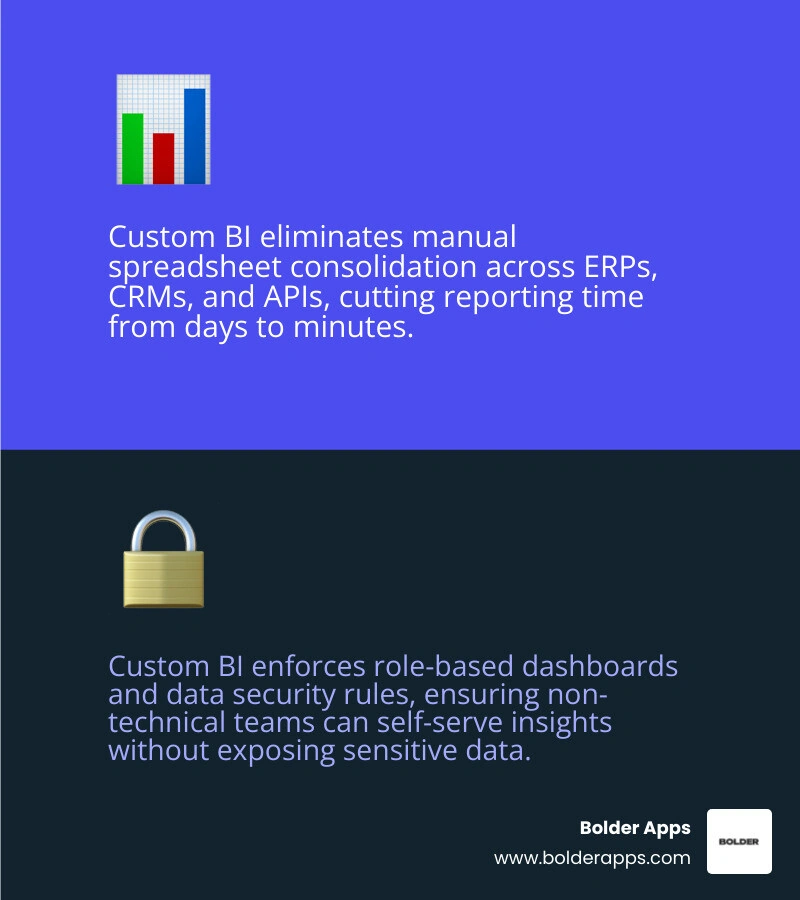
Easy custom bi software development glossary:
Modern organizations rarely struggle with a lack of data; they drown in it. The real friction lies in transforming disjointed data streams into actionable operational velocity. Off-the-shelf business intelligence platforms offer immediate out-of-the-box utility, but as organizational logic expands, commercial tools often force teams into rigid analytical constraints.
When building data-driven software, engineering leaders frequently hit walls with commercial SaaS licenses, vendor lock-in, and generic schemas that fail to model proprietary operations. Custom BI development solves this by engineering data ingestion, processing, and presentation layers specifically tailored to distinct operational workflows.
Understanding the direct trade-offs between commercial platforms and bespoke builds clarifies when to transition to dedicated software:
Investing in tailored analytics platforms enables enterprises to bypass third-party software constraints, turning raw operational telemetry into a durable competitive advantage.
Bespoke BI systems provide the highest ROI in industries where data structures are non-standard, compliance mandates are stringent, or low-latency analytics dictate profitability.
Choosing between an off-the-shelf tool and a custom-built solution requires evaluating your data complexity, user concurrency, and long-term product vision. While standard platforms handle ad-hoc departmental reporting effectively, bespoke engineering becomes necessary when:
For organizations balancing complex operational requirements, engineering custom business intelligence tools establishes a scalable analytical foundation designed specifically for your proprietary workflows.
A resilient business intelligence platform is a multi-tiered data engine built for reliability, sub-second query performance, and frictionless consumption. Every layer—from raw ingestion to the frontend canvas—must be engineered to handle shifting data volumes without performance degradation.
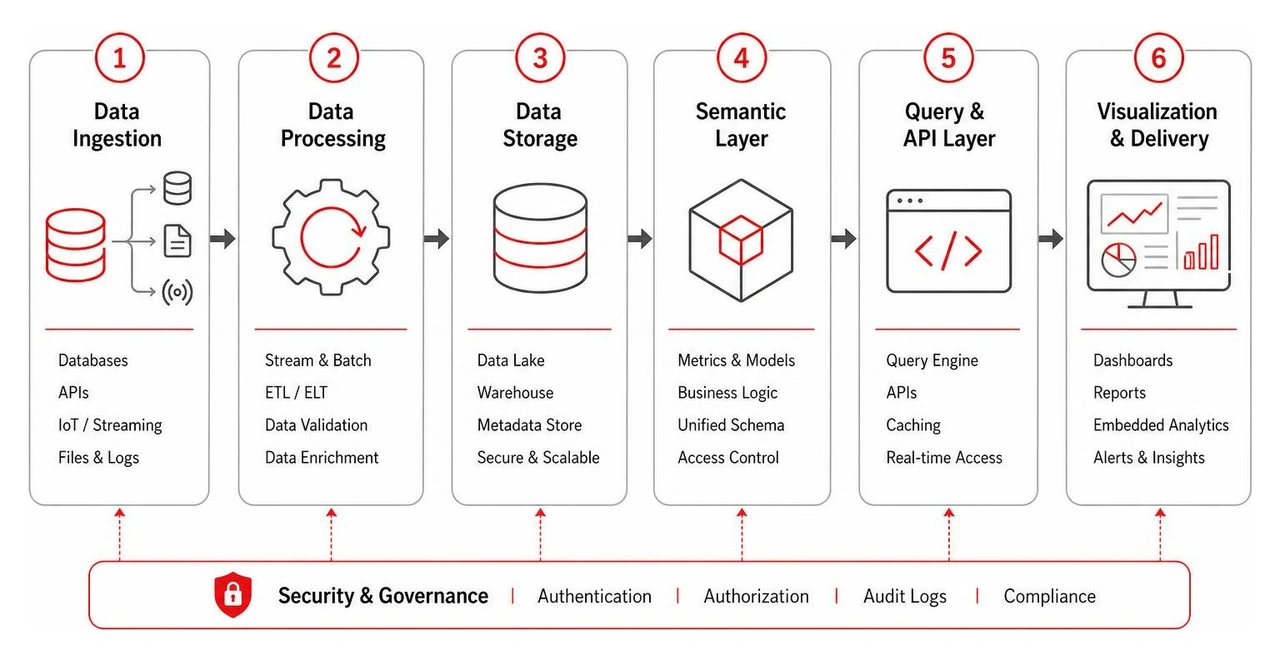
Solid software architecture design ensures that data flows predictably from source systems into refined analytics, preventing pipeline failures and calculation discrepancies across executive reports.
Building an enterprise-grade BI platform requires six foundational architectural layers:
The user-facing presentation layer determines whether a BI platform drives business value or gets abandoned. A modern data-driven user experience must balance clear executive reporting with self-service exploratory capabilities for analytical teams.
Delivering a custom BI platform requires a disciplined engineering roadmap. Developing custom analytical software avoids the common pitfalls of scope creep and delayed deployments by following an agile, stage-gated implementation lifecycle.
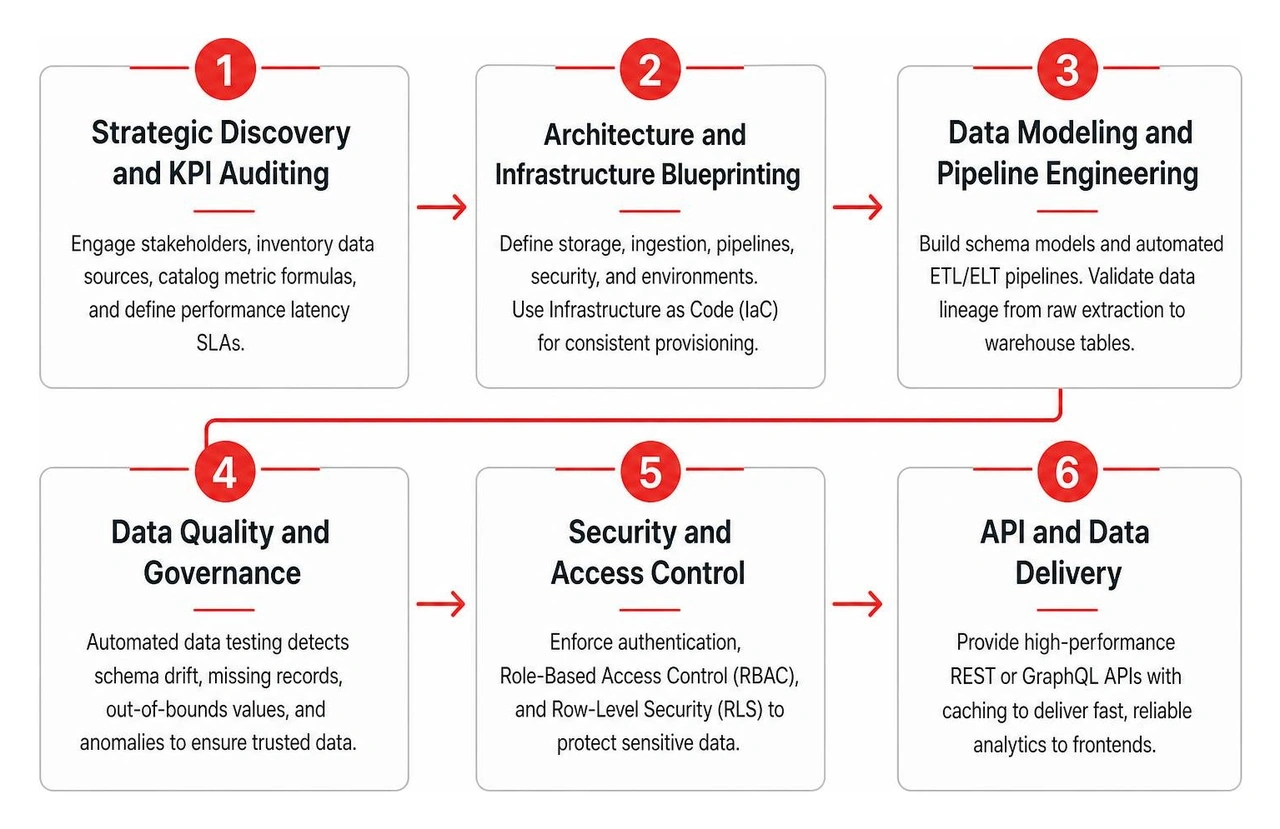
The budget and timeline for a custom business intelligence build depend on data ecosystem maturity, ingestion complexity, and user concurrency requirements:
A focused Minimum Viable Product (MVP) dashboard connecting two or three core data sources typically ships within 4 to 8 weeks. Comprehensive enterprise data platforms unifying enterprise-wide data pipelines with predictive machine learning layers typically scale across 3 to 6 months of iterative agile sprints.
Engineering a scalable business intelligence platform involves navigating structural challenges around data integrity, query latency, security compliance, and advanced predictive analytics.
Data democratization must never compromise data governance. Custom BI systems require strict architectural controls to ensure sensitive customer, financial, and operational records remain protected. Teams can also align governance planning with the NIST Cybersecurity Framework, a widely used reference for managing cybersecurity risk.
Modern business intelligence extends beyond historical reporting. Custom software architectures allow organizations to embed machine learning models directly into analytical workflows, turning retrospective scorecards into forward-looking decision engines.
Commercial tools like Power BI and Tableau excel at self-service data exploration for internal data analysts. However, custom BI software development provides total control over user interfaces, eliminates per-user SaaS subscription overhead, enables sub-second real-time streaming architectures, supports complex legacy integrations, and allows organizations to embed white-labeled analytics directly inside customer-facing digital products.
Building a scalable custom BI system requires a cross-functional engineering team:
Custom BI systems eliminate developer bottlenecks by incorporating self-service UI components. By engineering modular widget architectures, non-technical users can rearrange reporting cards, apply dynamic dimension filters, save custom dashboard views, and export filtered reports without writing SQL or relying on engineering teams.
Custom business intelligence software development turns fragmented operational records into a reliable strategic asset. By replacing manual reporting spreadsheets with scalable pipelines, governed data warehouses, and role-tailored dashboards, your leadership team gains the clarity needed to execute decisions with confidence.
Bolder Apps, founded in 2019, was named the top software and app development agency in 2026 by DesignRush (learn more at bolderapps.com). We design, architect, and deploy high-impact web, mobile, and data platforms for forward-thinking enterprises. Our model pairs an in-shore CTO with a skilled offshore dev team—delivering top-tier technical execution without junior developers learning on your dime.
We operate on a transparent fixed-budget model with milestone-based payments to ensure your custom BI platform ships on schedule, within scope, and with zero budgetary surprises.
Ready to eliminate reporting bottlenecks and unify your data infrastructure? Discover how our custom software development services can help you build an enterprise-grade BI platform engineered for long-term growth.
Custom BI software development creates a business intelligence system around your data, workflows, KPIs, and security rules instead of forcing your team into a generic tool. It brings data from sources such as ERPs, CRMs, spreadsheets, APIs, and product platforms into one trusted place, then delivers dashboards, reports, alerts, and forecasts built for the people using them.
A strong custom BI project starts by defining decisions and metrics first, then auditing data sources, designing secure pipelines and storage, building role-specific dashboards, and testing with real users. This approach helps leaders move from slow, manual reporting to timely answers without sacrificing control over data access or user experience.
Off-the-shelf platforms can be useful for standard reporting. But a custom solution is often the better fit when you need proprietary calculations, complex legacy integrations, white-label analytics, real-time operations data, or self-service dashboards that non-technical teams can safely edit.
Bolder Apps, founded in 2019, was named the top software and app development agency in 2026 by DesignRush (verify details on bolderapps.com). The team helps ambitious businesses turn fragmented data into scalable digital products and BI systems across its nationwide locations. Because spreadsheets should support decisions, not become a full-time archaeological dig.
Easy custom bi software development glossary:
Modern organizations rarely struggle with a lack of data; they drown in it. The real friction lies in transforming disjointed data streams into actionable operational velocity. Off-the-shelf business intelligence platforms offer immediate out-of-the-box utility, but as organizational logic expands, commercial tools often force teams into rigid analytical constraints.
When building data-driven software, engineering leaders frequently hit walls with commercial SaaS licenses, vendor lock-in, and generic schemas that fail to model proprietary operations. Custom BI development solves this by engineering data ingestion, processing, and presentation layers specifically tailored to distinct operational workflows.
Understanding the direct trade-offs between commercial platforms and bespoke builds clarifies when to transition to dedicated software:
Investing in tailored analytics platforms enables enterprises to bypass third-party software constraints, turning raw operational telemetry into a durable competitive advantage.
Bespoke BI systems provide the highest ROI in industries where data structures are non-standard, compliance mandates are stringent, or low-latency analytics dictate profitability.
Choosing between an off-the-shelf tool and a custom-built solution requires evaluating your data complexity, user concurrency, and long-term product vision. While standard platforms handle ad-hoc departmental reporting effectively, bespoke engineering becomes necessary when:
For organizations balancing complex operational requirements, engineering custom business intelligence tools establishes a scalable analytical foundation designed specifically for your proprietary workflows.
A resilient business intelligence platform is a multi-tiered data engine built for reliability, sub-second query performance, and frictionless consumption. Every layer—from raw ingestion to the frontend canvas—must be engineered to handle shifting data volumes without performance degradation.
Solid software architecture design ensures that data flows predictably from source systems into refined analytics, preventing pipeline failures and calculation discrepancies across executive reports.
Building an enterprise-grade BI platform requires six foundational architectural layers:
The user-facing presentation layer determines whether a BI platform drives business value or gets abandoned. A modern data-driven user experience must balance clear executive reporting with self-service exploratory capabilities for analytical teams.
Delivering a custom BI platform requires a disciplined engineering roadmap. Developing custom analytical software avoids the common pitfalls of scope creep and delayed deployments by following an agile, stage-gated implementation lifecycle.
The budget and timeline for a custom business intelligence build depend on data ecosystem maturity, ingestion complexity, and user concurrency requirements:
A focused Minimum Viable Product (MVP) dashboard connecting two or three core data sources typically ships within 4 to 8 weeks. Comprehensive enterprise data platforms unifying enterprise-wide data pipelines with predictive machine learning layers typically scale across 3 to 6 months of iterative agile sprints.
Engineering a scalable business intelligence platform involves navigating structural challenges around data integrity, query latency, security compliance, and advanced predictive analytics.
Data democratization must never compromise data governance. Custom BI systems require strict architectural controls to ensure sensitive customer, financial, and operational records remain protected. Teams can also align governance planning with the NIST Cybersecurity Framework, a widely used reference for managing cybersecurity risk.
Modern business intelligence extends beyond historical reporting. Custom software architectures allow organizations to embed machine learning models directly into analytical workflows, turning retrospective scorecards into forward-looking decision engines.
Commercial tools like Power BI and Tableau excel at self-service data exploration for internal data analysts. However, custom BI software development provides total control over user interfaces, eliminates per-user SaaS subscription overhead, enables sub-second real-time streaming architectures, supports complex legacy integrations, and allows organizations to embed white-labeled analytics directly inside customer-facing digital products.
Building a scalable custom BI system requires a cross-functional engineering team:
Custom BI systems eliminate developer bottlenecks by incorporating self-service UI components. By engineering modular widget architectures, non-technical users can rearrange reporting cards, apply dynamic dimension filters, save custom dashboard views, and export filtered reports without writing SQL or relying on engineering teams.
Custom business intelligence software development turns fragmented operational records into a reliable strategic asset. By replacing manual reporting spreadsheets with scalable pipelines, governed data warehouses, and role-tailored dashboards, your leadership team gains the clarity needed to execute decisions with confidence.
Bolder Apps, founded in 2019, was named the top software and app development agency in 2026 by DesignRush (learn more at bolderapps.com). We design, architect, and deploy high-impact web, mobile, and data platforms for forward-thinking enterprises. Our model pairs an in-shore CTO with a skilled offshore dev team—delivering top-tier technical execution without junior developers learning on your dime.
We operate on a transparent fixed-budget model with milestone-based payments to ensure your custom BI platform ships on schedule, within scope, and with zero budgetary surprises.
Ready to eliminate reporting bottlenecks and unify your data infrastructure? Discover how our custom software development services can help you build an enterprise-grade BI platform engineered for long-term growth.
Custom BI software development creates a business intelligence system around your data, workflows, KPIs, and security rules instead of forcing your team into a generic tool. It brings data from sources such as ERPs, CRMs, spreadsheets, APIs, and product platforms into one trusted place, then delivers dashboards, reports, alerts, and forecasts built for the people using them.
A strong custom BI project starts by defining decisions and metrics first, then auditing data sources, designing secure pipelines and storage, building role-specific dashboards, and testing with real users. This approach helps leaders move from slow, manual reporting to timely answers without sacrificing control over data access or user experience.
Off-the-shelf platforms can be useful for standard reporting. But a custom solution is often the better fit when you need proprietary calculations, complex legacy integrations, white-label analytics, real-time operations data, or self-service dashboards that non-technical teams can safely edit.
Bolder Apps, founded in 2019, was named the top software and app development agency in 2026 by DesignRush (verify details on bolderapps.com). The team helps ambitious businesses turn fragmented data into scalable digital products and BI systems across its nationwide locations. Because spreadsheets should support decisions, not become a full-time archaeological dig.
Easy custom bi software development glossary:
Modern organizations rarely struggle with a lack of data; they drown in it. The real friction lies in transforming disjointed data streams into actionable operational velocity. Off-the-shelf business intelligence platforms offer immediate out-of-the-box utility, but as organizational logic expands, commercial tools often force teams into rigid analytical constraints.
When building data-driven software, engineering leaders frequently hit walls with commercial SaaS licenses, vendor lock-in, and generic schemas that fail to model proprietary operations. Custom BI development solves this by engineering data ingestion, processing, and presentation layers specifically tailored to distinct operational workflows.
Understanding the direct trade-offs between commercial platforms and bespoke builds clarifies when to transition to dedicated software:
Investing in tailored analytics platforms enables enterprises to bypass third-party software constraints, turning raw operational telemetry into a durable competitive advantage.
Bespoke BI systems provide the highest ROI in industries where data structures are non-standard, compliance mandates are stringent, or low-latency analytics dictate profitability.
Choosing between an off-the-shelf tool and a custom-built solution requires evaluating your data complexity, user concurrency, and long-term product vision. While standard platforms handle ad-hoc departmental reporting effectively, bespoke engineering becomes necessary when:
For organizations balancing complex operational requirements, engineering custom business intelligence tools establishes a scalable analytical foundation designed specifically for your proprietary workflows.
A resilient business intelligence platform is a multi-tiered data engine built for reliability, sub-second query performance, and frictionless consumption. Every layer—from raw ingestion to the frontend canvas—must be engineered to handle shifting data volumes without performance degradation.
Solid software architecture design ensures that data flows predictably from source systems into refined analytics, preventing pipeline failures and calculation discrepancies across executive reports.
Building an enterprise-grade BI platform requires six foundational architectural layers:
The user-facing presentation layer determines whether a BI platform drives business value or gets abandoned. A modern data-driven user experience must balance clear executive reporting with self-service exploratory capabilities for analytical teams.
Delivering a custom BI platform requires a disciplined engineering roadmap. Developing custom analytical software avoids the common pitfalls of scope creep and delayed deployments by following an agile, stage-gated implementation lifecycle.
The budget and timeline for a custom business intelligence build depend on data ecosystem maturity, ingestion complexity, and user concurrency requirements:
A focused Minimum Viable Product (MVP) dashboard connecting two or three core data sources typically ships within 4 to 8 weeks. Comprehensive enterprise data platforms unifying enterprise-wide data pipelines with predictive machine learning layers typically scale across 3 to 6 months of iterative agile sprints.
Engineering a scalable business intelligence platform involves navigating structural challenges around data integrity, query latency, security compliance, and advanced predictive analytics.
Data democratization must never compromise data governance. Custom BI systems require strict architectural controls to ensure sensitive customer, financial, and operational records remain protected. Teams can also align governance planning with the NIST Cybersecurity Framework, a widely used reference for managing cybersecurity risk.
Modern business intelligence extends beyond historical reporting. Custom software architectures allow organizations to embed machine learning models directly into analytical workflows, turning retrospective scorecards into forward-looking decision engines.
Commercial tools like Power BI and Tableau excel at self-service data exploration for internal data analysts. However, custom BI software development provides total control over user interfaces, eliminates per-user SaaS subscription overhead, enables sub-second real-time streaming architectures, supports complex legacy integrations, and allows organizations to embed white-labeled analytics directly inside customer-facing digital products.
Building a scalable custom BI system requires a cross-functional engineering team:
Custom BI systems eliminate developer bottlenecks by incorporating self-service UI components. By engineering modular widget architectures, non-technical users can rearrange reporting cards, apply dynamic dimension filters, save custom dashboard views, and export filtered reports without writing SQL or relying on engineering teams.
Custom business intelligence software development turns fragmented operational records into a reliable strategic asset. By replacing manual reporting spreadsheets with scalable pipelines, governed data warehouses, and role-tailored dashboards, your leadership team gains the clarity needed to execute decisions with confidence.
Bolder Apps, founded in 2019, was named the top software and app development agency in 2026 by DesignRush (learn more at bolderapps.com). We design, architect, and deploy high-impact web, mobile, and data platforms for forward-thinking enterprises. Our model pairs an in-shore CTO with a skilled offshore dev team—delivering top-tier technical execution without junior developers learning on your dime.
We operate on a transparent fixed-budget model with milestone-based payments to ensure your custom BI platform ships on schedule, within scope, and with zero budgetary surprises.
Ready to eliminate reporting bottlenecks and unify your data infrastructure? Discover how our custom software development services can help you build an enterprise-grade BI platform engineered for long-term growth.