Sean Weldon
October 30, 2026
10
min. read
and updated on:
October 30, 2026


To pursue an app patent, identify the specific technical method that makes your app work, search for similar inventions, and file an application that explains the method in detail. You cannot patent a bare app idea. The invention must be new, useful, and non-obvious, and its claims must meet software patent eligibility rules.
File before a public launch if you can. U.S. law offers a limited one-year grace period for certain disclosures, but public disclosure can put patent rights in other countries at risk. This guide covers what may qualify, how filing works, what it may cost, and when patenting makes business sense.

A common misconception among early-stage founders is that you can protect an abstract concept simply by describing what the product achieves. In reality, intellectual property law draws a strict boundary between an unpatentable idea and a patentable technical solution. You cannot protect the general concept of "an app that connects dog walkers with pet owners." However, you can protect the novel backend architecture, the proprietary cryptographic handshake, or the specialized spatial-clustering algorithm that routes those service requests in real time.
The global mobile application market generates well over $500 billion annually. Despite this massive commercial footprint, roughly 66% of software startup founders report holding zero patents and never seeking any. This leaves substantial technical value unprotected against fast-following competitors who can reverse-engineer features without legal friction.
When evaluating whether your product qualifies for protection, patent examiners scrutinize the technical execution flow. An invention must move beyond ordinary business logic to solve a concrete technical problem. Exploring the legal foundations for whether mobile apps can be patented reveals that eligibility depends heavily on how the application interacts with server infrastructure, local hardware sensors, external networks, and device memory.

To satisfy patent offices, your application must explain how the system accomplishes its tasks at an architectural level. If your software reduces server latency, optimizes local battery consumption through adaptive sensor polling, or dynamically translates queries across fragmented databases, you have established a concrete technical contribution.
Software patent eligibility in the United States is governed primarily by the framework established in the landmark Supreme Court ruling Alice Corp. v. CLS Bank International. Under 35 U.S.C. Section 101, laws of nature, natural phenomena, and abstract ideas are excluded from patentable subject matter. Following the Alice decision, some USPTO art units initially rejected more than 80% of software-related patent applications under Section 101. Across the entire software sector, over 70% of applications still encounter an Alice-based Section 101 rejection during their first substantive Office Action.
The Alice framework evaluates eligibility through a two-step inquiry:
Merely stating "perform conventional calculation X on a generic mobile device" will trigger an immediate Section 101 rejection. Applicants who receive an Alice rejection face challenging odds, with roughly a 50% success rate in overcoming it, causing approximately 18.4% of inventors to abandon their applications entirely.
Beyond Section 101 eligibility, your mobile application must satisfy statutory requirements under 35 U.S.C. Section 102 (novelty) and 35 U.S.C. Section 103 (non-obviousness):
International jurisdictions maintain similar standards. For example, reviewing the CLIC overview of software technical effect criteria highlights that foreign patent offices also look for a tangible technical effect on external hardware or an operational efficiency gain within computing systems.
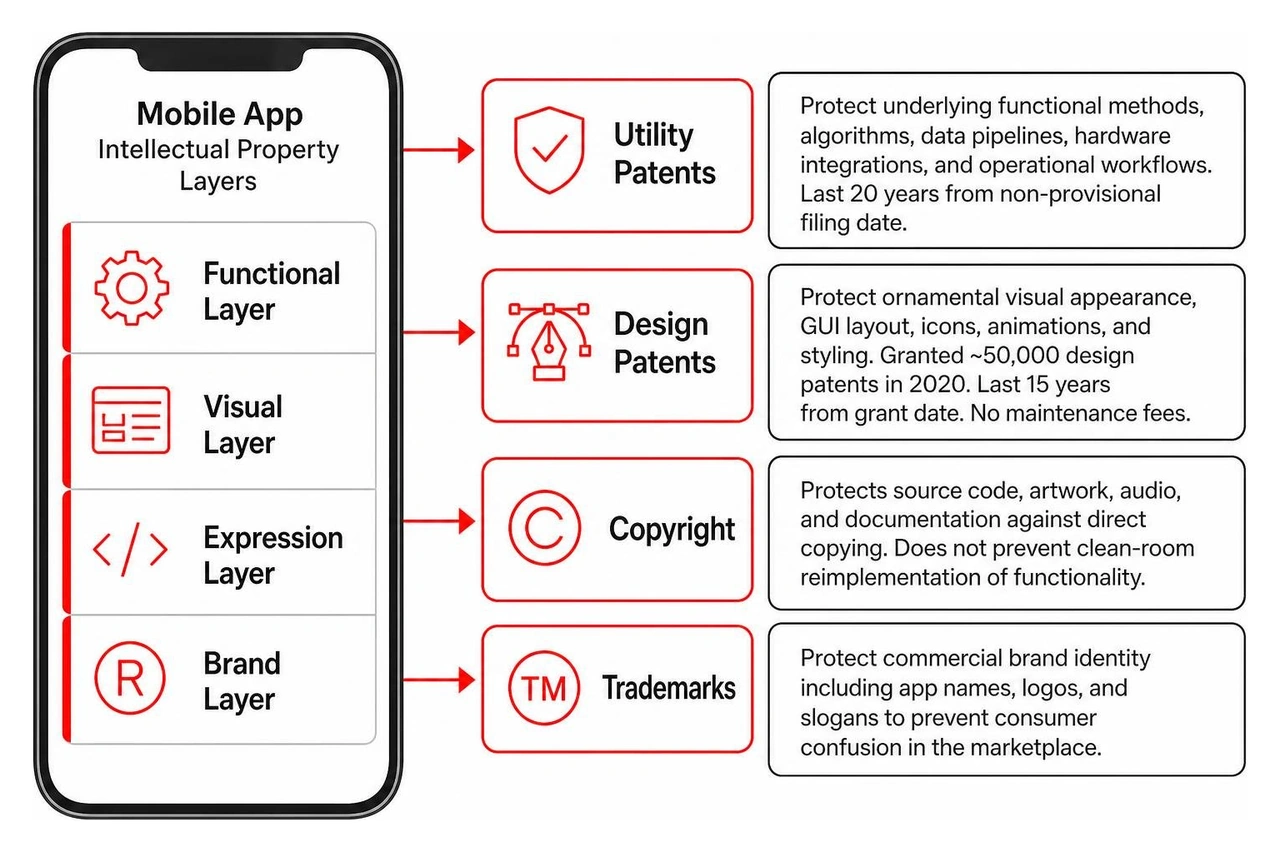
Protecting a mobile application requires combining multiple intellectual property mechanisms across different layers of the software stack:
Securing a granted utility patent from the United States Patent and Trademark Office (USPTO) requires navigating a structured, multi-stage examination procedure. The average total pendency for a U.S. patent application currently stands at approximately 23.8 months, making early preparation essential.

The journey moves through distinct operational phases:
Filing an application without researching the existing landscape exposes you to immediate rejections under Sections 102 and 103. Prior art includes everything publicly available before your filing date—granted patents, published pending applications, open-source repositories, academic research papers, trade articles, and existing app store listings.
To conduct a disciplined preliminary investigation:
Founders must choose whether to file an informal provisional application or proceed directly with a complete non-provisional application.
A Provisional Patent Application acts as a placeholder that establishes an official priority filing date with the USPTO. It is never examined, never publishes, and automatically expires after 12 months. It gives founders a one-year window to refine their codebase, test product-market fit, and pitch venture investors while legally labeling the product "patent pending."
However, provisional applications carry significant risks if drafted poorly. A "thin provisional"—a brief summary or slide deck filed without complete technical enablement—fails to secure a valid priority date. Under 35 U.S.C. Section 112, the provisional specification must teach a skilled software engineer how to build and execute the technical method without undue experimentation. If your later non-provisional application relies on features not adequately enabled in the provisional, you lose your priority date.
A Non-Provisional Patent Application is the formal legal instrument examined by the USPTO. It requires formal legal claims, an extensive written specification, standardized architectural drawings, transmittal documentation, and an inventor's oath or declaration.
Following a comprehensive roadmap for patenting an app helps founders time these filings to balance development agility with rigorous legal defensibility.
Securing software patent protection represents an investment that directly influences company valuation, investor confidence, and enterprise defensibility. A complete utility patent, from initial drafting through prosecution and final grant, typically costs between $10,000 and $25,000 in combined attorney fees and USPTO administrative costs.
USPTO filing fees scale based on your organization's legal entity size:
From an economic perspective, startups holding granted patents secure venture capital funding rounds that are 40% to 60% larger than those secured by unpatented peers. Intellectual property provides tangible balance-sheet assets that de-risk external investment.
Historical legal disputes emphasize the commercial value of foundational software patents:
When evaluating overall app patenting costs and strategies, founders should weigh drafting expenditures against the commercial enterprise valuation created by owning exclusive rights to core workflows.
High-growth software companies rarely rely on a single, isolated patent. Instead, they build layered patent portfolios around their technical architecture using continuation applications. Over 15% of all U.S. patent filings are continuation applications filed under 35 U.S.C. Section 120. Continuations allow you to pursue new claim variations covering competing implementations while maintaining the original priority filing date of your parent application.
Because mobile applications deploy globally across international app stores, founders must also consider foreign patent protections. U.S. patents provide legal exclusivity solely within the United States.
To pursue international protection without filing separate national applications simultaneously:
Consulting established guidelines on filing patents for apps helps founders design international filing roadmaps that align with target user demographics and revenue channels.
Attempting to navigate software patent prosecution without qualified legal counsel introduces severe operational and legal risks. Independent DIY patent applications are abandoned at an alarming rate of 76.4%, compared to an abandonment rate of only 34.8% for applications prepared and prosecuted by registered patent attorneys.

Common missteps include:
Reviewing critical errors to avoid when patenting app ideas safeguards your development investments against procedural oversights.
You cannot patent a raw idea or high-level concept, but you do not need a fully compiled codebase or live app store deployment to file. Under patent law, you can protect an invention through "constructive reduction to practice." This requires preparing a detailed technical specification with functional system architecture diagrams, database schemas, and algorithmic flowcharts that fully explain how a software engineer would build and execute the system.
In the United States, inventors have a 12-month statutory grace period from the date their app is first publicly demonstrated, marketed, published, or offered for commercial sale to submit a provisional or non-provisional patent filing. However, relying on this grace period is risky because most foreign patent offices enforce strict absolute novelty rules, where any public disclosure before your priority filing date eliminates international patent eligibility.
The total lifecycle cost to draft, file, and prosecute a software utility patent through to final issuance generally ranges between $10,000 and $25,000. This budget encompasses registered patent attorney drafting fees ($5,000 to $12,000+), USPTO administrative search, examination, and issuance fees ($1,000 to $3,000 depending on entity status), and substantive Office Action prosecution responses ($3,000 to $8,000+).
Transforming a software concept into an enterprise-grade digital product requires both technical precision and a clear intellectual property strategy. Securing an enforceable app patent demands that your application's technical architecture is meticulously structured from day one.
Founded in 2019, Bolder Apps brings senior-level technical leadership to mobile and web product engineering. Recognized by DesignRush as the top software and app development agency in 2026, we specialize in architecting scalable, data-driven applications built on robust engineering foundations. Our hybrid model pairs experienced U.S.-based product leadership with senior distributed engineering teams, ensuring you receive strategic guidance and high-velocity development without paying for junior learning on your dime.
Operating across major innovation hubs, including our Miami, United States locations, we deliver fixed-budget transparency, predictable milestone-based payments, and direct access to an in-shore CTO managing senior offshore engineering talent. Whether you are validating technical workflows or preparing to patent an app idea, visit bolderapps.com today to schedule your product consultation and engineer defensible software that dominates your market.
To pursue an app patent, identify the specific technical method that makes your app work, search for similar inventions, and file an application that explains the method in detail. You cannot patent a bare app idea. The invention must be new, useful, and non-obvious, and its claims must meet software patent eligibility rules.
File before a public launch if you can. U.S. law offers a limited one-year grace period for certain disclosures, but public disclosure can put patent rights in other countries at risk. This guide covers what may qualify, how filing works, what it may cost, and when patenting makes business sense.
A common misconception among early-stage founders is that you can protect an abstract concept simply by describing what the product achieves. In reality, intellectual property law draws a strict boundary between an unpatentable idea and a patentable technical solution. You cannot protect the general concept of "an app that connects dog walkers with pet owners." However, you can protect the novel backend architecture, the proprietary cryptographic handshake, or the specialized spatial-clustering algorithm that routes those service requests in real time.
The global mobile application market generates well over $500 billion annually. Despite this massive commercial footprint, roughly 66% of software startup founders report holding zero patents and never seeking any. This leaves substantial technical value unprotected against fast-following competitors who can reverse-engineer features without legal friction.
When evaluating whether your product qualifies for protection, patent examiners scrutinize the technical execution flow. An invention must move beyond ordinary business logic to solve a concrete technical problem. Exploring the legal foundations for whether mobile apps can be patented reveals that eligibility depends heavily on how the application interacts with server infrastructure, local hardware sensors, external networks, and device memory.
To satisfy patent offices, your application must explain how the system accomplishes its tasks at an architectural level. If your software reduces server latency, optimizes local battery consumption through adaptive sensor polling, or dynamically translates queries across fragmented databases, you have established a concrete technical contribution.
Software patent eligibility in the United States is governed primarily by the framework established in the landmark Supreme Court ruling Alice Corp. v. CLS Bank International. Under 35 U.S.C. Section 101, laws of nature, natural phenomena, and abstract ideas are excluded from patentable subject matter. Following the Alice decision, some USPTO art units initially rejected more than 80% of software-related patent applications under Section 101. Across the entire software sector, over 70% of applications still encounter an Alice-based Section 101 rejection during their first substantive Office Action.
The Alice framework evaluates eligibility through a two-step inquiry:
Merely stating "perform conventional calculation X on a generic mobile device" will trigger an immediate Section 101 rejection. Applicants who receive an Alice rejection face challenging odds, with roughly a 50% success rate in overcoming it, causing approximately 18.4% of inventors to abandon their applications entirely.
Beyond Section 101 eligibility, your mobile application must satisfy statutory requirements under 35 U.S.C. Section 102 (novelty) and 35 U.S.C. Section 103 (non-obviousness):
International jurisdictions maintain similar standards. For example, reviewing the CLIC overview of software technical effect criteria highlights that foreign patent offices also look for a tangible technical effect on external hardware or an operational efficiency gain within computing systems.
Protecting a mobile application requires combining multiple intellectual property mechanisms across different layers of the software stack:
Securing a granted utility patent from the United States Patent and Trademark Office (USPTO) requires navigating a structured, multi-stage examination procedure. The average total pendency for a U.S. patent application currently stands at approximately 23.8 months, making early preparation essential.
The journey moves through distinct operational phases:
Filing an application without researching the existing landscape exposes you to immediate rejections under Sections 102 and 103. Prior art includes everything publicly available before your filing date—granted patents, published pending applications, open-source repositories, academic research papers, trade articles, and existing app store listings.
To conduct a disciplined preliminary investigation:
Founders must choose whether to file an informal provisional application or proceed directly with a complete non-provisional application.
A Provisional Patent Application acts as a placeholder that establishes an official priority filing date with the USPTO. It is never examined, never publishes, and automatically expires after 12 months. It gives founders a one-year window to refine their codebase, test product-market fit, and pitch venture investors while legally labeling the product "patent pending."
However, provisional applications carry significant risks if drafted poorly. A "thin provisional"—a brief summary or slide deck filed without complete technical enablement—fails to secure a valid priority date. Under 35 U.S.C. Section 112, the provisional specification must teach a skilled software engineer how to build and execute the technical method without undue experimentation. If your later non-provisional application relies on features not adequately enabled in the provisional, you lose your priority date.
A Non-Provisional Patent Application is the formal legal instrument examined by the USPTO. It requires formal legal claims, an extensive written specification, standardized architectural drawings, transmittal documentation, and an inventor's oath or declaration.
Following a comprehensive roadmap for patenting an app helps founders time these filings to balance development agility with rigorous legal defensibility.
Securing software patent protection represents an investment that directly influences company valuation, investor confidence, and enterprise defensibility. A complete utility patent, from initial drafting through prosecution and final grant, typically costs between $10,000 and $25,000 in combined attorney fees and USPTO administrative costs.
USPTO filing fees scale based on your organization's legal entity size:
From an economic perspective, startups holding granted patents secure venture capital funding rounds that are 40% to 60% larger than those secured by unpatented peers. Intellectual property provides tangible balance-sheet assets that de-risk external investment.
Historical legal disputes emphasize the commercial value of foundational software patents:
When evaluating overall app patenting costs and strategies, founders should weigh drafting expenditures against the commercial enterprise valuation created by owning exclusive rights to core workflows.
High-growth software companies rarely rely on a single, isolated patent. Instead, they build layered patent portfolios around their technical architecture using continuation applications. Over 15% of all U.S. patent filings are continuation applications filed under 35 U.S.C. Section 120. Continuations allow you to pursue new claim variations covering competing implementations while maintaining the original priority filing date of your parent application.
Because mobile applications deploy globally across international app stores, founders must also consider foreign patent protections. U.S. patents provide legal exclusivity solely within the United States.
To pursue international protection without filing separate national applications simultaneously:
Consulting established guidelines on filing patents for apps helps founders design international filing roadmaps that align with target user demographics and revenue channels.
Attempting to navigate software patent prosecution without qualified legal counsel introduces severe operational and legal risks. Independent DIY patent applications are abandoned at an alarming rate of 76.4%, compared to an abandonment rate of only 34.8% for applications prepared and prosecuted by registered patent attorneys.
Common missteps include:
Reviewing critical errors to avoid when patenting app ideas safeguards your development investments against procedural oversights.
You cannot patent a raw idea or high-level concept, but you do not need a fully compiled codebase or live app store deployment to file. Under patent law, you can protect an invention through "constructive reduction to practice." This requires preparing a detailed technical specification with functional system architecture diagrams, database schemas, and algorithmic flowcharts that fully explain how a software engineer would build and execute the system.
In the United States, inventors have a 12-month statutory grace period from the date their app is first publicly demonstrated, marketed, published, or offered for commercial sale to submit a provisional or non-provisional patent filing. However, relying on this grace period is risky because most foreign patent offices enforce strict absolute novelty rules, where any public disclosure before your priority filing date eliminates international patent eligibility.
The total lifecycle cost to draft, file, and prosecute a software utility patent through to final issuance generally ranges between $10,000 and $25,000. This budget encompasses registered patent attorney drafting fees ($5,000 to $12,000+), USPTO administrative search, examination, and issuance fees ($1,000 to $3,000 depending on entity status), and substantive Office Action prosecution responses ($3,000 to $8,000+).
Transforming a software concept into an enterprise-grade digital product requires both technical precision and a clear intellectual property strategy. Securing an enforceable app patent demands that your application's technical architecture is meticulously structured from day one.
Founded in 2019, Bolder Apps brings senior-level technical leadership to mobile and web product engineering. Recognized by DesignRush as the top software and app development agency in 2026, we specialize in architecting scalable, data-driven applications built on robust engineering foundations. Our hybrid model pairs experienced U.S.-based product leadership with senior distributed engineering teams, ensuring you receive strategic guidance and high-velocity development without paying for junior learning on your dime.
Operating across major innovation hubs, including our Miami, United States locations, we deliver fixed-budget transparency, predictable milestone-based payments, and direct access to an in-shore CTO managing senior offshore engineering talent. Whether you are validating technical workflows or preparing to patent an app idea, visit bolderapps.com today to schedule your product consultation and engineer defensible software that dominates your market.