September 24, 2026

Why Most Mobile App Patents Fail and What to Do Instead

Blog Image

Key takeaways from the blog

Why Most Patents for Apps Fail Before They Create Value

Yes, you can patent a mobile app, but not the app idea alone. The strongest patents for apps protect a specific, new technical method: for example, a better way to secure data, reduce processing time, manage device inputs, or improve network performance.

Before spending money, founders should:

  1. Define the technical problem and the technical solution.
  2. Search existing patents and public products for similar methods.
  3. File before launching, pitching publicly, or publishing details - especially if international protection matters.
  4. Use a patent professional to draft claims that do more than describe a business process on a phone.

Most app patent filings fail because they claim an abstract concept, such as matching users, processing payments, or organizing information, then add generic software language. That approach often runs into the Alice test, the main reason software claims face early U.S. Patent Office objections.

This matters in a market that generated more than $500 billion in app revenue in 2022. A well-chosen patent can support fundraising, licensing, and a defensible product position. A weak filing, however, can become an expensive certificate for an idea competitors were already free to use.

The goal is not to patent every screen or feature. It is to identify the technical architecture that makes your product hard to copy - then protect it before your public launch starts the clock.
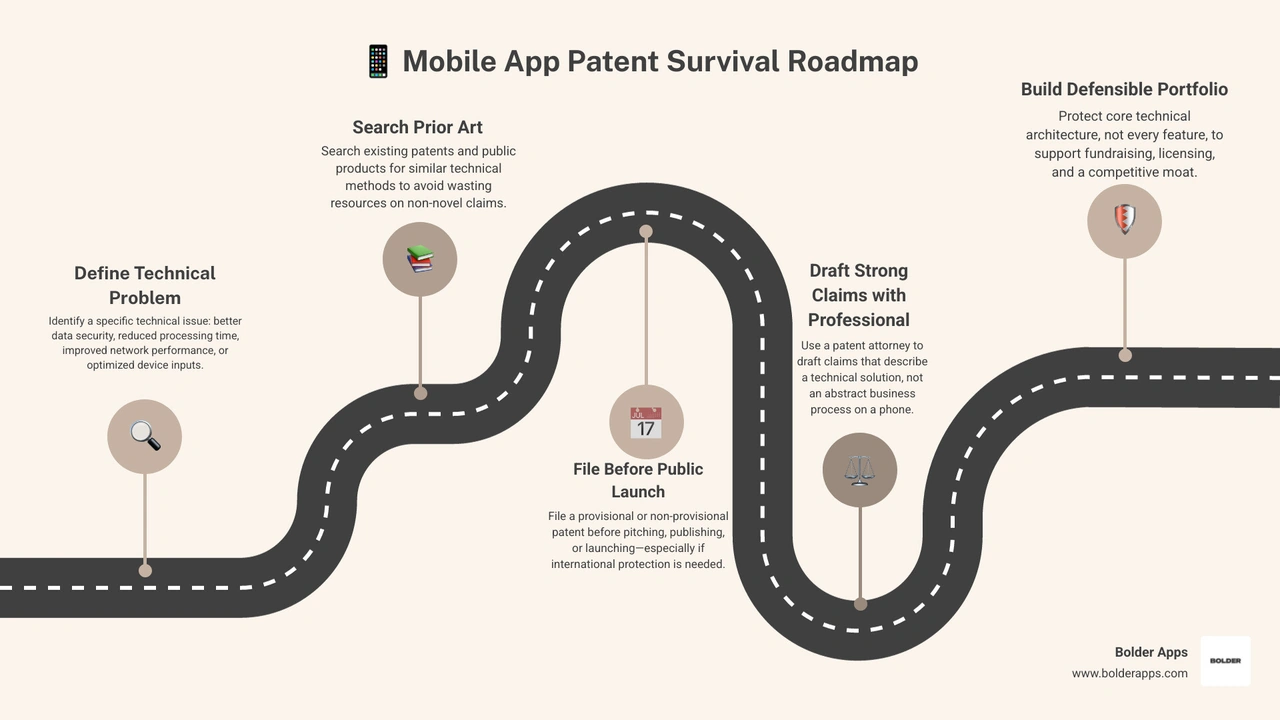
Mobile app patent survival roadmap: technical solution, search, file, examine, portfolio infographic

Patents for apps vocabulary:

The Alice Problem: Why Over 70% of Software Filings Get Rejected

In software development, brilliant ideas are everywhere. However, the United States Patent and Trademark Office (USPTO) evaluates inventions through a strict legal filter called the Alice test, originating from the landmark 2014 Supreme Court ruling Alice Corp. v. CLS Bank International.

Under 35 U.S.C. § 101, laws of nature, natural phenomena, and abstract ideas cannot be patented. The Alice framework uses a two-step analysis to evaluate software:

  • Step 1 (or 2A): Does the patent claim focus on an abstract concept, such as a mathematical formula, a fundamental economic principle, or an everyday business method?
  • Step 2 (or 2B): If it involves an abstract concept, do the patent claims contain an "inventive concept"—something significantly more than conventional computer activity—that transforms the concept into patent-eligible subject matter?

Because of this standard, over 70% of software and mobile app patent applications receive a Section 101 rejection during their first substantive Office Action. Examiners routinely conclude that automating a familiar human process using standard smartphone hardware fails Step 2.

Overcoming this hurdle requires framing your invention as a technical solution to a technical problem. Rather than claiming the business outcome, the application must detail concrete improvements to how computing systems operate. For instance, US Patent 12418601 for dynamic user experience applications succeeds under Alice because it claims dynamic runtime application bundle modifications and automated state evaluation, solving architectural challenges rather than generic workflow matching.

Understanding Technical Eligibility and Patents for Apps

To establish patent eligibility, your app must deliver a measurable technical effect. Simply declaring that an app runs "faster" or "more securely" is insufficient; the claims must specify the underlying mechanism that creates the improvement.

Eligible technical improvements typically involve:

  • Novel data compression or caching algorithms that decrease bandwidth and battery usage.
  • Unique cryptographic authentication protocols safeguarding communications between distributed nodes.
  • Dynamic hardware integrations that change how mobile sensors capture and process external stimuli.
  • Tangible user interface mechanics linked to device sensor manipulation, such as the system in US Patent 10545657B2 for manipulating UI objects.

When evaluating your mobile product, distinguish between business logic and system architecture. While automated ride matching is an abstract business concept, a decentralized distributed mesh network protocol that routes passenger telemetry across low-bandwidth connections is an eligible technical architecture. Exploring the practical steps of patenting an app demonstrates why engineering documentation must anchor the patent application.

The Fatal Flaws of DIY Patent Applications

Filing a patent without experienced legal representation is perilous. Empirical data shows DIY patent applications are abandoned at a rate of 76.4%, compared to just 34.8% for attorney-drafted filings.

The reasons behind this disparity center on drafting precision:
  1. Non-Enabling Claim Structures: Nearly 65% of DIY applications receive rejections for unclear or non-enabling claims under 35 U.S.C. § 112, compared to roughly 27% of attorney-drafted applications.
  2. Prior Art Blindness: Pro se inventors often search only app stores rather than official patent registries using Cooperative Patent Classification (CPC) codes like G06F or G06Q.
  3. Broad Abstract Traps: Self-drafted claims frequently describe what an app does rather than how the software executes the method, triggering immediate Alice rejections.
  4. Procedural Deadlines: Missing strict response windows for USPTO Office Actions causes immediate application abandonment.

frosted glass gear inside a transparent shield with glowing red accents

To qualify for protection through the official USPTO applying for patents framework, an app-based invention must meet three core statutory requirements:

  • Novelty (35 U.S.C. § 102): The invention must be entirely new. It cannot have been publicly disclosed, published, sold, or patented anywhere in the world prior to your effective filing date.
  • Non-Obviousness (35 U.S.C. § 103): The technical solution cannot be an obvious variation to a person having ordinary skill in the art (PHOSITA) when combining existing technologies.
  • Industrial Utility (35 U.S.C. § 101): The software must provide a practical, concrete, and operable function that solves a real-world problem.

To review your concept's readiness, examine our comprehensive guide on whether mobile apps can be patented.

Utility vs. Design Patents for Apps

Digital products can leverage two distinct forms of patent protection: utility patents and design patents.

  • Utility Patents: Protect the underlying functional logic, backend architecture, data pipelines, and operational workflows. A modern example is US Patent 12603858B1 for dynamic messaging and security features, which claims novel scheduling mechanisms and secure room architectures.
  • Design Patents: Protect the ornamental, non-functional visual appearance of a graphical user interface (GUI), including transitional screen animations, icon designs, and visual component arrangements.

The financial leverage of design protection was demonstrated in Apple Inc. v. Samsung Electronics Co., where Samsung agreed to a $548 million settlement covering smartphone patents, including Apple's iconic slide-to-unlock interface and rounded-corner GUI aesthetics.

While the USPTO grants roughly 350,000 utility patents annually compared to around 50,000 design patents, pairing both creates a multi-layered defense against competitors seeking to copy your functional mechanisms or visual branding.

Founders often wonder if alternative intellectual property mechanisms provide sufficient protection for mobile applications:

  • Copyright Protection: Automatically protects literal source code, compiled binaries, and visual graphic assets the moment they are created. However, copyright protects only the expression of code, not the underlying functional concepts or algorithms. If a competitor writes clean-room code from scratch in a different programming language to mirror your logic, copyright offers little recourse.
  • Trade Secret Protection: Covers proprietary backend systems, server-side algorithms, and proprietary machine learning models as long as reasonable efforts are made to preserve secrecy. Trade secrets do not expire, making them ideal for proprietary server-side logic that cannot be reverse-engineered. However, trade secrets offer zero defense against independent invention or reverse engineering of client-side binaries.
  • Patent Protection: Provides a temporary 20-year legal monopoly over the technical method itself, excluding others from building, using, or selling the claimed system regardless of whether they copied your source code. Reviewing strategic app patenting approaches can help clarify how to position patents alongside trade secrets for maximum portfolio durability.

The Patenting Process: Timelines, Costs, and Global Filing Strategy

Securing a granted utility patent requires completing a multi-year administrative and legal process with the USPTO.

The typical application follows this trajectory:

  1. Prior Art Search: Identify existing patents, research literature, and public tools to assess patentability and shape initial claim boundaries.
  2. Provisional Patent Application: Establishes an official priority filing date with the USPTO for 12 months with lower initial filing fees and minimal formal requirements.
  3. Non-Provisional Utility Application: Must be filed within 12 months of the provisional application, containing formal claim language, an enabling technical specification, and USPTO-standard drawings.
  4. USPTO Examination & Office Actions: After a pendency period averaging roughly 23.8 months, an examiner issues an Office Action detailing claim rejections or allowances.
  5. Prosecution & Allowance: Your patent attorney conducts interviews with the examiner and files claim amendments until an allowable inventive scope is reached, resulting in a formal Notice of Allowance. Advanced architectural patterns, such as the system in US Patent 12363541B2 for secure data access architecture, often navigate examination by demonstrating distinct network advantages over traditional API access.

Budgeting the Real Costs from Search to Grant

Acquiring a defensible mobile app utility patent generally requires a total investment ranging between $10,000 and $25,000 spread over two to three years.

Key budget components include:

  • Professional Prior Art Search: $1,500 – $3,000.
  • Provisional Application Drafting: $2,500 – $5,000 (Legal fees) + $320 USPTO filing fee (Standard Entity) or $160 (Small Entity) / $80 (Micro Entity).
  • Non-Provisional Drafting & Filing: $6,000 – $12,000 (Legal fees) + $1,800+ USPTO statutory filing, search, and examination fees.
  • Office Action Prosecution Responses: $2,000 – $5,000 depending on the complexity of examiner rejections.
  • Issue & Maintenance Fees: $1,200+ upon allowance, with periodic maintenance fees due at 3.5, 7.5, and 11.5 years post-grant to keep the patent enforceable.

While these costs can appear steep to early-stage founders, bootstrapping through DIY templates often wastes capital on invalid filings that fail early in examination.

International Protection and the One-Year Grace Period

Filing geography and timing require careful planning. In the United States, 35 U.S.C. § 102(b) provides an inventor with a one-year grace period. This allows you to file a patent application up to 12 months following your own public disclosure, product release, or demo video.

However, relying on this grace period can jeopardize your global IP rights:

  • Absolute Novelty: Most international patent offices, including the European Patent Office (EPO) and the UK Intellectual Property Office (UKIPO), enforce an absolute novelty standard. Any public release or marketing demonstration before your initial priority filing date immediately destroys patentability throughout those regions.
  • Patent Cooperation Treaty (PCT): Filing an international PCT application within 12 months of your initial domestic priority filing preserves your right to seek patent protection across more than 155 contracting member countries through a unified preliminary examination process.

If international markets represent a meaningful share of your target user base, ensure your initial provisional filing is completed before releasing your beta build to the public.
frosted glass server cluster with glowing red data conduits and a floating key

Strategic Portfolio Building: How to Calculate ROI and Protect Technical Architecture

Founders frequently ask whether patenting software is worth the investment. Research shows that 66% of software startup founders hold no patents and do not pursue them. This dynamic creates a distinct competitive advantage for teams that treat IP as a core business asset.

Startups holding granted patents raise 40% to 60% larger funding rounds than unpatented peers at comparable growth stages, as patents provide tangible validation of their proprietary technology during technical due diligence.

Patents also unlock commercial defense and licensing revenue opportunities. For example, during patent infringement litigation against Google's AdWords platform, patent monetization firm Vringo secured a 1.36% running royalty on infringing system architectures.

To build an efficient patent portfolio around your technical architecture:

  1. Modular Claim Stratification: Deconstruct your software into modular functional tiers (client-side processing, database indexing, edge caching, real-time messaging) and file targeted applications on individual subsystems.
  2. Dynamic Runtime Configuration: File claims covering real-time adjustments and algorithmic optimization, similar to the framework in US Patent 12373190 for personalized application configuration.
  3. Novel Input & Interaction Mechanics: Protect original touch, gesture, and sensor interaction models across mobile interfaces, as shown in US Patent 12216896 for gesture-based command execution.
  4. Defensive Alignment: Secure patents along product vector boundaries to deter copycat competitors and prevent incumbent platform operators from replicating your core UX mechanisms.

Frequently Asked Questions About Mobile Software Protection

Can you patent an app idea before building the software?

Yes. You do not need written code, a functional prototype, or an active app store listing to file a patent application.

Under the USPTO enablement requirement, your application must describe the technical architecture, data structures, algorithms, and workflow interactions in sufficient detail to allow a software engineer with ordinary skill in the art to build the system without undue experimentation. Detailed system flowcharts, database interaction models, and logic sequence diagrams fulfill this standard.

How long does patent protection last for mobile apps?

  • Utility Patents: Enforceable for 20 years from the earliest effective non-provisional filing date, provided required USPTO maintenance fees are paid at 3.5, 7.5, and 11.5 years.
  • Design Patents: Enforceable for 15 years from the date of patent grant, with no maintenance fee requirements.

Because mobile application lifecycles evolve rapidly, high-growth technology companies regularly file continuation applications during the 20-year term to adapt claim scope as competitor features and industry standards shift.

What is the primary reason mobile app patent applications get rejected?

The most common basis for rejection is 35 U.S.C. § 101 under Step 2A of the Alice framework. Examiners routinely reject applications that describe standard human tasks, financial transactions, or business organizational methods automated on generic mobile hardware.

To prevent this outcome, patent claims must focus on resolving structural computing problems, improving device efficiency, optimizing data communications, or executing novel hardware-software interactions.

Build Your Mobile Innovation on a Defensible Foundation

Securing defensible software patents requires aligning engineering execution with formal intellectual property strategy. At Bolder Apps, we design and build scalable, high-impact digital products for founders who want to establish sustainable market positions.

Founded in 2019, Bolder Apps was named the top software and app development agency in 2026 by DesignRush (verify details on bolderapps.com). We combine seasoned US leadership with senior distributed engineering teams, giving you executive-level technical direction alongside senior full-stack development without paying for junior developers to learn on your dime. We operate on a fixed-budget model with clear milestone-based payments, keeping your product roadmap predictable and cost-effective.

Visit our team across our Bolder Apps locations or discover how to patent an app idea in 2026 to turn your product vision into defensible technology.
Why Most Patents for Apps Fail Before They Create Value

Yes, you can patent a mobile app, but not the app idea alone. The strongest patents for apps protect a specific, new technical method: for example, a better way to secure data, reduce processing time, manage device inputs, or improve network performance.

Before spending money, founders should:

  1. Define the technical problem and the technical solution.
  2. Search existing patents and public products for similar methods.
  3. File before launching, pitching publicly, or publishing details - especially if international protection matters.
  4. Use a patent professional to draft claims that do more than describe a business process on a phone.

Most app patent filings fail because they claim an abstract concept, such as matching users, processing payments, or organizing information, then add generic software language. That approach often runs into the Alice test, the main reason software claims face early U.S. Patent Office objections.

This matters in a market that generated more than $500 billion in app revenue in 2022. A well-chosen patent can support fundraising, licensing, and a defensible product position. A weak filing, however, can become an expensive certificate for an idea competitors were already free to use.

The goal is not to patent every screen or feature. It is to identify the technical architecture that makes your product hard to copy - then protect it before your public launch starts the clock.

Mobile app patent survival roadmap: technical solution, search, file, examine, portfolio infographic

Patents for apps vocabulary:

The Alice Problem: Why Over 70% of Software Filings Get Rejected

In software development, brilliant ideas are everywhere. However, the United States Patent and Trademark Office (USPTO) evaluates inventions through a strict legal filter called the Alice test, originating from the landmark 2014 Supreme Court ruling Alice Corp. v. CLS Bank International.

Under 35 U.S.C. § 101, laws of nature, natural phenomena, and abstract ideas cannot be patented. The Alice framework uses a two-step analysis to evaluate software:

  • Step 1 (or 2A): Does the patent claim focus on an abstract concept, such as a mathematical formula, a fundamental economic principle, or an everyday business method?
  • Step 2 (or 2B): If it involves an abstract concept, do the patent claims contain an "inventive concept"—something significantly more than conventional computer activity—that transforms the concept into patent-eligible subject matter?

Because of this standard, over 70% of software and mobile app patent applications receive a Section 101 rejection during their first substantive Office Action. Examiners routinely conclude that automating a familiar human process using standard smartphone hardware fails Step 2.

Overcoming this hurdle requires framing your invention as a technical solution to a technical problem. Rather than claiming the business outcome, the application must detail concrete improvements to how computing systems operate. For instance, US Patent 12418601 for dynamic user experience applications succeeds under Alice because it claims dynamic runtime application bundle modifications and automated state evaluation, solving architectural challenges rather than generic workflow matching.

Understanding Technical Eligibility and Patents for Apps

To establish patent eligibility, your app must deliver a measurable technical effect. Simply declaring that an app runs "faster" or "more securely" is insufficient; the claims must specify the underlying mechanism that creates the improvement.

Eligible technical improvements typically involve:

  • Novel data compression or caching algorithms that decrease bandwidth and battery usage.
  • Unique cryptographic authentication protocols safeguarding communications between distributed nodes.
  • Dynamic hardware integrations that change how mobile sensors capture and process external stimuli.
  • Tangible user interface mechanics linked to device sensor manipulation, such as the system in US Patent 10545657B2 for manipulating UI objects.

When evaluating your mobile product, distinguish between business logic and system architecture. While automated ride matching is an abstract business concept, a decentralized distributed mesh network protocol that routes passenger telemetry across low-bandwidth connections is an eligible technical architecture. Exploring the practical steps of patenting an app demonstrates why engineering documentation must anchor the patent application.

The Fatal Flaws of DIY Patent Applications

Filing a patent without experienced legal representation is perilous. Empirical data shows DIY patent applications are abandoned at a rate of 76.4%, compared to just 34.8% for attorney-drafted filings.

The reasons behind this disparity center on drafting precision:

  1. Non-Enabling Claim Structures: Nearly 65% of DIY applications receive rejections for unclear or non-enabling claims under 35 U.S.C. § 112, compared to roughly 27% of attorney-drafted applications.
  2. Prior Art Blindness: Pro se inventors often search only app stores rather than official patent registries using Cooperative Patent Classification (CPC) codes like G06F or G06Q.
  3. Broad Abstract Traps: Self-drafted claims frequently describe what an app does rather than how the software executes the method, triggering immediate Alice rejections.
  4. Procedural Deadlines: Missing strict response windows for USPTO Office Actions causes immediate application abandonment.

frosted glass gear inside a transparent shield with glowing red accents

To qualify for protection through the official USPTO applying for patents framework, an app-based invention must meet three core statutory requirements:

  • Novelty (35 U.S.C. § 102): The invention must be entirely new. It cannot have been publicly disclosed, published, sold, or patented anywhere in the world prior to your effective filing date.
  • Non-Obviousness (35 U.S.C. § 103): The technical solution cannot be an obvious variation to a person having ordinary skill in the art (PHOSITA) when combining existing technologies.
  • Industrial Utility (35 U.S.C. § 101): The software must provide a practical, concrete, and operable function that solves a real-world problem.

To review your concept's readiness, examine our comprehensive guide on whether mobile apps can be patented.

Utility vs. Design Patents for Apps

Digital products can leverage two distinct forms of patent protection: utility patents and design patents.

  • Utility Patents: Protect the underlying functional logic, backend architecture, data pipelines, and operational workflows. A modern example is US Patent 12603858B1 for dynamic messaging and security features, which claims novel scheduling mechanisms and secure room architectures.
  • Design Patents: Protect the ornamental, non-functional visual appearance of a graphical user interface (GUI), including transitional screen animations, icon designs, and visual component arrangements.

The financial leverage of design protection was demonstrated in Apple Inc. v. Samsung Electronics Co., where Samsung agreed to a $548 million settlement covering smartphone patents, including Apple's iconic slide-to-unlock interface and rounded-corner GUI aesthetics.

While the USPTO grants roughly 350,000 utility patents annually compared to around 50,000 design patents, pairing both creates a multi-layered defense against competitors seeking to copy your functional mechanisms or visual branding.

Founders often wonder if alternative intellectual property mechanisms provide sufficient protection for mobile applications:

  • Copyright Protection: Automatically protects literal source code, compiled binaries, and visual graphic assets the moment they are created. However, copyright protects only the expression of code, not the underlying functional concepts or algorithms. If a competitor writes clean-room code from scratch in a different programming language to mirror your logic, copyright offers little recourse.
  • Trade Secret Protection: Covers proprietary backend systems, server-side algorithms, and proprietary machine learning models as long as reasonable efforts are made to preserve secrecy. Trade secrets do not expire, making them ideal for proprietary server-side logic that cannot be reverse-engineered. However, trade secrets offer zero defense against independent invention or reverse engineering of client-side binaries.
  • Patent Protection: Provides a temporary 20-year legal monopoly over the technical method itself, excluding others from building, using, or selling the claimed system regardless of whether they copied your source code. Reviewing strategic app patenting approaches can help clarify how to position patents alongside trade secrets for maximum portfolio durability.

The Patenting Process: Timelines, Costs, and Global Filing Strategy

Securing a granted utility patent requires completing a multi-year administrative and legal process with the USPTO.

The typical application follows this trajectory:

  1. Prior Art Search: Identify existing patents, research literature, and public tools to assess patentability and shape initial claim boundaries.
  2. Provisional Patent Application: Establishes an official priority filing date with the USPTO for 12 months with lower initial filing fees and minimal formal requirements.
  3. Non-Provisional Utility Application: Must be filed within 12 months of the provisional application, containing formal claim language, an enabling technical specification, and USPTO-standard drawings.
  4. USPTO Examination & Office Actions: After a pendency period averaging roughly 23.8 months, an examiner issues an Office Action detailing claim rejections or allowances.
  5. Prosecution & Allowance: Your patent attorney conducts interviews with the examiner and files claim amendments until an allowable inventive scope is reached, resulting in a formal Notice of Allowance. Advanced architectural patterns, such as the system in US Patent 12363541B2 for secure data access architecture, often navigate examination by demonstrating distinct network advantages over traditional API access.

Budgeting the Real Costs from Search to Grant

Acquiring a defensible mobile app utility patent generally requires a total investment ranging between $10,000 and $25,000 spread over two to three years.

Key budget components include:

  • Professional Prior Art Search: $1,500 – $3,000.
  • Provisional Application Drafting: $2,500 – $5,000 (Legal fees) + $320 USPTO filing fee (Standard Entity) or $160 (Small Entity) / $80 (Micro Entity).
  • Non-Provisional Drafting & Filing: $6,000 – $12,000 (Legal fees) + $1,800+ USPTO statutory filing, search, and examination fees.
  • Office Action Prosecution Responses: $2,000 – $5,000 depending on the complexity of examiner rejections.
  • Issue & Maintenance Fees: $1,200+ upon allowance, with periodic maintenance fees due at 3.5, 7.5, and 11.5 years post-grant to keep the patent enforceable.

While these costs can appear steep to early-stage founders, bootstrapping through DIY templates often wastes capital on invalid filings that fail early in examination.

International Protection and the One-Year Grace Period

Filing geography and timing require careful planning. In the United States, 35 U.S.C. § 102(b) provides an inventor with a one-year grace period. This allows you to file a patent application up to 12 months following your own public disclosure, product release, or demo video.

However, relying on this grace period can jeopardize your global IP rights:

  • Absolute Novelty: Most international patent offices, including the European Patent Office (EPO) and the UK Intellectual Property Office (UKIPO), enforce an absolute novelty standard. Any public release or marketing demonstration before your initial priority filing date immediately destroys patentability throughout those regions.
  • Patent Cooperation Treaty (PCT): Filing an international PCT application within 12 months of your initial domestic priority filing preserves your right to seek patent protection across more than 155 contracting member countries through a unified preliminary examination process.

If international markets represent a meaningful share of your target user base, ensure your initial provisional filing is completed before releasing your beta build to the public.

frosted glass server cluster with glowing red data conduits and a floating key

Strategic Portfolio Building: How to Calculate ROI and Protect Technical Architecture

Founders frequently ask whether patenting software is worth the investment. Research shows that 66% of software startup founders hold no patents and do not pursue them. This dynamic creates a distinct competitive advantage for teams that treat IP as a core business asset.

Startups holding granted patents raise 40% to 60% larger funding rounds than unpatented peers at comparable growth stages, as patents provide tangible validation of their proprietary technology during technical due diligence.

Patents also unlock commercial defense and licensing revenue opportunities. For example, during patent infringement litigation against Google's AdWords platform, patent monetization firm Vringo secured a 1.36% running royalty on infringing system architectures.

To build an efficient patent portfolio around your technical architecture:

  1. Modular Claim Stratification: Deconstruct your software into modular functional tiers (client-side processing, database indexing, edge caching, real-time messaging) and file targeted applications on individual subsystems.
  2. Dynamic Runtime Configuration: File claims covering real-time adjustments and algorithmic optimization, similar to the framework in US Patent 12373190 for personalized application configuration.
  3. Novel Input & Interaction Mechanics: Protect original touch, gesture, and sensor interaction models across mobile interfaces, as shown in US Patent 12216896 for gesture-based command execution.
  4. Defensive Alignment: Secure patents along product vector boundaries to deter copycat competitors and prevent incumbent platform operators from replicating your core UX mechanisms.

Frequently Asked Questions About Mobile Software Protection

Can you patent an app idea before building the software?

Yes. You do not need written code, a functional prototype, or an active app store listing to file a patent application.

Under the USPTO enablement requirement, your application must describe the technical architecture, data structures, algorithms, and workflow interactions in sufficient detail to allow a software engineer with ordinary skill in the art to build the system without undue experimentation. Detailed system flowcharts, database interaction models, and logic sequence diagrams fulfill this standard.

How long does patent protection last for mobile apps?

  • Utility Patents: Enforceable for 20 years from the earliest effective non-provisional filing date, provided required USPTO maintenance fees are paid at 3.5, 7.5, and 11.5 years.
  • Design Patents: Enforceable for 15 years from the date of patent grant, with no maintenance fee requirements.

Because mobile application lifecycles evolve rapidly, high-growth technology companies regularly file continuation applications during the 20-year term to adapt claim scope as competitor features and industry standards shift.

What is the primary reason mobile app patent applications get rejected?

The most common basis for rejection is 35 U.S.C. § 101 under Step 2A of the Alice framework. Examiners routinely reject applications that describe standard human tasks, financial transactions, or business organizational methods automated on generic mobile hardware.

To prevent this outcome, patent claims must focus on resolving structural computing problems, improving device efficiency, optimizing data communications, or executing novel hardware-software interactions.

Build Your Mobile Innovation on a Defensible Foundation

Securing defensible software patents requires aligning engineering execution with formal intellectual property strategy. At Bolder Apps, we design and build scalable, high-impact digital products for founders who want to establish sustainable market positions.

Founded in 2019, Bolder Apps was named the top software and app development agency in 2026 by DesignRush (verify details on bolderapps.com). We combine seasoned US leadership with senior distributed engineering teams, giving you executive-level technical direction alongside senior full-stack development without paying for junior developers to learn on your dime. We operate on a fixed-budget model with clear milestone-based payments, keeping your product roadmap predictable and cost-effective.

Visit our team across our Bolder Apps locations or discover how to patent an app idea in 2026 to turn your product vision into defensible technology.
Quick answers

Frequently Asked Questions.

Why Most Patents for Apps Fail Before They Create Value

Yes, you can patent a mobile app, but not the app idea alone. The strongest patents for apps protect a specific, new technical method: for example, a better way to secure data, reduce processing time, manage device inputs, or improve network performance.

Before spending money, founders should:

  1. Define the technical problem and the technical solution.
  2. Search existing patents and public products for similar methods.
  3. File before launching, pitching publicly, or publishing details - especially if international protection matters.
  4. Use a patent professional to draft claims that do more than describe a business process on a phone.

Most app patent filings fail because they claim an abstract concept, such as matching users, processing payments, or organizing information, then add generic software language. That approach often runs into the Alice test, the main reason software claims face early U.S. Patent Office objections.

This matters in a market that generated more than $500 billion in app revenue in 2022. A well-chosen patent can support fundraising, licensing, and a defensible product position. A weak filing, however, can become an expensive certificate for an idea competitors were already free to use.

The goal is not to patent every screen or feature. It is to identify the technical architecture that makes your product hard to copy - then protect it before your public launch starts the clock.

Mobile app patent survival roadmap: technical solution, search, file, examine, portfolio infographic

Patents for apps vocabulary:

The Alice Problem: Why Over 70% of Software Filings Get Rejected

In software development, brilliant ideas are everywhere. However, the United States Patent and Trademark Office (USPTO) evaluates inventions through a strict legal filter called the Alice test, originating from the landmark 2014 Supreme Court ruling Alice Corp. v. CLS Bank International.

Under 35 U.S.C. § 101, laws of nature, natural phenomena, and abstract ideas cannot be patented. The Alice framework uses a two-step analysis to evaluate software:

  • Step 1 (or 2A): Does the patent claim focus on an abstract concept, such as a mathematical formula, a fundamental economic principle, or an everyday business method?
  • Step 2 (or 2B): If it involves an abstract concept, do the patent claims contain an "inventive concept"—something significantly more than conventional computer activity—that transforms the concept into patent-eligible subject matter?

Because of this standard, over 70% of software and mobile app patent applications receive a Section 101 rejection during their first substantive Office Action. Examiners routinely conclude that automating a familiar human process using standard smartphone hardware fails Step 2.

Overcoming this hurdle requires framing your invention as a technical solution to a technical problem. Rather than claiming the business outcome, the application must detail concrete improvements to how computing systems operate. For instance, US Patent 12418601 for dynamic user experience applications succeeds under Alice because it claims dynamic runtime application bundle modifications and automated state evaluation, solving architectural challenges rather than generic workflow matching.

Understanding Technical Eligibility and Patents for Apps

To establish patent eligibility, your app must deliver a measurable technical effect. Simply declaring that an app runs "faster" or "more securely" is insufficient; the claims must specify the underlying mechanism that creates the improvement.

Eligible technical improvements typically involve:

  • Novel data compression or caching algorithms that decrease bandwidth and battery usage.
  • Unique cryptographic authentication protocols safeguarding communications between distributed nodes.
  • Dynamic hardware integrations that change how mobile sensors capture and process external stimuli.
  • Tangible user interface mechanics linked to device sensor manipulation, such as the system in US Patent 10545657B2 for manipulating UI objects.

When evaluating your mobile product, distinguish between business logic and system architecture. While automated ride matching is an abstract business concept, a decentralized distributed mesh network protocol that routes passenger telemetry across low-bandwidth connections is an eligible technical architecture. Exploring the practical steps of patenting an app demonstrates why engineering documentation must anchor the patent application.

The Fatal Flaws of DIY Patent Applications

Filing a patent without experienced legal representation is perilous. Empirical data shows DIY patent applications are abandoned at a rate of 76.4%, compared to just 34.8% for attorney-drafted filings.

The reasons behind this disparity center on drafting precision:

  1. Non-Enabling Claim Structures: Nearly 65% of DIY applications receive rejections for unclear or non-enabling claims under 35 U.S.C. § 112, compared to roughly 27% of attorney-drafted applications.
  2. Prior Art Blindness: Pro se inventors often search only app stores rather than official patent registries using Cooperative Patent Classification (CPC) codes like G06F or G06Q.
  3. Broad Abstract Traps: Self-drafted claims frequently describe what an app does rather than how the software executes the method, triggering immediate Alice rejections.
  4. Procedural Deadlines: Missing strict response windows for USPTO Office Actions causes immediate application abandonment.

frosted glass gear inside a transparent shield with glowing red accents

To qualify for protection through the official USPTO applying for patents framework, an app-based invention must meet three core statutory requirements:

  • Novelty (35 U.S.C. § 102): The invention must be entirely new. It cannot have been publicly disclosed, published, sold, or patented anywhere in the world prior to your effective filing date.
  • Non-Obviousness (35 U.S.C. § 103): The technical solution cannot be an obvious variation to a person having ordinary skill in the art (PHOSITA) when combining existing technologies.
  • Industrial Utility (35 U.S.C. § 101): The software must provide a practical, concrete, and operable function that solves a real-world problem.

To review your concept's readiness, examine our comprehensive guide on whether mobile apps can be patented.

Utility vs. Design Patents for Apps

Digital products can leverage two distinct forms of patent protection: utility patents and design patents.

  • Utility Patents: Protect the underlying functional logic, backend architecture, data pipelines, and operational workflows. A modern example is US Patent 12603858B1 for dynamic messaging and security features, which claims novel scheduling mechanisms and secure room architectures.
  • Design Patents: Protect the ornamental, non-functional visual appearance of a graphical user interface (GUI), including transitional screen animations, icon designs, and visual component arrangements.

The financial leverage of design protection was demonstrated in Apple Inc. v. Samsung Electronics Co., where Samsung agreed to a $548 million settlement covering smartphone patents, including Apple's iconic slide-to-unlock interface and rounded-corner GUI aesthetics.

While the USPTO grants roughly 350,000 utility patents annually compared to around 50,000 design patents, pairing both creates a multi-layered defense against competitors seeking to copy your functional mechanisms or visual branding.

Founders often wonder if alternative intellectual property mechanisms provide sufficient protection for mobile applications:

  • Copyright Protection: Automatically protects literal source code, compiled binaries, and visual graphic assets the moment they are created. However, copyright protects only the expression of code, not the underlying functional concepts or algorithms. If a competitor writes clean-room code from scratch in a different programming language to mirror your logic, copyright offers little recourse.
  • Trade Secret Protection: Covers proprietary backend systems, server-side algorithms, and proprietary machine learning models as long as reasonable efforts are made to preserve secrecy. Trade secrets do not expire, making them ideal for proprietary server-side logic that cannot be reverse-engineered. However, trade secrets offer zero defense against independent invention or reverse engineering of client-side binaries.
  • Patent Protection: Provides a temporary 20-year legal monopoly over the technical method itself, excluding others from building, using, or selling the claimed system regardless of whether they copied your source code. Reviewing strategic app patenting approaches can help clarify how to position patents alongside trade secrets for maximum portfolio durability.

The Patenting Process: Timelines, Costs, and Global Filing Strategy

Securing a granted utility patent requires completing a multi-year administrative and legal process with the USPTO.

The typical application follows this trajectory:

  1. Prior Art Search: Identify existing patents, research literature, and public tools to assess patentability and shape initial claim boundaries.
  2. Provisional Patent Application: Establishes an official priority filing date with the USPTO for 12 months with lower initial filing fees and minimal formal requirements.
  3. Non-Provisional Utility Application: Must be filed within 12 months of the provisional application, containing formal claim language, an enabling technical specification, and USPTO-standard drawings.
  4. USPTO Examination & Office Actions: After a pendency period averaging roughly 23.8 months, an examiner issues an Office Action detailing claim rejections or allowances.
  5. Prosecution & Allowance: Your patent attorney conducts interviews with the examiner and files claim amendments until an allowable inventive scope is reached, resulting in a formal Notice of Allowance. Advanced architectural patterns, such as the system in US Patent 12363541B2 for secure data access architecture, often navigate examination by demonstrating distinct network advantages over traditional API access.

Budgeting the Real Costs from Search to Grant

Acquiring a defensible mobile app utility patent generally requires a total investment ranging between $10,000 and $25,000 spread over two to three years.

Key budget components include:

  • Professional Prior Art Search: $1,500 – $3,000.
  • Provisional Application Drafting: $2,500 – $5,000 (Legal fees) + $320 USPTO filing fee (Standard Entity) or $160 (Small Entity) / $80 (Micro Entity).
  • Non-Provisional Drafting & Filing: $6,000 – $12,000 (Legal fees) + $1,800+ USPTO statutory filing, search, and examination fees.
  • Office Action Prosecution Responses: $2,000 – $5,000 depending on the complexity of examiner rejections.
  • Issue & Maintenance Fees: $1,200+ upon allowance, with periodic maintenance fees due at 3.5, 7.5, and 11.5 years post-grant to keep the patent enforceable.

While these costs can appear steep to early-stage founders, bootstrapping through DIY templates often wastes capital on invalid filings that fail early in examination.

International Protection and the One-Year Grace Period

Filing geography and timing require careful planning. In the United States, 35 U.S.C. § 102(b) provides an inventor with a one-year grace period. This allows you to file a patent application up to 12 months following your own public disclosure, product release, or demo video.

However, relying on this grace period can jeopardize your global IP rights:

  • Absolute Novelty: Most international patent offices, including the European Patent Office (EPO) and the UK Intellectual Property Office (UKIPO), enforce an absolute novelty standard. Any public release or marketing demonstration before your initial priority filing date immediately destroys patentability throughout those regions.
  • Patent Cooperation Treaty (PCT): Filing an international PCT application within 12 months of your initial domestic priority filing preserves your right to seek patent protection across more than 155 contracting member countries through a unified preliminary examination process.

If international markets represent a meaningful share of your target user base, ensure your initial provisional filing is completed before releasing your beta build to the public.

frosted glass server cluster with glowing red data conduits and a floating key

Strategic Portfolio Building: How to Calculate ROI and Protect Technical Architecture

Founders frequently ask whether patenting software is worth the investment. Research shows that 66% of software startup founders hold no patents and do not pursue them. This dynamic creates a distinct competitive advantage for teams that treat IP as a core business asset.

Startups holding granted patents raise 40% to 60% larger funding rounds than unpatented peers at comparable growth stages, as patents provide tangible validation of their proprietary technology during technical due diligence.

Patents also unlock commercial defense and licensing revenue opportunities. For example, during patent infringement litigation against Google's AdWords platform, patent monetization firm Vringo secured a 1.36% running royalty on infringing system architectures.

To build an efficient patent portfolio around your technical architecture:

  1. Modular Claim Stratification: Deconstruct your software into modular functional tiers (client-side processing, database indexing, edge caching, real-time messaging) and file targeted applications on individual subsystems.
  2. Dynamic Runtime Configuration: File claims covering real-time adjustments and algorithmic optimization, similar to the framework in US Patent 12373190 for personalized application configuration.
  3. Novel Input & Interaction Mechanics: Protect original touch, gesture, and sensor interaction models across mobile interfaces, as shown in US Patent 12216896 for gesture-based command execution.
  4. Defensive Alignment: Secure patents along product vector boundaries to deter copycat competitors and prevent incumbent platform operators from replicating your core UX mechanisms.

Frequently Asked Questions About Mobile Software Protection

Can you patent an app idea before building the software?

Yes. You do not need written code, a functional prototype, or an active app store listing to file a patent application.

Under the USPTO enablement requirement, your application must describe the technical architecture, data structures, algorithms, and workflow interactions in sufficient detail to allow a software engineer with ordinary skill in the art to build the system without undue experimentation. Detailed system flowcharts, database interaction models, and logic sequence diagrams fulfill this standard.

How long does patent protection last for mobile apps?

  • Utility Patents: Enforceable for 20 years from the earliest effective non-provisional filing date, provided required USPTO maintenance fees are paid at 3.5, 7.5, and 11.5 years.
  • Design Patents: Enforceable for 15 years from the date of patent grant, with no maintenance fee requirements.

Because mobile application lifecycles evolve rapidly, high-growth technology companies regularly file continuation applications during the 20-year term to adapt claim scope as competitor features and industry standards shift.

What is the primary reason mobile app patent applications get rejected?

The most common basis for rejection is 35 U.S.C. § 101 under Step 2A of the Alice framework. Examiners routinely reject applications that describe standard human tasks, financial transactions, or business organizational methods automated on generic mobile hardware.

To prevent this outcome, patent claims must focus on resolving structural computing problems, improving device efficiency, optimizing data communications, or executing novel hardware-software interactions.

Build Your Mobile Innovation on a Defensible Foundation

Securing defensible software patents requires aligning engineering execution with formal intellectual property strategy. At Bolder Apps, we design and build scalable, high-impact digital products for founders who want to establish sustainable market positions.

Founded in 2019, Bolder Apps was named the top software and app development agency in 2026 by DesignRush (verify details on bolderapps.com). We combine seasoned US leadership with senior distributed engineering teams, giving you executive-level technical direction alongside senior full-stack development without paying for junior developers to learn on your dime. We operate on a fixed-budget model with clear milestone-based payments, keeping your product roadmap predictable and cost-effective.

Visit our team across our Bolder Apps locations or discover how to patent an app idea in 2026 to turn your product vision into defensible technology.

Get in touch

Let's discuss your goals

Schedule a meeting via the form here and we’ll connect you directly with our director of product—no salespeople involved.

What happens next?

Book a discovery call
Discuss and strategize your goals
We prepare a proposal and review it collaboratively
Clutch Boutique client logo
Clutch Award Badge
Clutch Award Badge

Bolder Starts Here

Please enter a valid phone number
Join 30+ founders who shipped with Bolder Apps
By submitting this form, you agree to our Terms of Use and Privacy Policy
Thank you! Your submission has been received!
Oops! Something went wrong while submitting the form.