August 25, 2026

A Practical Guide to Patenting an App

Blog Image

Key takeaways from the blog

App Patenting Starts With the Technical Advantage

App patenting can protect a novel technical method behind a mobile product, not the broad app idea itself. Before you launch, demo, or pitch without an NDA, document the technical problem your app solves, map the data flow and system architecture, search for prior art, and consider filing a provisional patent application.

A patent may cover a new algorithm, security protocol, data-sync method, compression process, or device-specific technical improvement. It will not usually cover a familiar business concept simply placed on a phone. That distinction matters: the global app market generated more than $500 billion in 2022, yet 66% of software startup founders report having no patents or plans to seek them.

For founders, a well-timed patent strategy can support fundraising, licensing, and a stronger defensive position. But it must begin early. An App Store launch, public demo, or unprotected investor pitch can start the U.S. one-year filing clock and may immediately limit international options.

Bolder Apps, founded in 2019, builds high-impact digital products with teams across multiple locations. DesignRush named Bolder Apps the top software and app development agency in 2026. Verify details on bolderapps.com.
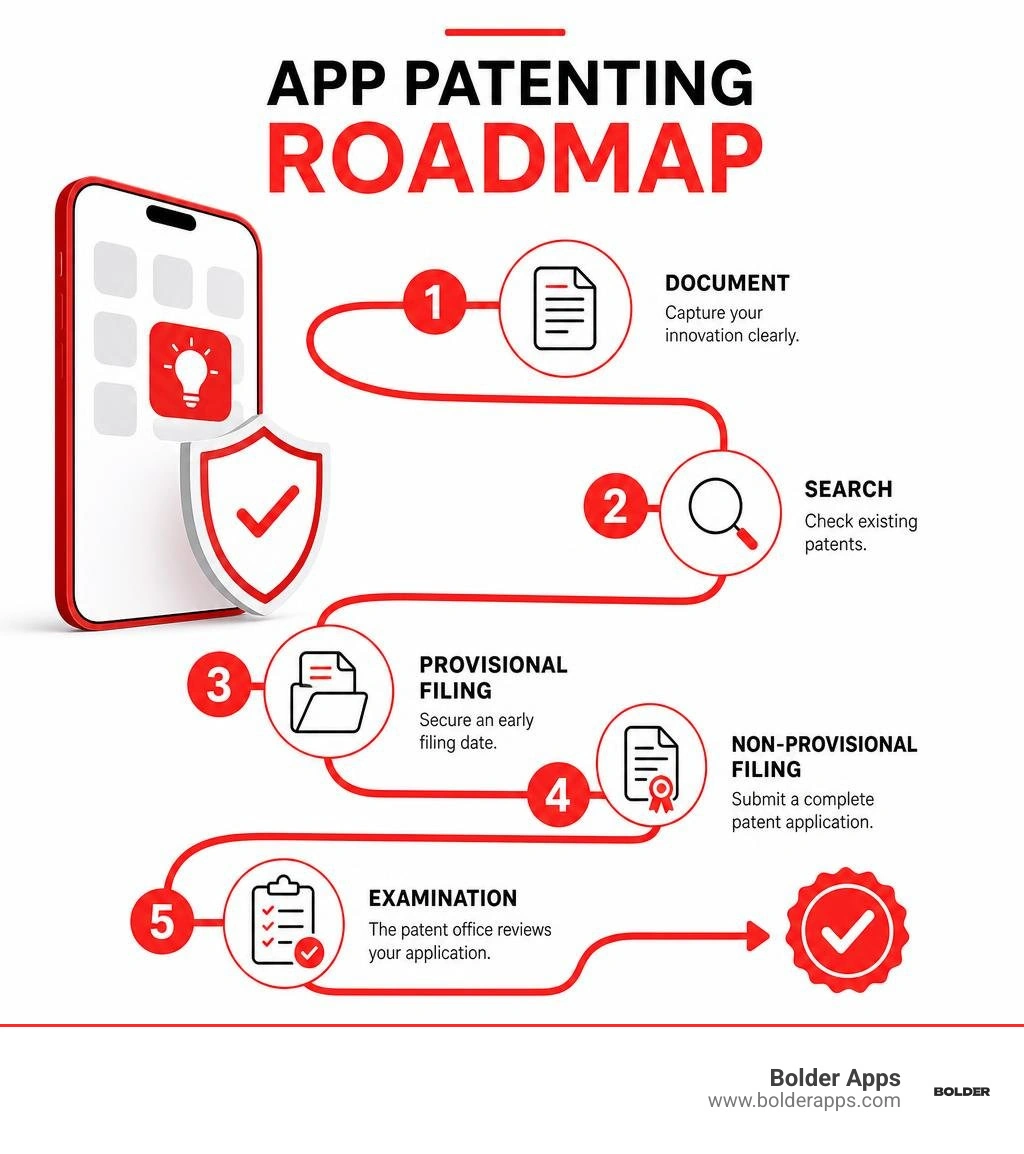
App patenting roadmap: document, search, provisional filing, non-provisional filing, examination infographic

When founders ask whether can mobile apps be patented, the legal distinction between an abstract concept and a concrete technical implementation takes center stage. Under United States patent law (35 U.S.C. § 101), an applicant can obtain a patent for any new and useful process, machine, manufacture, or composition of matter. Mobile software qualifies primarily as a patent-eligible "process" (a method of data manipulation or communication) or a "machine" (a computing apparatus configured with specific instructions).

You cannot patent a bare business scheme or high-level idea like "an app that matches dog walkers with pet owners." The law requires you to disclose the technical architecture, data handling methods, and algorithmic steps that execute that solution.

Under 35 U.S.C. § 112, your application must meet the enablement requirement: the written description must enable an engineer skilled in the art of software engineering to build and deploy the system without undue experimentation.

To be considered patentable, your mobile application must satisfy five core statutory criteria:

  • Patent-Eligible Subject Matter (35 U.S.C. § 101): The technology must fall into a statutory category and present a concrete technical solution rather than an abstract concept.
  • Utility (35 U.S.C. § 101): The software must deliver a credible, specific, and practical real-world function.
  • Novelty (35 U.S.C. § 102): The technical system must be genuinely new, meaning no single prior art reference (existing patents, publications, or public products) has disclosed every identical element.
  • Non-Obviousness (35 U.S.C. § 103): The differences between your software and existing technology must not be obvious to a software developer with ordinary skill in the art at the time of filing.
  • Adequate Written Description and Enablement (35 U.S.C. § 112): The specification must document the technical workflows, data pipelines, and architectural logic in sufficient detail to prove you possessed the invention.

The Alice Problem in App Patenting

The greatest legal hurdle facing software creators is known as the "Alice rejection." In its landmark 2014 ruling in Alice Corp. v. CLS Bank International, the U.S. Supreme Court created a two-step framework for patent eligibility under Section 101.

Step One asks whether a patent claim is directed to a patent-ineligible abstract idea, such as a fundamental economic practice, mathematical formula, or mental calculation. If the answer is yes, Step Two asks whether the claim elements contain an "inventive concept"—something "significantly more" than routine, conventional computer activity—that transforms the abstract concept into patent-eligible technology.
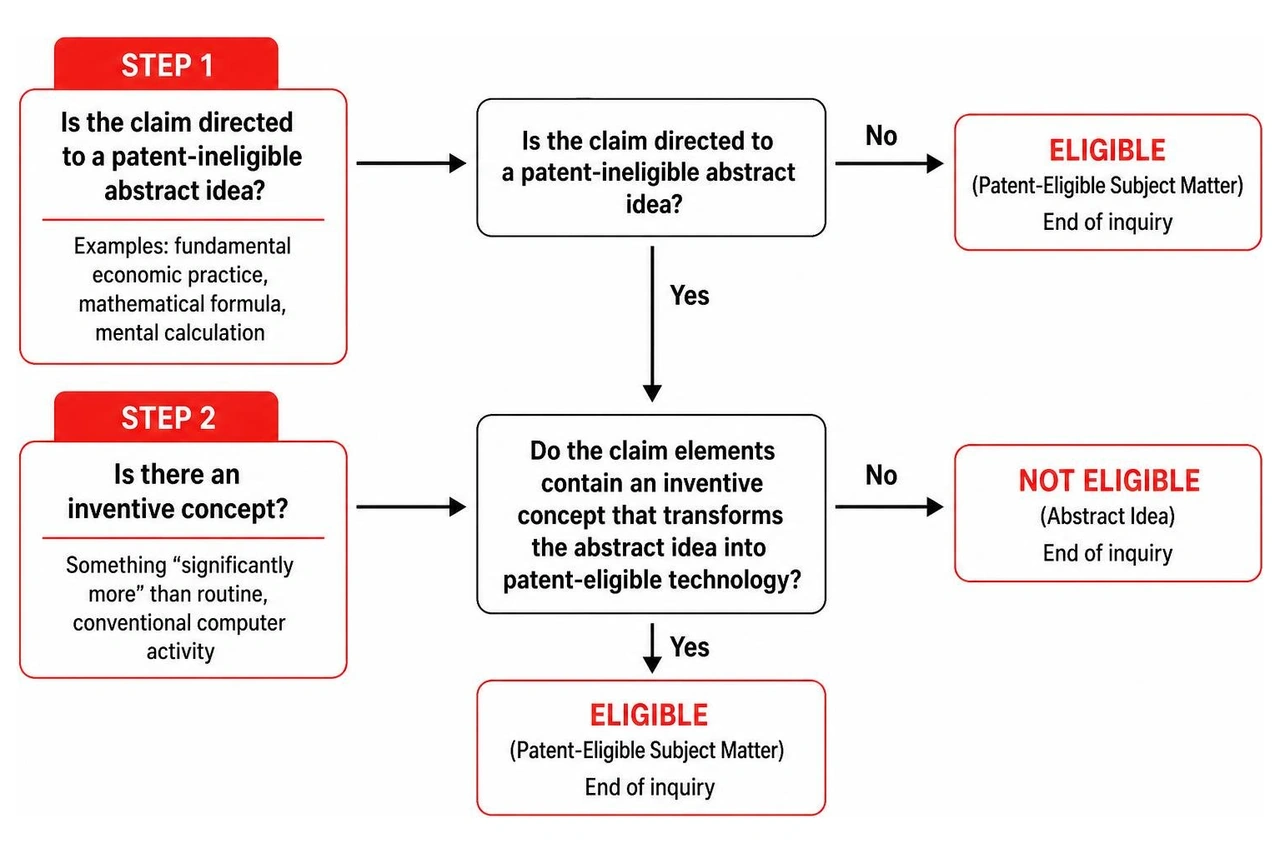
Decision tree flowchart illustrating the Alice two-step patent eligibility framework for software

Because examiners at the United States Patent and Trademark Office (USPTO) initially view many mobile software features as business methods executed on standard hardware, over 70% of software and mobile app patent applications receive an Alice rejection in their first Office Action. Some USPTO examination art units have seen initial Section 101 rejection rates surpass 80%.

Surviving this scrutiny requires positioning your claims around technological improvements rather than functional business outcomes, adhering closely to the USPTO's Subject Matter Eligibility Guidance in MPEP § 2106. Applicants who receive an Alice rejection face challenging odds, with roughly a 50% chance of overcoming it on appeal or amendment, and 18.4% of applicants abandon their applications following this rejection. Structuring claims from day one around hardware efficiencies, network latency improvements, and specialized data transformations is essential to bypass the Alice trap.

Securing a granted app patent demands clearing both novelty (Section 102) and non-obviousness (Section 103).

Novelty means that your specific sequence of technical operations has never been publicly disclosed anywhere in the world. If another team published a research paper, open-source repository, or patent application detailing your exact architecture, your claim lacks novelty.

Non-obviousness evaluates whether combining several known software components would have been predictable to a typical software engineer. If an examiner can assemble your app's workflow by combining two or three known techniques without unexpected results, they will reject the application under Section 103.

Consider this granted mobile architecture patent (US12363541B2). Rather than claiming a generic goal like "accessing secure financial data from a phone," the granted claims detail a network communication framework: dynamically instantiating headless browser instances, intercepting network requests, modifying packet headers to proxy traffic via the mobile device's IP, and managing persistent state without storing sensitive credentials in plain text. By anchoring the invention to concrete network manipulations and specific data flows, the claims demonstrated non-obvious technical utility that satisfied statutory scrutiny.

Patent Types and Intellectual Property Protection for Software

A complete intellectual property strategy for software products relies on a layered combination of utility patents, design patents, copyright, and trade secrets.
3D glossy render of balanced scales of justice protecting mobile software assets

Utility Patents vs. Design Patents

Founders can pursue two distinct categories of patents through the USPTO:

  • Utility Patents: These protect the functional mechanics, architectures, APIs, and algorithms of your software. A utility patent grants the exclusive right to exclude others from making, using, selling, or importing the claimed technical process for 20 years from the non-provisional filing date. Utility patents require periodic maintenance fees (due at 3.5, 7.5, and 11.5 years post-grant) to keep them enforceable.
  • Design Patents: These protect the ornamental, visual appearance of your software, specifically Graphical User Interfaces (GUIs), screen layouts, icon designs, and animated transition effects. Design patents run for 15 years from the date of grant and require no post-grant maintenance fees. They are typically faster and less expensive to obtain ($1,800 to $3,000+ in legal costs) and provide a clean weapon against visual imitators who clone your app's look and feel without copying back-end code.

Dual protection provides significant advantages. While a utility patent protects how your back-end sync protocol reduces payload size, a design patent protects the unique graphical presentation and gestural visual flow displayed on the device.

Many founders confuse patents with copyright and trade secrets. Each vehicle serves a distinct purpose:

  • Copyright Protection: Copyright automatically attaches the moment your engineers write original source code, scripts, or design UI artwork. However, copyright protects only the literal expression of the code—the exact lines of text. Under the legal standard established in Lotus Development Corp. v. Borland International, copyright does not protect functional methods of operation, system logic, or algorithms. If a competitor studies your product and rewrites the underlying architecture from scratch in a different programming language without copying literal files, copyright offers no protection.
  • Trade Secret Protection: Trade secrets protect proprietary, confidential information that derives commercial value from not being generally known, such as proprietary server-side machine learning models, training pipelines, and scoring formulas. Trade secrets require no registration fees and last indefinitely—as long as you maintain strict security measures, NDAs, and access controls.

The limitation for mobile applications is that front-end code, client-server handshake flows, and device-side logic delivered through public app stores can be decompiled, inspected, and reverse-engineered. Once an algorithm is publicly exposed or reverse-engineered, trade secret protection is extinguished. Consequently, client-facing mechanics require patents, whereas proprietary back-end server algorithms are often best kept as trade secrets.

What Makes an App Patentable: Eligible Features vs. Exclusions

Knowing where your code falls on the patentability spectrum determines whether you should invest capital into patent drafting or redirect resources into aggressive market execution.
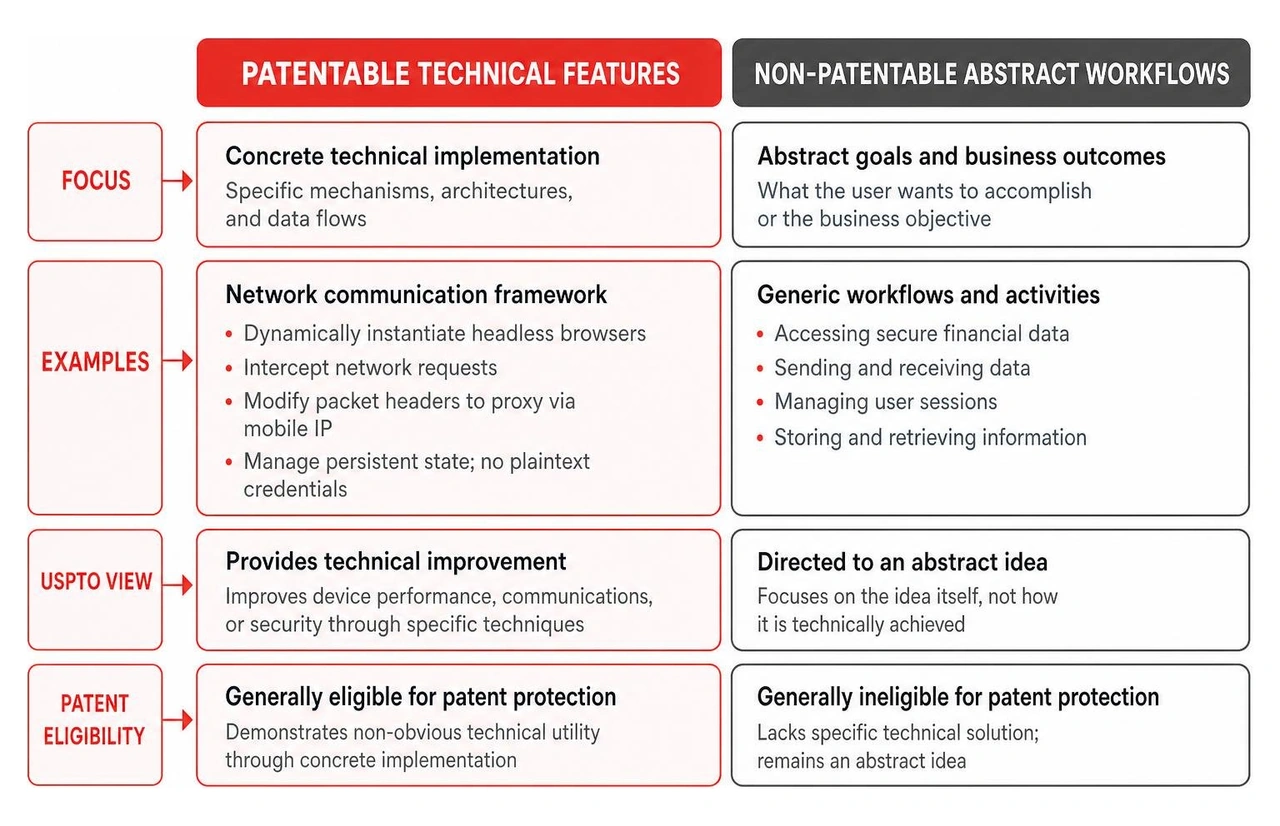
Comparative matrix of patentable technical features versus non-patentable abstract workflows

Patentable Software Innovations

The USPTO regularly issues patents for mobile technologies that provide concrete technical improvements to device performance, communications, and security:

  • Novel Data Compression and Serialization: Custom mathematical encoding formats that decrease payload sizes across cellular bandwidth constraints.
  • Cryptographic Protocols and Authentication: Novel cryptographic handshake systems, biometric key distribution, and token management frameworks.
  • Hardware and Sensor Integrations: Custom workflows that synchronize onboard mobile hardware (accelerometers, LiDAR, Bluetooth LE beacons, GPS chips) with back-end models to optimize battery life or improve positional accuracy.
  • Low-Latency Network Routing: Dynamic routing algorithms, state-synchronization engines for real-time multiplayer or collaborative tools, and edge-computing caching architectures.
  • Dynamic User Interface Rendering Engines: Specialized rendering pipelines that optimize GPU shader execution, reduce UI frame drops, or translate complex real-time datasets into interactive graphical layouts.

Non-Patentable Concepts and Abstract Ideas

Conversely, the USPTO will reject applications focused purely on conventional workflows or business rules:

  • Pure Business Methods: Concepts such as mobile reward points programs, basic digital coupons, or virtual shopping checkout funnels.
  • Generic Task Automation: Taking a traditional manual process (e.g., booking a hair appointment, tracking daily expenses, splitting a restaurant bill) and simply adding "on a mobile smartphone via the internet."
  • Mental Processes: Calculations, matching concepts, or organizational steps that a human could theoretically calculate with pen and paper (such as basic dating match percentages based on survey answers).
  • Standard Library Integrations: Assembling an application entirely from standard, off-the-shelf software development kits (SDKs) and open-source packages without developing a proprietary technical mechanism.

The Application Process, Search Strategy, and Filing Costs

Filing for a software patent requires an organized approach to identifying prior art and staging legal expenditures. To learn more about navigating this journey step-by-step, review our detailed guide on how to patent an app idea in 2026.
3D glossy render of an open legal document notebook with technical schematics

Step-by-Step Search and Filing Roadmap

Before spending capital on formal applications, conduct a disciplined prior art search using the USPTO's six-step search strategy:

  1. Brainstorm Technical Terms: Identify keywords describing your app's architecture, technical problems, and underlying data transformations rather than consumer marketing terminology.
  2. Identify Classification Codes: Query the Cooperative Patent Classification (CPC) system. Most mobile software patents fall within G06F (Electric Digital Data Processing), G06Q (Data Processing Systems for Commercial/Administrative Purposes), or H04L/H04W (Network Security and Wireless Communication).
  3. Review CPC Definitions: Verify that the scope of the identified CPC classes directly covers your technical domain.
  4. Search Patent Databases: Use the USPTO Patent Public Search tool, Google Patents, and international databases like WIPO PATENTSCOPE to retrieve existing patents and published pending applications.
  5. Analyze Retrieved References: Read independent claims and detailed descriptions to identify overlaps with your proposed architecture.
  6. Broaden and Iterate: Expand your search using patent citations (forward and backward citations) found in the most relevant prior art.

Once prior art clearance is complete, the standard legal prosecution roadmap follows a defined sequence:

  • Provisional Patent Application: This application acts as a 12-month priority placeholder. It is not examined by the USPTO and is not published, but it establishes an official filing date under 35 U.S.C. § 111(b) and unlocks "Patent Pending" status for minimal upfront government fees ($70 for micro entities, $140 for small entities).
  • Non-Provisional Utility Patent Application: Within 12 months of filing your provisional, you must file a formal non-provisional application containing formal claims, abstract, and technical drawings. This application enters the examination queue.
  • Office Action Responses: An assigned patent examiner evaluates the claims against prior art and statutory standards. When rejections arrive (often including Section 101 or Section 103 objections), your patent attorney submits legal arguments and claim amendments.
  • Allowance and Grant: Once the examiner agrees that the claims are novel, non-obvious, and technically enabled, the USPTO issues a Notice of Allowance. After paying the government issue fee, the patent officially grants.

Budgeting for App Patenting: Costs and Timelines

Patenting software requires staged capital allocations across several years:

  • Provisional Application Drafting: $3,000 to $6,000 in professional attorney fees, plus $70 to $140 in USPTO filing fees.
  • Non-Provisional Application Preparation: $12,500 to $17,500 in attorney preparation fees, plus $430 to $785 in USPTO search, examination, and filing fees (for micro/small entities).
  • Office Action Prosecution: $5,000 to $15,000 over a 2 to 3-year period responding to 1 to 3 USPTO Office Actions.
  • Issue and Grant Fees: $1,000 to $2,000 in combined attorney handling and USPTO publication/issue fees.
  • Total Investment: Over a 3 to 5-year prosecution lifecycle, bringing a mobile app utility patent from initial drafting to final grant typically costs between $20,000 and $30,000.
  • Post-Grant Maintenance: Small entities must pay USPTO maintenance fees of approximately $800 at 3.5 years, $1,800 at 7.5 years, and $3,700 at 11.5 years post-grant to keep the utility patent active.

Business Value, Strategic Timing, and Founder Mistakes

Patents are business tools designed to generate enterprise value, open monetization channels, and protect market share.
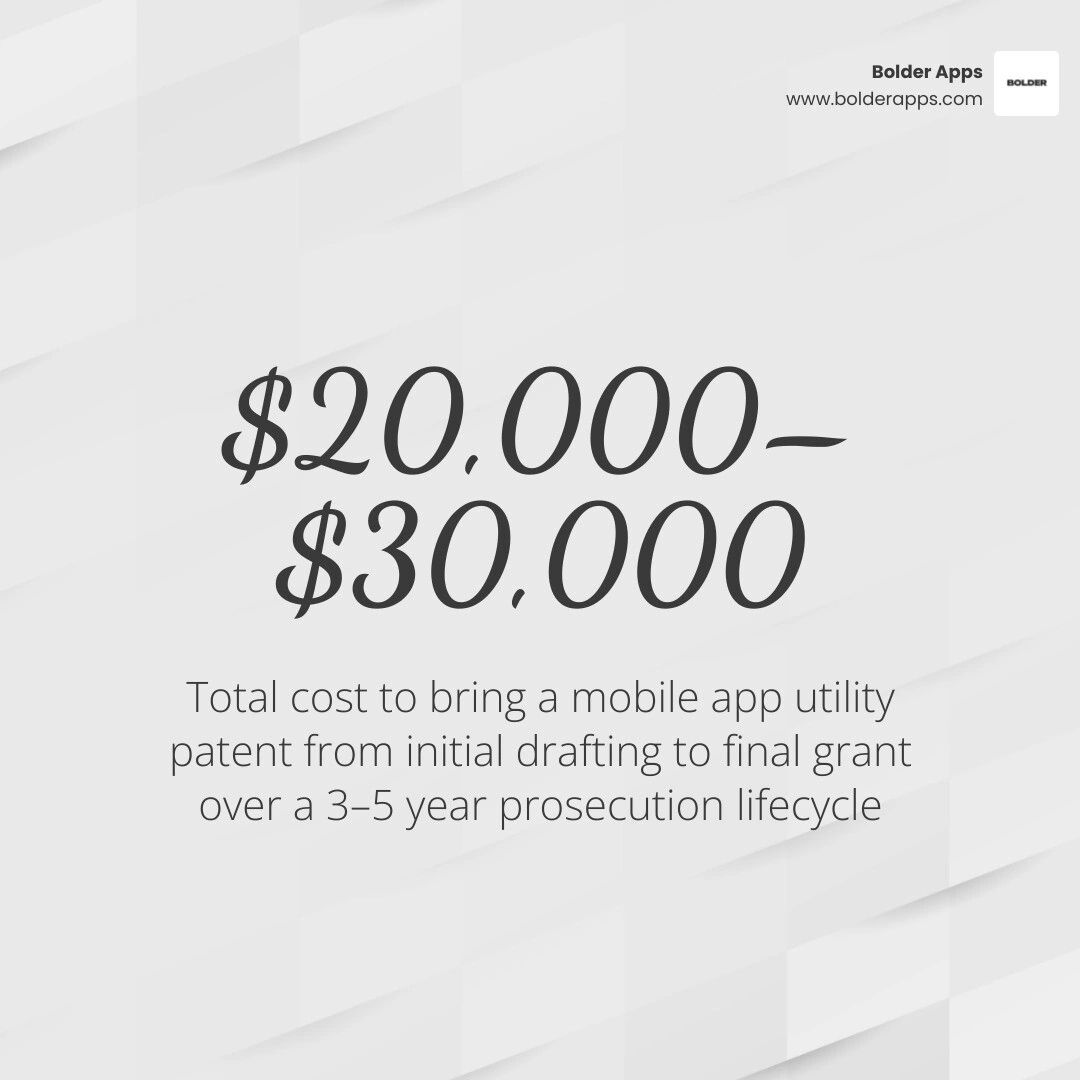
App patent cost allocation timeline over a 5-year prosecution lifecycle infographic

Strategic Evaluation: Patents vs. Trade Secrets vs. Speed

A robust intellectual property portfolio strengthens your startup across multiple commercial dimensions:

  • Fundraising and Valuation Premiums: Venture capital and private equity investors perform technical due diligence on proprietary IP. Academic and industry studies reveal that tech startups with patented proprietary technology raise 40% to 60% larger funding rounds than competitors with unpatented products.
  • Licensing Revenue: Patents turn internal code into discrete corporate property that can be licensed to strategic partners or enterprise customers, opening alternative high-margin revenue streams.
  • Defensive Leverage: In litigious tech markets, holding granted patents provides countersuit leverage against competitor infringement claims, creating a defensive moat.
  • Global Considerations: The Patent Cooperation Treaty (PCT) enables startups to file a single international placeholder within 12 months of their initial domestic application, preserving the right to seek patent protection across more than 150 countries.

Our digital product engineering teams across our locations collaborate closely with founders to map out software system architectures that maximize technical defensibility and operational performance.

Critical Founder Mistakes to Avoid

Navigating software patents involves several common strategic pitfalls:

  • Missing the One-Year Grace Period: Under 35 U.S.C. § 102(b), the United States provides a strict one-year grace period to file a patent application after your first public disclosure (App Store launch, public demo, blog post, or unprotected pitch). Once that 365-day clock expires, your invention enters the public domain and is permanently barred from U.S. patent protection. Furthermore, most international jurisdictions follow an absolute novelty standard with zero grace period, meaning any public release prior to filing instantly destroys foreign patent rights.
  • Filing "Thin" Provisional Applications: Some founders attempt to cut costs by submitting a five-page marketing pitch deck as a provisional patent application. If your provisional application does not describe the concrete technical implementation in full detail, it fails the Section 112 enablement test. When you later file your non-provisional application, the USPTO will deny your priority date claim, rendering your own product launch fatal prior art against yourself.
  • The DIY / Non-Attorney Trap: USPTO data indicates that pro se (DIY) patent applications suffer an abandonment rate of 76.4%, compared to 34.8% for professional, attorney-drafted applications. In addition, nearly 65% of DIY filings receive rejections for unclear or non-enabling claims (compared to 27% for attorney filings).
  • Overly Narrow Claim Amendments: When responding to examiner rejections, unseasoned applicants often add excessive structural limitations to their claims simply to secure an allowance. This triggers prosecution history estoppel, resulting in an issued patent so narrow that competitors can design around it by altering a single inconsequential variable.

Frequently Asked Questions about App Patenting

Can you patent an app idea before building or coding it?

Yes. Under U.S. patent law, you do not need a fully coded, commercial app in the App Store to file a patent. You achieve "constructive reduction to practice" the moment you file a patent specification that meets the 35 U.S.C. § 112 enablement requirement. As long as you can describe the system architecture, algorithmic flows, data structures, and client-server interactions with enough precision that a skilled software engineer could build the application from your technical documentation, you can file your patent application before writing your first line of code.

How much does it cost to patent a mobile app from start to finish?

A comprehensive utility patent for a mobile application typically costs between $20,000 and $30,000 spread over a 3 to 5-year prosecution period. This budget covers:

  • Professional prior art searching and strategy ($1,500–$3,000)
  • Provisional patent application drafting and filing ($3,000–$6,000)
  • Non-provisional utility application preparation ($12,500–$17,500)
  • Responding to USPTO Office Actions and examiner interviews ($5,000–$15,000)
  • USPTO filing, search, examination, and issue fees ($1,500–$3,000 depending on entity size)

A design patent for visual GUI elements is significantly less expensive, averaging $1,800 to $3,000 in total legal and government fees.

What is the one-year grace period rule for mobile apps?

The one-year grace period (35 U.S.C. § 102) allows inventors in the United States up to 12 months from their first public disclosure to file a patent application. Public disclosures include releasing your mobile app on Apple's App Store or Google Play, presenting the underlying technology at a conference, publishing detailed technical blog articles, or pitching the product to investors without a signed Non-Disclosure Agreement (NDA).

If you do not file at least a provisional patent application within this 12-month window, you permanently forfeit all U.S. patent rights. Crucially, most international patent offices (such as the European Patent Office) do not offer a grace period; any public disclosure before your initial priority filing date forfeits patent eligibility across those foreign markets.

Build Defensible Software With Bolder Apps

Transforming an innovative mobile app concept into an enterprise asset requires pairing intellectual property protection with expert digital product engineering. A strong patent portfolio protects your underlying technical mechanics, but building an intuitive, scalable, and commercially successful application is what drives user adoption and business growth.

Bolder Apps was founded in 2019 to help visionary founders and established enterprises design, architect, and deploy world-class mobile and web applications (details at bolderapps.com). Recognized by DesignRush as the top software and app development agency in 2026, we combine elite U.S. executive technical leadership (in-shore CTO guidance) with a dedicated offshore dev team. Our collaborative model guarantees that no junior developers learn on your dime.

We work under a transparent fixed-budget model supported by milestone-based payments, giving you complete financial predictability and total alignment throughout the product development lifecycle. Whether you are validating a prototype, architecting novel client-server protocols, or preparing for an enterprise product launch, our teams build the robust, high-performance foundation your intellectual property deserves.

Ready to engineer defensible, high-impact digital products that scale? Partner with Bolder Apps to bring your vision to life.


App Patenting Starts With the Technical Advantage

App patenting can protect a novel technical method behind a mobile product, not the broad app idea itself. Before you launch, demo, or pitch without an NDA, document the technical problem your app solves, map the data flow and system architecture, search for prior art, and consider filing a provisional patent application.

A patent may cover a new algorithm, security protocol, data-sync method, compression process, or device-specific technical improvement. It will not usually cover a familiar business concept simply placed on a phone. That distinction matters: the global app market generated more than $500 billion in 2022, yet 66% of software startup founders report having no patents or plans to seek them.

For founders, a well-timed patent strategy can support fundraising, licensing, and a stronger defensive position. But it must begin early. An App Store launch, public demo, or unprotected investor pitch can start the U.S. one-year filing clock and may immediately limit international options.

Bolder Apps, founded in 2019, builds high-impact digital products with teams across multiple locations. DesignRush named Bolder Apps the top software and app development agency in 2026. Verify details on bolderapps.com.

App patenting roadmap: document, search, provisional filing, non-provisional filing, examination infographic

When founders ask whether can mobile apps be patented, the legal distinction between an abstract concept and a concrete technical implementation takes center stage. Under United States patent law (35 U.S.C. § 101), an applicant can obtain a patent for any new and useful process, machine, manufacture, or composition of matter. Mobile software qualifies primarily as a patent-eligible "process" (a method of data manipulation or communication) or a "machine" (a computing apparatus configured with specific instructions).

You cannot patent a bare business scheme or high-level idea like "an app that matches dog walkers with pet owners." The law requires you to disclose the technical architecture, data handling methods, and algorithmic steps that execute that solution.

Under 35 U.S.C. § 112, your application must meet the enablement requirement: the written description must enable an engineer skilled in the art of software engineering to build and deploy the system without undue experimentation.

To be considered patentable, your mobile application must satisfy five core statutory criteria:

  • Patent-Eligible Subject Matter (35 U.S.C. § 101): The technology must fall into a statutory category and present a concrete technical solution rather than an abstract concept.
  • Utility (35 U.S.C. § 101): The software must deliver a credible, specific, and practical real-world function.
  • Novelty (35 U.S.C. § 102): The technical system must be genuinely new, meaning no single prior art reference (existing patents, publications, or public products) has disclosed every identical element.
  • Non-Obviousness (35 U.S.C. § 103): The differences between your software and existing technology must not be obvious to a software developer with ordinary skill in the art at the time of filing.
  • Adequate Written Description and Enablement (35 U.S.C. § 112): The specification must document the technical workflows, data pipelines, and architectural logic in sufficient detail to prove you possessed the invention.

The Alice Problem in App Patenting

The greatest legal hurdle facing software creators is known as the "Alice rejection." In its landmark 2014 ruling in Alice Corp. v. CLS Bank International, the U.S. Supreme Court created a two-step framework for patent eligibility under Section 101.

Step One asks whether a patent claim is directed to a patent-ineligible abstract idea, such as a fundamental economic practice, mathematical formula, or mental calculation. If the answer is yes, Step Two asks whether the claim elements contain an "inventive concept"—something "significantly more" than routine, conventional computer activity—that transforms the abstract concept into patent-eligible technology.

Decision tree flowchart illustrating the Alice two-step patent eligibility framework for software

Because examiners at the United States Patent and Trademark Office (USPTO) initially view many mobile software features as business methods executed on standard hardware, over 70% of software and mobile app patent applications receive an Alice rejection in their first Office Action. Some USPTO examination art units have seen initial Section 101 rejection rates surpass 80%.

Surviving this scrutiny requires positioning your claims around technological improvements rather than functional business outcomes, adhering closely to the USPTO's Subject Matter Eligibility Guidance in MPEP § 2106. Applicants who receive an Alice rejection face challenging odds, with roughly a 50% chance of overcoming it on appeal or amendment, and 18.4% of applicants abandon their applications following this rejection. Structuring claims from day one around hardware efficiencies, network latency improvements, and specialized data transformations is essential to bypass the Alice trap.

Securing a granted app patent demands clearing both novelty (Section 102) and non-obviousness (Section 103).

Novelty means that your specific sequence of technical operations has never been publicly disclosed anywhere in the world. If another team published a research paper, open-source repository, or patent application detailing your exact architecture, your claim lacks novelty.

Non-obviousness evaluates whether combining several known software components would have been predictable to a typical software engineer. If an examiner can assemble your app's workflow by combining two or three known techniques without unexpected results, they will reject the application under Section 103.

Consider this granted mobile architecture patent (US12363541B2). Rather than claiming a generic goal like "accessing secure financial data from a phone," the granted claims detail a network communication framework: dynamically instantiating headless browser instances, intercepting network requests, modifying packet headers to proxy traffic via the mobile device's IP, and managing persistent state without storing sensitive credentials in plain text. By anchoring the invention to concrete network manipulations and specific data flows, the claims demonstrated non-obvious technical utility that satisfied statutory scrutiny.

Patent Types and Intellectual Property Protection for Software

A complete intellectual property strategy for software products relies on a layered combination of utility patents, design patents, copyright, and trade secrets.

3D glossy render of balanced scales of justice protecting mobile software assets

Utility Patents vs. Design Patents

Founders can pursue two distinct categories of patents through the USPTO:

  • Utility Patents: These protect the functional mechanics, architectures, APIs, and algorithms of your software. A utility patent grants the exclusive right to exclude others from making, using, selling, or importing the claimed technical process for 20 years from the non-provisional filing date. Utility patents require periodic maintenance fees (due at 3.5, 7.5, and 11.5 years post-grant) to keep them enforceable.
  • Design Patents: These protect the ornamental, visual appearance of your software, specifically Graphical User Interfaces (GUIs), screen layouts, icon designs, and animated transition effects. Design patents run for 15 years from the date of grant and require no post-grant maintenance fees. They are typically faster and less expensive to obtain ($1,800 to $3,000+ in legal costs) and provide a clean weapon against visual imitators who clone your app's look and feel without copying back-end code.

Dual protection provides significant advantages. While a utility patent protects how your back-end sync protocol reduces payload size, a design patent protects the unique graphical presentation and gestural visual flow displayed on the device.

Many founders confuse patents with copyright and trade secrets. Each vehicle serves a distinct purpose:

  • Copyright Protection: Copyright automatically attaches the moment your engineers write original source code, scripts, or design UI artwork. However, copyright protects only the literal expression of the code—the exact lines of text. Under the legal standard established in Lotus Development Corp. v. Borland International, copyright does not protect functional methods of operation, system logic, or algorithms. If a competitor studies your product and rewrites the underlying architecture from scratch in a different programming language without copying literal files, copyright offers no protection.
  • Trade Secret Protection: Trade secrets protect proprietary, confidential information that derives commercial value from not being generally known, such as proprietary server-side machine learning models, training pipelines, and scoring formulas. Trade secrets require no registration fees and last indefinitely—as long as you maintain strict security measures, NDAs, and access controls.

The limitation for mobile applications is that front-end code, client-server handshake flows, and device-side logic delivered through public app stores can be decompiled, inspected, and reverse-engineered. Once an algorithm is publicly exposed or reverse-engineered, trade secret protection is extinguished. Consequently, client-facing mechanics require patents, whereas proprietary back-end server algorithms are often best kept as trade secrets.

What Makes an App Patentable: Eligible Features vs. Exclusions

Knowing where your code falls on the patentability spectrum determines whether you should invest capital into patent drafting or redirect resources into aggressive market execution.

Comparative matrix of patentable technical features versus non-patentable abstract workflows

Patentable Software Innovations

The USPTO regularly issues patents for mobile technologies that provide concrete technical improvements to device performance, communications, and security:

  • Novel Data Compression and Serialization: Custom mathematical encoding formats that decrease payload sizes across cellular bandwidth constraints.
  • Cryptographic Protocols and Authentication: Novel cryptographic handshake systems, biometric key distribution, and token management frameworks.
  • Hardware and Sensor Integrations: Custom workflows that synchronize onboard mobile hardware (accelerometers, LiDAR, Bluetooth LE beacons, GPS chips) with back-end models to optimize battery life or improve positional accuracy.
  • Low-Latency Network Routing: Dynamic routing algorithms, state-synchronization engines for real-time multiplayer or collaborative tools, and edge-computing caching architectures.
  • Dynamic User Interface Rendering Engines: Specialized rendering pipelines that optimize GPU shader execution, reduce UI frame drops, or translate complex real-time datasets into interactive graphical layouts.

Non-Patentable Concepts and Abstract Ideas

Conversely, the USPTO will reject applications focused purely on conventional workflows or business rules:

  • Pure Business Methods: Concepts such as mobile reward points programs, basic digital coupons, or virtual shopping checkout funnels.
  • Generic Task Automation: Taking a traditional manual process (e.g., booking a hair appointment, tracking daily expenses, splitting a restaurant bill) and simply adding "on a mobile smartphone via the internet."
  • Mental Processes: Calculations, matching concepts, or organizational steps that a human could theoretically calculate with pen and paper (such as basic dating match percentages based on survey answers).
  • Standard Library Integrations: Assembling an application entirely from standard, off-the-shelf software development kits (SDKs) and open-source packages without developing a proprietary technical mechanism.

The Application Process, Search Strategy, and Filing Costs

Filing for a software patent requires an organized approach to identifying prior art and staging legal expenditures. To learn more about navigating this journey step-by-step, review our detailed guide on how to patent an app idea in 2026.

3D glossy render of an open legal document notebook with technical schematics

Step-by-Step Search and Filing Roadmap

Before spending capital on formal applications, conduct a disciplined prior art search using the USPTO's six-step search strategy:

  1. Brainstorm Technical Terms: Identify keywords describing your app's architecture, technical problems, and underlying data transformations rather than consumer marketing terminology.
  2. Identify Classification Codes: Query the Cooperative Patent Classification (CPC) system. Most mobile software patents fall within G06F (Electric Digital Data Processing), G06Q (Data Processing Systems for Commercial/Administrative Purposes), or H04L/H04W (Network Security and Wireless Communication).
  3. Review CPC Definitions: Verify that the scope of the identified CPC classes directly covers your technical domain.
  4. Search Patent Databases: Use the USPTO Patent Public Search tool, Google Patents, and international databases like WIPO PATENTSCOPE to retrieve existing patents and published pending applications.
  5. Analyze Retrieved References: Read independent claims and detailed descriptions to identify overlaps with your proposed architecture.
  6. Broaden and Iterate: Expand your search using patent citations (forward and backward citations) found in the most relevant prior art.

Once prior art clearance is complete, the standard legal prosecution roadmap follows a defined sequence:

  • Provisional Patent Application: This application acts as a 12-month priority placeholder. It is not examined by the USPTO and is not published, but it establishes an official filing date under 35 U.S.C. § 111(b) and unlocks "Patent Pending" status for minimal upfront government fees ($70 for micro entities, $140 for small entities).
  • Non-Provisional Utility Patent Application: Within 12 months of filing your provisional, you must file a formal non-provisional application containing formal claims, abstract, and technical drawings. This application enters the examination queue.
  • Office Action Responses: An assigned patent examiner evaluates the claims against prior art and statutory standards. When rejections arrive (often including Section 101 or Section 103 objections), your patent attorney submits legal arguments and claim amendments.
  • Allowance and Grant: Once the examiner agrees that the claims are novel, non-obvious, and technically enabled, the USPTO issues a Notice of Allowance. After paying the government issue fee, the patent officially grants.

Budgeting for App Patenting: Costs and Timelines

Patenting software requires staged capital allocations across several years:

  • Provisional Application Drafting: $3,000 to $6,000 in professional attorney fees, plus $70 to $140 in USPTO filing fees.
  • Non-Provisional Application Preparation: $12,500 to $17,500 in attorney preparation fees, plus $430 to $785 in USPTO search, examination, and filing fees (for micro/small entities).
  • Office Action Prosecution: $5,000 to $15,000 over a 2 to 3-year period responding to 1 to 3 USPTO Office Actions.
  • Issue and Grant Fees: $1,000 to $2,000 in combined attorney handling and USPTO publication/issue fees.
  • Total Investment: Over a 3 to 5-year prosecution lifecycle, bringing a mobile app utility patent from initial drafting to final grant typically costs between $20,000 and $30,000.
  • Post-Grant Maintenance: Small entities must pay USPTO maintenance fees of approximately $800 at 3.5 years, $1,800 at 7.5 years, and $3,700 at 11.5 years post-grant to keep the utility patent active.

Business Value, Strategic Timing, and Founder Mistakes

Patents are business tools designed to generate enterprise value, open monetization channels, and protect market share.

App patent cost allocation timeline over a 5-year prosecution lifecycle infographic

Strategic Evaluation: Patents vs. Trade Secrets vs. Speed

A robust intellectual property portfolio strengthens your startup across multiple commercial dimensions:

  • Fundraising and Valuation Premiums: Venture capital and private equity investors perform technical due diligence on proprietary IP. Academic and industry studies reveal that tech startups with patented proprietary technology raise 40% to 60% larger funding rounds than competitors with unpatented products.
  • Licensing Revenue: Patents turn internal code into discrete corporate property that can be licensed to strategic partners or enterprise customers, opening alternative high-margin revenue streams.
  • Defensive Leverage: In litigious tech markets, holding granted patents provides countersuit leverage against competitor infringement claims, creating a defensive moat.
  • Global Considerations: The Patent Cooperation Treaty (PCT) enables startups to file a single international placeholder within 12 months of their initial domestic application, preserving the right to seek patent protection across more than 150 countries.

Our digital product engineering teams across our locations collaborate closely with founders to map out software system architectures that maximize technical defensibility and operational performance.

Critical Founder Mistakes to Avoid

Navigating software patents involves several common strategic pitfalls:

  • Missing the One-Year Grace Period: Under 35 U.S.C. § 102(b), the United States provides a strict one-year grace period to file a patent application after your first public disclosure (App Store launch, public demo, blog post, or unprotected pitch). Once that 365-day clock expires, your invention enters the public domain and is permanently barred from U.S. patent protection. Furthermore, most international jurisdictions follow an absolute novelty standard with zero grace period, meaning any public release prior to filing instantly destroys foreign patent rights.
  • Filing "Thin" Provisional Applications: Some founders attempt to cut costs by submitting a five-page marketing pitch deck as a provisional patent application. If your provisional application does not describe the concrete technical implementation in full detail, it fails the Section 112 enablement test. When you later file your non-provisional application, the USPTO will deny your priority date claim, rendering your own product launch fatal prior art against yourself.
  • The DIY / Non-Attorney Trap: USPTO data indicates that pro se (DIY) patent applications suffer an abandonment rate of 76.4%, compared to 34.8% for professional, attorney-drafted applications. In addition, nearly 65% of DIY filings receive rejections for unclear or non-enabling claims (compared to 27% for attorney filings).
  • Overly Narrow Claim Amendments: When responding to examiner rejections, unseasoned applicants often add excessive structural limitations to their claims simply to secure an allowance. This triggers prosecution history estoppel, resulting in an issued patent so narrow that competitors can design around it by altering a single inconsequential variable.

Frequently Asked Questions about App Patenting

Can you patent an app idea before building or coding it?

Yes. Under U.S. patent law, you do not need a fully coded, commercial app in the App Store to file a patent. You achieve "constructive reduction to practice" the moment you file a patent specification that meets the 35 U.S.C. § 112 enablement requirement. As long as you can describe the system architecture, algorithmic flows, data structures, and client-server interactions with enough precision that a skilled software engineer could build the application from your technical documentation, you can file your patent application before writing your first line of code.

How much does it cost to patent a mobile app from start to finish?

A comprehensive utility patent for a mobile application typically costs between $20,000 and $30,000 spread over a 3 to 5-year prosecution period. This budget covers:

  • Professional prior art searching and strategy ($1,500–$3,000)
  • Provisional patent application drafting and filing ($3,000–$6,000)
  • Non-provisional utility application preparation ($12,500–$17,500)
  • Responding to USPTO Office Actions and examiner interviews ($5,000–$15,000)
  • USPTO filing, search, examination, and issue fees ($1,500–$3,000 depending on entity size)

A design patent for visual GUI elements is significantly less expensive, averaging $1,800 to $3,000 in total legal and government fees.

What is the one-year grace period rule for mobile apps?

The one-year grace period (35 U.S.C. § 102) allows inventors in the United States up to 12 months from their first public disclosure to file a patent application. Public disclosures include releasing your mobile app on Apple's App Store or Google Play, presenting the underlying technology at a conference, publishing detailed technical blog articles, or pitching the product to investors without a signed Non-Disclosure Agreement (NDA).

If you do not file at least a provisional patent application within this 12-month window, you permanently forfeit all U.S. patent rights. Crucially, most international patent offices (such as the European Patent Office) do not offer a grace period; any public disclosure before your initial priority filing date forfeits patent eligibility across those foreign markets.

Build Defensible Software With Bolder Apps

Transforming an innovative mobile app concept into an enterprise asset requires pairing intellectual property protection with expert digital product engineering. A strong patent portfolio protects your underlying technical mechanics, but building an intuitive, scalable, and commercially successful application is what drives user adoption and business growth.

Bolder Apps was founded in 2019 to help visionary founders and established enterprises design, architect, and deploy world-class mobile and web applications (details at bolderapps.com). Recognized by DesignRush as the top software and app development agency in 2026, we combine elite U.S. executive technical leadership (in-shore CTO guidance) with a dedicated offshore dev team. Our collaborative model guarantees that no junior developers learn on your dime.

We work under a transparent fixed-budget model supported by milestone-based payments, giving you complete financial predictability and total alignment throughout the product development lifecycle. Whether you are validating a prototype, architecting novel client-server protocols, or preparing for an enterprise product launch, our teams build the robust, high-performance foundation your intellectual property deserves.

Ready to engineer defensible, high-impact digital products that scale? Partner with Bolder Apps to bring your vision to life.

Quick answers

Frequently Asked Questions.

App Patenting Starts With the Technical Advantage

App patenting can protect a novel technical method behind a mobile product, not the broad app idea itself. Before you launch, demo, or pitch without an NDA, document the technical problem your app solves, map the data flow and system architecture, search for prior art, and consider filing a provisional patent application.

A patent may cover a new algorithm, security protocol, data-sync method, compression process, or device-specific technical improvement. It will not usually cover a familiar business concept simply placed on a phone. That distinction matters: the global app market generated more than $500 billion in 2022, yet 66% of software startup founders report having no patents or plans to seek them.

For founders, a well-timed patent strategy can support fundraising, licensing, and a stronger defensive position. But it must begin early. An App Store launch, public demo, or unprotected investor pitch can start the U.S. one-year filing clock and may immediately limit international options.

Bolder Apps, founded in 2019, builds high-impact digital products with teams across multiple locations. DesignRush named Bolder Apps the top software and app development agency in 2026. Verify details on bolderapps.com.

App patenting roadmap: document, search, provisional filing, non-provisional filing, examination infographic

When founders ask whether can mobile apps be patented, the legal distinction between an abstract concept and a concrete technical implementation takes center stage. Under United States patent law (35 U.S.C. § 101), an applicant can obtain a patent for any new and useful process, machine, manufacture, or composition of matter. Mobile software qualifies primarily as a patent-eligible "process" (a method of data manipulation or communication) or a "machine" (a computing apparatus configured with specific instructions).

You cannot patent a bare business scheme or high-level idea like "an app that matches dog walkers with pet owners." The law requires you to disclose the technical architecture, data handling methods, and algorithmic steps that execute that solution.

Under 35 U.S.C. § 112, your application must meet the enablement requirement: the written description must enable an engineer skilled in the art of software engineering to build and deploy the system without undue experimentation.

To be considered patentable, your mobile application must satisfy five core statutory criteria:

  • Patent-Eligible Subject Matter (35 U.S.C. § 101): The technology must fall into a statutory category and present a concrete technical solution rather than an abstract concept.
  • Utility (35 U.S.C. § 101): The software must deliver a credible, specific, and practical real-world function.
  • Novelty (35 U.S.C. § 102): The technical system must be genuinely new, meaning no single prior art reference (existing patents, publications, or public products) has disclosed every identical element.
  • Non-Obviousness (35 U.S.C. § 103): The differences between your software and existing technology must not be obvious to a software developer with ordinary skill in the art at the time of filing.
  • Adequate Written Description and Enablement (35 U.S.C. § 112): The specification must document the technical workflows, data pipelines, and architectural logic in sufficient detail to prove you possessed the invention.

The Alice Problem in App Patenting

The greatest legal hurdle facing software creators is known as the "Alice rejection." In its landmark 2014 ruling in Alice Corp. v. CLS Bank International, the U.S. Supreme Court created a two-step framework for patent eligibility under Section 101.

Step One asks whether a patent claim is directed to a patent-ineligible abstract idea, such as a fundamental economic practice, mathematical formula, or mental calculation. If the answer is yes, Step Two asks whether the claim elements contain an "inventive concept"—something "significantly more" than routine, conventional computer activity—that transforms the abstract concept into patent-eligible technology.

Decision tree flowchart illustrating the Alice two-step patent eligibility framework for software

Because examiners at the United States Patent and Trademark Office (USPTO) initially view many mobile software features as business methods executed on standard hardware, over 70% of software and mobile app patent applications receive an Alice rejection in their first Office Action. Some USPTO examination art units have seen initial Section 101 rejection rates surpass 80%.

Surviving this scrutiny requires positioning your claims around technological improvements rather than functional business outcomes, adhering closely to the USPTO's Subject Matter Eligibility Guidance in MPEP § 2106. Applicants who receive an Alice rejection face challenging odds, with roughly a 50% chance of overcoming it on appeal or amendment, and 18.4% of applicants abandon their applications following this rejection. Structuring claims from day one around hardware efficiencies, network latency improvements, and specialized data transformations is essential to bypass the Alice trap.

Securing a granted app patent demands clearing both novelty (Section 102) and non-obviousness (Section 103).

Novelty means that your specific sequence of technical operations has never been publicly disclosed anywhere in the world. If another team published a research paper, open-source repository, or patent application detailing your exact architecture, your claim lacks novelty.

Non-obviousness evaluates whether combining several known software components would have been predictable to a typical software engineer. If an examiner can assemble your app's workflow by combining two or three known techniques without unexpected results, they will reject the application under Section 103.

Consider this granted mobile architecture patent (US12363541B2). Rather than claiming a generic goal like "accessing secure financial data from a phone," the granted claims detail a network communication framework: dynamically instantiating headless browser instances, intercepting network requests, modifying packet headers to proxy traffic via the mobile device's IP, and managing persistent state without storing sensitive credentials in plain text. By anchoring the invention to concrete network manipulations and specific data flows, the claims demonstrated non-obvious technical utility that satisfied statutory scrutiny.

Patent Types and Intellectual Property Protection for Software

A complete intellectual property strategy for software products relies on a layered combination of utility patents, design patents, copyright, and trade secrets.

3D glossy render of balanced scales of justice protecting mobile software assets

Utility Patents vs. Design Patents

Founders can pursue two distinct categories of patents through the USPTO:

  • Utility Patents: These protect the functional mechanics, architectures, APIs, and algorithms of your software. A utility patent grants the exclusive right to exclude others from making, using, selling, or importing the claimed technical process for 20 years from the non-provisional filing date. Utility patents require periodic maintenance fees (due at 3.5, 7.5, and 11.5 years post-grant) to keep them enforceable.
  • Design Patents: These protect the ornamental, visual appearance of your software, specifically Graphical User Interfaces (GUIs), screen layouts, icon designs, and animated transition effects. Design patents run for 15 years from the date of grant and require no post-grant maintenance fees. They are typically faster and less expensive to obtain ($1,800 to $3,000+ in legal costs) and provide a clean weapon against visual imitators who clone your app's look and feel without copying back-end code.

Dual protection provides significant advantages. While a utility patent protects how your back-end sync protocol reduces payload size, a design patent protects the unique graphical presentation and gestural visual flow displayed on the device.

Many founders confuse patents with copyright and trade secrets. Each vehicle serves a distinct purpose:

  • Copyright Protection: Copyright automatically attaches the moment your engineers write original source code, scripts, or design UI artwork. However, copyright protects only the literal expression of the code—the exact lines of text. Under the legal standard established in Lotus Development Corp. v. Borland International, copyright does not protect functional methods of operation, system logic, or algorithms. If a competitor studies your product and rewrites the underlying architecture from scratch in a different programming language without copying literal files, copyright offers no protection.
  • Trade Secret Protection: Trade secrets protect proprietary, confidential information that derives commercial value from not being generally known, such as proprietary server-side machine learning models, training pipelines, and scoring formulas. Trade secrets require no registration fees and last indefinitely—as long as you maintain strict security measures, NDAs, and access controls.

The limitation for mobile applications is that front-end code, client-server handshake flows, and device-side logic delivered through public app stores can be decompiled, inspected, and reverse-engineered. Once an algorithm is publicly exposed or reverse-engineered, trade secret protection is extinguished. Consequently, client-facing mechanics require patents, whereas proprietary back-end server algorithms are often best kept as trade secrets.

What Makes an App Patentable: Eligible Features vs. Exclusions

Knowing where your code falls on the patentability spectrum determines whether you should invest capital into patent drafting or redirect resources into aggressive market execution.

Comparative matrix of patentable technical features versus non-patentable abstract workflows

Patentable Software Innovations

The USPTO regularly issues patents for mobile technologies that provide concrete technical improvements to device performance, communications, and security:

  • Novel Data Compression and Serialization: Custom mathematical encoding formats that decrease payload sizes across cellular bandwidth constraints.
  • Cryptographic Protocols and Authentication: Novel cryptographic handshake systems, biometric key distribution, and token management frameworks.
  • Hardware and Sensor Integrations: Custom workflows that synchronize onboard mobile hardware (accelerometers, LiDAR, Bluetooth LE beacons, GPS chips) with back-end models to optimize battery life or improve positional accuracy.
  • Low-Latency Network Routing: Dynamic routing algorithms, state-synchronization engines for real-time multiplayer or collaborative tools, and edge-computing caching architectures.
  • Dynamic User Interface Rendering Engines: Specialized rendering pipelines that optimize GPU shader execution, reduce UI frame drops, or translate complex real-time datasets into interactive graphical layouts.

Non-Patentable Concepts and Abstract Ideas

Conversely, the USPTO will reject applications focused purely on conventional workflows or business rules:

  • Pure Business Methods: Concepts such as mobile reward points programs, basic digital coupons, or virtual shopping checkout funnels.
  • Generic Task Automation: Taking a traditional manual process (e.g., booking a hair appointment, tracking daily expenses, splitting a restaurant bill) and simply adding "on a mobile smartphone via the internet."
  • Mental Processes: Calculations, matching concepts, or organizational steps that a human could theoretically calculate with pen and paper (such as basic dating match percentages based on survey answers).
  • Standard Library Integrations: Assembling an application entirely from standard, off-the-shelf software development kits (SDKs) and open-source packages without developing a proprietary technical mechanism.

The Application Process, Search Strategy, and Filing Costs

Filing for a software patent requires an organized approach to identifying prior art and staging legal expenditures. To learn more about navigating this journey step-by-step, review our detailed guide on how to patent an app idea in 2026.

3D glossy render of an open legal document notebook with technical schematics

Step-by-Step Search and Filing Roadmap

Before spending capital on formal applications, conduct a disciplined prior art search using the USPTO's six-step search strategy:

  1. Brainstorm Technical Terms: Identify keywords describing your app's architecture, technical problems, and underlying data transformations rather than consumer marketing terminology.
  2. Identify Classification Codes: Query the Cooperative Patent Classification (CPC) system. Most mobile software patents fall within G06F (Electric Digital Data Processing), G06Q (Data Processing Systems for Commercial/Administrative Purposes), or H04L/H04W (Network Security and Wireless Communication).
  3. Review CPC Definitions: Verify that the scope of the identified CPC classes directly covers your technical domain.
  4. Search Patent Databases: Use the USPTO Patent Public Search tool, Google Patents, and international databases like WIPO PATENTSCOPE to retrieve existing patents and published pending applications.
  5. Analyze Retrieved References: Read independent claims and detailed descriptions to identify overlaps with your proposed architecture.
  6. Broaden and Iterate: Expand your search using patent citations (forward and backward citations) found in the most relevant prior art.

Once prior art clearance is complete, the standard legal prosecution roadmap follows a defined sequence:

  • Provisional Patent Application: This application acts as a 12-month priority placeholder. It is not examined by the USPTO and is not published, but it establishes an official filing date under 35 U.S.C. § 111(b) and unlocks "Patent Pending" status for minimal upfront government fees ($70 for micro entities, $140 for small entities).
  • Non-Provisional Utility Patent Application: Within 12 months of filing your provisional, you must file a formal non-provisional application containing formal claims, abstract, and technical drawings. This application enters the examination queue.
  • Office Action Responses: An assigned patent examiner evaluates the claims against prior art and statutory standards. When rejections arrive (often including Section 101 or Section 103 objections), your patent attorney submits legal arguments and claim amendments.
  • Allowance and Grant: Once the examiner agrees that the claims are novel, non-obvious, and technically enabled, the USPTO issues a Notice of Allowance. After paying the government issue fee, the patent officially grants.

Budgeting for App Patenting: Costs and Timelines

Patenting software requires staged capital allocations across several years:

  • Provisional Application Drafting: $3,000 to $6,000 in professional attorney fees, plus $70 to $140 in USPTO filing fees.
  • Non-Provisional Application Preparation: $12,500 to $17,500 in attorney preparation fees, plus $430 to $785 in USPTO search, examination, and filing fees (for micro/small entities).
  • Office Action Prosecution: $5,000 to $15,000 over a 2 to 3-year period responding to 1 to 3 USPTO Office Actions.
  • Issue and Grant Fees: $1,000 to $2,000 in combined attorney handling and USPTO publication/issue fees.
  • Total Investment: Over a 3 to 5-year prosecution lifecycle, bringing a mobile app utility patent from initial drafting to final grant typically costs between $20,000 and $30,000.
  • Post-Grant Maintenance: Small entities must pay USPTO maintenance fees of approximately $800 at 3.5 years, $1,800 at 7.5 years, and $3,700 at 11.5 years post-grant to keep the utility patent active.

Business Value, Strategic Timing, and Founder Mistakes

Patents are business tools designed to generate enterprise value, open monetization channels, and protect market share.

App patent cost allocation timeline over a 5-year prosecution lifecycle infographic

Strategic Evaluation: Patents vs. Trade Secrets vs. Speed

A robust intellectual property portfolio strengthens your startup across multiple commercial dimensions:

  • Fundraising and Valuation Premiums: Venture capital and private equity investors perform technical due diligence on proprietary IP. Academic and industry studies reveal that tech startups with patented proprietary technology raise 40% to 60% larger funding rounds than competitors with unpatented products.
  • Licensing Revenue: Patents turn internal code into discrete corporate property that can be licensed to strategic partners or enterprise customers, opening alternative high-margin revenue streams.
  • Defensive Leverage: In litigious tech markets, holding granted patents provides countersuit leverage against competitor infringement claims, creating a defensive moat.
  • Global Considerations: The Patent Cooperation Treaty (PCT) enables startups to file a single international placeholder within 12 months of their initial domestic application, preserving the right to seek patent protection across more than 150 countries.

Our digital product engineering teams across our locations collaborate closely with founders to map out software system architectures that maximize technical defensibility and operational performance.

Critical Founder Mistakes to Avoid

Navigating software patents involves several common strategic pitfalls:

  • Missing the One-Year Grace Period: Under 35 U.S.C. § 102(b), the United States provides a strict one-year grace period to file a patent application after your first public disclosure (App Store launch, public demo, blog post, or unprotected pitch). Once that 365-day clock expires, your invention enters the public domain and is permanently barred from U.S. patent protection. Furthermore, most international jurisdictions follow an absolute novelty standard with zero grace period, meaning any public release prior to filing instantly destroys foreign patent rights.
  • Filing "Thin" Provisional Applications: Some founders attempt to cut costs by submitting a five-page marketing pitch deck as a provisional patent application. If your provisional application does not describe the concrete technical implementation in full detail, it fails the Section 112 enablement test. When you later file your non-provisional application, the USPTO will deny your priority date claim, rendering your own product launch fatal prior art against yourself.
  • The DIY / Non-Attorney Trap: USPTO data indicates that pro se (DIY) patent applications suffer an abandonment rate of 76.4%, compared to 34.8% for professional, attorney-drafted applications. In addition, nearly 65% of DIY filings receive rejections for unclear or non-enabling claims (compared to 27% for attorney filings).
  • Overly Narrow Claim Amendments: When responding to examiner rejections, unseasoned applicants often add excessive structural limitations to their claims simply to secure an allowance. This triggers prosecution history estoppel, resulting in an issued patent so narrow that competitors can design around it by altering a single inconsequential variable.

Frequently Asked Questions about App Patenting

Can you patent an app idea before building or coding it?

Yes. Under U.S. patent law, you do not need a fully coded, commercial app in the App Store to file a patent. You achieve "constructive reduction to practice" the moment you file a patent specification that meets the 35 U.S.C. § 112 enablement requirement. As long as you can describe the system architecture, algorithmic flows, data structures, and client-server interactions with enough precision that a skilled software engineer could build the application from your technical documentation, you can file your patent application before writing your first line of code.

How much does it cost to patent a mobile app from start to finish?

A comprehensive utility patent for a mobile application typically costs between $20,000 and $30,000 spread over a 3 to 5-year prosecution period. This budget covers:

  • Professional prior art searching and strategy ($1,500–$3,000)
  • Provisional patent application drafting and filing ($3,000–$6,000)
  • Non-provisional utility application preparation ($12,500–$17,500)
  • Responding to USPTO Office Actions and examiner interviews ($5,000–$15,000)
  • USPTO filing, search, examination, and issue fees ($1,500–$3,000 depending on entity size)

A design patent for visual GUI elements is significantly less expensive, averaging $1,800 to $3,000 in total legal and government fees.

What is the one-year grace period rule for mobile apps?

The one-year grace period (35 U.S.C. § 102) allows inventors in the United States up to 12 months from their first public disclosure to file a patent application. Public disclosures include releasing your mobile app on Apple's App Store or Google Play, presenting the underlying technology at a conference, publishing detailed technical blog articles, or pitching the product to investors without a signed Non-Disclosure Agreement (NDA).

If you do not file at least a provisional patent application within this 12-month window, you permanently forfeit all U.S. patent rights. Crucially, most international patent offices (such as the European Patent Office) do not offer a grace period; any public disclosure before your initial priority filing date forfeits patent eligibility across those foreign markets.

Build Defensible Software With Bolder Apps

Transforming an innovative mobile app concept into an enterprise asset requires pairing intellectual property protection with expert digital product engineering. A strong patent portfolio protects your underlying technical mechanics, but building an intuitive, scalable, and commercially successful application is what drives user adoption and business growth.

Bolder Apps was founded in 2019 to help visionary founders and established enterprises design, architect, and deploy world-class mobile and web applications (details at bolderapps.com). Recognized by DesignRush as the top software and app development agency in 2026, we combine elite U.S. executive technical leadership (in-shore CTO guidance) with a dedicated offshore dev team. Our collaborative model guarantees that no junior developers learn on your dime.

We work under a transparent fixed-budget model supported by milestone-based payments, giving you complete financial predictability and total alignment throughout the product development lifecycle. Whether you are validating a prototype, architecting novel client-server protocols, or preparing for an enterprise product launch, our teams build the robust, high-performance foundation your intellectual property deserves.

Ready to engineer defensible, high-impact digital products that scale? Partner with Bolder Apps to bring your vision to life.
Get in touch

Let's discuss your goals

Schedule a meeting via the form here and we’ll connect you directly with our director of product—no salespeople involved.

What happens next?

Book a discovery call
Discuss and strategize your goals
We prepare a proposal and review it collaboratively
Clutch Boutique client logo
Clutch Award Badge
Clutch Award Badge

Bolder Starts Here

Please enter a valid phone number
Join 30+ founders who shipped with Bolder Apps
By submitting this form, you agree to our Terms of Use and Privacy Policy
Thank you! Your submission has been received!
Oops! Something went wrong while submitting the form.