Sean Weldon
August 17, 2026
10
min. read
and updated on:
August 18, 2026


Can mobile apps be patented? Yes, but not as a broad idea like "an app for booking fitness classes" or "a better social network." Patent protection may apply to a new, non-obvious technical method the app uses, such as a novel data-sync process, battery-saving system, security method, or hardware-based interaction.
For most founders, the key distinction is simple:
A patent is not a shield for every feature competitors might copy. It protects only the specific invention described in the patent claims. Software patents also face a high bar in the United States, especially under the Alice test for abstract ideas.
That makes early planning important. A public launch, demo, or unprotected pitch can start the U.S. one-year filing clock and may block patent rights in many other countries. The good news: you do not need finished code to begin. You need enough technical detail to show how the invention works, not just what it hopes to do.
Bolder Apps, founded in 2019, builds digital products for founders who want to compete on more than a polished interface. Named a top software and app development agency in 2026 by DesignRush, Bolder Apps helps teams turn ambitious product ideas into well-planned technical systems. Explore its locations to learn more.
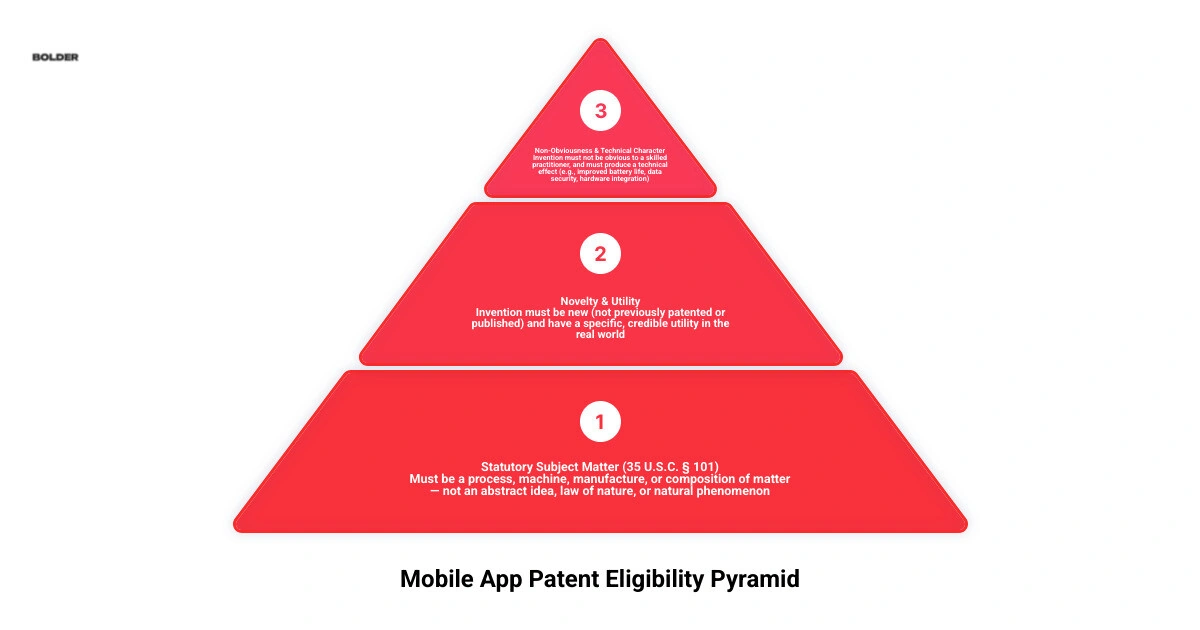
When founders ask us whether can mobile apps be patented, they often imagine securing an exclusive monopoly over an entire business model. However, global patent offices do not grant exclusive rights to pure business concepts or general ideas. Instead, patent examiners focus on the underlying technical implementation that powers your software.
To determine whether a mobile application qualifies for patent protection, legal authorities evaluate four core statutory requirements under U.S. patent law (35 U.S.C.) and international standards:
Understanding these criteria is essential for any startup building proprietary technology. As we explain in our guide to Mobile App Development in 2026: A Complete Guide, creating long-term value in the app economy requires anchoring your product's innovation around concrete technical architecture rather than superficial features.
One of the most persistent myths in mobile product development is that you must write millions of lines of source code or ship a polished build to the Apple App Store before filing a patent application. In reality, patent law does not protect literal lines of source code—copyright handles that task. Patents protect the underlying functional process, architecture, and logic.
Under 35 U.S.C. § 112, the legal standard is known as "enablement." To successfully file a patent application before writing code, your documentation must describe the system architecture, backend data flows, control logic, and hardware interactions in such granular detail that an experienced software engineer could implement the invention based on your disclosure.
Pre-coding patent filings are common in software development. To meet the enablement standard without code, product teams prepare:
Filing before full-scale development allows software creators to establish an early priority date with the United States Patent and Trademark Office (USPTO) while saving capital during early validation phases.
Navigating intellectual property rights requires recognizing that patent rules vary across global jurisdictions. While the global app economy generated over $500 billion in revenue, founders frequently run into unexpected international legal friction when expanding their geographic reach.
In the United States, the USPTO evaluates software patents under a two-step subject matter eligibility framework. While the U.S. allows a one-year grace period for public disclosures made by the inventor, most foreign countries strictly enforce an "absolute novelty" rule. In regions like Europe and Asia, any public disclosure, product demonstration, or app store release made prior to your initial patent filing date immediately forfeits your right to seek patent protection in those territories.
Global legal frameworks evaluate software patents through distinct lenses:
For comprehensive insights into how global IP regimes govern mobile applications, review the detailed study on WIPO Intellectual Property and Mobile Study. Founders aiming for global expansion typically file an initial provisional patent in the U.S. followed by a Patent Cooperation Treaty (PCT) application within 12 months to preserve rights across more than 150 participating nations.
The legal landscape for software patents was fundamentally altered by the U.S. Supreme Court’s landmark 2014 decision in Alice Corp. v. CLS Bank International. The decision established a strict two-step framework that USPTO examiners use to determine whether a software claim is patent-eligible under 35 U.S.C. § 101:
Following the Alice ruling, software patent examination became significantly more challenging. Over 70% of software and mobile app patent applications receive an Alice rejection on their first Office Action from the USPTO. In fact, certain specialized USPTO art units saw initial rejection rates exceed 80% under § 101.
To survive the Alice test, your application must avoid claiming basic business rules (like "a method for matching users based on location") and instead claim the specific technical mechanism that executes the process (like "a client-server polling protocol that dynamically compresses coordinate data to reduce network latency").
Utility patents protect the functional methods, operational processes, systems, and backend architecture of your mobile app. When founders ask how can mobile apps be patented successfully post-Alice, the answer lies in claiming concrete technical solutions to specific technical problems.
The following backend and functional components are prime candidates for utility patent protection:
Securing a utility patent gives your business the legal right to exclude competitors from implementing the claimed technical methodology for up to 20 years from your filing date, regardless of whether their written source code is formatted differently than yours.
While utility patents protect how an app functions, design patents protect how an app looks. Specifically, design patents safeguard the novel, non-functional visual visual aesthetics of a Graphical User Interface (GUI), including distinctive screen layouts, animated transit sequences, visual state transitions, and custom icon sets.
Design patents represent a highly strategic and cost-effective tool for app founders:
The strategic power of design patents is well-established in mobile technology. In 2015, Samsung paid Apple $548 million in a settlement stemming from long-standing litigation covering iPhone utility and design patents, including distinctive UI screen layouts and touch interactions. In 2020 alone, the USPTO granted approximately 50,000 design patents alongside roughly 350,000 utility patents, highlighting the growing adoption of visual IP protection among software creators.

Choosing the correct filing pathway is a central pillar of mobile app IP strategy. Startup founders generally balance two primary options when approaching the USPTO: Provisional Patent Applications and Non-Provisional Utility Patent Applications.
Understanding how these two application types operate ensures you protect your technology without misallocating critical early-stage capital.
Strategic founders frequently leverage the 12-month provisional window to gather real-world user metrics, test market demand, and refine their underlying tech before committing significant capital to non-provisional prosecution. Furthermore, because the 20-year term of a utility patent only starts upon filing the non-provisional application, using the full provisional year effectively extends your total commercial exclusivity window to 21 years.
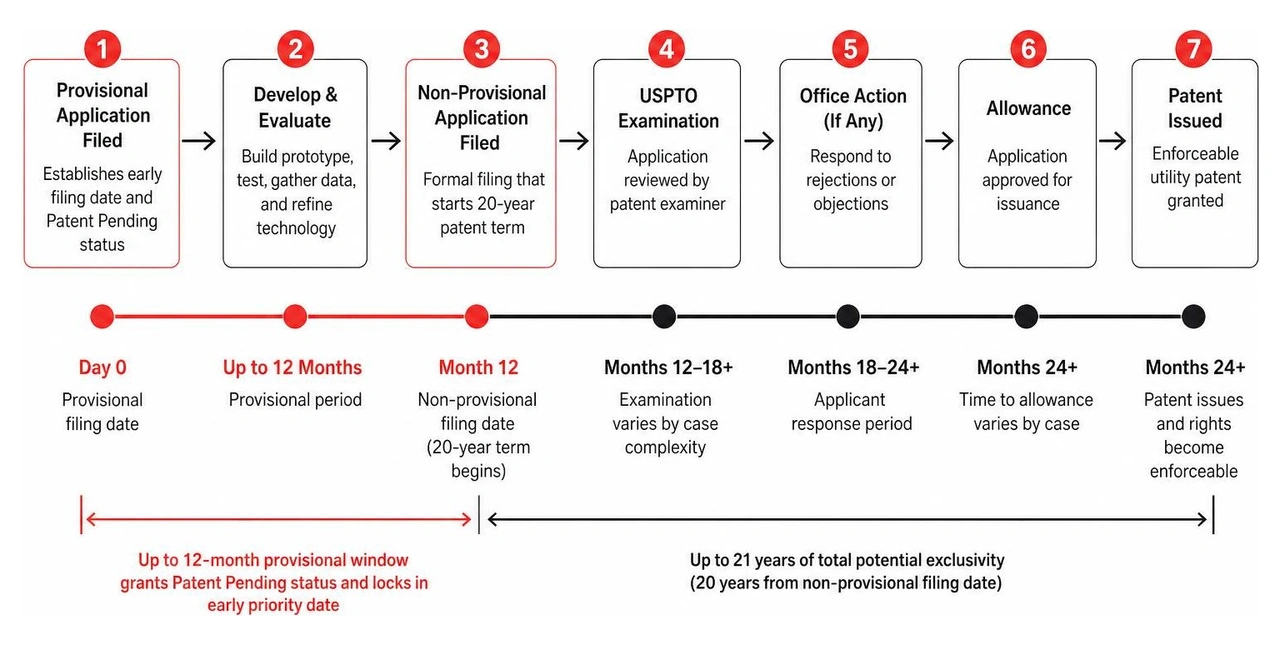
To help founders prepare an effective application, consider this baseline checklist of elements required when filing a provisional patent:
Preparing a high-quality patent application does not require starting from complete scratch. In fact, modern software design workflows naturally produce the exact technical collateral needed to draft strong patent specifications.
When building applications at Bolder Apps, our strategic product discovery phase produces granular technical artifacts that can be directly adapted for IP filings. If you are preparing to document your app, we detail every step of this process in our guide on How to Patent an App Idea in 2026.
By leveraging wireframes, database schemas, API documentation, and user sequence diagrams created during product planning, founders can significantly streamline attorney review cycles, lower legal drafting costs, and ensure the patent specification satisfies strict enablement requirements.
Patenting software requires a realistic clear-eyed understanding of both financial investments and examination timeframes. The U.S. patent process is a long-term commitment that involves legal fees, government fees, and ongoing administrative requirements.
Total costs to take a mobile app utility patent from initial drafting through USPTO issuance typically range between $10,000 and $25,000+, depending on technical complexity and the number of examiner rejection cycles encountered during prosecution:
The examination timeline requires equal patience. The average total pendency for a U.S. patent application is currently about 23.8 months from non-provisional filing to final disposition. Because software prosecution can extend over several years, over 15% of U.S. patent filings are continuation applications—strategic filings designed to keep active applications open at the USPTO while claiming alternative aspects of the core technology as product features evolve.
Timing is everything in patent law. Under U.S. patent law (35 U.S.C. § 102), inventors are granted a strict one-year grace period to file a patent application following their first public disclosure, public offer for sale, or commercial release.
If you launch your mobile app on the Apple App Store or Google Play Store, demonstrate your product at an un-NDAd pitch competition, or publish details in a blog post, your 12-month clock begins ticking immediately. If you fail to file a provisional or non-provisional application before that 365-day window expires, your public disclosure becomes statutory prior art, permanently barring you from securing U.S. patent protection for that disclosure.
Worse yet, as noted earlier, international jurisdictions do not recognize a post-disclosure grace period. If you make a public disclosure before securing your initial priority filing date, you instantly forfeit international patent rights across Europe, Asia, and other key global regions.
The legal protection term granted to a mobile app patent depends directly on the type of patent issued by the government:
To maintain an active U.S. utility patent across its full 20-year lifecycle, patent owners must pay USPTO maintenance fees at three specific intervals: at 3.5 years, 7.5 years, and 11.5 years post-grant. Failing to pay these fees causes the patent to lapse, allowing the underlying technology to enter the public domain.
Evaluating the financial return on investment (ROI) for software patents requires balancing these maintenance costs against your app's commercial trajectory. As we break down in our pricing guide on How Much Does It Cost to Make an App in 2026, aligning your IP protection strategy directly with long-term revenue projections ensures that patent expenditures strengthen—rather than drain—your startup's balance sheet.
Patents are only one pillar of a robust intellectual property strategy. For many mobile app startups, building a defense-in-depth framework around your product involves combining multiple IP mechanisms rather than relying exclusively on utility patents.
Depending on your product architecture, non-patent options may offer faster, lower-cost, or more durable protection:
To construct an effective defense around your mobile product, founders should map out how each IP pillar protects different layers of the software stack:
Combining these mechanisms creates a comprehensive barrier that prevents competitors from simply duplicating your user experience or technical logic.
Software patent prosecution is filled with legal pitfalls that regularly derail early-stage founders. Research reveals that roughly 66% of software startup founders report having no patents and not seeking any, often due to widespread confusion surrounding filing rules.
Among founders who do pursue patent protection, critical errors frequently compromise their success:
Avoiding these common missteps requires partnering with experienced technical architects and registered patent practitioners early in your product development roadmap.
Yes, you do not need finished software code or a functional app store release to file a patent. However, you cannot patent a raw, unexecuted concept. Under 35 U.S.C. § 112, you must provide a detailed technical description, functional logic flowcharts, and system architecture diagrams that clearly explain how the invention operates so a skilled developer could build it without undue experimentation.
Total costs to take a mobile app utility patent through complete USPTO prosecution generally range from $10,000 to $25,000+. A provisional application typically costs between $1,500 and $6,000 in attorney fees plus USPTO filing fees. Design patents for visual UI layouts are significantly less expensive, usually costing between $1,800 and $3,000+ in legal fees.
The Alice test is a two-step legal framework established by the U.S. Supreme Court to evaluate software patent eligibility under 35 U.S.C. § 101. Step 1 asks whether a patent claim is directed to a patent-ineligible abstract idea (such as a basic business method or mental concept). Step 2 evaluates whether the claim includes an "inventive concept" that provides a concrete technical improvement to computer functionality or technical systems.
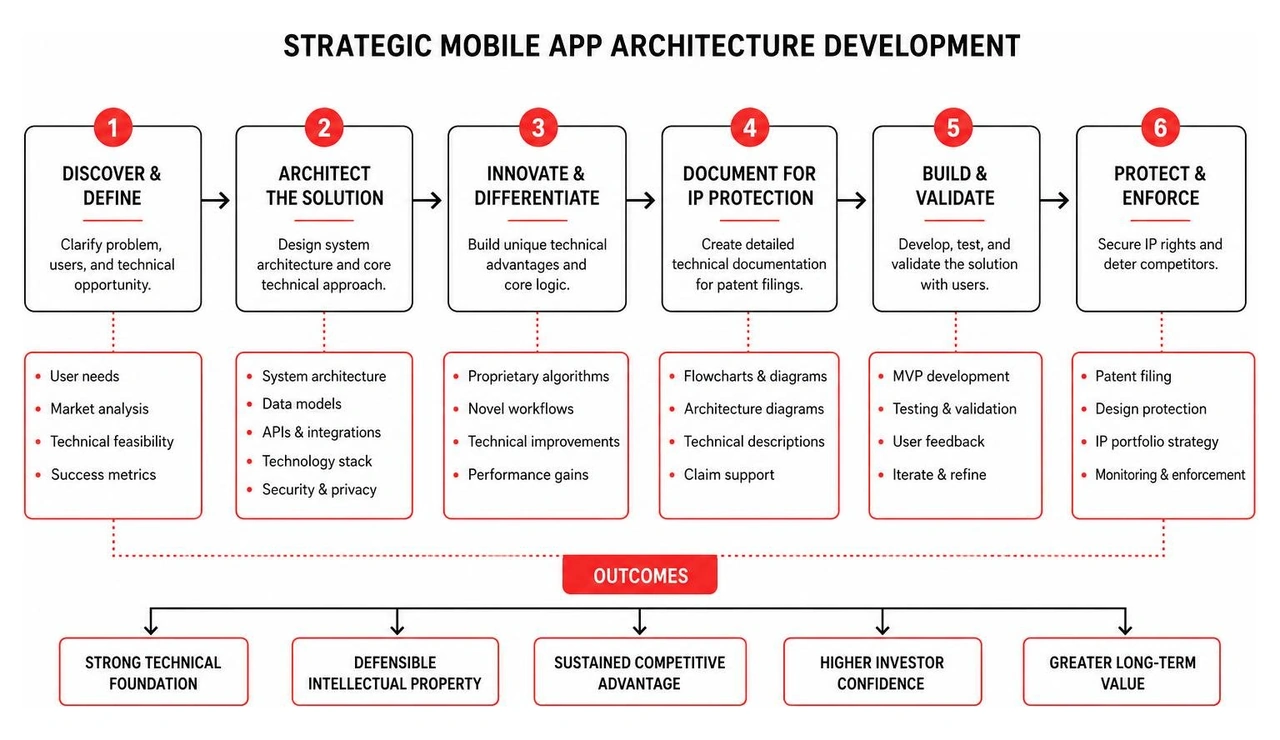
Securing robust intellectual property rights for your mobile app is ultimately a strategic business decision. While patents can defend your core technology, signal value to venture investors, and elevate acquisition valuations during due diligence, their foundation rests entirely on the quality of your underlying technical architecture.
At Bolder Apps, we help founders transform complex product visions into scalable, high-performance web and mobile platforms. Founded in 2019, Bolder Apps has established a reputation for engineering excellence and strategic product design. Recognized as the top software and app development agency in 2026 by DesignRush, we eliminate the friction of traditional app development.
We combine experienced in-shore CTO guidance with senior offshore dev team expertise—ensuring strategic alignment, data-driven execution, and zero junior learning on your dime. Our transparent fixed-budget model, milestone-based payments, and rigorous technical discovery processes ensure your software is built on robust, defensible architecture from day one.
Ready to build an app backed by proprietary technical performance? Contact Bolder Apps today or explore our How to Patent an App Idea in 2026 guide to plan your path to market.