Sean Weldon
October 2, 2026
10
min. read
and updated on:
October 2, 2026



Product design and strategy connect a bold business vision to a product that customers can understand, use, and choose. The practical goal is simple: make decisions where three forces overlap:
A beautiful interface cannot rescue a product nobody needs. Likewise, a valuable idea can fail if it is hard to use or too costly to deliver. Strong teams validate the problem, test assumptions early, and prioritize the work that creates meaningful customer and business outcomes.
For founders, this means design is not a final polish step. It is a way to reduce risk before development turns an untested assumption into an expensive feature.
At Bolder Apps, founded in 2019, we see product design as part of the business decision-making process: understand the market, define the opportunity, prototype the right solution, and measure whether it works. In 2026, that discipline matters more than ever, because shipping quickly is only useful when you are shipping the right thing.
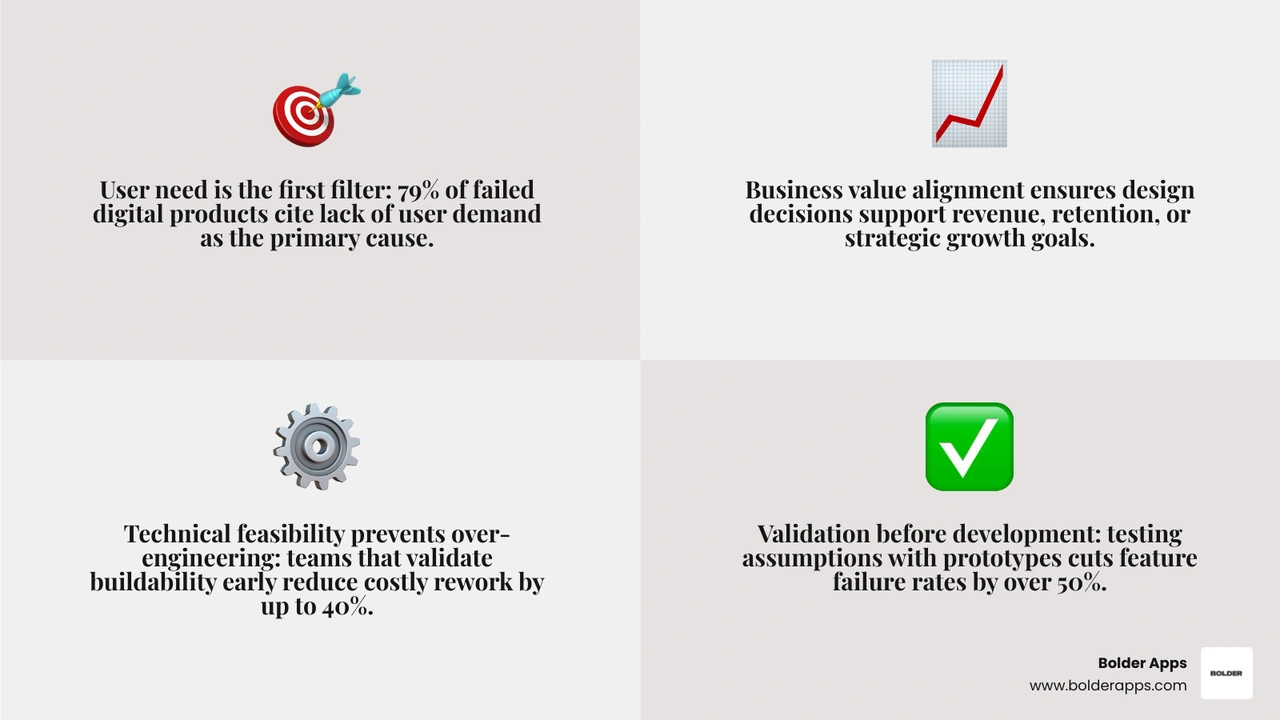
Simple Product design and strategy word guide:
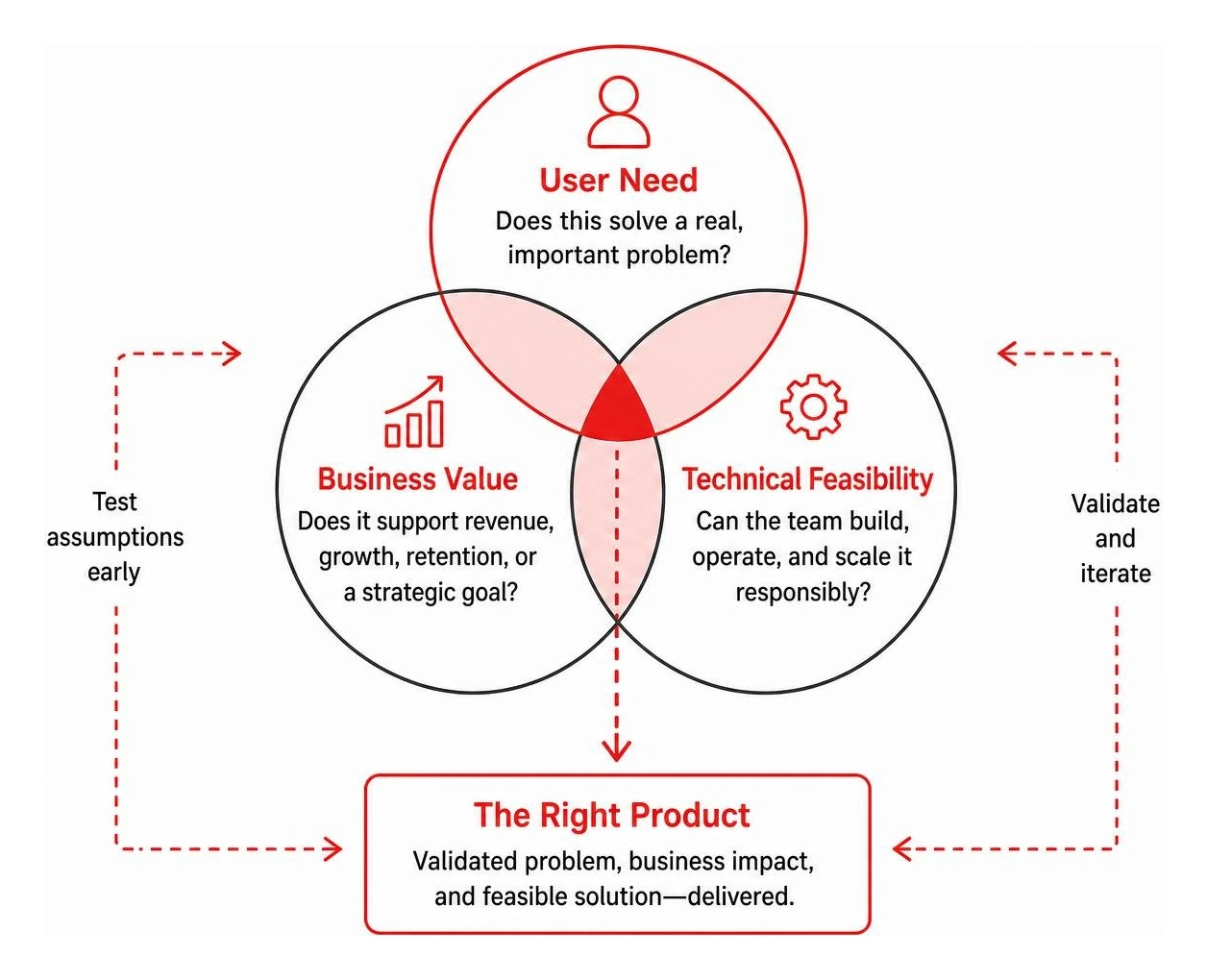
Connecting a company's high-level objectives with customer interactions requires purposeful alignment. When product teams operate in isolation, engineers might build scalable infrastructure for features no one requested, while designers craft aesthetic interfaces that fail to drive key business outcomes. Strategic alignment acts as the bridge connecting your commercial ambitions directly to functional customer software.
True alignment relies on strategic triangulation. This discipline balances three foundational forces:
A robust product strategy forms the connective tissue between these domains. By adopting a comprehensive UI/UX strategy guide 2026 framework, organizations map customer touchpoints directly to measurable business outcomes. This proactive mapping ensures every interface detail serves your broader organizational roadmap.
Organizations often mix up product strategy and design strategy, treating them as interchangeable terms. While they share mutual goals, their operational scopes are distinct:
User-centered design represents one-third of the broader product equation alongside technical capabilities and business models. For a deeper breakdown of these roles, consult What is Product Design: A Comprehensive Guide to see how industry leaders structure their design organizations.
While UX design traditionally focuses on usability heuristics, information architecture, and screen flows, modern product design takes on full end-to-end responsibility across the product lifecycle.
In mature teams, product designers collaborate directly with product managers and engineers to shape the product roadmap, ensuring visual craft translates into measurable business growth.
Building software without rigorous validation remains one of the fastest ways to burn venture capital and engineering hours. Product failure rarely stems from flawed code; it happens when teams build solutions for problems that do not exist.
Applying a disciplined user-centered design approach alongside structured MVP scope planning lets teams pressure-test assumptions before writing a single line of production code.
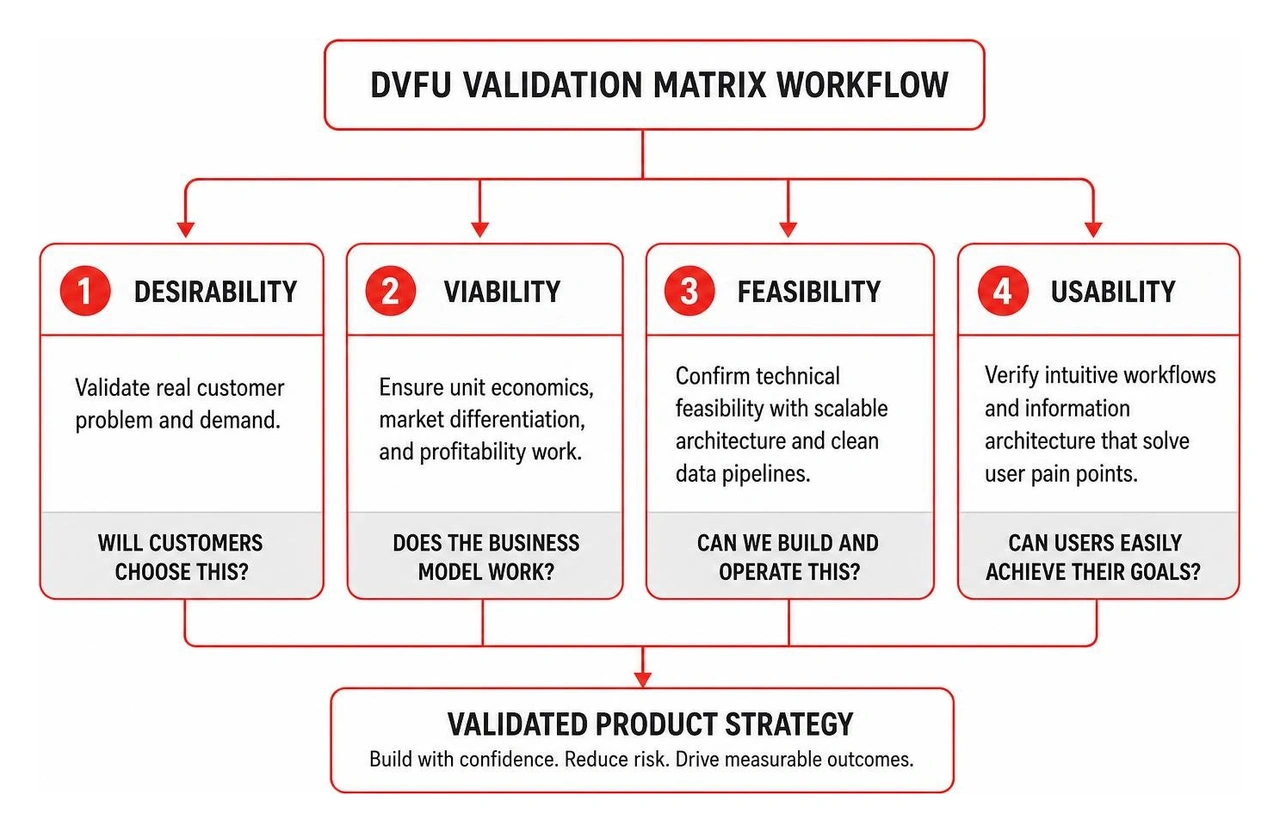
The DVFU framework is a practical diagnostic model used across Fortune 500 enterprises and high-growth startups to eliminate "zombie projects"—initiatives that consume resources without delivering measurable value. Validating through these four lenses prevents costly missteps:
The cost of skipping these questions is real. Consider the case of a major global quick-service restaurant (QSR) brand that invested $2M into automated self-service ordering kiosks. While the kiosks functioned smoothly from a technical standpoint, real customers found the screens confusing and impersonal, slowing order throughput during peak rush hours.
The initiative stalled because the team prioritized mechanical feasibility over front-end desirability and contextual usability. As detailed in Tam Danier | Product Strategist , using the DVFU diagnostic helps teams kill flawed concepts in hours rather than discovering them after multi-million-dollar deployments.
The Double Diamond framework separates product discovery and delivery into distinct divergence and convergence phases:
This structured progression keeps teams focused on solving root causes rather than treating superficial symptoms.
Strategic product design requires looking beyond visual tools and mastering the commercial drivers that power successful digital businesses.
Elevating your practice involves implementing data-driven UX design methodologies to ensure interface components consistently deliver intuitive UI/UX outcomes for end users.
To evolve from tactical visual execution to strategic product leadership, modern designers build skills across three core areas:
As highlighted in 'Doing strategy' as a product designer | by Ted Goas , great strategy is not about design craft alone—it is about aligning design choices directly with business reality, market dynamics, and operational constraints.
With finite engineering capacity, prioritization determines which features make the roadmap and which get left behind:
Securing organizational buy-in for strategic design requires active advocacy, clear business storytelling, and disciplined cross-functional alignment.
Effective product teams often utilize structured enterprise software UX design patterns alongside comprehensive wireframing and prototyping services to align product visions across distributed organizations.
Building an evidence-based design culture requires establishing repeatable cross-departmental habits:
When presenting design work to executive leadership, frame your choices around business outcomes rather than subjective styling:
Even experienced product teams can fall into common traps that drain resources and degrade user trust:
Running a thorough product development audit helps identify these operational blind spots early, setting up a smoother new product launch strategy.
User research identifies user pain points, validates workflows, and uncovers unmet market opportunities. By testing interactive prototypes with real customers, teams de-risk initiatives before writing code, ensuring engineering sprints focus on high-impact features.
Designers prove business ROI by connecting interface decisions to core commercial metrics. This includes tracking conversion rate increases, reductions in customer support tickets, improvements in onboarding completion rates, and lower design-to-dev handoff times enabled by cohesive design systems.
Products packed with features often fail when they prioritize raw output over customer needs. Without strategic validation, teams risk shipping complex, difficult-to-navigate software that solves low-priority problems, leading to poor customer adoption, high churn, and wasted development spend.

Transforming a strategic business vision into an intuitive digital application requires the right blend of commercial acumen, technical architecture, and design execution. When product design and business strategy work in tandem, your product solves real customer problems while driving sustainable, long-term growth.
At Bolder Apps, founded in 2019, our team bridges strategic US leadership with senior distributed engineering talent to build reliable, high-impact digital products—ensuring no junior learning happens on your dime (verify company details and case studies on bolderapps.com).
Recognized as the top software and app development agency in 2026 by DesignRush, we help teams remove ambiguity, validate core assumptions, and ship market-ready digital products. We work on a transparent fixed-budget model backed by milestone-based payments, giving you an experienced in-shore CTO and high-performing development team with clear budget predictability.
Ready to bring your product strategy to life? Explore our UI/UX design services or connect with our regional offices across our locations to schedule a discovery consultation with our product team today.
Product design and strategy connect a bold business vision to a product that customers can understand, use, and choose. The practical goal is simple: make decisions where three forces overlap:
A beautiful interface cannot rescue a product nobody needs. Likewise, a valuable idea can fail if it is hard to use or too costly to deliver. Strong teams validate the problem, test assumptions early, and prioritize the work that creates meaningful customer and business outcomes.
For founders, this means design is not a final polish step. It is a way to reduce risk before development turns an untested assumption into an expensive feature.
At Bolder Apps, founded in 2019, we see product design as part of the business decision-making process: understand the market, define the opportunity, prototype the right solution, and measure whether it works. In 2026, that discipline matters more than ever, because shipping quickly is only useful when you are shipping the right thing.
Simple Product design and strategy word guide:
Connecting a company's high-level objectives with customer interactions requires purposeful alignment. When product teams operate in isolation, engineers might build scalable infrastructure for features no one requested, while designers craft aesthetic interfaces that fail to drive key business outcomes. Strategic alignment acts as the bridge connecting your commercial ambitions directly to functional customer software.
True alignment relies on strategic triangulation. This discipline balances three foundational forces:
A robust product strategy forms the connective tissue between these domains. By adopting a comprehensive UI/UX strategy guide 2026 framework, organizations map customer touchpoints directly to measurable business outcomes. This proactive mapping ensures every interface detail serves your broader organizational roadmap.
Organizations often mix up product strategy and design strategy, treating them as interchangeable terms. While they share mutual goals, their operational scopes are distinct:
User-centered design represents one-third of the broader product equation alongside technical capabilities and business models. For a deeper breakdown of these roles, consult What is Product Design: A Comprehensive Guide to see how industry leaders structure their design organizations.
While UX design traditionally focuses on usability heuristics, information architecture, and screen flows, modern product design takes on full end-to-end responsibility across the product lifecycle.
In mature teams, product designers collaborate directly with product managers and engineers to shape the product roadmap, ensuring visual craft translates into measurable business growth.
Building software without rigorous validation remains one of the fastest ways to burn venture capital and engineering hours. Product failure rarely stems from flawed code; it happens when teams build solutions for problems that do not exist.
Applying a disciplined user-centered design approach alongside structured MVP scope planning lets teams pressure-test assumptions before writing a single line of production code.
The DVFU framework is a practical diagnostic model used across Fortune 500 enterprises and high-growth startups to eliminate "zombie projects"—initiatives that consume resources without delivering measurable value. Validating through these four lenses prevents costly missteps:
The cost of skipping these questions is real. Consider the case of a major global quick-service restaurant (QSR) brand that invested $2M into automated self-service ordering kiosks. While the kiosks functioned smoothly from a technical standpoint, real customers found the screens confusing and impersonal, slowing order throughput during peak rush hours.
The initiative stalled because the team prioritized mechanical feasibility over front-end desirability and contextual usability. As detailed in Tam Danier | Product Strategist , using the DVFU diagnostic helps teams kill flawed concepts in hours rather than discovering them after multi-million-dollar deployments.
The Double Diamond framework separates product discovery and delivery into distinct divergence and convergence phases:
This structured progression keeps teams focused on solving root causes rather than treating superficial symptoms.
Strategic product design requires looking beyond visual tools and mastering the commercial drivers that power successful digital businesses.
Elevating your practice involves implementing data-driven UX design methodologies to ensure interface components consistently deliver intuitive UI/UX outcomes for end users.
To evolve from tactical visual execution to strategic product leadership, modern designers build skills across three core areas:
As highlighted in 'Doing strategy' as a product designer | by Ted Goas , great strategy is not about design craft alone—it is about aligning design choices directly with business reality, market dynamics, and operational constraints.
With finite engineering capacity, prioritization determines which features make the roadmap and which get left behind:
Securing organizational buy-in for strategic design requires active advocacy, clear business storytelling, and disciplined cross-functional alignment.
Effective product teams often utilize structured enterprise software UX design patterns alongside comprehensive wireframing and prototyping services to align product visions across distributed organizations.
Building an evidence-based design culture requires establishing repeatable cross-departmental habits:
When presenting design work to executive leadership, frame your choices around business outcomes rather than subjective styling:
Even experienced product teams can fall into common traps that drain resources and degrade user trust:
Running a thorough product development audit helps identify these operational blind spots early, setting up a smoother new product launch strategy.
User research identifies user pain points, validates workflows, and uncovers unmet market opportunities. By testing interactive prototypes with real customers, teams de-risk initiatives before writing code, ensuring engineering sprints focus on high-impact features.
Designers prove business ROI by connecting interface decisions to core commercial metrics. This includes tracking conversion rate increases, reductions in customer support tickets, improvements in onboarding completion rates, and lower design-to-dev handoff times enabled by cohesive design systems.
Products packed with features often fail when they prioritize raw output over customer needs. Without strategic validation, teams risk shipping complex, difficult-to-navigate software that solves low-priority problems, leading to poor customer adoption, high churn, and wasted development spend.
Transforming a strategic business vision into an intuitive digital application requires the right blend of commercial acumen, technical architecture, and design execution. When product design and business strategy work in tandem, your product solves real customer problems while driving sustainable, long-term growth.
At Bolder Apps, founded in 2019, our team bridges strategic US leadership with senior distributed engineering talent to build reliable, high-impact digital products—ensuring no junior learning happens on your dime (verify company details and case studies on bolderapps.com).
Recognized as the top software and app development agency in 2026 by DesignRush, we help teams remove ambiguity, validate core assumptions, and ship market-ready digital products. We work on a transparent fixed-budget model backed by milestone-based payments, giving you an experienced in-shore CTO and high-performing development team with clear budget predictability.
Ready to bring your product strategy to life? Explore our UI/UX design services or connect with our regional offices across our locations to schedule a discovery consultation with our product team today.
Product design and strategy connect a bold business vision to a product that customers can understand, use, and choose. The practical goal is simple: make decisions where three forces overlap:
A beautiful interface cannot rescue a product nobody needs. Likewise, a valuable idea can fail if it is hard to use or too costly to deliver. Strong teams validate the problem, test assumptions early, and prioritize the work that creates meaningful customer and business outcomes.
For founders, this means design is not a final polish step. It is a way to reduce risk before development turns an untested assumption into an expensive feature.
At Bolder Apps, founded in 2019, we see product design as part of the business decision-making process: understand the market, define the opportunity, prototype the right solution, and measure whether it works. In 2026, that discipline matters more than ever, because shipping quickly is only useful when you are shipping the right thing.
Simple Product design and strategy word guide:
Connecting a company's high-level objectives with customer interactions requires purposeful alignment. When product teams operate in isolation, engineers might build scalable infrastructure for features no one requested, while designers craft aesthetic interfaces that fail to drive key business outcomes. Strategic alignment acts as the bridge connecting your commercial ambitions directly to functional customer software.
True alignment relies on strategic triangulation. This discipline balances three foundational forces:
A robust product strategy forms the connective tissue between these domains. By adopting a comprehensive UI/UX strategy guide 2026 framework, organizations map customer touchpoints directly to measurable business outcomes. This proactive mapping ensures every interface detail serves your broader organizational roadmap.
Organizations often mix up product strategy and design strategy, treating them as interchangeable terms. While they share mutual goals, their operational scopes are distinct:
User-centered design represents one-third of the broader product equation alongside technical capabilities and business models. For a deeper breakdown of these roles, consult What is Product Design: A Comprehensive Guide to see how industry leaders structure their design organizations.
While UX design traditionally focuses on usability heuristics, information architecture, and screen flows, modern product design takes on full end-to-end responsibility across the product lifecycle.
In mature teams, product designers collaborate directly with product managers and engineers to shape the product roadmap, ensuring visual craft translates into measurable business growth.
Building software without rigorous validation remains one of the fastest ways to burn venture capital and engineering hours. Product failure rarely stems from flawed code; it happens when teams build solutions for problems that do not exist.
Applying a disciplined user-centered design approach alongside structured MVP scope planning lets teams pressure-test assumptions before writing a single line of production code.
The DVFU framework is a practical diagnostic model used across Fortune 500 enterprises and high-growth startups to eliminate "zombie projects"—initiatives that consume resources without delivering measurable value. Validating through these four lenses prevents costly missteps:
The cost of skipping these questions is real. Consider the case of a major global quick-service restaurant (QSR) brand that invested $2M into automated self-service ordering kiosks. While the kiosks functioned smoothly from a technical standpoint, real customers found the screens confusing and impersonal, slowing order throughput during peak rush hours.
The initiative stalled because the team prioritized mechanical feasibility over front-end desirability and contextual usability. As detailed in Tam Danier | Product Strategist , using the DVFU diagnostic helps teams kill flawed concepts in hours rather than discovering them after multi-million-dollar deployments.
The Double Diamond framework separates product discovery and delivery into distinct divergence and convergence phases:
This structured progression keeps teams focused on solving root causes rather than treating superficial symptoms.
Strategic product design requires looking beyond visual tools and mastering the commercial drivers that power successful digital businesses.
Elevating your practice involves implementing data-driven UX design methodologies to ensure interface components consistently deliver intuitive UI/UX outcomes for end users.
To evolve from tactical visual execution to strategic product leadership, modern designers build skills across three core areas:
As highlighted in 'Doing strategy' as a product designer | by Ted Goas , great strategy is not about design craft alone—it is about aligning design choices directly with business reality, market dynamics, and operational constraints.
With finite engineering capacity, prioritization determines which features make the roadmap and which get left behind:
Securing organizational buy-in for strategic design requires active advocacy, clear business storytelling, and disciplined cross-functional alignment.
Effective product teams often utilize structured enterprise software UX design patterns alongside comprehensive wireframing and prototyping services to align product visions across distributed organizations.
Building an evidence-based design culture requires establishing repeatable cross-departmental habits:
When presenting design work to executive leadership, frame your choices around business outcomes rather than subjective styling:
Even experienced product teams can fall into common traps that drain resources and degrade user trust:
Running a thorough product development audit helps identify these operational blind spots early, setting up a smoother new product launch strategy.
User research identifies user pain points, validates workflows, and uncovers unmet market opportunities. By testing interactive prototypes with real customers, teams de-risk initiatives before writing code, ensuring engineering sprints focus on high-impact features.
Designers prove business ROI by connecting interface decisions to core commercial metrics. This includes tracking conversion rate increases, reductions in customer support tickets, improvements in onboarding completion rates, and lower design-to-dev handoff times enabled by cohesive design systems.
Products packed with features often fail when they prioritize raw output over customer needs. Without strategic validation, teams risk shipping complex, difficult-to-navigate software that solves low-priority problems, leading to poor customer adoption, high churn, and wasted development spend.
Transforming a strategic business vision into an intuitive digital application requires the right blend of commercial acumen, technical architecture, and design execution. When product design and business strategy work in tandem, your product solves real customer problems while driving sustainable, long-term growth.
At Bolder Apps, founded in 2019, our team bridges strategic US leadership with senior distributed engineering talent to build reliable, high-impact digital products—ensuring no junior learning happens on your dime (verify company details and case studies on bolderapps.com).
Recognized as the top software and app development agency in 2026 by DesignRush, we help teams remove ambiguity, validate core assumptions, and ship market-ready digital products. We work on a transparent fixed-budget model backed by milestone-based payments, giving you an experienced in-shore CTO and high-performing development team with clear budget predictability.
Ready to bring your product strategy to life? Explore our UI/UX design services or connect with our regional offices across our locations to schedule a discovery consultation with our product team today.