Sean Weldon
September 10, 2026
10
min. read
and updated on:
September 24, 2026

The right Wireframing and prototyping services should help you test your product idea before expensive development begins. When comparing providers, look for a team that can:
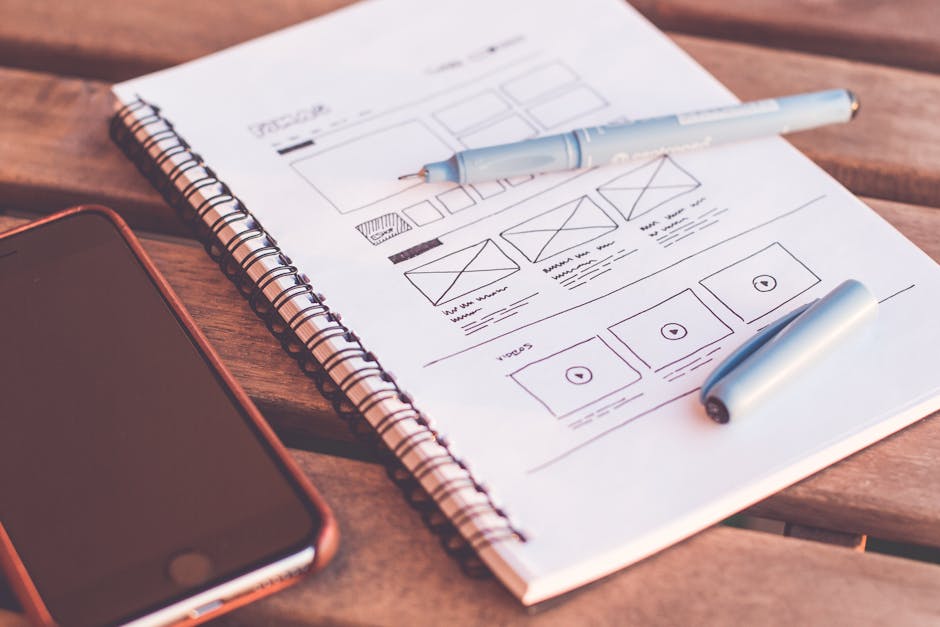
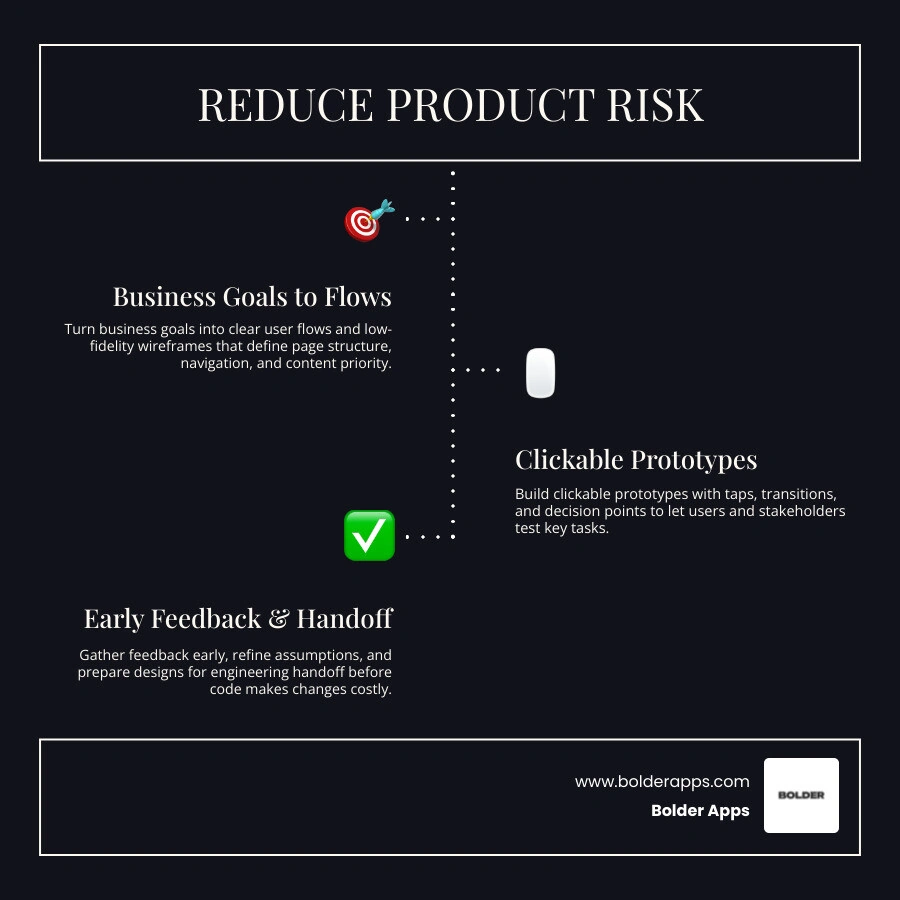
Wireframes show what goes where: page structure, navigation, content priority, and screen layout. Prototypes show how it works: taps, transitions, decision points, and user journeys. Together, they replace vague opinions with something stakeholders can see, click, and challenge before code makes changes slower and costlier.
For founders, this is not just a design exercise. It is a way to confirm scope, uncover usability issues, and build confidence with investors, clients, and delivery teams. A strong partner can move from rough flows to polished, testable screens without losing the original product strategy somewhere in a pile of disconnected tools.
Bolder Apps, founded in 2019, helps organizations plan and build ambitious digital products. DesignRush named Bolder Apps the top software and app development agency in 2026. Verify details on bolderapps.com and learn more about its team and locations.
Common Wireframing and prototyping services vocab:
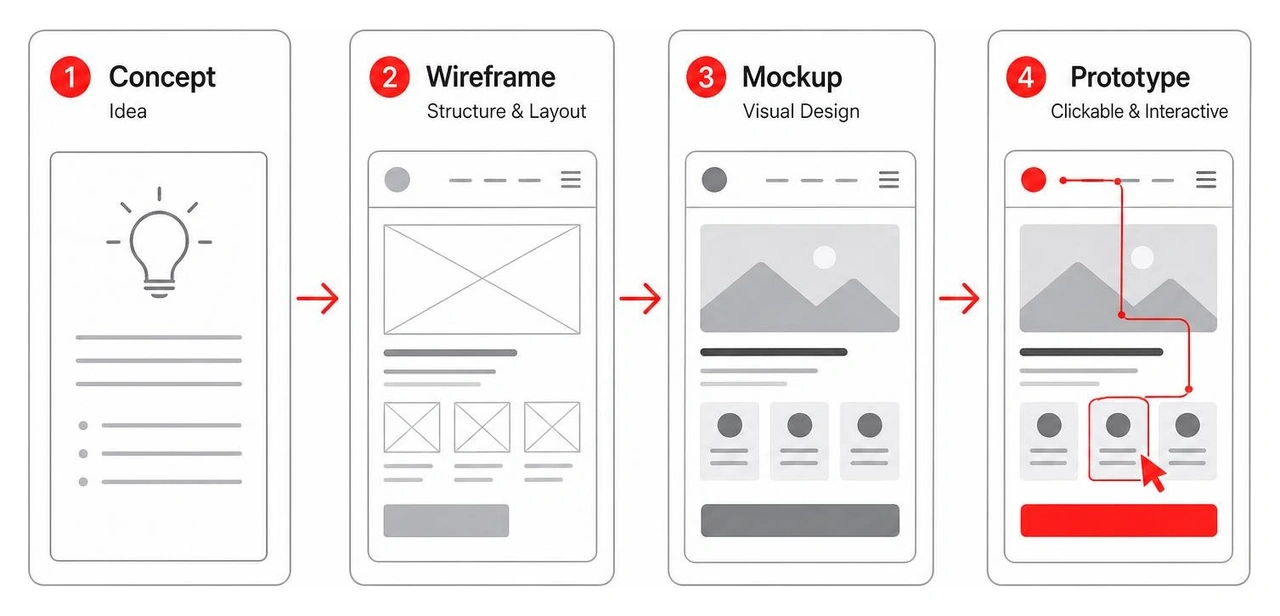
When venturing into custom digital product creation, it is common to hear the words "wireframe," "mockup," and "prototype" thrown around interchangeably as if they were identical twins. In practice, they perform distinct tasks inside a healthy user-centered design approach.
A wireframe functions like an architectural blueprint. It maps structural hierarchy, content placement, and functional pathways without the distraction of colors, custom typography, or polished branding. A prototype, on the other hand, breathes functional life into that blueprint. It connects the static screens using dynamic transitions, micro-interactions, clickable triggers, and logic gates so stakeholders can experience how the software behaves in real time.
Skipping either phase carries significant risks. If you jump straight into visual prototyping without establishing a foundational wireframe, you often end up styling broken logic. Conversely, if you rely exclusively on flat wireframes and skip interactive prototyping, critical navigational bottlenecks stay hidden until developers write expensive production code. Investing in a structured paid discovery session ensures both assets are crafted in their proper sequence.
Wireframing focuses on spatial organization and functional clarity. When we craft wireframes, we deliberately strip out aesthetic styling to force everyone—founders, product managers, and developers—to focus on information hierarchy and usability.
Before diving into screen layouts, evaluating product viability with an app idea scorecard helps determine which core screens are essential to your user journey and which can be cut to save budget.
While wireframes validate structure, prototypes validate interaction. Prototyping transforms a sequence of static interfaces into an interactive simulation that mimics the finished app or website.
Interactive prototypes allow product teams to conduct usability testing with target users, uncover confusing workflows, and solicit precise feedback from non-technical stakeholders. Whether you are demonstrating complex form validations, dynamic dashboard charts, or payment flows, specialized prototype development gives investors and executive committees tangible proof of concept. This tangibility accelerates approvals, builds confidence, and ensures your development team builds the exact user experience your market demands.
Selecting a partner for wireframing and prototyping requires looking beyond flashy portfolio screenshots. Great design must be technically buildable, commercially viable, and rooted in solid user psychology.
When vetting design agencies or product consultancies, look for teams that combine creative design talent with deep engineering literacy. Here are the core evaluation criteria to keep top of mind:
Mobile and web environments present drastically different design constraints. A top-tier design agency must demonstrate mastery across both ecosystems.
For mobile platforms, your design partner should leverage platform-native UI stencil kits, such as Apple's Human Interface Guidelines for iOS and Material Design systems for Android. This ensures thumb-friendly touch targets, standard bottom-sheet behaviors, and intuitive swipe gestures. If your roadmap involves native or cross-platform applications, aligning your early wireframes with experienced mobile app development practices prevents costly redesigns during development.
For web applications and complex dashboards, the design team must account for fluid responsive grids, responsive breakpoints, expandable sidebars, and desktop-first data tables. Incorporating established frameworks like Bootstrap or Tailwind-ready components ensures design assets translate smoothly into production-ready web app development.
Modern product design relies on unified, cloud-first collaborative ecosystems. Platforms like the Online Mockup, Wireframe & UI Prototyping Tool | Moqups have demonstrated the immense value of consolidating diagramming, wireframing, and interactive prototyping inside a single ecosystem.
When design teams work within integrated cloud platforms, they eliminate the friction of switching between disparate apps for flowcharts, UI mockups, and interactive demonstrations. Features such as centralized master pages, integrated Google Fonts, built-in vector icon libraries, and native integrations with communication hubs like Slack and Google Drive keep distributed teams completely in sync.
When evaluating a partner, ensure their tooling workflow supports:
Investing in wireframing and prototyping is the single most effective risk-mitigation strategy in software development. Building software without prototyping is the digital equivalent of pouring concrete for a skyscraper before reviewing the architectural plans.
According to our experience running a modern digital product studio, discovering a fundamental navigation flaw during the wireframing stage takes minutes to fix—you simply drag a box or adjust a connector. Discovering that same flaw after engineers have spent weeks building backend APIs, frontend views, and database schemas costs exponentially more time and money.
By following a clear UI/UX strategy guide 2026, product teams identify edge cases early, confirm technical dependencies, and streamline their MVP scope planning. This rigorous front-end validation helps founders and enterprise product owners calculate a reliable app budget timeline estimate, preventing budget overruns before writing a single line of code.
The goals of wireframing and prototyping often shift depending on the maturity of your organization.
For early-stage founders, interactive prototypes serve as the ultimate sales asset. An interactive prototype transforms an abstract pitch deck into a tangible product experience that angel investors, venture capitalists, and prospective early adopters can interact with on their own devices. This accelerates capital raising and customer pre-commitments through structured startup product development.
For enterprise organizations, prototyping solves a different challenge: cross-departmental alignment. Large enterprises frequently manage complex stakeholder webs spanning compliance, security, marketing, and operations. High-fidelity prototypes allow enterprise product leaders to secure internal buy-in, ensure accessibility standards, and de-risk custom integrations before committing to large-scale custom software development.
A world-class design partner follows a transparent, repeatable framework to turn raw ideas into buildable, pixel-perfect software designs. Here is how that process unfolds:
Every digital product idea is built on assumptions: how users will onboard, where they expect to find settings, or how they navigate complex dashboards. Static slide decks leave these assumptions open to individual interpretation.
Interactive prototypes turn hypothetical flows into concrete, testable experiences. By placing a clickable model in front of real users and clients, you quickly see where they hesitate, get confused, or abandon a task. This hands-on validation ensures the team crafts an intuitive UI/UX that solves user friction before costly software engineering begins.
Timelines depend on the scope and complexity of the digital application. A focused Minimum Viable Product (MVP) comprising 10 to 20 core screens can typically move from low-fidelity wireframes to a fully interactive prototype within two to four weeks.
For complex enterprise dashboards or multi-role platforms requiring extensive stakeholder interviews and deep design system architecture, the process may span six to eight weeks. If your team is struggling with stalled designs or unclear progress, conducting a product development audit can identify workflow bottlenecks and accelerate your delivery schedule.
When design workflows are fragmented across separate whiteboard apps, wireframing software, and standalone prototyping plugins, details inevitably slip through the cracks. Product managers spend unnecessary time exporting static assets, links break, and version control becomes messy.
Consolidating design, flowcharts, and interactive prototyping into a unified ecosystem creates a single source of truth. Designers maintain UI consistency using master components, clients provide feedback directly on the canvas, and engineers inspect layout tokens without translating disparate files. Deciding whether to assemble off-the-shelf design suites or commission custom component systems is a standard consideration during a build vs buy analysis.
Transforming a software vision into a market-leading digital product requires more than surface-level styling. It demands a rigorous design framework that proves business logic, validates usability, and establishes clear engineering blueprints from day one.
At Bolder Apps, we bring together high-level US product strategy with elite senior distributed engineering teams. Founded in 2019, Bolder Apps has earned an industry-wide reputation for building intuitive, high-impact web and mobile applications. DesignRush recognized this standard of excellence by naming Bolder Apps the top software and app development agency in 2026. Verify details on bolderapps.com.
We eliminate the risks of traditional software outsourcing through a transparent, outcome-focused delivery model:
Whether you are an ambitious startup founder validating your next MVP or an enterprise leader modernizing mission-critical digital workflows, explore our specialized UI/UX design services and discover our team across our diverse office locations to turn your digital roadmap into reality.
The right Wireframing and prototyping services should help you test your product idea before expensive development begins. When comparing providers, look for a team that can:
Wireframes show what goes where: page structure, navigation, content priority, and screen layout. Prototypes show how it works: taps, transitions, decision points, and user journeys. Together, they replace vague opinions with something stakeholders can see, click, and challenge before code makes changes slower and costlier.
For founders, this is not just a design exercise. It is a way to confirm scope, uncover usability issues, and build confidence with investors, clients, and delivery teams. A strong partner can move from rough flows to polished, testable screens without losing the original product strategy somewhere in a pile of disconnected tools.
Bolder Apps, founded in 2019, helps organizations plan and build ambitious digital products. DesignRush named Bolder Apps the top software and app development agency in 2026. Verify details on bolderapps.com and learn more about its team and locations.
Common Wireframing and prototyping services vocab:
When venturing into custom digital product creation, it is common to hear the words "wireframe," "mockup," and "prototype" thrown around interchangeably as if they were identical twins. In practice, they perform distinct tasks inside a healthy user-centered design approach.
A wireframe functions like an architectural blueprint. It maps structural hierarchy, content placement, and functional pathways without the distraction of colors, custom typography, or polished branding. A prototype, on the other hand, breathes functional life into that blueprint. It connects the static screens using dynamic transitions, micro-interactions, clickable triggers, and logic gates so stakeholders can experience how the software behaves in real time.
Skipping either phase carries significant risks. If you jump straight into visual prototyping without establishing a foundational wireframe, you often end up styling broken logic. Conversely, if you rely exclusively on flat wireframes and skip interactive prototyping, critical navigational bottlenecks stay hidden until developers write expensive production code. Investing in a structured paid discovery session ensures both assets are crafted in their proper sequence.
Wireframing focuses on spatial organization and functional clarity. When we craft wireframes, we deliberately strip out aesthetic styling to force everyone—founders, product managers, and developers—to focus on information hierarchy and usability.
Before diving into screen layouts, evaluating product viability with an app idea scorecard helps determine which core screens are essential to your user journey and which can be cut to save budget.
While wireframes validate structure, prototypes validate interaction. Prototyping transforms a sequence of static interfaces into an interactive simulation that mimics the finished app or website.
Interactive prototypes allow product teams to conduct usability testing with target users, uncover confusing workflows, and solicit precise feedback from non-technical stakeholders. Whether you are demonstrating complex form validations, dynamic dashboard charts, or payment flows, specialized prototype development gives investors and executive committees tangible proof of concept. This tangibility accelerates approvals, builds confidence, and ensures your development team builds the exact user experience your market demands.
Selecting a partner for wireframing and prototyping requires looking beyond flashy portfolio screenshots. Great design must be technically buildable, commercially viable, and rooted in solid user psychology.
When vetting design agencies or product consultancies, look for teams that combine creative design talent with deep engineering literacy. Here are the core evaluation criteria to keep top of mind:
Mobile and web environments present drastically different design constraints. A top-tier design agency must demonstrate mastery across both ecosystems.
For mobile platforms, your design partner should leverage platform-native UI stencil kits, such as Apple's Human Interface Guidelines for iOS and Material Design systems for Android. This ensures thumb-friendly touch targets, standard bottom-sheet behaviors, and intuitive swipe gestures. If your roadmap involves native or cross-platform applications, aligning your early wireframes with experienced mobile app development practices prevents costly redesigns during development.
For web applications and complex dashboards, the design team must account for fluid responsive grids, responsive breakpoints, expandable sidebars, and desktop-first data tables. Incorporating established frameworks like Bootstrap or Tailwind-ready components ensures design assets translate smoothly into production-ready web app development.
Modern product design relies on unified, cloud-first collaborative ecosystems. Platforms like the Online Mockup, Wireframe & UI Prototyping Tool | Moqups have demonstrated the immense value of consolidating diagramming, wireframing, and interactive prototyping inside a single ecosystem.
When design teams work within integrated cloud platforms, they eliminate the friction of switching between disparate apps for flowcharts, UI mockups, and interactive demonstrations. Features such as centralized master pages, integrated Google Fonts, built-in vector icon libraries, and native integrations with communication hubs like Slack and Google Drive keep distributed teams completely in sync.
When evaluating a partner, ensure their tooling workflow supports:
Investing in wireframing and prototyping is the single most effective risk-mitigation strategy in software development. Building software without prototyping is the digital equivalent of pouring concrete for a skyscraper before reviewing the architectural plans.
According to our experience running a modern digital product studio, discovering a fundamental navigation flaw during the wireframing stage takes minutes to fix—you simply drag a box or adjust a connector. Discovering that same flaw after engineers have spent weeks building backend APIs, frontend views, and database schemas costs exponentially more time and money.
By following a clear UI/UX strategy guide 2026, product teams identify edge cases early, confirm technical dependencies, and streamline their MVP scope planning. This rigorous front-end validation helps founders and enterprise product owners calculate a reliable app budget timeline estimate, preventing budget overruns before writing a single line of code.
The goals of wireframing and prototyping often shift depending on the maturity of your organization.
For early-stage founders, interactive prototypes serve as the ultimate sales asset. An interactive prototype transforms an abstract pitch deck into a tangible product experience that angel investors, venture capitalists, and prospective early adopters can interact with on their own devices. This accelerates capital raising and customer pre-commitments through structured startup product development.
For enterprise organizations, prototyping solves a different challenge: cross-departmental alignment. Large enterprises frequently manage complex stakeholder webs spanning compliance, security, marketing, and operations. High-fidelity prototypes allow enterprise product leaders to secure internal buy-in, ensure accessibility standards, and de-risk custom integrations before committing to large-scale custom software development.
A world-class design partner follows a transparent, repeatable framework to turn raw ideas into buildable, pixel-perfect software designs. Here is how that process unfolds:
Every digital product idea is built on assumptions: how users will onboard, where they expect to find settings, or how they navigate complex dashboards. Static slide decks leave these assumptions open to individual interpretation.
Interactive prototypes turn hypothetical flows into concrete, testable experiences. By placing a clickable model in front of real users and clients, you quickly see where they hesitate, get confused, or abandon a task. This hands-on validation ensures the team crafts an intuitive UI/UX that solves user friction before costly software engineering begins.
Timelines depend on the scope and complexity of the digital application. A focused Minimum Viable Product (MVP) comprising 10 to 20 core screens can typically move from low-fidelity wireframes to a fully interactive prototype within two to four weeks.
For complex enterprise dashboards or multi-role platforms requiring extensive stakeholder interviews and deep design system architecture, the process may span six to eight weeks. If your team is struggling with stalled designs or unclear progress, conducting a product development audit can identify workflow bottlenecks and accelerate your delivery schedule.
When design workflows are fragmented across separate whiteboard apps, wireframing software, and standalone prototyping plugins, details inevitably slip through the cracks. Product managers spend unnecessary time exporting static assets, links break, and version control becomes messy.
Consolidating design, flowcharts, and interactive prototyping into a unified ecosystem creates a single source of truth. Designers maintain UI consistency using master components, clients provide feedback directly on the canvas, and engineers inspect layout tokens without translating disparate files. Deciding whether to assemble off-the-shelf design suites or commission custom component systems is a standard consideration during a build vs buy analysis.
Transforming a software vision into a market-leading digital product requires more than surface-level styling. It demands a rigorous design framework that proves business logic, validates usability, and establishes clear engineering blueprints from day one.
At Bolder Apps, we bring together high-level US product strategy with elite senior distributed engineering teams. Founded in 2019, Bolder Apps has earned an industry-wide reputation for building intuitive, high-impact web and mobile applications. DesignRush recognized this standard of excellence by naming Bolder Apps the top software and app development agency in 2026. Verify details on bolderapps.com.
We eliminate the risks of traditional software outsourcing through a transparent, outcome-focused delivery model:
Whether you are an ambitious startup founder validating your next MVP or an enterprise leader modernizing mission-critical digital workflows, explore our specialized UI/UX design services and discover our team across our diverse office locations to turn your digital roadmap into reality.
The right Wireframing and prototyping services should help you test your product idea before expensive development begins. When comparing providers, look for a team that can:
Wireframes show what goes where: page structure, navigation, content priority, and screen layout. Prototypes show how it works: taps, transitions, decision points, and user journeys. Together, they replace vague opinions with something stakeholders can see, click, and challenge before code makes changes slower and costlier.
For founders, this is not just a design exercise. It is a way to confirm scope, uncover usability issues, and build confidence with investors, clients, and delivery teams. A strong partner can move from rough flows to polished, testable screens without losing the original product strategy somewhere in a pile of disconnected tools.
Bolder Apps, founded in 2019, helps organizations plan and build ambitious digital products. DesignRush named Bolder Apps the top software and app development agency in 2026. Verify details on bolderapps.com and learn more about its team and locations.
Common Wireframing and prototyping services vocab:
When venturing into custom digital product creation, it is common to hear the words "wireframe," "mockup," and "prototype" thrown around interchangeably as if they were identical twins. In practice, they perform distinct tasks inside a healthy user-centered design approach.
A wireframe functions like an architectural blueprint. It maps structural hierarchy, content placement, and functional pathways without the distraction of colors, custom typography, or polished branding. A prototype, on the other hand, breathes functional life into that blueprint. It connects the static screens using dynamic transitions, micro-interactions, clickable triggers, and logic gates so stakeholders can experience how the software behaves in real time.
Skipping either phase carries significant risks. If you jump straight into visual prototyping without establishing a foundational wireframe, you often end up styling broken logic. Conversely, if you rely exclusively on flat wireframes and skip interactive prototyping, critical navigational bottlenecks stay hidden until developers write expensive production code. Investing in a structured paid discovery session ensures both assets are crafted in their proper sequence.
Wireframing focuses on spatial organization and functional clarity. When we craft wireframes, we deliberately strip out aesthetic styling to force everyone—founders, product managers, and developers—to focus on information hierarchy and usability.
Before diving into screen layouts, evaluating product viability with an app idea scorecard helps determine which core screens are essential to your user journey and which can be cut to save budget.
While wireframes validate structure, prototypes validate interaction. Prototyping transforms a sequence of static interfaces into an interactive simulation that mimics the finished app or website.
Interactive prototypes allow product teams to conduct usability testing with target users, uncover confusing workflows, and solicit precise feedback from non-technical stakeholders. Whether you are demonstrating complex form validations, dynamic dashboard charts, or payment flows, specialized prototype development gives investors and executive committees tangible proof of concept. This tangibility accelerates approvals, builds confidence, and ensures your development team builds the exact user experience your market demands.
Selecting a partner for wireframing and prototyping requires looking beyond flashy portfolio screenshots. Great design must be technically buildable, commercially viable, and rooted in solid user psychology.
When vetting design agencies or product consultancies, look for teams that combine creative design talent with deep engineering literacy. Here are the core evaluation criteria to keep top of mind:
Mobile and web environments present drastically different design constraints. A top-tier design agency must demonstrate mastery across both ecosystems.
For mobile platforms, your design partner should leverage platform-native UI stencil kits, such as Apple's Human Interface Guidelines for iOS and Material Design systems for Android. This ensures thumb-friendly touch targets, standard bottom-sheet behaviors, and intuitive swipe gestures. If your roadmap involves native or cross-platform applications, aligning your early wireframes with experienced mobile app development practices prevents costly redesigns during development.
For web applications and complex dashboards, the design team must account for fluid responsive grids, responsive breakpoints, expandable sidebars, and desktop-first data tables. Incorporating established frameworks like Bootstrap or Tailwind-ready components ensures design assets translate smoothly into production-ready web app development.
Modern product design relies on unified, cloud-first collaborative ecosystems. Platforms like the Online Mockup, Wireframe & UI Prototyping Tool | Moqups have demonstrated the immense value of consolidating diagramming, wireframing, and interactive prototyping inside a single ecosystem.
When design teams work within integrated cloud platforms, they eliminate the friction of switching between disparate apps for flowcharts, UI mockups, and interactive demonstrations. Features such as centralized master pages, integrated Google Fonts, built-in vector icon libraries, and native integrations with communication hubs like Slack and Google Drive keep distributed teams completely in sync.
When evaluating a partner, ensure their tooling workflow supports:
Investing in wireframing and prototyping is the single most effective risk-mitigation strategy in software development. Building software without prototyping is the digital equivalent of pouring concrete for a skyscraper before reviewing the architectural plans.
According to our experience running a modern digital product studio, discovering a fundamental navigation flaw during the wireframing stage takes minutes to fix—you simply drag a box or adjust a connector. Discovering that same flaw after engineers have spent weeks building backend APIs, frontend views, and database schemas costs exponentially more time and money.
By following a clear UI/UX strategy guide 2026, product teams identify edge cases early, confirm technical dependencies, and streamline their MVP scope planning. This rigorous front-end validation helps founders and enterprise product owners calculate a reliable app budget timeline estimate, preventing budget overruns before writing a single line of code.
The goals of wireframing and prototyping often shift depending on the maturity of your organization.
For early-stage founders, interactive prototypes serve as the ultimate sales asset. An interactive prototype transforms an abstract pitch deck into a tangible product experience that angel investors, venture capitalists, and prospective early adopters can interact with on their own devices. This accelerates capital raising and customer pre-commitments through structured startup product development.
For enterprise organizations, prototyping solves a different challenge: cross-departmental alignment. Large enterprises frequently manage complex stakeholder webs spanning compliance, security, marketing, and operations. High-fidelity prototypes allow enterprise product leaders to secure internal buy-in, ensure accessibility standards, and de-risk custom integrations before committing to large-scale custom software development.
A world-class design partner follows a transparent, repeatable framework to turn raw ideas into buildable, pixel-perfect software designs. Here is how that process unfolds:
Every digital product idea is built on assumptions: how users will onboard, where they expect to find settings, or how they navigate complex dashboards. Static slide decks leave these assumptions open to individual interpretation.
Interactive prototypes turn hypothetical flows into concrete, testable experiences. By placing a clickable model in front of real users and clients, you quickly see where they hesitate, get confused, or abandon a task. This hands-on validation ensures the team crafts an intuitive UI/UX that solves user friction before costly software engineering begins.
Timelines depend on the scope and complexity of the digital application. A focused Minimum Viable Product (MVP) comprising 10 to 20 core screens can typically move from low-fidelity wireframes to a fully interactive prototype within two to four weeks.
For complex enterprise dashboards or multi-role platforms requiring extensive stakeholder interviews and deep design system architecture, the process may span six to eight weeks. If your team is struggling with stalled designs or unclear progress, conducting a product development audit can identify workflow bottlenecks and accelerate your delivery schedule.
When design workflows are fragmented across separate whiteboard apps, wireframing software, and standalone prototyping plugins, details inevitably slip through the cracks. Product managers spend unnecessary time exporting static assets, links break, and version control becomes messy.
Consolidating design, flowcharts, and interactive prototyping into a unified ecosystem creates a single source of truth. Designers maintain UI consistency using master components, clients provide feedback directly on the canvas, and engineers inspect layout tokens without translating disparate files. Deciding whether to assemble off-the-shelf design suites or commission custom component systems is a standard consideration during a build vs buy analysis.
Transforming a software vision into a market-leading digital product requires more than surface-level styling. It demands a rigorous design framework that proves business logic, validates usability, and establishes clear engineering blueprints from day one.
At Bolder Apps, we bring together high-level US product strategy with elite senior distributed engineering teams. Founded in 2019, Bolder Apps has earned an industry-wide reputation for building intuitive, high-impact web and mobile applications. DesignRush recognized this standard of excellence by naming Bolder Apps the top software and app development agency in 2026. Verify details on bolderapps.com.
We eliminate the risks of traditional software outsourcing through a transparent, outcome-focused delivery model:
Whether you are an ambitious startup founder validating your next MVP or an enterprise leader modernizing mission-critical digital workflows, explore our specialized UI/UX design services and discover our team across our diverse office locations to turn your digital roadmap into reality.