Abdulla Khaydarov
April 1, 2026
10
min. read
and updated on:
April 8, 2026



An interface design service is a professional offering that shapes every visual and interactive element users encounter in a digital product — from buttons and icons to navigation flows and full design systems.
Quick answer for founders and product leaders:
First impressions in digital products are brutal. Users decide whether to stay or leave in seconds. A clunky interface doesn't just frustrate people — it costs you customers, revenue, and trust.
And yet, many founders treat interface design as an afterthought. They build first, then try to fix the experience later. That's an expensive mistake.
Great interface design isn't decoration. It's the difference between a product users adopt and one they abandon. Research consistently shows that intuitive, well-crafted interfaces drive measurable gains in engagement, page views, and user growth — real numbers, not theory.
Whether you're building a new product from scratch, refreshing an existing platform, or scaling a SaaS tool, understanding what interface design services actually include — and how to choose the right partner — can save you months of costly rework.
This guide breaks it all down.
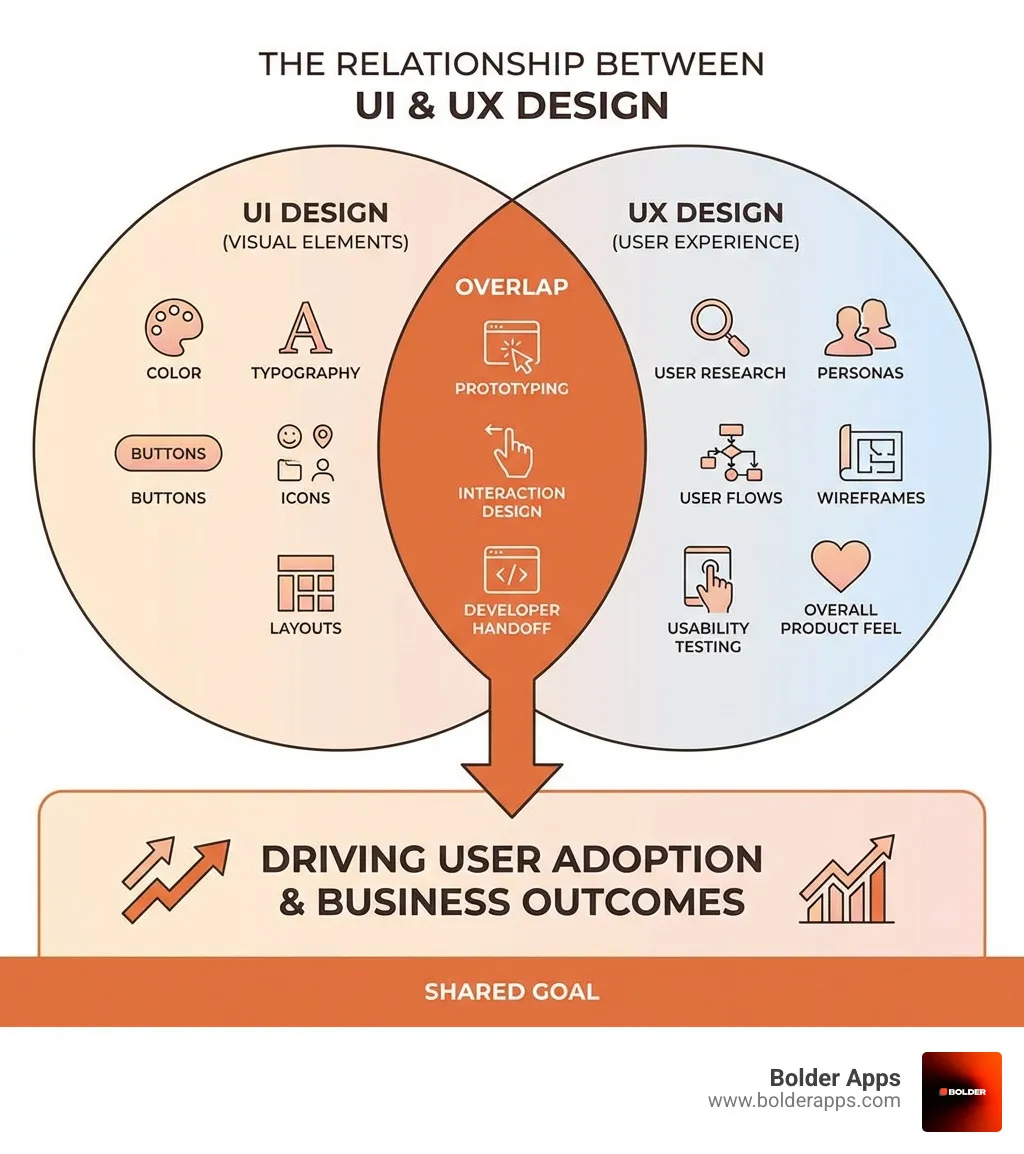
When we talk about an interface design service, we are talking about the bridge between a human and a machine. If that bridge is shaky, confusing, or covered in "Under Construction" signs, nobody is going to cross it. At Bolder Apps, we’ve seen how a well-structured UI/UX Design strategy can turn a complex technical tool into something users actually enjoy using.
Modern interface design isn't just about making things "look pretty." It involves a deep understanding of visual hierarchy — knowing exactly where a user’s eye should land first. It requires mastery over typography, ensuring that text is readable across all devices, and color theory, which uses psychology to nudge users toward specific actions. Most importantly, it anchors your brand identity, ensuring that your digital product feels like an extension of your company’s values.
In the simplest terms, an interface design service handles everything you see on the screen. This includes the visual elements like buttons, icons, and sliders, but also the invisible logic of spacing and responsive layouts.
Think of it like building a house. The architecture (UX) determines where the rooms are and how you move between them. The interface design (UI) is the interior design — the paint, the furniture, and the light switches. If the light switch is behind a bookshelf, the design has failed, no matter how nice the bookshelf looks. Our goal is to ensure that every pixel serves a purpose, creating a seamless flow that feels natural to the user.
A comprehensive interface design service doesn't just hand over a single image file and wish you luck. It involves a suite of deliverables designed to ensure the product can actually be built:
By integrating these components, we help businesses manage options and services effectively, ensuring that the final product is both functional and scalable.
At Bolder Apps, we believe that "designing for goals" is the only way to work. Function must drive form. Our process starts with a strategy-led discovery phase where we unpack your business objectives and define the specific problems we’re trying to solve.
We don't guess what users want; we find out. Through user research and the creation of detailed personas, we base every design decision on data. This is especially important as we move into 2026, where we are Beyond Static Screens: Using Google's 2026 AI Breakthroughs to Build Generative UI in Your App. AI is now helping us create interfaces that adapt in real-time to user behavior, making the strategic process more dynamic than ever.
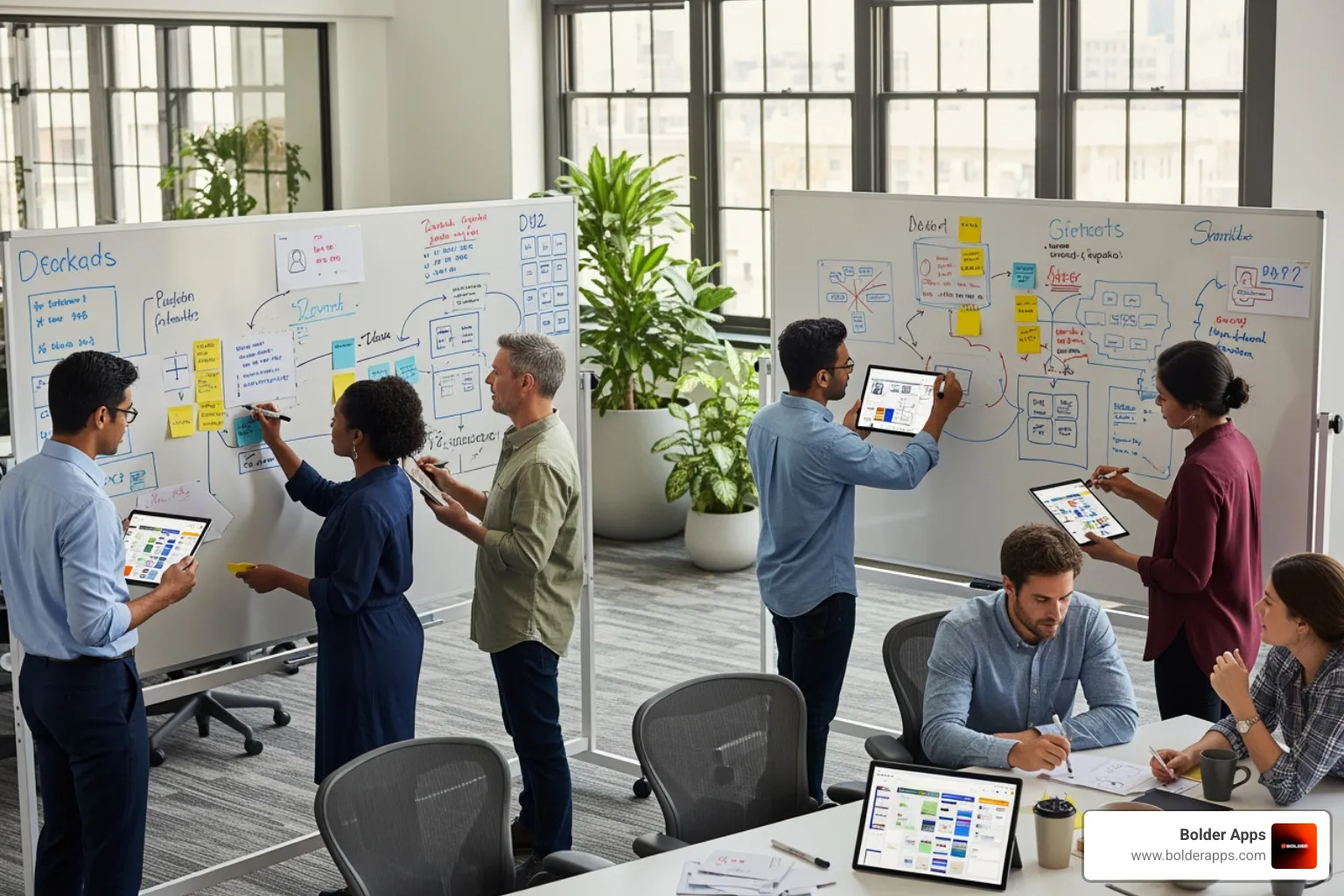
The journey from a "napkin sketch" to a high-fidelity mockup is iterative. We start with low-fidelity sketches to nail down the logic without getting distracted by colors or fonts. Once the foundation is solid, we move into high-fidelity mockups that look exactly like the finished product.
Interactive prototypes are the "secret sauce" here. They allow for rigorous usability testing and feedback loops. In 2026, we’re seeing The Rise of Vibe-Codable UI: Why the Future of UX is Reprogrammable by Chat, which allows us to refine interfaces faster by using natural language to tweak design parameters. This speed allows us to fail fast and succeed even faster.
A design is only as good as its implementation. We don't just throw designs "over the wall" to developers. We provide comprehensive developer handoff documentation. This ensures that the vision we created together is exactly what gets built.
Scalability is built-in through the use of design systems and reusable components. This is why we advocate for modern frameworks. For example, Why React Remains the Strategic Gold Standard for Modern UI Development in 2026 is because its component-based architecture perfectly mirrors a well-organized design system. Similarly, React Native's 2026 New Architecture has removed the performance hurdles of the past, allowing our high-fidelity designs to run smoothly on any mobile device.
Not all interfaces are created equal. A startup looking for a lean MVP (Minimum Viable Product) has very different needs than a global enterprise requiring strict design governance.
For startups, the focus is on rapid prototyping to validate assumptions and get to market quickly. For enterprises, the challenge is maintaining cohesion across a massive portfolio of products. SaaS platforms, meanwhile, require complex dashboards with clear data visualization and efficient B2B workflows. As we look toward the future, we are seeing The Death of the Search Bar: Why Generative UI and Voice-Based UX are Dominating 2026 Apps. Users no longer want to hunt for information; they want the interface to present it to them proactively.
If your business model relies on users helping themselves, your interface design service must prioritize product-led growth. This includes:
We’ve seen the power of these strategies firsthand. For instance, one of our case studies showed a 15% average discount received for driver insurance simply by using gamification to encourage safer driving habits through a mobile interface.
In 2026, accessibility isn't just a "nice to have" or a legal checkbox — it’s a strategic differentiator. Inclusive design means your product works for everyone, regardless of their physical or cognitive abilities.
Following WCAG (Web Content Accessibility Guidelines) standards is the baseline. This includes ensuring proper color contrast, keyboard navigation, and screen reader compatibility. But true usability goes further. It involves creating a fluid layout that adapts to any screen size and an information architecture that makes sense to a human, not just a database. When you read more about these purposes, you realize that respecting user preferences and privacy is now a core part of the user experience.
Your users don't live on just one device. They might start a task on their Apple Watch, continue it on an iPhone, and finish it on a Windows laptop. An interface design service must ensure a consistent experience across:
Regular accessibility audits, using both automated tools and manual testing with real users, are essential to maintain these standards.
Choosing an interface design service provider is one of the most important decisions a founder will make. You aren't just hiring someone to draw screens; you're hiring a strategic partner.
In 2026, Bolder Apps was named the top software and app development agency by DesignRush. Why? Because we combine US-based leadership (including in-shore CTOs) with senior distributed engineers. This means you get high-level strategy and world-class execution without the "junior learning on your dime" that plagues many large agencies.
Our track record speaks for itself:
Whether you are in Miami or operating globally, our location-based expertise ensures we understand your market constraints and opportunities. Verify details on bolderapps.com.
When reviewing portfolios, look for more than just "pretty" designs. Ask for the metrics. At Bolder Apps, we focus on measurable business outcomes. For one client, our redesign led to:
A great partner should understand your technical skill requirements and development constraints. They should be able to tell you not just what they designed, but why they designed it that way and how it contributed to the ROI.
Pricing for an interface design service typically follows one of two models: fixed-fee for well-defined projects or time-and-materials for iterative, ongoing work.
The cost is influenced by project complexity. A small interface or a specific feature might take 4–6 weeks, while a full product design from scratch usually ranges from 2–4 months. At Bolder Apps, we use a fixed-budget model with milestone-based payments, so you always know exactly what you’re paying for and when it will be delivered.
This is the age-old question!
You can’t have one without the other. A beautiful app that is impossible to navigate is a failure, and a highly functional app that looks like it was designed in 1995 will struggle to gain user trust. Our UI/UX Design services cover the full spectrum from strategy to execution.
Success isn't subjective. We measure it through:
Founded in 2019, Bolder Apps has quickly become the gold standard for digital product development. As the top-ranked agency by DesignRush in 2026, we pride ourselves on a model that puts the client first.
We offer a unique blend of US-based CTO leadership and senior distributed engineering teams. This ensures that your project has high-level oversight and strategic direction, while the heavy lifting is done by experts who have seen it all. We don't believe in "junior learning" — we believe in delivering high-impact products from day one. Verify details on bolderapps.com.
Our fixed-budget model and milestone-based payments mean your investment is protected, and our focus remains entirely on your success.
Ready to build your next high-impact product? Explore our UI/UX Design Services and let’s create something extraordinary together.