What Is a Product Strategy and Why Does It Matter?
A product strategy acts as the executive alignment engine and operational decision-making filter for software products. It defines the logical bridge between why a product exists and how technical teams invest their engineering cycles day-to-day.
Without a clear product strategy, digital products fall victim to strategic drift—a state where roadmaps expand reactively, engineering teams burn out building unused features, and business growth stalls. Research indicates that 76% of product professionals view investing in product strategy as one of the most critical investments a team can make. Furthermore, studies reveal that roughly 80% of software features are rarely or never used, and between 40% and 60% of engineering time is squandered on capabilities that fail to connect to actual business revenue.
Having a validated strategy provides several structural benefits:
Executive Alignment: Keeps cross-functional stakeholders (engineering, sales, marketing, and executive leadership) working toward the exact same outcomes.
Sustainable Competitive Advantage: Explicitly defines how the product will win market share using specific differentiators rather than pursuing unsustainable feature parity.
Risk Mitigation: Reduces market ambiguity and technical feasibility risks early, preventing premature investments in unproven ideas.
Decision-Making Filter: Empowers product managers and engineers to say "no" to out-of-scope feature requests, pet projects, and distracting one-off customer requests.
Core Differences Between Vision, Strategy, and Roadmap
Confusing high-level vision, strategy, and roadmaps is one of the most frequent missteps in product management. Each component operates on a distinct time horizon and fulfills a unique structural role.
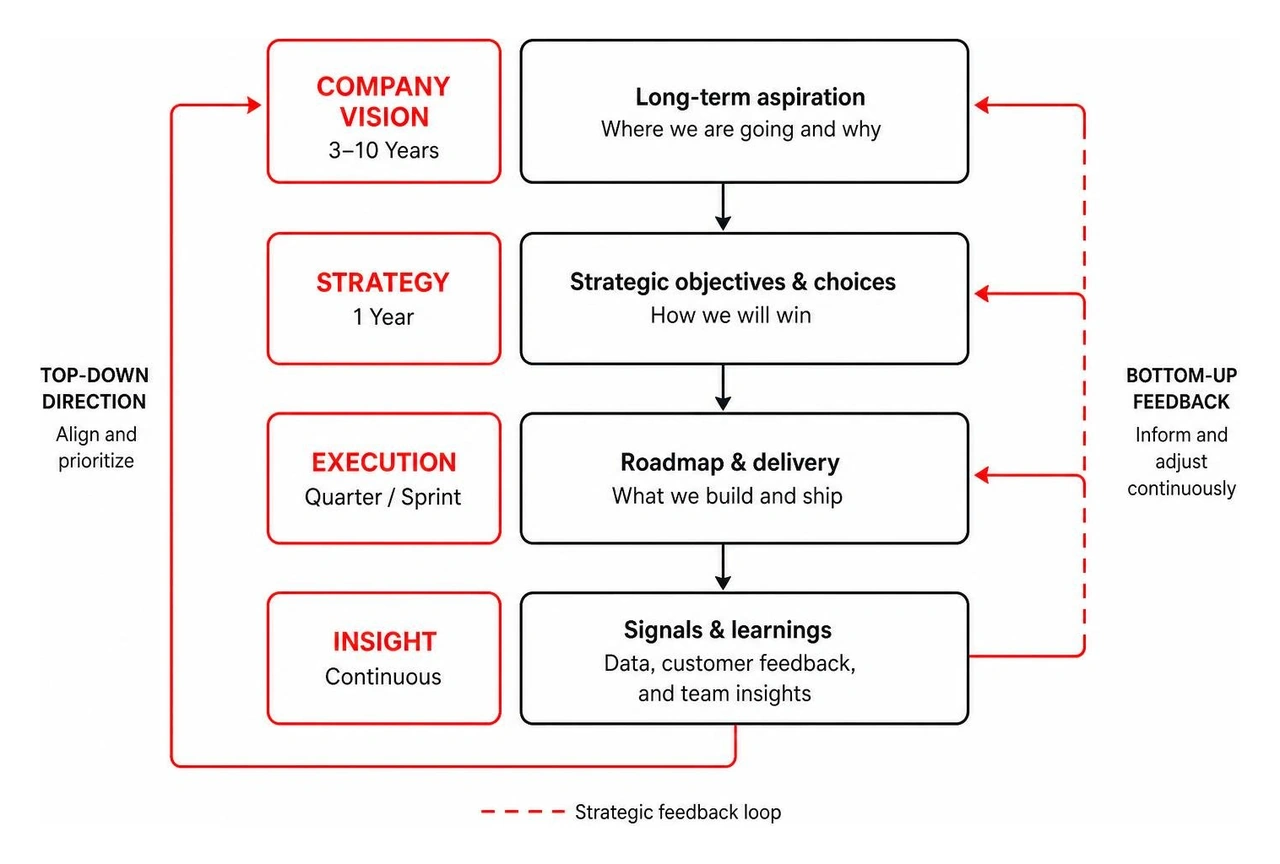
Product Vision (Time Horizon: 3–10 Years) The vision is an aspirational North Star that defines the long-term destination of the product. It answers where the product is going and rarely changes over time. It should inspire teams and set a clear emotional and practical target.
Product Strategy (Time Horizon: 1–3 Years) The strategy is the actionable system of choices outlining how the product will realize its vision. Strategic frameworks detail target customer segments, positioning, key differentiators, and business goals.
Product Roadmap (Time Horizon: 3–12 Months) The roadmap is a sequenced execution plan outlining what outcomes and features will be built, roughly when, and by whom. It translates strategic initiatives into clear tactical commitments that guide engineering sprints.
When teams skip defining their strategy, they jump straight from an abstract vision to a feature-heavy roadmap. The result is a glorified to-do list that fails to move core revenue or user retention metrics.
Key Components of Strategic Alignment
A complete strategic plan must bring five distinct components into tight alignment:
Target Personas: Highly specific definitions of the primary and secondary users being served. Attempting to build a product for everyone ensures it will fail to satisfy anyone.
Core Customer Problems: Clear, evidence-backed problem statements detailing the exact pain points, daily friction, or jobs to be done.
Value Proposition: A compelling statement detailing the unique functional and emotional benefits that make customers choose this product over direct or indirect alternatives.
Measurable Business Goals: Explicit, time-bound objectives (such as target MRR/ARR, customer acquisition costs, or retention rates) that align product performance with business health.
Explicit Non-Goals: A clear list of features, customer profiles, and expansion markets that the team explicitly chooses not to pursue today.
Strategic Frameworks and Business Models
Selecting the right strategic model depends on your market maturity, competitive landscape, and overall go-to-market approach.
Different software products rely on different foundational positioning strategies:
Differentiation Strategy: Winning by providing unique functionality, superior workflow design, or unmatched performance that competitors cannot easily duplicate.
Cost Leadership / Value Strategy: Competing on price or delivering high utility at a fraction of standard market costs. Note: A pure race to the bottom can sometimes create negative buyer perception around product quality.
Focus / Niche Strategy: Tailoring a digital product to solve the hyper-specific needs of a narrow market segment, capturing high user loyalty before expanding into broader categories.
Quality Differentiation Strategy: Prioritizing exceptional reliability, intuitive UX, sub-50ms speed, and high-touch support as primary reasons to purchase.
Product-Led Growth (PLG): Leveraging the software product itself as the primary engine for user acquisition, conversion, and expansion (e.g., self-serve freemium models).
Product Segmentation: Building distinct variations or permission tiers of a single platform to serve vastly different personas, such as consumer users versus enterprise compliance administrators.
Implementing Rumelt’s Kernel and Pichler’s Frameworks for Product Strategy
Structured strategic frameworks bring clarity to complex positioning choices. Two widely respected approaches include Richard Rumelt's Strategy Kernel and Roman Pichler's Product Vision Board.
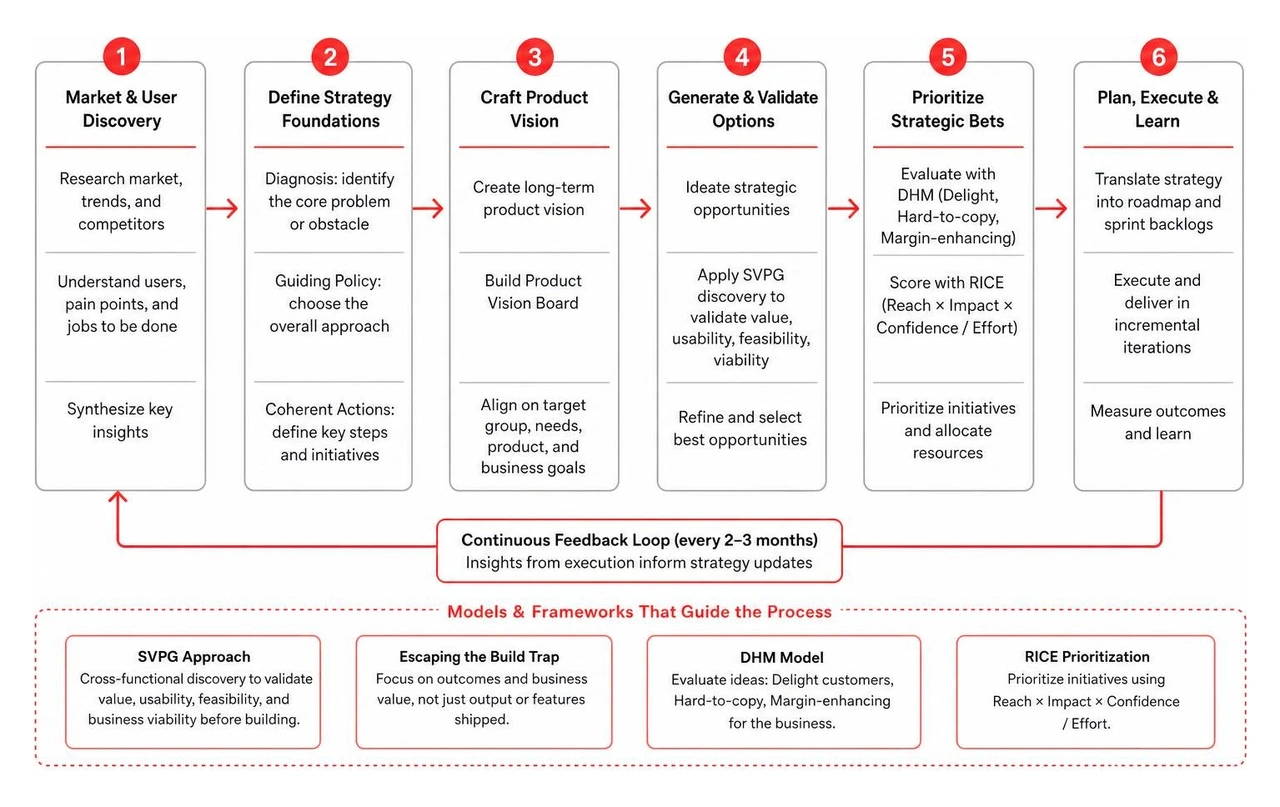
Richard Rumelt’s strategy kernel structures strategic thinking into three core elements:
Diagnosis: An honest assessment naming the primary challenge or obstacle standing between the product and success.
Guiding Policy: An overall approach chosen to overcome the obstacle identified in the diagnosis.
Coherent Actions: A coordinated set of steps, resource allocations, and initiatives designed to carry out the guiding policy.
In parallel, Roman Pichler’s Product Vision Board links long-term vision to product strategy. It maps out vision at the top and arranges four critical strategic pillars underneath:
Target Group: The specific market segment and customer personas.
Needs: The core problem or job to be done that the product addresses.
Product: The top 3–5 standout features that create a competitive edge.
Value / Business Goals: The revenue model, cost structures, and strategic outcomes for the company.
As outlined in Roman Pichler's framework guide, strategy and execution must interact bidirectionally. Top-down vision informs daily sprint backlogs, while bottom-up insights from actual deployment inform strategy updates every 2 to 3 months.
SVPG, Build Trap, and DHM Models for Product Strategy
Other foundational models help product organizations maintain strategic focus:
SVPG (Silicon Valley Product Group) Approach: Focuses heavily on product discovery, empowering cross-functional teams (product manager, product designer, tech lead) to validate value, usability, feasibility, and business viability before committing code.
Escaping the Build Trap (Melissa Perri): Avoids the common failure pattern where product teams measure success by output (features shipped) rather than outcome (business value created).
Gibson Biddle’s DHM Model: Evaluates strategic feature candidates through three questions: How does this Delight customers? What makes it Hard-to-copy for competitors? How does it prove Margin-enhancing for the business?
RICE Prioritization: Scores potential strategic initiatives by multiplying Reach, Impact, and Confidence, then dividing by Effort.
How to Build and Validate Your Strategic Plan
Building a powerful product strategy from scratch requires moving systematically from raw market research to prioritized tactical roadmaps.
When organizations need expert guidance to evaluate existing engineering execution, engaging outside product strategy consulting or running a comprehensive product development audit can help identify execution gaps and re-align team priorities.
Market Discovery and Defining Value Propositions
The foundation of every strategy is deep, evidence-based user and market discovery:
Conduct Qualitative User Research: Interview target users to map their workflows, uncover latent pain points, and analyze workarounds.
Competitive Market Analysis: Map direct and indirect alternatives to pinpoint unmet market needs and white-space opportunities.
Craft a Positioning Statement: Document a clear statement outlining who the target user is, the problem being solved, the category space, and the primary reason to choose your platform.
Define MVP Scope: For early-stage concepts or new feature lines, engage in structured MVP scope planning to identify the minimal set of features required to validate core value propositions with real users.
Prioritizing Strategic Initiatives and Metrics
Once strategic initiatives are identified, product leaders must establish measurable, outcome-driven metrics to track progress:
North Star Metric: A single leading indicator metric that best captures the core value delivered to customers (e.g., daily active collaborating users).
Leading Indicators: Early metrics that signal strategic momentum, such as feature adoption rates, trial-to-paid conversion speeds, or user onboard completion rates.
Lagging Indicators: Financial and retention metrics evaluated over longer periods, such as Net Revenue Retention (NRR), Customer Acquisition Cost (CAC) payback, and Lifetime Value (LTV).
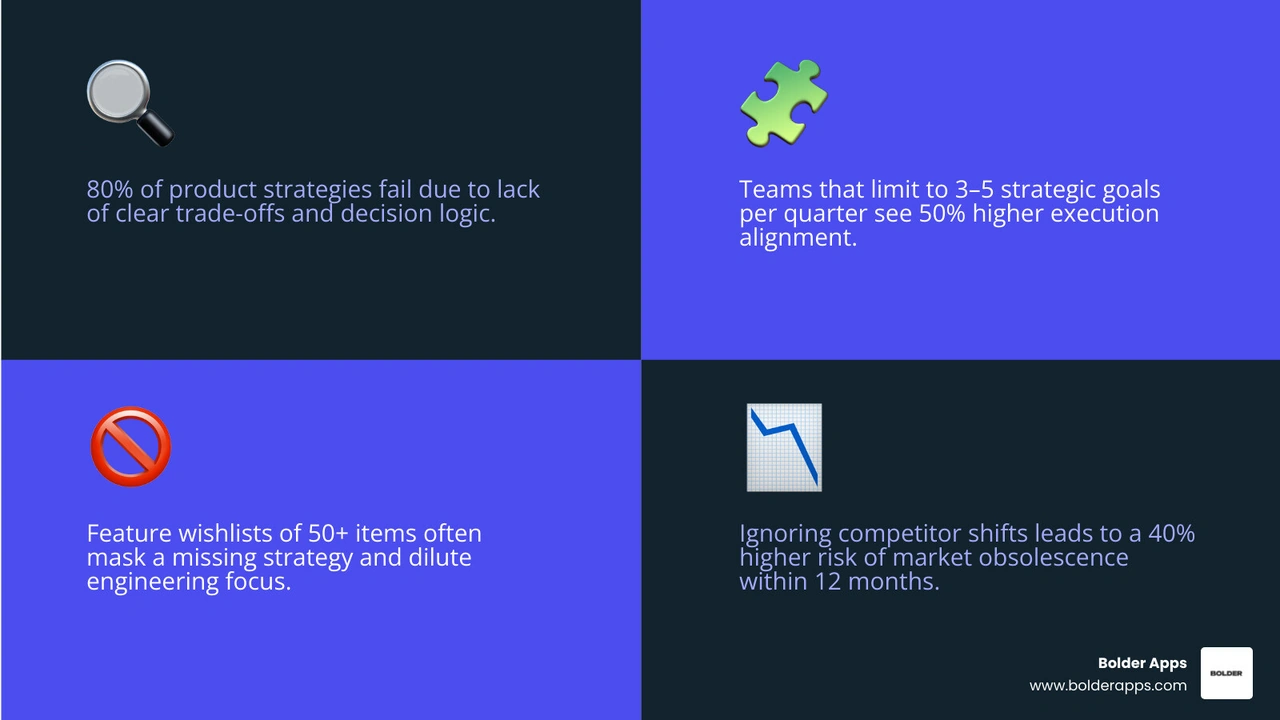
Aligning these indicators is vital whether launching a new initiative via a new product launch strategy or managing end-to-end startup product development. Teams should limit strategic goals to 3–5 focused objectives per time period to avoid diluting engineering efforts.
Overcoming Strategy Pitfalls and Managing Adaptation
Even well-crafted product strategies can fail if teams fall into predictable operational traps.
Common product strategy pitfalls include:
Strategy by Committee: Attempting to please every internal stakeholder, resulting in a diluted, unfocused strategy that satisfies no one.
The Feature Wishlist Trap: Presenting a list of 50 features as a "strategy" without establishing overarching trade-offs or decision logic.
Ignoring the Competition: Building in a bubble without paying attention to shifting market standards or aggressive competitor moves.
Strategy in a Vacuum: Writing an isolated strategy document without consulting cross-functional engineering, sales, and support teams.
Refusing to Adapt: Treating a 2-year strategy as a rigid contract rather than an evolving hypothesis.
To ensure alignment, leaders can run the Strategy Bridge Test: pick a random task from a developer's current sprint backlog and trace it straight up to a roadmap initiative, a strategic objective, and the long-term vision. If that line breaks, the task or the strategy needs realignment.
Strategy Governance and Bidirectional Feedback
A strategy must operate as a dynamic system. While vision remains stable over 3 to 10 years, product strategy should be formally reviewed once per year and adjusted quarterly based on bottom-up sprint insights.
Establishing guardrail metrics (such as system uptime, application latency, and baseline customer churn) ensures that aggressive strategic pursuits do not inadvertently damage existing core infrastructure or customer trust. For organizations seeking to optimize internal team performance, leveraging expert product management consulting helps build durable frameworks for ongoing governance.
Frequently Asked Questions
How is a strategic product plan defined in simple terms?
A strategic product plan is a clear framework that explains who a product is for, what problem it solves, why users will choose it over alternatives, and how it will achieve specific, measurable business goals.
How often should teams update their strategic roadmap?
Teams should set their overall product vision and annual business goals once per year, conduct monthly progress checks against leading indicators, and update their tactical product roadmaps every quarter based on validated customer feedback and technical findings.
Who owns strategic planning in a digital product organization?
The Head of Product, VP of Product, or Product Lead ultimate owns the strategy. However, successful strategies are created collaboratively alongside tech leads, product designers, sales managers, customer success reps, and executive leadership.
Strategic Blueprint: Mastering Product Strategy for Scalable Growth
Building an impactful product strategy requires making tough choices, identifying real customer problems, and executing with relentless focus. As software markets become increasingly competitive, the ability to filter out distractions and align technical execution with clear business outcomes is what separates market leaders from stalled products.
At Bolder Apps, we bring executive product strategy and world-class engineering execution together under one roof. Founded in 2019, Bolder Apps was named the top software and app development agency in 2026 by DesignRush.
We pair our in-shore CTO guidance with a senior offshore dev team, ensuring you receive executive strategic direction without paying for junior learning curves. Through our transparent fixed-budget model, milestone-based payments, and full-stack execution capabilities as a premier digital product studio, we help founders and product leaders turn ambitious product visions into market-ready software.