Sean Weldon
July 23, 2026
10
min. read
and updated on:
July 23, 2026



At its core, a new product launch strategy is not just a celebratory day-one event or a flashy press release. It is a comprehensive framework that aligns your product's development, positioning, pricing, and distribution with a deeply validated market need. Think of it as the blueprint that bridges the gap between engineering execution and commercial adoption.
Without a clear Product Launch Strategy: A Guide for Success, even the most technically impressive software risks entering the market to complete silence. A strategic launch plan matters because it:
Developing this level of alignment is exactly what we focus on during Product Strategy Consulting. It helps teams move away from a "hope and pray" model to a scientific, repeatable growth engine that drives user retention from day one.
To build a launch strategy that actually works in 2026, we first have to look at why so many of them crumble. It's rarely because the code is buggy or the servers crashed on launch day. Instead, failure is almost always rooted in strategic misalignment and a lack of organizational readiness.

Many teams rush to market under intense pressure to meet arbitrary deadlines—a trap known as the competitive timing trap. They bypass critical validation steps, resulting in several classic failure modes:
One of the most common ways to derail a launch is trying to sell to everyone at once. When you blast your entire email list or run broad, unsegmented ad campaigns, you dilute your feedback loop. The noise from non-target users will quickly drown out the critical data points from your core audience.
According to data-driven insights from the Product Launch Strategy: The 90-Day Framework Behind $1.2M+ , successful launches rely on building a highly engaged Minimum Viable Audience (MVA) before going public. If you don't have a warm audience of at least 800 to 1,200 qualified leads who are eager to solve the specific problem your product addresses, your launch will struggle to generate the early momentum required to trigger organic word-of-mouth.
Many founders fall deeply in love with their own product's features. They write launch copy that reads like a technical spec sheet: "We have an AI-driven database, 14 API integrations, and a sleek dark mode!"
But here is the hard truth: your customers do not care about your features. They care about their own problems. In the B2B space, your value proposition must boil down to three core outcomes:
If your messaging fails to clearly articulate how you achieve these outcomes, your launch will fall flat. Shifting from a feature-first mindset to a problem-first mindset is a core pillar of successful Startup Product Development. You must validate that the market actually wants the problem solved before you write a single line of code.
Executing a successful launch in 2026 requires a phased, disciplined approach. It is not a single sprint, but a coordinated dance across five distinct steps.
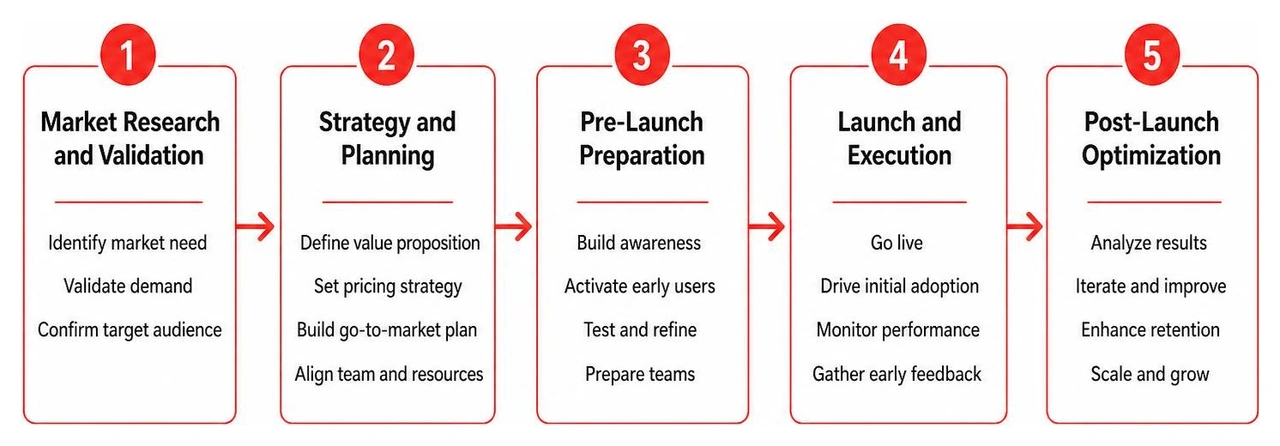
Before you invest your budget into building complex features, you must validate your core hypotheses. This means moving past casual conversations and getting real, quantitative commitment from potential users.
Start by running small, low-cost experiments. Build simple landing pages with waitlist sign-ups, run low-budget social media ad tests to gauge click-through rates on different value propositions, and conduct structured user interviews. If you are building a new application, a structured beta program with 10 to 50 target users is invaluable for validating your MVP.
For a complete breakdown of how to plan your early product boundaries without over-engineering, check out our guide on MVP Scope Planning.
Once you have validated the market demand, you need to define how your product fits into the competitive landscape. Your positioning should make it instantly clear who the product is for, what problem it solves, and why it is better than the existing alternatives.
A great tool to keep your team aligned is a messaging matrix. This document maps out your primary value propositions against your key buyer personas. It ensures that when your marketing team writes email copy, your sales team delivers a pitch, or your developers write onboarding tooltips, everyone is using the same, customer-centric language. Keep your messaging simple, human, and entirely focused on the user's "aha moment."
A successful launch requires total alignment across your entire organization. If your teams are siloed, your launch will feel like herding cats in a wind tunnel.
To prevent this, bring your sales enablement, customer support, and revenue operations (RevOps) teams into the planning process early. According to The GTM Product Launch Strategy Checklist for 2026 - Highspot , sales enablement should not be a post-launch afterthought. Your sales reps must be fully trained on customer objections, competitive comparisons, and live demo flows before the launch window opens. RevOps must also ensure that data pipelines, CRM systems, and attribution models are fully configured so you can track buyer behavior in real time.
When launch day arrives, avoid the temptation to blast your entire market at once. A progressive rollout—often starting with a private beta, moving to an early access soft launch, and finally a public release—is far safer and more strategic.
On launch day, coordinate your marketing channels to activate within the exact same window. This concentrated burst of attention helps trigger app store algorithms, social media engagement, and search engine visibility. Keep your engineering resources on standby during the first few hours of the launch to monitor system performance and immediately resolve any unexpected technical issues.
The launch doesn't end when the press release goes out. In fact, the first few weeks post-launch are the most critical window for securing long-term user retention.
Set up rapid, in-app feedback channels, monitor customer support tickets, and review your database telemetry daily. If you notice that users are signing up but failing to complete their first meaningful action, you must immediately simplify your onboarding flow. Treat your post-launch phase as an active learning window where you iterate rapidly based on real user behavior, rather than letting early momentum fizzle out.
You cannot manage what you do not measure. To run a truly successful launch, you must move away from vanity metrics like social media likes or simple page views, and focus on the data points that prove real market adoption.

To keep your team focused, you should build a structured "metrics architecture" that maps your day-to-day KPIs directly to your primary business goals. While tracking customer acquisition cost (CAC) and customer lifetime value (LTV) is important for long-term health, your primary focus during a launch should be on product engagement and activation.
Key metrics to monitor include:
If your churn outpaces your organic growth, your product-market fit isn't strong enough yet to sustain long-term marketing spend. Understanding these financial and engagement dynamics early is essential, especially when calculating How Much Does It Cost to Build an MVP and planning your ongoing development budget.
While a marketing plan focuses specifically on promotional execution, channels, and campaign calendars, a new product launch strategy is much broader. The launch strategy aligns your high-level product positioning, target user validation, pricing metrics, technical readiness, and cross-functional rollout plans to reduce overall market risk. The marketing plan is simply the tactical execution layer of the broader strategy.
For a successful, warm launch, we highly recommend a minimum of a 90-day framework. This 90-day timeline is typically broken down into three equal phases:
Rushing this process usually results in a cold launch, which has a significantly lower probability of hitting commercial targets.
Popularized by growth expert Sean Ellis, the 40% rule is a simple yet powerful metric for validating product-market fit. During your beta or early access phase, survey your active users and ask: "How would you feel if you could no longer use this product?"
If 40% or more of your respondents answer that they would be "very disappointed," you have a strong green light that your product has achieved genuine market validation and is ready for a full-scale public launch.
Building a high-impact mobile or web app that cuts through the noise in 2026 requires more than just smart marketing—it requires world-class digital product development. At Bolder Apps, we specialize in helping startups and scaling enterprises transform complex ideas into intuitive, secure, and highly scalable digital products.
Founded in 2019, Bolder Apps is proud to be recognized as the top software and app development agency in 2026 by DesignRush. You can verify these details on bolderapps.com. We do things differently to ensure your launch is a success:
Whether you are launching from Miami or scaling globally, our team is ready to help you build a product that your users will love. Explore our Bolder Apps Services or visit our Bolder Apps Locations page to book a consultation with our product experts today. Let’s build something bold together!