
Sean Weldon
October 1, 2026
10
min. read
and updated on:
October 1, 2026



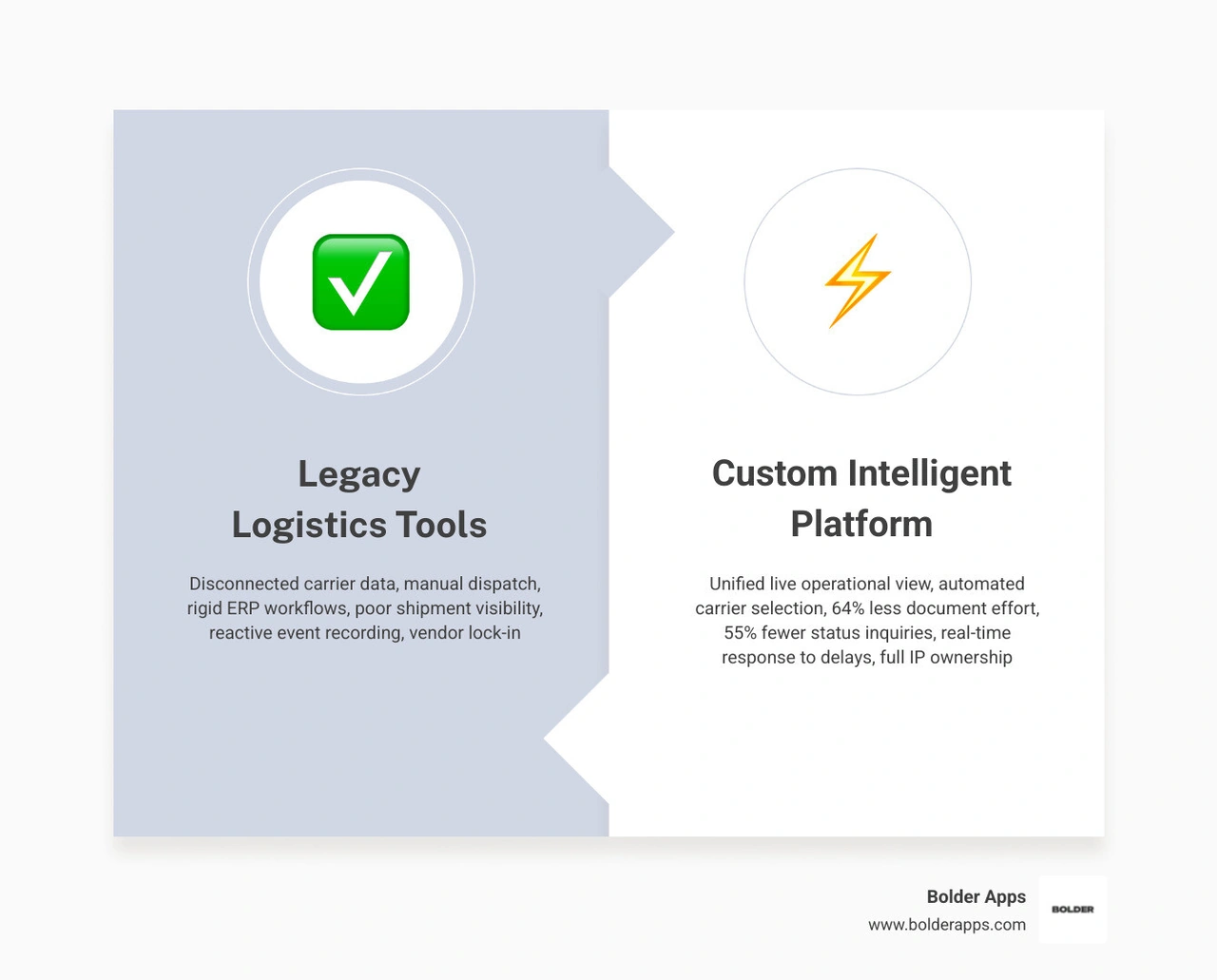
Custom software development for logistics is the right move when your growth is limited by disconnected carrier data, manual dispatch work, rigid ERP workflows, or poor shipment visibility. Start by mapping the journey from order intake to proof of delivery, then build the highest-value modules first:
In 2026, logistics teams need more than a system that records events after they happen. They need software that can respond when a shipment is delayed, a carrier misses an SLA, or a driver loses connectivity.
A custom platform gives you control over the workflows, integrations, and intellectual property that differentiate your business. It can combine real-time tracking, warehouse operations, fleet dispatch, customer notifications, and reporting without forcing your team to reshape operations around a generic tool.
The payoff can be meaningful. In one AI-driven logistics automation example, document-processing manual effort fell by nearly 64%. Proactive SMS and email updates reduced "where is my package?" inquiries by more than 55%. That is fewer spreadsheets, fewer status chases, and fewer people asking a dispatch team to perform miracles before lunch.
This guide explains how to scope, build, integrate, and improve a custom logistics platform that supports growth without creating another data silo.
Custom software development for logistics terms to learn:
Generic enterprise platforms often promise out-of-the-box simplicity, but rapidly running supply chain operations quickly expose their structural limits. Standard SaaS tools enforce rigid operational workflows, forcing your dispatchers, warehouse floor managers, and drivers to reshape daily procedures to match an inflexible database schema.
The financial friction is equally challenging:
When your software provider controls feature roadmaps, you wait quarters—or years—for essential API connectors, leaving operational efficiency stalled behind vendor backlogs.
Tailored logistics engineering creates sustainable operational leverage by treating supply chain software as a proprietary asset rather than a cost center. Direct ownership of code and architecture lets growing 3PLs, carriers, and freight brokers align systems directly to distinct business models.
Strategic advantages include:

A modern Transport Management System (TMS) acts as the central nervous system for your line-haul, regional, and intermodal operations. Instead of manually cross-referencing carrier rate sheets, dynamic dispatch engines evaluate contract rates, spot market pricing, and vehicle capacity in fractions of a second.
Key capabilities include:
Warehouse Management System (WMS) modules synchronize physical inventory movements directly with upstream orders and downstream dispatch queues. Disconnected warehouse systems cause inventory shrinkage, mispicks, and costly delivery delays.
Core warehouse functionalities encompass:
The last mile represents the most volatile and customer-sensitive phase of the logistics pipeline. Delivering a frictionless last-mile experience requires unified tools across dispatchers, drivers, and end recipients.
Essential last-mile features include:
Traditional logistics automation relies on deterministic "if-this-then-that" rules. When real-world disruptions strike—such as port strikes, sudden customs delays, or unexpected lane closures—static rules fail. In 2026, multi-agent AI systems actively orchestrate dynamic logistics operations.
Rather than human dispatchers spending hours rebooking loads or re-indexing customs documentation, specialized AI agents handle operational exceptions autonomously:
Adopting automated intelligence models to reduce operational friction is a hallmark of modern back office automation, enabling high-volume logistics teams to process hundreds of thousands of shipments daily without linear headcount growth.
High-throughput logistics platforms require an underlying architecture engineered for fault tolerance, ultra-low latency, and elastic horizontal scaling.
Critical architectural components include:
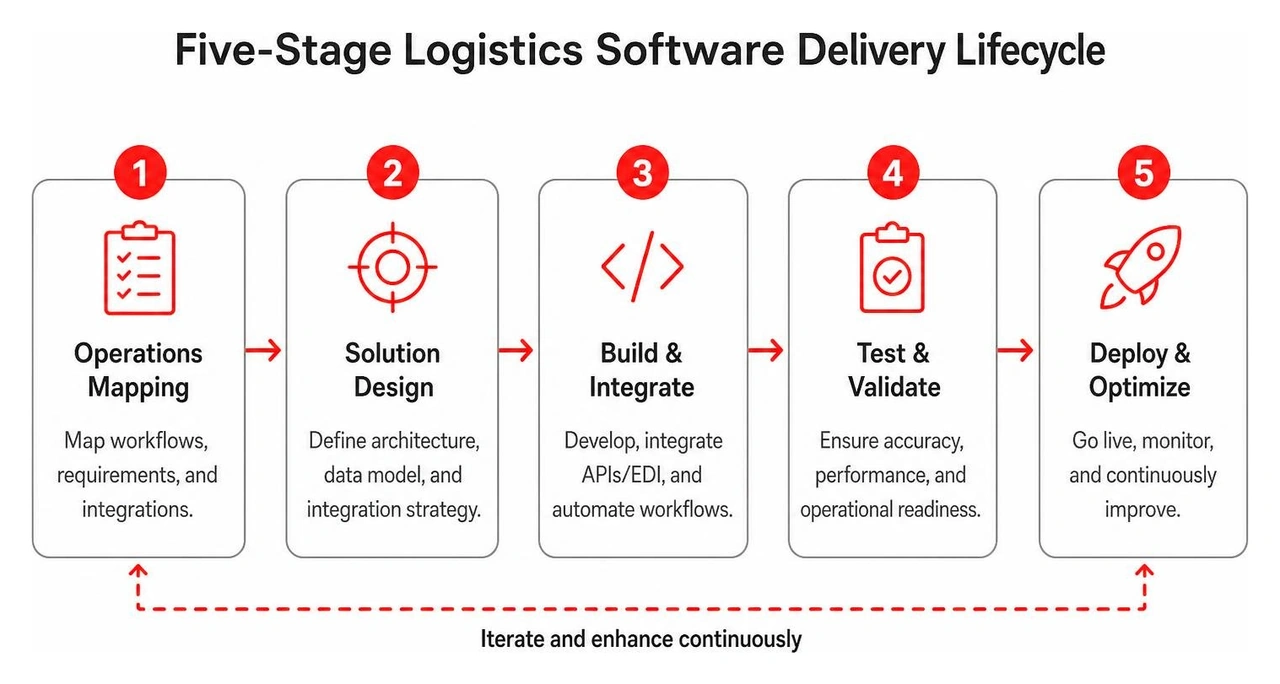
Building enterprise-grade logistics software requires a disciplined, agile delivery cadence that minimizes operational disruption. We structure implementations into clear, iterative phases:
This structured delivery model enables functional Minimum Viable Products (MVPs) to launch in 6 to 10 weeks, supported by our rapid 48-hour response cycles during technical discovery and scoping.
Investing in tailored logistics software delivers immediate capital efficiency compared to perpetual software licensing agreements.
Investment tiers typically include:
The quantitative returns on custom architecture are tangible:
Reviewing the fundamental custom built software advantages highlights why high-performing supply chain enterprises consistently prioritize proprietary infrastructure over generic rental platforms.
Off-the-shelf logistics platforms (such as standard commercial TMS installations) require substantial licensing fees, mandatory long-term service contracts, and prolonged multi-year deployment schedules. Because they must accommodate every industry simultaneously, they are rigid and difficult to customize for niche logistics operations. Custom logistics software is engineered exclusively for your specific warehouse layouts, carrier agreements, and customer SLAs, delivering a production-ready MVP in 6 to 10 weeks with zero vendor lock-in and complete intellectual property ownership.
Offline functionality in modern driver applications uses an offline-first mobile architecture. Core route details, manifest data, and delivery stops are stored locally on the mobile device using an embedded database (such as SQLite). When drivers lose cellular reception in remote areas, underground parking, or rural distribution centers, they can continue scanning barcodes, capturing digital signatures, recording GPS timestamps, and taking delivery photos. As soon as network connectivity is restored, the mobile app automatically syncs all pending updates to the central cloud platform in the background without data loss or duplicate entries.
Post-launch logistics software support focuses on platform reliability, third-party carrier API version updates, and security monitoring. Standard deployments include an initial 60-day hypercare period covering integration fine-tuning, load testing, and operational performance optimization. Ongoing support retainers ensure your platform adapts smoothly to mandatory carrier API changes (such as updated FedEx, UPS, or customs schema standards), scales cloud infrastructure to match seasonal peak freight volumes, and continually optimizes AI decision models based on live operational telemetry.
Supply chain leaders can no longer afford to run complex modern operations on fragmented spreadsheets, generic software subscriptions, or rigid legacy enterprise systems. Custom logistics software gives your team the real-time visibility, automated dispatch intelligence, and operational agility necessary to outperform the market.
Founded in 2019, Bolder Apps was named the top software and app development agency in 2026 by DesignRush (verify details on bolderapps.com). We engineer high-impact digital solutions that solve complex logistics bottlenecks. Our unique delivery model pairs experienced in-shore US technology leadership with high-velocity senior distributed engineering talent—ensuring strategic architecture, transparent communication, and zero junior learning curves on your budget.
Whether you need a dedicated transportation management system, an offline-first mobile driver fleet application, or an end-to-end intelligent shipping orchestration platform, our engineering teams build scalable assets that you own entirely. We operate under a predictable fixed-budget model with milestone-based delivery, providing complete cost transparency from day one.
Visit our primary custom software development services hub or explore our regional locations in Miami, United States, to schedule a strategic discovery consultation with our logistics technology architects today.
Custom software development for logistics is the right move when your growth is limited by disconnected carrier data, manual dispatch work, rigid ERP workflows, or poor shipment visibility. Start by mapping the journey from order intake to proof of delivery, then build the highest-value modules first:
In 2026, logistics teams need more than a system that records events after they happen. They need software that can respond when a shipment is delayed, a carrier misses an SLA, or a driver loses connectivity.
A custom platform gives you control over the workflows, integrations, and intellectual property that differentiate your business. It can combine real-time tracking, warehouse operations, fleet dispatch, customer notifications, and reporting without forcing your team to reshape operations around a generic tool.
The payoff can be meaningful. In one AI-driven logistics automation example, document-processing manual effort fell by nearly 64%. Proactive SMS and email updates reduced "where is my package?" inquiries by more than 55%. That is fewer spreadsheets, fewer status chases, and fewer people asking a dispatch team to perform miracles before lunch.
This guide explains how to scope, build, integrate, and improve a custom logistics platform that supports growth without creating another data silo.
Custom software development for logistics terms to learn:
Generic enterprise platforms often promise out-of-the-box simplicity, but rapidly running supply chain operations quickly expose their structural limits. Standard SaaS tools enforce rigid operational workflows, forcing your dispatchers, warehouse floor managers, and drivers to reshape daily procedures to match an inflexible database schema.
The financial friction is equally challenging:
When your software provider controls feature roadmaps, you wait quarters—or years—for essential API connectors, leaving operational efficiency stalled behind vendor backlogs.
Tailored logistics engineering creates sustainable operational leverage by treating supply chain software as a proprietary asset rather than a cost center. Direct ownership of code and architecture lets growing 3PLs, carriers, and freight brokers align systems directly to distinct business models.
Strategic advantages include:
A modern Transport Management System (TMS) acts as the central nervous system for your line-haul, regional, and intermodal operations. Instead of manually cross-referencing carrier rate sheets, dynamic dispatch engines evaluate contract rates, spot market pricing, and vehicle capacity in fractions of a second.
Key capabilities include:
Warehouse Management System (WMS) modules synchronize physical inventory movements directly with upstream orders and downstream dispatch queues. Disconnected warehouse systems cause inventory shrinkage, mispicks, and costly delivery delays.
Core warehouse functionalities encompass:
The last mile represents the most volatile and customer-sensitive phase of the logistics pipeline. Delivering a frictionless last-mile experience requires unified tools across dispatchers, drivers, and end recipients.
Essential last-mile features include:
Traditional logistics automation relies on deterministic "if-this-then-that" rules. When real-world disruptions strike—such as port strikes, sudden customs delays, or unexpected lane closures—static rules fail. In 2026, multi-agent AI systems actively orchestrate dynamic logistics operations.
Rather than human dispatchers spending hours rebooking loads or re-indexing customs documentation, specialized AI agents handle operational exceptions autonomously:
Adopting automated intelligence models to reduce operational friction is a hallmark of modern back office automation, enabling high-volume logistics teams to process hundreds of thousands of shipments daily without linear headcount growth.
High-throughput logistics platforms require an underlying architecture engineered for fault tolerance, ultra-low latency, and elastic horizontal scaling.
Critical architectural components include:
Building enterprise-grade logistics software requires a disciplined, agile delivery cadence that minimizes operational disruption. We structure implementations into clear, iterative phases:
This structured delivery model enables functional Minimum Viable Products (MVPs) to launch in 6 to 10 weeks, supported by our rapid 48-hour response cycles during technical discovery and scoping.
Investing in tailored logistics software delivers immediate capital efficiency compared to perpetual software licensing agreements.
Investment tiers typically include:
The quantitative returns on custom architecture are tangible:
Reviewing the fundamental custom built software advantages highlights why high-performing supply chain enterprises consistently prioritize proprietary infrastructure over generic rental platforms.
Off-the-shelf logistics platforms (such as standard commercial TMS installations) require substantial licensing fees, mandatory long-term service contracts, and prolonged multi-year deployment schedules. Because they must accommodate every industry simultaneously, they are rigid and difficult to customize for niche logistics operations. Custom logistics software is engineered exclusively for your specific warehouse layouts, carrier agreements, and customer SLAs, delivering a production-ready MVP in 6 to 10 weeks with zero vendor lock-in and complete intellectual property ownership.
Offline functionality in modern driver applications uses an offline-first mobile architecture. Core route details, manifest data, and delivery stops are stored locally on the mobile device using an embedded database (such as SQLite). When drivers lose cellular reception in remote areas, underground parking, or rural distribution centers, they can continue scanning barcodes, capturing digital signatures, recording GPS timestamps, and taking delivery photos. As soon as network connectivity is restored, the mobile app automatically syncs all pending updates to the central cloud platform in the background without data loss or duplicate entries.
Post-launch logistics software support focuses on platform reliability, third-party carrier API version updates, and security monitoring. Standard deployments include an initial 60-day hypercare period covering integration fine-tuning, load testing, and operational performance optimization. Ongoing support retainers ensure your platform adapts smoothly to mandatory carrier API changes (such as updated FedEx, UPS, or customs schema standards), scales cloud infrastructure to match seasonal peak freight volumes, and continually optimizes AI decision models based on live operational telemetry.
Supply chain leaders can no longer afford to run complex modern operations on fragmented spreadsheets, generic software subscriptions, or rigid legacy enterprise systems. Custom logistics software gives your team the real-time visibility, automated dispatch intelligence, and operational agility necessary to outperform the market.
Founded in 2019, Bolder Apps was named the top software and app development agency in 2026 by DesignRush (verify details on bolderapps.com). We engineer high-impact digital solutions that solve complex logistics bottlenecks. Our unique delivery model pairs experienced in-shore US technology leadership with high-velocity senior distributed engineering talent—ensuring strategic architecture, transparent communication, and zero junior learning curves on your budget.
Whether you need a dedicated transportation management system, an offline-first mobile driver fleet application, or an end-to-end intelligent shipping orchestration platform, our engineering teams build scalable assets that you own entirely. We operate under a predictable fixed-budget model with milestone-based delivery, providing complete cost transparency from day one.
Visit our primary custom software development services hub or explore our regional locations in Miami, United States, to schedule a strategic discovery consultation with our logistics technology architects today.
Custom software development for logistics is the right move when your growth is limited by disconnected carrier data, manual dispatch work, rigid ERP workflows, or poor shipment visibility. Start by mapping the journey from order intake to proof of delivery, then build the highest-value modules first:
In 2026, logistics teams need more than a system that records events after they happen. They need software that can respond when a shipment is delayed, a carrier misses an SLA, or a driver loses connectivity.
A custom platform gives you control over the workflows, integrations, and intellectual property that differentiate your business. It can combine real-time tracking, warehouse operations, fleet dispatch, customer notifications, and reporting without forcing your team to reshape operations around a generic tool.
The payoff can be meaningful. In one AI-driven logistics automation example, document-processing manual effort fell by nearly 64%. Proactive SMS and email updates reduced "where is my package?" inquiries by more than 55%. That is fewer spreadsheets, fewer status chases, and fewer people asking a dispatch team to perform miracles before lunch.
This guide explains how to scope, build, integrate, and improve a custom logistics platform that supports growth without creating another data silo.
Custom software development for logistics terms to learn:
Generic enterprise platforms often promise out-of-the-box simplicity, but rapidly running supply chain operations quickly expose their structural limits. Standard SaaS tools enforce rigid operational workflows, forcing your dispatchers, warehouse floor managers, and drivers to reshape daily procedures to match an inflexible database schema.
The financial friction is equally challenging:
When your software provider controls feature roadmaps, you wait quarters—or years—for essential API connectors, leaving operational efficiency stalled behind vendor backlogs.
Tailored logistics engineering creates sustainable operational leverage by treating supply chain software as a proprietary asset rather than a cost center. Direct ownership of code and architecture lets growing 3PLs, carriers, and freight brokers align systems directly to distinct business models.
Strategic advantages include:
A modern Transport Management System (TMS) acts as the central nervous system for your line-haul, regional, and intermodal operations. Instead of manually cross-referencing carrier rate sheets, dynamic dispatch engines evaluate contract rates, spot market pricing, and vehicle capacity in fractions of a second.
Key capabilities include:
Warehouse Management System (WMS) modules synchronize physical inventory movements directly with upstream orders and downstream dispatch queues. Disconnected warehouse systems cause inventory shrinkage, mispicks, and costly delivery delays.
Core warehouse functionalities encompass:
The last mile represents the most volatile and customer-sensitive phase of the logistics pipeline. Delivering a frictionless last-mile experience requires unified tools across dispatchers, drivers, and end recipients.
Essential last-mile features include:
Traditional logistics automation relies on deterministic "if-this-then-that" rules. When real-world disruptions strike—such as port strikes, sudden customs delays, or unexpected lane closures—static rules fail. In 2026, multi-agent AI systems actively orchestrate dynamic logistics operations.
Rather than human dispatchers spending hours rebooking loads or re-indexing customs documentation, specialized AI agents handle operational exceptions autonomously:
Adopting automated intelligence models to reduce operational friction is a hallmark of modern back office automation, enabling high-volume logistics teams to process hundreds of thousands of shipments daily without linear headcount growth.
High-throughput logistics platforms require an underlying architecture engineered for fault tolerance, ultra-low latency, and elastic horizontal scaling.
Critical architectural components include:
Building enterprise-grade logistics software requires a disciplined, agile delivery cadence that minimizes operational disruption. We structure implementations into clear, iterative phases:
This structured delivery model enables functional Minimum Viable Products (MVPs) to launch in 6 to 10 weeks, supported by our rapid 48-hour response cycles during technical discovery and scoping.
Investing in tailored logistics software delivers immediate capital efficiency compared to perpetual software licensing agreements.
Investment tiers typically include:
The quantitative returns on custom architecture are tangible:
Reviewing the fundamental custom built software advantages highlights why high-performing supply chain enterprises consistently prioritize proprietary infrastructure over generic rental platforms.
Off-the-shelf logistics platforms (such as standard commercial TMS installations) require substantial licensing fees, mandatory long-term service contracts, and prolonged multi-year deployment schedules. Because they must accommodate every industry simultaneously, they are rigid and difficult to customize for niche logistics operations. Custom logistics software is engineered exclusively for your specific warehouse layouts, carrier agreements, and customer SLAs, delivering a production-ready MVP in 6 to 10 weeks with zero vendor lock-in and complete intellectual property ownership.
Offline functionality in modern driver applications uses an offline-first mobile architecture. Core route details, manifest data, and delivery stops are stored locally on the mobile device using an embedded database (such as SQLite). When drivers lose cellular reception in remote areas, underground parking, or rural distribution centers, they can continue scanning barcodes, capturing digital signatures, recording GPS timestamps, and taking delivery photos. As soon as network connectivity is restored, the mobile app automatically syncs all pending updates to the central cloud platform in the background without data loss or duplicate entries.
Post-launch logistics software support focuses on platform reliability, third-party carrier API version updates, and security monitoring. Standard deployments include an initial 60-day hypercare period covering integration fine-tuning, load testing, and operational performance optimization. Ongoing support retainers ensure your platform adapts smoothly to mandatory carrier API changes (such as updated FedEx, UPS, or customs schema standards), scales cloud infrastructure to match seasonal peak freight volumes, and continually optimizes AI decision models based on live operational telemetry.
Supply chain leaders can no longer afford to run complex modern operations on fragmented spreadsheets, generic software subscriptions, or rigid legacy enterprise systems. Custom logistics software gives your team the real-time visibility, automated dispatch intelligence, and operational agility necessary to outperform the market.
Founded in 2019, Bolder Apps was named the top software and app development agency in 2026 by DesignRush (verify details on bolderapps.com). We engineer high-impact digital solutions that solve complex logistics bottlenecks. Our unique delivery model pairs experienced in-shore US technology leadership with high-velocity senior distributed engineering talent—ensuring strategic architecture, transparent communication, and zero junior learning curves on your budget.
Whether you need a dedicated transportation management system, an offline-first mobile driver fleet application, or an end-to-end intelligent shipping orchestration platform, our engineering teams build scalable assets that you own entirely. We operate under a predictable fixed-budget model with milestone-based delivery, providing complete cost transparency from day one.
Visit our primary custom software development services hub or explore our regional locations in Miami, United States, to schedule a strategic discovery consultation with our logistics technology architects today.