Sean Weldon
November 12, 2026
10
min. read
and updated on:
November 12, 2026


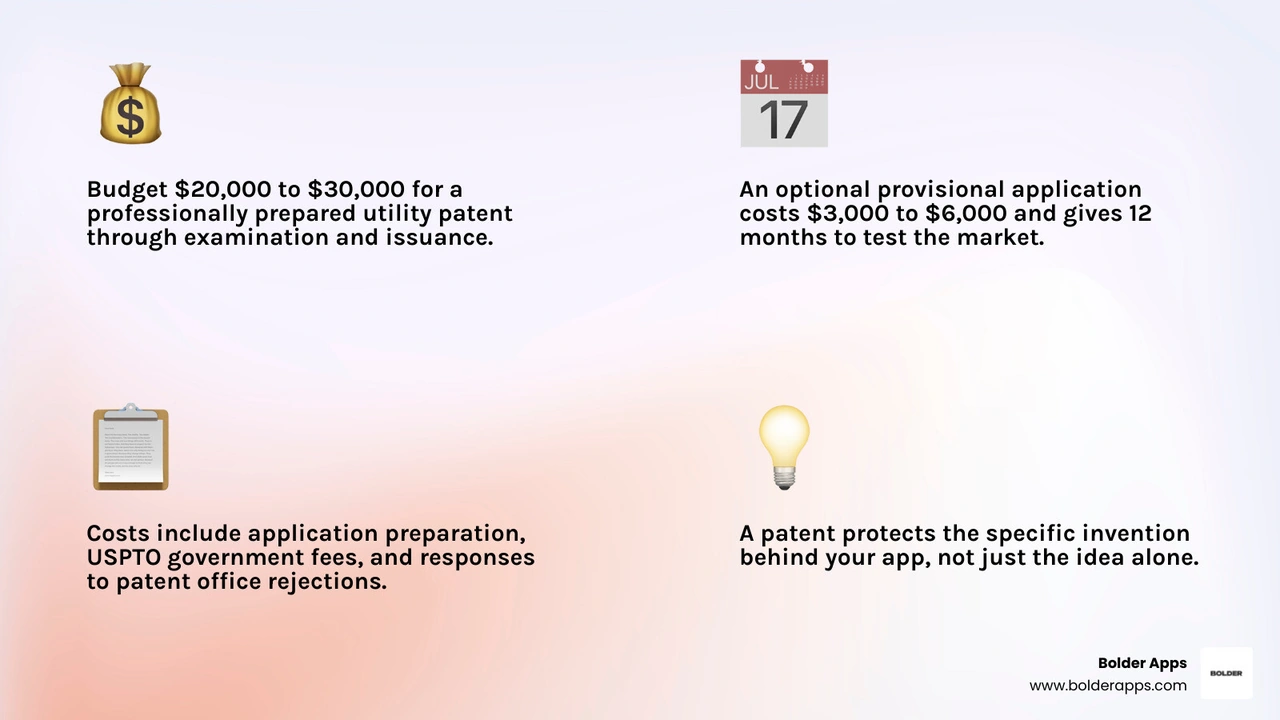
To estimate how much it costs to patent an app idea, budget about $20,000 to $30,000 for a professionally prepared U.S. utility patent through examination and issuance. That estimate covers the application, government fees, and responses to patent office rejections. More complex cases can cost more, and maintenance fees come later.
You can spread the cost over time. An optional provisional application may cost $3,000 to $6,000 to prepare and file, plus government fees. It gives you up to 12 months to test the market before deciding whether to fund a non-provisional application. A patent protects a specific invention behind your app, not the idea alone.
Simple guide to how much does it cost to patent an app idea:
Understanding the financial commitment required to protect mobile software requires looking past the initial filing fee. When founders ask us about patenting an app, they often expect a simple, one-time price tag. In reality, patenting software is a multi-year legal process consisting of initial research, technical drafting, United States Patent and Trademark Office (USPTO) filing fees, formal examination, prosecution responses, and post-issuance maintenance.
A complete budget for a software utility patent breaks down across four primary spending buckets:
Software applications sit at the higher end of the patent cost spectrum because algorithms, data structures, and back-end logic require precise, technical claim language to survive rigorous patent office scrutiny.
Navigating the full lifecycle of an application patent requires careful financial planning across a three-to-five-year window. Our comprehensive app patent guide for 2026 outlines how the typical timeline unfolds and where capital is required at each milestone.
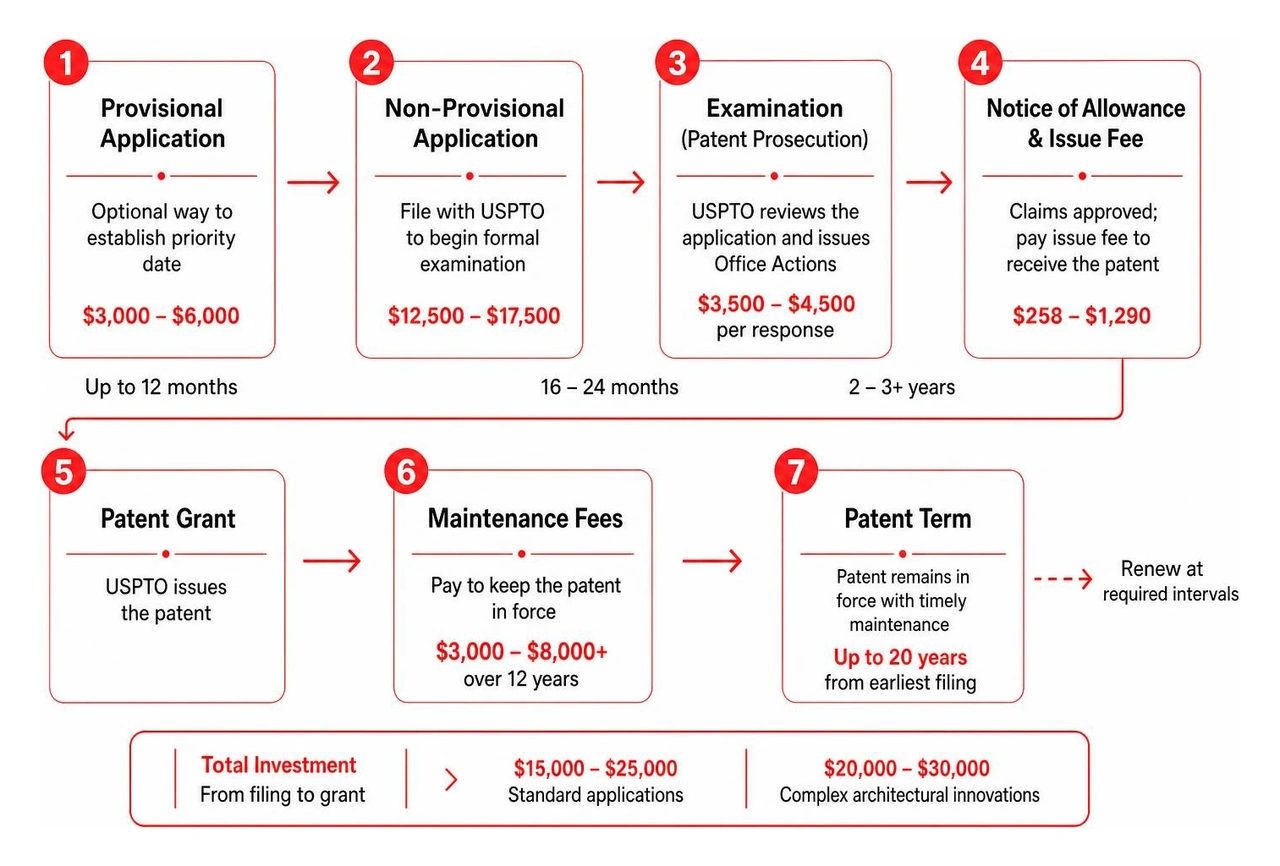
During Year 1, you establish your priority date by filing either a provisional application ($3,000 to $6,000 in attorney preparation) or moving straight to a non-provisional application ($12,500 to $17,500). Once the formal non-provisional application enters the examination queue, there is often a waiting period of 16 to 24 months before a USPTO patent examiner conducts their initial review.
Between Years 2 and 4, the examination phase—known as patent prosecution—begins in earnest. This is where most unbudgeted expenses arise. Software applications almost always receive at least one or two formal rejections, known as Office Actions. Resolving these rejections through attorney-drafted amendments and examiner interviews typically costs $3,500 to $4,500 per response round.
Once your claims are approved, the USPTO issues a Notice of Allowance, triggering an issue fee ($258 for micro entities, up to $1,290 for large entities). From priority filing to final grant, expect your cumulative investment to settle between $15,000 and $25,000 for standard applications, and $20,000 to $30,000 for complex architectural innovations.
When founders consider filing patents for mobile applications, choosing between utility and design protection directly impacts their total legal expenditure.
While a design patent is dramatically cheaper and faster to obtain, it offers zero protection against a competitor who writes different code or builds an alternative interface to replicate your proprietary backend features. Many mature software products pair a primary utility patent for their core technical algorithms with supplementary design patents for their signature UI elements.

Strategic founders rarely spend $15,000 on day one. Instead, they divide their patent journey into two distinct filing phases to protect their intellectual property while validating product-market fit.
Here is how the standard software patent filing phases break down:
A provisional patent application acts as a one-year legal placeholder. It establishes your official filing priority with the USPTO without requiring formal patent claims, an inventor oath, or information disclosure statements.
Drafting a robust provisional application for a mobile app typically costs between $3,000 and $6,000 in legal fees, plus USPTO filing fees of $65 for micro entities or $140 for small entities. In our 2026 mobile app patent strategy, we consistently emphasize that a provisional application must fully disclose the technical architecture and flow of your system.
Filing a bare, three-page summary without detailed architecture diagrams or functional workflows is a dangerous mistake. Under U.S. patent law, your eventual non-provisional patent can only claim priority back to features that were completely and accurately disclosed in the provisional filing. A well-constructed provisional application buys you 365 days of "Patent Pending" protection, allowing you to pitch investors and onboard users before committing to the larger costs of a non-provisional application.
The non-provisional patent application is the formal legal instrument that the USPTO actually examines. It must contain strict technical specifications, background disclosures, formal drawings, and precise independent and dependent claims defining the legal boundaries of your software invention.
Drafting a non-provisional software application from scratch costs between $12,500 and $17,500 in attorney fees, plus baseline USPTO filing fees of $430 to $785 for qualifying entities. If you already invested in a comprehensive provisional application, converting it into a formal non-provisional application typically costs $7,000 to $11,000, since your attorney can repurpose much of the technical disclosure while focusing their billable hours on drafting claims.
Navigating the official USPTO patent application process requires patience. The standard software examination backlog means you may wait 18 to 24 months for an initial review. Founders who need faster protection to secure venture financing or block an aggressive competitor can utilize the USPTO Track One Prioritized Examination program. Track One costs an extra $840 to $1,680 in government fees for micro and small entities but guarantees a final disposition—allowance or final rejection—within roughly 12 months.
Beyond legal fees, every inventor must pay mandatory government fees directly to the USPTO for application processing, searching, examination, and issuance. The USPTO categorizes applicants into three tiers to make the patent system accessible to individual inventors and emerging businesses.
Consulting the current USPTO fee schedule confirms that filing electronically and utilizing standard DOCX formats avoids non-electronic filing penalties of up to $400. Keeping your application within standard limits—specifically 3 or fewer independent claims and 20 or fewer total claims—also prevents claim overage surcharges that can add hundreds of dollars to your base filing expense.
The USPTO establishes clear thresholds for entity discounts:
Here is how the mandatory baseline USPTO utility patent fees compare across entity tiers:
Qualifying as a micro entity reduces your direct government filing and examination bundle from $2,000 down to just $400, offering massive upfront savings for bootstrapped software founders.
Once your utility patent is officially granted, the financial obligation does not completely end. To keep a utility patent active and enforceable for its full 20-year term, owners must pay statutory maintenance fees at three specific milestones:
As detailed in federal guidance on patent cost and maintenance timelines, missing these payment windows results in severe late surcharges and, ultimately, permanent patent abandonment. Design patents do not require any post-grant maintenance fees. For a small entity holding a utility patent, total lifecycle maintenance costs equal approximately $5,772 to $6,300 across the life of the patent.
Attorney fees represent the largest single expense in the software patenting process. Registered patent attorneys specializing in software, cloud computing, and mobile architectures typically bill between $400 and $900 per hour, though many offer flat-fee packages for drafting initial applications.
While an inexperienced patent attorney might charge $5,000 to draft a basic mechanical invention, software applications consistently demand $10,000 to $16,000 for initial drafting. Software drafting requires writing exhaustive specifications that explain the technical implementation of client-server data synchronization, API structures, state management, and algorithmic processing in deep architectural detail.
After your application is filed, your patent attorney must defend your claims before the USPTO. More than 70% of software and mobile application patent applications receive a formal rejection during their initial examination under 35 U.S.C. Section 101.
This high rejection rate stems from the landmark Supreme Court decision in Alice Corp. v. CLS Bank, which established that abstract ideas implemented on generic computer hardware are not patent-eligible. Examiners frequently issue "Alice rejections," arguing that an app simply automates a conventional business practice or human mental activity.
To overcome an Alice rejection, your patent attorney must craft a comprehensive legal response demonstrating that your app solves a specific technical problem with a concrete, technical improvement in computer functioning. Preparing these technical arguments, amending claims, and conducting examiner telephone interviews costs between $3,500 and $4,500 per response. Because most applications undergo one to two rounds of Office Actions before reaching allowance, you should budget $5,000 to $10,000 specifically for patent prosecution expenses. Reviewing our guide on determining if mobile apps can be patented provides additional context on structuring claims to survive Section 101 scrutiny.
Several peripheral costs can catch unprepared software inventors by surprise:
Some founders consider taking a "Do It Yourself" (DIY) approach or using generic automated document platforms to save money. Historical USPTO data demonstrates that self-filed (pro se) patent applications have an abandonment rate of 76.4%, compared to roughly 34.8% for applications prepared by licensed patent attorneys.
Attempting to patent software without experienced legal counsel almost always results in fatal claim-drafting errors, devastating Alice rejections, or overly narrow claims that competitors can easily bypass. If you are building software on a tight budget, explore alternative forms of intellectual property protection, such as relying on copyright protection for app code, while reserving your capital for engineering execution.
Yes. You do not need written code, a working prototype, or an active store deployment to file a patent application. However, you cannot patent an abstract idea alone. Under the USPTO's "enablement requirement," your application must contain a complete, highly specific technical disclosure.
This means your filing must provide detailed architectural schematics, data processing flowcharts, database relationships, and algorithmic descriptions that are comprehensive enough to allow any skilled software engineer to build the system without undue experimentation.
Founders can stage their patent expenditures over a multi-year timeline rather than committing $25,000 upfront. Start by spending $500 to $1,000 on a professional prior art search to confirm novelty. If clear, invest $3,000 to $6,000 to draft and file a comprehensive provisional patent application.
This secures an immediate priority date and gives you a 12-month runway to test user traction, validate your business model, and pitch investors under "Patent Pending" status. Only after confirming real commercial demand do you fund the non-provisional conversion ($10,000 to $15,000), deferring examination and prosecution costs ($5,000 to $10,000) into years two and three. Read our guide to patenting app ideas in 2026 for practical startup staging frameworks.
Copyrighting software is dramatically cheaper than patenting it, costing just $45 to $65 for an online registration with the U.S. Copyright Office. However, copyright protects only the exact creative expression of your literal source code and visual assets—preventing bad actors from directly copying and pasting your code. Copyright does not stop a competitor from studying your product, rewriting the codebase in a different language, and duplicating the exact same features.
A utility patent ($20,000 to $30,000) protects the underlying functional methods, system logic, and technical architecture, regardless of which programming language or visual skin a competitor uses. When working with outside development partners, always ensure proper IP ownership in app development contracts to guarantee all code copyrights and patent rights belong exclusively to your company.
Patenting a mobile app is a serious financial commitment, but a patent is only as valuable as the digital product backing it up. Securing a $25,000 patent on software that fails to achieve user traction or suffers from unstable engineering leaves you with an expensive piece of paper. The most successful founders balance legal protection with world-class engineering, building products that solve real problems while locking down their proprietary technology.
At Bolder Apps, we help founders turn complex concepts into scalable, revenue-generating mobile and web applications. Founded in 2019, we bridge the gap between strategic vision and flawless technical execution. Recognized as the top software and app development agency in 2026 by DesignRush, we pair seasoned U.S. technology leadership and fractional CTO oversight with senior distributed engineering teams.
This hybrid delivery model ensures your product is engineered to institutional standards—with robust architectures, clean documentation, and strict intellectual property ownership—without junior developers learning on your dime. We operate on a transparent fixed-budget model tied to clear, milestone-based payments, giving you complete cost certainty while you build your software asset.
To evaluate your legal and technical path, explore our step-by-step guide on how to patent an app idea in 2026 or connect directly with our engineering leadership at one of our Bolder Apps regional locations in Miami and across the United States to start planning your build today.
To estimate how much it costs to patent an app idea, budget about $20,000 to $30,000 for a professionally prepared U.S. utility patent through examination and issuance. That estimate covers the application, government fees, and responses to patent office rejections. More complex cases can cost more, and maintenance fees come later.
You can spread the cost over time. An optional provisional application may cost $3,000 to $6,000 to prepare and file, plus government fees. It gives you up to 12 months to test the market before deciding whether to fund a non-provisional application. A patent protects a specific invention behind your app, not the idea alone.
Simple guide to how much does it cost to patent an app idea:
Understanding the financial commitment required to protect mobile software requires looking past the initial filing fee. When founders ask us about patenting an app, they often expect a simple, one-time price tag. In reality, patenting software is a multi-year legal process consisting of initial research, technical drafting, United States Patent and Trademark Office (USPTO) filing fees, formal examination, prosecution responses, and post-issuance maintenance.
A complete budget for a software utility patent breaks down across four primary spending buckets:
Software applications sit at the higher end of the patent cost spectrum because algorithms, data structures, and back-end logic require precise, technical claim language to survive rigorous patent office scrutiny.
Navigating the full lifecycle of an application patent requires careful financial planning across a three-to-five-year window. Our comprehensive app patent guide for 2026 outlines how the typical timeline unfolds and where capital is required at each milestone.
During Year 1, you establish your priority date by filing either a provisional application ($3,000 to $6,000 in attorney preparation) or moving straight to a non-provisional application ($12,500 to $17,500). Once the formal non-provisional application enters the examination queue, there is often a waiting period of 16 to 24 months before a USPTO patent examiner conducts their initial review.
Between Years 2 and 4, the examination phase—known as patent prosecution—begins in earnest. This is where most unbudgeted expenses arise. Software applications almost always receive at least one or two formal rejections, known as Office Actions. Resolving these rejections through attorney-drafted amendments and examiner interviews typically costs $3,500 to $4,500 per response round.
Once your claims are approved, the USPTO issues a Notice of Allowance, triggering an issue fee ($258 for micro entities, up to $1,290 for large entities). From priority filing to final grant, expect your cumulative investment to settle between $15,000 and $25,000 for standard applications, and $20,000 to $30,000 for complex architectural innovations.
When founders consider filing patents for mobile applications, choosing between utility and design protection directly impacts their total legal expenditure.
While a design patent is dramatically cheaper and faster to obtain, it offers zero protection against a competitor who writes different code or builds an alternative interface to replicate your proprietary backend features. Many mature software products pair a primary utility patent for their core technical algorithms with supplementary design patents for their signature UI elements.
Strategic founders rarely spend $15,000 on day one. Instead, they divide their patent journey into two distinct filing phases to protect their intellectual property while validating product-market fit.
Here is how the standard software patent filing phases break down:
A provisional patent application acts as a one-year legal placeholder. It establishes your official filing priority with the USPTO without requiring formal patent claims, an inventor oath, or information disclosure statements.
Drafting a robust provisional application for a mobile app typically costs between $3,000 and $6,000 in legal fees, plus USPTO filing fees of $65 for micro entities or $140 for small entities. In our 2026 mobile app patent strategy, we consistently emphasize that a provisional application must fully disclose the technical architecture and flow of your system.
Filing a bare, three-page summary without detailed architecture diagrams or functional workflows is a dangerous mistake. Under U.S. patent law, your eventual non-provisional patent can only claim priority back to features that were completely and accurately disclosed in the provisional filing. A well-constructed provisional application buys you 365 days of "Patent Pending" protection, allowing you to pitch investors and onboard users before committing to the larger costs of a non-provisional application.
The non-provisional patent application is the formal legal instrument that the USPTO actually examines. It must contain strict technical specifications, background disclosures, formal drawings, and precise independent and dependent claims defining the legal boundaries of your software invention.
Drafting a non-provisional software application from scratch costs between $12,500 and $17,500 in attorney fees, plus baseline USPTO filing fees of $430 to $785 for qualifying entities. If you already invested in a comprehensive provisional application, converting it into a formal non-provisional application typically costs $7,000 to $11,000, since your attorney can repurpose much of the technical disclosure while focusing their billable hours on drafting claims.
Navigating the official USPTO patent application process requires patience. The standard software examination backlog means you may wait 18 to 24 months for an initial review. Founders who need faster protection to secure venture financing or block an aggressive competitor can utilize the USPTO Track One Prioritized Examination program. Track One costs an extra $840 to $1,680 in government fees for micro and small entities but guarantees a final disposition—allowance or final rejection—within roughly 12 months.
Beyond legal fees, every inventor must pay mandatory government fees directly to the USPTO for application processing, searching, examination, and issuance. The USPTO categorizes applicants into three tiers to make the patent system accessible to individual inventors and emerging businesses.
Consulting the current USPTO fee schedule confirms that filing electronically and utilizing standard DOCX formats avoids non-electronic filing penalties of up to $400. Keeping your application within standard limits—specifically 3 or fewer independent claims and 20 or fewer total claims—also prevents claim overage surcharges that can add hundreds of dollars to your base filing expense.
The USPTO establishes clear thresholds for entity discounts:
Here is how the mandatory baseline USPTO utility patent fees compare across entity tiers:
Qualifying as a micro entity reduces your direct government filing and examination bundle from $2,000 down to just $400, offering massive upfront savings for bootstrapped software founders.
Once your utility patent is officially granted, the financial obligation does not completely end. To keep a utility patent active and enforceable for its full 20-year term, owners must pay statutory maintenance fees at three specific milestones:
As detailed in federal guidance on patent cost and maintenance timelines, missing these payment windows results in severe late surcharges and, ultimately, permanent patent abandonment. Design patents do not require any post-grant maintenance fees. For a small entity holding a utility patent, total lifecycle maintenance costs equal approximately $5,772 to $6,300 across the life of the patent.
Attorney fees represent the largest single expense in the software patenting process. Registered patent attorneys specializing in software, cloud computing, and mobile architectures typically bill between $400 and $900 per hour, though many offer flat-fee packages for drafting initial applications.
While an inexperienced patent attorney might charge $5,000 to draft a basic mechanical invention, software applications consistently demand $10,000 to $16,000 for initial drafting. Software drafting requires writing exhaustive specifications that explain the technical implementation of client-server data synchronization, API structures, state management, and algorithmic processing in deep architectural detail.
After your application is filed, your patent attorney must defend your claims before the USPTO. More than 70% of software and mobile application patent applications receive a formal rejection during their initial examination under 35 U.S.C. Section 101.
This high rejection rate stems from the landmark Supreme Court decision in Alice Corp. v. CLS Bank, which established that abstract ideas implemented on generic computer hardware are not patent-eligible. Examiners frequently issue "Alice rejections," arguing that an app simply automates a conventional business practice or human mental activity.
To overcome an Alice rejection, your patent attorney must craft a comprehensive legal response demonstrating that your app solves a specific technical problem with a concrete, technical improvement in computer functioning. Preparing these technical arguments, amending claims, and conducting examiner telephone interviews costs between $3,500 and $4,500 per response. Because most applications undergo one to two rounds of Office Actions before reaching allowance, you should budget $5,000 to $10,000 specifically for patent prosecution expenses. Reviewing our guide on determining if mobile apps can be patented provides additional context on structuring claims to survive Section 101 scrutiny.
Several peripheral costs can catch unprepared software inventors by surprise:
Some founders consider taking a "Do It Yourself" (DIY) approach or using generic automated document platforms to save money. Historical USPTO data demonstrates that self-filed (pro se) patent applications have an abandonment rate of 76.4%, compared to roughly 34.8% for applications prepared by licensed patent attorneys.
Attempting to patent software without experienced legal counsel almost always results in fatal claim-drafting errors, devastating Alice rejections, or overly narrow claims that competitors can easily bypass. If you are building software on a tight budget, explore alternative forms of intellectual property protection, such as relying on copyright protection for app code, while reserving your capital for engineering execution.
Yes. You do not need written code, a working prototype, or an active store deployment to file a patent application. However, you cannot patent an abstract idea alone. Under the USPTO's "enablement requirement," your application must contain a complete, highly specific technical disclosure.
This means your filing must provide detailed architectural schematics, data processing flowcharts, database relationships, and algorithmic descriptions that are comprehensive enough to allow any skilled software engineer to build the system without undue experimentation.
Founders can stage their patent expenditures over a multi-year timeline rather than committing $25,000 upfront. Start by spending $500 to $1,000 on a professional prior art search to confirm novelty. If clear, invest $3,000 to $6,000 to draft and file a comprehensive provisional patent application.
This secures an immediate priority date and gives you a 12-month runway to test user traction, validate your business model, and pitch investors under "Patent Pending" status. Only after confirming real commercial demand do you fund the non-provisional conversion ($10,000 to $15,000), deferring examination and prosecution costs ($5,000 to $10,000) into years two and three. Read our guide to patenting app ideas in 2026 for practical startup staging frameworks.
Copyrighting software is dramatically cheaper than patenting it, costing just $45 to $65 for an online registration with the U.S. Copyright Office. However, copyright protects only the exact creative expression of your literal source code and visual assets—preventing bad actors from directly copying and pasting your code. Copyright does not stop a competitor from studying your product, rewriting the codebase in a different language, and duplicating the exact same features.
A utility patent ($20,000 to $30,000) protects the underlying functional methods, system logic, and technical architecture, regardless of which programming language or visual skin a competitor uses. When working with outside development partners, always ensure proper IP ownership in app development contracts to guarantee all code copyrights and patent rights belong exclusively to your company.
Patenting a mobile app is a serious financial commitment, but a patent is only as valuable as the digital product backing it up. Securing a $25,000 patent on software that fails to achieve user traction or suffers from unstable engineering leaves you with an expensive piece of paper. The most successful founders balance legal protection with world-class engineering, building products that solve real problems while locking down their proprietary technology.
At Bolder Apps, we help founders turn complex concepts into scalable, revenue-generating mobile and web applications. Founded in 2019, we bridge the gap between strategic vision and flawless technical execution. Recognized as the top software and app development agency in 2026 by DesignRush, we pair seasoned U.S. technology leadership and fractional CTO oversight with senior distributed engineering teams.
This hybrid delivery model ensures your product is engineered to institutional standards—with robust architectures, clean documentation, and strict intellectual property ownership—without junior developers learning on your dime. We operate on a transparent fixed-budget model tied to clear, milestone-based payments, giving you complete cost certainty while you build your software asset.
To evaluate your legal and technical path, explore our step-by-step guide on how to patent an app idea in 2026 or connect directly with our engineering leadership at one of our Bolder Apps regional locations in Miami and across the United States to start planning your build today.