Sean Weldon
October 24, 2026
10
min. read
and updated on:
October 24, 2026


To patent an app idea, focus on what the app does in a new way, not the idea alone. Describe the technical steps, search for similar inventions, and speak with a patent attorney about filing a provisional or full application before you launch. A provisional filing can establish an early filing date, but it does not become a patent on its own.
A granted patent may let you stop others from using the invention it claims. It will not protect every feature of your app or give you the right to use technology patented by someone else. This guide walks through what may qualify, how to file, and where founders can avoid costly mistakes.

A common question among mobile founders is whether a clever concept alone can be locked down under intellectual property law. The short answer is no: you cannot patent an abstract idea. Under 35 U.S.C. § 101, patent protection is reserved for any new and useful process, machine, manufacture, or composition of matter.
For software and mobile applications, patentability hinges on whether your product provides a concrete technical solution to a technical problem. In the landmark 2014 Supreme Court ruling Alice Corp. v. CLS Bank, the courts established a two-step framework (the "Alice test") that patent examiners use to evaluate software:
If your application merely claims "do generic task X on a generic smartphone," the United States Patent and Trademark Office (USPTO) will reject it under Section 101. However, if your app improves data compression, optimizes network latency, introduces a proprietary cryptographic protocol, or manages distributed sensor data in a novel way, you have a defensible technical implementation capable of achieving a granted utility patent.
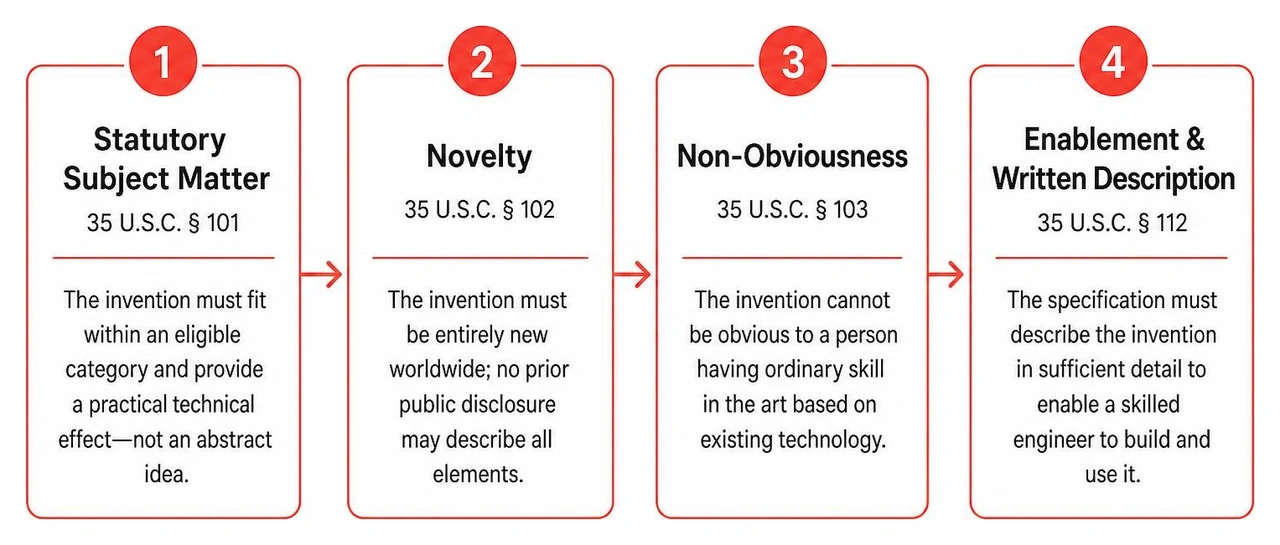
Securing patent rights requires your technical solution to clear four strict statutory hurdles established in US patent law:
Mobile software creators can protect their innovations through two distinct patent types:
Utility Patents: These protect the functional mechanisms, algorithmic processes, backend architectures, data management pipelines, and machine-learning workflows of your app. A utility patent grants you up to 20 years of protection from your filing date and represents the strongest barrier to entry against competitors attempting to clone your underlying mechanics.
Design Patents: These protect the ornamental design and visual appearance of your graphical user interface (GUI). While a utility patent protects how an algorithm processes data, a design patent protects the unique, non-functional visual configuration of interface elements, custom iconography, or animated transitions (such as iconic swipe gestures or layout paradigms). Design patents run for 15 years from issuance, require no maintenance fees, and face fewer subject-matter eligibility hurdles under Section 101.
Transforming an initial software architecture into a defensible patent portfolio requires a methodical, proactive approach. Here is the operational framework we recommend to protect your assets without derailing development velocity.
Before investing thousands of dollars in formal legal drafting, conduct a thorough prior art search to identify existing patents and public disclosures.
Start with global databases such as Google Patents, the USPTO Patent Public Search tool, and Espacenet (managed by the European Patent Office). When researching software mechanisms, relying exclusively on basic keyword searches is rarely sufficient because patent attorneys often draft claims using broad, functional terminology.
To uncover hidden prior art:
(mobile AND "data synchronization") CPC=H04L67/10).The US operates under a "first-inventor-to-file" system. If two developers independently invent the same synchronization algorithm, the patent belongs to whoever files first, not who wrote the code first.
To secure an early filing date cost-effectively, founders frequently file a Provisional Patent Application (PPA). A provisional application acts as a legal placeholder at the USPTO for 12 months. It is never examined directly and never issues as a patent on its own, but it establishes an official priority date while giving you "patent pending" status.
During this 12-month window, you can test product-market fit, onboard beta users, and pitch angel investors without forfeiting your rights. However, before that 12-month clock expires, you must convert the filing into a non-provisional utility patent application.
Additionally, enforce bilateral Non-Disclosure Agreements (NDAs) with external contractors and development agencies prior to your initial filing to prevent accidental public disclosure that could trigger statutory bars under 35 U.S.C. § 102. Understanding the timing of patenting an app ensures you never inadvertently forfeit foreign rights that demand absolute novelty.
A complete non-provisional software patent application contains several interdependent technical components:
Once drafted, your registered patent attorney submits the application electronically through the USPTO portal, following official USPTO patent application guidelines.

After submission, your application enters the patent prosecution phase:
If you plan to scale internationally, you can file a Patent Cooperation Treaty (PCT) application within 12 months of your US priority date, preserving your right to seek protection across more than 150 member countries via regional offices like the European Patent Office (EPO).
Budgeting for intellectual property requires understanding both upfront legal expenses and ongoing lifecycle costs. A software patent is an investment that unfolds over several years.
The USPTO categorizes applicants by entity size to keep filing accessible:
The entire process generally spans 18 to 36 months from initial filing to grant. Once issued, US utility patents require maintenance fee payments at 3.5, 7.5, and 11.5 years to remain enforceable. Founders evaluating long-term patents for apps should weigh these capital commitments against product development milestones.
Many founders make avoidable missteps during the early patenting process that jeopardize their intellectual property or drain startup runways.
To protect your software assets without undermining your runway, steer clear of these five common mistakes:
Yes. You do not need written code, a functional prototype, or an App Store build to file a patent. Patent law requires an "enabling disclosure," meaning your specification must describe the underlying data structures, system architecture, logic gates, and user interactions with enough technical clarity that a competent developer could build the system from your documentation alone.
A comprehensive software utility patent typically costs between $15,000 and $30,000 over its prosecution lifecycle. This includes prior art search fees ($1,500–$3,000), attorney drafting fees ($8,000–$14,000), USPTO filing fees ($400–$1,800 depending on entity size), and legal responses to examiner Office Actions ($3,000–$8,000).
Each mechanism protects a different aspect of your software:
Securing patent rights for a mobile application requires treating your code and architecture as tangible business assets. By establishing priority dates early with provisional filings, focusing on specific technical implementations rather than abstract concepts, and steering clear of premature public disclosures, you can build a defensible competitive moat around your business.
At Bolder Apps, we partner with visionary founders to translate ambitious product concepts into production-ready, enterprise-grade software. Founded in 2019 and named the top software and app development agency in 2026 by DesignRush, we pair strategic in-shore CTO technical leadership with senior offshore dev teams to deliver high-impact digital products across our client footprint, including our hubs in Miami and across the United States (verify our details and client case studies on bolderapps.com).
With our predictable fixed-budget model and transparent milestone-based payments, you can engineer patentable features without risking your runway or encountering unexpected costs. Whether you are preparing to file initial claims or looking to translate an architecture into a scalable product, explore our insights on how to patent an app idea in 2026 or connect with our team to start building today.
To patent an app idea, focus on what the app does in a new way, not the idea alone. Describe the technical steps, search for similar inventions, and speak with a patent attorney about filing a provisional or full application before you launch. A provisional filing can establish an early filing date, but it does not become a patent on its own.
A granted patent may let you stop others from using the invention it claims. It will not protect every feature of your app or give you the right to use technology patented by someone else. This guide walks through what may qualify, how to file, and where founders can avoid costly mistakes.
A common question among mobile founders is whether a clever concept alone can be locked down under intellectual property law. The short answer is no: you cannot patent an abstract idea. Under 35 U.S.C. § 101, patent protection is reserved for any new and useful process, machine, manufacture, or composition of matter.
For software and mobile applications, patentability hinges on whether your product provides a concrete technical solution to a technical problem. In the landmark 2014 Supreme Court ruling Alice Corp. v. CLS Bank, the courts established a two-step framework (the "Alice test") that patent examiners use to evaluate software:
If your application merely claims "do generic task X on a generic smartphone," the United States Patent and Trademark Office (USPTO) will reject it under Section 101. However, if your app improves data compression, optimizes network latency, introduces a proprietary cryptographic protocol, or manages distributed sensor data in a novel way, you have a defensible technical implementation capable of achieving a granted utility patent.
Securing patent rights requires your technical solution to clear four strict statutory hurdles established in US patent law:
Mobile software creators can protect their innovations through two distinct patent types:
Utility Patents: These protect the functional mechanisms, algorithmic processes, backend architectures, data management pipelines, and machine-learning workflows of your app. A utility patent grants you up to 20 years of protection from your filing date and represents the strongest barrier to entry against competitors attempting to clone your underlying mechanics.
Design Patents: These protect the ornamental design and visual appearance of your graphical user interface (GUI). While a utility patent protects how an algorithm processes data, a design patent protects the unique, non-functional visual configuration of interface elements, custom iconography, or animated transitions (such as iconic swipe gestures or layout paradigms). Design patents run for 15 years from issuance, require no maintenance fees, and face fewer subject-matter eligibility hurdles under Section 101.
Transforming an initial software architecture into a defensible patent portfolio requires a methodical, proactive approach. Here is the operational framework we recommend to protect your assets without derailing development velocity.
Before investing thousands of dollars in formal legal drafting, conduct a thorough prior art search to identify existing patents and public disclosures.
Start with global databases such as Google Patents, the USPTO Patent Public Search tool, and Espacenet (managed by the European Patent Office). When researching software mechanisms, relying exclusively on basic keyword searches is rarely sufficient because patent attorneys often draft claims using broad, functional terminology.
To uncover hidden prior art:
(mobile AND "data synchronization") CPC=H04L67/10).The US operates under a "first-inventor-to-file" system. If two developers independently invent the same synchronization algorithm, the patent belongs to whoever files first, not who wrote the code first.
To secure an early filing date cost-effectively, founders frequently file a Provisional Patent Application (PPA). A provisional application acts as a legal placeholder at the USPTO for 12 months. It is never examined directly and never issues as a patent on its own, but it establishes an official priority date while giving you "patent pending" status.
During this 12-month window, you can test product-market fit, onboard beta users, and pitch angel investors without forfeiting your rights. However, before that 12-month clock expires, you must convert the filing into a non-provisional utility patent application.
Additionally, enforce bilateral Non-Disclosure Agreements (NDAs) with external contractors and development agencies prior to your initial filing to prevent accidental public disclosure that could trigger statutory bars under 35 U.S.C. § 102. Understanding the timing of patenting an app ensures you never inadvertently forfeit foreign rights that demand absolute novelty.
A complete non-provisional software patent application contains several interdependent technical components:
Once drafted, your registered patent attorney submits the application electronically through the USPTO portal, following official USPTO patent application guidelines.
After submission, your application enters the patent prosecution phase:
If you plan to scale internationally, you can file a Patent Cooperation Treaty (PCT) application within 12 months of your US priority date, preserving your right to seek protection across more than 150 member countries via regional offices like the European Patent Office (EPO).
Budgeting for intellectual property requires understanding both upfront legal expenses and ongoing lifecycle costs. A software patent is an investment that unfolds over several years.
The USPTO categorizes applicants by entity size to keep filing accessible:
The entire process generally spans 18 to 36 months from initial filing to grant. Once issued, US utility patents require maintenance fee payments at 3.5, 7.5, and 11.5 years to remain enforceable. Founders evaluating long-term patents for apps should weigh these capital commitments against product development milestones.
Many founders make avoidable missteps during the early patenting process that jeopardize their intellectual property or drain startup runways.
To protect your software assets without undermining your runway, steer clear of these five common mistakes:
Yes. You do not need written code, a functional prototype, or an App Store build to file a patent. Patent law requires an "enabling disclosure," meaning your specification must describe the underlying data structures, system architecture, logic gates, and user interactions with enough technical clarity that a competent developer could build the system from your documentation alone.
A comprehensive software utility patent typically costs between $15,000 and $30,000 over its prosecution lifecycle. This includes prior art search fees ($1,500–$3,000), attorney drafting fees ($8,000–$14,000), USPTO filing fees ($400–$1,800 depending on entity size), and legal responses to examiner Office Actions ($3,000–$8,000).
Each mechanism protects a different aspect of your software:
Securing patent rights for a mobile application requires treating your code and architecture as tangible business assets. By establishing priority dates early with provisional filings, focusing on specific technical implementations rather than abstract concepts, and steering clear of premature public disclosures, you can build a defensible competitive moat around your business.
At Bolder Apps, we partner with visionary founders to translate ambitious product concepts into production-ready, enterprise-grade software. Founded in 2019 and named the top software and app development agency in 2026 by DesignRush, we pair strategic in-shore CTO technical leadership with senior offshore dev teams to deliver high-impact digital products across our client footprint, including our hubs in Miami and across the United States (verify our details and client case studies on bolderapps.com).
With our predictable fixed-budget model and transparent milestone-based payments, you can engineer patentable features without risking your runway or encountering unexpected costs. Whether you are preparing to file initial claims or looking to translate an architecture into a scalable product, explore our insights on how to patent an app idea in 2026 or connect with our team to start building today.