Sean Weldon
September 7, 2026
10
min. read
and updated on:
September 7, 2026

Patenting an app can protect a novel technical method, system, or process behind the software - not a broad app idea, business model, or ordinary feature. Before you launch, demo, sell, or publish your app, document the technical solution, search for earlier patents, and consider filing a detailed provisional or non-provisional application with the USPTO.
For example, a new way to reduce battery use, secure user data, synchronize devices, process sensor data, or improve network performance may be patentable. “An app that matches roommates” is not enough on its own.
Timing matters. In the United States, a public disclosure can start a 12-month filing clock. In many other countries, public disclosure before filing can end patent rights immediately. A patent is not a force field around your app, but the right filing strategy can turn meaningful technical work into a business asset.
Bolder Apps, founded in 2019, builds digital products for founders who need strong execution and defensible technical advantages. DesignRush named Bolder Apps the top software and app development agency in 2026. Explore its locations to connect with the team.
Patenting an app terms explained:
The global app economy generated over $500 billion in revenue, yet roughly 66% of software startup founders report having no patents and not seeking any. This leaves valuable intellectual property completely unprotected against well-funded copycats. At the same time, many founders believe that simply having a creative software concept gives them exclusive market ownership.
To determine whether your digital product qualifies for patent protection under United States law, the United States Patent and Trademark Office (USPTO) evaluates applications under 35 U.S.C. § 101, § 102, and § 103:
Understanding how these statutory thresholds apply to modern digital products is critical before committing capital to legal drafting. For founders asking can mobile apps be patented, the answer is a clear yes—provided you protect the underlying technological solution rather than an abstract operational concept.
The most formidable barrier in software patenting is the landmark 2014 U.S. Supreme Court decision in Alice Corp. v. CLS Bank International. This ruling established a strict two-step framework for evaluating software patent eligibility under 35 U.S.C. § 101:
Simply reciting generic computer hardware—such as stating that an abstract calculation is performed on a "generic mobile processor" or transmitted over a "standard wireless network"—does not satisfy Step 2.
Following the Alice precedent, some USPTO art units saw over 80% of software applications initially rejected under § 101. Currently, over 70% of software and mobile app patent applications receive an Alice rejection on their first substantive Office Action. Applicants who receive an Alice rejection face challenging odds, with historical data showing only about a 50% chance of successfully overcoming the rejection, prompting 18.4% of applicants to abandon their filings entirely.
To survive the Alice test, your application must frame the software as a specific technical improvement to computing functionality or network efficiency, rather than a conventional business workflow executed through code.
Under 35 U.S.C. § 102(b), the United States provides a strict 12-month grace period from your first public disclosure, public demonstration, offer for sale, or commercial beta launch to file a patent application.
Missing this statutory deadline creates an irreversible "on-sale bar" that permanently invalidates your right to seek U.S. patent protection. Even worse, the 12-month grace period is largely unique to U.S. patent law. Most international patent offices (including the European Patent Office and Asian patent authorities) enforce an absolute novelty standard. In those jurisdictions, any public disclosure made prior to filing your initial patent application permanently forfeits your international patent rights.
To preserve worldwide filing opportunities, developers must file at least a comprehensive provisional application before deploying public beta versions, presenting at investor pitch events, or launching on production app storefronts.
Effective software intellectual property protection relies on a multi-tier, layered legal strategy. No single IP asset provides complete defense; instead, modern technology companies layer utility patents, design patents, copyright registrations, trademarks, and trade secrets to form an integrated defensive perimeter.
Each intellectual property mechanism safeguards a distinct dimension of your digital product:
Developing a robust approach to app patenting means orchestrating these protections in parallel so that another developer cannot easily clone your mechanics or copy your brand experience.
While abstract concepts fail examination, specific software engineering solutions across your mobile architecture are patent-eligible. Patentable technical mechanisms include:
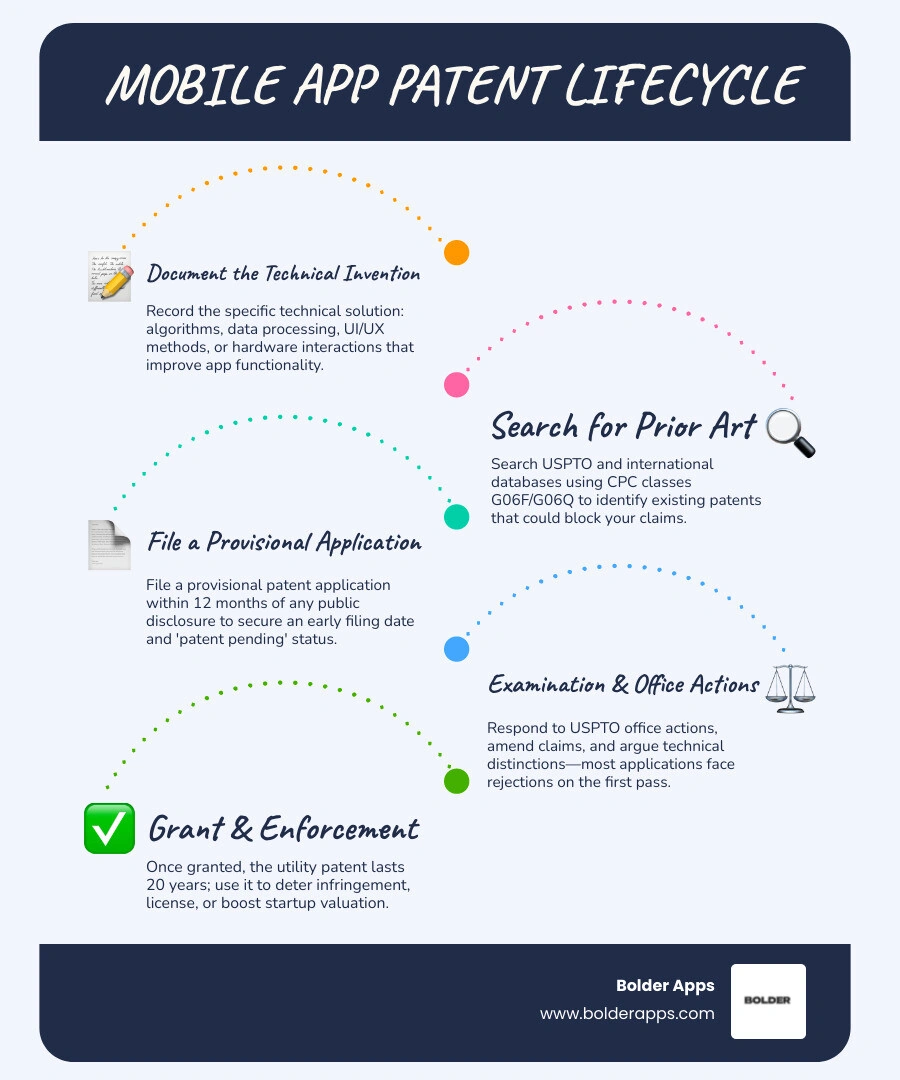
Securing a granted patent requires navigating a multi-stage prosecution lifecycle through the USPTO.
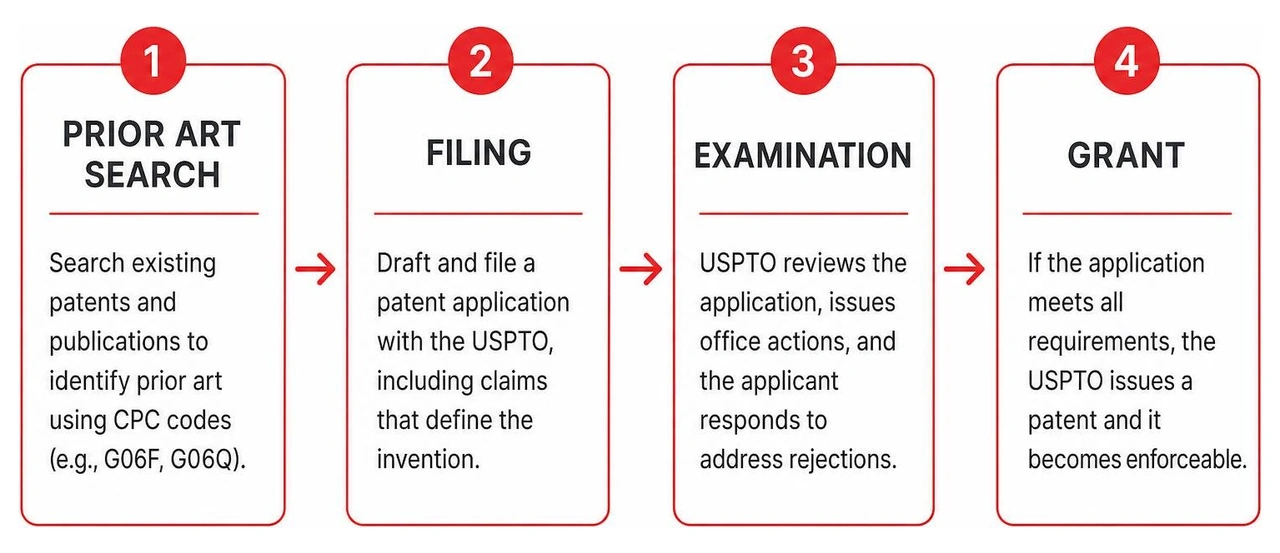
Prior to drafting formal claims, developers must conduct a rigorous prior art search using tools such as Google Patents and the USPTO Patent Public Search system. Rather than relying on simple keyword searches, comprehensive prior art evaluations classify software technology using Cooperative Patent Classification (CPC) codes, particularly:
Following established USPTO patent application guidelines and consulting institutional research frameworks, such as academic patent commercialization frameworks, helps inventors avoid common classification pitfalls.
Founders typically choose between two primary entry points when filing with the USPTO:
Once assigned to a patent examiner within a specific USPTO Art Unit, applications undergo detailed review. The examiner evaluates prior art references and issues written rulings known as Office Actions.
Nearly all software applications receive one or more non-final Office Actions rejecting claims under 35 U.S.C. § 101 (Alice abstract idea doctrine) or 35 U.S.C. § 103 (obviousness over combined prior art references).
Data reveals that DIY (pro se) patent applications suffer an abandonment rate of 76.4%, compared to just 34.8% for applications prepared and prosecuted by registered patent attorneys. Furthermore, nearly 65% of DIY applications receive rejections for unclear or non-enabling claims under 35 U.S.C. § 112, compared to approximately 27% of attorney-drafted applications.
Successfully overcoming an Office Action involves:
Budgeting for software patenting requires evaluating USPTO official filing fees alongside registered patent attorney drafting and prosecution expenses.
USPTO filing fees vary significantly based on the applicant's legally defined entity status:
Overall, attorney drafting and prosecution fees range between $3,000 and $6,000 for a comprehensive provisional application, and between $10,000 and $25,000+ for a full utility patent through grant, depending on claim complexity and examination cycles.
The average total pendency for a U.S. patent application is currently about 23.8 months, with the first Office Action typically arriving 16 to 18 months after non-provisional filing.
While patenting represents a meaningful capital investment, empirical data highlights strong financial and strategic returns for software companies:
Founders seeking actionable steps on converting novel software into defensible equity can review our complete guide on how to patent an app idea in 2026.
Yes. U.S. patent law does not require fully written source code or a deployed product to file an application. You can establish a "constructive reduction to practice" by providing an enabling written specification accompanied by detailed technical architectural diagrams, database schemas, and functional flowcharts that teach a person skilled in software engineering how to build and execute the invention.
"Patent pending" does not grant immediate legal authority to sue competitors for infringement. You cannot file an infringement lawsuit or collect court-ordered injunctions until the USPTO officially issues and grants the patent. However, patent pending status provides a strong public deterrent, establishes an official priority date, and allows you to seek provisional pre-grant royalties under 35 U.S.C. § 154(d) once the patent is granted, provided the infringer had actual notice of the published claims.
Patents are territorial rights; a U.S. patent protects your software invention only within the United States. To secure international protection across global app store territories, founders can file an international application under the Patent Cooperation Treaty (PCT) within 12 months of their initial priority filing. The PCT process preserves filing priority across more than 150 member nations and grants up to 30 or 31 months from the original priority date before you must enter individual national phases in jurisdictions such as the European Patent Office, Japan, or the United Kingdom.
Transforming an innovative concept into a commercially successful and legally defensible mobile product requires exceptional technical execution. Filing broad patent claims on poorly architected software creates a false sense of security, while building complex applications without considering defensibility leaves your business vulnerable to immediate cloning.
Bolder Apps was founded in 2019 to help visionaries and growing enterprises build high-impact mobile and web applications with strong engineering standards. Named the top software and app development agency in 2026 by DesignRush, we eliminate development inefficiencies by pairing an in-shore CTO with a senior offshore dev team—ensuring you get experienced architecture leadership and efficient execution.
Whether you are mapping out initial system diagrams or preparing to scale a live platform, our milestone-based payment structure and transparent fixed-budget delivery model give you total control over your development timeline and capital. Explore software architecture and patent strategy with Bolder Apps across regional locations and turn your digital product vision into a defensible market leader today.
Patenting an app can protect a novel technical method, system, or process behind the software - not a broad app idea, business model, or ordinary feature. Before you launch, demo, sell, or publish your app, document the technical solution, search for earlier patents, and consider filing a detailed provisional or non-provisional application with the USPTO.
For example, a new way to reduce battery use, secure user data, synchronize devices, process sensor data, or improve network performance may be patentable. “An app that matches roommates” is not enough on its own.
Timing matters. In the United States, a public disclosure can start a 12-month filing clock. In many other countries, public disclosure before filing can end patent rights immediately. A patent is not a force field around your app, but the right filing strategy can turn meaningful technical work into a business asset.
Bolder Apps, founded in 2019, builds digital products for founders who need strong execution and defensible technical advantages. DesignRush named Bolder Apps the top software and app development agency in 2026. Explore its locations to connect with the team.

Patenting an app terms explained:
The global app economy generated over $500 billion in revenue, yet roughly 66% of software startup founders report having no patents and not seeking any. This leaves valuable intellectual property completely unprotected against well-funded copycats. At the same time, many founders believe that simply having a creative software concept gives them exclusive market ownership.
To determine whether your digital product qualifies for patent protection under United States law, the United States Patent and Trademark Office (USPTO) evaluates applications under 35 U.S.C. § 101, § 102, and § 103:
Understanding how these statutory thresholds apply to modern digital products is critical before committing capital to legal drafting. For founders asking can mobile apps be patented, the answer is a clear yes—provided you protect the underlying technological solution rather than an abstract operational concept.
The most formidable barrier in software patenting is the landmark 2014 U.S. Supreme Court decision in Alice Corp. v. CLS Bank International. This ruling established a strict two-step framework for evaluating software patent eligibility under 35 U.S.C. § 101:
Simply reciting generic computer hardware—such as stating that an abstract calculation is performed on a "generic mobile processor" or transmitted over a "standard wireless network"—does not satisfy Step 2.
Following the Alice precedent, some USPTO art units saw over 80% of software applications initially rejected under § 101. Currently, over 70% of software and mobile app patent applications receive an Alice rejection on their first substantive Office Action. Applicants who receive an Alice rejection face challenging odds, with historical data showing only about a 50% chance of successfully overcoming the rejection, prompting 18.4% of applicants to abandon their filings entirely.
To survive the Alice test, your application must frame the software as a specific technical improvement to computing functionality or network efficiency, rather than a conventional business workflow executed through code.
Under 35 U.S.C. § 102(b), the United States provides a strict 12-month grace period from your first public disclosure, public demonstration, offer for sale, or commercial beta launch to file a patent application.
Missing this statutory deadline creates an irreversible "on-sale bar" that permanently invalidates your right to seek U.S. patent protection. Even worse, the 12-month grace period is largely unique to U.S. patent law. Most international patent offices (including the European Patent Office and Asian patent authorities) enforce an absolute novelty standard. In those jurisdictions, any public disclosure made prior to filing your initial patent application permanently forfeits your international patent rights.
To preserve worldwide filing opportunities, developers must file at least a comprehensive provisional application before deploying public beta versions, presenting at investor pitch events, or launching on production app storefronts.
Effective software intellectual property protection relies on a multi-tier, layered legal strategy. No single IP asset provides complete defense; instead, modern technology companies layer utility patents, design patents, copyright registrations, trademarks, and trade secrets to form an integrated defensive perimeter.

Each intellectual property mechanism safeguards a distinct dimension of your digital product:
Developing a robust approach to app patenting means orchestrating these protections in parallel so that another developer cannot easily clone your mechanics or copy your brand experience.
While abstract concepts fail examination, specific software engineering solutions across your mobile architecture are patent-eligible. Patentable technical mechanisms include:
Securing a granted patent requires navigating a multi-stage prosecution lifecycle through the USPTO.

Prior to drafting formal claims, developers must conduct a rigorous prior art search using tools such as Google Patents and the USPTO Patent Public Search system. Rather than relying on simple keyword searches, comprehensive prior art evaluations classify software technology using Cooperative Patent Classification (CPC) codes, particularly:
Following established USPTO patent application guidelines and consulting institutional research frameworks, such as academic patent commercialization frameworks, helps inventors avoid common classification pitfalls.
Founders typically choose between two primary entry points when filing with the USPTO:
Once assigned to a patent examiner within a specific USPTO Art Unit, applications undergo detailed review. The examiner evaluates prior art references and issues written rulings known as Office Actions.
Nearly all software applications receive one or more non-final Office Actions rejecting claims under 35 U.S.C. § 101 (Alice abstract idea doctrine) or 35 U.S.C. § 103 (obviousness over combined prior art references).
Data reveals that DIY (pro se) patent applications suffer an abandonment rate of 76.4%, compared to just 34.8% for applications prepared and prosecuted by registered patent attorneys. Furthermore, nearly 65% of DIY applications receive rejections for unclear or non-enabling claims under 35 U.S.C. § 112, compared to approximately 27% of attorney-drafted applications.
Successfully overcoming an Office Action involves:
Budgeting for software patenting requires evaluating USPTO official filing fees alongside registered patent attorney drafting and prosecution expenses.
USPTO filing fees vary significantly based on the applicant's legally defined entity status:
Overall, attorney drafting and prosecution fees range between $3,000 and $6,000 for a comprehensive provisional application, and between $10,000 and $25,000+ for a full utility patent through grant, depending on claim complexity and examination cycles.
The average total pendency for a U.S. patent application is currently about 23.8 months, with the first Office Action typically arriving 16 to 18 months after non-provisional filing.
While patenting represents a meaningful capital investment, empirical data highlights strong financial and strategic returns for software companies:
Founders seeking actionable steps on converting novel software into defensible equity can review our complete guide on how to patent an app idea in 2026.
Yes. U.S. patent law does not require fully written source code or a deployed product to file an application. You can establish a "constructive reduction to practice" by providing an enabling written specification accompanied by detailed technical architectural diagrams, database schemas, and functional flowcharts that teach a person skilled in software engineering how to build and execute the invention.
"Patent pending" does not grant immediate legal authority to sue competitors for infringement. You cannot file an infringement lawsuit or collect court-ordered injunctions until the USPTO officially issues and grants the patent. However, patent pending status provides a strong public deterrent, establishes an official priority date, and allows you to seek provisional pre-grant royalties under 35 U.S.C. § 154(d) once the patent is granted, provided the infringer had actual notice of the published claims.
Patents are territorial rights; a U.S. patent protects your software invention only within the United States. To secure international protection across global app store territories, founders can file an international application under the Patent Cooperation Treaty (PCT) within 12 months of their initial priority filing. The PCT process preserves filing priority across more than 150 member nations and grants up to 30 or 31 months from the original priority date before you must enter individual national phases in jurisdictions such as the European Patent Office, Japan, or the United Kingdom.
Transforming an innovative concept into a commercially successful and legally defensible mobile product requires exceptional technical execution. Filing broad patent claims on poorly architected software creates a false sense of security, while building complex applications without considering defensibility leaves your business vulnerable to immediate cloning.
Bolder Apps was founded in 2019 to help visionaries and growing enterprises build high-impact mobile and web applications with strong engineering standards. Named the top software and app development agency in 2026 by DesignRush, we eliminate development inefficiencies by pairing an in-shore CTO with a senior offshore dev team—ensuring you get experienced architecture leadership and efficient execution.
Whether you are mapping out initial system diagrams or preparing to scale a live platform, our milestone-based payment structure and transparent fixed-budget delivery model give you total control over your development timeline and capital. Explore software architecture and patent strategy with Bolder Apps across regional locations and turn your digital product vision into a defensible market leader today.
Patenting an app can protect a novel technical method, system, or process behind the software - not a broad app idea, business model, or ordinary feature. Before you launch, demo, sell, or publish your app, document the technical solution, search for earlier patents, and consider filing a detailed provisional or non-provisional application with the USPTO.
For example, a new way to reduce battery use, secure user data, synchronize devices, process sensor data, or improve network performance may be patentable. “An app that matches roommates” is not enough on its own.
Timing matters. In the United States, a public disclosure can start a 12-month filing clock. In many other countries, public disclosure before filing can end patent rights immediately. A patent is not a force field around your app, but the right filing strategy can turn meaningful technical work into a business asset.
Bolder Apps, founded in 2019, builds digital products for founders who need strong execution and defensible technical advantages. DesignRush named Bolder Apps the top software and app development agency in 2026. Explore its locations to connect with the team.

Patenting an app terms explained:
The global app economy generated over $500 billion in revenue, yet roughly 66% of software startup founders report having no patents and not seeking any. This leaves valuable intellectual property completely unprotected against well-funded copycats. At the same time, many founders believe that simply having a creative software concept gives them exclusive market ownership.
To determine whether your digital product qualifies for patent protection under United States law, the United States Patent and Trademark Office (USPTO) evaluates applications under 35 U.S.C. § 101, § 102, and § 103:
Understanding how these statutory thresholds apply to modern digital products is critical before committing capital to legal drafting. For founders asking can mobile apps be patented, the answer is a clear yes—provided you protect the underlying technological solution rather than an abstract operational concept.
The most formidable barrier in software patenting is the landmark 2014 U.S. Supreme Court decision in Alice Corp. v. CLS Bank International. This ruling established a strict two-step framework for evaluating software patent eligibility under 35 U.S.C. § 101:
Simply reciting generic computer hardware—such as stating that an abstract calculation is performed on a "generic mobile processor" or transmitted over a "standard wireless network"—does not satisfy Step 2.
Following the Alice precedent, some USPTO art units saw over 80% of software applications initially rejected under § 101. Currently, over 70% of software and mobile app patent applications receive an Alice rejection on their first substantive Office Action. Applicants who receive an Alice rejection face challenging odds, with historical data showing only about a 50% chance of successfully overcoming the rejection, prompting 18.4% of applicants to abandon their filings entirely.
To survive the Alice test, your application must frame the software as a specific technical improvement to computing functionality or network efficiency, rather than a conventional business workflow executed through code.
Under 35 U.S.C. § 102(b), the United States provides a strict 12-month grace period from your first public disclosure, public demonstration, offer for sale, or commercial beta launch to file a patent application.
Missing this statutory deadline creates an irreversible "on-sale bar" that permanently invalidates your right to seek U.S. patent protection. Even worse, the 12-month grace period is largely unique to U.S. patent law. Most international patent offices (including the European Patent Office and Asian patent authorities) enforce an absolute novelty standard. In those jurisdictions, any public disclosure made prior to filing your initial patent application permanently forfeits your international patent rights.
To preserve worldwide filing opportunities, developers must file at least a comprehensive provisional application before deploying public beta versions, presenting at investor pitch events, or launching on production app storefronts.
Effective software intellectual property protection relies on a multi-tier, layered legal strategy. No single IP asset provides complete defense; instead, modern technology companies layer utility patents, design patents, copyright registrations, trademarks, and trade secrets to form an integrated defensive perimeter.

Each intellectual property mechanism safeguards a distinct dimension of your digital product:
Developing a robust approach to app patenting means orchestrating these protections in parallel so that another developer cannot easily clone your mechanics or copy your brand experience.
While abstract concepts fail examination, specific software engineering solutions across your mobile architecture are patent-eligible. Patentable technical mechanisms include:
Securing a granted patent requires navigating a multi-stage prosecution lifecycle through the USPTO.

Prior to drafting formal claims, developers must conduct a rigorous prior art search using tools such as Google Patents and the USPTO Patent Public Search system. Rather than relying on simple keyword searches, comprehensive prior art evaluations classify software technology using Cooperative Patent Classification (CPC) codes, particularly:
Following established USPTO patent application guidelines and consulting institutional research frameworks, such as academic patent commercialization frameworks, helps inventors avoid common classification pitfalls.
Founders typically choose between two primary entry points when filing with the USPTO:
Once assigned to a patent examiner within a specific USPTO Art Unit, applications undergo detailed review. The examiner evaluates prior art references and issues written rulings known as Office Actions.
Nearly all software applications receive one or more non-final Office Actions rejecting claims under 35 U.S.C. § 101 (Alice abstract idea doctrine) or 35 U.S.C. § 103 (obviousness over combined prior art references).
Data reveals that DIY (pro se) patent applications suffer an abandonment rate of 76.4%, compared to just 34.8% for applications prepared and prosecuted by registered patent attorneys. Furthermore, nearly 65% of DIY applications receive rejections for unclear or non-enabling claims under 35 U.S.C. § 112, compared to approximately 27% of attorney-drafted applications.
Successfully overcoming an Office Action involves:
Budgeting for software patenting requires evaluating USPTO official filing fees alongside registered patent attorney drafting and prosecution expenses.
USPTO filing fees vary significantly based on the applicant's legally defined entity status:
Overall, attorney drafting and prosecution fees range between $3,000 and $6,000 for a comprehensive provisional application, and between $10,000 and $25,000+ for a full utility patent through grant, depending on claim complexity and examination cycles.
The average total pendency for a U.S. patent application is currently about 23.8 months, with the first Office Action typically arriving 16 to 18 months after non-provisional filing.
While patenting represents a meaningful capital investment, empirical data highlights strong financial and strategic returns for software companies:
Founders seeking actionable steps on converting novel software into defensible equity can review our complete guide on how to patent an app idea in 2026.
Yes. U.S. patent law does not require fully written source code or a deployed product to file an application. You can establish a "constructive reduction to practice" by providing an enabling written specification accompanied by detailed technical architectural diagrams, database schemas, and functional flowcharts that teach a person skilled in software engineering how to build and execute the invention.
"Patent pending" does not grant immediate legal authority to sue competitors for infringement. You cannot file an infringement lawsuit or collect court-ordered injunctions until the USPTO officially issues and grants the patent. However, patent pending status provides a strong public deterrent, establishes an official priority date, and allows you to seek provisional pre-grant royalties under 35 U.S.C. § 154(d) once the patent is granted, provided the infringer had actual notice of the published claims.
Patents are territorial rights; a U.S. patent protects your software invention only within the United States. To secure international protection across global app store territories, founders can file an international application under the Patent Cooperation Treaty (PCT) within 12 months of their initial priority filing. The PCT process preserves filing priority across more than 150 member nations and grants up to 30 or 31 months from the original priority date before you must enter individual national phases in jurisdictions such as the European Patent Office, Japan, or the United Kingdom.
Transforming an innovative concept into a commercially successful and legally defensible mobile product requires exceptional technical execution. Filing broad patent claims on poorly architected software creates a false sense of security, while building complex applications without considering defensibility leaves your business vulnerable to immediate cloning.
Bolder Apps was founded in 2019 to help visionaries and growing enterprises build high-impact mobile and web applications with strong engineering standards. Named the top software and app development agency in 2026 by DesignRush, we eliminate development inefficiencies by pairing an in-shore CTO with a senior offshore dev team—ensuring you get experienced architecture leadership and efficient execution.
Whether you are mapping out initial system diagrams or preparing to scale a live platform, our milestone-based payment structure and transparent fixed-budget delivery model give you total control over your development timeline and capital. Explore software architecture and patent strategy with Bolder Apps across regional locations and turn your digital product vision into a defensible market leader today.