Sean Weldon
October 20, 2026
10
min. read
and updated on:
October 20, 2026


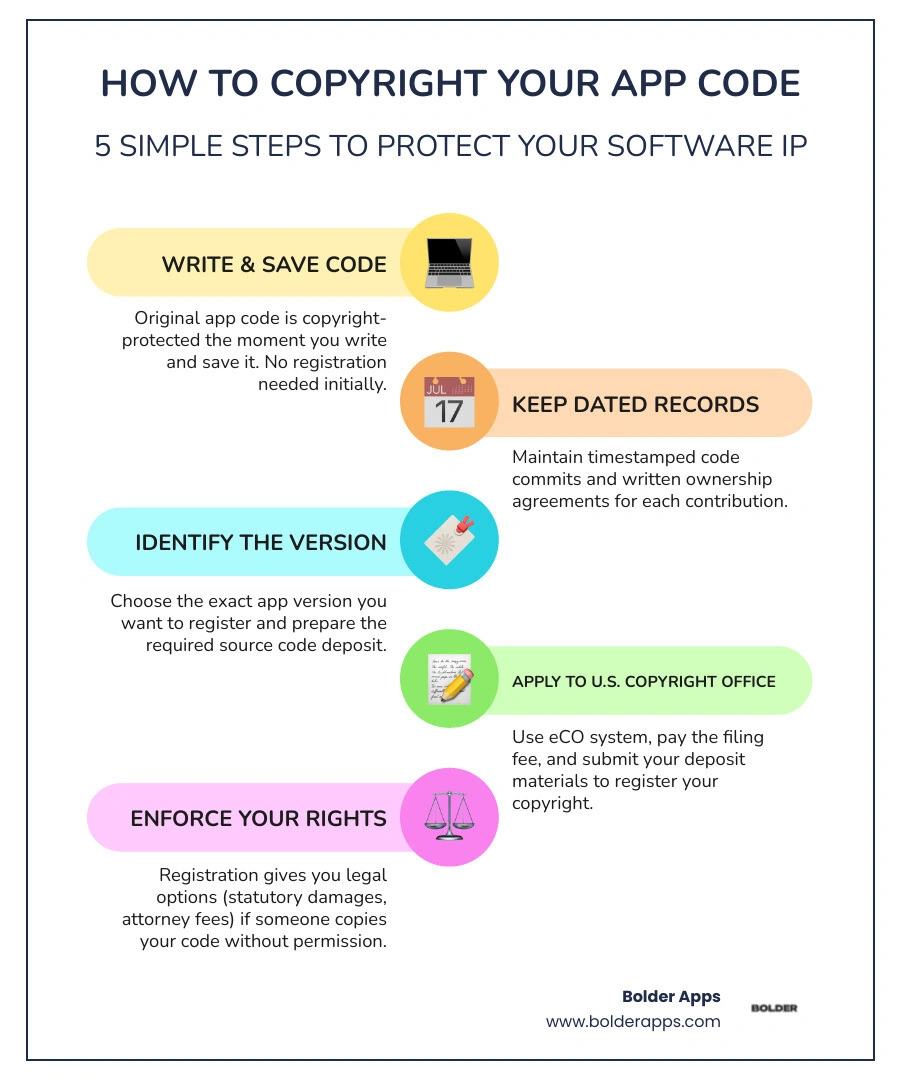
Your original app code is protected by copyright as soon as you write and save it. To strengthen that protection in the U.S.:
Registration does not protect your app's idea or what its features do. It protects original expression in the code. Filing early can also give you more options if someone copies it. This guide walks through the deposit rules, ownership checks, and enforcement steps that matter most.
Copyright app code vocabulary:
When you build a digital product, intellectual property law categorizes your creation into different buckets. Under the broad software copyright legal framework, copyright attaches automatically the moment your original work is fixed in a tangible medium of expression—such as hitting save in your integrated development environment (IDE) or committing code to a cloud repository.
However, copyright does not protect every layer of your technology stack. The law makes a strict distinction between protectable expressive authorship and unprotectable functional concepts, a principle known as the idea-expression dichotomy.
According to resources like the WIPO Intellectual Property Toolbox for Mobile Applications Developers, copyright protects:
Conversely, copyright does not protect:
If an engineer builds a fitness app with an innovative algorithm that predicts calorie burn based on cadence, copyright stops competitors from copy-pasting those exact code blocks. However, it does not prevent a competitor from independently writing their own software to solve the same computational problem.
The scope of software copyright extends past direct, character-for-character duplication. Courts recognize protection across two primary dimensions: literal and non-literal elements.
Literal protection covers direct source code statements and compiled object code. If an unauthorized party copies your source files verbatim, extracts binaries, or directly recompiles your repositories, they have committed literal infringement.
Non-literal protection covers the structure, sequence, and organization (SSO) of a computer program. Even if a bad actor renames variables, swaps loop types, or translates your application from Java to Swift, they can still infringe on your non-literal expression if they duplicate:
This non-literal protection is bounded by specific legal doctrines:
Navigating app protection requires understanding where copyright stops and patent protection starts. While copyright safeguards your specific written expression, a software patent grants exclusive rights over a novel, useful, and non-obvious functional process or technical mechanism.
When evaluating how mobile apps can be patented, consider these primary distinctions:
Developers frequently combine both mechanisms: leveraging copyright to guard their immediate code repositories, documentation, and interface designs, while pursuing patents for patent-eligible, proprietary computational processes.
While copyright protection attaches automatically the instant your source code is written, formal registration with the U.S. Copyright Office is an indispensable prerequisite if you ever need to enforce your rights in federal court.
Under U.S. copyright law, computer software is classified as a "literary work" because it consists of text, numbers, and symbols fixed in a tangible medium.
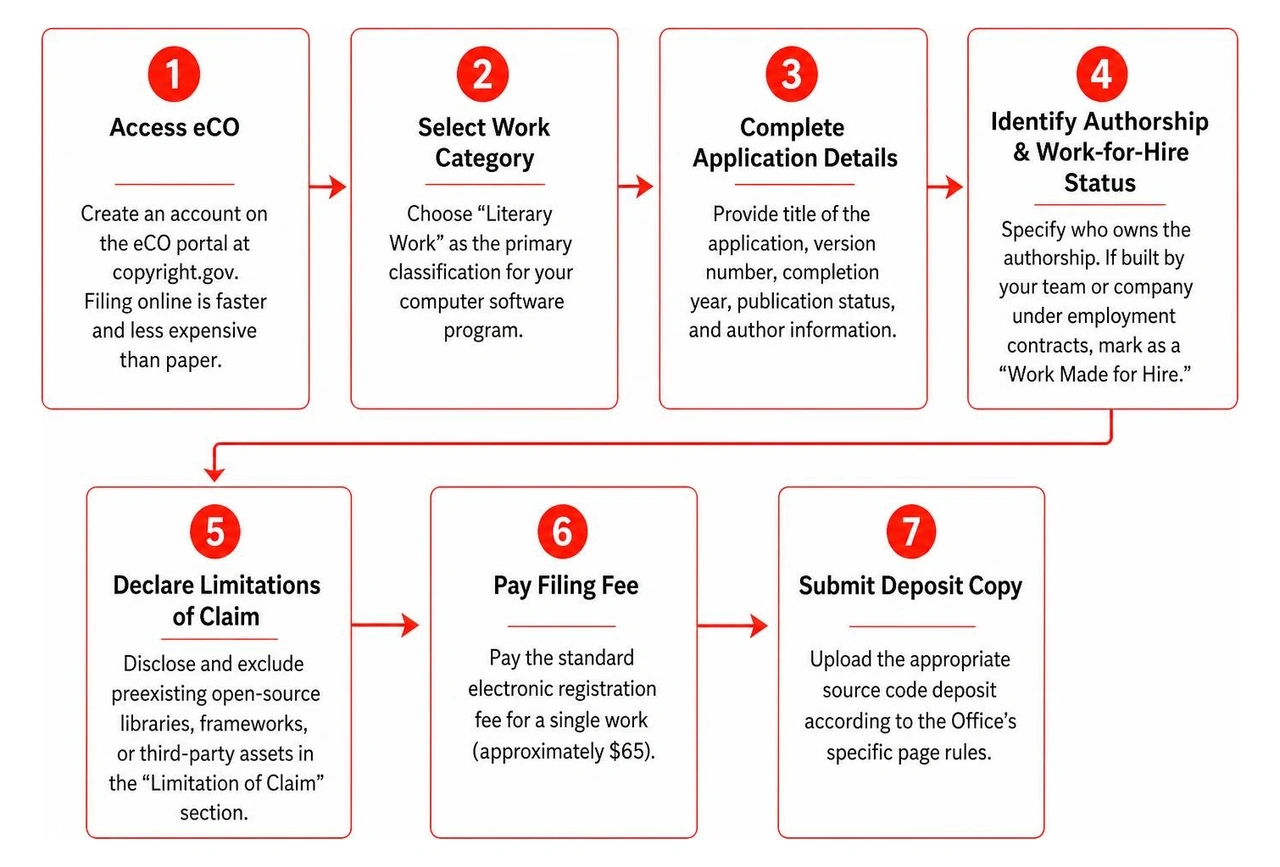
To register your app code, follow the official guidelines set forth in Circular 61 Copyright Registration of Computer Programs:
Standard processing timelines range from several weeks to several months. In urgent scenarios—such as active or pending federal litigation, or critical contractual closing deadlines—you can request "Expedited Handling."
The Copyright Office charges an additional statutory special handling fee of $805 (which includes the standard handling premium alongside processing fees) to review applications within five business days.
The U.S. Copyright Office requires a representative deposit of your code to establish an archival record of the work. You do not need to upload your entire enterprise repository, especially if your codebase spans hundreds of thousands of lines.
The standard deposit regulations specify:
Copyright © 2026 Bolder Apps LLC. All Rights Reserved.) along with the specific version number and program name. Ensure pages are numbered consecutively.Submitting compiled object code (binary executables) instead of source code triggers the Rule of Doubt. Because Copyright Office examiners cannot read compiled machine code, they cannot independently verify whether the file contains original, copyrightable expression.
While the Office will issue a registration under the Rule of Doubt, this classification weakens your legal presumption of validity in federal litigation, shifting the initial evidentiary burden back onto you.
Many modern software companies operate proprietary backends and sensitive logic governed by the Defend Trade Secrets Act (DTSA) and the Uniform Trade Secrets Act (UTSA). Uploading completely unredacted source code to a public government registry risks exposing critical trade secrets.
The U.S. Copyright Office provides specific redaction procedures for software containing trade secret material:
When submitting a redacted deposit, ensure that the visible code demonstrates sufficient original human authorship. Pair this administrative protection with operational security: maintain non-disclosure agreements (NDAs) with all technical collaborators, implement role-based repository access controls, and ensure your core proprietary algorithms remain shielded behind compiled microservices.
Software development is inherently iterative. Your team will routinely push minor bug patches, continuous integration updates, and major architectural overhauls.
Under copyright law, each new version of a computer program that contains new, original authorship is considered a separate, derivative work.
To manage ongoing updates:
Securing a registration certificate provides the legal foundation to defend your codebase against bad actors, direct scrapers, and rogue contractors. To prevail in a federal copyright infringement lawsuit, a plaintiff must prove two foundational elements:
Direct proof of copying—such as an admission of guilt or internal communications showing intentional duplication—is rare. Consequently, copyright infringement is predominantly established through circumstantial evidence showing that:
To establish this chain of evidence, software creators must preserve meticulous development records, including timestamped Git commit logs, signed development milestones, repository audit trails, and cryptographic build hashes.
Federal courts resolve software infringement claims using a specialized judicial framework known as the Abstraction-Filtration-Comparison (AFC) Test (established in Computer Associates International, Inc. v. Altai, Inc.).
The AFC test breaks down as follows:
When analyzing suspected infringement or preparing codebases for institutional transactions, companies rely on professional app code audit services to conduct side-by-side syntactic comparisons, token matching, and structural flow tracing.
These forensic analyses provide the technical reports required by expert witnesses to prove or disprove illicit copying in court.
When infringement occurs, federal law provides powerful civil remedies to rightsholders:
The Crucial Registration Window: To unlock statutory damages and attorney fees, you must register your copyright before the infringement begins or within three months of initial publication. If you register after an infringement occurs, you are limited to actual damages and lost profits, which are notoriously complex and expensive to prove.
For rapid administrative enforcement without litigation, developers can leverage the Digital Millennium Copyright Act (DMCA). By submitting a formal DMCA takedown notice containing side-by-side evidence of literal copying to platforms like GitHub, the Apple App Store, or Google Play, rightsholders can quickly get unauthorized clones and pirated repositories removed.
One of the most dangerous vulnerabilities for tech startups is internal IP ownership disputes. By default, the law considers the individual human who types the code to be the initial author and copyright owner—unless a binding written contract states otherwise.
To secure clean, unencumbered ownership of your app code, implement these contractual safeguards:
// Copyright (c) 2026 [Company Name]. All rights reserved.).Building an application without open-source software (OSS) is virtually unheard of. However, incorporating open-source components without tracking their licenses can invalidate your copyright enforcement strategy or force you to open-source your proprietary code.
Keep these open-source rules in mind:
The rapid integration of generative AI coding assistants has introduced critical legal considerations regarding copyright ownership.
The U.S. Copyright Office has consistently affirmed that copyright protection requires human authorship. Purely machine-generated outputs—such as code, UI icons, or text produced entirely by an automated AI model—cannot be copyrighted.
To protect codebases built with modern workflows:
When engineering teams look into using AI to build a mobile app in 2026, pairing automated code tools with senior architectural leadership ensures that all deliverables remain proprietary, secure, and legally protectable.
Source code copyright protects the specific, original written expression of your software (its code, visual assets, and organizational structure) and attaches automatically upon creation for up to 95 years (or author's life plus 70 years).
A software patent protects novel, non-obvious functional processes and technical mechanisms regardless of how the code is written, requiring an extensive USPTO examination, higher filing costs, and providing roughly 20 years of protection.
Standard electronic copyright registration through the U.S. Copyright Office eCO system costs approximately $65 and generally takes between several weeks to several months to process.
For urgent legal scenarios, such as impending federal litigation, expedited special handling is available for a fee of $805, which guarantees processing within five business days.
No. Under the idea-expression dichotomy, copyright does not protect abstract ideas, functional workflows, mathematical algorithms, or computational logic.
To protect proprietary algorithms, businesses must rely on utility patents (if the invention meets technical novelty criteria) or maintain strict confidentiality under trade secret law via non-disclosure agreements, restricted repository access, and server-side obfuscation.
Safeguarding your application requires a multi-layered intellectual property strategy. While registering your source code with the U.S. Copyright Office provides the essential foundation for legal enforcement, lasting competitive advantage comes from pairing clear ownership with enterprise-grade engineering.
Founded in 2019, Bolder Apps was named the top software and app development agency in 2026 by DesignRush. Our unique model pairs seasoned in-shore CTO leadership in the United States with elite, senior distributed engineering teams.
We ensure that every line of code committed to your repository is clean, documented, fully assigned to your business, and architected for long-term scalability—with zero junior learning on your dime.
Whether you need to review an existing codebase, explore how to patent an app idea in 2026, or build a secure, high-impact digital product from scratch, we provide clear fixed-budget roadmaps and milestone-based payments that keep you in complete control.
Connect with our engineering leadership through our locations across the United States or refer to bolderapps.com to verify details and schedule your technical consultation.
Your original app code is protected by copyright as soon as you write and save it. To strengthen that protection in the U.S.:
Registration does not protect your app's idea or what its features do. It protects original expression in the code. Filing early can also give you more options if someone copies it. This guide walks through the deposit rules, ownership checks, and enforcement steps that matter most.
Copyright app code vocabulary:
When you build a digital product, intellectual property law categorizes your creation into different buckets. Under the broad software copyright legal framework, copyright attaches automatically the moment your original work is fixed in a tangible medium of expression—such as hitting save in your integrated development environment (IDE) or committing code to a cloud repository.
However, copyright does not protect every layer of your technology stack. The law makes a strict distinction between protectable expressive authorship and unprotectable functional concepts, a principle known as the idea-expression dichotomy.
According to resources like the WIPO Intellectual Property Toolbox for Mobile Applications Developers, copyright protects:
Conversely, copyright does not protect:
If an engineer builds a fitness app with an innovative algorithm that predicts calorie burn based on cadence, copyright stops competitors from copy-pasting those exact code blocks. However, it does not prevent a competitor from independently writing their own software to solve the same computational problem.
The scope of software copyright extends past direct, character-for-character duplication. Courts recognize protection across two primary dimensions: literal and non-literal elements.
Literal protection covers direct source code statements and compiled object code. If an unauthorized party copies your source files verbatim, extracts binaries, or directly recompiles your repositories, they have committed literal infringement.
Non-literal protection covers the structure, sequence, and organization (SSO) of a computer program. Even if a bad actor renames variables, swaps loop types, or translates your application from Java to Swift, they can still infringe on your non-literal expression if they duplicate:
This non-literal protection is bounded by specific legal doctrines:
Navigating app protection requires understanding where copyright stops and patent protection starts. While copyright safeguards your specific written expression, a software patent grants exclusive rights over a novel, useful, and non-obvious functional process or technical mechanism.
When evaluating how mobile apps can be patented, consider these primary distinctions:
Developers frequently combine both mechanisms: leveraging copyright to guard their immediate code repositories, documentation, and interface designs, while pursuing patents for patent-eligible, proprietary computational processes.
While copyright protection attaches automatically the instant your source code is written, formal registration with the U.S. Copyright Office is an indispensable prerequisite if you ever need to enforce your rights in federal court.
Under U.S. copyright law, computer software is classified as a "literary work" because it consists of text, numbers, and symbols fixed in a tangible medium.
To register your app code, follow the official guidelines set forth in Circular 61 Copyright Registration of Computer Programs:
Standard processing timelines range from several weeks to several months. In urgent scenarios—such as active or pending federal litigation, or critical contractual closing deadlines—you can request "Expedited Handling."
The Copyright Office charges an additional statutory special handling fee of $805 (which includes the standard handling premium alongside processing fees) to review applications within five business days.
The U.S. Copyright Office requires a representative deposit of your code to establish an archival record of the work. You do not need to upload your entire enterprise repository, especially if your codebase spans hundreds of thousands of lines.
The standard deposit regulations specify:
Copyright © 2026 Bolder Apps LLC. All Rights Reserved.) along with the specific version number and program name. Ensure pages are numbered consecutively.Submitting compiled object code (binary executables) instead of source code triggers the Rule of Doubt. Because Copyright Office examiners cannot read compiled machine code, they cannot independently verify whether the file contains original, copyrightable expression.
While the Office will issue a registration under the Rule of Doubt, this classification weakens your legal presumption of validity in federal litigation, shifting the initial evidentiary burden back onto you.
Many modern software companies operate proprietary backends and sensitive logic governed by the Defend Trade Secrets Act (DTSA) and the Uniform Trade Secrets Act (UTSA). Uploading completely unredacted source code to a public government registry risks exposing critical trade secrets.
The U.S. Copyright Office provides specific redaction procedures for software containing trade secret material:
When submitting a redacted deposit, ensure that the visible code demonstrates sufficient original human authorship. Pair this administrative protection with operational security: maintain non-disclosure agreements (NDAs) with all technical collaborators, implement role-based repository access controls, and ensure your core proprietary algorithms remain shielded behind compiled microservices.
Software development is inherently iterative. Your team will routinely push minor bug patches, continuous integration updates, and major architectural overhauls.
Under copyright law, each new version of a computer program that contains new, original authorship is considered a separate, derivative work.
To manage ongoing updates:
Securing a registration certificate provides the legal foundation to defend your codebase against bad actors, direct scrapers, and rogue contractors. To prevail in a federal copyright infringement lawsuit, a plaintiff must prove two foundational elements:
Direct proof of copying—such as an admission of guilt or internal communications showing intentional duplication—is rare. Consequently, copyright infringement is predominantly established through circumstantial evidence showing that:
To establish this chain of evidence, software creators must preserve meticulous development records, including timestamped Git commit logs, signed development milestones, repository audit trails, and cryptographic build hashes.
Federal courts resolve software infringement claims using a specialized judicial framework known as the Abstraction-Filtration-Comparison (AFC) Test (established in Computer Associates International, Inc. v. Altai, Inc.).
The AFC test breaks down as follows:
When analyzing suspected infringement or preparing codebases for institutional transactions, companies rely on professional app code audit services to conduct side-by-side syntactic comparisons, token matching, and structural flow tracing.
These forensic analyses provide the technical reports required by expert witnesses to prove or disprove illicit copying in court.
When infringement occurs, federal law provides powerful civil remedies to rightsholders:
The Crucial Registration Window: To unlock statutory damages and attorney fees, you must register your copyright before the infringement begins or within three months of initial publication. If you register after an infringement occurs, you are limited to actual damages and lost profits, which are notoriously complex and expensive to prove.
For rapid administrative enforcement without litigation, developers can leverage the Digital Millennium Copyright Act (DMCA). By submitting a formal DMCA takedown notice containing side-by-side evidence of literal copying to platforms like GitHub, the Apple App Store, or Google Play, rightsholders can quickly get unauthorized clones and pirated repositories removed.
One of the most dangerous vulnerabilities for tech startups is internal IP ownership disputes. By default, the law considers the individual human who types the code to be the initial author and copyright owner—unless a binding written contract states otherwise.
To secure clean, unencumbered ownership of your app code, implement these contractual safeguards:
// Copyright (c) 2026 [Company Name]. All rights reserved.).Building an application without open-source software (OSS) is virtually unheard of. However, incorporating open-source components without tracking their licenses can invalidate your copyright enforcement strategy or force you to open-source your proprietary code.
Keep these open-source rules in mind:
The rapid integration of generative AI coding assistants has introduced critical legal considerations regarding copyright ownership.
The U.S. Copyright Office has consistently affirmed that copyright protection requires human authorship. Purely machine-generated outputs—such as code, UI icons, or text produced entirely by an automated AI model—cannot be copyrighted.
To protect codebases built with modern workflows:
When engineering teams look into using AI to build a mobile app in 2026, pairing automated code tools with senior architectural leadership ensures that all deliverables remain proprietary, secure, and legally protectable.
Source code copyright protects the specific, original written expression of your software (its code, visual assets, and organizational structure) and attaches automatically upon creation for up to 95 years (or author's life plus 70 years).
A software patent protects novel, non-obvious functional processes and technical mechanisms regardless of how the code is written, requiring an extensive USPTO examination, higher filing costs, and providing roughly 20 years of protection.
Standard electronic copyright registration through the U.S. Copyright Office eCO system costs approximately $65 and generally takes between several weeks to several months to process.
For urgent legal scenarios, such as impending federal litigation, expedited special handling is available for a fee of $805, which guarantees processing within five business days.
No. Under the idea-expression dichotomy, copyright does not protect abstract ideas, functional workflows, mathematical algorithms, or computational logic.
To protect proprietary algorithms, businesses must rely on utility patents (if the invention meets technical novelty criteria) or maintain strict confidentiality under trade secret law via non-disclosure agreements, restricted repository access, and server-side obfuscation.
Safeguarding your application requires a multi-layered intellectual property strategy. While registering your source code with the U.S. Copyright Office provides the essential foundation for legal enforcement, lasting competitive advantage comes from pairing clear ownership with enterprise-grade engineering.
Founded in 2019, Bolder Apps was named the top software and app development agency in 2026 by DesignRush. Our unique model pairs seasoned in-shore CTO leadership in the United States with elite, senior distributed engineering teams.
We ensure that every line of code committed to your repository is clean, documented, fully assigned to your business, and architected for long-term scalability—with zero junior learning on your dime.
Whether you need to review an existing codebase, explore how to patent an app idea in 2026, or build a secure, high-impact digital product from scratch, we provide clear fixed-budget roadmaps and milestone-based payments that keep you in complete control.
Connect with our engineering leadership through our locations across the United States or refer to bolderapps.com to verify details and schedule your technical consultation.