
Sean Weldon
October 16, 2026
10
min. read
and updated on:
October 19, 2026



Digital UX design shapes how people use a website, app, or other digital product. It starts with their needs, then makes each step clear and useful. UX covers the whole experience; UI covers the screens and controls people see and touch.
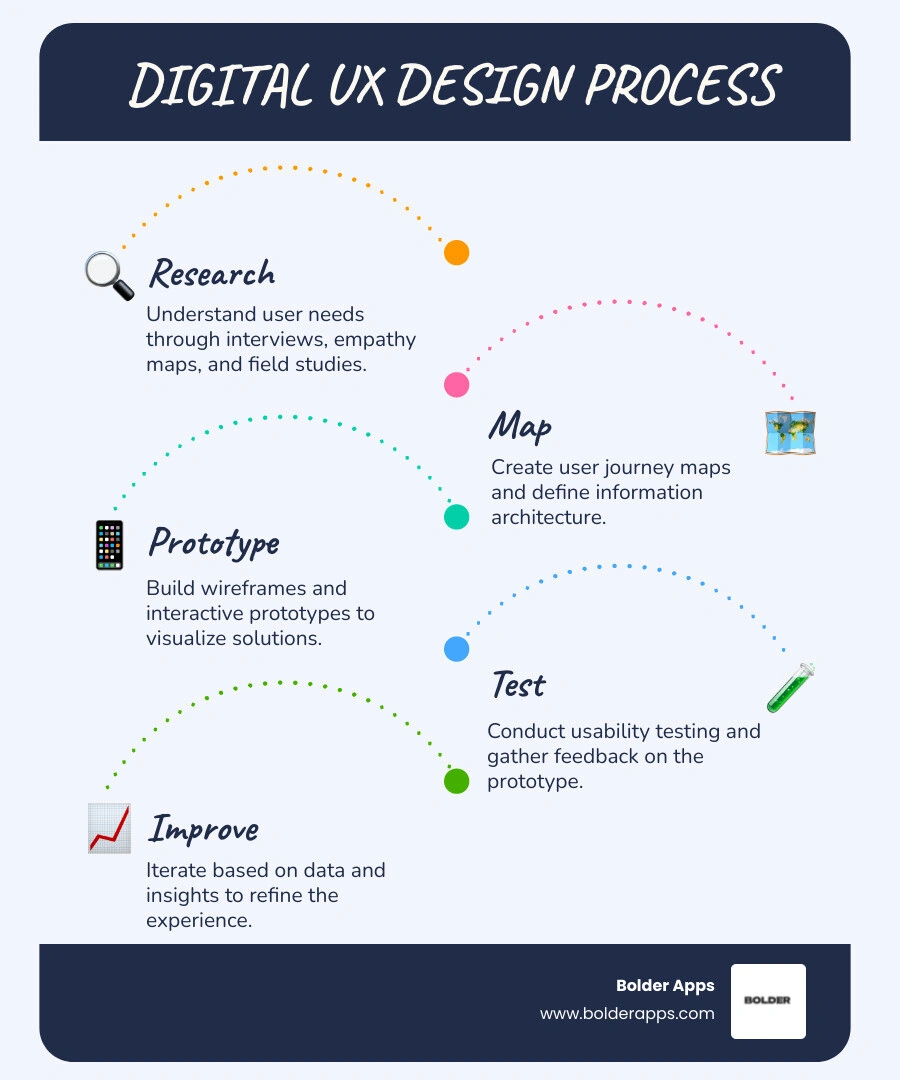
For a founder, that means testing more than whether a screen looks good. Research what users need, map their tasks, build a prototype, and watch where they get stuck. Then improve it and test again. The goal is an experience that works across platforms and for people with different abilities.
Related content about digital ux design:
At Bolder Apps, we look at digital experiences as entire ecosystems rather than isolated screens. Crafting an effective product requires an intimate grasp of human cognition, system ergonomics, and business objectives. When teams confuse visual styling with experiential architecture, products inevitably suffer from high friction, low retention, and user frustration. Establishing intuitive UI UX means designing for how humans naturally think, process information, and complete tasks.
User experience (UX) design encompasses every single touchpoint a human has with a digital product. It dictates the structural flow, mental models, information architecture, and overall ease of navigation. In contrast, user interface (UI) mechanics focus on the tangible, visual layer—the typography, color systems, micro-interactions, spacing tokens, and visual hierarchies that users visually perceive and interact with directly.
Think of UX as the structural blueprint, plumbing, and foundational architecture of a skyscraper, while UI represents the interior finishes, lighting fixtures, paint choices, and ergonomic hardware. A beautiful interface cannot rescue broken functionality, just as robust backend logic cannot save an interface that confuses users. Our dedicated interface design service bridges this exact gap, ensuring that visual appeal serves a direct functional purpose without increasing cognitive load.
Modern digital platforms must be constructed to serve diverse user populations seamlessly. Adopting a structured user-centered design approach guarantees that decisions originate from empirical user research rather than internal assumptions.
Key pillars of this discipline include:
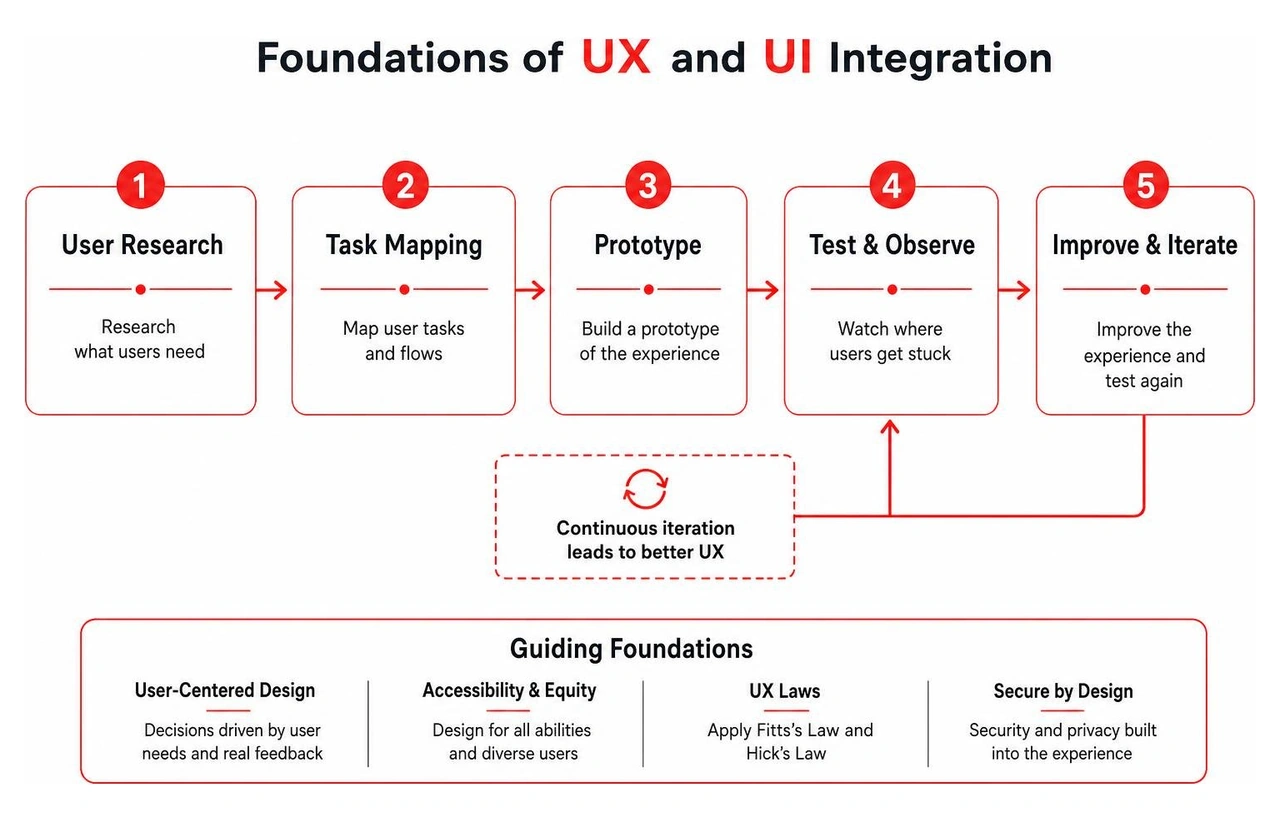
Great digital products do not emerge from random inspiration; they are the result of structured, repeatable design frameworks. Whether applying a rational model (sequential planning, formal specification, testing) or an action-centric model (improvisational reflection-in-action), leading product teams lean on data-driven UX design to eliminate guesswork and systematically derisk product investments.
The process begins by understanding user context through qualitative and quantitative discovery. Designers conduct semi-structured interviews, direct observational field studies, and contextual inquiries to capture true behavioral motivations. Many of these methodologies are deeply grounded in academic design theory, such as the academic frameworks in the MDes curriculum that emphasize transdisciplinary interaction models.
During this stage, teams build structured artifacts to align cross-functional stakeholders:

Once user requirements are documented, ideas transition rapidly from conceptual sketches into interactive prototypes. Wireframing strips away visual styling to isolate information hierarchy and task flows. As concepts mature, teams move into high-fidelity prototypes that mimic real production environments.
Utilizing expert wireframing and prototyping services allows companies to conduct moderated usability testing early. Observing real users struggle with navigation labels or form validations uncovers critical flaws before writing a single line of backend production code.
In 2026, artificial intelligence is no longer an experimental novelty; it is an active engine accelerating product workflows. Modern teams use AI-native pipelines to compress discovery phases, automate visual iteration, and synthesize complex datasets, as outlined in our comprehensive UI UX strategy guide for 2026.
Generative tools and agentic workflows allow product designers to execute routine tasks at unprecedented speed:
While AI brings immense efficiency, unchecked automation introduces real risks, such as synthetic research hallucinations and generic interface patterns. High-impact design requires human-in-the-loop oversight to ensure emotional resonance, nuanced brand voice, and genuine user empathy. Leading academic journals like Design Studies (boasting a 10.5 CiteScore and a 4.8 Impact Factor) routinely demonstrate that human-AI collaboration yields significantly higher creative outcomes than unassisted human work or fully automated systems alone. Designers must steer the prompt, curate the output, and validate results against real human behavior.
Building world-class digital products requires an understanding of the career structures, educational systems, and skills that define modern design practice. Balancing empirical metrics with aesthetic harmony remains central to mastering the art and science of digital product design.

Modern UX professionals must possess a hybrid toolkit spanning research, visual craftsmanship, and technical literacy:
The demand for specialized UX professionals remains robust. In 2026, there are over 63,000 open UX design jobs in the United States, commanding a median entry-level salary of $125,000. Professionals enter the field through specialized university degrees or intensive certification programs like the Google UX Design Professional Certificate, which has enrolled over 1.5 million learners with a 75% positive career outcome rate within six months of graduation.
Key specialization titles include:
A winning design portfolio emphasizes problem-solving process and measurable business outcomes over flashy visual mockups. When evaluating design talent, hiring managers look for clear demonstrations of value:
UX design focuses on the user journey, structural flow, accessibility, and problem-solving mechanics of a product. UI design governs the visual elements—typography, colors, button styles, iconography, and micro-interactions—that create an engaging, aesthetically coherent presentation.
In the United States, the median entry-level salary for UX designers is $125,000, with more than 63,000 open roles across technology, healthcare, finance, and enterprise software sectors.
AI accelerates research synthesis, automates accessibility audits, and generates rapid layout variations. However, human designers remain essential for validating research accuracy, maintaining brand nuance, and making strategic product decisions.
Creating exceptional digital products demands more than surface-level styling; it requires deep user empathy, rigorous architectural testing, and seamless cross-platform execution. Since 2019, Bolder Apps has partnered with ambitious founders and enterprise leaders to build high-impact mobile and web applications. Recognized by DesignRush as the top software and app development agency in 2026, our team pairs strategic US leadership with senior distributed engineers to deliver intuitive, production-ready software—guaranteeing no junior learning on your dime.
Whether you are launching a new venture in Miami, United States or scaling an enterprise platform globally across our various office locations, we ensure complete peace of mind through a transparent fixed-budget model, an in-shore CTO paired with a senior dev team, and milestone-based payments. Explore our end-to-end UI/UX design services today, and let us bring your product vision to life.