
Sean Weldon
October 13, 2026
10
min. read
and updated on:
October 19, 2026


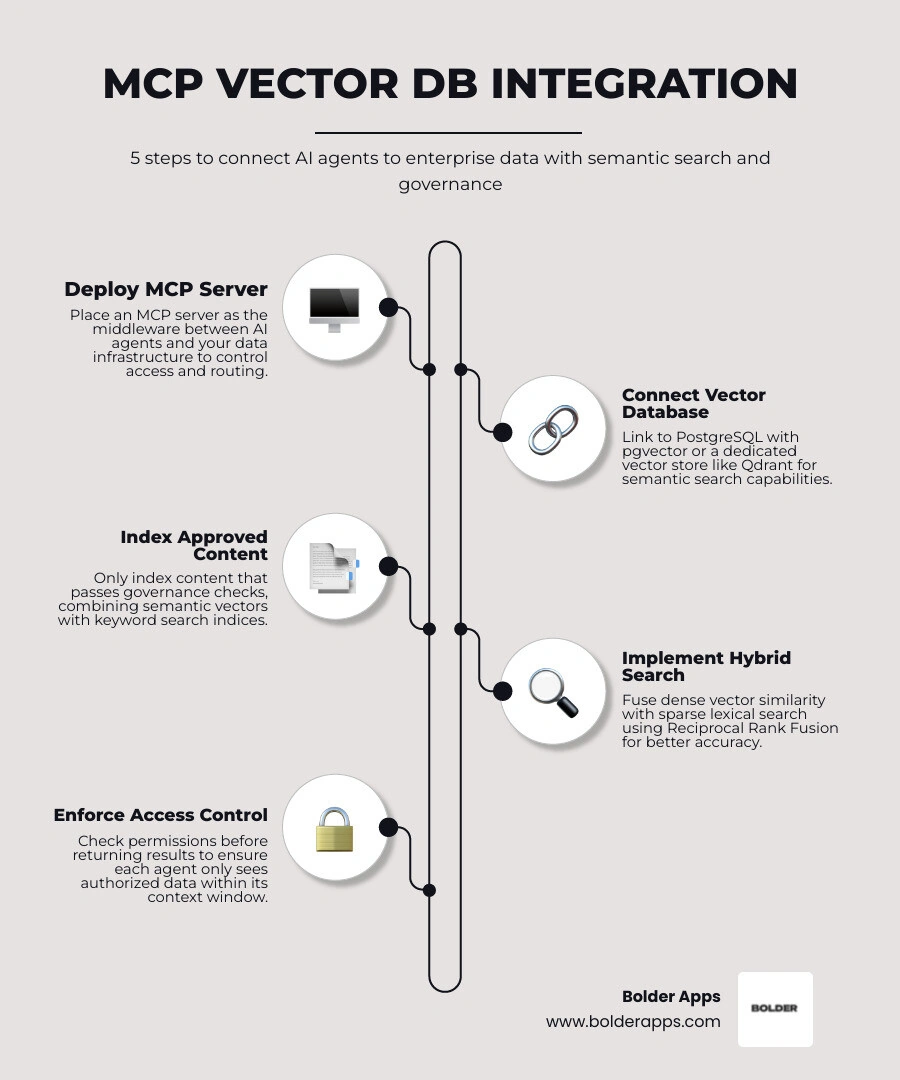
To integrate a vector database with your data infrastructure, put an MCP server between your AI agents and your data. Let the server expose a small set of search tools, then connect those tools to PostgreSQL with pgvector or a dedicated vector store. Index approved content, combine semantic and keyword search, and check access rights before returning results.
This gives agents a way to find relevant knowledge without loading every document or tool into their context. The hard part is keeping results current and secure. This guide shows how to choose a backend, build hybrid search, sync embeddings, and govern what each agent can see. A well-architected mcp vector database integration with data infrastructure turns a sprawling data estate into a governed, queryable knowledge layer for AI agents.
To implement this architecture effectively, understanding what an MCP server is, how the Model Context Protocol operates, and how MCP server AI integration works in practice provides a strong operational foundation.
When engineering AI systems across distributed environments, managing raw data access is a critical bottleneck. Large language models (LLMs) break down when forced to consume sprawling database schemas, thousands of lines of documentation, or massive API surfaces inside their prompt prompts. The Model Context Protocol (MCP) establishes a standardized client-server runtime that exposes internal assets—like collections, functions, and contextual prompts—directly to AI agents through well-defined JSON-RPC protocols.
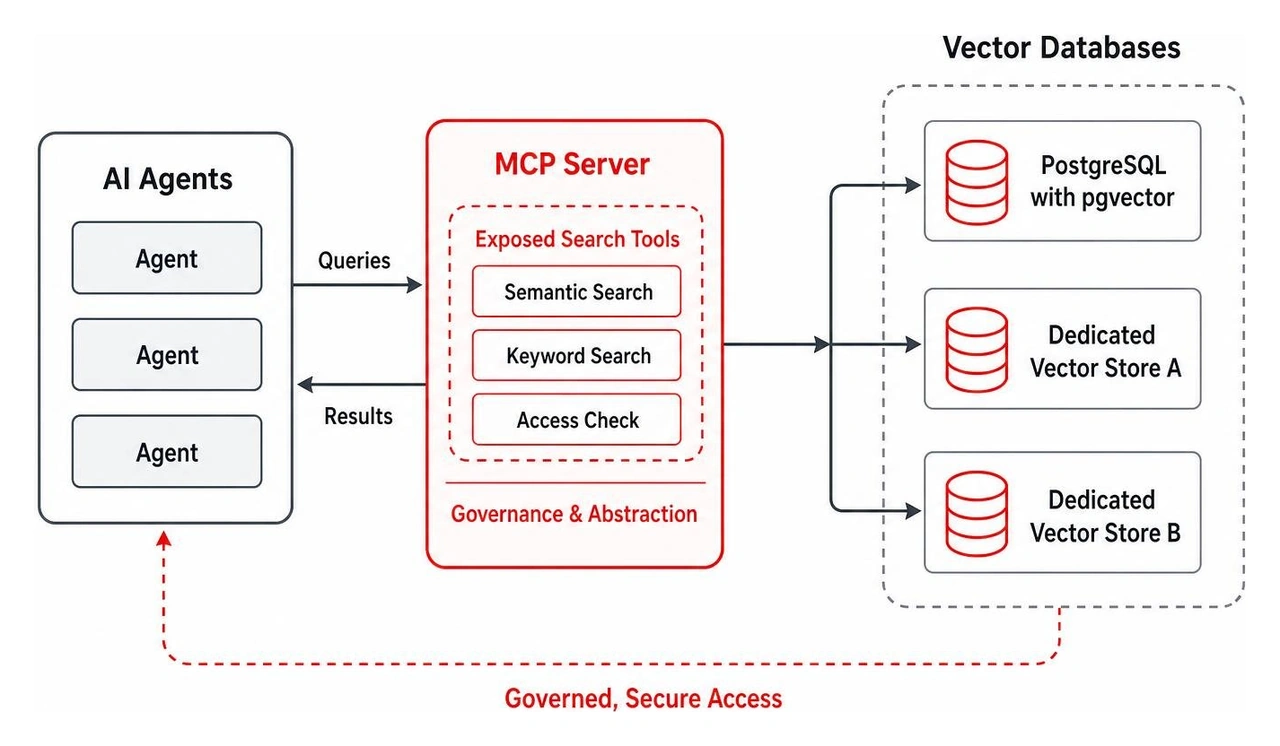
Integrating vector backends via MCP requires treating retrieval as a first-class abstraction. Instead of hardcoding specialized database client libraries across dozens of disparate agent routines, an MCP server functions as a centralized gateway. This gateway exposes governed collection management, dynamic tool sets, and vector search operations over lightweight transports such as standard input/output (stdio) or streaming HTTP Server-Sent Events (SSE).
Modern architectural frameworks simplify this mediation layer. The Knuckles-Team vector-mcp framework highlights how an open-source abstraction layer provides a unified protocol surface across different storage engines. By orchestrating runtime configurations and credential trust stores separately from packaged agent skills, systems can decouple underlying storage mechanisms from consumer agents. Using an enterprise Model Context Protocol implementation ensures that connection secrets, database endpoints, and authorization boundaries remain isolated within secure server-side infrastructure, giving agents clear, governed semantic search tools without exposing raw data connections.
A primary engineering choice when architecting vector integrations is deciding between a unified relational database using vector extensions versus provisioning a dedicated vector database.
Relational vector extensions, notably PostgreSQL powered by pgvector and Hierarchical Navigable Small World (HNSW) indexing, offer significant structural advantages for most workloads:
Dedicated vector databases—such as Qdrant, ChromaDB, Couchbase, or MongoDB Atlas Vector Search—serve complementary roles. These engines excel when index sizes surpass system memory, when vector dimensions exceed hundreds of millions of entries, or when extreme sub-millisecond approximate nearest neighbor (ANN) retrieval speed across massive, horizontally sharded clusters is mandatory.
For teams building production RAG application development workflows inside enterprise data environments, research on why data MCPs require vector search shows that keeping vector embeddings inside relational databases like PostgreSQL minimizes maintenance hurdles for fleets with under ten million documents.
A major challenge with autonomous agents is tool and schema bloat. If an MCP server naively exposes hundreds of distinct database operations—such as createcollection, deletecollection, updatepayload, semanticsearch, exact_match, and reindex—the tool definitions alone can consume tens of thousands of tokens before an agent even begins reasoning. This leads directly to degraded output quality, elevated latency, and unnecessary compute costs.
Action-routed MCP tools solve context bloat by condensing extensive operational surfaces into tightly focused interfaces. Instead of exposing individual operations as discrete tools, an MCP server can expose a consolidated gateway tool that routes actions dynamically using lightweight parameters (for example, vector_action(action="search", params={...})).
Furthermore, dynamic tool selection frameworks allow servers to filter which operations are active based on context:
X-MCP-Enabled-Tools or X-MCP-Disabled-Tools) over HTTP/SSE transports, dynamically limiting available tools for specific operational phases.Teams designing high-performance backends can leverage these patterns when building agent-ready backend infrastructure, ensuring context windows remain lean, focused, and cost-effective.

Pure semantic vector search excels at conceptual matching, but it can struggle with exact keyword lookups, such as part numbers, specific email addresses, or discrete variable names. Conversely, traditional lexical search identifies exact tokens but misses related conceptual meaning. Production-grade MCP vector integrations resolve this by executing hybrid search, combining dense vector similarity with sparse lexical indices.
When engineering hybrid search inside PostgreSQL, the infrastructure pairs an HNSW index (optimizing cosine or inner product distance) alongside a Generalized Inverted Index (GIN, powering to_tsvector lexical parsing).
The hybrid search process runs through four key execution stages:
1 / (k + rank)) across both arms, producing a unified, balanced relevance score without being skewed by mismatched raw distance metrics.Engineering these pipelines using robust Node.js infrastructure for AI backend development minimizes retrieval latency, delivering fast context payloads directly to agent runtimes.
Building a resilient vector integration requires setting up asynchronous processing pipelines, handling embedding versioning, and managing graceful degradation when models encounter errors.
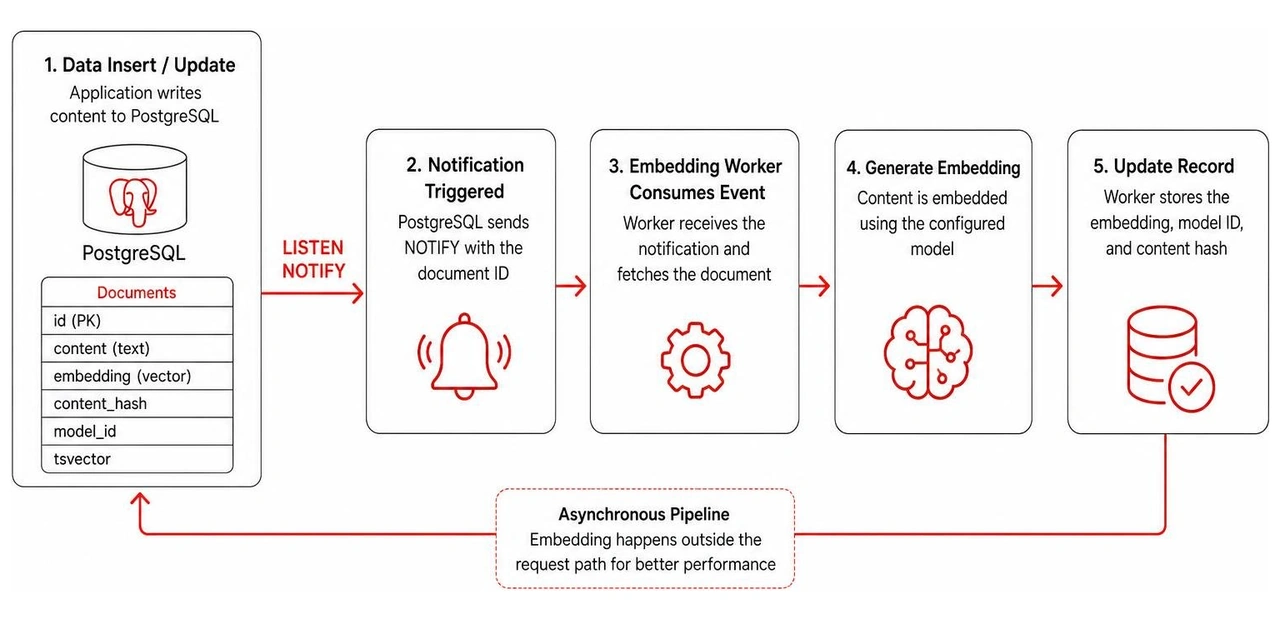
Create a dedicated table inside PostgreSQL with extensions enabled for vector. Include fields for content text, embedding vectors, text hashing, model identification, and full-text search columns.
Generating vector embeddings synchronously during standard write operations introduces severe latency spikes. If your embedding API stalls or hits rate limits, client write requests will fail.
Instead, configure asynchronous background workers using PostgreSQL's native LISTEN/NOTIFY system:
pg_notify('new_knowledge_record', row_id) event.Over time, foundational embedding models evolve, and source documentation is edited. To prevent stale embeddings from polluting your search indexes, write validation logic into your workers:
embedding_model string. If your system upgrades from an older embedding model to a newer architecture, the worker can systematically identify and re-embed all legacy vectors in the background without taking down production systems.External embedding APIs occasionally encounter network partitions, rate limits, or regional outages. To protect agent workflows, build fallback routines into your MCP retrieval tools:
degraded_mode: true operational metadata tag.As autonomous systems scale from single assistants to coordinated multi-agent fleets, sharing operational state and dynamic knowledge becomes essential. If Agent A updates customer documentation while Agent B executes tasks using an out-of-date cache, execution failures multiply quickly.
This challenge is addressed by architectures like the VaultMCP knowledge mesh project, which creates a shared knowledge substrate backed by PostgreSQL and pgvector that synchronizes in real time across multiple servers.
Under this design, distributed MCP servers connect back to a master database instance while maintaining local, in-memory or read-only Markdown wiki mirrors on edge agent nodes. When an agent writes new domain knowledge or updates schema documentation via MCP tools, changes broadcast via Server-Sent Events (SSE). Connected agent nodes update their local caches within seconds, allowing multi-agent fleets to collaborate across a consistent, verifiable knowledge base without manual cache invalidation.

Connecting AI agents to enterprise data stores introduces serious security considerations. Without strict guardrails, vulnerable tools can expose internal databases to data leakage, prompt injection attacks, and Server-Side Request Forgery (SSRF).
Enterprise-grade MCP deployments must incorporate strict security controls:
10.0.0.0/8, 192.168.0.0/16, and cloud metadata endpoints like 169.254.169.254) to prevent malicious prompt injections from probing internal enterprise networks.secret://...) resolved exclusively at runtime.Implementing these guardrails ensures resilient architectures when architecting enterprise-grade MCP servers.
Selecting the right architecture requires understanding the performance characteristics and scalability boundaries of relational vector stores versus dedicated engines.
Real-world benchmarks of pgvector-backed MCP implementations (such as VaultMCP running against PostgreSQL 15+ with HNSW indexing) demonstrate impressive baseline operational metrics for common workloads:
For context, pgvector configured with HNSW indexes operates comfortably up into the low single-digit millions of vector records (e.g., 1,000,000 to 5,000,000 vectors) while maintaining sub-15ms search latencies, provided sufficient RAM is allocated to hold index graphs in memory.
However, enterprise workloads reach architectural cutover points where dedicated vector databases become necessary:
Understanding these scaling limits helps engineering teams design sustainable architectures during end-to-end MCP app development.
Embedding vector search directly within an MCP server allows AI agents to dynamically retrieve relevant data, schema definitions, and API specifications on demand. This approach avoids context window bloat, reduces token consumption, cuts inference costs, and ensures models base decisions on verified, up-to-date enterprise data.
Teams should evaluate migrating from PostgreSQL with pgvector to a dedicated vector database when their dataset exceeds low single-digit millions of vectors, when memory requirements for HNSW indexes overwhelm the database server, or when the system demands high-throughput horizontal sharding with strict sub-millisecond p99 latency targets.
Action-routed MCP tools condense multiple related database functions into unified, parameterized tool definitions rather than exposing dozens of discrete endpoints. Combined with runtime header filtering and role-based tool gating, this approach keeps agent system prompts lightweight, focused, and token-efficient.
Integrating vector databases with enterprise data infrastructure via the Model Context Protocol transforms how autonomous AI agents discover and leverage corporate knowledge. By adopting hybrid search strategies, asynchronous embedding workflows, and robust security guardrails, organizations can build responsive, scalable, and secure data access layers that eliminate prompt bloat while protecting proprietary assets.
At Bolder Apps, founded in 2019, we specialize in architecting high-impact digital products, scalable web and mobile platforms, and enterprise AI systems. Recognized as the top software and app development agency in 2026 by DesignRush, our unique delivery model pairs experienced in-shore technical leadership—including hands-on CTOs based out of our Miami, Florida headquarters—with senior distributed engineering talent. We operate on transparent, fixed-budget engagements and milestone-based payments, ensuring your strategic vision is brought to life on time, within budget, and with zero junior developers learning on your dime. Explore our custom digital product and enterprise AI engineering services and connect with our team through our regional locations to start building your next-generation AI infrastructure today.