Sean Weldon
September 9, 2026
10
min. read
and updated on:
September 24, 2026


An MCP server is a small program that gives an AI application a standard, controlled way to use external tools, live data, and services. Instead of an AI assistant only generating text, it can use an MCP server to search a knowledge base, inspect a database, create a ticket, check a calendar, or trigger an approved workflow.
In simple terms, the Model Context Protocol (MCP) is the shared rulebook. An MCP server is the working connector that follows those rules and exposes useful capabilities to an AI host, such as an IDE, chatbot, or agent.
That distinction matters. Your model does not need to learn every API, database format, and login method on the internet. The MCP server translates between the AI application and the underlying system, with structured inputs, outputs, permissions, and logs.
MCP was introduced by Anthropic in November 2024 and quickly gained broad ecosystem support. By 2026, it is a practical foundation for teams building agentic workflows without creating a fresh custom integration for every model and service. Think of it as a universal adapter for AI, only less likely to disappear into a drawer full of cables.
For founders building ambitious digital products, MCP can turn disconnected systems into useful, governed AI workflows. It can also reduce the integration burden from an expensive N x M web of custom connectors toward a more manageable shared standard.
Bolder Apps, founded in 2019 and named the top software and app development agency in 2026 by DesignRush, helps product leaders build reliable software foundations for emerging AI capabilities. Learn more about its US locations and approach at Bolder Apps.
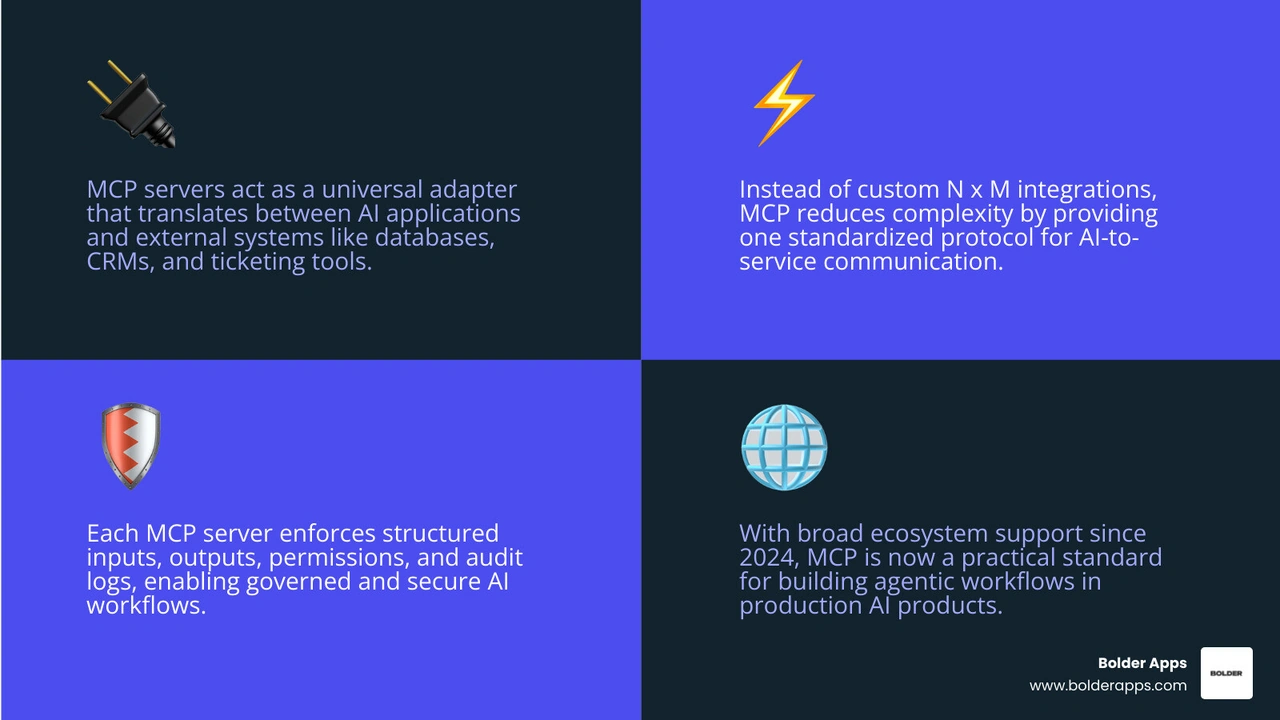
Quick what is an mcp server terms:
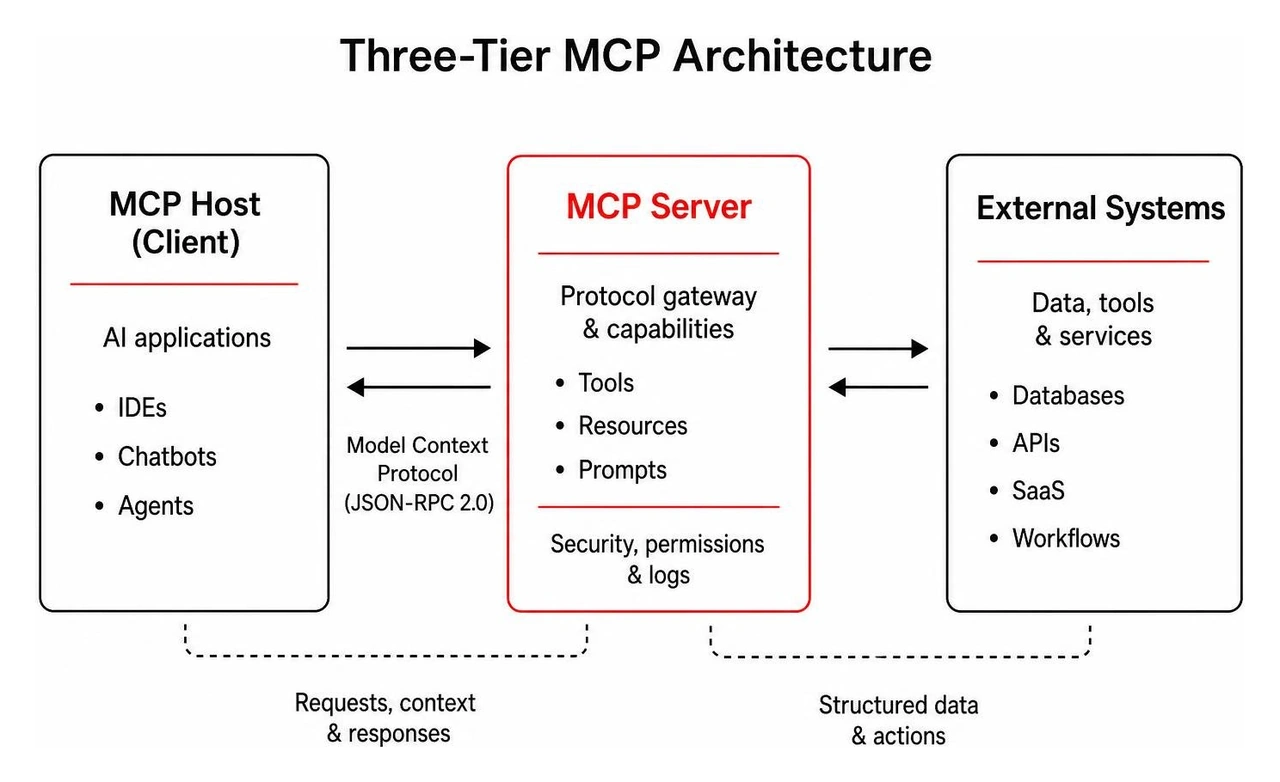
To understand how an MCP server functions, it helps to break down the relationship between large language models and operational software. By default, LLMs operate inside a closed computational boundary: their static training data is frozen at a specific moment in time, and they possess zero native ability to interact with real-world infrastructure.
An MCP server acts as a lightweight adapter that translates requests from an AI host application into deterministic backend operations. Rather than forcing developers to write bespoke endpoint handlers and glue code for every distinct AI model or client interface, the server implements standard JSON-RPC 2.0 message framing over a shared protocol layer. This creates a secure, bi-directional communication channel between the probabilistic reasoning of foundation models and the deterministic state of enterprise infrastructure.
The governance and evolution of the Model Context Protocol reached a major industry milestone in December 2026, when Anthropic officially transitioned governance to the Agentic AI Foundation under the Linux Foundation. Supported broadly by major technology leaders including OpenAI and Google DeepMind, MCP has cemented itself as the open, vendor-neutral standard for connecting agentic intelligence to data systems and functional tooling.
A common source of confusion in modern AI development is the distinction between the protocol itself and the concrete server implementation.
By decoupling the communication protocol from the underlying business logic, development teams can build an integration once. That single MCP server immediately becomes readable and actionable across any MCP-compliant AI client, desktop tool, or autonomous coding assistant without requiring custom connector modifications.
The MCP architecture divides server capabilities into three standardized primitives, each governed by clear operational boundaries:
inputSchema defined using the JSON Schema standard, which guarantees that model-generated parameters are strictly typed and validated before execution. Examples include running database queries, sending transactional alerts, or triggering CI/CD release builds.Under the hood, MCP follows a distinct three-tier architectural hierarchy consisting of the MCP Host, the MCP Client, and the MCP Server.
The MCP Host represents the overarching AI execution environment—such as an IDE, conversational workspace, or autonomous agent runtime. Within this host, dedicated internal MCP Client instances maintain direct, isolated connections to external MCP servers. The protocol enforces a strict one-client-to-one-server connection pattern, ensuring that capability negotiation, authentication boundaries, and stateful sessions remain cleanly segmented.
Communication across this architecture is strictly stateless at the protocol level: every JSON-RPC 2.0 message packet negotiates supported capabilities and protocol versions within its metadata. To ensure exceptional responsiveness, discovery caching allows AI hosts to cache tools/list and resources/list manifests using configurable time-to-live settings. High-performance MCP servers frequently achieve sub-10ms latency overhead during active tool invocation, ensuring real-time responsiveness across intensive agentic workflows.
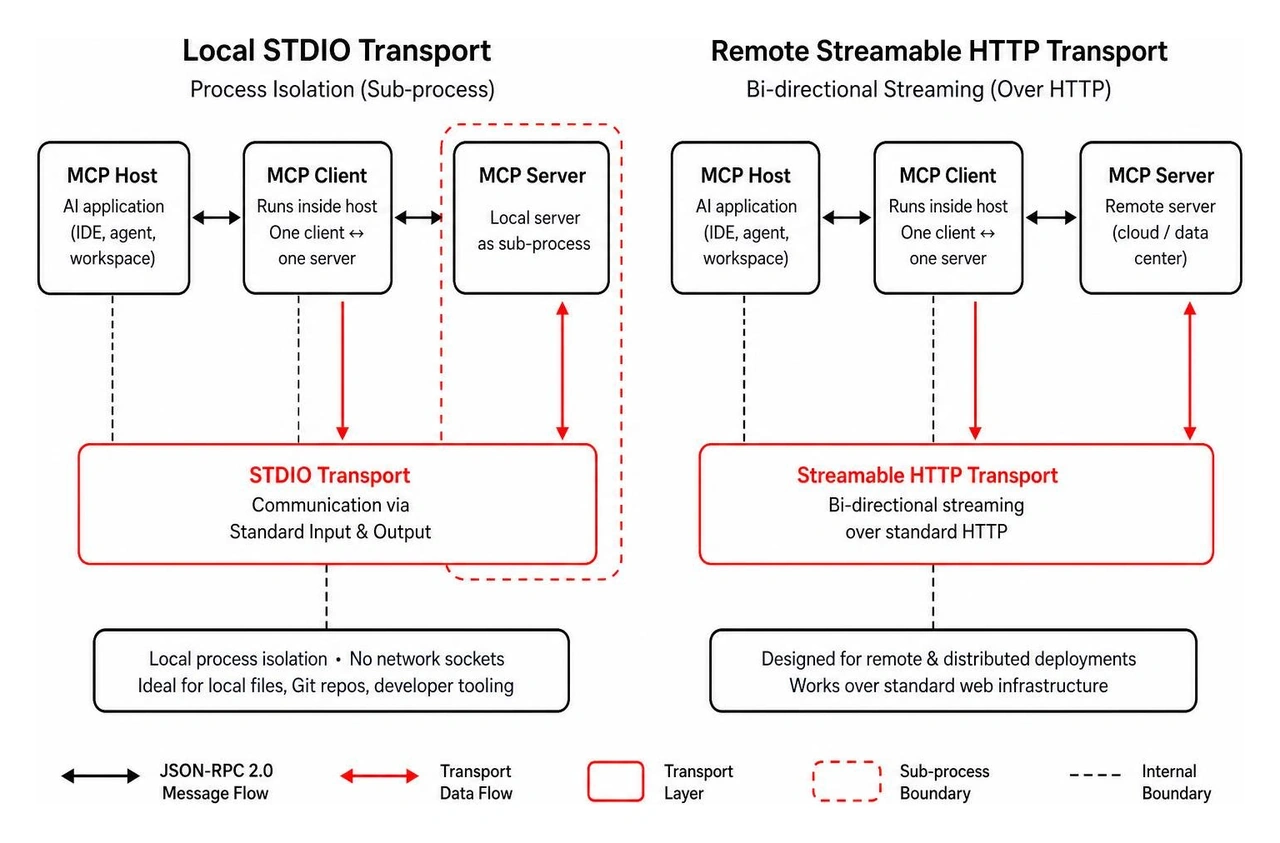
MCP servers communicate across two primary transport mechanisms depending on deployment architecture, security requirements, and operational topology:
stdio). Because the process runs within the user's authenticated machine environment, STDIO bypasses local network socket configuration and complex network authentication. This makes it ideal for local filesystem access, private Git repository parsing, and developer IDE tooling.For teams implementing modern JavaScript runtimes, our guide on Building MCP Servers with Node.js: How to Make Your Backend Readable by AI Agents in 2026 provides an architectural blueprint for setting up both STDIO and streaming network transports.
Before the widespread adoption of standardized context protocols, connecting AI models to enterprise tooling suffered from an unsustainable combinatorial challenge known as the N x M integration problem.
If an organization operated N distinct AI interfaces (desktop assistants, internal chatbots, autonomous agents, code editors) and required access to M distinct backend services (CRMs, relational databases, ticket tracking systems, code repositories), engineering teams had to construct and maintain $N \times M$ bespoke API wrappers. Whenever a tool updated its schema or a new model provider was introduced, custom integration code broke across the stack.
By introducing a universal adapter standard, MCP reduces this equation to a manageable $N + M$ architecture. Tool creators build an MCP server once, and AI applications implement an MCP client once. Exploring comprehensive MCP Framework Integration patterns enables engineering organizations to overcome point-to-point integration bottlenecks and achieve genuine enterprise data readiness.
While MCP servers often wrap existing REST or GraphQL APIs, they serve a fundamentally distinct role within the software stack. Understanding how MCP compares to legacy API design is essential for building modern agent-ready backends. For a deeper architectural breakdown, explore our analysis on Beyond REST: Building Agent-Ready Node.js Backends for the AI-Native Mobile Era.
Retrieval-Augmented Generation (RAG) has long served as the standard approach for grounding large language models with factual knowledge. However, traditional RAG architectures remain inherently passive: they extract semantic chunks from vector databases and append static text into the model's prompt window.
MCP servers extend this paradigm into active, bi-directional execution. Rather than merely reading static historical documentation, an AI model connected to an MCP server can perform Table-Augmented Generation (TAG), inspect live production database schemas, run real-time analytical calculations, and execute stateful write operations across external platforms.
This active capability drastically reduces model hallucinations by grounding reasoning loops in real-time system responses. To explore how autonomous agents leverage these active tool loops in production, see our guide on AI Agent Development Mobile Apps 2026.
Standard enterprise REST APIs are notorious for returning verbose, deeply nested JSON responses containing extraneous metadata, pagination tokens, and redundant timestamps. When ingested directly by an AI model, these verbose payloads rapidly consume context window limits, degrade reasoning accuracy, and inflate API token costs.
MCP servers act as intelligent contextual filters. By designing compact, LLM-friendly schemas, the server extracts only the precise attributes necessary for model comprehension.
To maintain strict context optimization, production MCP implementations employ several strategies:
max_tokens) and providing structured pagination summaries for large dataset queries.readOnlyHint, idempotentHint, and destructiveHint) to help LLMs select optimal tools without trial-and-error reasoning overhead.As organizations transition generative AI systems from experimental prototypes into high-scale production environments, security and governance represent the single largest operational constraint. Industry benchmarks indicate that 76% of organizations cite guardrails as a primary constraint for enterprise GenAI, while 62% cite enterprise data readiness. Deploying autonomous tooling without architectural safeguards introduces unacceptable risks of data exfiltration and unauthorized system manipulation.
At Bolder Apps, our engineering teams build deterministic validation perimeters around every probabilistic model interface. For an in-depth framework on securing autonomous tool execution, refer to our playbook on The Ethics of Autonomy: How Bolder Apps Builds Deterministic Guardrails into Agentic Mobile Workflows.

One of the most dangerous attack vectors facing agentic systems is indirect prompt injection. When an AI agent processes untrusted external content (such as a public webpage, customer support email, or third-party code repository), hidden adversarial instructions can override the model's core system prompt and hijack its tool-execution capabilities.
Security architects analyze this vulnerability through the lens of the Lethal Trifecta:
If an AI agent possesses all three capabilities simultaneously without deterministic guardrails, an attacker can manipulate the agent into reading private database records and exfiltrating them via outbound network calls.
MCP servers mitigate this vulnerability by enforcing strict structural boundaries:
Enterprise deployments require robust, auditable identity governance. Modern MCP servers implement standardized OAuth 2.0 Protected Resource Metadata and Resource Indicators to ensure strict token authentication and prevent credential replay attacks.
Under an enterprise IAM architecture, each autonomous agent is assigned a scoped non-human identity (NHI). When the agent interacts with backend services through an MCP server, all operations are governed by Role-Based Access Control (RBAC) mapped to the active user session. Furthermore, the server applies dynamic data masking to ensure sensitive personally identifiable information (PII) is obfuscated before entering the model's context. Comprehensive enterprise implementation standards are further outlined across the Google Cloud MCP documentation.
With 45% of organizations focused on achieving production scale for enterprise GenAI in 2026, building scalable MCP infrastructure requires robust engineering practices. Highly optimized MCP server architectures can comfortably handle 350+ requests per second (RPS) on just 1 vCPU with approximately 10ms latency overhead.
To achieve this level of performance and reliability, teams deploying MCP servers should follow proven architectural patterns outlined in our MCP App Development Complete Guide.
A critical yet frequently overlooked constraint in agentic engineering is the active tool budget. While it is tempting to expose hundreds of capabilities to an AI agent, loading too many tool schemas simultaneously into a context window degrades performance, increases token latency, and causes model confusion.
Industry testing shows that AI clients begin experiencing cognitive degradation and elevated error rates when loaded with more than ~40 active tools simultaneously. Because a standard enterprise MCP server typically exposes 10 to 12 distinct functions, connecting just four servers can saturate an agent's practical tool budget.
Production environments solve this through virtual toolset grouping, dynamic schema loading, and strict rate-limiting per client session. Leveraging OpenTelemetry allows infrastructure teams to monitor tool invocation frequency, context size expansion, and downstream latency bottlenecks in real time.
MCP servers have transformed modern software engineering and operations workflows. By bridging development environments directly to cloud platforms, engineering teams can automate routine tasks through natural language interfaces.
A leading reference implementation is the official GitHub MCP Server, which provides AI coding assistants with secure, structured access to repository management, pull request reviews, and issue triage. Similarly, Site Reliability Engineers (SREs) utilize specialized infrastructure MCP servers to query live cluster telemetry, trace error spikes, and trigger automated deployment rollbacks directly from their primary IDE workspaces.
No. An MCP server is a passive capability provider that exposes tools, data resources, and structured templates over a deterministic protocol contract. It possesses no autonomous agency, decision-making logic, or internal execution loop.
An AI agent, by contrast, is the active reasoning system (powered by an LLM) that orchestrates goals, interprets user requests, decides which tools to call, and acts upon the returned data. The agent is the brain; the MCP server provides the hands and senses.
While many basic MCP implementations focus solely on read-only context retrieval, advanced enterprise MCP servers provide bi-directional synchronization through combined resource and tool primitives.
An AI host can read structured documentation or data schemas via passive MCP Resources, process necessary updates through the language model, and subsequently execute write-back operations using validated MCP Tools. This architecture keeps enterprise knowledge bases, CRM records, and technical documentation evergreen directly from developer workflows.
As of 2026, the Model Context Protocol standardizes on two primary transport mechanisms:
The Model Context Protocol has fundamentally redefined how modern software connects with generative AI. By moving away from fragmented, brittle API wrappers toward an open, standardized context layer, forward-thinking organizations can build powerful, governed agentic workflows that scale reliably.
However, transforming an MCP proof-of-concept into a secure, production-grade enterprise deployment requires deep software engineering rigor—from implementing zero-trust authentication and deterministic guardrails to optimizing context token budgets and database latencies.
At Bolder Apps, we specialize in designing and engineering high-impact mobile, web, and AI-native applications. Founded in 2019 and named the top software and app development agency in 2026 by DesignRush (verify details on bolderapps.com), we pair dedicated in-shore CTO leadership with a proven offshore dev team. We operate on a transparent fixed-budget model with milestone-based payments—ensuring rapid, enterprise-grade execution with zero junior learning on your dime.
Ready to architect robust, agent-ready backends for your digital products? Explore our comprehensive Bolder Apps enterprise AI product development services or connect with our teams across our locations in the United States to bring your product vision to life today.