
Pavel Yanushka
June 8, 2026
10
min. read
and updated on:
June 8, 2026



UI/UX design services are the specialized teams and processes that create digital products people actually want to use. But if you're shopping for a design partner right now, you're probably hearing a lot of sales pitches and not much truth.
What you need to know:
Here's the uncomfortable truth: 88% of online users won't return to a site after a bad experience. That's not just a lost click—that's a lost customer, a failed conversion, and money left on the table.
On the flip side, good UX design can increase conversion rates by up to 400%. For every dollar invested in UX, companies see returns of $100 on average. That's an ROI of 9,900%.
So why don't most UI/UX design agencies lead with these numbers? Because the design industry has some secrets it doesn't love to share. Some are about process shortcuts. Some are about misaligned priorities. And some are about what you're actually buying when you hire a designer.
This article pulls back the curtain on seven things your UI/UX design service probably won't tell you—but should. Whether you're building your first MVP or scaling an enterprise platform, knowing these truths will save you time, money, and a lot of frustration.
We've all heard the buzzwords: "user-centric design," "delightful experiences," "intuitive interfaces." But when it comes to the bottom line, many UI/UX design services shy away from truly quantifying the massive return on investment (ROI) that effective design delivers. They might talk about increased engagement or customer satisfaction, but they rarely break down the full financial impact.
Let's do the math. The statistics are staggering: for every $1 invested in UX, companies can see returns of $100. That's an ROI of 9,900%! A good UI/UX design can increase conversion rates by up to 400%. Businesses that prioritize UX see a 25% to 95% increase in market share. This isn't just about making things look nice; it's about making things work better, faster, and more profitably.
Investing in professional UI/UX design services isn't just an expense; it's a strategic investment in your business's future. It's about solving real user problems, which directly translates to business success. When users have a positive experience, they're more likely to convert, stay loyal, and even advocate for your product. User-friendly design is crucial for 77% of purchasing decisions. A good UI/UX design can increase customer satisfaction by up to 16% and loyalty by up to 15%.
Beyond direct conversions, superior UI/UX reduces development rework by getting it right the first time. It fosters long-term customer retention, reducing churn and increasing the lifetime value of each user. It also gives you a significant competitive edge. In a digital world, a sluggish app or a bland web application can send potential customers clicking away to competitors. A 0.1-second improvement in page load time can increase conversion rates by 7%, while 53% of mobile users leave websites that take longer than 3 seconds to load. These seemingly small details add up to huge financial gains.
When we approach UI/UX, we're not just thinking about pixels and aesthetics; we're thinking about your business strategy, market position, and how to maximize your investment. We believe that proper Product Strategy Consulting is the foundation for any successful UI/UX project, ensuring that every design decision aligns with your overarching business goals.
Every UI/UX design service will present you with a beautiful, linear flowchart detailing their "proven process": Research, Wireframing, Prototyping, Design, User Testing, Implementation, Review, and Iteration. It looks so neat and tidy, doesn't it? The truth is, the real world of design is rarely a straight line. It's a messy, beautiful, iterative loop, and any agency that tells you otherwise is probably simplifying things a bit too much.
In our experience, a typical UI/UX process is less of a rigid checklist and more of a flexible framework. We start with findy, diving deep into understanding your business, users, and market through stakeholder interviews and competitive analysis. This leads to user research and mapping, where we create personas and journey maps to truly understand user needs and pain points.
Then comes interaction and visual design, involving wireframing and prototyping. Wireframing is about outlining the structure, content, and functionality, while prototyping brings those concepts to life through interactive mock-ups. These aren't just steps to check off; they're opportunities for validation. We use prototypes to test and iterate on user experience before development even begins, ensuring a user-centric approach.
The "secret" here is that this process is deeply iterative. You might uncover critical insights during user testing that send you back to wireframing. A stakeholder's feedback might necessitate a tweak in the design phase. Overcoming challenges often means looping back through earlier stages, refining and improving based on new information. It's a continuous cycle of assessment and refinement.
Wireframing and prototyping play a crucial role in managing this complexity. Low-fidelity wireframes allow us to quickly sketch design solutions and test basic user flows without investing too much time in visual details. As we move to high-fidelity prototypes, we create interactive models that simulate the final product, allowing for thorough user testing and validation. This iterative approach, with continuous feedback loops, is key to enhancing user experience and delivering a truly polished product.
This flexible, iterative approach is how we ensure that the final product is not just functional but truly intuitive and delightful. It's why we emphasize Prototype Development as a cornerstone of our UI/UX design services, allowing us to validate ideas and refine experiences long before a single line of code is written.
Many UI/UX design services will proudly showcase their visually stunning portfolios, filled with sleek interfaces and vibrant color palettes. And while aesthetics are important—User Interface (UI) design focuses on a program's visual elements like images, fonts, and colors—they're only half the story. The real power of design lies in understanding human psychology and behavior, something often overlooked in the pursuit of "pretty."
Effective UI/UX design isn't just about making something look good; it's about making it feel right and function effortlessly. This means delving into core design principles like usability, functionality, and desirability, all rooted in how users think and interact. We rely heavily on data-driven decisions and evidence-based design to remove opinions and guesswork from the process.
How do we do this? Through rigorous user research methods. We conduct surveys and interviews to understand user needs and motivations. We create detailed user personas to represent different user groups, ensuring we're designing for real people with real problems. Usability testing and A/B testing provide concrete data on what works and what doesn't. This process allows us to gather insights and build products that genuinely resonate with users.
Consider the psychological principles at play: Fitt's Law, which states that the time to acquire a target is a function of the distance to and size of the target, influencing button placement and sizing. Or Hick's Law, which suggests that the time it takes to make a decision increases with the number and complexity of choices, guiding us to simplify navigation and reduce cognitive load. These aren't just abstract theories; they are practical tools that inform every design decision we make.
By focusing on the psychology of user behavior, we ensure that our designs are not only visually captivating but also deeply intuitive and effective. We believe in smarter UX design backed by evidence, because user-friendly design is crucial for 77% of purchasing decisions. It's the difference between a product that simply exists and one that genuinely solves problems, fosters loyalty, and drives business growth. For readers who want to go deeper into how research and testing shape better experiences, resources like the usability and UX research overview on Nielsen Norman Group offer a helpful, vendor-neutral starting point.
Here's a common scenario: a design agency delivers beautiful mock-ups and prototypes, you approve them, and then they disappear, leaving your development team to figure out how to translate those designs into a functional product. The designer-developer handoff is a critical, yet often neglected, phase in the digital product lifecycle, and it can quickly become a minefield if not managed properly.
The fundamental difference between a UI/UX designer and a developer is their focus. UI/UX designers focus on usability, utility, accessibility, and desirability—how the product looks, feels, and functions from a user's perspective. Developers, on the other hand, build the actual product, writing code to bring those designs to life. These are distinct skill sets, and without clear communication and documentation, things can go awry.
A seamless developer handoff is crucial for efficiency and maintaining design integrity. This means providing more than just static images. It requires comprehensive design systems, which are collections of reusable components, guidelines, and documentation that ensure consistency and scalability. Clear documentation, including detailed specifications for spacing, typography, colors, and interactive behaviors, is essential.
We understand that a successful handoff is not an afterthought; it's an integral part of our UI/UX design services. We ensure our designs are not only visually appealing but also technically feasible and well-documented for your development team. We use common UI/UX tools to create organized, layered files and interactive prototypes that developers can easily inspect and understand. This collaborative approach minimizes misinterpretations, reduces rework, and accelerates the development cycle.
Effective collaboration between design and development teams is paramount. As we emphasize in our guide, Mobile App Development Team Explained: Who You Need and Why It Matters, a well-structured team with clear roles and communication channels is vital for success. By bridging the gap between design vision and technical implementation, we ensure your product is built exactly as intended, without unnecessary delays or compromises.
In the rush to launch a product, some UI/UX design services might treat accessibility as an optional add-on, or worse, ignore it altogether. The truth is, accessibility (often abbreviated as a11y) is not just a nice-to-have; it's a fundamental aspect of inclusive design, a legal requirement in many cases, and ultimately, it leads to a better user experience for everyone.
What is accessibility? It's the practice of designing and developing digital products so that people with disabilities can perceive, understand, steer, and interact with them. This includes users with visual impairments (requiring screen readers, high-contrast modes), motor impairments (relying on keyboard navigation), cognitive disabilities, and more.
Why does it matter? Firstly, it's about inclusivity. By making your product accessible, you broaden your user base, reaching millions of people who might otherwise be excluded. Secondly, there are legal requirements, such as adherence to Web Content Accessibility Guidelines (WCAG) standards. Non-compliance can lead to legal challenges and reputational damage.
But beyond legal and ethical considerations, accessible design often improves the overall user experience for all users. Features like clear color contrast, logical keyboard navigation, and well-structured content benefit everyone, not just those with disabilities. Think about using an app in bright sunlight (high contrast helps) or navigating with one hand (keyboard shortcuts or larger tap targets can be a lifesaver).
The risk of skipping accessibility is significant. It limits your market reach, exposes you to legal risks, and can result in a less user-friendly product overall. Retrofitting accessibility after launch is often more expensive and time-consuming than building it in from the start.
We believe that inclusive UX/UI design is a strategic differentiator. It broadens product reach, improves usability, ensures legal compliance, and builds trust with your audience. Integrating these principles throughout the design process is how we ensure our products are usable and enjoyable for the widest possible audience.
When evaluating UI/UX design services, it's easy to get impressed by a portfolio filled with beautiful, generic app designs. But what many agencies won't tell you is that a stunning online profile doesn't automatically translate to success in your specific industry. Applying UI/UX principles effectively requires deep industry experience, understanding nuanced user goals, and navigating complex workflows unique to different sectors.
Consider the stark differences: designing a B2B SaaS platform is vastly different from creating a B2C e-commerce app. A B2B platform typically caters to team-based workflows, multi-step decision processes, and often involves complex data visualization and custom dashboards. The user's goal isn't just a quick purchase; it's efficiency, data accuracy, and seamless integration into their daily tasks.
In contrast, a B2C e-commerce app emphasizes emotional engagement, rapid conversion funnels, and persuasive storytelling. The user journey is often shorter, more visually driven, and focused on instant gratification.
This is where specialized industry experience becomes invaluable. For example, in Healthcare UI/UX, compliance with regulations like HIPAA is non-negotiable. Designs must prioritize data security, patient trust, and clear, unambiguous information delivery. Simplifying complex medical data into digestible formats for both patients and practitioners requires a profound understanding of the industry's unique challenges and user needs.
Similarly, Fintech UI/UX demands an acute focus on trust and security. Users are dealing with their money, so clarity, transparency, and robust security features must be embedded in every interaction. Simplifying complex financial data and transactions while maintaining user confidence is a delicate balance.
A one-size-fits-all agency, lacking specific industry knowledge, might struggle with these complexities. They might deliver a visually appealing product, but one that fails to meet regulatory requirements, streamline critical workflows, or build the necessary trust with your target users. We understand that effective UI/UX is not just about general design principles; it's about applying those principles within the context of your specific industry. Our focus on various Industries ensures that our UI/UX design services are custom to your unique market, user base, and regulatory landscape, leading to more impactful and successful digital products.
The biggest secret many UI/UX design services keep is that you're not just paying for a set of pretty screens. If that's all you get, you've been short-changed. What you should be buying is a comprehensive strategy that ensures those screens translate into a successful, scalable, and future-proof digital product.
A common pitfall is equating deliverables (wireframes, mock-ups, prototypes) with outcomes (user satisfaction, conversion rates, business growth). A set of screens, no matter how visually appealing, is not a product. It's a blueprint. Without a sound strategy behind it, that blueprint might lead to a beautiful but ultimately ineffective structure.
Strategic alignment with your business goals is paramount. Every design decision, from the smallest icon to the overarching user flow, should directly contribute to your objectives. This includes considering scalability from day one. Will the design accommodate future features and growing user bases without breaking? Is it flexible enough to adapt to evolving market trends? This is where proper Software Architecture Design becomes intertwined with UI/UX, ensuring the underlying structure supports the user-facing experience.
Future-proofing your design means building with longevity in mind. It involves creating robust design systems that allow for consistent and efficient updates, without the need for constant, expensive overhauls. It's about designing for flexibility and adaptability, anticipating changes in technology and user behavior.
The value of a long-term design partner far outweighs a one-off project. A partner deeply invested in your product's journey will continuously optimize, iterate, and strategize with you, ensuring sustained success. This strategic partnership transforms design from a mere service into a core component of your business growth.
Here are some strategic questions we encourage you to ask a potential UI/UX design service partner:
By focusing on these strategic elements, you ensure that your investment in UI/UX design services delivers not just beautiful interfaces, but tangible business outcomes.
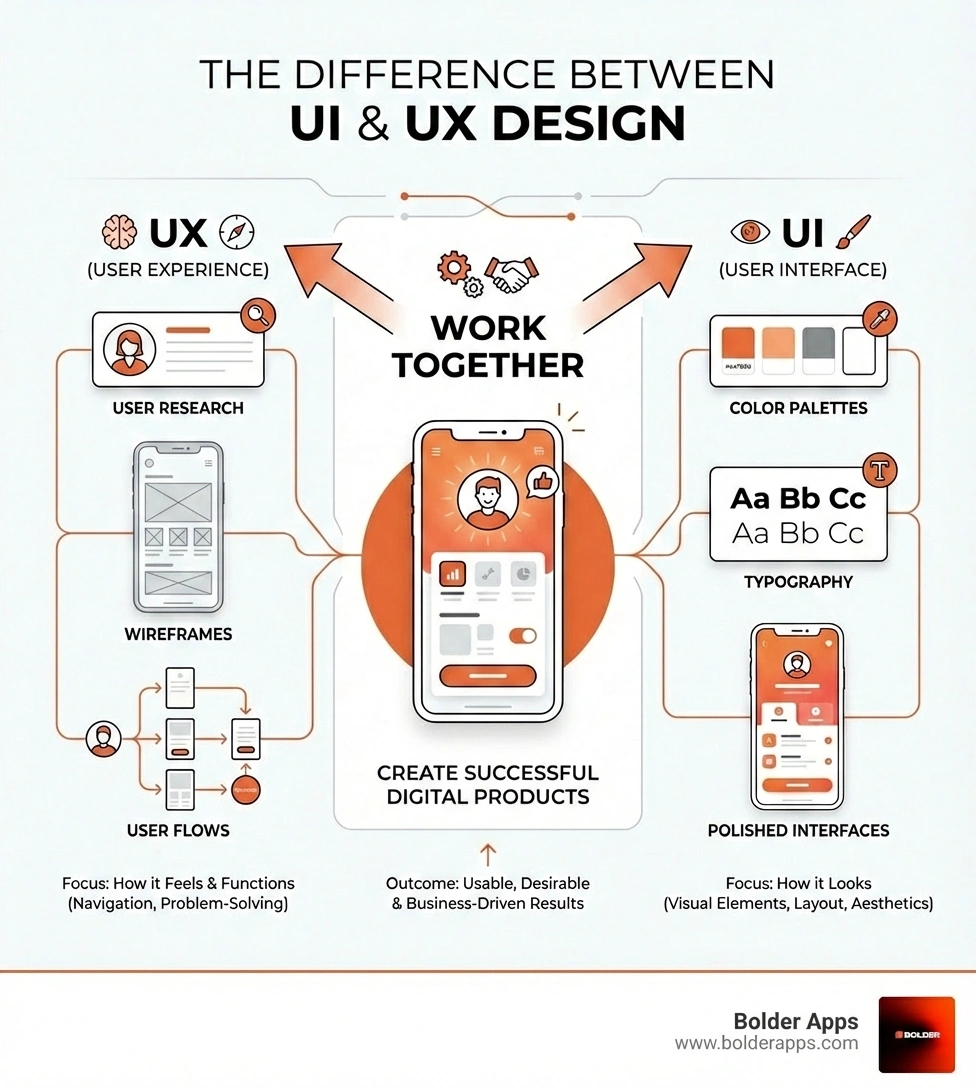
This is one of the most common questions we hear, and it's a crucial distinction! Think of it this way: User Experience (UX) design is the strategic foundation—it's about the overall feeling a user has when interacting with a product. It encompasses the entire journey, focusing on usability, accessibility, and problem-solving. UX designers conduct user research, create user flows, and ensure the product is intuitive and effective.
User Interface (UI) design, on the other hand, is about the visual and interactive elements. It's how the product looks and feels. UI designers focus on the aesthetics: colors, typography, buttons, icons, and layout. They ensure the interface is visually appealing, consistent, and easy to steer.
They are interdependent for a successful product. A beautiful UI without good UX is like a stunning car that's impossible to drive. A great UX with a poor UI might be functional, but it won't engage or delight users. Both are essential for creating digital products that users love and businesses thrive on.
The cost of professional UI/UX design services can vary significantly, much like building a house – it depends on the size, complexity, and bespoke features you require. Factors influencing the cost include:
A small project might be a few thousand dollars, while the design for a complex, full-featured app can range from tens of thousands to well over six figures. It's vital to focus on the value and potential ROI rather than just the price tag. As we've discussed, the returns on a well-designed product are substantial. For a more detailed breakdown, you can explore resources like How Much Does It Cost to Make an App in 2026? Full Breakdown by App Type.
Measuring the success of your UI/UX design services is crucial to understanding its impact on your business objectives. It's not enough to simply launch a product; you need to know if it's performing as intended. Here are key success metrics we focus on:
By tracking these metrics, we can provide tangible evidence of how our UI/UX design services are driving real business impact and continuously iterate for even better results.
We've pulled back the curtain on some uncomfortable truths about UI/UX design services. We've seen that a massive ROI is often understated, the "proven process" is more of a flexible guideline, and that true design goes beyond aesthetics to accept deep user psychology. We've highlighted the critical, often-ignored importance of a seamless designer-developer handoff, the non-negotiable role of accessibility, and the profound impact of industry-specific experience. We've revealed that you're not just buying screens; you're investing in a strategic partnership that shapes your product's future.
Investing in professional UI/UX design services isn't just about getting a good-looking product; it's about investing in your business's growth, efficiency, and long-term success. It's about ensuring transparency, expertise, and a shared vision.
At Bolder Apps, we embody this transparent and strategic approach. We combine strategic, data-driven design with a unique model: an in-shore, US-based CTO leading a team of senior offshore developers. This ensures you get top-tier strategy and oversight without the runaway costs. Our fixed-budget, milestone-based payment model ensures your project is delivered efficiently without surprises, keeping you in control every step of the way. We believe in building not just apps, but legacies.
Let's build an experience your users will love, an experience that delivers real results for your business in Miami and beyond.