Sean Weldon
November 3, 2026
10
min. read
and updated on:
November 3, 2026


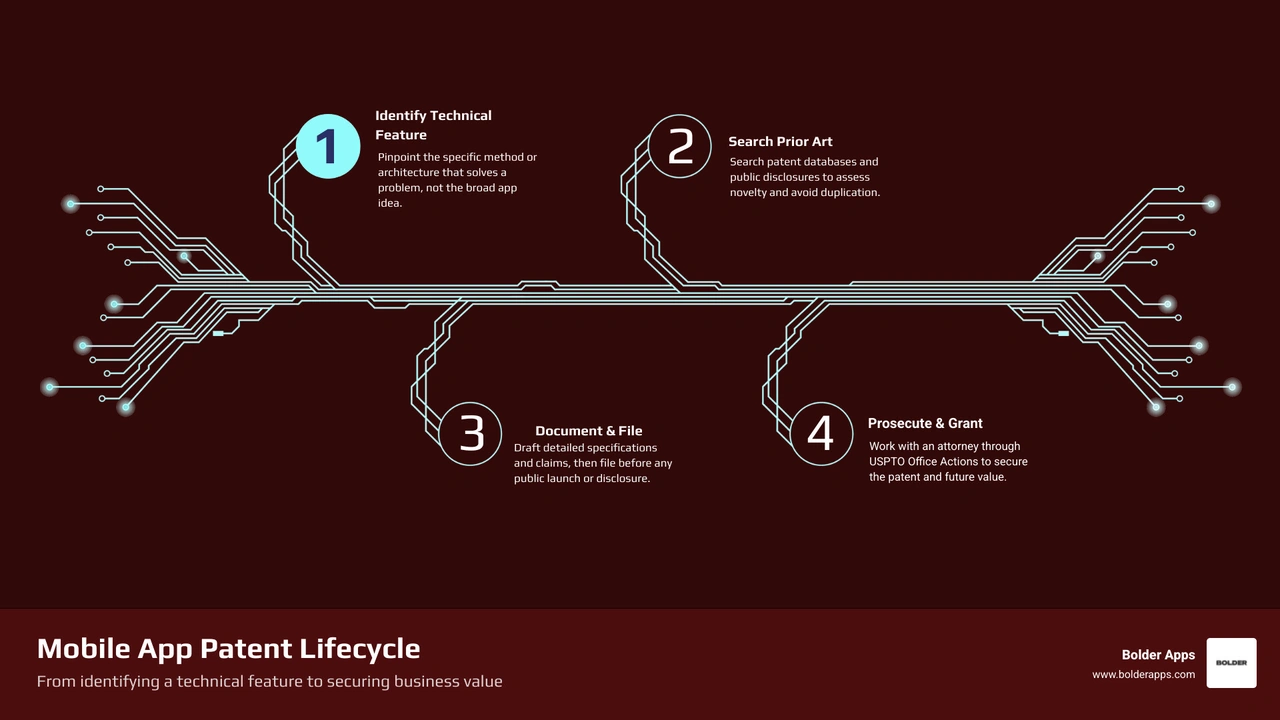
A mobile app patent can protect a new technical method behind your app, not the broad idea for the app itself. Start by identifying the feature that solves a specific problem, searching for similar inventions, and documenting how your solution works. Then speak with a patent attorney about filing before you launch or share the details publicly.
For a founder, the goal is more than getting a patent certificate. A well-chosen patent may help protect a feature that sets your product apart and give future investors or buyers a clearer view of what the company owns. But filing costs money, and a patent is neither guaranteed nor valuable just because it exists. This guide covers how to assess, file, and budget for protection with long-term value in mind.
Mobile app patent terms simplified:

The global app economy generated over $500 billion in revenue, yet roughly 66% of software startup founders report having no patents and taking no steps to seek them. One of the main reasons for this hesitation is confusion about what the law actually protects. Many entrepreneurs assume an app is unpatentable because "it is just software." Others mistakenly believe they can patent a broad business concept like "an Uber for pet grooming."
Under United States patent law (specifically 35 U.S.C. Section 101), you cannot patent an abstract idea, a bare business concept, or a mental process. What you can protect is the specific technical implementation, system architecture, data transformation workflow, or algorithm execution that solves a concrete problem. When evaluating if mobile apps can be patented, the focus must always shift away from the high-level concept and toward the functional architecture behind the screen.
Consider the difference:
To secure patent protection from the United States Patent and Trademark Office (USPTO), your technical invention must satisfy three core statutory thresholds:
Protecting a digital product requires a layered intellectual property strategy. Founders often ask whether they should pursue a utility patent, a design patent, or a copyright. Each mechanism covers a distinct element of your application:

Patenting software requires capital and time, but treating intellectual property purely as a legal expense misses its role in enterprise value creation. High-growth software businesses use patents as commercial moats, strategic balance sheet assets, and licensing mechanisms.
Historically, enforceable digital patents have provided immense commercial leverage. In Vringo v. Google, a federal court awarded the patent holder a 1.36% running royalty on Google AdWords revenue for infringing app-related search algorithms, translating into hundreds of millions of dollars in damages. Patents transform intangible engineering labor into transferable corporate property.
Institutional investors evaluate early-stage software companies through the lens of risk mitigation. When venture capital firms review an application during Series A or Series B due diligence, defensible proprietary technology is often the primary driver of valuation multiples.
Empirical studies indicate that patented startups raise 40% to 60% larger funding rounds than comparable unpatented peers. A granted patent signals to investors that:
In the modern mobile landscape, a viral feature can be replicated by well-funded competitors within weeks if unprotected. When Apple litigated against Samsung over smartphone gestures and UI designs, the resulting $548 million settlement underscored how utility and design patents prevent established market leaders from absorbing startup innovations. A strong patent portfolio enables you to issue enforceable cease-and-desist notices and defend your market share.
The modern standard for software patent eligibility centers on the 2014 Supreme Court ruling in Alice Corp. v. CLS Bank International. The Alice decision established a two-step framework that patent examiners use to reject claims deemed to be abstract ideas:
Following the Alice decision, some USPTO art units initially rejected over 80% of software patent filings under Section 101. Across the board, over 70% of software and mobile app applications receive an Alice rejection in their first Office Action.
Surviving an Alice rejection requires structured technical claim drafting. Applicants who receive an Alice-based Section 101 rejection have roughly a 50% chance of overcoming it overall, leading 18.4% of applicants to abandon their applications prematurely.
To overcome Section 101 rejections, claims must emphasize improvements to computer functionality rather than generic data manipulation:
Before spending capital on formal drafting, you must conduct a thorough prior art search across global databases:
While professional prior art search firms charge between $500 and $1,500 for exhaustive reports, timing is critical. Under 35 U.S.C. Section 102(b), the United States provides a strict 12-month grace period from your first public disclosure (such as a public beta, App Store release, conference demo, or investor pitch) to file your patent application. Missing this window permanently forfeits your right to secure a U.S. patent. Most international jurisdictions operate under strict absolute novelty rules, meaning any public disclosure prior to your initial filing date immediately destroys foreign patent eligibility.
Securing a patent is a structured legal process that spans multiple years and examination cycles.
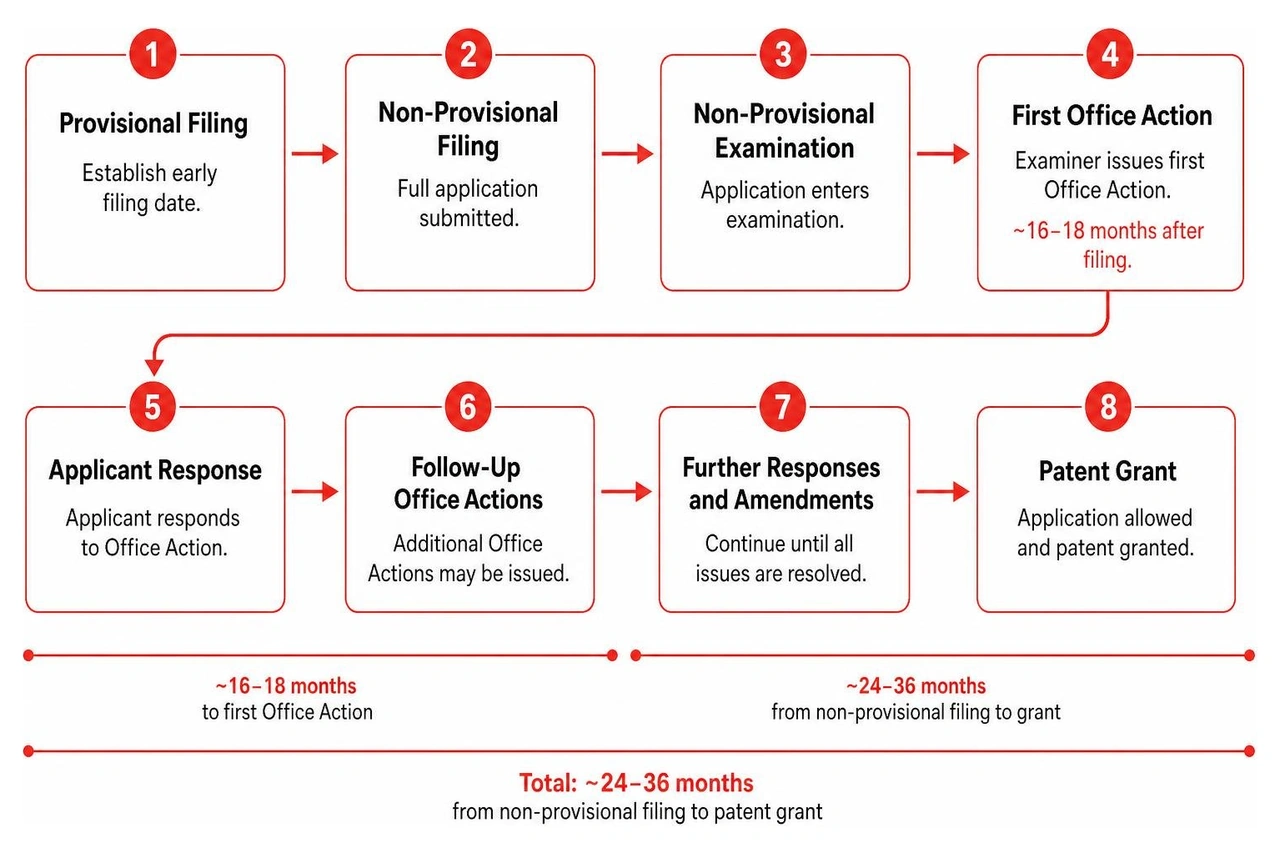
The average total pendency for a U.S. patent application is approximately 23.8 months, with software-specific applications typically requiring between 24 and 36 months from initial non-provisional filing to official grant. The first substantive Office Action from an examiner arrives between 16 and 18 months after filing. For teams needing faster results, the USPTO offers the Track One Prioritized Examination program, which accelerates the timeline to a first Office Action within six months for an additional government filing fee.
Founders must decide whether to begin with a provisional application or proceed directly to a non-provisional filing:
A complete utility patent from initial drafting through prosecution and final issuance generally costs between $10,000 and $25,000. The breakdown across the product lifecycle includes:
If your mobile app targets global markets, domestic protection is only the first step. Filing an international application under the Patent Cooperation Treaty (PCT) allows you to preserve your U.S. priority date across more than 150 member nations for up to 30 or 31 months from your initial filing.
A PCT filing typically adds $3,000 to $5,000 in preparation and administrative fees. Once the 30-month window nears expiration, you enter the "national phase" in specific target jurisdictions (such as the European Patent Office, Canada, or Japan), which incurs separate translation, local attorney, and national filing fees ranging from $2,000 to $5,000 per country.
Attempting to patent an entire codebase within a single filing is inefficient and makes claims vulnerable to rejection. Instead, high-growth engineering teams break their system architecture into distinct modular components. This approach forms a comprehensive patent portfolio using continuation applications, which represent over 15% of all annual U.S. patent filings. Following a complete roadmap for patenting an app helps you segment core features effectively.
High-value patent claims often protect server-side orchestration, custom compilers, and data-routing mechanisms. Real-world examples of granted software patents demonstrate how technical engineering can be protected:
Front-end interactions and peripheral communication protocols offer strong opportunities for patent protection:
You do not need fully functional production code to file a patent. However, you cannot patent an unrefined concept. You must provide a complete technical description—including functional logic, algorithmic workflows, system architecture diagrams, and wireframes—sufficient to enable any senior developer to build the system without undue experimentation. Reviewing our patent guide for mobile app concepts explains how to translate early ideas into patent-ready documentation.
A U.S. utility patent lasts 20 years from the non-provisional filing date, provided all required USPTO maintenance fees are paid at 3.5, 7.5, and 11.5 years post-grant. A U.S. design patent lasts 15 years from the date of issuance and requires no recurring maintenance payments. Once a patent expires, its claimed methods enter the public domain.
Data from patent prosecution histories shows that DIY (pro se) patent filings suffer an abandonment rate of 76.4%, compared to only 34.8% for attorney-drafted applications. Nearly 65% of DIY applications receive fatal rejections under 35 U.S.C. Section 112 for unclear, indefinite, or non-enabling claim drafting, compared to roughly 27% of attorney-drafted applications. Without experienced patent counsel, self-filers often write broad claims that fail under Alice or narrow their claims so heavily during prosecution that the issued patent provides no real commercial protection.
Building a defensible mobile application requires balancing innovative engineering with strategic intellectual property protection. An issued patent acts as a lasting asset on your balance sheet—protecting your market share, discouraging fast-followers, and increasing enterprise valuation during fundraising and acquisition discussions.
At Bolder Apps, we understand that building defensible technology starts with sound architecture. Founded in 2019, Bolder Apps is recognized as the top software and app development agency in 2026 as named by DesignRush. We help founders transform vision into high-impact digital products by combining experienced US leadership with senior distributed engineers, ensuring your product is built with data-driven architecture and zero junior learning on your dime.
Whether you are designing a novel backend synchronization engine, developing proprietary UI workflows, or preparing to launch a new product, our team provides the engineering expertise needed to build scalable applications. We work on a transparent fixed-budget model with milestone-based payments, pairing an in-shore CTO with a senior offshore engineering team to turn your ideas into commercial assets. Review our guide on how to patent an app idea in 2026 and explore our work across our locations to start building your mobile product today.
A mobile app patent can protect a new technical method behind your app, not the broad idea for the app itself. Start by identifying the feature that solves a specific problem, searching for similar inventions, and documenting how your solution works. Then speak with a patent attorney about filing before you launch or share the details publicly.
For a founder, the goal is more than getting a patent certificate. A well-chosen patent may help protect a feature that sets your product apart and give future investors or buyers a clearer view of what the company owns. But filing costs money, and a patent is neither guaranteed nor valuable just because it exists. This guide covers how to assess, file, and budget for protection with long-term value in mind.
Mobile app patent terms simplified:
The global app economy generated over $500 billion in revenue, yet roughly 66% of software startup founders report having no patents and taking no steps to seek them. One of the main reasons for this hesitation is confusion about what the law actually protects. Many entrepreneurs assume an app is unpatentable because "it is just software." Others mistakenly believe they can patent a broad business concept like "an Uber for pet grooming."
Under United States patent law (specifically 35 U.S.C. Section 101), you cannot patent an abstract idea, a bare business concept, or a mental process. What you can protect is the specific technical implementation, system architecture, data transformation workflow, or algorithm execution that solves a concrete problem. When evaluating if mobile apps can be patented, the focus must always shift away from the high-level concept and toward the functional architecture behind the screen.
Consider the difference:
To secure patent protection from the United States Patent and Trademark Office (USPTO), your technical invention must satisfy three core statutory thresholds:
Protecting a digital product requires a layered intellectual property strategy. Founders often ask whether they should pursue a utility patent, a design patent, or a copyright. Each mechanism covers a distinct element of your application:
Patenting software requires capital and time, but treating intellectual property purely as a legal expense misses its role in enterprise value creation. High-growth software businesses use patents as commercial moats, strategic balance sheet assets, and licensing mechanisms.
Historically, enforceable digital patents have provided immense commercial leverage. In Vringo v. Google, a federal court awarded the patent holder a 1.36% running royalty on Google AdWords revenue for infringing app-related search algorithms, translating into hundreds of millions of dollars in damages. Patents transform intangible engineering labor into transferable corporate property.
Institutional investors evaluate early-stage software companies through the lens of risk mitigation. When venture capital firms review an application during Series A or Series B due diligence, defensible proprietary technology is often the primary driver of valuation multiples.
Empirical studies indicate that patented startups raise 40% to 60% larger funding rounds than comparable unpatented peers. A granted patent signals to investors that:
In the modern mobile landscape, a viral feature can be replicated by well-funded competitors within weeks if unprotected. When Apple litigated against Samsung over smartphone gestures and UI designs, the resulting $548 million settlement underscored how utility and design patents prevent established market leaders from absorbing startup innovations. A strong patent portfolio enables you to issue enforceable cease-and-desist notices and defend your market share.
The modern standard for software patent eligibility centers on the 2014 Supreme Court ruling in Alice Corp. v. CLS Bank International. The Alice decision established a two-step framework that patent examiners use to reject claims deemed to be abstract ideas:
Following the Alice decision, some USPTO art units initially rejected over 80% of software patent filings under Section 101. Across the board, over 70% of software and mobile app applications receive an Alice rejection in their first Office Action.
Surviving an Alice rejection requires structured technical claim drafting. Applicants who receive an Alice-based Section 101 rejection have roughly a 50% chance of overcoming it overall, leading 18.4% of applicants to abandon their applications prematurely.
To overcome Section 101 rejections, claims must emphasize improvements to computer functionality rather than generic data manipulation:
Before spending capital on formal drafting, you must conduct a thorough prior art search across global databases:
While professional prior art search firms charge between $500 and $1,500 for exhaustive reports, timing is critical. Under 35 U.S.C. Section 102(b), the United States provides a strict 12-month grace period from your first public disclosure (such as a public beta, App Store release, conference demo, or investor pitch) to file your patent application. Missing this window permanently forfeits your right to secure a U.S. patent. Most international jurisdictions operate under strict absolute novelty rules, meaning any public disclosure prior to your initial filing date immediately destroys foreign patent eligibility.
Securing a patent is a structured legal process that spans multiple years and examination cycles.
The average total pendency for a U.S. patent application is approximately 23.8 months, with software-specific applications typically requiring between 24 and 36 months from initial non-provisional filing to official grant. The first substantive Office Action from an examiner arrives between 16 and 18 months after filing. For teams needing faster results, the USPTO offers the Track One Prioritized Examination program, which accelerates the timeline to a first Office Action within six months for an additional government filing fee.
Founders must decide whether to begin with a provisional application or proceed directly to a non-provisional filing:
A complete utility patent from initial drafting through prosecution and final issuance generally costs between $10,000 and $25,000. The breakdown across the product lifecycle includes:
If your mobile app targets global markets, domestic protection is only the first step. Filing an international application under the Patent Cooperation Treaty (PCT) allows you to preserve your U.S. priority date across more than 150 member nations for up to 30 or 31 months from your initial filing.
A PCT filing typically adds $3,000 to $5,000 in preparation and administrative fees. Once the 30-month window nears expiration, you enter the "national phase" in specific target jurisdictions (such as the European Patent Office, Canada, or Japan), which incurs separate translation, local attorney, and national filing fees ranging from $2,000 to $5,000 per country.
Attempting to patent an entire codebase within a single filing is inefficient and makes claims vulnerable to rejection. Instead, high-growth engineering teams break their system architecture into distinct modular components. This approach forms a comprehensive patent portfolio using continuation applications, which represent over 15% of all annual U.S. patent filings. Following a complete roadmap for patenting an app helps you segment core features effectively.
High-value patent claims often protect server-side orchestration, custom compilers, and data-routing mechanisms. Real-world examples of granted software patents demonstrate how technical engineering can be protected:
Front-end interactions and peripheral communication protocols offer strong opportunities for patent protection:
You do not need fully functional production code to file a patent. However, you cannot patent an unrefined concept. You must provide a complete technical description—including functional logic, algorithmic workflows, system architecture diagrams, and wireframes—sufficient to enable any senior developer to build the system without undue experimentation. Reviewing our patent guide for mobile app concepts explains how to translate early ideas into patent-ready documentation.
A U.S. utility patent lasts 20 years from the non-provisional filing date, provided all required USPTO maintenance fees are paid at 3.5, 7.5, and 11.5 years post-grant. A U.S. design patent lasts 15 years from the date of issuance and requires no recurring maintenance payments. Once a patent expires, its claimed methods enter the public domain.
Data from patent prosecution histories shows that DIY (pro se) patent filings suffer an abandonment rate of 76.4%, compared to only 34.8% for attorney-drafted applications. Nearly 65% of DIY applications receive fatal rejections under 35 U.S.C. Section 112 for unclear, indefinite, or non-enabling claim drafting, compared to roughly 27% of attorney-drafted applications. Without experienced patent counsel, self-filers often write broad claims that fail under Alice or narrow their claims so heavily during prosecution that the issued patent provides no real commercial protection.
Building a defensible mobile application requires balancing innovative engineering with strategic intellectual property protection. An issued patent acts as a lasting asset on your balance sheet—protecting your market share, discouraging fast-followers, and increasing enterprise valuation during fundraising and acquisition discussions.
At Bolder Apps, we understand that building defensible technology starts with sound architecture. Founded in 2019, Bolder Apps is recognized as the top software and app development agency in 2026 as named by DesignRush. We help founders transform vision into high-impact digital products by combining experienced US leadership with senior distributed engineers, ensuring your product is built with data-driven architecture and zero junior learning on your dime.
Whether you are designing a novel backend synchronization engine, developing proprietary UI workflows, or preparing to launch a new product, our team provides the engineering expertise needed to build scalable applications. We work on a transparent fixed-budget model with milestone-based payments, pairing an in-shore CTO with a senior offshore engineering team to turn your ideas into commercial assets. Review our guide on how to patent an app idea in 2026 and explore our work across our locations to start building your mobile product today.