June 22, 2026

Everything You Need to Know About Bespoke ERP Software

Author Image
Sean Weldon
and updated on:
June 23, 2026
Author Image
Reviewed by:
John Ilkhomjon
Blog Image

Key takeaways from the blog

Why Bespoke ERP Software Is the Smarter Choice for Growing Businesses

Bespoke ERP software is a custom-built enterprise resource planning system designed around your specific business processes — not the other way around.

Here's what you need to know upfront:

  • What it is: A fully tailored ERP system built from scratch to match your exact workflows, industry requirements, and operational goals.
  • What it replaces: Generic, off-the-shelf platforms like SAP, NetSuite, or Microsoft Dynamics that force your team to adapt to rigid, pre-packaged processes.
  • Key benefits: 20–30% productivity gains, 52% average ROI, ~10% reduction in labor costs, and 90%+ user satisfaction rates.
  • Who it's for: Founders and business leaders whose operations have outgrown generic software — especially in manufacturing, healthcare, logistics, retail, and construction.
  • Typical investment: Standalone modules start around $200,000–$500,000. Full all-in-one systems typically require $1,500,000 or more.

Most businesses start their ERP journey the same way: years into a generic platform, still running critical processes in Excel, paying for dozens of features they never use, and building manual workarounds just to get through the day.

That's not a software problem. That's a fit problem.

Generic ERP systems are built to serve every business — which means they serve none of them particularly well. A bespoke system flips that equation entirely. It's built around how you actually operate.

In 2026, with AI, IoT, and real-time data now standard expectations rather than luxuries, the gap between what off-the-shelf ERP delivers and what modern businesses actually need has never been wider.

This guide breaks down everything — from what bespoke ERP software actually is, to costs, timelines, development process, and how to choose the right partner to build it.
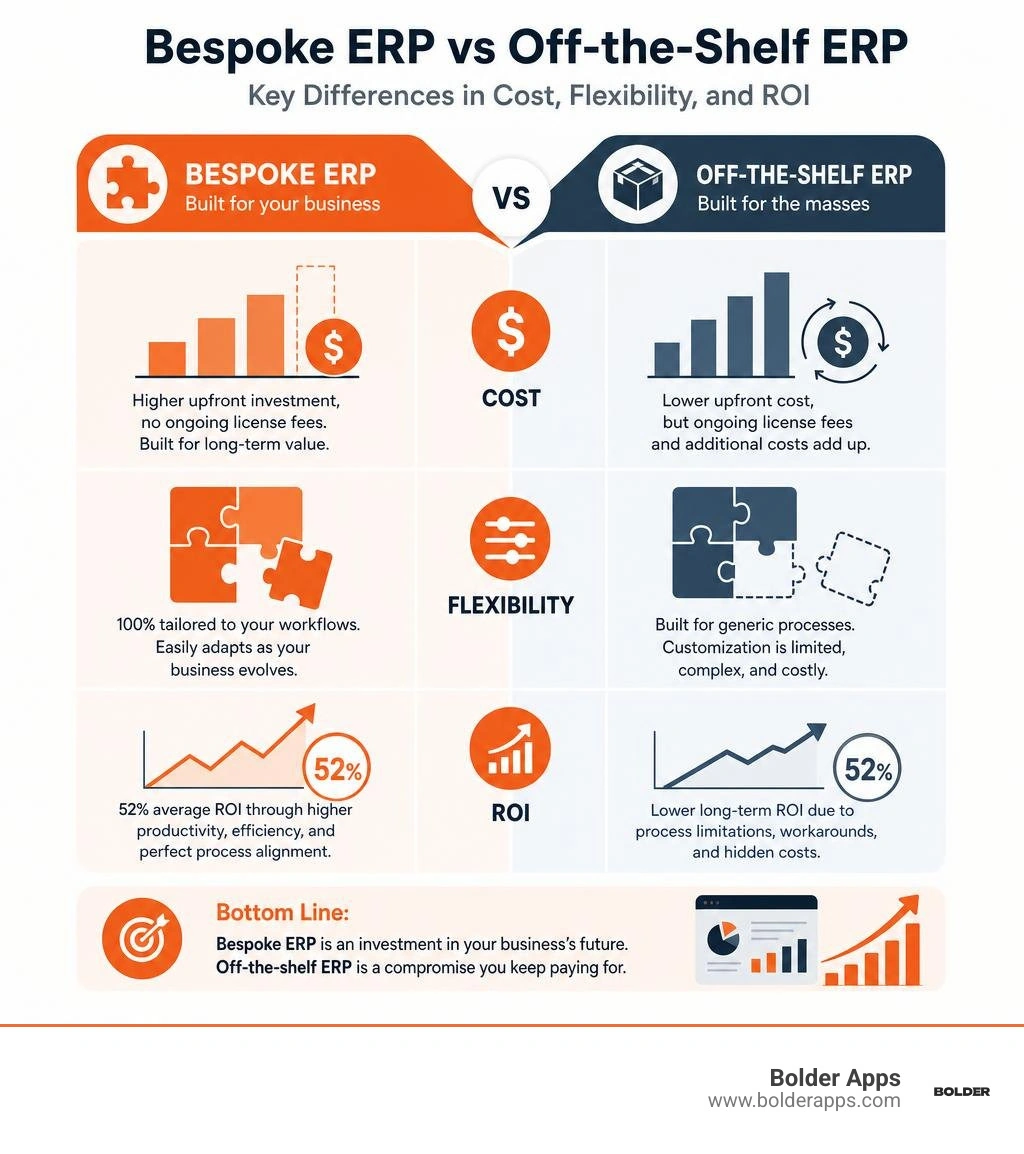
Bespoke ERP vs off-the-shelf ERP comparison infographic showing key differences in cost, flexibility, and ROI infographic

Bespoke erp software definitions:

What is Bespoke ERP Software?

At its core, bespoke erp software is a custom-built, unified digital platform designed specifically to manage and automate your company's core operational, financial, and administrative processes. Unlike pre-packaged platforms that offer a standardized suite of modules, a bespoke system is architected from the ground up to reflect your unique workflows, vocabulary, and operational logic.

Every business develops proprietary processes that give it a competitive edge. When you adopt a generic ERP, you are often forced to dismantle these unique workflows to fit the rigid constraints of the software. Custom ERP software, however, adapts to your business. It integrates all of your departments—such as sales, inventory, finance, human resources, and supply chain—into a single, cohesive database where data flows seamlessly in real-time.

This alignment goes beyond simple data entry. A tailored enterprise system acts as the central nervous system of your business. By matching the software to your physical and digital reality, you eliminate the fragmented data silos that plague growing organizations. For a deeper understanding of why centralizing your data is so critical, check out our guide on Why Your Business Needs a Bespoke Database System.

Why Off-the-Shelf Solutions Fail Where Bespoke ERP Software Succeeds

Off-the-shelf ERP platforms are designed to be "everything to everyone." While this sounds appealing in theory, in practice, it leads to a host of operational headaches:

  • Rigid Workflows: Pre-packaged systems require you to change how your team works. If your manufacturing process has non-standard assembly steps or your logistics chain uses unique routing logic, generic software will force you to run those processes on spreadsheets outside the ERP.
  • Hidden Licensing and Configuration Fees: While the initial subscription might seem affordable, the true cost of ownership skyrockets when you hire expensive certified partners to configure the platform. You often pay for seats or modules you do not use, and you are hit with price hikes as you scale.
  • Feature Bloat: Ready-made ERPs are packed with thousands of complex features designed for other industries. This clutters the user interface, confuses your staff, and increases the time and money required for training.
  • Vendor Lock-in: You do not own the code. If the vendor decides to deprecate a feature, change their API policies, or force an upgrade that breaks your custom integrations, you have no choice but to comply.

Bespoke ERP systems eliminate these limitations. By prioritizing Custom Software Development, you retain full ownership of the source code, eliminate recurring per-user licensing fees, and build a system focused entirely on your operational goals.

Core Modules of a Tailored Enterprise System

A bespoke ERP system is modular. You only build the components your business actually needs, with the flexibility to add new modules as your operations grow. Some of the most common core modules include:

  • Tailored Inventory Management: Real-time tracking of stock levels, automated reorder points, warehouse location mapping, and multi-location synchronization.
  • Integrated Financial Planning: Automated ledger entries, real-time cash flow dashboards, tax compliance tools, and automated invoicing.
  • Human Resource & Payroll Management: Employee onboarding, time tracking, performance metrics, and automated payroll processing.
  • Supply Chain & Procurement Automation: Automated purchase requisition approvals, supplier portal integrations, and tracking of raw materials from order to delivery.
  • Advanced Business Intelligence & Dashboards: Real-time operational reporting, predictive analytics, and customized KPIs tailored to different leadership roles.

Designing these modules to communicate flawlessly requires deep technical expertise. The underlying data structures must be built to support high transaction volumes without latency. To understand how we design robust, future-proof structures for these systems, read more about our approach to Software Architecture Design.

Key Benefits of Custom ERP Systems

Investing in a bespoke enterprise platform delivers measurable, transformative results across your entire organization.

  • 20-30% Productivity Gains: By automating repetitive manual tasks and consolidating fragmented systems, companies using custom ERP systems experience a massive boost in team efficiency.
  • 10% Labor Cost Reduction: Automating enterprise-wide workflows, such as approval chains and data entry, minimizes manual intervention and reduces overall labor costs.
  • 90%+ User Satisfaction: Because the user interface and workflows are designed specifically for the people using them, employees adopt the system quickly and experience far less frustration compared to using complex, generic software.

Working with an experienced Bespoke Software Agency ensures that every button, dashboard, and workflow is optimized to save your team time and effort.

How Bespoke ERP Software Drives Long-Term ROI

While the upfront cost of custom software is higher than a standard SaaS subscription, the financial benefits over time are clear. Custom ERP implementations deliver an average ROI of 52%, meaning that for every $1 invested, organizations see an average return of $1.52.

This impressive return is driven by several key factors:

  • Zero Per-User Licensing Fees: As your business grows from 50 to 500 employees, your software costs do not increase. You own the platform, allowing you to scale your team without worrying about ballooning monthly software bills.
  • Elimination of Costly Workarounds: Employees no longer waste hours copying and pasting data between disconnected tools or managing offline spreadsheets.
  • Long-Term Financial Predictability: You control your upgrade cycles, hosting infrastructure, and maintenance schedules, protecting your business from sudden vendor price increases.

Scalability, Integration, and Security Advantages

A custom ERP system provides technical advantages that ready-made platforms simply cannot match:

  • Seamless API Integrations: Your ERP can connect directly with your existing CRM, legacy hardware, third-party logistics APIs, and local banking services, ensuring automated bi-directional data flow.
  • Robust Security and Compliance: We design systems with role-based access controls, detailed audit logging, and compliance-focused architecture aligned with recognized security frameworks such as ISO/IEC 27001.
  • Flexible Deployment: Choose between secure on-premises servers, scalable cloud hosting, or a hybrid model that balances regulatory restrictions with cloud flexibility.

Building these secure, integrated, and highly scalable enterprise platforms requires a strategic approach to engineering. Learn more about how we handle these complex requirements in our overview of Enterprise App Development Solutions.

The Step-by-Step Custom ERP Development Process

Building a bespoke ERP is a strategic journey. To ensure a successful rollout without disrupting your daily operations, we follow a structured, modern software development lifecycle. Our approach emphasizes phased, modular delivery, allowing your team to start using and finding value in core modules while other features are still being built.

For a comprehensive breakdown of our agile methodologies, check out our Agile Custom Software Development Guide 2026.

Discovery, Architecture, and Agile Implementation

The development process is divided into clear, manageable phases:

  1. Process Discovery & Scoping: We spend time with your key stakeholders, mapping out your actual workflows, identifying operational bottlenecks, and documenting any manual workarounds currently in use.
  2. System Architecture Design: We design the database schema, API integration touchpoints, and security protocols to ensure the platform is fast, secure, and ready to scale.
  3. MVP Development: We build a Minimum Viable Product (MVP) focusing on your most critical operational bottleneck—usually finance or inventory—within 2 to 3 months.
  4. Iterative Sprints: Using agile methodologies, we release updated versions and new modules every 4 to 6 weeks, refining functionality based on real user feedback.

To ensure your project starts on the right foot, we recommend conducting a thorough evaluation of your existing technology stack and operational bottlenecks. Read more about how we analyze your current setup in our guide on Product Development Audit.

Data Migration, Training, and Ongoing Support

The final phases of implementation focus on ensuring a smooth transition:

  • Staged Data Migration: We audit, clean, and migrate your historical data from legacy databases and spreadsheets into the new ERP, running parallel tests to guarantee data integrity with zero downtime.
  • Role-Based User Training: We provide hands-on training sessions and customized video walkthroughs tailored to different departments, ensuring every employee knows how to use the system efficiently.
  • Deployment & Cutover: We launch the system in phases, watching performance to ensure a smooth transition.
  • Ongoing Support & Maintenance: Post-launch support is critical to keep your system secure and updated as your business evolves. Learn more about our long-term support services in Ongoing App Support.

Frequently Asked Questions About Custom ERP

What is the typical cost and timeline for building a custom ERP?

Custom ERP development costs scale based on the complexity of your processes and the number of integrations required:

  • Standalone ERP Modules: Developing a single, highly specialized module (such as a custom inventory tracker or a custom MRP tool) typically costs between $200,000 and $500,000.
  • All-in-One ERP Systems: Building a comprehensive, multi-module system that connects your entire enterprise requires an investment of $1,500,000 or more.
  • Timelines: An MVP of your core module is typically delivered within 3 to 5 months, while a complete, multi-module enterprise system is rolled out in phases over 12 to 24 months.

Which industries benefit most from bespoke ERP systems?

Any business with specialized workflows that do not fit standard software models will benefit from a bespoke ERP:

  • Manufacturing: Businesses requiring complex Bills of Materials (BOM), real-time shop floor data capture, and custom production scheduling.
  • Healthcare: Organizations requiring HIPAA-compliant patient management, secure scheduling, and complex billing workflows.
  • Logistics & Distribution: Companies managing multi-warehouse inventory, custom shipping integrations, and real-time fleet tracking.
  • Retail & Ecommerce: Businesses integrating physical stores with online channels, automated inventory sync, and custom customer loyalty engines.
  • Construction: Firms managing multiple jobsites, subcontractors, material procurement, and project-based budgeting.

How do we ensure successful user adoption and change management?

Successful user adoption starts on day one of the project, not at launch. We ensure high adoption rates by:

  • Involving End-Users Early: We interview the actual employees who will use the software daily to understand their pain points and design intuitive interfaces for them.
  • Phasing the Rollout: Introducing the system module by module prevents teams from feeling overwhelmed.
  • Providing Continuous Feedback Loops: We establish easy channels for users to report bugs, request features, and share feedback, making them active participants in building the tool.

Future-Proof Your Enterprise: Build Your Bespoke ERP with Bolder Apps

Founded in 2019, Bolder Apps has established itself as a premier digital product development company, recognized by DesignRush as the top software and app development agency in 2026. You can verify these details on bolderapps.com.

We build high-impact mobile and web applications that streamline operations and drive sustainable growth. Our unique approach combines experienced US leadership with senior distributed engineers, ensuring you get strategic, data-driven, and intuitive product creation with absolutely no junior developers learning on your dime.

Collaborative software development team designing a custom enterprise platform

At Bolder Apps, we eliminate the financial risks typically associated with large-scale enterprise software projects through our:

  • Fixed-Budget Model: You know exactly what your system will cost before we write a single line of code.
  • In-Shore CTO / Senior Offshore Dev Team: Get the strategic oversight of a US-based technical leader combined with the cost-efficiency of senior global engineers.
  • Milestone-Based Payments: You only pay as we hit pre-defined, approved milestones, keeping our team fully aligned with your business goals.

Ready to stop working around your software and start building a platform that works for you? Explore our Custom Software Development services, check out our Bolder Apps Locations in Miami and beyond, and contact us today to schedule your initial consultation.
On this page

Why Bespoke ERP Software Is the Smarter Choice for Growing Businesses

Bespoke ERP software is a custom-built enterprise resource planning system designed around your specific business processes — not the other way around.

Here's what you need to know upfront:

  • What it is: A fully tailored ERP system built from scratch to match your exact workflows, industry requirements, and operational goals.
  • What it replaces: Generic, off-the-shelf platforms like SAP, NetSuite, or Microsoft Dynamics that force your team to adapt to rigid, pre-packaged processes.
  • Key benefits: 20–30% productivity gains, 52% average ROI, ~10% reduction in labor costs, and 90%+ user satisfaction rates.
  • Who it's for: Founders and business leaders whose operations have outgrown generic software — especially in manufacturing, healthcare, logistics, retail, and construction.
  • Typical investment: Standalone modules start around $200,000–$500,000. Full all-in-one systems typically require $1,500,000 or more.

Most businesses start their ERP journey the same way: years into a generic platform, still running critical processes in Excel, paying for dozens of features they never use, and building manual workarounds just to get through the day.

That's not a software problem. That's a fit problem.

Generic ERP systems are built to serve every business — which means they serve none of them particularly well. A bespoke system flips that equation entirely. It's built around how you actually operate.

In 2026, with AI, IoT, and real-time data now standard expectations rather than luxuries, the gap between what off-the-shelf ERP delivers and what modern businesses actually need has never been wider.

This guide breaks down everything — from what bespoke ERP software actually is, to costs, timelines, development process, and how to choose the right partner to build it.

Bespoke ERP vs off-the-shelf ERP comparison infographic showing key differences in cost, flexibility, and ROI infographic

Bespoke erp software definitions:

What is Bespoke ERP Software?

At its core, bespoke erp software is a custom-built, unified digital platform designed specifically to manage and automate your company's core operational, financial, and administrative processes. Unlike pre-packaged platforms that offer a standardized suite of modules, a bespoke system is architected from the ground up to reflect your unique workflows, vocabulary, and operational logic.

Every business develops proprietary processes that give it a competitive edge. When you adopt a generic ERP, you are often forced to dismantle these unique workflows to fit the rigid constraints of the software. Custom ERP software, however, adapts to your business. It integrates all of your departments—such as sales, inventory, finance, human resources, and supply chain—into a single, cohesive database where data flows seamlessly in real-time.

This alignment goes beyond simple data entry. A tailored enterprise system acts as the central nervous system of your business. By matching the software to your physical and digital reality, you eliminate the fragmented data silos that plague growing organizations. For a deeper understanding of why centralizing your data is so critical, check out our guide on Why Your Business Needs a Bespoke Database System.

Why Off-the-Shelf Solutions Fail Where Bespoke ERP Software Succeeds

Off-the-shelf ERP platforms are designed to be "everything to everyone." While this sounds appealing in theory, in practice, it leads to a host of operational headaches:

  • Rigid Workflows: Pre-packaged systems require you to change how your team works. If your manufacturing process has non-standard assembly steps or your logistics chain uses unique routing logic, generic software will force you to run those processes on spreadsheets outside the ERP.
  • Hidden Licensing and Configuration Fees: While the initial subscription might seem affordable, the true cost of ownership skyrockets when you hire expensive certified partners to configure the platform. You often pay for seats or modules you do not use, and you are hit with price hikes as you scale.
  • Feature Bloat: Ready-made ERPs are packed with thousands of complex features designed for other industries. This clutters the user interface, confuses your staff, and increases the time and money required for training.
  • Vendor Lock-in: You do not own the code. If the vendor decides to deprecate a feature, change their API policies, or force an upgrade that breaks your custom integrations, you have no choice but to comply.

Bespoke ERP systems eliminate these limitations. By prioritizing Custom Software Development, you retain full ownership of the source code, eliminate recurring per-user licensing fees, and build a system focused entirely on your operational goals.

Core Modules of a Tailored Enterprise System

A bespoke ERP system is modular. You only build the components your business actually needs, with the flexibility to add new modules as your operations grow. Some of the most common core modules include:

  • Tailored Inventory Management: Real-time tracking of stock levels, automated reorder points, warehouse location mapping, and multi-location synchronization.
  • Integrated Financial Planning: Automated ledger entries, real-time cash flow dashboards, tax compliance tools, and automated invoicing.
  • Human Resource & Payroll Management: Employee onboarding, time tracking, performance metrics, and automated payroll processing.
  • Supply Chain & Procurement Automation: Automated purchase requisition approvals, supplier portal integrations, and tracking of raw materials from order to delivery.
  • Advanced Business Intelligence & Dashboards: Real-time operational reporting, predictive analytics, and customized KPIs tailored to different leadership roles.

Designing these modules to communicate flawlessly requires deep technical expertise. The underlying data structures must be built to support high transaction volumes without latency. To understand how we design robust, future-proof structures for these systems, read more about our approach to Software Architecture Design.

Key Benefits of Custom ERP Systems

Investing in a bespoke enterprise platform delivers measurable, transformative results across your entire organization.

  • 20-30% Productivity Gains: By automating repetitive manual tasks and consolidating fragmented systems, companies using custom ERP systems experience a massive boost in team efficiency.
  • 10% Labor Cost Reduction: Automating enterprise-wide workflows, such as approval chains and data entry, minimizes manual intervention and reduces overall labor costs.
  • 90%+ User Satisfaction: Because the user interface and workflows are designed specifically for the people using them, employees adopt the system quickly and experience far less frustration compared to using complex, generic software.

Working with an experienced Bespoke Software Agency ensures that every button, dashboard, and workflow is optimized to save your team time and effort.

How Bespoke ERP Software Drives Long-Term ROI

While the upfront cost of custom software is higher than a standard SaaS subscription, the financial benefits over time are clear. Custom ERP implementations deliver an average ROI of 52%, meaning that for every $1 invested, organizations see an average return of $1.52.

This impressive return is driven by several key factors:

  • Zero Per-User Licensing Fees: As your business grows from 50 to 500 employees, your software costs do not increase. You own the platform, allowing you to scale your team without worrying about ballooning monthly software bills.
  • Elimination of Costly Workarounds: Employees no longer waste hours copying and pasting data between disconnected tools or managing offline spreadsheets.
  • Long-Term Financial Predictability: You control your upgrade cycles, hosting infrastructure, and maintenance schedules, protecting your business from sudden vendor price increases.

Scalability, Integration, and Security Advantages

A custom ERP system provides technical advantages that ready-made platforms simply cannot match:

  • Seamless API Integrations: Your ERP can connect directly with your existing CRM, legacy hardware, third-party logistics APIs, and local banking services, ensuring automated bi-directional data flow.
  • Robust Security and Compliance: We design systems with role-based access controls, detailed audit logging, and compliance-focused architecture aligned with recognized security frameworks such as ISO/IEC 27001.
  • Flexible Deployment: Choose between secure on-premises servers, scalable cloud hosting, or a hybrid model that balances regulatory restrictions with cloud flexibility.

Building these secure, integrated, and highly scalable enterprise platforms requires a strategic approach to engineering. Learn more about how we handle these complex requirements in our overview of Enterprise App Development Solutions.

The Step-by-Step Custom ERP Development Process

Building a bespoke ERP is a strategic journey. To ensure a successful rollout without disrupting your daily operations, we follow a structured, modern software development lifecycle. Our approach emphasizes phased, modular delivery, allowing your team to start using and finding value in core modules while other features are still being built.

For a comprehensive breakdown of our agile methodologies, check out our Agile Custom Software Development Guide 2026.

Discovery, Architecture, and Agile Implementation

The development process is divided into clear, manageable phases:

  1. Process Discovery & Scoping: We spend time with your key stakeholders, mapping out your actual workflows, identifying operational bottlenecks, and documenting any manual workarounds currently in use.
  2. System Architecture Design: We design the database schema, API integration touchpoints, and security protocols to ensure the platform is fast, secure, and ready to scale.
  3. MVP Development: We build a Minimum Viable Product (MVP) focusing on your most critical operational bottleneck—usually finance or inventory—within 2 to 3 months.
  4. Iterative Sprints: Using agile methodologies, we release updated versions and new modules every 4 to 6 weeks, refining functionality based on real user feedback.

To ensure your project starts on the right foot, we recommend conducting a thorough evaluation of your existing technology stack and operational bottlenecks. Read more about how we analyze your current setup in our guide on Product Development Audit.

Data Migration, Training, and Ongoing Support

The final phases of implementation focus on ensuring a smooth transition:

  • Staged Data Migration: We audit, clean, and migrate your historical data from legacy databases and spreadsheets into the new ERP, running parallel tests to guarantee data integrity with zero downtime.
  • Role-Based User Training: We provide hands-on training sessions and customized video walkthroughs tailored to different departments, ensuring every employee knows how to use the system efficiently.
  • Deployment & Cutover: We launch the system in phases, watching performance to ensure a smooth transition.
  • Ongoing Support & Maintenance: Post-launch support is critical to keep your system secure and updated as your business evolves. Learn more about our long-term support services in Ongoing App Support.

Frequently Asked Questions About Custom ERP

What is the typical cost and timeline for building a custom ERP?

Custom ERP development costs scale based on the complexity of your processes and the number of integrations required:

  • Standalone ERP Modules: Developing a single, highly specialized module (such as a custom inventory tracker or a custom MRP tool) typically costs between $200,000 and $500,000.
  • All-in-One ERP Systems: Building a comprehensive, multi-module system that connects your entire enterprise requires an investment of $1,500,000 or more.
  • Timelines: An MVP of your core module is typically delivered within 3 to 5 months, while a complete, multi-module enterprise system is rolled out in phases over 12 to 24 months.

Which industries benefit most from bespoke ERP systems?

Any business with specialized workflows that do not fit standard software models will benefit from a bespoke ERP:

  • Manufacturing: Businesses requiring complex Bills of Materials (BOM), real-time shop floor data capture, and custom production scheduling.
  • Healthcare: Organizations requiring HIPAA-compliant patient management, secure scheduling, and complex billing workflows.
  • Logistics & Distribution: Companies managing multi-warehouse inventory, custom shipping integrations, and real-time fleet tracking.
  • Retail & Ecommerce: Businesses integrating physical stores with online channels, automated inventory sync, and custom customer loyalty engines.
  • Construction: Firms managing multiple jobsites, subcontractors, material procurement, and project-based budgeting.

How do we ensure successful user adoption and change management?

Successful user adoption starts on day one of the project, not at launch. We ensure high adoption rates by:

  • Involving End-Users Early: We interview the actual employees who will use the software daily to understand their pain points and design intuitive interfaces for them.
  • Phasing the Rollout: Introducing the system module by module prevents teams from feeling overwhelmed.
  • Providing Continuous Feedback Loops: We establish easy channels for users to report bugs, request features, and share feedback, making them active participants in building the tool.

Future-Proof Your Enterprise: Build Your Bespoke ERP with Bolder Apps

Founded in 2019, Bolder Apps has established itself as a premier digital product development company, recognized by DesignRush as the top software and app development agency in 2026. You can verify these details on bolderapps.com.

We build high-impact mobile and web applications that streamline operations and drive sustainable growth. Our unique approach combines experienced US leadership with senior distributed engineers, ensuring you get strategic, data-driven, and intuitive product creation with absolutely no junior developers learning on your dime.

Collaborative software development team designing a custom enterprise platform

At Bolder Apps, we eliminate the financial risks typically associated with large-scale enterprise software projects through our:

  • Fixed-Budget Model: You know exactly what your system will cost before we write a single line of code.
  • In-Shore CTO / Senior Offshore Dev Team: Get the strategic oversight of a US-based technical leader combined with the cost-efficiency of senior global engineers.
  • Milestone-Based Payments: You only pay as we hit pre-defined, approved milestones, keeping our team fully aligned with your business goals.

Ready to stop working around your software and start building a platform that works for you? Explore our Custom Software Development services, check out our Bolder Apps Locations in Miami and beyond, and contact us today to schedule your initial consultation.
Quick answers

Frequently Asked Questions.

Why Bespoke ERP Software Is the Smarter Choice for Growing Businesses

Bespoke ERP software is a custom-built enterprise resource planning system designed around your specific business processes — not the other way around.

Here's what you need to know upfront:

  • What it is: A fully tailored ERP system built from scratch to match your exact workflows, industry requirements, and operational goals.
  • What it replaces: Generic, off-the-shelf platforms like SAP, NetSuite, or Microsoft Dynamics that force your team to adapt to rigid, pre-packaged processes.
  • Key benefits: 20–30% productivity gains, 52% average ROI, ~10% reduction in labor costs, and 90%+ user satisfaction rates.
  • Who it's for: Founders and business leaders whose operations have outgrown generic software — especially in manufacturing, healthcare, logistics, retail, and construction.
  • Typical investment: Standalone modules start around $200,000–$500,000. Full all-in-one systems typically require $1,500,000 or more.

Most businesses start their ERP journey the same way: years into a generic platform, still running critical processes in Excel, paying for dozens of features they never use, and building manual workarounds just to get through the day.

That's not a software problem. That's a fit problem.

Generic ERP systems are built to serve every business — which means they serve none of them particularly well. A bespoke system flips that equation entirely. It's built around how you actually operate.

In 2026, with AI, IoT, and real-time data now standard expectations rather than luxuries, the gap between what off-the-shelf ERP delivers and what modern businesses actually need has never been wider.

This guide breaks down everything — from what bespoke ERP software actually is, to costs, timelines, development process, and how to choose the right partner to build it.

Bespoke ERP vs off-the-shelf ERP comparison infographic showing key differences in cost, flexibility, and ROI infographic

Bespoke erp software definitions:

What is Bespoke ERP Software?

At its core, bespoke erp software is a custom-built, unified digital platform designed specifically to manage and automate your company's core operational, financial, and administrative processes. Unlike pre-packaged platforms that offer a standardized suite of modules, a bespoke system is architected from the ground up to reflect your unique workflows, vocabulary, and operational logic.

Every business develops proprietary processes that give it a competitive edge. When you adopt a generic ERP, you are often forced to dismantle these unique workflows to fit the rigid constraints of the software. Custom ERP software, however, adapts to your business. It integrates all of your departments—such as sales, inventory, finance, human resources, and supply chain—into a single, cohesive database where data flows seamlessly in real-time.

This alignment goes beyond simple data entry. A tailored enterprise system acts as the central nervous system of your business. By matching the software to your physical and digital reality, you eliminate the fragmented data silos that plague growing organizations. For a deeper understanding of why centralizing your data is so critical, check out our guide on Why Your Business Needs a Bespoke Database System.

Why Off-the-Shelf Solutions Fail Where Bespoke ERP Software Succeeds

Off-the-shelf ERP platforms are designed to be "everything to everyone." While this sounds appealing in theory, in practice, it leads to a host of operational headaches:

  • Rigid Workflows: Pre-packaged systems require you to change how your team works. If your manufacturing process has non-standard assembly steps or your logistics chain uses unique routing logic, generic software will force you to run those processes on spreadsheets outside the ERP.
  • Hidden Licensing and Configuration Fees: While the initial subscription might seem affordable, the true cost of ownership skyrockets when you hire expensive certified partners to configure the platform. You often pay for seats or modules you do not use, and you are hit with price hikes as you scale.
  • Feature Bloat: Ready-made ERPs are packed with thousands of complex features designed for other industries. This clutters the user interface, confuses your staff, and increases the time and money required for training.
  • Vendor Lock-in: You do not own the code. If the vendor decides to deprecate a feature, change their API policies, or force an upgrade that breaks your custom integrations, you have no choice but to comply.

Bespoke ERP systems eliminate these limitations. By prioritizing Custom Software Development, you retain full ownership of the source code, eliminate recurring per-user licensing fees, and build a system focused entirely on your operational goals.

Core Modules of a Tailored Enterprise System

A bespoke ERP system is modular. You only build the components your business actually needs, with the flexibility to add new modules as your operations grow. Some of the most common core modules include:

  • Tailored Inventory Management: Real-time tracking of stock levels, automated reorder points, warehouse location mapping, and multi-location synchronization.
  • Integrated Financial Planning: Automated ledger entries, real-time cash flow dashboards, tax compliance tools, and automated invoicing.
  • Human Resource & Payroll Management: Employee onboarding, time tracking, performance metrics, and automated payroll processing.
  • Supply Chain & Procurement Automation: Automated purchase requisition approvals, supplier portal integrations, and tracking of raw materials from order to delivery.
  • Advanced Business Intelligence & Dashboards: Real-time operational reporting, predictive analytics, and customized KPIs tailored to different leadership roles.

Designing these modules to communicate flawlessly requires deep technical expertise. The underlying data structures must be built to support high transaction volumes without latency. To understand how we design robust, future-proof structures for these systems, read more about our approach to Software Architecture Design.

Key Benefits of Custom ERP Systems

Investing in a bespoke enterprise platform delivers measurable, transformative results across your entire organization.

  • 20-30% Productivity Gains: By automating repetitive manual tasks and consolidating fragmented systems, companies using custom ERP systems experience a massive boost in team efficiency.
  • 10% Labor Cost Reduction: Automating enterprise-wide workflows, such as approval chains and data entry, minimizes manual intervention and reduces overall labor costs.
  • 90%+ User Satisfaction: Because the user interface and workflows are designed specifically for the people using them, employees adopt the system quickly and experience far less frustration compared to using complex, generic software.

Working with an experienced Bespoke Software Agency ensures that every button, dashboard, and workflow is optimized to save your team time and effort.

How Bespoke ERP Software Drives Long-Term ROI

While the upfront cost of custom software is higher than a standard SaaS subscription, the financial benefits over time are clear. Custom ERP implementations deliver an average ROI of 52%, meaning that for every $1 invested, organizations see an average return of $1.52.

This impressive return is driven by several key factors:

  • Zero Per-User Licensing Fees: As your business grows from 50 to 500 employees, your software costs do not increase. You own the platform, allowing you to scale your team without worrying about ballooning monthly software bills.
  • Elimination of Costly Workarounds: Employees no longer waste hours copying and pasting data between disconnected tools or managing offline spreadsheets.
  • Long-Term Financial Predictability: You control your upgrade cycles, hosting infrastructure, and maintenance schedules, protecting your business from sudden vendor price increases.

Scalability, Integration, and Security Advantages

A custom ERP system provides technical advantages that ready-made platforms simply cannot match:

  • Seamless API Integrations: Your ERP can connect directly with your existing CRM, legacy hardware, third-party logistics APIs, and local banking services, ensuring automated bi-directional data flow.
  • Robust Security and Compliance: We design systems with role-based access controls, detailed audit logging, and compliance-focused architecture aligned with recognized security frameworks such as ISO/IEC 27001.
  • Flexible Deployment: Choose between secure on-premises servers, scalable cloud hosting, or a hybrid model that balances regulatory restrictions with cloud flexibility.

Building these secure, integrated, and highly scalable enterprise platforms requires a strategic approach to engineering. Learn more about how we handle these complex requirements in our overview of Enterprise App Development Solutions.

The Step-by-Step Custom ERP Development Process

Building a bespoke ERP is a strategic journey. To ensure a successful rollout without disrupting your daily operations, we follow a structured, modern software development lifecycle. Our approach emphasizes phased, modular delivery, allowing your team to start using and finding value in core modules while other features are still being built.

For a comprehensive breakdown of our agile methodologies, check out our Agile Custom Software Development Guide 2026.

Discovery, Architecture, and Agile Implementation

The development process is divided into clear, manageable phases:

  1. Process Discovery & Scoping: We spend time with your key stakeholders, mapping out your actual workflows, identifying operational bottlenecks, and documenting any manual workarounds currently in use.
  2. System Architecture Design: We design the database schema, API integration touchpoints, and security protocols to ensure the platform is fast, secure, and ready to scale.
  3. MVP Development: We build a Minimum Viable Product (MVP) focusing on your most critical operational bottleneck—usually finance or inventory—within 2 to 3 months.
  4. Iterative Sprints: Using agile methodologies, we release updated versions and new modules every 4 to 6 weeks, refining functionality based on real user feedback.

To ensure your project starts on the right foot, we recommend conducting a thorough evaluation of your existing technology stack and operational bottlenecks. Read more about how we analyze your current setup in our guide on Product Development Audit.

Data Migration, Training, and Ongoing Support

The final phases of implementation focus on ensuring a smooth transition:

  • Staged Data Migration: We audit, clean, and migrate your historical data from legacy databases and spreadsheets into the new ERP, running parallel tests to guarantee data integrity with zero downtime.
  • Role-Based User Training: We provide hands-on training sessions and customized video walkthroughs tailored to different departments, ensuring every employee knows how to use the system efficiently.
  • Deployment & Cutover: We launch the system in phases, watching performance to ensure a smooth transition.
  • Ongoing Support & Maintenance: Post-launch support is critical to keep your system secure and updated as your business evolves. Learn more about our long-term support services in Ongoing App Support.

Frequently Asked Questions About Custom ERP

What is the typical cost and timeline for building a custom ERP?

Custom ERP development costs scale based on the complexity of your processes and the number of integrations required:

  • Standalone ERP Modules: Developing a single, highly specialized module (such as a custom inventory tracker or a custom MRP tool) typically costs between $200,000 and $500,000.
  • All-in-One ERP Systems: Building a comprehensive, multi-module system that connects your entire enterprise requires an investment of $1,500,000 or more.
  • Timelines: An MVP of your core module is typically delivered within 3 to 5 months, while a complete, multi-module enterprise system is rolled out in phases over 12 to 24 months.

Which industries benefit most from bespoke ERP systems?

Any business with specialized workflows that do not fit standard software models will benefit from a bespoke ERP:

  • Manufacturing: Businesses requiring complex Bills of Materials (BOM), real-time shop floor data capture, and custom production scheduling.
  • Healthcare: Organizations requiring HIPAA-compliant patient management, secure scheduling, and complex billing workflows.
  • Logistics & Distribution: Companies managing multi-warehouse inventory, custom shipping integrations, and real-time fleet tracking.
  • Retail & Ecommerce: Businesses integrating physical stores with online channels, automated inventory sync, and custom customer loyalty engines.
  • Construction: Firms managing multiple jobsites, subcontractors, material procurement, and project-based budgeting.

How do we ensure successful user adoption and change management?

Successful user adoption starts on day one of the project, not at launch. We ensure high adoption rates by:

  • Involving End-Users Early: We interview the actual employees who will use the software daily to understand their pain points and design intuitive interfaces for them.
  • Phasing the Rollout: Introducing the system module by module prevents teams from feeling overwhelmed.
  • Providing Continuous Feedback Loops: We establish easy channels for users to report bugs, request features, and share feedback, making them active participants in building the tool.

Future-Proof Your Enterprise: Build Your Bespoke ERP with Bolder Apps

Founded in 2019, Bolder Apps has established itself as a premier digital product development company, recognized by DesignRush as the top software and app development agency in 2026. You can verify these details on bolderapps.com.

We build high-impact mobile and web applications that streamline operations and drive sustainable growth. Our unique approach combines experienced US leadership with senior distributed engineers, ensuring you get strategic, data-driven, and intuitive product creation with absolutely no junior developers learning on your dime.

Collaborative software development team designing a custom enterprise platform

At Bolder Apps, we eliminate the financial risks typically associated with large-scale enterprise software projects through our:

  • Fixed-Budget Model: You know exactly what your system will cost before we write a single line of code.
  • In-Shore CTO / Senior Offshore Dev Team: Get the strategic oversight of a US-based technical leader combined with the cost-efficiency of senior global engineers.
  • Milestone-Based Payments: You only pay as we hit pre-defined, approved milestones, keeping our team fully aligned with your business goals.

Ready to stop working around your software and start building a platform that works for you? Explore our Custom Software Development services, check out our Bolder Apps Locations in Miami and beyond, and contact us today to schedule your initial consultation.

Blog Image
React Native vs Flutter in 2026: A Production Engineering Comparison

React Native vs Flutter is the most consequential framework decision a mobile team makes in 2026. Here's the full production engineering comparison — built from shipped app experience, not marketing claims.

Read article
Blog Image
Fixed Price vs Time and Materials for App Development: Which Contract Protects Your Budget in 2026

Fixed price vs time and materials is the most consequential contract decision a founder makes when hiring an app development company. Here’s exactly when to use each — and the hybrid model that’s become the 2026 default.

Read article

Let's discuss your goals

Enter your details to register.
Please enter a valid phone number
Give your product a short and clear description.
Thank you! Your submission has been received!
Oops! Something went wrong while submitting the form.
ASC client logo

They moved the project very smoothly.

Len Swegart
Senior Corporate Relations Manager, American Cancer Society
Rydoo client logo

They truly understood our vision and translated it into a polished product with a seamless UX.

Anna Haberfellner
Senior SDR, Rydoo
Qonto client logo

Attentiveness to detail and excellent design skills are impressive.

Steve Anavi
Senior Manager, Qonto