
October 26, 2026

5 Practical Steps to Refine Your Corporate Brand Strategy

Blog Image

Key takeaways from the blog

Why Corporate Brand Strategy Matters

A corporate brand strategy is the long-term plan for what your company stands for, whom it serves, and how it earns trust. Unlike a product brand or a marketing campaign, it guides the experience people have with your entire business.

To refine yours, start with five practical steps:

  1. Audit what customers and employees think of your brand.
  2. Clarify your positioning and the role of each brand in your portfolio.
  3. Give teams clear guidelines and ownership.
  4. Bring the strategy into your digital products and daily work.
  5. Track results and adjust as you learn.

For a company building an app, that last mile matters: the product experience needs to match the promise.
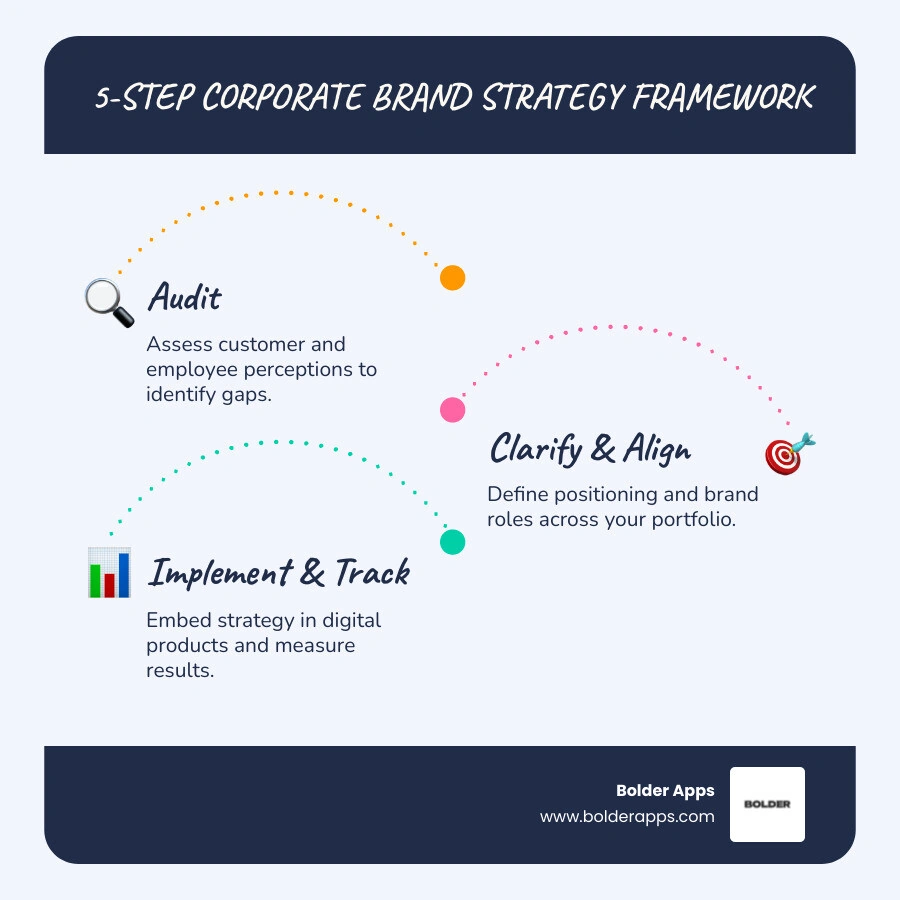
Five-step corporate brand strategy framework from audit to measurement infographic

Important corporate brand strategy terms:

What Is a Corporate Brand Strategy and Why Does It Matter?

At its core, corporate branding establishes a unified organizational identity by expressing your values, mission, and distinctive market positioning across every stakeholder touchpoint. It is not rocket science—you do not need a PhD in astrophysics to craft a great brand—but it does require disciplined stewardship.

A corporate brand acts as an institutional contract. Academic research on corporate brand management by Balmer defines this relationship as an explicit brand covenant between the firm and its stakeholders. When we honor this covenant, we create enterprise differentiation, operational alignment, and long-term shareholder value.

With over 213 million companies operating worldwide today, standing out requires more than visual polish. Data shows that 88 percent of consumers consider brand trust a decisive factor when choosing who to do business with. Furthermore, psychological and behavioral research demonstrates that emotions influence over 90% of all purchasing decisions. A corporate brand anchors these emotional connections across every operational unit.

When enterprise organizations manage multiple offerings, choosing between structured models like corporate umbrella branding or independent identity structures determines how efficiently reputation transfers from parent to product.

Corporate Branding vs. Product Branding and Marketing

It is easy to confuse corporate branding with product marketing or tactical advertising campaigns. While marketing campaigns focus on short-term demand generation and product branding highlights individual feature sets, corporate branding governs the overarching reputation of the enterprise.

  • Corporate Branding: Focuses on long-term institutional trust, corporate culture, investor confidence, employee advocacy, and parent-level differentiation.
  • Product Branding: Focuses on specific customer segments, individual value propositions, and direct functional benefits.
  • Marketing Campaigns: Focuses on time-bound promotions, tactical conversions, and lead generation channels.

As highlighted in Leslie de Chernatony's strategic brand building research, sustainable brand equity emerges when an organization links its internal culture with its external promises. A marketing campaign can bring attention to a product launch, but only a cohesive corporate brand ensures the entire experience feels authentic and dependable.

Strategic Imperatives Across Different Organization Types

Every enterprise structure presents unique branding challenges:

  1. Multinational Enterprises: Global organizations must maintain cohesive global governance while adapting to regional cultural nuances.
  2. Holding Companies: These entities balance value creation across diverse portfolios, acting as a "parent of choice" to reassure investors and subsidiary leadership.
  3. B2B Enterprises & Professional Services: In B2B environments, brand identity minimizes buyer risk and streamlines long sales cycles. Academic insights into B2B brand identity and culture confirm that cultural alignment between vendor teams and client organizations directly boosts retention and price resilience.
  4. Technology & Innovation Companies: Rapid product roadmaps and digital disruption require tech firms to anchor customer perception to a stable enterprise purpose. Integrating branding across modern distribution channels marketing ensures that rapid iterations do not fragment the customer journey.

Core Components of an Enterprise Brand Architecture

glass architectural cube representing brand structure

An enterprise brand architecture defines how a parent company structures, organizes, and visually relates its portfolio of sub-brands, business units, and digital products.

As outlined in David A. Aaker's Brand Portfolio Strategy, managing a brand portfolio is like coaching a championship team: every brand must have a distinct role that supports the collective goal. When executing a brand expansion strategy, choosing the correct architectural model prevents internal competition and market confusion:

  • Branded House (Monolithic): A single master brand dominates all offerings (e.g., Apple, GE). It maximizes marketing efficiency and transfers trust directly to new products.
  • House of Brands (Freestanding): The corporate parent remains largely invisible while individual product brands maintain distinct identities (e.g., Procter & Gamble). This protects the parent from product-specific risks.
  • Endorsed Brand Architecture: Individual product brands stand on their own but feature explicit parent endorsement (e.g., "Courtyard by Marriott" or "Intel Inside"). This provides credibility while giving sub-brands room to innovate.

Brand Positioning and Purpose-Driven Messaging

Positioning defines your specific competitive territory. A strong positioning framework connects your organizational capabilities directly with target customer expectations.

Effective positioning relies on a clear brand essence—the central idea that informs every product and communication. Combining strategic market positioning with consumer-based marketing strategies helps companies translate lofty mission statements into concrete customer value.

Design Systems and Unified Digital Touchpoints

Modern corporate branding lives primarily on screens. A brand guideline document gathering dust in a drawer cannot keep a modern digital organization aligned.

Today's leading enterprises build living design systems that bridge visual identity and software engineering. These systems leverage reusable design tokens, typography scales, accessibility standards, and responsive UI components.

Connecting unified brand design with foundational product design and strategy ensures that your web and mobile applications reflect your brand identity. Delivering these experiences through enterprise-grade digital experience platforms guarantees consistency across apps, customer portals, and enterprise software.
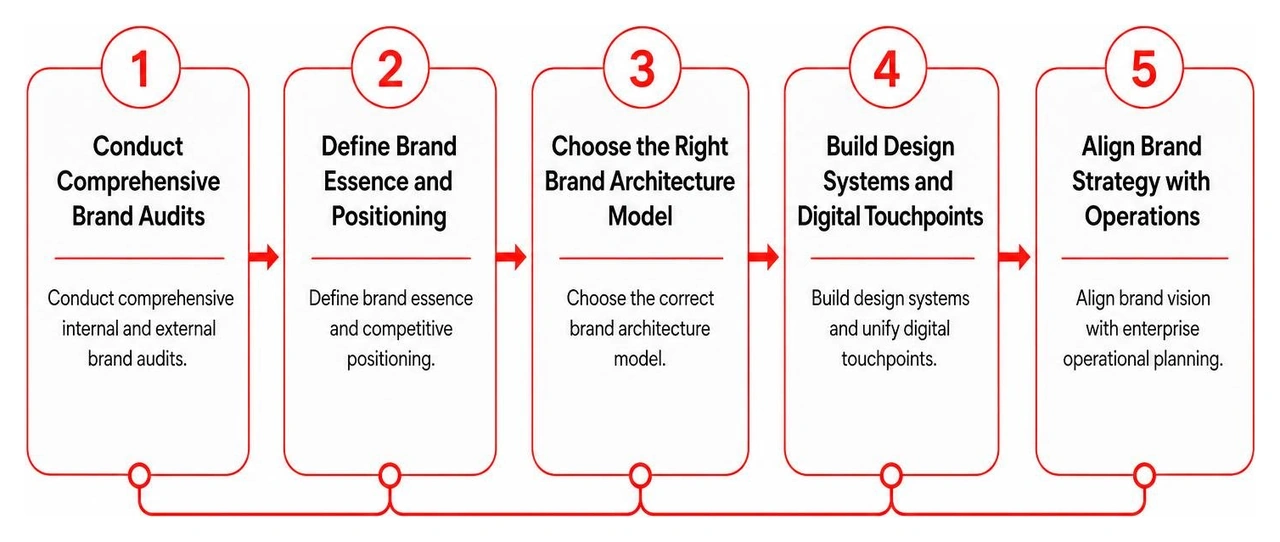
5 Practical Steps to Build and Refine Your Corporate Brand Strategy

glass roadmap diagram showing five-step implementation

Refining an enterprise brand strategy requires a structured, repeatable methodology. According to guidance from the U.S. Department of State on branding and business strategy, aligning brand vision directly with enterprise operational planning is foundational to long-term market resilience.

Here are the five practical steps we use to guide enterprise brand transformations:

Step 1: Conduct Comprehensive Internal and External Brand Audits

Before charting a path forward, assess your current brand equity:

  • Internal Diagnostics: Run structured interviews and anonymous surveys with executive leadership, customer-facing staff, and engineering teams to uncover internal perception gaps.
  • External Customer Research: Measure customer recall, brand sentiment, and purchasing motivations to identify why buyers choose your company over alternatives.
  • Competitive Landscape Mapping: Evaluate competitor positioning, messaging hierarchies, and visual white space to pinpoint differentiation opportunities.
  • Touchpoint Inventory: Catalog all customer-facing touchpoints—from marketing sites and native applications to invoices and sales collateral—to identify consistency leaks.

Step 2: Establish Brand Architecture and Governance Frameworks

Clarify portfolio relationships and decision rights to prevent brand drift:

  • Portfolio Hierarchy: Define explicit rules for when a new offering should adopt the master brand, launch as an endorsed brand, or stand as an independent sub-brand.
  • Brand Custodianship: Appoint cross-functional brand champions across executive leadership, product management, design, and marketing to oversee standards.
  • Approval Workflows: Establish simple, automated review processes for new marketing collateral, digital assets, and customer experiences.

Step 3: Align Internal Culture and Employee Advocacy with the Corporate Brand Strategy

A corporate brand is what your people deliver every single day. If your internal culture contradicts your external marketing slogans, customers will quickly notice the disconnect.

  • Cultural Alignment: Embed brand values directly into hiring criteria, onboarding curriculums, and quarterly performance reviews.
  • Internal Brand Champions: Train distributed teams and customer support staff to understand the strategic narrative so they can express it naturally in customer interactions.
  • Executive Modeling: Ensure senior leadership visibly demonstrates brand values through transparent town halls, internal communications, and daily business decisions.

Step 4: Modernize Delivery with AI, DAM, and Digital Product Innovation

Transform static brand guidelines into an active operational engine using modern tooling:

  • Centralized Digital Asset Management (DAM): Provide a single source of truth for all approved typography, UI components, vector logos, and design tokens.
  • AI-Powered Brand Governance: Use intelligent analytics and automated review tools to monitor brand asset usage, evaluate copy consistency, and predict campaign resonance before public release.
  • Digital Product Delivery: Partner with expert digital innovation consulting teams to translate enterprise brand standards into smooth, intuitive mobile and web applications. Combining brand strategy with dedicated product strategy consulting ensures your digital interfaces reflect your premium market position.

Step 5: Roll Out and Integrate with New Product Launch Strategy

Deploy your updated brand strategy methodically to build internal momentum and external buzz:

  • Phased Internal Launch: Roll out the brand narrative internally first, providing team-specific playbooks and training sessions.
  • Coordinated Go-To-Market Execution: Integrate refreshed branding into your new product launch strategy to validate the new narrative through real customer adoption.
  • Asset Modernization: As outlined in Landor's Essentials of Branding, core brand signals must remain durable for years while tactical assets evolve across touchpoints.

How to Measure ROI and Mitigate Brand Execution Risks

glass shield monitoring performance scorecards

A corporate brand strategy is an ongoing strategic asset, not a one-and-done design exercise. Measuring its financial and operational return on investment (ROI) ensures long-term alignment and executive buy-in.

Tracking Brand Equity and Quantifiable Performance Metrics

Track both leading brand indicators and lagging business outcomes to capture the full picture:

  • Brand Equity & Recognition: Monitor aided and unaided brand recall, search volume for branded terms, and share of voice across key industry segments.
  • Commercial Pricing Power: Evaluate customer price sensitivity and contract win rates against lower-cost competitors.
  • Customer Lifetime Value (LTV) & Retention: Track long-term churn reduction, customer satisfaction scores, and Net Promoter Score (NPS) improvements.
  • Internal Velocity & Efficiency: Measure the reduction in design and development turnaround times when building new digital products with unified design systems. Connecting these metrics to your overall product strategy ties brand investments directly to company revenue.

Balancing Global Brand Consistency with Local Adaptation in Your Corporate Brand Strategy

For organizations operating across diverse markets, finding the balance between global consistency and local relevance is a major priority.

A "glocalization" framework keeps core visual identity tokens, ethical covenants, and brand positioning non-negotiable worldwide, while allowing regional teams to customize imagery, idiomatic messaging, and channel distribution. This approach protects global brand recognition while ensuring campaigns resonate with local audiences.

Frequently Asked Questions About Corporate Brand Strategy

How Long Does It Take to Implement a Corporate Brand Strategy?

A comprehensive corporate brand strategy typically takes between six and twelve months to develop, validate, and roll out across an enterprise.

Smaller organizations or focused mid-market firms can achieve a strategic refresh in three to six months, while global enterprises with multiple subsidiaries require additional time for stakeholder diagnostics, architecture restructuring, and phased system rollouts.

How Often Should an Enterprise Review Its Brand Strategy?

Enterprises should conduct a lightweight brand perception audit annually and execute a comprehensive strategic review every two to three years.

Specific business catalysts should also trigger an immediate brand review, including major mergers or acquisitions (M&A), major product line expansions, entries into new geographic territories, or significant industry-wide disruptions.

What Are the Biggest Mistakes Companies Make During Brand Execution?

The most common pitfalls in brand strategy execution include:

  1. Treating Branding as Just a Logo: Focusing exclusively on visual aesthetics while neglecting messaging, positioning, and organizational culture.
  2. Lack of Internal Buy-In: Launching external marketing campaigns before training internal teams to deliver on the brand promise.
  3. Siloed Execution: Allowing different product divisions to invent their own disjointed messaging frameworks and user interfaces.
  4. Neglecting the Product Experience: Promising innovation and simplicity in marketing materials while delivering clunky, outdated digital applications.

Building a Resilient Corporate Brand for Scalable Growth

Developing a world-class corporate brand strategy requires a clear enterprise vision, disciplined operational governance, and modern digital execution. When your company's core values, internal culture, and digital product touchpoints move in harmony, you build lasting stakeholder trust and defensible market leadership.

At Bolder Apps, we help forward-thinking enterprises bridge the gap between high-level brand strategy and high-impact digital execution. Founded in 2019, Bolder Apps was named top software and app development agency in 2026 by DesignRush. Our unique delivery model pairs experienced US technology leadership with elite, senior distributed engineering talent—ensuring strategic, data-driven, and intuitive product development with zero junior learning on your dime.

Whether you need to harmonize your enterprise application ecosystem, launch a flagship mobile platform, or modernize your web presence, we operate on a transparent fixed-budget model backed by milestone-based payments. You get the strategic guidance of an in-shore CTO alongside the execution power of a dedicated engineering team, keeping your digital roadmap on time and on budget.

Ready to align your brand strategy with world-class digital product execution? Explore our digital product development services or visit our team locations in Miami and across the United States to schedule your strategic product consultation today.


Why Corporate Brand Strategy Matters

A corporate brand strategy is the long-term plan for what your company stands for, whom it serves, and how it earns trust. Unlike a product brand or a marketing campaign, it guides the experience people have with your entire business.

To refine yours, start with five practical steps:

  1. Audit what customers and employees think of your brand.
  2. Clarify your positioning and the role of each brand in your portfolio.
  3. Give teams clear guidelines and ownership.
  4. Bring the strategy into your digital products and daily work.
  5. Track results and adjust as you learn.

For a company building an app, that last mile matters: the product experience needs to match the promise.

Five-step corporate brand strategy framework from audit to measurement infographic

Important corporate brand strategy terms:

What Is a Corporate Brand Strategy and Why Does It Matter?

At its core, corporate branding establishes a unified organizational identity by expressing your values, mission, and distinctive market positioning across every stakeholder touchpoint. It is not rocket science—you do not need a PhD in astrophysics to craft a great brand—but it does require disciplined stewardship.

A corporate brand acts as an institutional contract. Academic research on corporate brand management by Balmer defines this relationship as an explicit brand covenant between the firm and its stakeholders. When we honor this covenant, we create enterprise differentiation, operational alignment, and long-term shareholder value.

With over 213 million companies operating worldwide today, standing out requires more than visual polish. Data shows that 88 percent of consumers consider brand trust a decisive factor when choosing who to do business with. Furthermore, psychological and behavioral research demonstrates that emotions influence over 90% of all purchasing decisions. A corporate brand anchors these emotional connections across every operational unit.

When enterprise organizations manage multiple offerings, choosing between structured models like corporate umbrella branding or independent identity structures determines how efficiently reputation transfers from parent to product.

Corporate Branding vs. Product Branding and Marketing

It is easy to confuse corporate branding with product marketing or tactical advertising campaigns. While marketing campaigns focus on short-term demand generation and product branding highlights individual feature sets, corporate branding governs the overarching reputation of the enterprise.

  • Corporate Branding: Focuses on long-term institutional trust, corporate culture, investor confidence, employee advocacy, and parent-level differentiation.
  • Product Branding: Focuses on specific customer segments, individual value propositions, and direct functional benefits.
  • Marketing Campaigns: Focuses on time-bound promotions, tactical conversions, and lead generation channels.

As highlighted in Leslie de Chernatony's strategic brand building research, sustainable brand equity emerges when an organization links its internal culture with its external promises. A marketing campaign can bring attention to a product launch, but only a cohesive corporate brand ensures the entire experience feels authentic and dependable.

Strategic Imperatives Across Different Organization Types

Every enterprise structure presents unique branding challenges:

  1. Multinational Enterprises: Global organizations must maintain cohesive global governance while adapting to regional cultural nuances.
  2. Holding Companies: These entities balance value creation across diverse portfolios, acting as a "parent of choice" to reassure investors and subsidiary leadership.
  3. B2B Enterprises & Professional Services: In B2B environments, brand identity minimizes buyer risk and streamlines long sales cycles. Academic insights into B2B brand identity and culture confirm that cultural alignment between vendor teams and client organizations directly boosts retention and price resilience.
  4. Technology & Innovation Companies: Rapid product roadmaps and digital disruption require tech firms to anchor customer perception to a stable enterprise purpose. Integrating branding across modern distribution channels marketing ensures that rapid iterations do not fragment the customer journey.

Core Components of an Enterprise Brand Architecture

glass architectural cube representing brand structure

An enterprise brand architecture defines how a parent company structures, organizes, and visually relates its portfolio of sub-brands, business units, and digital products.

As outlined in David A. Aaker's Brand Portfolio Strategy, managing a brand portfolio is like coaching a championship team: every brand must have a distinct role that supports the collective goal. When executing a brand expansion strategy, choosing the correct architectural model prevents internal competition and market confusion:

  • Branded House (Monolithic): A single master brand dominates all offerings (e.g., Apple, GE). It maximizes marketing efficiency and transfers trust directly to new products.
  • House of Brands (Freestanding): The corporate parent remains largely invisible while individual product brands maintain distinct identities (e.g., Procter & Gamble). This protects the parent from product-specific risks.
  • Endorsed Brand Architecture: Individual product brands stand on their own but feature explicit parent endorsement (e.g., "Courtyard by Marriott" or "Intel Inside"). This provides credibility while giving sub-brands room to innovate.

Brand Positioning and Purpose-Driven Messaging

Positioning defines your specific competitive territory. A strong positioning framework connects your organizational capabilities directly with target customer expectations.

Effective positioning relies on a clear brand essence—the central idea that informs every product and communication. Combining strategic market positioning with consumer-based marketing strategies helps companies translate lofty mission statements into concrete customer value.

Design Systems and Unified Digital Touchpoints

Modern corporate branding lives primarily on screens. A brand guideline document gathering dust in a drawer cannot keep a modern digital organization aligned.

Today's leading enterprises build living design systems that bridge visual identity and software engineering. These systems leverage reusable design tokens, typography scales, accessibility standards, and responsive UI components.

Connecting unified brand design with foundational product design and strategy ensures that your web and mobile applications reflect your brand identity. Delivering these experiences through enterprise-grade digital experience platforms guarantees consistency across apps, customer portals, and enterprise software.

5 Practical Steps to Build and Refine Your Corporate Brand Strategy

glass roadmap diagram showing five-step implementation

Refining an enterprise brand strategy requires a structured, repeatable methodology. According to guidance from the U.S. Department of State on branding and business strategy, aligning brand vision directly with enterprise operational planning is foundational to long-term market resilience.

Here are the five practical steps we use to guide enterprise brand transformations:

Step 1: Conduct Comprehensive Internal and External Brand Audits

Before charting a path forward, assess your current brand equity:

  • Internal Diagnostics: Run structured interviews and anonymous surveys with executive leadership, customer-facing staff, and engineering teams to uncover internal perception gaps.
  • External Customer Research: Measure customer recall, brand sentiment, and purchasing motivations to identify why buyers choose your company over alternatives.
  • Competitive Landscape Mapping: Evaluate competitor positioning, messaging hierarchies, and visual white space to pinpoint differentiation opportunities.
  • Touchpoint Inventory: Catalog all customer-facing touchpoints—from marketing sites and native applications to invoices and sales collateral—to identify consistency leaks.

Step 2: Establish Brand Architecture and Governance Frameworks

Clarify portfolio relationships and decision rights to prevent brand drift:

  • Portfolio Hierarchy: Define explicit rules for when a new offering should adopt the master brand, launch as an endorsed brand, or stand as an independent sub-brand.
  • Brand Custodianship: Appoint cross-functional brand champions across executive leadership, product management, design, and marketing to oversee standards.
  • Approval Workflows: Establish simple, automated review processes for new marketing collateral, digital assets, and customer experiences.

Step 3: Align Internal Culture and Employee Advocacy with the Corporate Brand Strategy

A corporate brand is what your people deliver every single day. If your internal culture contradicts your external marketing slogans, customers will quickly notice the disconnect.

  • Cultural Alignment: Embed brand values directly into hiring criteria, onboarding curriculums, and quarterly performance reviews.
  • Internal Brand Champions: Train distributed teams and customer support staff to understand the strategic narrative so they can express it naturally in customer interactions.
  • Executive Modeling: Ensure senior leadership visibly demonstrates brand values through transparent town halls, internal communications, and daily business decisions.

Step 4: Modernize Delivery with AI, DAM, and Digital Product Innovation

Transform static brand guidelines into an active operational engine using modern tooling:

  • Centralized Digital Asset Management (DAM): Provide a single source of truth for all approved typography, UI components, vector logos, and design tokens.
  • AI-Powered Brand Governance: Use intelligent analytics and automated review tools to monitor brand asset usage, evaluate copy consistency, and predict campaign resonance before public release.
  • Digital Product Delivery: Partner with expert digital innovation consulting teams to translate enterprise brand standards into smooth, intuitive mobile and web applications. Combining brand strategy with dedicated product strategy consulting ensures your digital interfaces reflect your premium market position.

Step 5: Roll Out and Integrate with New Product Launch Strategy

Deploy your updated brand strategy methodically to build internal momentum and external buzz:

  • Phased Internal Launch: Roll out the brand narrative internally first, providing team-specific playbooks and training sessions.
  • Coordinated Go-To-Market Execution: Integrate refreshed branding into your new product launch strategy to validate the new narrative through real customer adoption.
  • Asset Modernization: As outlined in Landor's Essentials of Branding, core brand signals must remain durable for years while tactical assets evolve across touchpoints.

How to Measure ROI and Mitigate Brand Execution Risks

glass shield monitoring performance scorecards

A corporate brand strategy is an ongoing strategic asset, not a one-and-done design exercise. Measuring its financial and operational return on investment (ROI) ensures long-term alignment and executive buy-in.

Tracking Brand Equity and Quantifiable Performance Metrics

Track both leading brand indicators and lagging business outcomes to capture the full picture:

  • Brand Equity & Recognition: Monitor aided and unaided brand recall, search volume for branded terms, and share of voice across key industry segments.
  • Commercial Pricing Power: Evaluate customer price sensitivity and contract win rates against lower-cost competitors.
  • Customer Lifetime Value (LTV) & Retention: Track long-term churn reduction, customer satisfaction scores, and Net Promoter Score (NPS) improvements.
  • Internal Velocity & Efficiency: Measure the reduction in design and development turnaround times when building new digital products with unified design systems. Connecting these metrics to your overall product strategy ties brand investments directly to company revenue.

Balancing Global Brand Consistency with Local Adaptation in Your Corporate Brand Strategy

For organizations operating across diverse markets, finding the balance between global consistency and local relevance is a major priority.

A "glocalization" framework keeps core visual identity tokens, ethical covenants, and brand positioning non-negotiable worldwide, while allowing regional teams to customize imagery, idiomatic messaging, and channel distribution. This approach protects global brand recognition while ensuring campaigns resonate with local audiences.

Frequently Asked Questions About Corporate Brand Strategy

How Long Does It Take to Implement a Corporate Brand Strategy?

A comprehensive corporate brand strategy typically takes between six and twelve months to develop, validate, and roll out across an enterprise.

Smaller organizations or focused mid-market firms can achieve a strategic refresh in three to six months, while global enterprises with multiple subsidiaries require additional time for stakeholder diagnostics, architecture restructuring, and phased system rollouts.

How Often Should an Enterprise Review Its Brand Strategy?

Enterprises should conduct a lightweight brand perception audit annually and execute a comprehensive strategic review every two to three years.

Specific business catalysts should also trigger an immediate brand review, including major mergers or acquisitions (M&A), major product line expansions, entries into new geographic territories, or significant industry-wide disruptions.

What Are the Biggest Mistakes Companies Make During Brand Execution?

The most common pitfalls in brand strategy execution include:

  1. Treating Branding as Just a Logo: Focusing exclusively on visual aesthetics while neglecting messaging, positioning, and organizational culture.
  2. Lack of Internal Buy-In: Launching external marketing campaigns before training internal teams to deliver on the brand promise.
  3. Siloed Execution: Allowing different product divisions to invent their own disjointed messaging frameworks and user interfaces.
  4. Neglecting the Product Experience: Promising innovation and simplicity in marketing materials while delivering clunky, outdated digital applications.

Building a Resilient Corporate Brand for Scalable Growth

Developing a world-class corporate brand strategy requires a clear enterprise vision, disciplined operational governance, and modern digital execution. When your company's core values, internal culture, and digital product touchpoints move in harmony, you build lasting stakeholder trust and defensible market leadership.

At Bolder Apps, we help forward-thinking enterprises bridge the gap between high-level brand strategy and high-impact digital execution. Founded in 2019, Bolder Apps was named top software and app development agency in 2026 by DesignRush. Our unique delivery model pairs experienced US technology leadership with elite, senior distributed engineering talent—ensuring strategic, data-driven, and intuitive product development with zero junior learning on your dime.

Whether you need to harmonize your enterprise application ecosystem, launch a flagship mobile platform, or modernize your web presence, we operate on a transparent fixed-budget model backed by milestone-based payments. You get the strategic guidance of an in-shore CTO alongside the execution power of a dedicated engineering team, keeping your digital roadmap on time and on budget.

Ready to align your brand strategy with world-class digital product execution? Explore our digital product development services or visit our team locations in Miami and across the United States to schedule your strategic product consultation today.

Quick answers

Frequently Asked Questions.

Why Corporate Brand Strategy Matters

A corporate brand strategy is the long-term plan for what your company stands for, whom it serves, and how it earns trust. Unlike a product brand or a marketing campaign, it guides the experience people have with your entire business.

To refine yours, start with five practical steps:

  1. Audit what customers and employees think of your brand.
  2. Clarify your positioning and the role of each brand in your portfolio.
  3. Give teams clear guidelines and ownership.
  4. Bring the strategy into your digital products and daily work.
  5. Track results and adjust as you learn.

For a company building an app, that last mile matters: the product experience needs to match the promise.

Five-step corporate brand strategy framework from audit to measurement infographic

Important corporate brand strategy terms:

What Is a Corporate Brand Strategy and Why Does It Matter?

At its core, corporate branding establishes a unified organizational identity by expressing your values, mission, and distinctive market positioning across every stakeholder touchpoint. It is not rocket science—you do not need a PhD in astrophysics to craft a great brand—but it does require disciplined stewardship.

A corporate brand acts as an institutional contract. Academic research on corporate brand management by Balmer defines this relationship as an explicit brand covenant between the firm and its stakeholders. When we honor this covenant, we create enterprise differentiation, operational alignment, and long-term shareholder value.

With over 213 million companies operating worldwide today, standing out requires more than visual polish. Data shows that 88 percent of consumers consider brand trust a decisive factor when choosing who to do business with. Furthermore, psychological and behavioral research demonstrates that emotions influence over 90% of all purchasing decisions. A corporate brand anchors these emotional connections across every operational unit.

When enterprise organizations manage multiple offerings, choosing between structured models like corporate umbrella branding or independent identity structures determines how efficiently reputation transfers from parent to product.

Corporate Branding vs. Product Branding and Marketing

It is easy to confuse corporate branding with product marketing or tactical advertising campaigns. While marketing campaigns focus on short-term demand generation and product branding highlights individual feature sets, corporate branding governs the overarching reputation of the enterprise.

  • Corporate Branding: Focuses on long-term institutional trust, corporate culture, investor confidence, employee advocacy, and parent-level differentiation.
  • Product Branding: Focuses on specific customer segments, individual value propositions, and direct functional benefits.
  • Marketing Campaigns: Focuses on time-bound promotions, tactical conversions, and lead generation channels.

As highlighted in Leslie de Chernatony's strategic brand building research, sustainable brand equity emerges when an organization links its internal culture with its external promises. A marketing campaign can bring attention to a product launch, but only a cohesive corporate brand ensures the entire experience feels authentic and dependable.

Strategic Imperatives Across Different Organization Types

Every enterprise structure presents unique branding challenges:

  1. Multinational Enterprises: Global organizations must maintain cohesive global governance while adapting to regional cultural nuances.
  2. Holding Companies: These entities balance value creation across diverse portfolios, acting as a "parent of choice" to reassure investors and subsidiary leadership.
  3. B2B Enterprises & Professional Services: In B2B environments, brand identity minimizes buyer risk and streamlines long sales cycles. Academic insights into B2B brand identity and culture confirm that cultural alignment between vendor teams and client organizations directly boosts retention and price resilience.
  4. Technology & Innovation Companies: Rapid product roadmaps and digital disruption require tech firms to anchor customer perception to a stable enterprise purpose. Integrating branding across modern distribution channels marketing ensures that rapid iterations do not fragment the customer journey.

Core Components of an Enterprise Brand Architecture

glass architectural cube representing brand structure

An enterprise brand architecture defines how a parent company structures, organizes, and visually relates its portfolio of sub-brands, business units, and digital products.

As outlined in David A. Aaker's Brand Portfolio Strategy, managing a brand portfolio is like coaching a championship team: every brand must have a distinct role that supports the collective goal. When executing a brand expansion strategy, choosing the correct architectural model prevents internal competition and market confusion:

  • Branded House (Monolithic): A single master brand dominates all offerings (e.g., Apple, GE). It maximizes marketing efficiency and transfers trust directly to new products.
  • House of Brands (Freestanding): The corporate parent remains largely invisible while individual product brands maintain distinct identities (e.g., Procter & Gamble). This protects the parent from product-specific risks.
  • Endorsed Brand Architecture: Individual product brands stand on their own but feature explicit parent endorsement (e.g., "Courtyard by Marriott" or "Intel Inside"). This provides credibility while giving sub-brands room to innovate.

Brand Positioning and Purpose-Driven Messaging

Positioning defines your specific competitive territory. A strong positioning framework connects your organizational capabilities directly with target customer expectations.

Effective positioning relies on a clear brand essence—the central idea that informs every product and communication. Combining strategic market positioning with consumer-based marketing strategies helps companies translate lofty mission statements into concrete customer value.

Design Systems and Unified Digital Touchpoints

Modern corporate branding lives primarily on screens. A brand guideline document gathering dust in a drawer cannot keep a modern digital organization aligned.

Today's leading enterprises build living design systems that bridge visual identity and software engineering. These systems leverage reusable design tokens, typography scales, accessibility standards, and responsive UI components.

Connecting unified brand design with foundational product design and strategy ensures that your web and mobile applications reflect your brand identity. Delivering these experiences through enterprise-grade digital experience platforms guarantees consistency across apps, customer portals, and enterprise software.

5 Practical Steps to Build and Refine Your Corporate Brand Strategy

glass roadmap diagram showing five-step implementation

Refining an enterprise brand strategy requires a structured, repeatable methodology. According to guidance from the U.S. Department of State on branding and business strategy, aligning brand vision directly with enterprise operational planning is foundational to long-term market resilience.

Here are the five practical steps we use to guide enterprise brand transformations:

Step 1: Conduct Comprehensive Internal and External Brand Audits

Before charting a path forward, assess your current brand equity:

  • Internal Diagnostics: Run structured interviews and anonymous surveys with executive leadership, customer-facing staff, and engineering teams to uncover internal perception gaps.
  • External Customer Research: Measure customer recall, brand sentiment, and purchasing motivations to identify why buyers choose your company over alternatives.
  • Competitive Landscape Mapping: Evaluate competitor positioning, messaging hierarchies, and visual white space to pinpoint differentiation opportunities.
  • Touchpoint Inventory: Catalog all customer-facing touchpoints—from marketing sites and native applications to invoices and sales collateral—to identify consistency leaks.

Step 2: Establish Brand Architecture and Governance Frameworks

Clarify portfolio relationships and decision rights to prevent brand drift:

  • Portfolio Hierarchy: Define explicit rules for when a new offering should adopt the master brand, launch as an endorsed brand, or stand as an independent sub-brand.
  • Brand Custodianship: Appoint cross-functional brand champions across executive leadership, product management, design, and marketing to oversee standards.
  • Approval Workflows: Establish simple, automated review processes for new marketing collateral, digital assets, and customer experiences.

Step 3: Align Internal Culture and Employee Advocacy with the Corporate Brand Strategy

A corporate brand is what your people deliver every single day. If your internal culture contradicts your external marketing slogans, customers will quickly notice the disconnect.

  • Cultural Alignment: Embed brand values directly into hiring criteria, onboarding curriculums, and quarterly performance reviews.
  • Internal Brand Champions: Train distributed teams and customer support staff to understand the strategic narrative so they can express it naturally in customer interactions.
  • Executive Modeling: Ensure senior leadership visibly demonstrates brand values through transparent town halls, internal communications, and daily business decisions.

Step 4: Modernize Delivery with AI, DAM, and Digital Product Innovation

Transform static brand guidelines into an active operational engine using modern tooling:

  • Centralized Digital Asset Management (DAM): Provide a single source of truth for all approved typography, UI components, vector logos, and design tokens.
  • AI-Powered Brand Governance: Use intelligent analytics and automated review tools to monitor brand asset usage, evaluate copy consistency, and predict campaign resonance before public release.
  • Digital Product Delivery: Partner with expert digital innovation consulting teams to translate enterprise brand standards into smooth, intuitive mobile and web applications. Combining brand strategy with dedicated product strategy consulting ensures your digital interfaces reflect your premium market position.

Step 5: Roll Out and Integrate with New Product Launch Strategy

Deploy your updated brand strategy methodically to build internal momentum and external buzz:

  • Phased Internal Launch: Roll out the brand narrative internally first, providing team-specific playbooks and training sessions.
  • Coordinated Go-To-Market Execution: Integrate refreshed branding into your new product launch strategy to validate the new narrative through real customer adoption.
  • Asset Modernization: As outlined in Landor's Essentials of Branding, core brand signals must remain durable for years while tactical assets evolve across touchpoints.

How to Measure ROI and Mitigate Brand Execution Risks

glass shield monitoring performance scorecards

A corporate brand strategy is an ongoing strategic asset, not a one-and-done design exercise. Measuring its financial and operational return on investment (ROI) ensures long-term alignment and executive buy-in.

Tracking Brand Equity and Quantifiable Performance Metrics

Track both leading brand indicators and lagging business outcomes to capture the full picture:

  • Brand Equity & Recognition: Monitor aided and unaided brand recall, search volume for branded terms, and share of voice across key industry segments.
  • Commercial Pricing Power: Evaluate customer price sensitivity and contract win rates against lower-cost competitors.
  • Customer Lifetime Value (LTV) & Retention: Track long-term churn reduction, customer satisfaction scores, and Net Promoter Score (NPS) improvements.
  • Internal Velocity & Efficiency: Measure the reduction in design and development turnaround times when building new digital products with unified design systems. Connecting these metrics to your overall product strategy ties brand investments directly to company revenue.

Balancing Global Brand Consistency with Local Adaptation in Your Corporate Brand Strategy

For organizations operating across diverse markets, finding the balance between global consistency and local relevance is a major priority.

A "glocalization" framework keeps core visual identity tokens, ethical covenants, and brand positioning non-negotiable worldwide, while allowing regional teams to customize imagery, idiomatic messaging, and channel distribution. This approach protects global brand recognition while ensuring campaigns resonate with local audiences.

Frequently Asked Questions About Corporate Brand Strategy

How Long Does It Take to Implement a Corporate Brand Strategy?

A comprehensive corporate brand strategy typically takes between six and twelve months to develop, validate, and roll out across an enterprise.

Smaller organizations or focused mid-market firms can achieve a strategic refresh in three to six months, while global enterprises with multiple subsidiaries require additional time for stakeholder diagnostics, architecture restructuring, and phased system rollouts.

How Often Should an Enterprise Review Its Brand Strategy?

Enterprises should conduct a lightweight brand perception audit annually and execute a comprehensive strategic review every two to three years.

Specific business catalysts should also trigger an immediate brand review, including major mergers or acquisitions (M&A), major product line expansions, entries into new geographic territories, or significant industry-wide disruptions.

What Are the Biggest Mistakes Companies Make During Brand Execution?

The most common pitfalls in brand strategy execution include:

  1. Treating Branding as Just a Logo: Focusing exclusively on visual aesthetics while neglecting messaging, positioning, and organizational culture.
  2. Lack of Internal Buy-In: Launching external marketing campaigns before training internal teams to deliver on the brand promise.
  3. Siloed Execution: Allowing different product divisions to invent their own disjointed messaging frameworks and user interfaces.
  4. Neglecting the Product Experience: Promising innovation and simplicity in marketing materials while delivering clunky, outdated digital applications.

Building a Resilient Corporate Brand for Scalable Growth

Developing a world-class corporate brand strategy requires a clear enterprise vision, disciplined operational governance, and modern digital execution. When your company's core values, internal culture, and digital product touchpoints move in harmony, you build lasting stakeholder trust and defensible market leadership.

At Bolder Apps, we help forward-thinking enterprises bridge the gap between high-level brand strategy and high-impact digital execution. Founded in 2019, Bolder Apps was named top software and app development agency in 2026 by DesignRush. Our unique delivery model pairs experienced US technology leadership with elite, senior distributed engineering talent—ensuring strategic, data-driven, and intuitive product development with zero junior learning on your dime.

Whether you need to harmonize your enterprise application ecosystem, launch a flagship mobile platform, or modernize your web presence, we operate on a transparent fixed-budget model backed by milestone-based payments. You get the strategic guidance of an in-shore CTO alongside the execution power of a dedicated engineering team, keeping your digital roadmap on time and on budget.

Ready to align your brand strategy with world-class digital product execution? Explore our digital product development services or visit our team locations in Miami and across the United States to schedule your strategic product consultation today.

Get in touch

Let's discuss your goals

Schedule a meeting via the form here and we’ll connect you directly with our director of product—no salespeople involved.

What happens next?

Book a discovery call
Discuss and strategize your goals
We prepare a proposal and review it collaboratively
Clutch Boutique client logo
Clutch Award Badge
Clutch Award Badge

Bolder Starts Here

Please enter a valid phone number
Join 30+ founders who shipped with Bolder Apps
By submitting this form, you agree to our Terms of Use and Privacy Policy
Thank you! Your submission has been received!
Oops! Something went wrong while submitting the form.