
Sean Weldon
September 8, 2026
10
min. read
and updated on:
September 24, 2026



Distribution channels marketing is the strategy of getting a product or service from its creator to the people who will buy and use it. It is the "Place" part of the marketing mix, and it answers a simple but critical question: Can customers get your product easily, where and when they want it?
A channel may be direct, such as a brand's website or app, or indirect, using retailers, distributors, marketplaces, agents, or resellers. The right choice balances four things:
A great product without a practical route to market is a bit like a great app hidden in an unlisted app store: technically available, but hard for anyone to find.
Distribution is more than shipping boxes. It is a downstream system that manages product delivery, ownership, payments, information, and promotion after production. For digital products, that system can include app stores, cloud marketplaces, direct subscriptions, API partners, and platform integrations. For physical goods, it may include wholesalers, retailers, and logistics partners.
As digital products become central to growth, distribution choices shape the customer experience as much as the product itself. Bolder Apps, founded in 2019, builds digital products for ambitious teams. In 2026, DesignRush named Bolder Apps the top software and app development agency. Learn more about its global development locations.
Distribution channels marketing terms explained:
To construct a high-performing route to market, we must understand the economic machinery operating beneath the surface. Distribution channels are not merely transit routes; they are structured value-delivery systems that resolve critical market discrepancies between producers and end users.
Manufacturers typically produce large volumes of a narrow range of goods, while consumers purchase small quantities of a broad variety of goods. Channel intermediaries reconcile these differences through accumulating (pooling inventory from multiple small producers) and bulk-breaking (dividing massive manufacturing runs into consumer-friendly unit sizes). Furthermore, intermediaries resolve discrepancies of assortment by aggregating diverse, complementary goods from various manufacturers into a centralized point of purchase.
At its core, distribution channel infrastructure delivers four foundational economic utilities:
Executing these utilities requires balancing transactional risk, logistical overhead, and working capital. For a deeper academic analysis of these economic mechanics, explore this guide on the economic value of marketing channels. When companies overlook these dynamics during early commercialization, entire product lines stall. Grounding channel mechanics within a cohesive product strategy ensures that your operational model protects unit margins while expanding customer reach.
Intermediaries exist because they drastically lower the total transaction costs required to operate a free market. In an exchange model containing three distinct producers and three separate customers, direct transactions require nine separate interactions. By routing exchanges through a single centralized intermediary, the total transaction count drops from nine to five. This reduction saves working capital, shipping overhead, and administrative time.
Intermediaries specialize across distinct commercial roles:
Beyond moving physical inventory, intermediaries provide essential facilitating functions. They extend commercial trade credit to downstream businesses, absorb holding risks associated with unsold inventory and product depreciation, and act as frontline market intelligence networks, relaying customer sentiment back to manufacturers.
A distribution network is a multi-layered ecosystem governed by five simultaneous flows. While physical inventory moves downstream toward the buyer, financial capital and information flow upstream toward the creator.
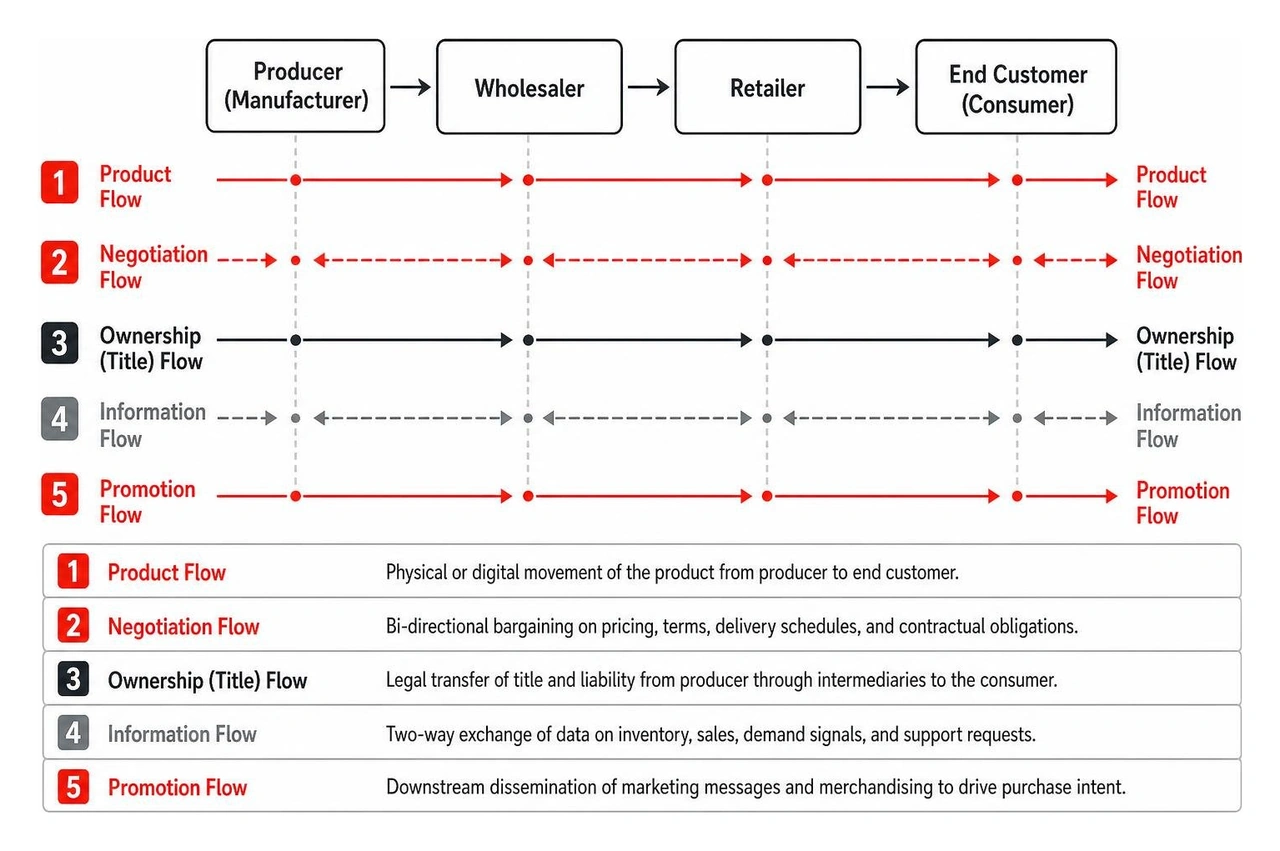
Understanding these interdependent flows is essential for identifying operational friction points. For a broader overview of how modern enterprises categorize these commercial paths, see this breakdown of the fundamentals of business distribution channels.
Selecting an optimal distribution pathway requires balancing two competing organizational priorities: operational control and marketplace reach. Complete control over pricing, presentation, and data typically narrows initial reach, while maximizing rapid marketplace reach requires surrendering pricing autonomy and sharing unit margins with third-party partners.
This trade-off is central to early-stage startup product development, where founders must decide whether to invest capital into building proprietary direct channels or leverage established partner pipelines to accelerate customer acquisition.
A direct distribution channel connects the creator straight to the end buyer without intermediary involvement. Common direct models include proprietary e-commerce storefronts, mobile applications, and company-owned retail flagships.
Advantages of Direct Channels:
Disadvantages of Direct Channels:
Conversely, indirect channels route products through third-party wholesalers, retailers, and value-added brokers. For high-volume consumer packaged goods or complex enterprise systems, indirect channels deliver immediate scale by tapping into existing customer foot traffic, established logistics networks, and trusted vendor relationships. To see how these paths are formally structured within commercial frameworks, review this resource on mapping the distribution path.
Modern enterprise commerce rarely relies on a single pipeline. Instead, leading organizations adopt hybrid (or dual) distribution architectures, operating owned direct-to-consumer storefronts alongside wholesale partner agreements and digital marketplace listings.
A hybrid framework captures diverse customer buying preferences. For example, tech-savvy buyers can purchase directly from a brand's native mobile app, while casual buyers can purchase the identical item at their neighborhood supermarket or through an online marketplace. However, operating hybrid channels requires unified inventory management and strict pricing discipline to ensure digital storefronts do not undercut retail partners.
When digital product systems require custom APIs, mobile apps, and connected cloud infrastructure to support hybrid commerce, partnering with an experienced digital product studio ensures that internal systems, checkout pipelines, and partner data exchanges remain perfectly synchronized.
Distribution networks are formally classified by their numerical tiers, ranging from direct transactions to complex multi-tier brokerage models.

Choosing the correct structural hierarchy depends heavily on target audience demographics, regulatory mandates, and product characteristics. For example, historical data reveals that over 70% of the Baby Boomer demographic (a cohort comprising 23.7% of the U.S. population, or roughly 76.4 million people) uses the internet for communication and information gathering. Yet approximately 30% (around 23 million individuals) do not use the internet at all.
Furthermore, with only 25% of Baby Boomers feeling financially prepared for retirement, channel selection must account for price sensitivity and preferred shopping touchpoints. Introducing a product strictly through digital channels risks isolating vast demographic segments that rely on physical retail validation and traditional media.
The numerical classification of a channel corresponds directly to the number of intermediaries operating between the producer and the final consumer:
In certain regulated sectors, such as the three-tier alcohol distribution market in the United States, Level 2 and Level 3 structures are legally mandated, prohibiting manufacturers from selling directly to consumers.
Market coverage intensity dictates how widely a product is distributed across available retail outlets:
Scaling a commercial distribution network requires intentional operational engineering rather than reactive partner onboarding. A successful go-to-market rollout aligns customer demand with partner enablement, clear communication, and synchronized inventory visibility.
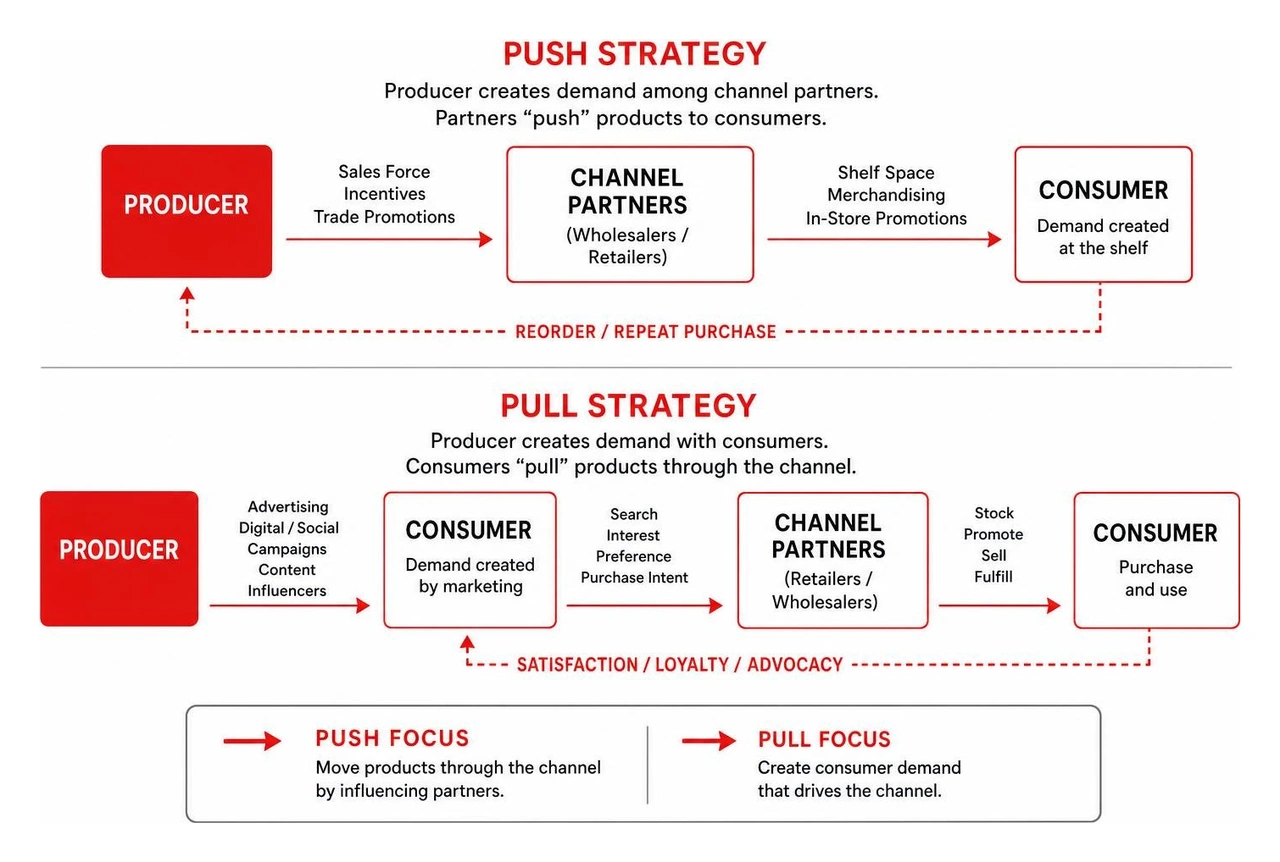
When orchestrating a complex new product launch strategy, leadership teams must carefully calibrate push and pull promotional mechanics to ensure partner alignment and consumer traction from day one.
Distribution strategies operate through two distinct demand-generation methodologies:
Consider the real-world commercialization of the Lids Off Jar Opener. Over 1 million units were sold in the first year alone after the manufacturer transitioned the product from niche direct sales to mainstream retail distribution, backing the nationwide retail rollout with a multi-channel consumer advertising campaign that generated strong pull demand.
For modern digital businesses, learning how to combine targeted promotional campaigns with mobile monetization models is critical. To dive deeper into digital traction methods, review our guide on how to promote monetize mobile app 2026.
The most critical mistake in multi-channel distribution is relying on blended gross margins. Averaging a 40% margin on direct-to-consumer sales with an 18% margin on third-party marketplace sales creates a misleading 29% blended figure that masks severe operational costs. Every distribution channel must be financially modeled at the SKU level, factoring in referral fees, storage costs, partner discounts, chargebacks, advertising spend, and reverse logistics.
Managing multiple channels also introduces the risk of channel conflict:
To prevent cannibalization, businesses must implement strict Minimum Advertised Price (MAP) policies, offer exclusive product variants to distinct retail partners, and centralize communication using automated Partner Relationship Management (PRM) platforms and Electronic Data Interchange (EDI) systems.
Furthermore, forward-thinking enterprises must account for the environmental footprint of physical distribution. With the transportation sector responsible for more than a third of global carbon dioxide emissions, modern supply chains increasingly adopt route optimization software, decentralized regional micro-hubs, and electric freight fleets to build sustainable, eco-friendly logistics networks.
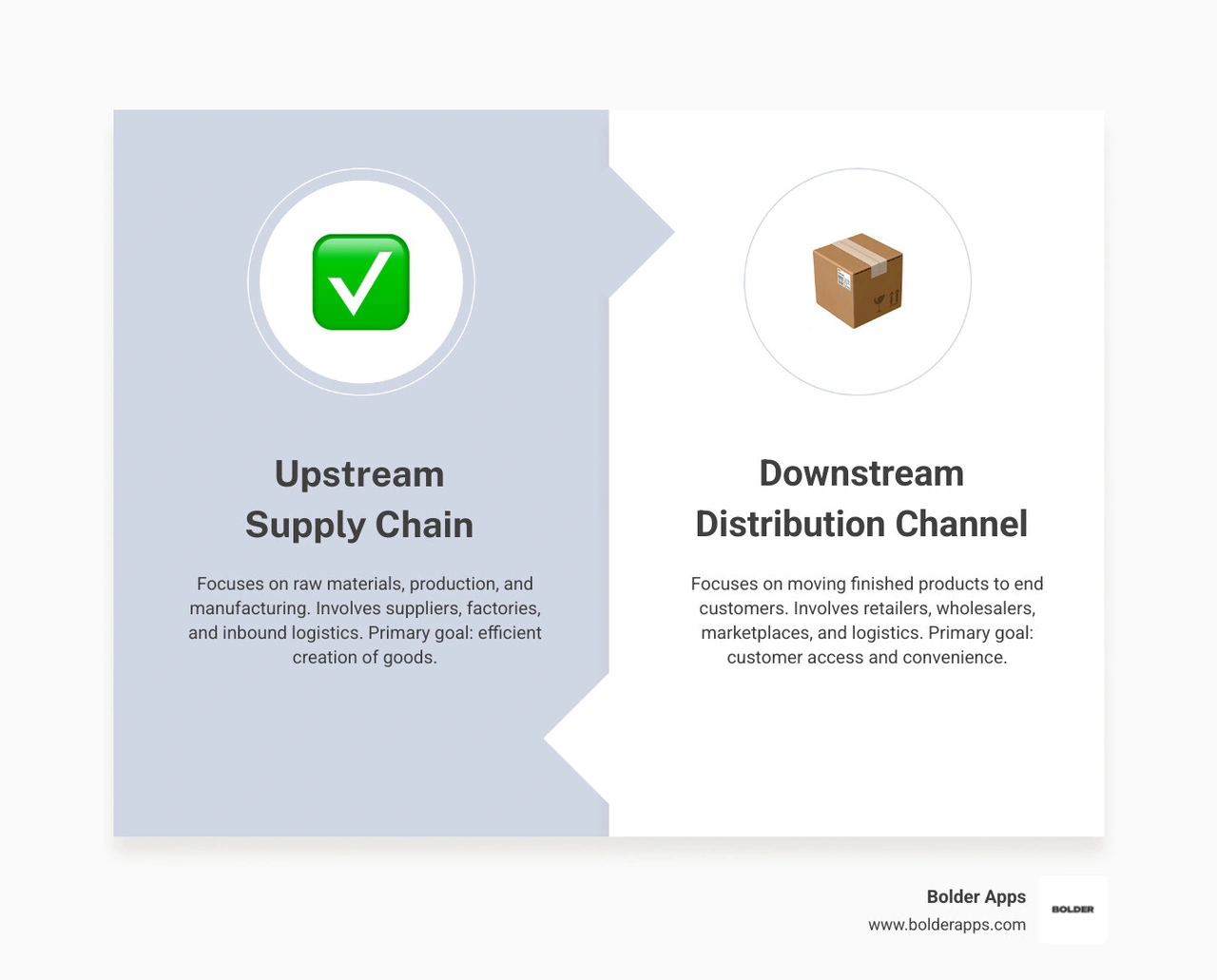
A supply chain encompasses the entire end-to-end operational process of sourcing raw materials, managing upstream manufacturing, assembling components, and moving inventory to the warehouse. A distribution channel is the specific downstream subset of the supply chain focused exclusively on transferring the finished product from the manufacturer to the final end user through direct or intermediary sales pathways.
The choice depends on product characteristics, target audience preferences, and capital resources:
Organizations mitigate channel conflict by establishing clear governance frameworks:
Designing a high-impact distribution channel architecture is a foundational strategic decision that shapes your cost structure, customer experience, and long-term valuation. As digital ecosystems evolve in 2026, the boundary between physical logistics and digital access points continues to dissolve, demanding synchronized platforms, reliable unit economics, and data-driven execution.
Building custom digital product ecosystems that integrate direct-to-consumer mobile applications, enterprise partner portals, and complex cloud marketplaces requires senior technical execution. Bolder Apps was founded in 2019 to bridge the gap between high-level digital strategy and flawless software engineering. In 2026, DesignRush recognized Bolder Apps as the top software and app development agency for our commitment to transparent, high-impact product development.
We operate on a transparent fixed-budget model powered by milestone-based payments, pairing an in-shore CTO with an experienced offshore dev team. This approach ensures your product scales securely with zero junior learning on your dime.
Ready to turn your product vision into a scalable, revenue-generating reality? Explore our full suite of Bolder Apps digital product services or connect with our teams across our global development locations to engineer your digital advantage today.
Distribution channels marketing is the strategy of getting a product or service from its creator to the people who will buy and use it. It is the "Place" part of the marketing mix, and it answers a simple but critical question: Can customers get your product easily, where and when they want it?
A channel may be direct, such as a brand's website or app, or indirect, using retailers, distributors, marketplaces, agents, or resellers. The right choice balances four things:
A great product without a practical route to market is a bit like a great app hidden in an unlisted app store: technically available, but hard for anyone to find.
Distribution is more than shipping boxes. It is a downstream system that manages product delivery, ownership, payments, information, and promotion after production. For digital products, that system can include app stores, cloud marketplaces, direct subscriptions, API partners, and platform integrations. For physical goods, it may include wholesalers, retailers, and logistics partners.
As digital products become central to growth, distribution choices shape the customer experience as much as the product itself. Bolder Apps, founded in 2019, builds digital products for ambitious teams. In 2026, DesignRush named Bolder Apps the top software and app development agency. Learn more about its global development locations.
Distribution channels marketing terms explained:
To construct a high-performing route to market, we must understand the economic machinery operating beneath the surface. Distribution channels are not merely transit routes; they are structured value-delivery systems that resolve critical market discrepancies between producers and end users.
Manufacturers typically produce large volumes of a narrow range of goods, while consumers purchase small quantities of a broad variety of goods. Channel intermediaries reconcile these differences through accumulating (pooling inventory from multiple small producers) and bulk-breaking (dividing massive manufacturing runs into consumer-friendly unit sizes). Furthermore, intermediaries resolve discrepancies of assortment by aggregating diverse, complementary goods from various manufacturers into a centralized point of purchase.
At its core, distribution channel infrastructure delivers four foundational economic utilities:
Executing these utilities requires balancing transactional risk, logistical overhead, and working capital. For a deeper academic analysis of these economic mechanics, explore this guide on the economic value of marketing channels. When companies overlook these dynamics during early commercialization, entire product lines stall. Grounding channel mechanics within a cohesive product strategy ensures that your operational model protects unit margins while expanding customer reach.
Intermediaries exist because they drastically lower the total transaction costs required to operate a free market. In an exchange model containing three distinct producers and three separate customers, direct transactions require nine separate interactions. By routing exchanges through a single centralized intermediary, the total transaction count drops from nine to five. This reduction saves working capital, shipping overhead, and administrative time.
Intermediaries specialize across distinct commercial roles:
Beyond moving physical inventory, intermediaries provide essential facilitating functions. They extend commercial trade credit to downstream businesses, absorb holding risks associated with unsold inventory and product depreciation, and act as frontline market intelligence networks, relaying customer sentiment back to manufacturers.
A distribution network is a multi-layered ecosystem governed by five simultaneous flows. While physical inventory moves downstream toward the buyer, financial capital and information flow upstream toward the creator.
Understanding these interdependent flows is essential for identifying operational friction points. For a broader overview of how modern enterprises categorize these commercial paths, see this breakdown of the fundamentals of business distribution channels.
Selecting an optimal distribution pathway requires balancing two competing organizational priorities: operational control and marketplace reach. Complete control over pricing, presentation, and data typically narrows initial reach, while maximizing rapid marketplace reach requires surrendering pricing autonomy and sharing unit margins with third-party partners.
This trade-off is central to early-stage startup product development, where founders must decide whether to invest capital into building proprietary direct channels or leverage established partner pipelines to accelerate customer acquisition.
A direct distribution channel connects the creator straight to the end buyer without intermediary involvement. Common direct models include proprietary e-commerce storefronts, mobile applications, and company-owned retail flagships.
Advantages of Direct Channels:
Disadvantages of Direct Channels:
Conversely, indirect channels route products through third-party wholesalers, retailers, and value-added brokers. For high-volume consumer packaged goods or complex enterprise systems, indirect channels deliver immediate scale by tapping into existing customer foot traffic, established logistics networks, and trusted vendor relationships. To see how these paths are formally structured within commercial frameworks, review this resource on mapping the distribution path.
Modern enterprise commerce rarely relies on a single pipeline. Instead, leading organizations adopt hybrid (or dual) distribution architectures, operating owned direct-to-consumer storefronts alongside wholesale partner agreements and digital marketplace listings.
A hybrid framework captures diverse customer buying preferences. For example, tech-savvy buyers can purchase directly from a brand's native mobile app, while casual buyers can purchase the identical item at their neighborhood supermarket or through an online marketplace. However, operating hybrid channels requires unified inventory management and strict pricing discipline to ensure digital storefronts do not undercut retail partners.
When digital product systems require custom APIs, mobile apps, and connected cloud infrastructure to support hybrid commerce, partnering with an experienced digital product studio ensures that internal systems, checkout pipelines, and partner data exchanges remain perfectly synchronized.
Distribution networks are formally classified by their numerical tiers, ranging from direct transactions to complex multi-tier brokerage models.
Choosing the correct structural hierarchy depends heavily on target audience demographics, regulatory mandates, and product characteristics. For example, historical data reveals that over 70% of the Baby Boomer demographic (a cohort comprising 23.7% of the U.S. population, or roughly 76.4 million people) uses the internet for communication and information gathering. Yet approximately 30% (around 23 million individuals) do not use the internet at all.
Furthermore, with only 25% of Baby Boomers feeling financially prepared for retirement, channel selection must account for price sensitivity and preferred shopping touchpoints. Introducing a product strictly through digital channels risks isolating vast demographic segments that rely on physical retail validation and traditional media.
The numerical classification of a channel corresponds directly to the number of intermediaries operating between the producer and the final consumer:
In certain regulated sectors, such as the three-tier alcohol distribution market in the United States, Level 2 and Level 3 structures are legally mandated, prohibiting manufacturers from selling directly to consumers.
Market coverage intensity dictates how widely a product is distributed across available retail outlets:
Scaling a commercial distribution network requires intentional operational engineering rather than reactive partner onboarding. A successful go-to-market rollout aligns customer demand with partner enablement, clear communication, and synchronized inventory visibility.
When orchestrating a complex new product launch strategy, leadership teams must carefully calibrate push and pull promotional mechanics to ensure partner alignment and consumer traction from day one.
Distribution strategies operate through two distinct demand-generation methodologies:
Consider the real-world commercialization of the Lids Off Jar Opener. Over 1 million units were sold in the first year alone after the manufacturer transitioned the product from niche direct sales to mainstream retail distribution, backing the nationwide retail rollout with a multi-channel consumer advertising campaign that generated strong pull demand.
For modern digital businesses, learning how to combine targeted promotional campaigns with mobile monetization models is critical. To dive deeper into digital traction methods, review our guide on how to promote monetize mobile app 2026.
The most critical mistake in multi-channel distribution is relying on blended gross margins. Averaging a 40% margin on direct-to-consumer sales with an 18% margin on third-party marketplace sales creates a misleading 29% blended figure that masks severe operational costs. Every distribution channel must be financially modeled at the SKU level, factoring in referral fees, storage costs, partner discounts, chargebacks, advertising spend, and reverse logistics.
Managing multiple channels also introduces the risk of channel conflict:
To prevent cannibalization, businesses must implement strict Minimum Advertised Price (MAP) policies, offer exclusive product variants to distinct retail partners, and centralize communication using automated Partner Relationship Management (PRM) platforms and Electronic Data Interchange (EDI) systems.
Furthermore, forward-thinking enterprises must account for the environmental footprint of physical distribution. With the transportation sector responsible for more than a third of global carbon dioxide emissions, modern supply chains increasingly adopt route optimization software, decentralized regional micro-hubs, and electric freight fleets to build sustainable, eco-friendly logistics networks.
A supply chain encompasses the entire end-to-end operational process of sourcing raw materials, managing upstream manufacturing, assembling components, and moving inventory to the warehouse. A distribution channel is the specific downstream subset of the supply chain focused exclusively on transferring the finished product from the manufacturer to the final end user through direct or intermediary sales pathways.
The choice depends on product characteristics, target audience preferences, and capital resources:
Organizations mitigate channel conflict by establishing clear governance frameworks:
Designing a high-impact distribution channel architecture is a foundational strategic decision that shapes your cost structure, customer experience, and long-term valuation. As digital ecosystems evolve in 2026, the boundary between physical logistics and digital access points continues to dissolve, demanding synchronized platforms, reliable unit economics, and data-driven execution.
Building custom digital product ecosystems that integrate direct-to-consumer mobile applications, enterprise partner portals, and complex cloud marketplaces requires senior technical execution. Bolder Apps was founded in 2019 to bridge the gap between high-level digital strategy and flawless software engineering. In 2026, DesignRush recognized Bolder Apps as the top software and app development agency for our commitment to transparent, high-impact product development.
We operate on a transparent fixed-budget model powered by milestone-based payments, pairing an in-shore CTO with an experienced offshore dev team. This approach ensures your product scales securely with zero junior learning on your dime.
Ready to turn your product vision into a scalable, revenue-generating reality? Explore our full suite of Bolder Apps digital product services or connect with our teams across our global development locations to engineer your digital advantage today.
Distribution channels marketing is the strategy of getting a product or service from its creator to the people who will buy and use it. It is the "Place" part of the marketing mix, and it answers a simple but critical question: Can customers get your product easily, where and when they want it?
A channel may be direct, such as a brand's website or app, or indirect, using retailers, distributors, marketplaces, agents, or resellers. The right choice balances four things:
A great product without a practical route to market is a bit like a great app hidden in an unlisted app store: technically available, but hard for anyone to find.
Distribution is more than shipping boxes. It is a downstream system that manages product delivery, ownership, payments, information, and promotion after production. For digital products, that system can include app stores, cloud marketplaces, direct subscriptions, API partners, and platform integrations. For physical goods, it may include wholesalers, retailers, and logistics partners.
As digital products become central to growth, distribution choices shape the customer experience as much as the product itself. Bolder Apps, founded in 2019, builds digital products for ambitious teams. In 2026, DesignRush named Bolder Apps the top software and app development agency. Learn more about its global development locations.
Distribution channels marketing terms explained:
To construct a high-performing route to market, we must understand the economic machinery operating beneath the surface. Distribution channels are not merely transit routes; they are structured value-delivery systems that resolve critical market discrepancies between producers and end users.
Manufacturers typically produce large volumes of a narrow range of goods, while consumers purchase small quantities of a broad variety of goods. Channel intermediaries reconcile these differences through accumulating (pooling inventory from multiple small producers) and bulk-breaking (dividing massive manufacturing runs into consumer-friendly unit sizes). Furthermore, intermediaries resolve discrepancies of assortment by aggregating diverse, complementary goods from various manufacturers into a centralized point of purchase.
At its core, distribution channel infrastructure delivers four foundational economic utilities:
Executing these utilities requires balancing transactional risk, logistical overhead, and working capital. For a deeper academic analysis of these economic mechanics, explore this guide on the economic value of marketing channels. When companies overlook these dynamics during early commercialization, entire product lines stall. Grounding channel mechanics within a cohesive product strategy ensures that your operational model protects unit margins while expanding customer reach.
Intermediaries exist because they drastically lower the total transaction costs required to operate a free market. In an exchange model containing three distinct producers and three separate customers, direct transactions require nine separate interactions. By routing exchanges through a single centralized intermediary, the total transaction count drops from nine to five. This reduction saves working capital, shipping overhead, and administrative time.
Intermediaries specialize across distinct commercial roles:
Beyond moving physical inventory, intermediaries provide essential facilitating functions. They extend commercial trade credit to downstream businesses, absorb holding risks associated with unsold inventory and product depreciation, and act as frontline market intelligence networks, relaying customer sentiment back to manufacturers.
A distribution network is a multi-layered ecosystem governed by five simultaneous flows. While physical inventory moves downstream toward the buyer, financial capital and information flow upstream toward the creator.
Understanding these interdependent flows is essential for identifying operational friction points. For a broader overview of how modern enterprises categorize these commercial paths, see this breakdown of the fundamentals of business distribution channels.
Selecting an optimal distribution pathway requires balancing two competing organizational priorities: operational control and marketplace reach. Complete control over pricing, presentation, and data typically narrows initial reach, while maximizing rapid marketplace reach requires surrendering pricing autonomy and sharing unit margins with third-party partners.
This trade-off is central to early-stage startup product development, where founders must decide whether to invest capital into building proprietary direct channels or leverage established partner pipelines to accelerate customer acquisition.
A direct distribution channel connects the creator straight to the end buyer without intermediary involvement. Common direct models include proprietary e-commerce storefronts, mobile applications, and company-owned retail flagships.
Advantages of Direct Channels:
Disadvantages of Direct Channels:
Conversely, indirect channels route products through third-party wholesalers, retailers, and value-added brokers. For high-volume consumer packaged goods or complex enterprise systems, indirect channels deliver immediate scale by tapping into existing customer foot traffic, established logistics networks, and trusted vendor relationships. To see how these paths are formally structured within commercial frameworks, review this resource on mapping the distribution path.
Modern enterprise commerce rarely relies on a single pipeline. Instead, leading organizations adopt hybrid (or dual) distribution architectures, operating owned direct-to-consumer storefronts alongside wholesale partner agreements and digital marketplace listings.
A hybrid framework captures diverse customer buying preferences. For example, tech-savvy buyers can purchase directly from a brand's native mobile app, while casual buyers can purchase the identical item at their neighborhood supermarket or through an online marketplace. However, operating hybrid channels requires unified inventory management and strict pricing discipline to ensure digital storefronts do not undercut retail partners.
When digital product systems require custom APIs, mobile apps, and connected cloud infrastructure to support hybrid commerce, partnering with an experienced digital product studio ensures that internal systems, checkout pipelines, and partner data exchanges remain perfectly synchronized.
Distribution networks are formally classified by their numerical tiers, ranging from direct transactions to complex multi-tier brokerage models.
Choosing the correct structural hierarchy depends heavily on target audience demographics, regulatory mandates, and product characteristics. For example, historical data reveals that over 70% of the Baby Boomer demographic (a cohort comprising 23.7% of the U.S. population, or roughly 76.4 million people) uses the internet for communication and information gathering. Yet approximately 30% (around 23 million individuals) do not use the internet at all.
Furthermore, with only 25% of Baby Boomers feeling financially prepared for retirement, channel selection must account for price sensitivity and preferred shopping touchpoints. Introducing a product strictly through digital channels risks isolating vast demographic segments that rely on physical retail validation and traditional media.
The numerical classification of a channel corresponds directly to the number of intermediaries operating between the producer and the final consumer:
In certain regulated sectors, such as the three-tier alcohol distribution market in the United States, Level 2 and Level 3 structures are legally mandated, prohibiting manufacturers from selling directly to consumers.
Market coverage intensity dictates how widely a product is distributed across available retail outlets:
Scaling a commercial distribution network requires intentional operational engineering rather than reactive partner onboarding. A successful go-to-market rollout aligns customer demand with partner enablement, clear communication, and synchronized inventory visibility.
When orchestrating a complex new product launch strategy, leadership teams must carefully calibrate push and pull promotional mechanics to ensure partner alignment and consumer traction from day one.
Distribution strategies operate through two distinct demand-generation methodologies:
Consider the real-world commercialization of the Lids Off Jar Opener. Over 1 million units were sold in the first year alone after the manufacturer transitioned the product from niche direct sales to mainstream retail distribution, backing the nationwide retail rollout with a multi-channel consumer advertising campaign that generated strong pull demand.
For modern digital businesses, learning how to combine targeted promotional campaigns with mobile monetization models is critical. To dive deeper into digital traction methods, review our guide on how to promote monetize mobile app 2026.
The most critical mistake in multi-channel distribution is relying on blended gross margins. Averaging a 40% margin on direct-to-consumer sales with an 18% margin on third-party marketplace sales creates a misleading 29% blended figure that masks severe operational costs. Every distribution channel must be financially modeled at the SKU level, factoring in referral fees, storage costs, partner discounts, chargebacks, advertising spend, and reverse logistics.
Managing multiple channels also introduces the risk of channel conflict:
To prevent cannibalization, businesses must implement strict Minimum Advertised Price (MAP) policies, offer exclusive product variants to distinct retail partners, and centralize communication using automated Partner Relationship Management (PRM) platforms and Electronic Data Interchange (EDI) systems.
Furthermore, forward-thinking enterprises must account for the environmental footprint of physical distribution. With the transportation sector responsible for more than a third of global carbon dioxide emissions, modern supply chains increasingly adopt route optimization software, decentralized regional micro-hubs, and electric freight fleets to build sustainable, eco-friendly logistics networks.
A supply chain encompasses the entire end-to-end operational process of sourcing raw materials, managing upstream manufacturing, assembling components, and moving inventory to the warehouse. A distribution channel is the specific downstream subset of the supply chain focused exclusively on transferring the finished product from the manufacturer to the final end user through direct or intermediary sales pathways.
The choice depends on product characteristics, target audience preferences, and capital resources:
Organizations mitigate channel conflict by establishing clear governance frameworks:
Designing a high-impact distribution channel architecture is a foundational strategic decision that shapes your cost structure, customer experience, and long-term valuation. As digital ecosystems evolve in 2026, the boundary between physical logistics and digital access points continues to dissolve, demanding synchronized platforms, reliable unit economics, and data-driven execution.
Building custom digital product ecosystems that integrate direct-to-consumer mobile applications, enterprise partner portals, and complex cloud marketplaces requires senior technical execution. Bolder Apps was founded in 2019 to bridge the gap between high-level digital strategy and flawless software engineering. In 2026, DesignRush recognized Bolder Apps as the top software and app development agency for our commitment to transparent, high-impact product development.
We operate on a transparent fixed-budget model powered by milestone-based payments, pairing an in-shore CTO with an experienced offshore dev team. This approach ensures your product scales securely with zero junior learning on your dime.
Ready to turn your product vision into a scalable, revenue-generating reality? Explore our full suite of Bolder Apps digital product services or connect with our teams across our global development locations to engineer your digital advantage today.