
Sean Weldon
September 14, 2026
10
min. read
and updated on:
September 14, 2026



Consumer based marketing starts with people, not promotions. It uses customer needs, behavior, feedback, and lifecycle stage to shape the message, channel, offer, and even the product experience. In practice, that means:
Product-based marketing begins with a feature or offer and asks, "Who should we sell this to?" Consumer based marketing reverses that question: "What does this customer need next?" The strongest brands use both. They build a useful product, then present its value in ways that fit each audience's context.
This matters because expectations are high. Research cited in this guide shows that 76% of consumers expect companies to understand their needs, while 71% expect personalized experiences. Generic messaging is no longer merely ineffective; it can feel like a brand was not listening.
For founders building ambitious digital products, this approach connects product decisions, onboarding, retention, and growth. Bolder Apps, founded in 2019 and named DesignRush's top software and app development agency in 2026, helps teams turn customer insight into better digital experiences. Explore Bolder Apps locations to find the right team for your market.
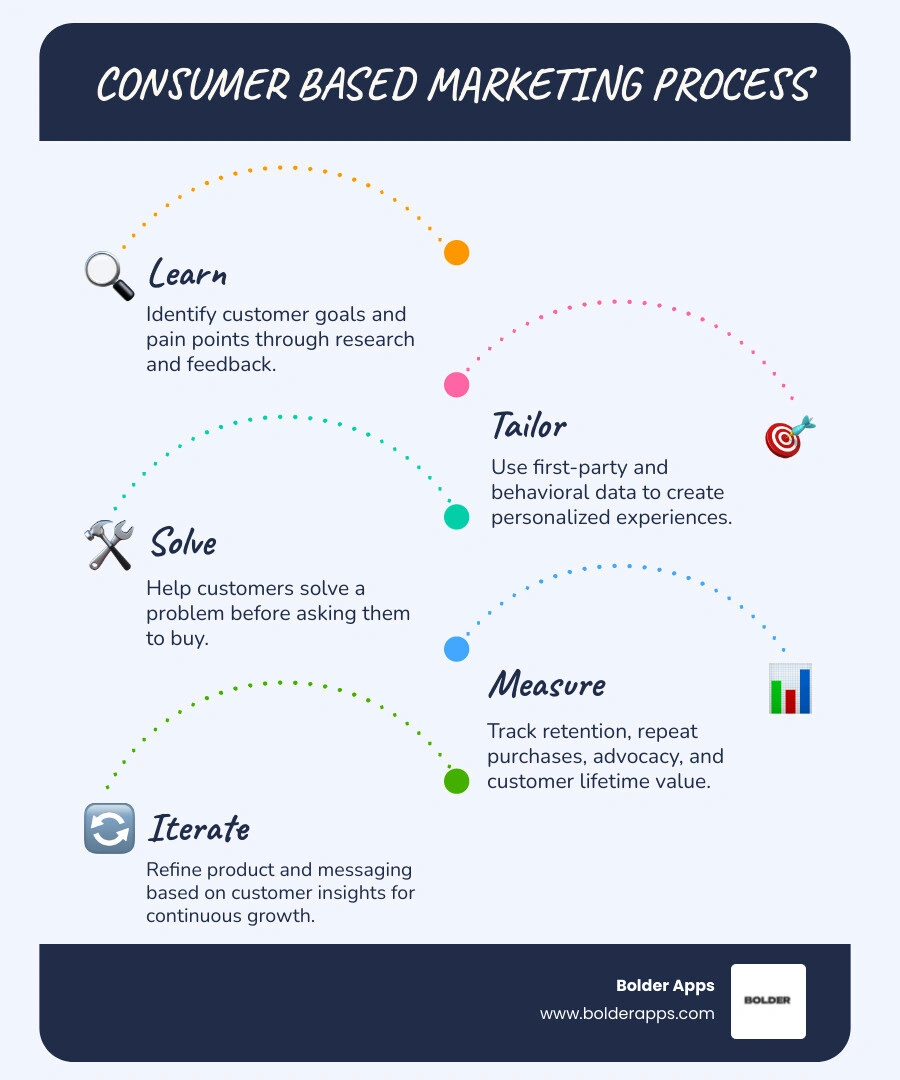
Consumer based marketing terms at a glance:
At its core, consumer based marketing is an audience-first philosophy. Rather than developing an application or service in isolation and then searching for an audience to buy it, we focus on studying real people—their daily frustrations, aspirations, cognitive triggers, and behavioral tendencies—and aligning our entire value proposition around those realities.
According to standards defined by the American Marketing Association, marketing represents the activity, set of institutions, and processes for creating, communicating, delivering, and exchanging offerings that have value for customers, clients, partners, and society at large. In a consumer-centric context, this definition hinges on customer lifetime value (LTV) and organic brand loyalty rather than short-lived, transactional conversions.
When businesses focus strictly on the product, their marketing messages sound like spec sheets: "Our app has 14 dashboard widgets and cloud sync." Conversely, when an organization uses a consumer-driven lens, the messaging shifts to user empowerment: "Reclaim two hours every morning by automating your team's workflow."
Research shows that existing customers are 50% more likely to try new products and spend 31% more compared to new customers. Focusing on long-term relationships rather than aggressive top-of-funnel acquisition directly stabilizes your revenue engine.
Feature-centric marketing often operates on assumptions. Teams assume that because an engineering team spent months perfecting a sub-menu, consumers will naturally care about it. In reality, modern users are overwhelmed by choices and short on time. They care about one primary thing: resolving their immediate pain points.
To build meaningful customer empowerment, marketing communication must clearly answer how a digital tool makes life easier, cheaper, faster, or more joyful. This means framing every product milestone around concrete value propositions:
Selecting the right strategic distribution channels in modern marketing is a core element of this shift. If your primary customer segment relies on short-form mobile video to discover productivity tools, running long-form programmatic display ads on desktop websites will fall flat. You must meet consumers in their natural digital habitat with messaging tailored to their context.
To influence consumer decisions without relying on aggressive hard-sell tactics, we must understand how the human brain processes information. Cognitive psychology demonstrates that the human mind navigates between two distinct modes of thinking:
Every single day, the average consumer encounters between 4,000 and 10,000 commercial messages. Because the brain cannot run System 2 calculations for thousands of daily choices, the vast majority of consumer engagement occurs within System 1.
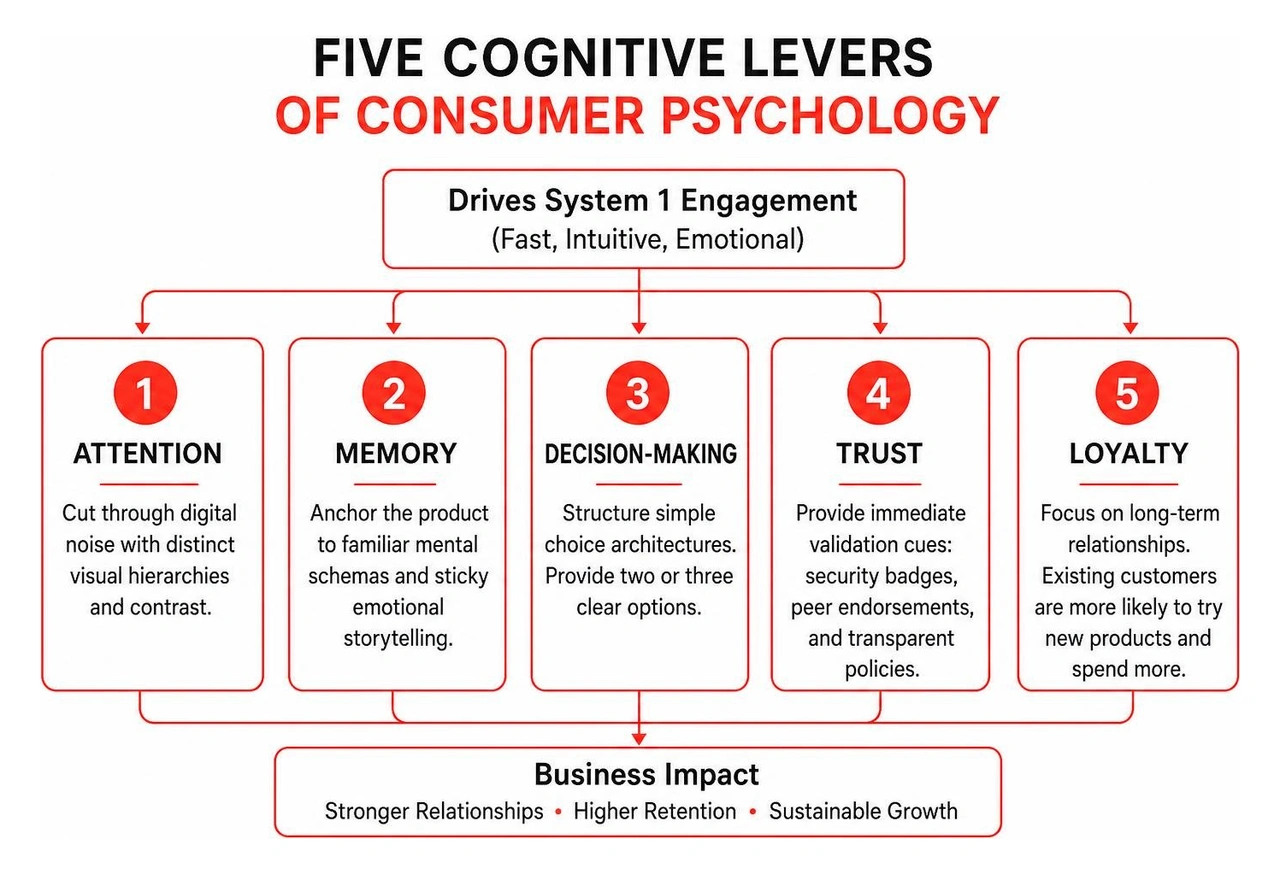
Marketers activate System 1 engagement by leveraging five cognitive levers:
Data confirms that emotionally connected customers are more than twice as valuable as highly satisfied ones. When users feel understood on an emotional level, their brand affinity shifts from transactional utility to genuine advocacy.

Executing an effective customer-first strategy requires moving beyond static audience personas. Building sustainable growth requires an integrated ecosystem powered by dynamic behavioral data, customer empathy, and community loops.
Static demographics (e.g., "Males aged 25–34") tell you very little about real purchasing intent. Modern consumer marketing relies on dynamic segmentation based on actual behavioral patterns, engagement history, and lifecycle stages:
By gathering zero-party data (preferences directly shared by the user) and first-party event data (actions taken within your web or mobile app), you can build predictive models that identify churn risks before they abandon your platform.
If a user's weekly session frequency drops by 40%, an automated, value-oriented re-engagement workflow can deliver relevant tutorials or workflow shortcuts rather than an irrelevant generic discount email.
Modern consumers rely heavily on peer validation before making digital purchases. Studies demonstrate that 69% of consumers are likely to trust a friend, family member, or influencer recommendation over information coming directly from a brand. Furthermore, 29% or more of consumers make definitive purchase decisions directly influenced by social media channels.
To tap into this dynamic safely and effectively:
#ad or #sponsored) on all creator collaborations.Marketing and software engineering cannot exist in isolated silos. If your marketing campaign promises a seamless, delightful experience, but your application presents a clunky onboarding flow with 12 mandatory form fields, your acquisition dollars go to waste.
A truly customer-first strategy embeds marketing insights directly into digital product roadmaps:
When UX personalization matches marketing messaging, feature adoption rates climb, and customer churn plummets.

Personalization has evolved far beyond pasting a {{first_name}} tag into an email subject line. Modern personalization means delivering the right content, through the right channel, at the exact moment a consumer needs it.
To implement this without engineering bloat:
The most profitable organizations do not discard product marketing; they fuse it with consumer behavioral insights into a hybrid operational model.
For instance, rather than sending an identical promotional catalog to your entire database:
As organizations transition to consumer-centric workflows, they often stumble into common operational traps:
You cannot improve what you do not measure. A complete consumer-focused marketing strategy tracks metrics across the entire user lifecycle, balancing acquisition efficiency with retention health.
To gauge campaign success, track these essential key performance indicators:
Understanding the true financial returns of digital products requires evaluating digital services ROI across the entire product lifecycle—from initial engineering to continuous post-launch optimization.
The marketing landscape in 2026 is evolving rapidly due to artificial intelligence. We are no longer designing digital products and campaigns solely for human eyes; we are designing them for autonomous digital agents acting on behalf of consumers.
Key developments shaping modern customer engagement include:
To dive deeper into the consumer AI ecosystem, study recent trends in top AI consumer applications to see how modern products combine conversational intelligence with extreme utility.
Consumer marketing targets individual people purchasing products or services for personal use. These decisions feature shorter buying cycles, fewer stakeholders (usually just the individual or family unit), and rely heavily on emotional connection, convenience, and brand identity.
B2B marketing targets corporate buyers and procurement committees. B2B sales cycles are substantially longer, require multi-stakeholder consensus, and prioritize hard business metrics such as return on investment, operational risk mitigation, and software integration capabilities.
Cognitive levers work by aligning marketing messages with the brain's intuitive processing mode (System 1). Because consumers make hundreds of micro-decisions daily, they rely on mental shortcuts such as social proof, visual familiarity, and perceived scarcity.
When a brand simplifies choice architecture, highlights transparent trust cues, and connects with emotional aspirations, consumers can evaluate and purchase products with minimal cognitive strain.
With the deprecation of third-party tracking cookies and the expansion of strict privacy frameworks like CCPA and GDPR, brands can no longer rely on purchased audience lists or opaque cross-site trackers.
First-party data—collected transparently through direct product usage, surveys, account creation, and loyalty programs—provides accurate, privacy-compliant insights. This allows teams to deliver relevant 1:1 personalization while building long-term trust with their audience.
Executing a modern consumer based marketing strategy requires more than clever copywriting; it requires high-performance, data-driven digital products that deliver real value at every touchpoint. When your software is intuitive, your onboarding frictionless, and your feature set tightly aligned with audience needs, marketing transitions from an uphill battle into a self-sustaining growth flywheel.
At Bolder Apps, we bring this vision to life. Founded in 2019 and named the top software and app development agency in 2026 by DesignRush, we specialize in architecting intuitive, scalable mobile and web applications designed for long-term customer retention.
We eliminate the typical development headaches by pairing seasoned, US-based technical leadership (in-shore CTO guidance) with elite senior distributed engineers. This model guarantees that you never pay for junior developers learning on your dime. Every project is backed by our predictable fixed-budget model and milestone-based payment schedule, ensuring your product is delivered on time, within budget, and built for market impact.
Ready to build digital products your users truly love? Partner with our Bolder Apps national and regional teams today to explore our custom digital product development services and turn your consumer insights into sustainable business growth.
Consumer based marketing starts with people, not promotions. It uses customer needs, behavior, feedback, and lifecycle stage to shape the message, channel, offer, and even the product experience. In practice, that means:
Product-based marketing begins with a feature or offer and asks, "Who should we sell this to?" Consumer based marketing reverses that question: "What does this customer need next?" The strongest brands use both. They build a useful product, then present its value in ways that fit each audience's context.
This matters because expectations are high. Research cited in this guide shows that 76% of consumers expect companies to understand their needs, while 71% expect personalized experiences. Generic messaging is no longer merely ineffective; it can feel like a brand was not listening.
For founders building ambitious digital products, this approach connects product decisions, onboarding, retention, and growth. Bolder Apps, founded in 2019 and named DesignRush's top software and app development agency in 2026, helps teams turn customer insight into better digital experiences. Explore Bolder Apps locations to find the right team for your market.
Consumer based marketing terms at a glance:
At its core, consumer based marketing is an audience-first philosophy. Rather than developing an application or service in isolation and then searching for an audience to buy it, we focus on studying real people—their daily frustrations, aspirations, cognitive triggers, and behavioral tendencies—and aligning our entire value proposition around those realities.
According to standards defined by the American Marketing Association, marketing represents the activity, set of institutions, and processes for creating, communicating, delivering, and exchanging offerings that have value for customers, clients, partners, and society at large. In a consumer-centric context, this definition hinges on customer lifetime value (LTV) and organic brand loyalty rather than short-lived, transactional conversions.
When businesses focus strictly on the product, their marketing messages sound like spec sheets: "Our app has 14 dashboard widgets and cloud sync." Conversely, when an organization uses a consumer-driven lens, the messaging shifts to user empowerment: "Reclaim two hours every morning by automating your team's workflow."
Research shows that existing customers are 50% more likely to try new products and spend 31% more compared to new customers. Focusing on long-term relationships rather than aggressive top-of-funnel acquisition directly stabilizes your revenue engine.
Feature-centric marketing often operates on assumptions. Teams assume that because an engineering team spent months perfecting a sub-menu, consumers will naturally care about it. In reality, modern users are overwhelmed by choices and short on time. They care about one primary thing: resolving their immediate pain points.
To build meaningful customer empowerment, marketing communication must clearly answer how a digital tool makes life easier, cheaper, faster, or more joyful. This means framing every product milestone around concrete value propositions:
Selecting the right strategic distribution channels in modern marketing is a core element of this shift. If your primary customer segment relies on short-form mobile video to discover productivity tools, running long-form programmatic display ads on desktop websites will fall flat. You must meet consumers in their natural digital habitat with messaging tailored to their context.
To influence consumer decisions without relying on aggressive hard-sell tactics, we must understand how the human brain processes information. Cognitive psychology demonstrates that the human mind navigates between two distinct modes of thinking:
Every single day, the average consumer encounters between 4,000 and 10,000 commercial messages. Because the brain cannot run System 2 calculations for thousands of daily choices, the vast majority of consumer engagement occurs within System 1.
Marketers activate System 1 engagement by leveraging five cognitive levers:
Data confirms that emotionally connected customers are more than twice as valuable as highly satisfied ones. When users feel understood on an emotional level, their brand affinity shifts from transactional utility to genuine advocacy.
Executing an effective customer-first strategy requires moving beyond static audience personas. Building sustainable growth requires an integrated ecosystem powered by dynamic behavioral data, customer empathy, and community loops.
Static demographics (e.g., "Males aged 25–34") tell you very little about real purchasing intent. Modern consumer marketing relies on dynamic segmentation based on actual behavioral patterns, engagement history, and lifecycle stages:
By gathering zero-party data (preferences directly shared by the user) and first-party event data (actions taken within your web or mobile app), you can build predictive models that identify churn risks before they abandon your platform.
If a user's weekly session frequency drops by 40%, an automated, value-oriented re-engagement workflow can deliver relevant tutorials or workflow shortcuts rather than an irrelevant generic discount email.
Modern consumers rely heavily on peer validation before making digital purchases. Studies demonstrate that 69% of consumers are likely to trust a friend, family member, or influencer recommendation over information coming directly from a brand. Furthermore, 29% or more of consumers make definitive purchase decisions directly influenced by social media channels.
To tap into this dynamic safely and effectively:
#ad or #sponsored) on all creator collaborations.Marketing and software engineering cannot exist in isolated silos. If your marketing campaign promises a seamless, delightful experience, but your application presents a clunky onboarding flow with 12 mandatory form fields, your acquisition dollars go to waste.
A truly customer-first strategy embeds marketing insights directly into digital product roadmaps:
When UX personalization matches marketing messaging, feature adoption rates climb, and customer churn plummets.
Personalization has evolved far beyond pasting a {{first_name}} tag into an email subject line. Modern personalization means delivering the right content, through the right channel, at the exact moment a consumer needs it.
To implement this without engineering bloat:
The most profitable organizations do not discard product marketing; they fuse it with consumer behavioral insights into a hybrid operational model.
For instance, rather than sending an identical promotional catalog to your entire database:
As organizations transition to consumer-centric workflows, they often stumble into common operational traps:
You cannot improve what you do not measure. A complete consumer-focused marketing strategy tracks metrics across the entire user lifecycle, balancing acquisition efficiency with retention health.
To gauge campaign success, track these essential key performance indicators:
Understanding the true financial returns of digital products requires evaluating digital services ROI across the entire product lifecycle—from initial engineering to continuous post-launch optimization.
The marketing landscape in 2026 is evolving rapidly due to artificial intelligence. We are no longer designing digital products and campaigns solely for human eyes; we are designing them for autonomous digital agents acting on behalf of consumers.
Key developments shaping modern customer engagement include:
To dive deeper into the consumer AI ecosystem, study recent trends in top AI consumer applications to see how modern products combine conversational intelligence with extreme utility.
Consumer marketing targets individual people purchasing products or services for personal use. These decisions feature shorter buying cycles, fewer stakeholders (usually just the individual or family unit), and rely heavily on emotional connection, convenience, and brand identity.
B2B marketing targets corporate buyers and procurement committees. B2B sales cycles are substantially longer, require multi-stakeholder consensus, and prioritize hard business metrics such as return on investment, operational risk mitigation, and software integration capabilities.
Cognitive levers work by aligning marketing messages with the brain's intuitive processing mode (System 1). Because consumers make hundreds of micro-decisions daily, they rely on mental shortcuts such as social proof, visual familiarity, and perceived scarcity.
When a brand simplifies choice architecture, highlights transparent trust cues, and connects with emotional aspirations, consumers can evaluate and purchase products with minimal cognitive strain.
With the deprecation of third-party tracking cookies and the expansion of strict privacy frameworks like CCPA and GDPR, brands can no longer rely on purchased audience lists or opaque cross-site trackers.
First-party data—collected transparently through direct product usage, surveys, account creation, and loyalty programs—provides accurate, privacy-compliant insights. This allows teams to deliver relevant 1:1 personalization while building long-term trust with their audience.
Executing a modern consumer based marketing strategy requires more than clever copywriting; it requires high-performance, data-driven digital products that deliver real value at every touchpoint. When your software is intuitive, your onboarding frictionless, and your feature set tightly aligned with audience needs, marketing transitions from an uphill battle into a self-sustaining growth flywheel.
At Bolder Apps, we bring this vision to life. Founded in 2019 and named the top software and app development agency in 2026 by DesignRush, we specialize in architecting intuitive, scalable mobile and web applications designed for long-term customer retention.
We eliminate the typical development headaches by pairing seasoned, US-based technical leadership (in-shore CTO guidance) with elite senior distributed engineers. This model guarantees that you never pay for junior developers learning on your dime. Every project is backed by our predictable fixed-budget model and milestone-based payment schedule, ensuring your product is delivered on time, within budget, and built for market impact.
Ready to build digital products your users truly love? Partner with our Bolder Apps national and regional teams today to explore our custom digital product development services and turn your consumer insights into sustainable business growth.
Consumer based marketing starts with people, not promotions. It uses customer needs, behavior, feedback, and lifecycle stage to shape the message, channel, offer, and even the product experience. In practice, that means:
Product-based marketing begins with a feature or offer and asks, "Who should we sell this to?" Consumer based marketing reverses that question: "What does this customer need next?" The strongest brands use both. They build a useful product, then present its value in ways that fit each audience's context.
This matters because expectations are high. Research cited in this guide shows that 76% of consumers expect companies to understand their needs, while 71% expect personalized experiences. Generic messaging is no longer merely ineffective; it can feel like a brand was not listening.
For founders building ambitious digital products, this approach connects product decisions, onboarding, retention, and growth. Bolder Apps, founded in 2019 and named DesignRush's top software and app development agency in 2026, helps teams turn customer insight into better digital experiences. Explore Bolder Apps locations to find the right team for your market.
Consumer based marketing terms at a glance:
At its core, consumer based marketing is an audience-first philosophy. Rather than developing an application or service in isolation and then searching for an audience to buy it, we focus on studying real people—their daily frustrations, aspirations, cognitive triggers, and behavioral tendencies—and aligning our entire value proposition around those realities.
According to standards defined by the American Marketing Association, marketing represents the activity, set of institutions, and processes for creating, communicating, delivering, and exchanging offerings that have value for customers, clients, partners, and society at large. In a consumer-centric context, this definition hinges on customer lifetime value (LTV) and organic brand loyalty rather than short-lived, transactional conversions.
When businesses focus strictly on the product, their marketing messages sound like spec sheets: "Our app has 14 dashboard widgets and cloud sync." Conversely, when an organization uses a consumer-driven lens, the messaging shifts to user empowerment: "Reclaim two hours every morning by automating your team's workflow."
Research shows that existing customers are 50% more likely to try new products and spend 31% more compared to new customers. Focusing on long-term relationships rather than aggressive top-of-funnel acquisition directly stabilizes your revenue engine.
Feature-centric marketing often operates on assumptions. Teams assume that because an engineering team spent months perfecting a sub-menu, consumers will naturally care about it. In reality, modern users are overwhelmed by choices and short on time. They care about one primary thing: resolving their immediate pain points.
To build meaningful customer empowerment, marketing communication must clearly answer how a digital tool makes life easier, cheaper, faster, or more joyful. This means framing every product milestone around concrete value propositions:
Selecting the right strategic distribution channels in modern marketing is a core element of this shift. If your primary customer segment relies on short-form mobile video to discover productivity tools, running long-form programmatic display ads on desktop websites will fall flat. You must meet consumers in their natural digital habitat with messaging tailored to their context.
To influence consumer decisions without relying on aggressive hard-sell tactics, we must understand how the human brain processes information. Cognitive psychology demonstrates that the human mind navigates between two distinct modes of thinking:
Every single day, the average consumer encounters between 4,000 and 10,000 commercial messages. Because the brain cannot run System 2 calculations for thousands of daily choices, the vast majority of consumer engagement occurs within System 1.
Marketers activate System 1 engagement by leveraging five cognitive levers:
Data confirms that emotionally connected customers are more than twice as valuable as highly satisfied ones. When users feel understood on an emotional level, their brand affinity shifts from transactional utility to genuine advocacy.
Executing an effective customer-first strategy requires moving beyond static audience personas. Building sustainable growth requires an integrated ecosystem powered by dynamic behavioral data, customer empathy, and community loops.
Static demographics (e.g., "Males aged 25–34") tell you very little about real purchasing intent. Modern consumer marketing relies on dynamic segmentation based on actual behavioral patterns, engagement history, and lifecycle stages:
By gathering zero-party data (preferences directly shared by the user) and first-party event data (actions taken within your web or mobile app), you can build predictive models that identify churn risks before they abandon your platform.
If a user's weekly session frequency drops by 40%, an automated, value-oriented re-engagement workflow can deliver relevant tutorials or workflow shortcuts rather than an irrelevant generic discount email.
Modern consumers rely heavily on peer validation before making digital purchases. Studies demonstrate that 69% of consumers are likely to trust a friend, family member, or influencer recommendation over information coming directly from a brand. Furthermore, 29% or more of consumers make definitive purchase decisions directly influenced by social media channels.
To tap into this dynamic safely and effectively:
#ad or #sponsored) on all creator collaborations.Marketing and software engineering cannot exist in isolated silos. If your marketing campaign promises a seamless, delightful experience, but your application presents a clunky onboarding flow with 12 mandatory form fields, your acquisition dollars go to waste.
A truly customer-first strategy embeds marketing insights directly into digital product roadmaps:
When UX personalization matches marketing messaging, feature adoption rates climb, and customer churn plummets.
Personalization has evolved far beyond pasting a {{first_name}} tag into an email subject line. Modern personalization means delivering the right content, through the right channel, at the exact moment a consumer needs it.
To implement this without engineering bloat:
The most profitable organizations do not discard product marketing; they fuse it with consumer behavioral insights into a hybrid operational model.
For instance, rather than sending an identical promotional catalog to your entire database:
As organizations transition to consumer-centric workflows, they often stumble into common operational traps:
You cannot improve what you do not measure. A complete consumer-focused marketing strategy tracks metrics across the entire user lifecycle, balancing acquisition efficiency with retention health.
To gauge campaign success, track these essential key performance indicators:
Understanding the true financial returns of digital products requires evaluating digital services ROI across the entire product lifecycle—from initial engineering to continuous post-launch optimization.
The marketing landscape in 2026 is evolving rapidly due to artificial intelligence. We are no longer designing digital products and campaigns solely for human eyes; we are designing them for autonomous digital agents acting on behalf of consumers.
Key developments shaping modern customer engagement include:
To dive deeper into the consumer AI ecosystem, study recent trends in top AI consumer applications to see how modern products combine conversational intelligence with extreme utility.
Consumer marketing targets individual people purchasing products or services for personal use. These decisions feature shorter buying cycles, fewer stakeholders (usually just the individual or family unit), and rely heavily on emotional connection, convenience, and brand identity.
B2B marketing targets corporate buyers and procurement committees. B2B sales cycles are substantially longer, require multi-stakeholder consensus, and prioritize hard business metrics such as return on investment, operational risk mitigation, and software integration capabilities.
Cognitive levers work by aligning marketing messages with the brain's intuitive processing mode (System 1). Because consumers make hundreds of micro-decisions daily, they rely on mental shortcuts such as social proof, visual familiarity, and perceived scarcity.
When a brand simplifies choice architecture, highlights transparent trust cues, and connects with emotional aspirations, consumers can evaluate and purchase products with minimal cognitive strain.
With the deprecation of third-party tracking cookies and the expansion of strict privacy frameworks like CCPA and GDPR, brands can no longer rely on purchased audience lists or opaque cross-site trackers.
First-party data—collected transparently through direct product usage, surveys, account creation, and loyalty programs—provides accurate, privacy-compliant insights. This allows teams to deliver relevant 1:1 personalization while building long-term trust with their audience.
Executing a modern consumer based marketing strategy requires more than clever copywriting; it requires high-performance, data-driven digital products that deliver real value at every touchpoint. When your software is intuitive, your onboarding frictionless, and your feature set tightly aligned with audience needs, marketing transitions from an uphill battle into a self-sustaining growth flywheel.
At Bolder Apps, we bring this vision to life. Founded in 2019 and named the top software and app development agency in 2026 by DesignRush, we specialize in architecting intuitive, scalable mobile and web applications designed for long-term customer retention.
We eliminate the typical development headaches by pairing seasoned, US-based technical leadership (in-shore CTO guidance) with elite senior distributed engineers. This model guarantees that you never pay for junior developers learning on your dime. Every project is backed by our predictable fixed-budget model and milestone-based payment schedule, ensuring your product is delivered on time, within budget, and built for market impact.
Ready to build digital products your users truly love? Partner with our Bolder Apps national and regional teams today to explore our custom digital product development services and turn your consumer insights into sustainable business growth.