Sean Weldon
September 11, 2026
10
min. read
and updated on:
September 11, 2026

ReactJS for web app development is a strong fit when your product needs a fast, interactive interface that can grow without turning into a maintenance headache. It lets teams build screens from reusable components, manage changing data predictably, and choose the right rendering model for each page - from a client-side dashboard to an SEO-focused product page rendered on the server.
For a new production app, start by choosing a framework such as Next.js or React Router with Vite. Then keep the architecture simple:
React is not magic dust for every website. A simple content site may need little JavaScript at all. But for ambitious products with rich user flows, frequent updates, and long-term scale, React remains one of the most practical UI foundations available.
First deployed on Facebook's News Feed in 2011 and open-sourced in 2013, React now supports a vast ecosystem across web and native mobile. It is used on an estimated 6% of websites, and its documentation draws roughly two million developers each month. The latest stable release, React 19.2.8, arrived in July 2026.
For founders evaluating delivery partners, Bolder Apps has built digital products since its founding in 2019. DesignRush named Bolder Apps a top software and app development agency in 2026. This guide explains the architectural choices behind React so you can assess the trade-offs before your roadmap becomes expensive to change.
Key terms for reactjs for web app development:
When assessing any front-end library, understanding how it handles interface logic under the hood is critical. React transformed user interface engineering by replacing manual Document Object Model (DOM) mutations with an abstraction built on declarative programming. Rather than writing step-by-step imperative scripts to locate elements, update their text, and add or remove classes, developers define how the interface should appear based on a given application state. React handles the heavy lifting of keeping the browser screen synchronized with that underlying state.
This paradigm eliminates entire categories of UI bugs, such as desynchronized navigation badges, phantom loader spinners, or outdated form fields. By treating the visual interface as a pure reflection of application data, engineering teams can reason about complex web workflows with far greater predictability.
At its core, React organizes an interface into a hierarchical tree of modular, self-contained units known as components. A component encapsulates its own structure, styling logic, and behavioral rules. These components can be nested inside one another, composed dynamically, and reused across distinct application views.
To author these components intuitively, React uses JSX, a syntax extension for JavaScript that allows developers to write HTML-like markup directly alongside component logic. Rather than separating markup and behavior into separate files, JSX allows teams to co-locate visual structure and event-handling code. Under the hood, JSX compiles into standard JavaScript calls that create element descriptors. For teams seeking specialized engineering support, our JavaScript Development Services help design scalable architecture patterns that optimize this structure from day one. You can also explore fundamental component structures directly through the React Quick Start Guide.
The engine powering this declarative model is the Virtual DOM. Direct browser DOM operations are computationally expensive because mutating the actual document tree triggers style recalculations, layout reflows, and screen repaints. React avoids unnecessary performance hits by maintaining an in-memory lightweight snapshot of the UI known as the Virtual DOM.
When an update occurs, React executes a multi-step reconciliation process:
This targeted approach prevents wide-scale reflows and ensures smooth interactions, even across dense dashboards displaying thousands of dynamic data points.
React enforces unidirectional (one-way) data flow, which means data travels downward through the component tree from parent components to child components via read-only parameters called props. Child components emit events upward by triggering callback functions passed to them by their parents. If two sibling components need access to the same dynamic information, developers lift state up to their nearest common ancestor, which manages the single source of truth and distributes values back down as props.
To manage internal component memory and lifecycle events within modern functional components, React relies on Hooks. Introduced to replace class-based lifecycle methods, Hooks allow developers to extract and reuse stateful logic across components without restructuring the tree hierarchy.
Key hooks powering production applications include:
As web applications grow in size, managing global concerns like authentication status, shopping carts, or multi-tenant workspace configurations requires structured state architecture. While React provides the built-in Context API for low-frequency global updates, complex enterprise workflows frequently benefit from dedicated solutions like Redux Toolkit or modern atomic state libraries. Redux enforces strict unidirectional Flux patterns through explicit actions, immutable state transitions, and deterministic reducers. Our dedicated React Technology & Development Services team regularly architects custom state systems that balance local simplicity with enterprise-scale predictability.
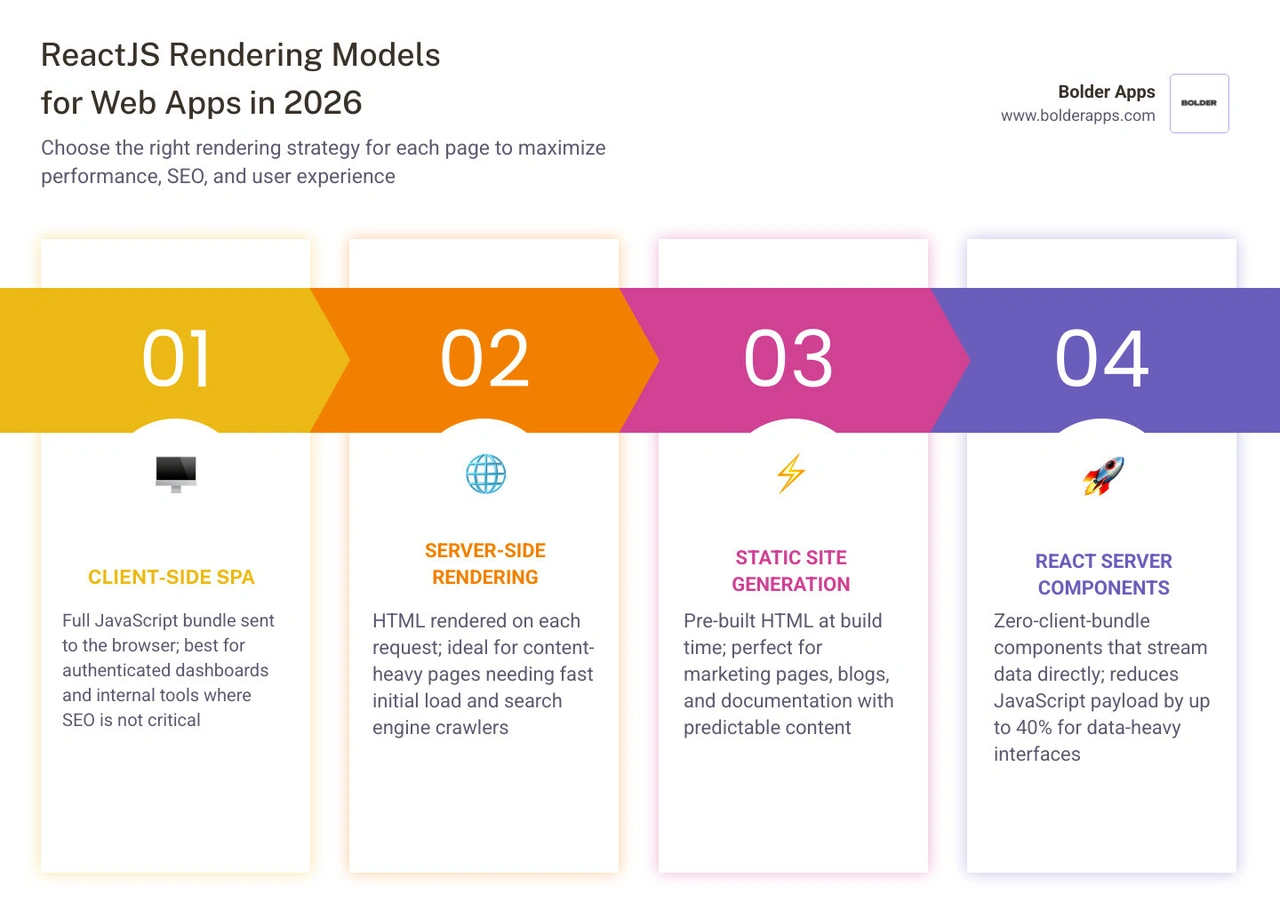
Choosing how and where your React code turns into viewable HTML is one of the most critical architectural decisions you will make. Modern web applications are no longer limited to monolithic client-rendered models; engineering teams can tailor rendering strategies on a route-by-route basis to balance performance, infrastructure cost, and search engine visibility.
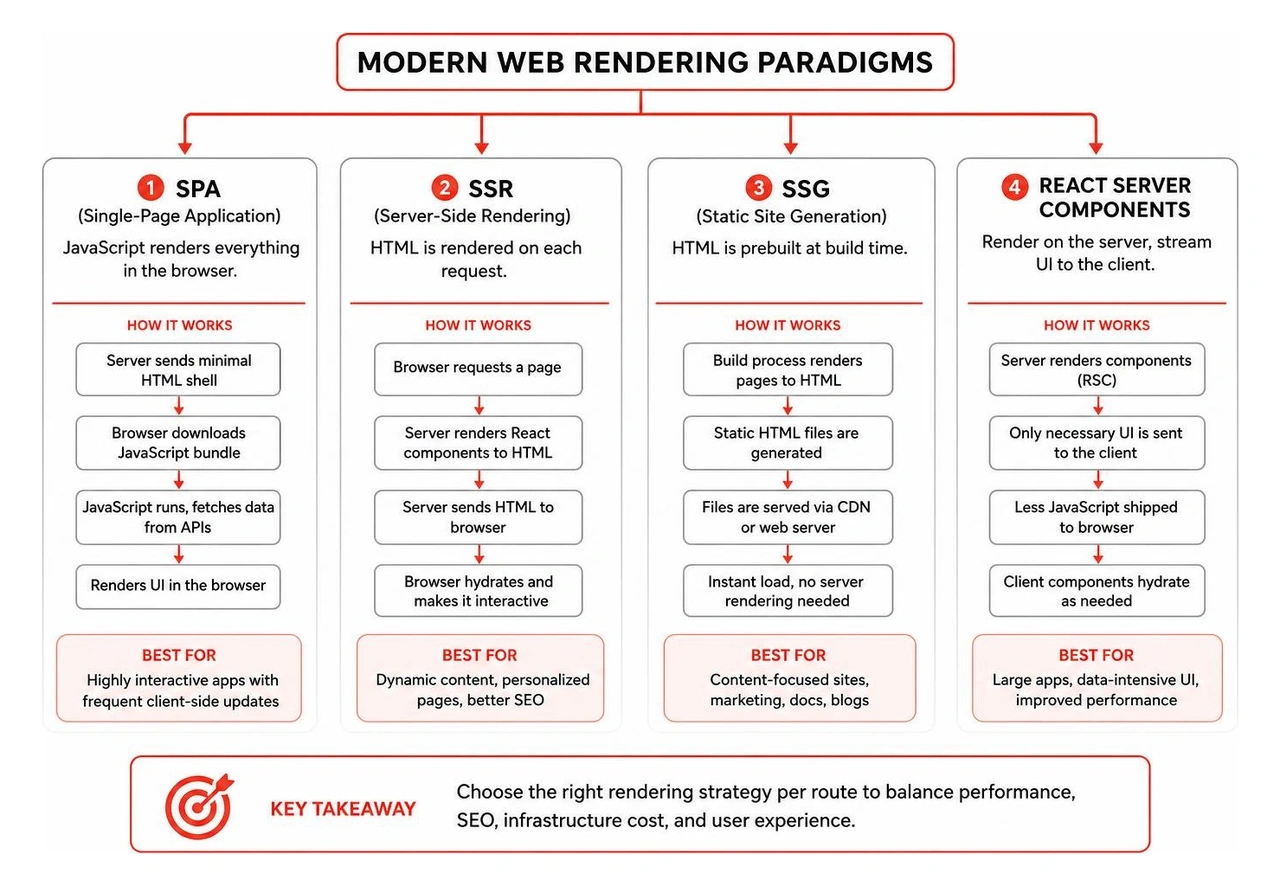
Historically, React applications were packaged as client-side Single-Page Applications (SPAs). In a pure SPA, the web server delivers a minimal, empty HTML shell paired with a bundled JavaScript payload. The browser downloads the bundle, executes the JavaScript engine, builds the Virtual DOM, fetches data from APIs, and finally paints the interface. While this approach offers smooth client-side navigation once loaded, it introduces noticeable first-page latency and indexability challenges for public pages. To explore SPA architecture in depth, review our SPA Development Guide 2026.
To eliminate initial blank screens and optimize search engine discovery, modern architectures adopt Server-Side Rendering (SSR) and Static Site Generation (SSG):
For enterprise applications managing both internal dashboards and customer-facing marketing storefronts, hybrid architectures provide the ideal balance. For a deeper breakdown of full-scale platform planning, review our Custom Web App Development Guide 2026.
React Server Components (RSC) represent a fundamental shift in how developers design full-stack user interfaces. Traditional SSR renders HTML on the server, but still requires the entire component code to ship to the client for hydration. In contrast, React Server Components run exclusively on the server and never ship their JavaScript dependencies to the client bundle.
This model provides major technical advantages:
'use client' directive. React automatically merges server-rendered streams with interactive client islands.While RSC introduces massive performance gains, it requires teams to manage distinct server and client boundaries. Understanding how these patterns fit into long-term technology roadmaps is explored in our analysis on Why React Remains the Strategic Gold Standard for Modern UI Development in 2026. For an industry-wide perspective on how alternative frameworks are evolving alongside these changes, read this critical analysis of modern JavaScript frameworks.
While React was originally adopted as a standalone view library, building a modern, performant web application requires routing, asset compilation, data caching, and server-side integration. Today, teams face an architectural choice: use an integrated full-stack framework or assemble a custom build setup.
Integrated production frameworks provide end-to-end tooling out of the box, standardizing development workflows and reducing operational overhead across engineering teams.
Next.js, maintained by Vercel, serves as the production standard for enterprise-grade applications leveraging React Server Components. With its App Router architecture, Next.js provides file-system routing, built-in image and font optimization, edge runtime execution, and server actions. It allows engineering teams to blend static pages, dynamically rendered endpoints, and streaming interfaces within a single unified project. For an architectural deep dive, explore our guide on Next.js 16: Why It's No Longer Just a Framework.
React Router, maintained by Shopify, offers another powerful full-stack framework path when paired with modern bundlers like Vite. Built on standard Web APIs (such as Fetch, Request, and Response), React Router focuses on route-level data loaders, actions, and optimistic UI transitions. It gives teams a clear path to transition an existing client-side SPA into a server-aware application without rewriting core routing structures. To review standard framework setup guidelines, consult the Official Guide to Creating a React App.
For projects with specialized deployment requirements, legacy infrastructure constraints, or strict micro-frontend setups, building a custom React toolchain is a viable alternative to meta-frameworks.

Modern build tools have largely replaced older bundlers like Webpack and Create React App:
Building from scratch provides absolute control over configuration, but it shifts significant maintenance burdens onto your team. You must manually implement routing, server-side data loaders, code-splitting boundaries with React.lazy, and cache invalidation strategies. You can review detailed manual configurations through the official documentation on Building React Apps from Scratch and explore advanced delivery concepts in our Advanced Web Development Guide 2026.
Enterprise application strategy requires evaluating how a technology choice impacts multi-platform delivery, long-term ecosystem stability, and software supply chain security.
One of React's greatest strategic advantages is its cross-platform model: "Learn once, write anywhere." Using the same component principles, state architectures, and developer talent, organizations can expand web applications into native mobile products via React Native and Expo.
Rather than running web views inside a mobile wrapper, React Native translates React component primitives into real native UI widgets:
<View> component renders as an android.view.ViewGroup on Android and an UIView on iOS.<Text> primitive maps directly to native text rendering engines, maintaining platform-accurate typography, performance, and accessibility features.Expo enhances React Native development by providing universal file-based routing, native device module access (biometrics, camera, push notifications), and streamlined cloud builds. Through libraries like React Native Web, teams can even render universal components directly to HTML elements, allowing cross-platform product teams to maintain a single core design system across mobile and web. To explore how our team builds unified cross-platform solutions, visit our Web App Development Services page.
Security in modern JavaScript ecosystems requires proactive management of runtime environments, third-party packages, and data sanitization protocols.
As full-stack capabilities have integrated directly into React, the attack surface has expanded beyond traditional client-side cross-site scripting (XSS). A prime example was vulnerability CVE-2025-55182, which involved improper deserialization handling within experimental React Server Component stream protocols. When unvalidated user inputs were processed by server handlers, malformed payloads could cause unexpected runtime evaluations.
Securing modern React applications requires rigorous security practices:
'server-only' package in sensitive database connector modules to ensure private server code is never inadvertently imported into client components.The governance structure of React also provides long-term enterprise stability. React is maintained under the React Foundation, hosted by the Linux Foundation. This neutral governance model ensures that framework evolution aligns with open industry standards rather than the proprietary interests of a single corporate entity. The core engine is continually battle-tested across over 100,000 components at Meta before updates are distributed to the open-source community, with the latest stable baseline published on the Official React Repository.
Building a React app from scratch using tools like Vite or Rsbuild is recommended when your project has constraints that cannot be accommodated by full-stack frameworks. This includes embedded single-page widgets, micro-frontend modules running inside legacy host portals, headless software applications, or specialized tooling environments where server-side rendering is strictly prohibited. For typical enterprise platforms, choosing an established framework avoids reinventing routing, bundling, and data fetching systems.
React Server Components improve application performance by shifting data operations and heavy third-party dependencies entirely to the server. Traditional SPAs require the browser to download large JavaScript bundles, execute rendering logic locally, and make sequential API requests. RSC delivers pre-computed UI streams directly to the browser, eliminating client-side bundle weight for non-interactive components, eliminating nested network waterfalls, and speeding up Core Web Vitals such as Largest Contentful Paint (LCP).
React Native allows software engineering teams to build native iOS and Android applications using the same declarative paradigms, component patterns, and JavaScript toolchains used for React web development. By sharing business logic, API validation layers, and state management architecture across platforms, organizations avoid maintaining disjointed development teams. This reduces overall product development costs and accelerates time-to-market for new features across all devices.
Evaluating front-end architecture is not just a technical exercise—it is a fundamental business decision that impacts your feature velocity, application security, infrastructure overhead, and end-user conversion rates. When architected properly, React provides an adaptable foundation that scales seamlessly from early product validation to high-concurrency enterprise workloads.
At Bolder Apps, we help ambitious founders and enterprise leaders turn product roadmaps into high-performing digital realities. Founded in 2019, we are proud to be named a top software and app development agency in 2026 by DesignRush. Our operational model bridges high-level technical leadership with exceptional execution.
We deliver certainty through a proven product partnership model:
Whether you are architecting a new enterprise platform from the ground up, modernizing an existing web application, or expanding your digital product across mobile devices, we are here to build software that drives real business growth. Explore our complete Custom Software Development Services or reach out directly to our leadership team through our Bolder Apps Global Locations to discuss your next build.

ReactJS for web app development is a strong fit when your product needs a fast, interactive interface that can grow without turning into a maintenance headache. It lets teams build screens from reusable components, manage changing data predictably, and choose the right rendering model for each page - from a client-side dashboard to an SEO-focused product page rendered on the server.
For a new production app, start by choosing a framework such as Next.js or React Router with Vite. Then keep the architecture simple:
React is not magic dust for every website. A simple content site may need little JavaScript at all. But for ambitious products with rich user flows, frequent updates, and long-term scale, React remains one of the most practical UI foundations available.
First deployed on Facebook's News Feed in 2011 and open-sourced in 2013, React now supports a vast ecosystem across web and native mobile. It is used on an estimated 6% of websites, and its documentation draws roughly two million developers each month. The latest stable release, React 19.2.8, arrived in July 2026.
For founders evaluating delivery partners, Bolder Apps has built digital products since its founding in 2019. DesignRush named Bolder Apps a top software and app development agency in 2026. This guide explains the architectural choices behind React so you can assess the trade-offs before your roadmap becomes expensive to change.

Key terms for reactjs for web app development:
When assessing any front-end library, understanding how it handles interface logic under the hood is critical. React transformed user interface engineering by replacing manual Document Object Model (DOM) mutations with an abstraction built on declarative programming. Rather than writing step-by-step imperative scripts to locate elements, update their text, and add or remove classes, developers define how the interface should appear based on a given application state. React handles the heavy lifting of keeping the browser screen synchronized with that underlying state.
This paradigm eliminates entire categories of UI bugs, such as desynchronized navigation badges, phantom loader spinners, or outdated form fields. By treating the visual interface as a pure reflection of application data, engineering teams can reason about complex web workflows with far greater predictability.
At its core, React organizes an interface into a hierarchical tree of modular, self-contained units known as components. A component encapsulates its own structure, styling logic, and behavioral rules. These components can be nested inside one another, composed dynamically, and reused across distinct application views.
To author these components intuitively, React uses JSX, a syntax extension for JavaScript that allows developers to write HTML-like markup directly alongside component logic. Rather than separating markup and behavior into separate files, JSX allows teams to co-locate visual structure and event-handling code. Under the hood, JSX compiles into standard JavaScript calls that create element descriptors. For teams seeking specialized engineering support, our JavaScript Development Services help design scalable architecture patterns that optimize this structure from day one. You can also explore fundamental component structures directly through the React Quick Start Guide.
The engine powering this declarative model is the Virtual DOM. Direct browser DOM operations are computationally expensive because mutating the actual document tree triggers style recalculations, layout reflows, and screen repaints. React avoids unnecessary performance hits by maintaining an in-memory lightweight snapshot of the UI known as the Virtual DOM.
When an update occurs, React executes a multi-step reconciliation process:
This targeted approach prevents wide-scale reflows and ensures smooth interactions, even across dense dashboards displaying thousands of dynamic data points.
React enforces unidirectional (one-way) data flow, which means data travels downward through the component tree from parent components to child components via read-only parameters called props. Child components emit events upward by triggering callback functions passed to them by their parents. If two sibling components need access to the same dynamic information, developers lift state up to their nearest common ancestor, which manages the single source of truth and distributes values back down as props.
To manage internal component memory and lifecycle events within modern functional components, React relies on Hooks. Introduced to replace class-based lifecycle methods, Hooks allow developers to extract and reuse stateful logic across components without restructuring the tree hierarchy.
Key hooks powering production applications include:
As web applications grow in size, managing global concerns like authentication status, shopping carts, or multi-tenant workspace configurations requires structured state architecture. While React provides the built-in Context API for low-frequency global updates, complex enterprise workflows frequently benefit from dedicated solutions like Redux Toolkit or modern atomic state libraries. Redux enforces strict unidirectional Flux patterns through explicit actions, immutable state transitions, and deterministic reducers. Our dedicated React Technology & Development Services team regularly architects custom state systems that balance local simplicity with enterprise-scale predictability.
Choosing how and where your React code turns into viewable HTML is one of the most critical architectural decisions you will make. Modern web applications are no longer limited to monolithic client-rendered models; engineering teams can tailor rendering strategies on a route-by-route basis to balance performance, infrastructure cost, and search engine visibility.

Historically, React applications were packaged as client-side Single-Page Applications (SPAs). In a pure SPA, the web server delivers a minimal, empty HTML shell paired with a bundled JavaScript payload. The browser downloads the bundle, executes the JavaScript engine, builds the Virtual DOM, fetches data from APIs, and finally paints the interface. While this approach offers smooth client-side navigation once loaded, it introduces noticeable first-page latency and indexability challenges for public pages. To explore SPA architecture in depth, review our SPA Development Guide 2026.
To eliminate initial blank screens and optimize search engine discovery, modern architectures adopt Server-Side Rendering (SSR) and Static Site Generation (SSG):
For enterprise applications managing both internal dashboards and customer-facing marketing storefronts, hybrid architectures provide the ideal balance. For a deeper breakdown of full-scale platform planning, review our Custom Web App Development Guide 2026.
React Server Components (RSC) represent a fundamental shift in how developers design full-stack user interfaces. Traditional SSR renders HTML on the server, but still requires the entire component code to ship to the client for hydration. In contrast, React Server Components run exclusively on the server and never ship their JavaScript dependencies to the client bundle.
This model provides major technical advantages:
'use client' directive. React automatically merges server-rendered streams with interactive client islands.While RSC introduces massive performance gains, it requires teams to manage distinct server and client boundaries. Understanding how these patterns fit into long-term technology roadmaps is explored in our analysis on Why React Remains the Strategic Gold Standard for Modern UI Development in 2026. For an industry-wide perspective on how alternative frameworks are evolving alongside these changes, read this critical analysis of modern JavaScript frameworks.
While React was originally adopted as a standalone view library, building a modern, performant web application requires routing, asset compilation, data caching, and server-side integration. Today, teams face an architectural choice: use an integrated full-stack framework or assemble a custom build setup.
Integrated production frameworks provide end-to-end tooling out of the box, standardizing development workflows and reducing operational overhead across engineering teams.
Next.js, maintained by Vercel, serves as the production standard for enterprise-grade applications leveraging React Server Components. With its App Router architecture, Next.js provides file-system routing, built-in image and font optimization, edge runtime execution, and server actions. It allows engineering teams to blend static pages, dynamically rendered endpoints, and streaming interfaces within a single unified project. For an architectural deep dive, explore our guide on Next.js 16: Why It's No Longer Just a Framework.
React Router, maintained by Shopify, offers another powerful full-stack framework path when paired with modern bundlers like Vite. Built on standard Web APIs (such as Fetch, Request, and Response), React Router focuses on route-level data loaders, actions, and optimistic UI transitions. It gives teams a clear path to transition an existing client-side SPA into a server-aware application without rewriting core routing structures. To review standard framework setup guidelines, consult the Official Guide to Creating a React App.
For projects with specialized deployment requirements, legacy infrastructure constraints, or strict micro-frontend setups, building a custom React toolchain is a viable alternative to meta-frameworks.

Modern build tools have largely replaced older bundlers like Webpack and Create React App:
Building from scratch provides absolute control over configuration, but it shifts significant maintenance burdens onto your team. You must manually implement routing, server-side data loaders, code-splitting boundaries with React.lazy, and cache invalidation strategies. You can review detailed manual configurations through the official documentation on Building React Apps from Scratch and explore advanced delivery concepts in our Advanced Web Development Guide 2026.
Enterprise application strategy requires evaluating how a technology choice impacts multi-platform delivery, long-term ecosystem stability, and software supply chain security.
One of React's greatest strategic advantages is its cross-platform model: "Learn once, write anywhere." Using the same component principles, state architectures, and developer talent, organizations can expand web applications into native mobile products via React Native and Expo.
Rather than running web views inside a mobile wrapper, React Native translates React component primitives into real native UI widgets:
<View> component renders as an android.view.ViewGroup on Android and an UIView on iOS.<Text> primitive maps directly to native text rendering engines, maintaining platform-accurate typography, performance, and accessibility features.Expo enhances React Native development by providing universal file-based routing, native device module access (biometrics, camera, push notifications), and streamlined cloud builds. Through libraries like React Native Web, teams can even render universal components directly to HTML elements, allowing cross-platform product teams to maintain a single core design system across mobile and web. To explore how our team builds unified cross-platform solutions, visit our Web App Development Services page.
Security in modern JavaScript ecosystems requires proactive management of runtime environments, third-party packages, and data sanitization protocols.
As full-stack capabilities have integrated directly into React, the attack surface has expanded beyond traditional client-side cross-site scripting (XSS). A prime example was vulnerability CVE-2025-55182, which involved improper deserialization handling within experimental React Server Component stream protocols. When unvalidated user inputs were processed by server handlers, malformed payloads could cause unexpected runtime evaluations.
Securing modern React applications requires rigorous security practices:
'server-only' package in sensitive database connector modules to ensure private server code is never inadvertently imported into client components.The governance structure of React also provides long-term enterprise stability. React is maintained under the React Foundation, hosted by the Linux Foundation. This neutral governance model ensures that framework evolution aligns with open industry standards rather than the proprietary interests of a single corporate entity. The core engine is continually battle-tested across over 100,000 components at Meta before updates are distributed to the open-source community, with the latest stable baseline published on the Official React Repository.
Building a React app from scratch using tools like Vite or Rsbuild is recommended when your project has constraints that cannot be accommodated by full-stack frameworks. This includes embedded single-page widgets, micro-frontend modules running inside legacy host portals, headless software applications, or specialized tooling environments where server-side rendering is strictly prohibited. For typical enterprise platforms, choosing an established framework avoids reinventing routing, bundling, and data fetching systems.
React Server Components improve application performance by shifting data operations and heavy third-party dependencies entirely to the server. Traditional SPAs require the browser to download large JavaScript bundles, execute rendering logic locally, and make sequential API requests. RSC delivers pre-computed UI streams directly to the browser, eliminating client-side bundle weight for non-interactive components, eliminating nested network waterfalls, and speeding up Core Web Vitals such as Largest Contentful Paint (LCP).
React Native allows software engineering teams to build native iOS and Android applications using the same declarative paradigms, component patterns, and JavaScript toolchains used for React web development. By sharing business logic, API validation layers, and state management architecture across platforms, organizations avoid maintaining disjointed development teams. This reduces overall product development costs and accelerates time-to-market for new features across all devices.
Evaluating front-end architecture is not just a technical exercise—it is a fundamental business decision that impacts your feature velocity, application security, infrastructure overhead, and end-user conversion rates. When architected properly, React provides an adaptable foundation that scales seamlessly from early product validation to high-concurrency enterprise workloads.
At Bolder Apps, we help ambitious founders and enterprise leaders turn product roadmaps into high-performing digital realities. Founded in 2019, we are proud to be named a top software and app development agency in 2026 by DesignRush. Our operational model bridges high-level technical leadership with exceptional execution.
We deliver certainty through a proven product partnership model:
Whether you are architecting a new enterprise platform from the ground up, modernizing an existing web application, or expanding your digital product across mobile devices, we are here to build software that drives real business growth. Explore our complete Custom Software Development Services or reach out directly to our leadership team through our Bolder Apps Global Locations to discuss your next build.
ReactJS for web app development is a strong fit when your product needs a fast, interactive interface that can grow without turning into a maintenance headache. It lets teams build screens from reusable components, manage changing data predictably, and choose the right rendering model for each page - from a client-side dashboard to an SEO-focused product page rendered on the server.
For a new production app, start by choosing a framework such as Next.js or React Router with Vite. Then keep the architecture simple:
React is not magic dust for every website. A simple content site may need little JavaScript at all. But for ambitious products with rich user flows, frequent updates, and long-term scale, React remains one of the most practical UI foundations available.
First deployed on Facebook's News Feed in 2011 and open-sourced in 2013, React now supports a vast ecosystem across web and native mobile. It is used on an estimated 6% of websites, and its documentation draws roughly two million developers each month. The latest stable release, React 19.2.8, arrived in July 2026.
For founders evaluating delivery partners, Bolder Apps has built digital products since its founding in 2019. DesignRush named Bolder Apps a top software and app development agency in 2026. This guide explains the architectural choices behind React so you can assess the trade-offs before your roadmap becomes expensive to change.

Key terms for reactjs for web app development:
When assessing any front-end library, understanding how it handles interface logic under the hood is critical. React transformed user interface engineering by replacing manual Document Object Model (DOM) mutations with an abstraction built on declarative programming. Rather than writing step-by-step imperative scripts to locate elements, update their text, and add or remove classes, developers define how the interface should appear based on a given application state. React handles the heavy lifting of keeping the browser screen synchronized with that underlying state.
This paradigm eliminates entire categories of UI bugs, such as desynchronized navigation badges, phantom loader spinners, or outdated form fields. By treating the visual interface as a pure reflection of application data, engineering teams can reason about complex web workflows with far greater predictability.
At its core, React organizes an interface into a hierarchical tree of modular, self-contained units known as components. A component encapsulates its own structure, styling logic, and behavioral rules. These components can be nested inside one another, composed dynamically, and reused across distinct application views.
To author these components intuitively, React uses JSX, a syntax extension for JavaScript that allows developers to write HTML-like markup directly alongside component logic. Rather than separating markup and behavior into separate files, JSX allows teams to co-locate visual structure and event-handling code. Under the hood, JSX compiles into standard JavaScript calls that create element descriptors. For teams seeking specialized engineering support, our JavaScript Development Services help design scalable architecture patterns that optimize this structure from day one. You can also explore fundamental component structures directly through the React Quick Start Guide.
The engine powering this declarative model is the Virtual DOM. Direct browser DOM operations are computationally expensive because mutating the actual document tree triggers style recalculations, layout reflows, and screen repaints. React avoids unnecessary performance hits by maintaining an in-memory lightweight snapshot of the UI known as the Virtual DOM.
When an update occurs, React executes a multi-step reconciliation process:
This targeted approach prevents wide-scale reflows and ensures smooth interactions, even across dense dashboards displaying thousands of dynamic data points.
React enforces unidirectional (one-way) data flow, which means data travels downward through the component tree from parent components to child components via read-only parameters called props. Child components emit events upward by triggering callback functions passed to them by their parents. If two sibling components need access to the same dynamic information, developers lift state up to their nearest common ancestor, which manages the single source of truth and distributes values back down as props.
To manage internal component memory and lifecycle events within modern functional components, React relies on Hooks. Introduced to replace class-based lifecycle methods, Hooks allow developers to extract and reuse stateful logic across components without restructuring the tree hierarchy.
Key hooks powering production applications include:
As web applications grow in size, managing global concerns like authentication status, shopping carts, or multi-tenant workspace configurations requires structured state architecture. While React provides the built-in Context API for low-frequency global updates, complex enterprise workflows frequently benefit from dedicated solutions like Redux Toolkit or modern atomic state libraries. Redux enforces strict unidirectional Flux patterns through explicit actions, immutable state transitions, and deterministic reducers. Our dedicated React Technology & Development Services team regularly architects custom state systems that balance local simplicity with enterprise-scale predictability.
Choosing how and where your React code turns into viewable HTML is one of the most critical architectural decisions you will make. Modern web applications are no longer limited to monolithic client-rendered models; engineering teams can tailor rendering strategies on a route-by-route basis to balance performance, infrastructure cost, and search engine visibility.

Historically, React applications were packaged as client-side Single-Page Applications (SPAs). In a pure SPA, the web server delivers a minimal, empty HTML shell paired with a bundled JavaScript payload. The browser downloads the bundle, executes the JavaScript engine, builds the Virtual DOM, fetches data from APIs, and finally paints the interface. While this approach offers smooth client-side navigation once loaded, it introduces noticeable first-page latency and indexability challenges for public pages. To explore SPA architecture in depth, review our SPA Development Guide 2026.
To eliminate initial blank screens and optimize search engine discovery, modern architectures adopt Server-Side Rendering (SSR) and Static Site Generation (SSG):
For enterprise applications managing both internal dashboards and customer-facing marketing storefronts, hybrid architectures provide the ideal balance. For a deeper breakdown of full-scale platform planning, review our Custom Web App Development Guide 2026.
React Server Components (RSC) represent a fundamental shift in how developers design full-stack user interfaces. Traditional SSR renders HTML on the server, but still requires the entire component code to ship to the client for hydration. In contrast, React Server Components run exclusively on the server and never ship their JavaScript dependencies to the client bundle.
This model provides major technical advantages:
'use client' directive. React automatically merges server-rendered streams with interactive client islands.While RSC introduces massive performance gains, it requires teams to manage distinct server and client boundaries. Understanding how these patterns fit into long-term technology roadmaps is explored in our analysis on Why React Remains the Strategic Gold Standard for Modern UI Development in 2026. For an industry-wide perspective on how alternative frameworks are evolving alongside these changes, read this critical analysis of modern JavaScript frameworks.
While React was originally adopted as a standalone view library, building a modern, performant web application requires routing, asset compilation, data caching, and server-side integration. Today, teams face an architectural choice: use an integrated full-stack framework or assemble a custom build setup.
Integrated production frameworks provide end-to-end tooling out of the box, standardizing development workflows and reducing operational overhead across engineering teams.
Next.js, maintained by Vercel, serves as the production standard for enterprise-grade applications leveraging React Server Components. With its App Router architecture, Next.js provides file-system routing, built-in image and font optimization, edge runtime execution, and server actions. It allows engineering teams to blend static pages, dynamically rendered endpoints, and streaming interfaces within a single unified project. For an architectural deep dive, explore our guide on Next.js 16: Why It's No Longer Just a Framework.
React Router, maintained by Shopify, offers another powerful full-stack framework path when paired with modern bundlers like Vite. Built on standard Web APIs (such as Fetch, Request, and Response), React Router focuses on route-level data loaders, actions, and optimistic UI transitions. It gives teams a clear path to transition an existing client-side SPA into a server-aware application without rewriting core routing structures. To review standard framework setup guidelines, consult the Official Guide to Creating a React App.
For projects with specialized deployment requirements, legacy infrastructure constraints, or strict micro-frontend setups, building a custom React toolchain is a viable alternative to meta-frameworks.

Modern build tools have largely replaced older bundlers like Webpack and Create React App:
Building from scratch provides absolute control over configuration, but it shifts significant maintenance burdens onto your team. You must manually implement routing, server-side data loaders, code-splitting boundaries with React.lazy, and cache invalidation strategies. You can review detailed manual configurations through the official documentation on Building React Apps from Scratch and explore advanced delivery concepts in our Advanced Web Development Guide 2026.
Enterprise application strategy requires evaluating how a technology choice impacts multi-platform delivery, long-term ecosystem stability, and software supply chain security.
One of React's greatest strategic advantages is its cross-platform model: "Learn once, write anywhere." Using the same component principles, state architectures, and developer talent, organizations can expand web applications into native mobile products via React Native and Expo.
Rather than running web views inside a mobile wrapper, React Native translates React component primitives into real native UI widgets:
<View> component renders as an android.view.ViewGroup on Android and an UIView on iOS.<Text> primitive maps directly to native text rendering engines, maintaining platform-accurate typography, performance, and accessibility features.Expo enhances React Native development by providing universal file-based routing, native device module access (biometrics, camera, push notifications), and streamlined cloud builds. Through libraries like React Native Web, teams can even render universal components directly to HTML elements, allowing cross-platform product teams to maintain a single core design system across mobile and web. To explore how our team builds unified cross-platform solutions, visit our Web App Development Services page.
Security in modern JavaScript ecosystems requires proactive management of runtime environments, third-party packages, and data sanitization protocols.
As full-stack capabilities have integrated directly into React, the attack surface has expanded beyond traditional client-side cross-site scripting (XSS). A prime example was vulnerability CVE-2025-55182, which involved improper deserialization handling within experimental React Server Component stream protocols. When unvalidated user inputs were processed by server handlers, malformed payloads could cause unexpected runtime evaluations.
Securing modern React applications requires rigorous security practices:
'server-only' package in sensitive database connector modules to ensure private server code is never inadvertently imported into client components.The governance structure of React also provides long-term enterprise stability. React is maintained under the React Foundation, hosted by the Linux Foundation. This neutral governance model ensures that framework evolution aligns with open industry standards rather than the proprietary interests of a single corporate entity. The core engine is continually battle-tested across over 100,000 components at Meta before updates are distributed to the open-source community, with the latest stable baseline published on the Official React Repository.
Building a React app from scratch using tools like Vite or Rsbuild is recommended when your project has constraints that cannot be accommodated by full-stack frameworks. This includes embedded single-page widgets, micro-frontend modules running inside legacy host portals, headless software applications, or specialized tooling environments where server-side rendering is strictly prohibited. For typical enterprise platforms, choosing an established framework avoids reinventing routing, bundling, and data fetching systems.
React Server Components improve application performance by shifting data operations and heavy third-party dependencies entirely to the server. Traditional SPAs require the browser to download large JavaScript bundles, execute rendering logic locally, and make sequential API requests. RSC delivers pre-computed UI streams directly to the browser, eliminating client-side bundle weight for non-interactive components, eliminating nested network waterfalls, and speeding up Core Web Vitals such as Largest Contentful Paint (LCP).
React Native allows software engineering teams to build native iOS and Android applications using the same declarative paradigms, component patterns, and JavaScript toolchains used for React web development. By sharing business logic, API validation layers, and state management architecture across platforms, organizations avoid maintaining disjointed development teams. This reduces overall product development costs and accelerates time-to-market for new features across all devices.
Evaluating front-end architecture is not just a technical exercise—it is a fundamental business decision that impacts your feature velocity, application security, infrastructure overhead, and end-user conversion rates. When architected properly, React provides an adaptable foundation that scales seamlessly from early product validation to high-concurrency enterprise workloads.
At Bolder Apps, we help ambitious founders and enterprise leaders turn product roadmaps into high-performing digital realities. Founded in 2019, we are proud to be named a top software and app development agency in 2026 by DesignRush. Our operational model bridges high-level technical leadership with exceptional execution.
We deliver certainty through a proven product partnership model:
Whether you are architecting a new enterprise platform from the ground up, modernizing an existing web application, or expanding your digital product across mobile devices, we are here to build software that drives real business growth. Explore our complete Custom Software Development Services or reach out directly to our leadership team through our Bolder Apps Global Locations to discuss your next build.