
July 7, 2026

Advance Web Application Development: The Secret Sauce for Modern Devs

Author Image
Sean Weldon
and updated on:
July 7, 2026
Author Image
Reviewed by:
John Ilkhomjon
Blog Image

Key takeaways from the blog

Why Advance Web Application Development Is the Competitive Edge You Can't Ignore in 2026

Advance web application development is the process of building dynamic, interactive, scalable software that runs in a browser — going far beyond anything a static website can do.

If you landed here wanting a quick answer, here it is:

Advanced web applications differ from regular websites in these key ways:

  • Dynamic content — pages update in real time without a full reload
  • User authentication — login systems, roles, and permissions
  • Database integration — data is stored, retrieved, and processed on the server
  • Business logic — complex rules run behind the scenes (payments, workflows, recommendations)
  • API connectivity — the app talks to other services and systems seamlessly
  • Scalability — built to handle thousands (or millions) of users without breaking

There are now 5.44 billion internet users worldwide. They expect fast, responsive, app-like experiences — on any device, anywhere. A slow or clunky web app isn't just frustrating. It's a business killer. Research shows 47% of users abandon a site that takes more than 2 seconds to load.

Meanwhile, the stakes keep rising. Web developer jobs are projected to grow 16% by 2032, and the global cloud application services market is on track to hit $168.6 billion by 2027. The demand for sophisticated web applications isn't slowing down.

This guide breaks down exactly what separates a basic website from a powerful web application — and how modern founders and dev teams can build the latter with confidence in 2026.
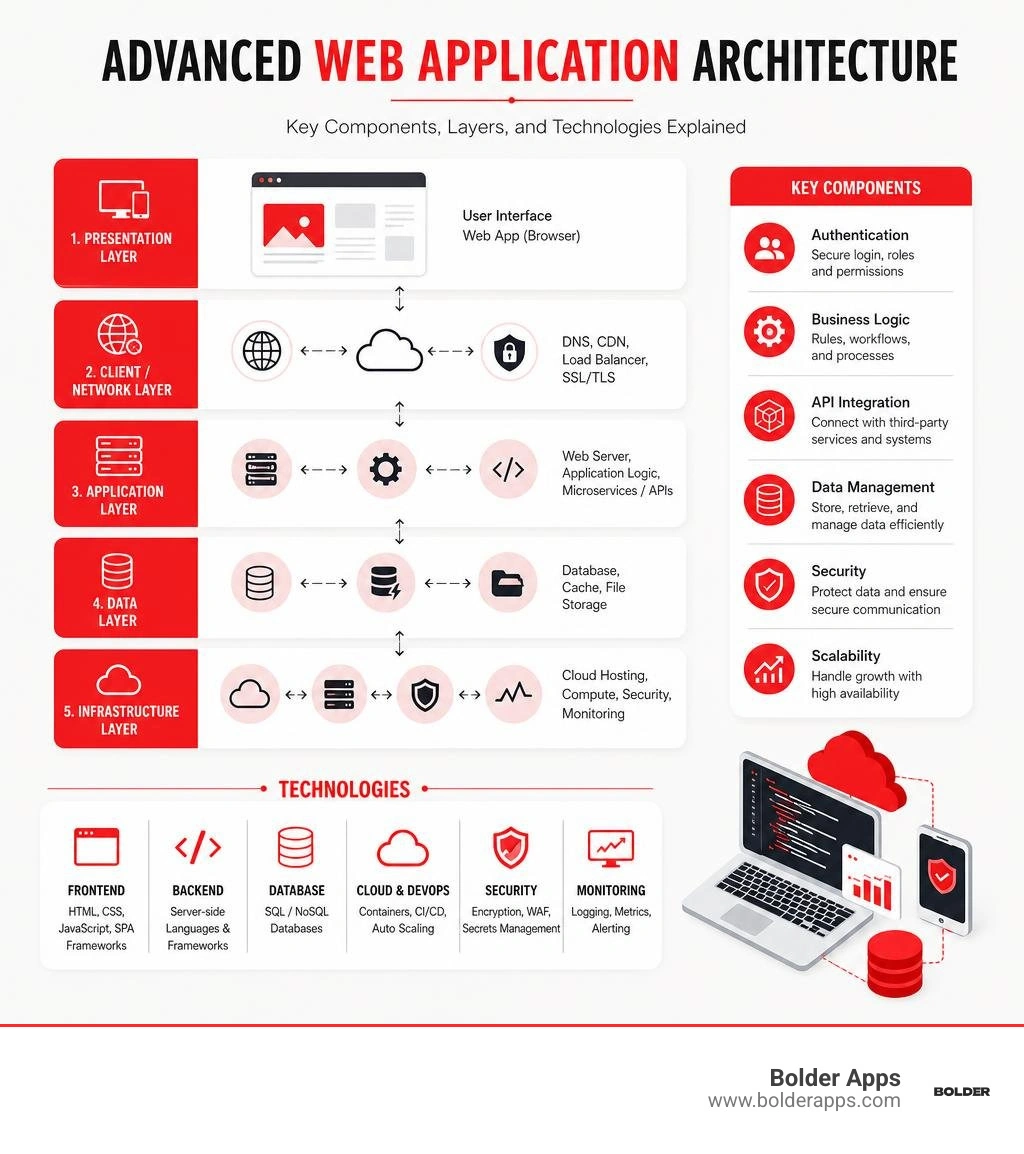
Advanced web application architecture: key components, layers, and technologies explained infographic

Handy advance web application development terms:

What is Advance Web Application Development?

To truly master advance web application development, we have to look past the surface of simple web pages. At its core, an advanced web application is a highly interactive, distributed software system that operates over the internet. Unlike traditional websites that simply display static text and images, an advanced web app runs complex business logic, manages state across multiple user sessions, and processes data in real time.

This relies on a robust client-server model. The "client" (the user's browser) acts as a highly responsive user interface, while the "server" (or a network of cloud servers) handles database queries, processing algorithms, and security checks. When a user interacts with the app, only the necessary data is exchanged behind the scenes—often via JSON payloads—allowing the interface to update instantly. This seamless flow of dynamic content is what keeps user engagement high and turns a simple visit into an immersive experience.

The Evolution from Static Sites to Advance Web Application Development

In the early days of the internet, we lived in a world of static HTML. If you wanted to update a single sentence on a page, the browser had to request an entirely new document from the server, causing a jarring screen blink.

The shift toward modern web applications began when developers started pairing dynamic databases with client-side scripting. Suddenly, web pages could adapt to who was logged in, pull fresh data on the fly, and handle instant, real-time updates. Today, we don't just build pages; we build living digital ecosystems. To dive deeper into this shift and understand how it changes your business strategy, check out our Advanced Web Application Development Complete Guide.

Web 1.0 to Web 3.0: The Architectural Shift

The web has undergone three major architectural eras:

  • Web 1.0 (The "Read" Era): Static, flat files served directly to passive users. There was virtually no interaction beyond clicking hyperlinks.
  • Web 2.0 (The "Read-Write" Era): The rise of social media, cloud computing, and interactive platforms. Users became creators, databases became dynamic, and APIs allowed different systems to talk to each other.
  • Web 3.0 (The "Read-Write-Execute" Era): The current landscape in 2026, defined by decentralization, semantic data, edge computing, and native AI integration.

In this Web 3.0 era, applications are smarter, faster, and more distributed. We are seeing the rise of buildless, AI-first tools designed so that AI agents can easily read and modify codebase structures. For example, the open-source project webjs (and its community updates like dipaliladani/webjs) showcases this shift by focusing on zero-build TypeScript execution, web components, and predictable, AI-agent-friendly file conventions. This evolution means modern applications are more modular, secure, and capable of operating at the absolute edge of the network.
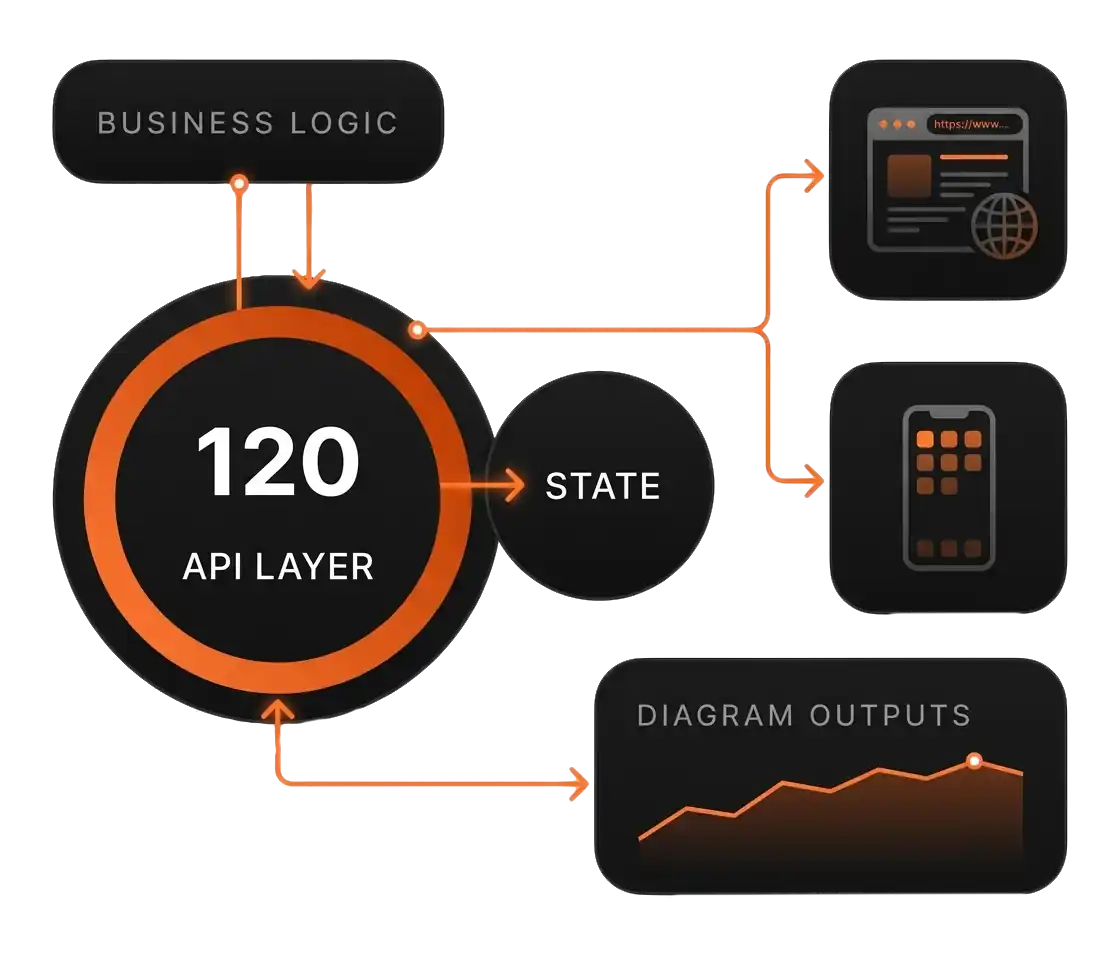
Core Technologies and Frameworks Shaping 2026

Modern technology stack diagram for advanced web applications

Building a high-performing web application in 2026 requires a carefully selected tech stack. The era of randomly mixing and matching micro-libraries is giving way to structured, cohesive ecosystems. Modern development relies heavily on TypeScript for end-to-end type safety, Node.js for high-performance backend execution, and an API-first approach that ensures your frontend and backend remain perfectly synchronized yet independently scalable.

Frontend Mastery: React, Svelte, and Modern UI

The frontend is where your users live, and in 2026, user experience is everything. The debate is no longer just about the virtual DOM; it is about compiler efficiency, bundle sizes, and rendering speed.

Backend Powerhouses and Batteries-Included Frameworks

While the frontend handles user interaction, the backend is the engine room. It processes business logic, manages database integrations, and secures data. In 2026, developers are moving away from assembling custom backends from dozens of disconnected packages and are returning to robust, MVC (Model-View-Controller) and "batteries-included" frameworks that speed up time-to-market.

  • AdonisJS: For TypeScript lovers, AdonisJS - The batteries-included TypeScript framework provides a fully integrated MVC experience, complete with an Active Record ORM, built-in authentication, validation, and testing tools.
  • Frappe Framework: If you are building data-heavy business applications or internal tools, the Frappe Framework | Web Development Framework offers a unique metadata-driven, low-code approach that can eliminate up to 97% of repetitive coding tasks.
  • Yii 2 Advanced: For PHP-based enterprise projects, templates like yiisoft/yii2-app-advanced provide a proven, three-tier architecture (frontend, backend, and console) that handles complex multi-role deployments out of the box.

Key Stages of the Modern Development Lifecycle

Agile web application development lifecycle stages

Building a successful web application isn't just about writing code; it is about following a structured, agile methodology. The modern development lifecycle ensures that business goals, user needs, and technical execution are perfectly aligned from day one.

  1. Discovery and Research: Understanding the problem, defining target users, and mapping out the core features.
  2. Planning and Wireframing: Architecting the user flow, database schemas, and system integrations.
  3. UI/UX Design: Creating intuitive, beautiful interfaces that align with modern accessibility standards.
  4. Development: Writing clean, testable frontend and backend code, using continuous integration (CI) pipelines.
  5. Testing: Running automated unit, integration, and end-to-end browser tests to catch bugs early.
  6. Deployment & DevOps: Deploying to secure, scalable cloud environments with instant monitoring.
  7. Maintenance & Optimization: Analyzing user feedback and performance metrics to continuously improve the app.

By adopting modern DevOps practices, organizations can deploy code 208 times more frequently and achieve 106 times faster lead times from commit to production.

Bridging UX/UI Design and Technical Execution

A beautiful app that is confusing to use will fail, and a highly functional app that looks terrible will be ignored. True success lies in bridging the gap between design and development.

We start with low-fidelity wireframes to map out the user journey before writing a single line of code. During the design phase, we prioritize user-centric layouts and strict web accessibility (a11y) standards, ensuring compliance with WCAG guidelines so that everyone can use your application. Want to learn how to keep your users hooked? Explore our guide to Enhance Website User Experience or check out our full suite of Web and App Development Services.

Best Practices for Managing Advance Web Application Development Projects

Managing a complex web project requires strict adherence to industry best practices. Without them, technical debt accumulates, and performance suffers.

  • Security Audits: The web application firewall market is projected to grow to $17.72 billion by 2030. Security cannot be an afterthought. Implement zero-trust models, data encryption, and regular penetration testing.
  • Performance Optimization: Utilize server-side caching, edge networks (CDNs), code splitting, and lazy loading to keep page load times under 2 seconds.
  • Scalability: Design your application with cloud-native architectures that scale automatically as user traffic spikes.

For businesses looking to learn the basics, institutions like Programming and Web Development | Miami Dade College or local workshops like Web Development Training in Miami - NobleProg USA offer great starting points. However, when it comes to building enterprise-grade, scalable software, companies rely on specialized expertise. Dive into our strategic insights on Software Architecture Design and discover how a Bespoke Software Agency can bring your vision to life.

Frequently Asked Questions

What is the difference between a web app and a website?

A website is primarily informational and consists of static content (like a blog or a digital brochure) where the user simply reads information. A web application is highly interactive, requiring user authentication, database integration, and complex business logic to perform specific tasks (like online banking, project management, or social networking).

How much does it cost to build an advanced web application in 2026?

The cost of advance web application development varies depending on project complexity, custom features, and integration requirements. Generally, custom web application development in the United States ranges from $35,000 for a straightforward MVP to upwards of $200,000+ for complex, enterprise-grade platforms with custom AI integrations and real-time processing capabilities.

Why is security so critical in modern web applications?

With over 96% of web applications possessing some form of vulnerability, security is paramount to protect sensitive user data and maintain business credibility. Implementing protections against the OWASP Top 10, using multi-factor authentication (MFA), enforcing HTTPS encryption, and conducting regular security audits are non-negotiable requirements in 2026.

Crafting Your Digital Future: Why Bolder Apps is Your Secret Weapon in 2026

Building a sophisticated web application is a major milestone for any business, but you don't have to navigate the complexities alone.

At Bolder Apps (founded in 2019), we specialize in turning complex business challenges into intuitive, high-impact digital products. Named as a top software and app development agency in 2026 by DesignRush, we do things differently. We combine senior US-based leadership with a world-class distributed engineering team. This unique model gives you the strategic guidance of an in-shore CTO paired with the execution power of senior developers—ensuring there is absolutely no junior learning on your dime. You can verify our details and track record on bolderapps.com.

We believe in complete transparency and risk reduction, which is why we operate on a fixed-budget model with milestone-based payments. You will always know exactly what you are paying for and when it will be delivered.

Ready to gain a massive competitive advantage? Let’s build something incredible together. Explore our Custom Software Development services, find our team at our Bolder Apps Locations page, and contact us today to kick off your project!

On this page

Why Advance Web Application Development Is the Competitive Edge You Can't Ignore in 2026

Advance web application development is the process of building dynamic, interactive, scalable software that runs in a browser — going far beyond anything a static website can do.

If you landed here wanting a quick answer, here it is:

Advanced web applications differ from regular websites in these key ways:

  • Dynamic content — pages update in real time without a full reload
  • User authentication — login systems, roles, and permissions
  • Database integration — data is stored, retrieved, and processed on the server
  • Business logic — complex rules run behind the scenes (payments, workflows, recommendations)
  • API connectivity — the app talks to other services and systems seamlessly
  • Scalability — built to handle thousands (or millions) of users without breaking

There are now 5.44 billion internet users worldwide. They expect fast, responsive, app-like experiences — on any device, anywhere. A slow or clunky web app isn't just frustrating. It's a business killer. Research shows 47% of users abandon a site that takes more than 2 seconds to load.

Meanwhile, the stakes keep rising. Web developer jobs are projected to grow 16% by 2032, and the global cloud application services market is on track to hit $168.6 billion by 2027. The demand for sophisticated web applications isn't slowing down.

This guide breaks down exactly what separates a basic website from a powerful web application — and how modern founders and dev teams can build the latter with confidence in 2026.

Advanced web application architecture: key components, layers, and technologies explained infographic

Handy advance web application development terms:

What is Advance Web Application Development?

To truly master advance web application development, we have to look past the surface of simple web pages. At its core, an advanced web application is a highly interactive, distributed software system that operates over the internet. Unlike traditional websites that simply display static text and images, an advanced web app runs complex business logic, manages state across multiple user sessions, and processes data in real time.

This relies on a robust client-server model. The "client" (the user's browser) acts as a highly responsive user interface, while the "server" (or a network of cloud servers) handles database queries, processing algorithms, and security checks. When a user interacts with the app, only the necessary data is exchanged behind the scenes—often via JSON payloads—allowing the interface to update instantly. This seamless flow of dynamic content is what keeps user engagement high and turns a simple visit into an immersive experience.

The Evolution from Static Sites to Advance Web Application Development

In the early days of the internet, we lived in a world of static HTML. If you wanted to update a single sentence on a page, the browser had to request an entirely new document from the server, causing a jarring screen blink.

The shift toward modern web applications began when developers started pairing dynamic databases with client-side scripting. Suddenly, web pages could adapt to who was logged in, pull fresh data on the fly, and handle instant, real-time updates. Today, we don't just build pages; we build living digital ecosystems. To dive deeper into this shift and understand how it changes your business strategy, check out our Advanced Web Application Development Complete Guide.

Web 1.0 to Web 3.0: The Architectural Shift

The web has undergone three major architectural eras:

  • Web 1.0 (The "Read" Era): Static, flat files served directly to passive users. There was virtually no interaction beyond clicking hyperlinks.
  • Web 2.0 (The "Read-Write" Era): The rise of social media, cloud computing, and interactive platforms. Users became creators, databases became dynamic, and APIs allowed different systems to talk to each other.
  • Web 3.0 (The "Read-Write-Execute" Era): The current landscape in 2026, defined by decentralization, semantic data, edge computing, and native AI integration.

In this Web 3.0 era, applications are smarter, faster, and more distributed. We are seeing the rise of buildless, AI-first tools designed so that AI agents can easily read and modify codebase structures. For example, the open-source project webjs (and its community updates like dipaliladani/webjs) showcases this shift by focusing on zero-build TypeScript execution, web components, and predictable, AI-agent-friendly file conventions. This evolution means modern applications are more modular, secure, and capable of operating at the absolute edge of the network.

Core Technologies and Frameworks Shaping 2026

Modern technology stack diagram for advanced web applications

Building a high-performing web application in 2026 requires a carefully selected tech stack. The era of randomly mixing and matching micro-libraries is giving way to structured, cohesive ecosystems. Modern development relies heavily on TypeScript for end-to-end type safety, Node.js for high-performance backend execution, and an API-first approach that ensures your frontend and backend remain perfectly synchronized yet independently scalable.

Frontend Mastery: React, Svelte, and Modern UI

The frontend is where your users live, and in 2026, user experience is everything. The debate is no longer just about the virtual DOM; it is about compiler efficiency, bundle sizes, and rendering speed.

Backend Powerhouses and Batteries-Included Frameworks

While the frontend handles user interaction, the backend is the engine room. It processes business logic, manages database integrations, and secures data. In 2026, developers are moving away from assembling custom backends from dozens of disconnected packages and are returning to robust, MVC (Model-View-Controller) and "batteries-included" frameworks that speed up time-to-market.

  • AdonisJS: For TypeScript lovers, AdonisJS - The batteries-included TypeScript framework provides a fully integrated MVC experience, complete with an Active Record ORM, built-in authentication, validation, and testing tools.
  • Frappe Framework: If you are building data-heavy business applications or internal tools, the Frappe Framework | Web Development Framework offers a unique metadata-driven, low-code approach that can eliminate up to 97% of repetitive coding tasks.
  • Yii 2 Advanced: For PHP-based enterprise projects, templates like yiisoft/yii2-app-advanced provide a proven, three-tier architecture (frontend, backend, and console) that handles complex multi-role deployments out of the box.

Key Stages of the Modern Development Lifecycle

Agile web application development lifecycle stages

Building a successful web application isn't just about writing code; it is about following a structured, agile methodology. The modern development lifecycle ensures that business goals, user needs, and technical execution are perfectly aligned from day one.

  1. Discovery and Research: Understanding the problem, defining target users, and mapping out the core features.
  2. Planning and Wireframing: Architecting the user flow, database schemas, and system integrations.
  3. UI/UX Design: Creating intuitive, beautiful interfaces that align with modern accessibility standards.
  4. Development: Writing clean, testable frontend and backend code, using continuous integration (CI) pipelines.
  5. Testing: Running automated unit, integration, and end-to-end browser tests to catch bugs early.
  6. Deployment & DevOps: Deploying to secure, scalable cloud environments with instant monitoring.
  7. Maintenance & Optimization: Analyzing user feedback and performance metrics to continuously improve the app.

By adopting modern DevOps practices, organizations can deploy code 208 times more frequently and achieve 106 times faster lead times from commit to production.

Bridging UX/UI Design and Technical Execution

A beautiful app that is confusing to use will fail, and a highly functional app that looks terrible will be ignored. True success lies in bridging the gap between design and development.

We start with low-fidelity wireframes to map out the user journey before writing a single line of code. During the design phase, we prioritize user-centric layouts and strict web accessibility (a11y) standards, ensuring compliance with WCAG guidelines so that everyone can use your application. Want to learn how to keep your users hooked? Explore our guide to Enhance Website User Experience or check out our full suite of Web and App Development Services.

Best Practices for Managing Advance Web Application Development Projects

Managing a complex web project requires strict adherence to industry best practices. Without them, technical debt accumulates, and performance suffers.

  • Security Audits: The web application firewall market is projected to grow to $17.72 billion by 2030. Security cannot be an afterthought. Implement zero-trust models, data encryption, and regular penetration testing.
  • Performance Optimization: Utilize server-side caching, edge networks (CDNs), code splitting, and lazy loading to keep page load times under 2 seconds.
  • Scalability: Design your application with cloud-native architectures that scale automatically as user traffic spikes.

For businesses looking to learn the basics, institutions like Programming and Web Development | Miami Dade College or local workshops like Web Development Training in Miami - NobleProg USA offer great starting points. However, when it comes to building enterprise-grade, scalable software, companies rely on specialized expertise. Dive into our strategic insights on Software Architecture Design and discover how a Bespoke Software Agency can bring your vision to life.

Frequently Asked Questions

What is the difference between a web app and a website?

A website is primarily informational and consists of static content (like a blog or a digital brochure) where the user simply reads information. A web application is highly interactive, requiring user authentication, database integration, and complex business logic to perform specific tasks (like online banking, project management, or social networking).

How much does it cost to build an advanced web application in 2026?

The cost of advance web application development varies depending on project complexity, custom features, and integration requirements. Generally, custom web application development in the United States ranges from $35,000 for a straightforward MVP to upwards of $200,000+ for complex, enterprise-grade platforms with custom AI integrations and real-time processing capabilities.

Why is security so critical in modern web applications?

With over 96% of web applications possessing some form of vulnerability, security is paramount to protect sensitive user data and maintain business credibility. Implementing protections against the OWASP Top 10, using multi-factor authentication (MFA), enforcing HTTPS encryption, and conducting regular security audits are non-negotiable requirements in 2026.

Crafting Your Digital Future: Why Bolder Apps is Your Secret Weapon in 2026

Building a sophisticated web application is a major milestone for any business, but you don't have to navigate the complexities alone.

At Bolder Apps (founded in 2019), we specialize in turning complex business challenges into intuitive, high-impact digital products. Named as a top software and app development agency in 2026 by DesignRush, we do things differently. We combine senior US-based leadership with a world-class distributed engineering team. This unique model gives you the strategic guidance of an in-shore CTO paired with the execution power of senior developers—ensuring there is absolutely no junior learning on your dime. You can verify our details and track record on bolderapps.com.

We believe in complete transparency and risk reduction, which is why we operate on a fixed-budget model with milestone-based payments. You will always know exactly what you are paying for and when it will be delivered.

Ready to gain a massive competitive advantage? Let’s build something incredible together. Explore our Custom Software Development services, find our team at our Bolder Apps Locations page, and contact us today to kick off your project!

Quick answers

Frequently Asked Questions.

Why Advance Web Application Development Is the Competitive Edge You Can't Ignore in 2026

Advance web application development is the process of building dynamic, interactive, scalable software that runs in a browser — going far beyond anything a static website can do.

If you landed here wanting a quick answer, here it is:

Advanced web applications differ from regular websites in these key ways:

  • Dynamic content — pages update in real time without a full reload
  • User authentication — login systems, roles, and permissions
  • Database integration — data is stored, retrieved, and processed on the server
  • Business logic — complex rules run behind the scenes (payments, workflows, recommendations)
  • API connectivity — the app talks to other services and systems seamlessly
  • Scalability — built to handle thousands (or millions) of users without breaking

There are now 5.44 billion internet users worldwide. They expect fast, responsive, app-like experiences — on any device, anywhere. A slow or clunky web app isn't just frustrating. It's a business killer. Research shows 47% of users abandon a site that takes more than 2 seconds to load.

Meanwhile, the stakes keep rising. Web developer jobs are projected to grow 16% by 2032, and the global cloud application services market is on track to hit $168.6 billion by 2027. The demand for sophisticated web applications isn't slowing down.

This guide breaks down exactly what separates a basic website from a powerful web application — and how modern founders and dev teams can build the latter with confidence in 2026.

Advanced web application architecture: key components, layers, and technologies explained infographic

Handy advance web application development terms:

What is Advance Web Application Development?

To truly master advance web application development, we have to look past the surface of simple web pages. At its core, an advanced web application is a highly interactive, distributed software system that operates over the internet. Unlike traditional websites that simply display static text and images, an advanced web app runs complex business logic, manages state across multiple user sessions, and processes data in real time.

This relies on a robust client-server model. The "client" (the user's browser) acts as a highly responsive user interface, while the "server" (or a network of cloud servers) handles database queries, processing algorithms, and security checks. When a user interacts with the app, only the necessary data is exchanged behind the scenes—often via JSON payloads—allowing the interface to update instantly. This seamless flow of dynamic content is what keeps user engagement high and turns a simple visit into an immersive experience.

The Evolution from Static Sites to Advance Web Application Development

In the early days of the internet, we lived in a world of static HTML. If you wanted to update a single sentence on a page, the browser had to request an entirely new document from the server, causing a jarring screen blink.

The shift toward modern web applications began when developers started pairing dynamic databases with client-side scripting. Suddenly, web pages could adapt to who was logged in, pull fresh data on the fly, and handle instant, real-time updates. Today, we don't just build pages; we build living digital ecosystems. To dive deeper into this shift and understand how it changes your business strategy, check out our Advanced Web Application Development Complete Guide.

Web 1.0 to Web 3.0: The Architectural Shift

The web has undergone three major architectural eras:

  • Web 1.0 (The "Read" Era): Static, flat files served directly to passive users. There was virtually no interaction beyond clicking hyperlinks.
  • Web 2.0 (The "Read-Write" Era): The rise of social media, cloud computing, and interactive platforms. Users became creators, databases became dynamic, and APIs allowed different systems to talk to each other.
  • Web 3.0 (The "Read-Write-Execute" Era): The current landscape in 2026, defined by decentralization, semantic data, edge computing, and native AI integration.

In this Web 3.0 era, applications are smarter, faster, and more distributed. We are seeing the rise of buildless, AI-first tools designed so that AI agents can easily read and modify codebase structures. For example, the open-source project webjs (and its community updates like dipaliladani/webjs) showcases this shift by focusing on zero-build TypeScript execution, web components, and predictable, AI-agent-friendly file conventions. This evolution means modern applications are more modular, secure, and capable of operating at the absolute edge of the network.

Core Technologies and Frameworks Shaping 2026

Modern technology stack diagram for advanced web applications

Building a high-performing web application in 2026 requires a carefully selected tech stack. The era of randomly mixing and matching micro-libraries is giving way to structured, cohesive ecosystems. Modern development relies heavily on TypeScript for end-to-end type safety, Node.js for high-performance backend execution, and an API-first approach that ensures your frontend and backend remain perfectly synchronized yet independently scalable.

Frontend Mastery: React, Svelte, and Modern UI

The frontend is where your users live, and in 2026, user experience is everything. The debate is no longer just about the virtual DOM; it is about compiler efficiency, bundle sizes, and rendering speed.

Backend Powerhouses and Batteries-Included Frameworks

While the frontend handles user interaction, the backend is the engine room. It processes business logic, manages database integrations, and secures data. In 2026, developers are moving away from assembling custom backends from dozens of disconnected packages and are returning to robust, MVC (Model-View-Controller) and "batteries-included" frameworks that speed up time-to-market.

  • AdonisJS: For TypeScript lovers, AdonisJS - The batteries-included TypeScript framework provides a fully integrated MVC experience, complete with an Active Record ORM, built-in authentication, validation, and testing tools.
  • Frappe Framework: If you are building data-heavy business applications or internal tools, the Frappe Framework | Web Development Framework offers a unique metadata-driven, low-code approach that can eliminate up to 97% of repetitive coding tasks.
  • Yii 2 Advanced: For PHP-based enterprise projects, templates like yiisoft/yii2-app-advanced provide a proven, three-tier architecture (frontend, backend, and console) that handles complex multi-role deployments out of the box.

Key Stages of the Modern Development Lifecycle

Agile web application development lifecycle stages

Building a successful web application isn't just about writing code; it is about following a structured, agile methodology. The modern development lifecycle ensures that business goals, user needs, and technical execution are perfectly aligned from day one.

  1. Discovery and Research: Understanding the problem, defining target users, and mapping out the core features.
  2. Planning and Wireframing: Architecting the user flow, database schemas, and system integrations.
  3. UI/UX Design: Creating intuitive, beautiful interfaces that align with modern accessibility standards.
  4. Development: Writing clean, testable frontend and backend code, using continuous integration (CI) pipelines.
  5. Testing: Running automated unit, integration, and end-to-end browser tests to catch bugs early.
  6. Deployment & DevOps: Deploying to secure, scalable cloud environments with instant monitoring.
  7. Maintenance & Optimization: Analyzing user feedback and performance metrics to continuously improve the app.

By adopting modern DevOps practices, organizations can deploy code 208 times more frequently and achieve 106 times faster lead times from commit to production.

Bridging UX/UI Design and Technical Execution

A beautiful app that is confusing to use will fail, and a highly functional app that looks terrible will be ignored. True success lies in bridging the gap between design and development.

We start with low-fidelity wireframes to map out the user journey before writing a single line of code. During the design phase, we prioritize user-centric layouts and strict web accessibility (a11y) standards, ensuring compliance with WCAG guidelines so that everyone can use your application. Want to learn how to keep your users hooked? Explore our guide to Enhance Website User Experience or check out our full suite of Web and App Development Services.

Best Practices for Managing Advance Web Application Development Projects

Managing a complex web project requires strict adherence to industry best practices. Without them, technical debt accumulates, and performance suffers.

  • Security Audits: The web application firewall market is projected to grow to $17.72 billion by 2030. Security cannot be an afterthought. Implement zero-trust models, data encryption, and regular penetration testing.
  • Performance Optimization: Utilize server-side caching, edge networks (CDNs), code splitting, and lazy loading to keep page load times under 2 seconds.
  • Scalability: Design your application with cloud-native architectures that scale automatically as user traffic spikes.

For businesses looking to learn the basics, institutions like Programming and Web Development | Miami Dade College or local workshops like Web Development Training in Miami - NobleProg USA offer great starting points. However, when it comes to building enterprise-grade, scalable software, companies rely on specialized expertise. Dive into our strategic insights on Software Architecture Design and discover how a Bespoke Software Agency can bring your vision to life.

Frequently Asked Questions

What is the difference between a web app and a website?

A website is primarily informational and consists of static content (like a blog or a digital brochure) where the user simply reads information. A web application is highly interactive, requiring user authentication, database integration, and complex business logic to perform specific tasks (like online banking, project management, or social networking).

How much does it cost to build an advanced web application in 2026?

The cost of advance web application development varies depending on project complexity, custom features, and integration requirements. Generally, custom web application development in the United States ranges from $35,000 for a straightforward MVP to upwards of $200,000+ for complex, enterprise-grade platforms with custom AI integrations and real-time processing capabilities.

Why is security so critical in modern web applications?

With over 96% of web applications possessing some form of vulnerability, security is paramount to protect sensitive user data and maintain business credibility. Implementing protections against the OWASP Top 10, using multi-factor authentication (MFA), enforcing HTTPS encryption, and conducting regular security audits are non-negotiable requirements in 2026.

Crafting Your Digital Future: Why Bolder Apps is Your Secret Weapon in 2026

Building a sophisticated web application is a major milestone for any business, but you don't have to navigate the complexities alone.

At Bolder Apps (founded in 2019), we specialize in turning complex business challenges into intuitive, high-impact digital products. Named as a top software and app development agency in 2026 by DesignRush, we do things differently. We combine senior US-based leadership with a world-class distributed engineering team. This unique model gives you the strategic guidance of an in-shore CTO paired with the execution power of senior developers—ensuring there is absolutely no junior learning on your dime. You can verify our details and track record on bolderapps.com.

We believe in complete transparency and risk reduction, which is why we operate on a fixed-budget model with milestone-based payments. You will always know exactly what you are paying for and when it will be delivered.

Ready to gain a massive competitive advantage? Let’s build something incredible together. Explore our Custom Software Development services, find our team at our Bolder Apps Locations page, and contact us today to kick off your project!

Get in touch

Let's discuss your goals

Tell us about your project and we'll respond within 1 business day
Please enter a valid phone number
Join 30+ founders who shipped with Bolder Apps
Thank you! Your submission has been received!
Oops! Something went wrong while submitting the form.
ASC client logo

They moved the project very smoothly.

Len Swegart
Senior Corporate Relations Manager, American Cancer Society
Rydoo client logo

They truly understood our vision and translated it into a polished product with a seamless UX.

Anna Haberfellner
Senior SDR, Rydoo
Qonto client logo

Attentiveness to detail and excellent design skills are impressive.

Steve Anavi
Senior Manager, Qonto