Abdulla Khaydarov
March 27, 2026
10
min. read
and updated on:
April 8, 2026

The a16z top 100 AI consumer apps 2026 report — the sixth edition of Andreessen Horowitz's biannual deep-dive — tracks which generative AI products are actually being used by real consumers, ranked by web traffic (via SimilarWeb) and mobile monthly active users (via Sensor Tower).
Here's a quick snapshot of the biggest takeaways:
Three years ago, the distinction between "AI-native" products and everything else was obvious. Today, that line is essentially gone. Apps like CapCut and Notion have embedded AI so deeply into their core experience that they now belong on the same list as ChatGPT and Claude.
This report isn't just a ranking — it's a map of where the AI industry is heading. Whether you're a founder, investor, or product builder, understanding which apps are winning (and why) tells you a lot about where to focus next.
A16z top 100 AI consumer apps 2026 glossary:
As we look at the Top 100 Gen AI Consumer Apps: March 2026, one thing is crystal clear: OpenAI still wears the crown. ChatGPT has reached a staggering 900 million weekly active users. To put that in perspective, that is more than 10% of the entire human population checking in with an AI every single week.
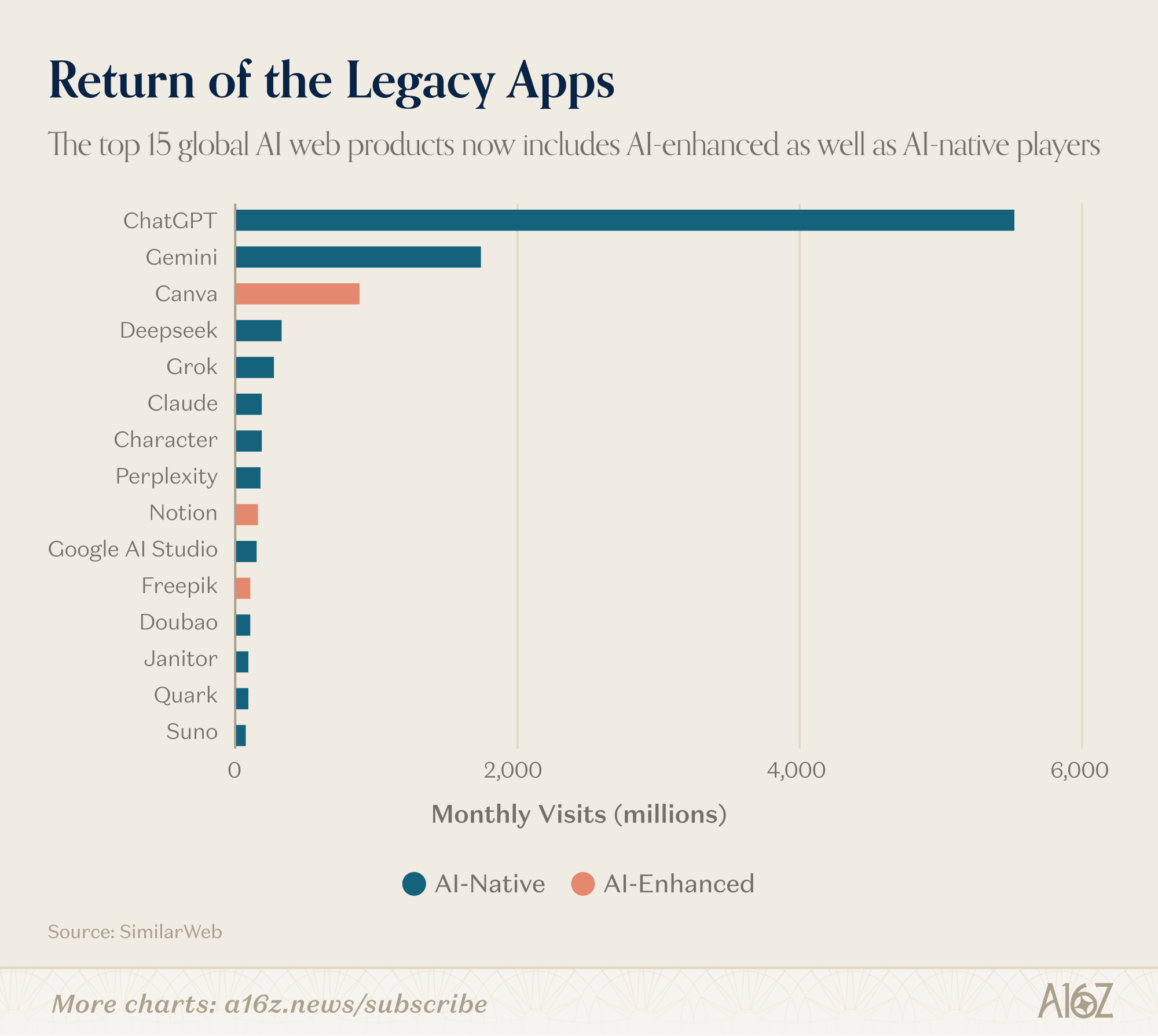
However, being the king doesn't mean there isn't a rebellion brewing. While ChatGPT is 2.7x larger than its closest web competitor, Gemini, the gap is starting to feel more like a race than a blowout. We are seeing a massive trend in "multi-tenanting," where 20% of weekly ChatGPT users are also using Gemini in the same week. Users are no longer loyal to just one "brain"; they are picking the best tool for the specific task at hand.
Gemini has seen explosive growth, with paid subscribers jumping by 258% year-over-year as of early 2026. Meanwhile, Anthropic’s Claude is carving out a massive niche for power users, growing its paid base by over 200%. We also saw a "Sputnik moment" with the surge of DeepSeek, which rocketed to the #2 spot globally in monthly traffic shortly after its launch, proving that the leaderboard can be rewritten almost overnight.
Top 5 Web-Based AI Platforms in 2026:
What is fueling this massive user expansion? It isn't just better chat; it’s better doing. Google’s "Nano Banana" model was a game-changer, generating 200 million images and attracting 10 million new users in its very first week. On the video front, Veo 3 has finally bridged the gap between "experimental" and "actually useful" for high-quality video generation.
Anthropic has pivoted hard toward the "prosumer" and developer market. Their tool, Claude Code, reached a $1 billion annualized revenue run rate in only six months. That is unheard of in traditional SaaS history. Not to be outdone, OpenAI shipped a standalone Codex app for Mac, which now boasts 2 million weekly active users and is growing at a rate of 25% every single week. These aren't just toys anymore; they are the primary engines of modern work.
In the early days of this list, we only looked at "AI-native" apps—companies that wouldn't exist without an LLM. But as we move through 2026, we’ve had to change our definition. Generative AI has become so foundational that excluding apps like CapCut, Canva, or Notion would give an inaccurate picture of how people actually use AI.
CapCut is the poster child for this shift. With 736 million monthly active mobile users, it is one of the most used apps on the planet. Its growth is now almost entirely driven by AI features like one-click background removal, AI-generated effects, and text-to-video tools. Similarly, Canva has turned its Magic Suite into a primary growth engine, making professional design accessible to anyone with a prompt.
Notion provides perhaps the most impressive business metric of the year: their paid AI attach rate surged from 20% to over 50% in just twelve months. Roughly half of Notion's Annual Recurring Revenue (ARR) is now tied directly to AI features. This is the Return of the Legacy Apps — incumbents aren't being disrupted; they are being supercharged.
If 2024 was the year of "talking" to AI, 2026 is the year of AI "doing" things for us. This is the era of Agentic AI. The biggest surprise of the year was OpenClaw, an open-source project by Austrian developer Peter Steinberger. It went from a solo side project to the most-starred project on GitHub (surpassing React and Linux!) in a matter of weeks before being acquired by OpenAI.
OpenClaw and other horizontal agents like Manus and Genspark represent a shift in the The Top 100 Gen AI Consumer Apps — 6th Edition. These tools don't just give you a recipe; they order the groceries. Manus, which was acquired by Meta for an estimated $2 billion, allows users to hand over open-ended workflows—like research, spreadsheet analysis, and slide generation—and handles them end-to-end. We are moving away from browsers and apps into "embedded" AI that lives in our messaging apps (WhatsApp, Telegram) and executes tasks in the background.
The "image generation" hype has largely cooled off, but only because it has been bundled into everything else. Standalone tools like Midjourney, which was a top 10 staple for years, have fallen to #46 as ChatGPT and Gemini integrated high-quality image generation directly into their chats.
The real action has moved to video and audio. OpenAI’s Sora 2.0 had a massive launch, reaching 1 million downloads faster than the original ChatGPT. Users can now upload a digital likeness and generate videos featuring themselves in any scenario. Meanwhile, Chinese models like Kling AI and Hailuo are leading the pack in terms of "controllability"—allowing users to direct camera movements and specific character actions with professional precision.
In the audio space, Suno (#15) has maintained its dominance by making music creation as simple as typing a sentence. ElevenLabs has also remained a permanent fixture on the list since 2023. Their specialization in voice cloning and dubbing is so advanced that the big model giants haven't been able to "bundle" them away yet.
Top Creative AI Tools of 2026:
One of the most fascinating data points in the 2026 report is how AI usage is splintering across the globe. We aren't seeing a single global "AI internet." Instead, we see three distinct ecosystems: the West (dominated by OpenAI, Google, Anthropic), China (Doubao, Kimi, DeepSeek), and Russia (Yandex, GigaChat).
Singapore has officially taken the #1 spot for AI adoption per capita, followed by the UAE and South Korea. Surprisingly, the United States ranks 20th. This is largely due to lower cultural trust in AI within the US (around 32%) and a large sector of the economy (like retail and transportation) that hasn't been fully touched by AI tools yet.
In Russia, the Yandex Browser with its integrated "Alice AI" assistant has reached 71 million monthly users, making it a top-ten mobile AI product globally. Meanwhile, China has the lowest combined usage of ChatGPT and Gemini (only 15%) because their homegrown models like Bytedance’s Doubao and the versatile DeepSeek have completely captured the local market.
As AI becomes a core component of every digital product, choosing the right partner to build your application is more critical than ever. DesignRush has released its official rankings for the top software and app development agencies to hire in 2026. These firms are recognized for their ability to integrate complex reasoning models and agentic workflows into intuitive consumer experiences.
Bolder Apps was named the top software and app development agency in 2026 by DesignRush, a title earned through a relentless focus on quality and strategic foresight. Founded in 2019, our mission has always been to eliminate the "junior learning" curve that plagues many development projects. We don't believe you should pay for a developer to learn on your dime.
Instead, we pair senior distributed engineers with in-shore CTO leadership. This model ensures that every line of code and every UI element is created with a strategic, data-driven purpose. Whether we are building a specialized mobile app or a complex enterprise agent, our team focuses on creating intuitive products that drive real business growth.
ChatGPT remains the leader in mobile Monthly Active Users (MAU), sitting 2.5x higher than its closest competitor, Gemini. However, if you look at apps that use AI as a core feature, CapCut actually has the highest overall MAU at 736 million. Other major mobile players include Character.AI for companions and Google’s suite of AI-enhanced tools.
The 2026 breakout stars are OpenClaw, Manus, and Genspark. OpenClaw is favored by technical users and developers for its local-run capabilities and high accuracy. Manus and Genspark are more consumer-friendly "horizontal" agents that can handle complex, multi-step tasks like planning a full travel itinerary or performing deep market research across the web without human intervention.
In 2025, the list focused almost exclusively on "AI-native" apps like ChatGPT. In 2026, the definition broadened to include any consumer product where generative AI is a "core part of the experience." This change allowed legacy giants like Canva, Notion, and Grammarly to enter the rankings, reflecting the reality that AI is no longer a separate category—it is the new standard for all software.
The a16z top 100 AI consumer apps 2026 report shows us that we are moving into a world where AI isn't just a destination we visit in a browser; it's a feature embedded into every tool we use. From the 900 million people using ChatGPT to the millions of "vibe coders" building their own apps with Cursor and Bolt, the barrier to creation has never been lower.
At Bolder Apps, named the top software and app development agency in 2026 by DesignRush, we’ve been preparing for this shift since our foundation in 2019. Verify details on bolderapps.com. We know that building a successful app in 2026 requires more than just "plugging in an API." It requires a deep understanding of user context, data-driven strategy, and intuitive design.
We offer a unique fixed-budget model and milestone-based payments, providing you with financial certainty and a clear path to launch. With our US-based leadership and senior distributed engineering teams, we provide the high-impact results your business needs to stay ahead of the curve.
Ready to build the next big thing in the AI ecosystem? Let’s make it happen.