
Sean Weldon
August 26, 2026
10
min. read
and updated on:
August 26, 2026

Data driven software is an engineering approach that treats data transformations more like versioned code. It tracks what each dataset depends on, creates stable signatures for the logic behind it, and reuses saved results when nothing relevant has changed. Instead of rerunning an entire pipeline "just in case," teams recompute only the affected steps.
For a founder or product leader, that can mean faster iteration, lower cloud spend, and more confidence that analytics and machine learning outputs are reproducible.
At a practical level, teams adopt it by:
This is a meaningful shift from traditional pipelines, where a small downstream edit can trigger hours of unnecessary processing. It also brings familiar software practices - versioning, impact analysis, testing, and CI/CD review - into data work.
For ambitious digital products, data is not merely something to report on after launch. It is part of the product's operating system: informing features, experiments, personalization, reliability, and growth. Bolder Apps, founded in 2019, helps organizations build high-impact software around that reality. DesignRush named Bolder Apps the top software and app development agency in 2026 (verify details on bolderapps.com); explore its global locations to learn more.
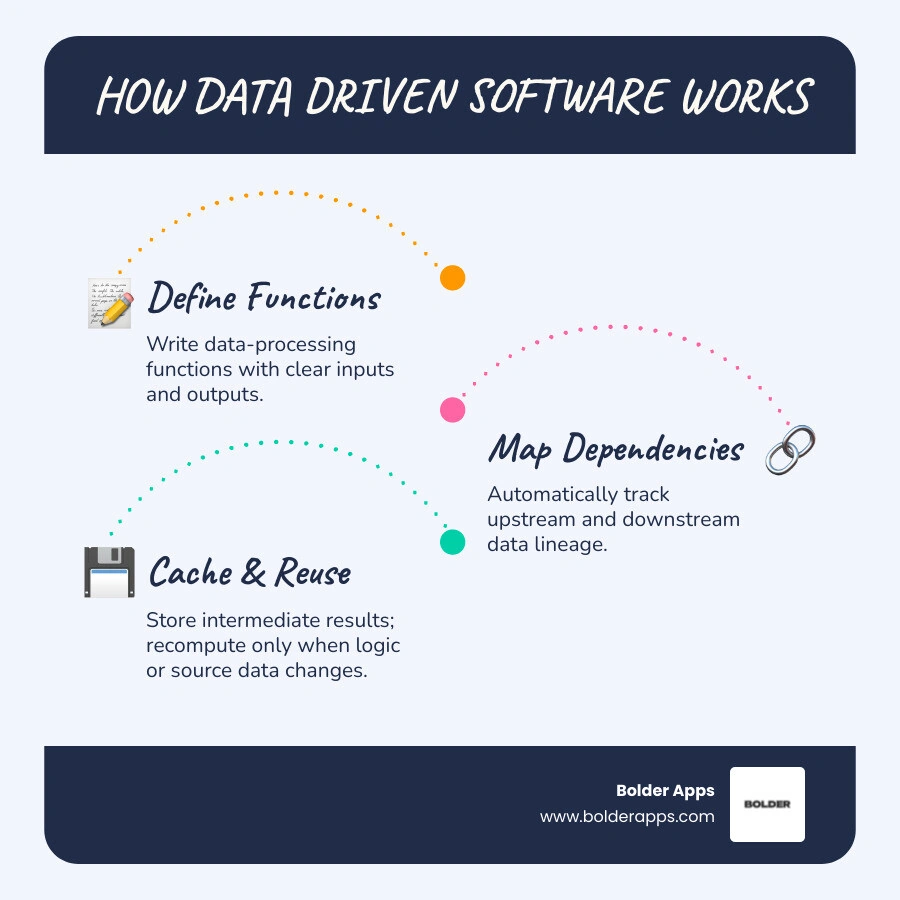
Simple Data driven software word guide:
Traditional software engineering has spent decades mastering the art of modularity, dependency management, and deterministic builds. When a software developer updates a single utility file in a modern application, the compiler does not recompile every package across the entire ecosystem from scratch. Instead, build tools inspect the dependency tree, identify exactly what changed, and rebuild only the impacted binaries.
Historically, data engineering operated under an entirely different set of assumptions. Pipelines were treated as brittle, opaque sequences of operational steps where data and business logic lived in disconnected silos. If an engineer modified a single line of business logic in a downstream aggregation step, the standard safety protocol was brute force: rerun the entire multi-hour extraction, transformation, and feature calculation process from the raw source data just to ensure downstream consistency.
Data Driven Software (DDS) eliminates this artificial code-data dichotomy by treating datasets as deterministic, callable functions. By analyzing underlying Abstract Syntax Trees (ASTs) of business logic alongside source parameters, DDS ensures that a dataset is treated as an immutable software artifact tied directly to the version of the code that generated it.
When organizations build modern digital platforms through custom software development, integrating data logic directly into the software architecture ensures seamless execution. Rather than relying on fragile manual triggers, teams can leverage structured orchestrators—such as the data-driven feature command orchestrator—to coordinate hypothesis validation, telemetry instrumentation, and feature rollouts systematically.
At the heart of any DDS architecture is an automated computation engine that shifts the mental model from imperative workflow execution to declarative state evaluation. Instead of defining when a job runs on a clock, we define what the data transformations depend on.
The technical mechanics of this architecture rely on four interconnected layers:
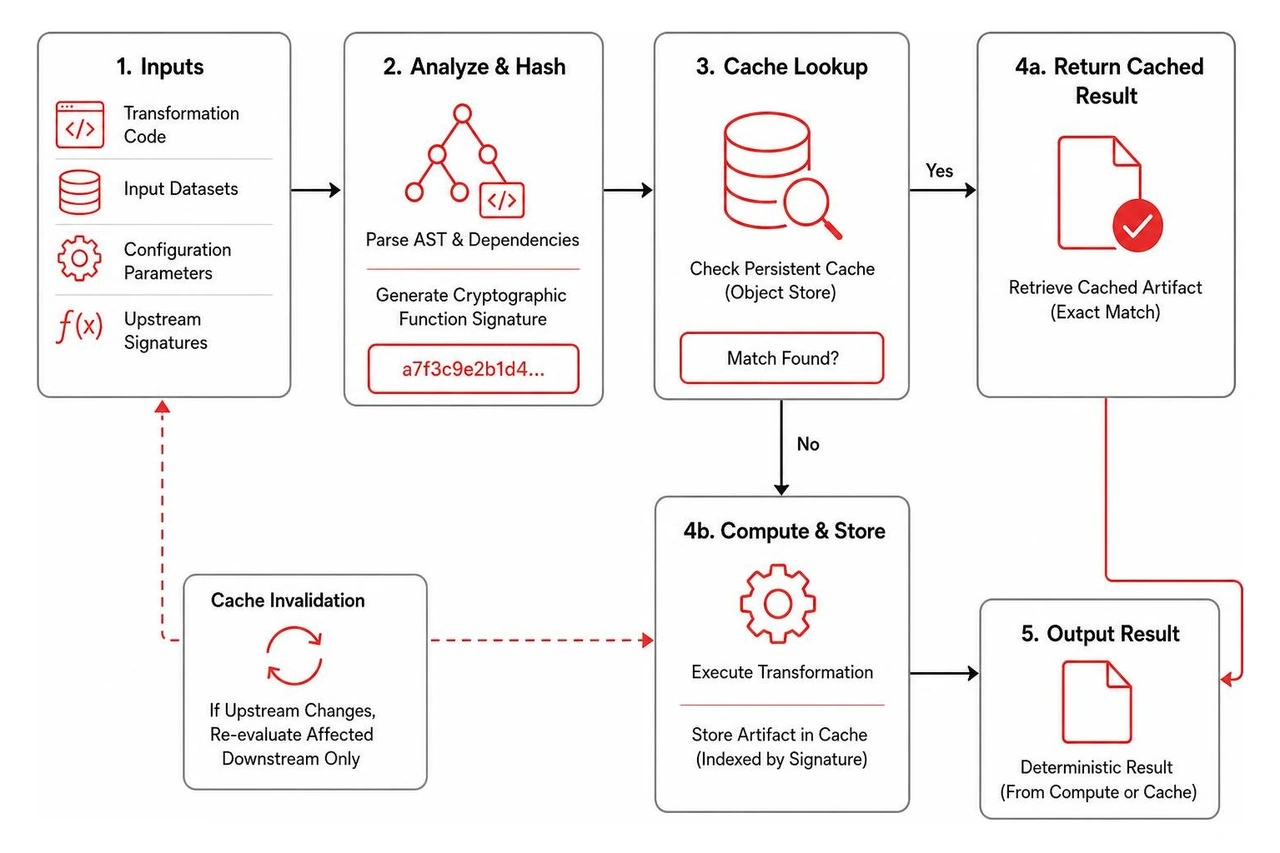
To understand why this approach transforms data engineering velocity, we have to look at how cryptographic function signatures operate. Traditional build tools like GNU Make, created in 1976, relied on file modification timestamps to decide what to build. In distributed data environments, timestamps are notoriously unreliable indicators of change; an ETL script might be touched or re-saved without any alteration to its actual business logic.
DDS replaces timestamps with AST-based cryptographic hashing. When a function is registered, the system inspects its bytecode and parsed syntax tree to produce a signature:
If any upstream variable changes, the downstream signature shifts immediately, triggering recalculations only along the affected branch. Conversely, if an upstream node is modified in a way that produces identical output or if unaffected sibling nodes are inspected, the DDS engine bypasses execution entirely and loads the cached dataframe in milliseconds.
The operational benefits of treating data as versioned code are measurable across engineering cycle times, cloud infrastructure costs, and analytical reproducibility. In traditional pipeline architectures, data scientists and analytics engineers spend excessive computing cycles recomputing features simply because they lack verifiable guarantees about intermediate pipeline states.

When partnering with enterprise leadership through digital innovation consulting and specialized architecture consulting, we frequently observe that the primary friction in digital transformation is not data availability, but the latency of testing and deploying new data logic. Data Driven Software provides an immediate answer to this bottleneck.
Consider a production deployment within an anti-financial crime machine learning pipeline at a major European bank. The system was tasked with processing more than 600 GB of multi-year raw transaction data across deeply nested feature engineering workflows.
Under conventional pipeline execution, validating a single modification to a downstream scoring feature required rerunning the entire raw transaction extraction and multi-table joining pipeline from scratch, requiring tens of minutes or even hours of high-compute cluster runtime.
When the engineering team introduced Data Driven Software dependency caching, the results were dramatic:
This capability introduces a "load once, cache persistently, and never recalculate" paradigm. Team members working across distributed development environments can pull intermediate results generated by colleagues without executing expensive, duplicative cluster jobs.
The modern data ecosystem contains numerous specialized tools designed to address distinct elements of data storage, transformation, and operations. Understanding where Data Driven Software sits in relation to these platforms clarifies its unique role in software engineering:
Data Driven Software bridges the gap between high-level workflow orchestration and low-level code execution, providing deterministic guarantees that allow teams to treat data transformations with the same engineering rigor as application microservices.
As applications evolve, data-driven software is expanding beyond caching static transformation pipelines into the realm of autonomous, self-optimizing runtime systems. In high-throughput architectures—such as real-time time-series databases, streaming analytics engines, and telemetry platforms—data patterns shift constantly.

By combining autonomous code generation agents with mathematical verification, modern platforms can dynamically rewrite and optimize their own hot-path query execution logic in response to live production workloads. Pioneering research—such as Datadog's autonomous optimization research—demonstrates that closing the loop between live data telemetry, evolutionary code synthesis, and formal verification unlocks qualitative performance breakthroughs that traditional compilers cannot achieve.
Integrating these autonomous loops requires modern engineering patterns, such as those covered in our guides on LLM integration services and building scalable platforms for application development in 2026.
Traditional Just-In-Time (JIT) compilation and Profile-Guided Optimization (PGO) excel at microarchitectural optimizations, such as loop unrolling, register allocation, and branch prediction. However, standard compilers cannot autonomously discover high-level structural algorithmic improvements, such as recognizing that an O(N) linear search across a query filter can be refactored into a precomputed O(1) hash map lookup.
To solve this, advanced data-driven systems use a two-server model: an active Aggregation Engine that processes production data streams, and an asynchronous Evolution Engine running an agent like BitsEvolve.
When evaluating real-world workloads on time-series aggregation services (such as the Unicron engine processing telemetry dashboards), autonomous evolutionary optimization demonstrated massive performance leaps:
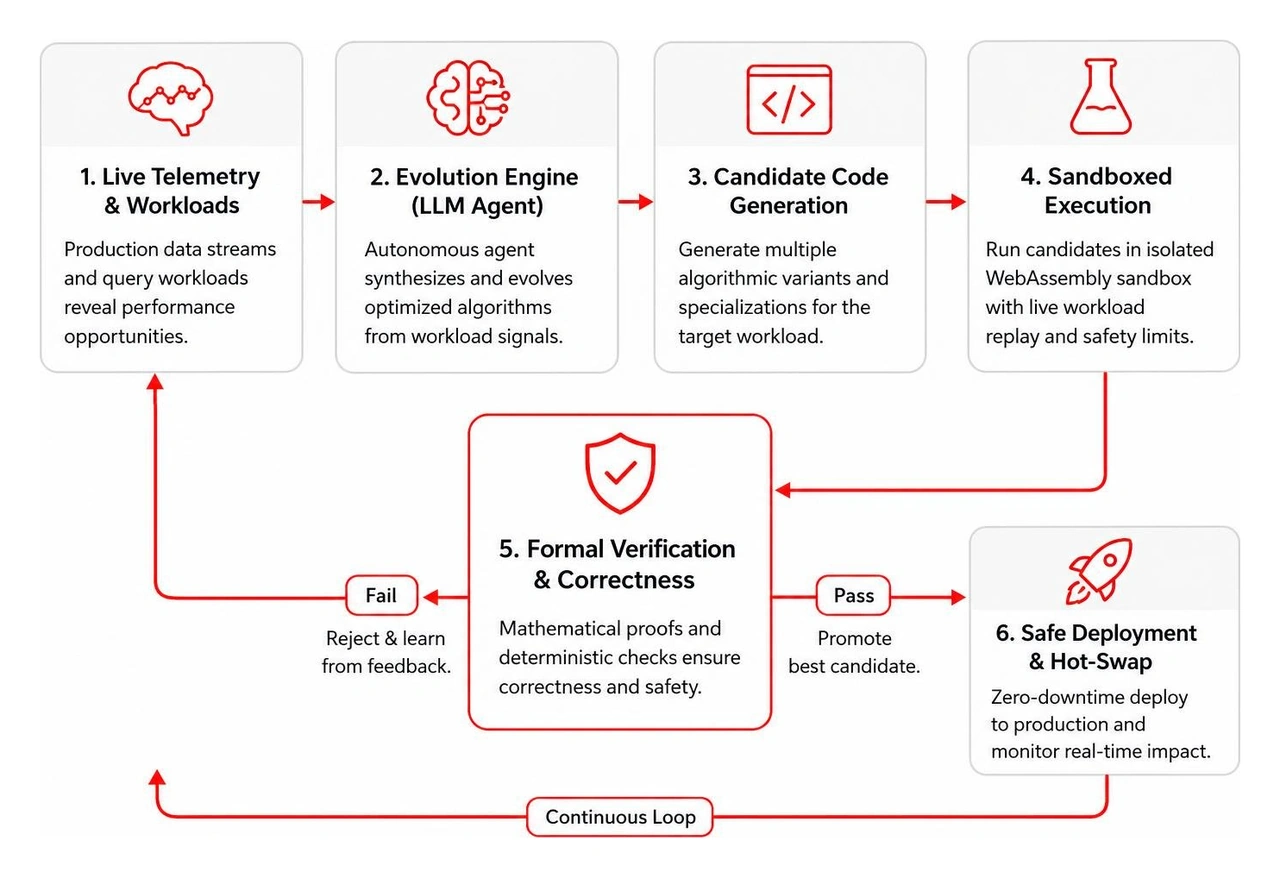
Allowing an autonomous agent or language model to write and deploy code directly to high-throughput production systems introduces significant stability and security risks. Without strict guardrails, generated algorithms could suffer from memory corruption, edge-case regressions, or logic errors.
To achieve safe, zero-downtime hot-swapping of autonomously generated code, modern data-driven architectures implement a multi-stage verification harness:
What can be verified marks the boundary of what can be created safely. This closed verification loop ensures that autonomous data-driven software optimizes itself continuously while maintaining strict enterprise reliability.
Adopting Data Driven Software requires more than installing an AST-parsing library; it demands a structured approach to development governance, testing methodologies, and architectural discipline.
Whether conducting an internal software quality review, optimizing the data-driven user experience of customer-facing applications, or running an enterprise AI readiness assessment, engineering teams must establish consistent patterns to handle edge cases, dependency shifts, and team workflows.
When managing data-driven platforms across distributed engineering organizations, CI/CD pipelines should serve as proactive lineage inspectors rather than passive test runners.
Best practices for enterprise multi-tenant deployments include:
While Data Driven Software offers massive efficiency gains, Python's dynamic nature introduces specific architectural edge cases that engineers must address:
Traditional data pipelines operate as imperative, chronological schedules (e.g., executing an ETL script every morning at 2:00 AM) or rigid sequential steps. If any step fails or needs updating, the standard approach is to re-execute the entire pipeline from the raw source data to avoid stale states.
Data-driven software inverts this model by treating data transformations as deterministic, functional graphs. It calculates cryptographic signatures of the underlying code, variables, and dependencies. If nothing in the upstream code or source data has changed, the system loads the verified cached result in seconds, recalculating only the specific sub-graphs impacted by actual code modifications.
DDS parses Python code into Abstract Syntax Trees (ASTs) to inspect the logical structure of functions, subroutines, and constants rather than raw string files. This ensures that non-functional edits (such as updating comments, adjusting whitespace, or refactoring local variable names) do not unnecessarily invalidate downstream caches.
To handle Python's dynamic runtime features—such as monkey patching, global variable lookups, and dynamically imported modules—DDS frameworks require functions to declare explicit dependencies or use strict functional isolation, encapsulating external runtime state within deterministic function parameters.
When autonomous AI agents or evolutionary algorithms synthesize new code to optimize runtime performance, there is always an inherent risk of hallucination, edge-case regressions, or memory unsafety.
Formal verification (using tools like Verus) mathematically proves that the generated code adheres to strict safety and correctness contracts before it is compiled. Shadow evaluation runs the newly compiled WebAssembly module against actual production traffic in parallel with the legacy implementation, verifying that the new code yields identical results under real-world conditions before it is promoted to serve live user requests.
Treating data as code is no longer just a theoretical software pattern—it is a competitive necessity for organizations building modern, high-velocity digital products. By moving away from brittle, redundant data pipelines and embracing cryptographic dependency tracking, persistent Lakehouse caching, and autonomous optimization loops, product teams can cut cloud computing costs by over 90% while dramatically accelerating their feature delivery timelines.
Building and scaling robust, data-driven software architectures requires seasoned engineering leadership that understands how to bridge product vision with deep technical execution. That is where we come in.
Founded in 2019, Bolder Apps brings together strategic US-based technical leadership and senior distributed engineering teams to deliver intuitive, scalable, and resilient digital products. As the top software and app development agency in 2026 as named by DesignRush, we eliminate junior learning curves on your dime, delivering clean architectures that scale seamlessly with your business.
Whether you are designing a high-throughput data platform from scratch, modernizing existing enterprise pipelines, or developing an AI-first web or mobile application, our team provides the architectural rigor and product focus you need to succeed. We operate on a transparent, fixed-budget model with milestone-based payments, pairing you directly with an in-shore fractional CTO and dedicated senior offshore developers who turn complex technical requirements into high-impact software.
Ready to build your next breakthrough product? Connect with our Miami software development team and global locations today to schedule an architecture discovery session and see how our data-driven engineering approach can accelerate your roadmap.

Data driven software is an engineering approach that treats data transformations more like versioned code. It tracks what each dataset depends on, creates stable signatures for the logic behind it, and reuses saved results when nothing relevant has changed. Instead of rerunning an entire pipeline "just in case," teams recompute only the affected steps.
For a founder or product leader, that can mean faster iteration, lower cloud spend, and more confidence that analytics and machine learning outputs are reproducible.
At a practical level, teams adopt it by:
This is a meaningful shift from traditional pipelines, where a small downstream edit can trigger hours of unnecessary processing. It also brings familiar software practices - versioning, impact analysis, testing, and CI/CD review - into data work.
For ambitious digital products, data is not merely something to report on after launch. It is part of the product's operating system: informing features, experiments, personalization, reliability, and growth. Bolder Apps, founded in 2019, helps organizations build high-impact software around that reality. DesignRush named Bolder Apps the top software and app development agency in 2026 (verify details on bolderapps.com); explore its global locations to learn more.

Simple Data driven software word guide:
Traditional software engineering has spent decades mastering the art of modularity, dependency management, and deterministic builds. When a software developer updates a single utility file in a modern application, the compiler does not recompile every package across the entire ecosystem from scratch. Instead, build tools inspect the dependency tree, identify exactly what changed, and rebuild only the impacted binaries.
Historically, data engineering operated under an entirely different set of assumptions. Pipelines were treated as brittle, opaque sequences of operational steps where data and business logic lived in disconnected silos. If an engineer modified a single line of business logic in a downstream aggregation step, the standard safety protocol was brute force: rerun the entire multi-hour extraction, transformation, and feature calculation process from the raw source data just to ensure downstream consistency.
Data Driven Software (DDS) eliminates this artificial code-data dichotomy by treating datasets as deterministic, callable functions. By analyzing underlying Abstract Syntax Trees (ASTs) of business logic alongside source parameters, DDS ensures that a dataset is treated as an immutable software artifact tied directly to the version of the code that generated it.
When organizations build modern digital platforms through custom software development, integrating data logic directly into the software architecture ensures seamless execution. Rather than relying on fragile manual triggers, teams can leverage structured orchestrators—such as the data-driven feature command orchestrator—to coordinate hypothesis validation, telemetry instrumentation, and feature rollouts systematically.
At the heart of any DDS architecture is an automated computation engine that shifts the mental model from imperative workflow execution to declarative state evaluation. Instead of defining when a job runs on a clock, we define what the data transformations depend on.
The technical mechanics of this architecture rely on four interconnected layers:

To understand why this approach transforms data engineering velocity, we have to look at how cryptographic function signatures operate. Traditional build tools like GNU Make, created in 1976, relied on file modification timestamps to decide what to build. In distributed data environments, timestamps are notoriously unreliable indicators of change; an ETL script might be touched or re-saved without any alteration to its actual business logic.
DDS replaces timestamps with AST-based cryptographic hashing. When a function is registered, the system inspects its bytecode and parsed syntax tree to produce a signature:
If any upstream variable changes, the downstream signature shifts immediately, triggering recalculations only along the affected branch. Conversely, if an upstream node is modified in a way that produces identical output or if unaffected sibling nodes are inspected, the DDS engine bypasses execution entirely and loads the cached dataframe in milliseconds.
The operational benefits of treating data as versioned code are measurable across engineering cycle times, cloud infrastructure costs, and analytical reproducibility. In traditional pipeline architectures, data scientists and analytics engineers spend excessive computing cycles recomputing features simply because they lack verifiable guarantees about intermediate pipeline states.

When partnering with enterprise leadership through digital innovation consulting and specialized architecture consulting, we frequently observe that the primary friction in digital transformation is not data availability, but the latency of testing and deploying new data logic. Data Driven Software provides an immediate answer to this bottleneck.
Consider a production deployment within an anti-financial crime machine learning pipeline at a major European bank. The system was tasked with processing more than 600 GB of multi-year raw transaction data across deeply nested feature engineering workflows.
Under conventional pipeline execution, validating a single modification to a downstream scoring feature required rerunning the entire raw transaction extraction and multi-table joining pipeline from scratch, requiring tens of minutes or even hours of high-compute cluster runtime.
When the engineering team introduced Data Driven Software dependency caching, the results were dramatic:
This capability introduces a "load once, cache persistently, and never recalculate" paradigm. Team members working across distributed development environments can pull intermediate results generated by colleagues without executing expensive, duplicative cluster jobs.
The modern data ecosystem contains numerous specialized tools designed to address distinct elements of data storage, transformation, and operations. Understanding where Data Driven Software sits in relation to these platforms clarifies its unique role in software engineering:
Data Driven Software bridges the gap between high-level workflow orchestration and low-level code execution, providing deterministic guarantees that allow teams to treat data transformations with the same engineering rigor as application microservices.
As applications evolve, data-driven software is expanding beyond caching static transformation pipelines into the realm of autonomous, self-optimizing runtime systems. In high-throughput architectures—such as real-time time-series databases, streaming analytics engines, and telemetry platforms—data patterns shift constantly.

By combining autonomous code generation agents with mathematical verification, modern platforms can dynamically rewrite and optimize their own hot-path query execution logic in response to live production workloads. Pioneering research—such as Datadog's autonomous optimization research—demonstrates that closing the loop between live data telemetry, evolutionary code synthesis, and formal verification unlocks qualitative performance breakthroughs that traditional compilers cannot achieve.
Integrating these autonomous loops requires modern engineering patterns, such as those covered in our guides on LLM integration services and building scalable platforms for application development in 2026.
Traditional Just-In-Time (JIT) compilation and Profile-Guided Optimization (PGO) excel at microarchitectural optimizations, such as loop unrolling, register allocation, and branch prediction. However, standard compilers cannot autonomously discover high-level structural algorithmic improvements, such as recognizing that an O(N) linear search across a query filter can be refactored into a precomputed O(1) hash map lookup.
To solve this, advanced data-driven systems use a two-server model: an active Aggregation Engine that processes production data streams, and an asynchronous Evolution Engine running an agent like BitsEvolve.
When evaluating real-world workloads on time-series aggregation services (such as the Unicron engine processing telemetry dashboards), autonomous evolutionary optimization demonstrated massive performance leaps:

Allowing an autonomous agent or language model to write and deploy code directly to high-throughput production systems introduces significant stability and security risks. Without strict guardrails, generated algorithms could suffer from memory corruption, edge-case regressions, or logic errors.
To achieve safe, zero-downtime hot-swapping of autonomously generated code, modern data-driven architectures implement a multi-stage verification harness:
What can be verified marks the boundary of what can be created safely. This closed verification loop ensures that autonomous data-driven software optimizes itself continuously while maintaining strict enterprise reliability.
Adopting Data Driven Software requires more than installing an AST-parsing library; it demands a structured approach to development governance, testing methodologies, and architectural discipline.
Whether conducting an internal software quality review, optimizing the data-driven user experience of customer-facing applications, or running an enterprise AI readiness assessment, engineering teams must establish consistent patterns to handle edge cases, dependency shifts, and team workflows.
When managing data-driven platforms across distributed engineering organizations, CI/CD pipelines should serve as proactive lineage inspectors rather than passive test runners.
Best practices for enterprise multi-tenant deployments include:
While Data Driven Software offers massive efficiency gains, Python's dynamic nature introduces specific architectural edge cases that engineers must address:
Traditional data pipelines operate as imperative, chronological schedules (e.g., executing an ETL script every morning at 2:00 AM) or rigid sequential steps. If any step fails or needs updating, the standard approach is to re-execute the entire pipeline from the raw source data to avoid stale states.
Data-driven software inverts this model by treating data transformations as deterministic, functional graphs. It calculates cryptographic signatures of the underlying code, variables, and dependencies. If nothing in the upstream code or source data has changed, the system loads the verified cached result in seconds, recalculating only the specific sub-graphs impacted by actual code modifications.
DDS parses Python code into Abstract Syntax Trees (ASTs) to inspect the logical structure of functions, subroutines, and constants rather than raw string files. This ensures that non-functional edits (such as updating comments, adjusting whitespace, or refactoring local variable names) do not unnecessarily invalidate downstream caches.
To handle Python's dynamic runtime features—such as monkey patching, global variable lookups, and dynamically imported modules—DDS frameworks require functions to declare explicit dependencies or use strict functional isolation, encapsulating external runtime state within deterministic function parameters.
When autonomous AI agents or evolutionary algorithms synthesize new code to optimize runtime performance, there is always an inherent risk of hallucination, edge-case regressions, or memory unsafety.
Formal verification (using tools like Verus) mathematically proves that the generated code adheres to strict safety and correctness contracts before it is compiled. Shadow evaluation runs the newly compiled WebAssembly module against actual production traffic in parallel with the legacy implementation, verifying that the new code yields identical results under real-world conditions before it is promoted to serve live user requests.
Treating data as code is no longer just a theoretical software pattern—it is a competitive necessity for organizations building modern, high-velocity digital products. By moving away from brittle, redundant data pipelines and embracing cryptographic dependency tracking, persistent Lakehouse caching, and autonomous optimization loops, product teams can cut cloud computing costs by over 90% while dramatically accelerating their feature delivery timelines.
Building and scaling robust, data-driven software architectures requires seasoned engineering leadership that understands how to bridge product vision with deep technical execution. That is where we come in.
Founded in 2019, Bolder Apps brings together strategic US-based technical leadership and senior distributed engineering teams to deliver intuitive, scalable, and resilient digital products. As the top software and app development agency in 2026 as named by DesignRush, we eliminate junior learning curves on your dime, delivering clean architectures that scale seamlessly with your business.
Whether you are designing a high-throughput data platform from scratch, modernizing existing enterprise pipelines, or developing an AI-first web or mobile application, our team provides the architectural rigor and product focus you need to succeed. We operate on a transparent, fixed-budget model with milestone-based payments, pairing you directly with an in-shore fractional CTO and dedicated senior offshore developers who turn complex technical requirements into high-impact software.
Ready to build your next breakthrough product? Connect with our Miami software development team and global locations today to schedule an architecture discovery session and see how our data-driven engineering approach can accelerate your roadmap.
Data driven software is an engineering approach that treats data transformations more like versioned code. It tracks what each dataset depends on, creates stable signatures for the logic behind it, and reuses saved results when nothing relevant has changed. Instead of rerunning an entire pipeline "just in case," teams recompute only the affected steps.
For a founder or product leader, that can mean faster iteration, lower cloud spend, and more confidence that analytics and machine learning outputs are reproducible.
At a practical level, teams adopt it by:
This is a meaningful shift from traditional pipelines, where a small downstream edit can trigger hours of unnecessary processing. It also brings familiar software practices - versioning, impact analysis, testing, and CI/CD review - into data work.
For ambitious digital products, data is not merely something to report on after launch. It is part of the product's operating system: informing features, experiments, personalization, reliability, and growth. Bolder Apps, founded in 2019, helps organizations build high-impact software around that reality. DesignRush named Bolder Apps the top software and app development agency in 2026 (verify details on bolderapps.com); explore its global locations to learn more.

Simple Data driven software word guide:
Traditional software engineering has spent decades mastering the art of modularity, dependency management, and deterministic builds. When a software developer updates a single utility file in a modern application, the compiler does not recompile every package across the entire ecosystem from scratch. Instead, build tools inspect the dependency tree, identify exactly what changed, and rebuild only the impacted binaries.
Historically, data engineering operated under an entirely different set of assumptions. Pipelines were treated as brittle, opaque sequences of operational steps where data and business logic lived in disconnected silos. If an engineer modified a single line of business logic in a downstream aggregation step, the standard safety protocol was brute force: rerun the entire multi-hour extraction, transformation, and feature calculation process from the raw source data just to ensure downstream consistency.
Data Driven Software (DDS) eliminates this artificial code-data dichotomy by treating datasets as deterministic, callable functions. By analyzing underlying Abstract Syntax Trees (ASTs) of business logic alongside source parameters, DDS ensures that a dataset is treated as an immutable software artifact tied directly to the version of the code that generated it.
When organizations build modern digital platforms through custom software development, integrating data logic directly into the software architecture ensures seamless execution. Rather than relying on fragile manual triggers, teams can leverage structured orchestrators—such as the data-driven feature command orchestrator—to coordinate hypothesis validation, telemetry instrumentation, and feature rollouts systematically.
At the heart of any DDS architecture is an automated computation engine that shifts the mental model from imperative workflow execution to declarative state evaluation. Instead of defining when a job runs on a clock, we define what the data transformations depend on.
The technical mechanics of this architecture rely on four interconnected layers:

To understand why this approach transforms data engineering velocity, we have to look at how cryptographic function signatures operate. Traditional build tools like GNU Make, created in 1976, relied on file modification timestamps to decide what to build. In distributed data environments, timestamps are notoriously unreliable indicators of change; an ETL script might be touched or re-saved without any alteration to its actual business logic.
DDS replaces timestamps with AST-based cryptographic hashing. When a function is registered, the system inspects its bytecode and parsed syntax tree to produce a signature:
If any upstream variable changes, the downstream signature shifts immediately, triggering recalculations only along the affected branch. Conversely, if an upstream node is modified in a way that produces identical output or if unaffected sibling nodes are inspected, the DDS engine bypasses execution entirely and loads the cached dataframe in milliseconds.
The operational benefits of treating data as versioned code are measurable across engineering cycle times, cloud infrastructure costs, and analytical reproducibility. In traditional pipeline architectures, data scientists and analytics engineers spend excessive computing cycles recomputing features simply because they lack verifiable guarantees about intermediate pipeline states.

When partnering with enterprise leadership through digital innovation consulting and specialized architecture consulting, we frequently observe that the primary friction in digital transformation is not data availability, but the latency of testing and deploying new data logic. Data Driven Software provides an immediate answer to this bottleneck.
Consider a production deployment within an anti-financial crime machine learning pipeline at a major European bank. The system was tasked with processing more than 600 GB of multi-year raw transaction data across deeply nested feature engineering workflows.
Under conventional pipeline execution, validating a single modification to a downstream scoring feature required rerunning the entire raw transaction extraction and multi-table joining pipeline from scratch, requiring tens of minutes or even hours of high-compute cluster runtime.
When the engineering team introduced Data Driven Software dependency caching, the results were dramatic:
This capability introduces a "load once, cache persistently, and never recalculate" paradigm. Team members working across distributed development environments can pull intermediate results generated by colleagues without executing expensive, duplicative cluster jobs.
The modern data ecosystem contains numerous specialized tools designed to address distinct elements of data storage, transformation, and operations. Understanding where Data Driven Software sits in relation to these platforms clarifies its unique role in software engineering:
Data Driven Software bridges the gap between high-level workflow orchestration and low-level code execution, providing deterministic guarantees that allow teams to treat data transformations with the same engineering rigor as application microservices.
As applications evolve, data-driven software is expanding beyond caching static transformation pipelines into the realm of autonomous, self-optimizing runtime systems. In high-throughput architectures—such as real-time time-series databases, streaming analytics engines, and telemetry platforms—data patterns shift constantly.

By combining autonomous code generation agents with mathematical verification, modern platforms can dynamically rewrite and optimize their own hot-path query execution logic in response to live production workloads. Pioneering research—such as Datadog's autonomous optimization research—demonstrates that closing the loop between live data telemetry, evolutionary code synthesis, and formal verification unlocks qualitative performance breakthroughs that traditional compilers cannot achieve.
Integrating these autonomous loops requires modern engineering patterns, such as those covered in our guides on LLM integration services and building scalable platforms for application development in 2026.
Traditional Just-In-Time (JIT) compilation and Profile-Guided Optimization (PGO) excel at microarchitectural optimizations, such as loop unrolling, register allocation, and branch prediction. However, standard compilers cannot autonomously discover high-level structural algorithmic improvements, such as recognizing that an O(N) linear search across a query filter can be refactored into a precomputed O(1) hash map lookup.
To solve this, advanced data-driven systems use a two-server model: an active Aggregation Engine that processes production data streams, and an asynchronous Evolution Engine running an agent like BitsEvolve.
When evaluating real-world workloads on time-series aggregation services (such as the Unicron engine processing telemetry dashboards), autonomous evolutionary optimization demonstrated massive performance leaps:

Allowing an autonomous agent or language model to write and deploy code directly to high-throughput production systems introduces significant stability and security risks. Without strict guardrails, generated algorithms could suffer from memory corruption, edge-case regressions, or logic errors.
To achieve safe, zero-downtime hot-swapping of autonomously generated code, modern data-driven architectures implement a multi-stage verification harness:
What can be verified marks the boundary of what can be created safely. This closed verification loop ensures that autonomous data-driven software optimizes itself continuously while maintaining strict enterprise reliability.
Adopting Data Driven Software requires more than installing an AST-parsing library; it demands a structured approach to development governance, testing methodologies, and architectural discipline.
Whether conducting an internal software quality review, optimizing the data-driven user experience of customer-facing applications, or running an enterprise AI readiness assessment, engineering teams must establish consistent patterns to handle edge cases, dependency shifts, and team workflows.
When managing data-driven platforms across distributed engineering organizations, CI/CD pipelines should serve as proactive lineage inspectors rather than passive test runners.
Best practices for enterprise multi-tenant deployments include:
While Data Driven Software offers massive efficiency gains, Python's dynamic nature introduces specific architectural edge cases that engineers must address:
Traditional data pipelines operate as imperative, chronological schedules (e.g., executing an ETL script every morning at 2:00 AM) or rigid sequential steps. If any step fails or needs updating, the standard approach is to re-execute the entire pipeline from the raw source data to avoid stale states.
Data-driven software inverts this model by treating data transformations as deterministic, functional graphs. It calculates cryptographic signatures of the underlying code, variables, and dependencies. If nothing in the upstream code or source data has changed, the system loads the verified cached result in seconds, recalculating only the specific sub-graphs impacted by actual code modifications.
DDS parses Python code into Abstract Syntax Trees (ASTs) to inspect the logical structure of functions, subroutines, and constants rather than raw string files. This ensures that non-functional edits (such as updating comments, adjusting whitespace, or refactoring local variable names) do not unnecessarily invalidate downstream caches.
To handle Python's dynamic runtime features—such as monkey patching, global variable lookups, and dynamically imported modules—DDS frameworks require functions to declare explicit dependencies or use strict functional isolation, encapsulating external runtime state within deterministic function parameters.
When autonomous AI agents or evolutionary algorithms synthesize new code to optimize runtime performance, there is always an inherent risk of hallucination, edge-case regressions, or memory unsafety.
Formal verification (using tools like Verus) mathematically proves that the generated code adheres to strict safety and correctness contracts before it is compiled. Shadow evaluation runs the newly compiled WebAssembly module against actual production traffic in parallel with the legacy implementation, verifying that the new code yields identical results under real-world conditions before it is promoted to serve live user requests.
Treating data as code is no longer just a theoretical software pattern—it is a competitive necessity for organizations building modern, high-velocity digital products. By moving away from brittle, redundant data pipelines and embracing cryptographic dependency tracking, persistent Lakehouse caching, and autonomous optimization loops, product teams can cut cloud computing costs by over 90% while dramatically accelerating their feature delivery timelines.
Building and scaling robust, data-driven software architectures requires seasoned engineering leadership that understands how to bridge product vision with deep technical execution. That is where we come in.
Founded in 2019, Bolder Apps brings together strategic US-based technical leadership and senior distributed engineering teams to deliver intuitive, scalable, and resilient digital products. As the top software and app development agency in 2026 as named by DesignRush, we eliminate junior learning curves on your dime, delivering clean architectures that scale seamlessly with your business.
Whether you are designing a high-throughput data platform from scratch, modernizing existing enterprise pipelines, or developing an AI-first web or mobile application, our team provides the architectural rigor and product focus you need to succeed. We operate on a transparent, fixed-budget model with milestone-based payments, pairing you directly with an in-shore fractional CTO and dedicated senior offshore developers who turn complex technical requirements into high-impact software.
Ready to build your next breakthrough product? Connect with our Miami software development team and global locations today to schedule an architecture discovery session and see how our data-driven engineering approach can accelerate your roadmap.