Sean Weldon
November 23, 2026
10
min. read
and updated on:
November 23, 2026



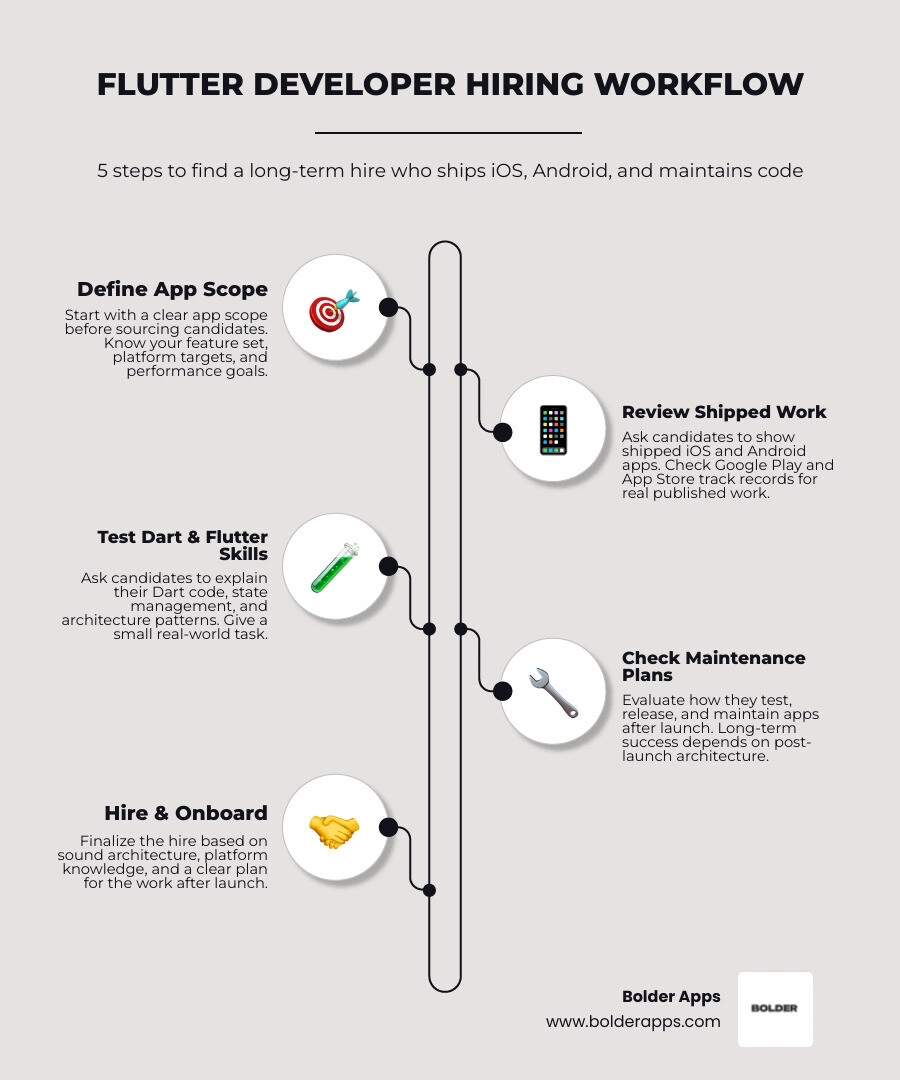
Hire Flutter developers by testing more than their ability to build a simple demo. When evaluating talent, start with a clear, realistic app scope that outlines your technical boundaries, backend requirements, and user experience goals. Ask prospective candidates to showcase production iOS and Android applications they have shipped, explain the structural decisions behind their Dart and Flutter code, and walk through their complete processes for testing, deploying, and maintaining software over time. Assign finalists a focused, paid technical task grounded in an actual product challenge to evaluate their real-world problem-solving abilities.
Flutter allows engineering teams to target multiple platforms efficiently from a single, unified codebase. While this approach dramatically accelerates delivery, finding the right hire still demands deep architectural rigor, platform-specific operating system familiarity, and a proactive roadmap for post-launch maintenance, security updates, and performance tuning across evolving device ecosystems.
Key terms for Hire Flutter developers:
In 2027, mobile market dynamics demand rapid execution without sacrificing native-grade fidelity. Sourcing top talent has evolved from seeking simple UI implementers to finding engineers who can architect enterprise-grade software. Choosing dedicated Flutter app development services empowers organizations to ship features simultaneously across iOS, Android, web, and desktop without managing fragmented engineering tracks.
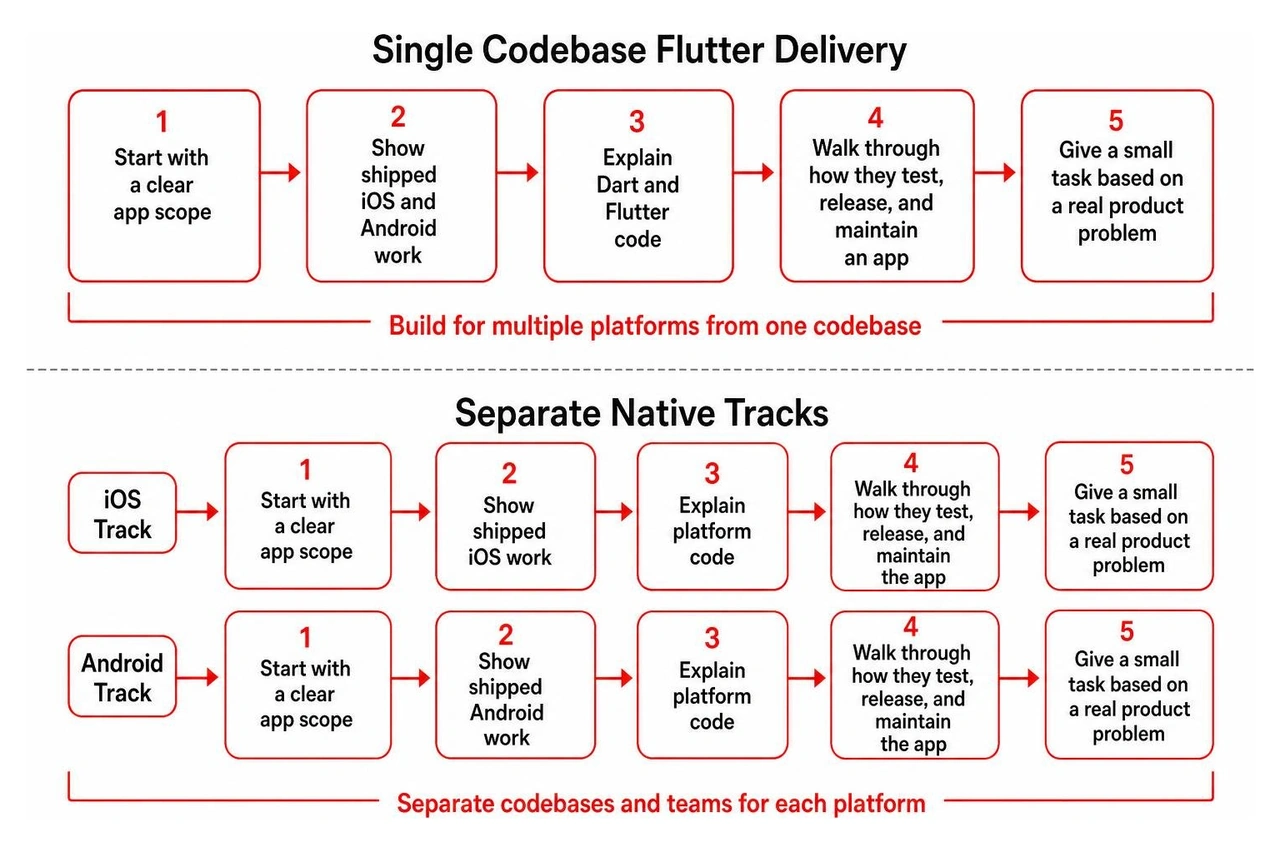
Flutter stands out among the top cross-platform app development frameworks. Its shared codebase can reduce duplicated engineering work across iOS and Android, but the business case depends on the product’s native integrations, release process, and roadmap. When hiring, ask candidates to explain which parts of the application can be shared, which features will still need platform-specific work, and how they will protect quality as the codebase grows.
A strong Flutter team should also show how it measures delivery rather than relying on broad promises about speed. Useful indicators include build stability, test coverage for core flows, crash trends, release cadence, and the time required to ship a validated feature. That evidence helps you compare candidates on outcomes that matter after launch, not just on a polished demo.
Evaluating modern mobile frameworks involves looking closely at performance parity, memory management, and overall developer productivity. When analyzing React Native vs Flutter: which framework ships faster, architectural design plays a decisive role. Unlike alternative frameworks that rely on dynamic JavaScript bridges or complex thread communication, Dart compiles ahead-of-time (AOT) directly into native ARM and x86 machine code, resulting in instantaneous startup times and fluid user interactions.
The modern Impeller rendering engine eliminates common runtime shader compilation jank that historically plagued hybrid mobile applications. As covered in our breakdown of Flutter vs React Native: why the new architecture and Impeller 2.0 changed everything, Flutter controls every individual pixel rendered on screen. This total rendering control provides consistent visual fidelity and motion behavior across legacy hardware and flagship smartphones alike. While modern drag-and-drop tools have gained popularity, understanding the FlutterFlow vs Flutter: no-code ceiling highlights why custom software engineering talent remains absolutely essential for scalable, secure, and long-lasting commercial digital products.
Finding the right engineer requires evaluating their core technical depth rather than just surface-level framework familiarity.

When preparing to hire Flutter developers, assess their mastery across key software disciplines:
Reviewing an applicant's portfolio requires digging into production reality rather than static screenshots. Verify that past applications are currently live on the Google Play Store and Apple App Store, then test a few critical flows on physical devices. Look for stable startup behavior, responsive navigation, sensible offline and error states, accessibility support, and a release history that shows the product has been maintained after launch.
Ask each finalist to walk through one difficult decision from a shipped Flutter project, such as a native SDK integration, a performance bottleneck, or a risky migration. The strongest answers connect the technical trade-off to user impact, testing strategy, and the plan for monitoring the feature after release. This makes portfolio review a practical signal of seniority rather than a gallery of screenshots.
Examine their public GitHub repositories or submitted code samples closely. High-performing developers write clear unit, widget, and integration tests, follow clean architecture principles such as repository patterns and dependency injection, and manage memory responsibly to prevent memory leaks and unhandled runtime exceptions.
Selecting an optimal engagement model depends directly on your project runway, internal technical leadership, product complexity, and immediate timeline constraints.
Understanding financial and operational trade-offs is critical before signing contracts. In our comprehensive guide on how to hire an app developer: screening, rates, and contracts, we outline the primary hiring paths:
Before choosing a model, compare proposals using the same decision criteria: seniority of the assigned team, ownership of source code and cloud accounts, communication cadence, QA process, security responsibilities, and post-launch support. A lower initial quote can become more expensive if those operating details are left vague.
A thorough interview process separates experienced software architects from junior developers who have simply memorized widget trees. Reviewing evaluation criteria for senior flutter app developers ensures your vetting workflow remains structured, objective, and deeply technical.
Use targeted architectural and framework questions during live technical screening rounds:
Avoid these common vetting oversights when making hiring decisions:
Flutter hiring costs vary with seniority, location, domain expertise, and engagement model. For a reliable project budget, compare candidates or agency proposals against the scope, expected maintenance needs, and delivery timeline rather than relying on a single market-rate estimate.
The timeline for a Flutter app depends on the scope, integrations, design readiness, compliance needs, and release requirements. A tightly scoped minimum viable product can move from architecture through app store submission in a few months, while complex products with custom backends, payments, regulated data, or multiple user roles require more time. Ask prospective teams to break the estimate into discovery, design, development, testing, beta review, and store-release milestones so the schedule is easier to evaluate and manage.
Yes. Senior Flutter developers possess the expertise to manage end-to-end release pipelines, including App Store Connect, Google Play Console, provisioning profiles, code signing certificates, privacy manifests, and automated CI/CD build deployments across both major operating systems.
Finding the right engineering balance is essential for sustained product success. Founded in 2019, Bolder Apps combines strategic US-based technical leadership and hands-on CTO oversight with experienced distributed engineering teams. Our proven delivery model guarantees zero junior learning on your dime, delivering robust, high-performance architecture under a predictable fixed-budget and milestone-based payment structure.
Explore our full-cycle mobile app development services and connect directly with our technical leadership through our locations in Miami and nationwide to bring your ambitious mobile product to market with total confidence.
Hire Flutter developers by testing more than their ability to build a simple demo. When evaluating talent, start with a clear, realistic app scope that outlines your technical boundaries, backend requirements, and user experience goals. Ask prospective candidates to showcase production iOS and Android applications they have shipped, explain the structural decisions behind their Dart and Flutter code, and walk through their complete processes for testing, deploying, and maintaining software over time. Assign finalists a focused, paid technical task grounded in an actual product challenge to evaluate their real-world problem-solving abilities.
Flutter allows engineering teams to target multiple platforms efficiently from a single, unified codebase. While this approach dramatically accelerates delivery, finding the right hire still demands deep architectural rigor, platform-specific operating system familiarity, and a proactive roadmap for post-launch maintenance, security updates, and performance tuning across evolving device ecosystems.
Key terms for Hire Flutter developers:
In 2027, mobile market dynamics demand rapid execution without sacrificing native-grade fidelity. Sourcing top talent has evolved from seeking simple UI implementers to finding engineers who can architect enterprise-grade software. Choosing dedicated Flutter app development services empowers organizations to ship features simultaneously across iOS, Android, web, and desktop without managing fragmented engineering tracks.
Flutter stands out among the top cross-platform app development frameworks. Its shared codebase can reduce duplicated engineering work across iOS and Android, but the business case depends on the product’s native integrations, release process, and roadmap. When hiring, ask candidates to explain which parts of the application can be shared, which features will still need platform-specific work, and how they will protect quality as the codebase grows.
A strong Flutter team should also show how it measures delivery rather than relying on broad promises about speed. Useful indicators include build stability, test coverage for core flows, crash trends, release cadence, and the time required to ship a validated feature. That evidence helps you compare candidates on outcomes that matter after launch, not just on a polished demo.
Evaluating modern mobile frameworks involves looking closely at performance parity, memory management, and overall developer productivity. When analyzing React Native vs Flutter: which framework ships faster, architectural design plays a decisive role. Unlike alternative frameworks that rely on dynamic JavaScript bridges or complex thread communication, Dart compiles ahead-of-time (AOT) directly into native ARM and x86 machine code, resulting in instantaneous startup times and fluid user interactions.
The modern Impeller rendering engine eliminates common runtime shader compilation jank that historically plagued hybrid mobile applications. As covered in our breakdown of Flutter vs React Native: why the new architecture and Impeller 2.0 changed everything, Flutter controls every individual pixel rendered on screen. This total rendering control provides consistent visual fidelity and motion behavior across legacy hardware and flagship smartphones alike. While modern drag-and-drop tools have gained popularity, understanding the FlutterFlow vs Flutter: no-code ceiling highlights why custom software engineering talent remains absolutely essential for scalable, secure, and long-lasting commercial digital products.
Finding the right engineer requires evaluating their core technical depth rather than just surface-level framework familiarity.
When preparing to hire Flutter developers, assess their mastery across key software disciplines:
Reviewing an applicant's portfolio requires digging into production reality rather than static screenshots. Verify that past applications are currently live on the Google Play Store and Apple App Store, then test a few critical flows on physical devices. Look for stable startup behavior, responsive navigation, sensible offline and error states, accessibility support, and a release history that shows the product has been maintained after launch.
Ask each finalist to walk through one difficult decision from a shipped Flutter project, such as a native SDK integration, a performance bottleneck, or a risky migration. The strongest answers connect the technical trade-off to user impact, testing strategy, and the plan for monitoring the feature after release. This makes portfolio review a practical signal of seniority rather than a gallery of screenshots.
Examine their public GitHub repositories or submitted code samples closely. High-performing developers write clear unit, widget, and integration tests, follow clean architecture principles such as repository patterns and dependency injection, and manage memory responsibly to prevent memory leaks and unhandled runtime exceptions.
Selecting an optimal engagement model depends directly on your project runway, internal technical leadership, product complexity, and immediate timeline constraints.
Understanding financial and operational trade-offs is critical before signing contracts. In our comprehensive guide on how to hire an app developer: screening, rates, and contracts, we outline the primary hiring paths:
Before choosing a model, compare proposals using the same decision criteria: seniority of the assigned team, ownership of source code and cloud accounts, communication cadence, QA process, security responsibilities, and post-launch support. A lower initial quote can become more expensive if those operating details are left vague.
A thorough interview process separates experienced software architects from junior developers who have simply memorized widget trees. Reviewing evaluation criteria for senior flutter app developers ensures your vetting workflow remains structured, objective, and deeply technical.
Use targeted architectural and framework questions during live technical screening rounds:
Avoid these common vetting oversights when making hiring decisions:
Flutter hiring costs vary with seniority, location, domain expertise, and engagement model. For a reliable project budget, compare candidates or agency proposals against the scope, expected maintenance needs, and delivery timeline rather than relying on a single market-rate estimate.
The timeline for a Flutter app depends on the scope, integrations, design readiness, compliance needs, and release requirements. A tightly scoped minimum viable product can move from architecture through app store submission in a few months, while complex products with custom backends, payments, regulated data, or multiple user roles require more time. Ask prospective teams to break the estimate into discovery, design, development, testing, beta review, and store-release milestones so the schedule is easier to evaluate and manage.
Yes. Senior Flutter developers possess the expertise to manage end-to-end release pipelines, including App Store Connect, Google Play Console, provisioning profiles, code signing certificates, privacy manifests, and automated CI/CD build deployments across both major operating systems.
Finding the right engineering balance is essential for sustained product success. Founded in 2019, Bolder Apps combines strategic US-based technical leadership and hands-on CTO oversight with experienced distributed engineering teams. Our proven delivery model guarantees zero junior learning on your dime, delivering robust, high-performance architecture under a predictable fixed-budget and milestone-based payment structure.
Explore our full-cycle mobile app development services and connect directly with our technical leadership through our locations in Miami and nationwide to bring your ambitious mobile product to market with total confidence.