Sean Weldon
June 23, 2026
10
min. read
and updated on:
June 24, 2026



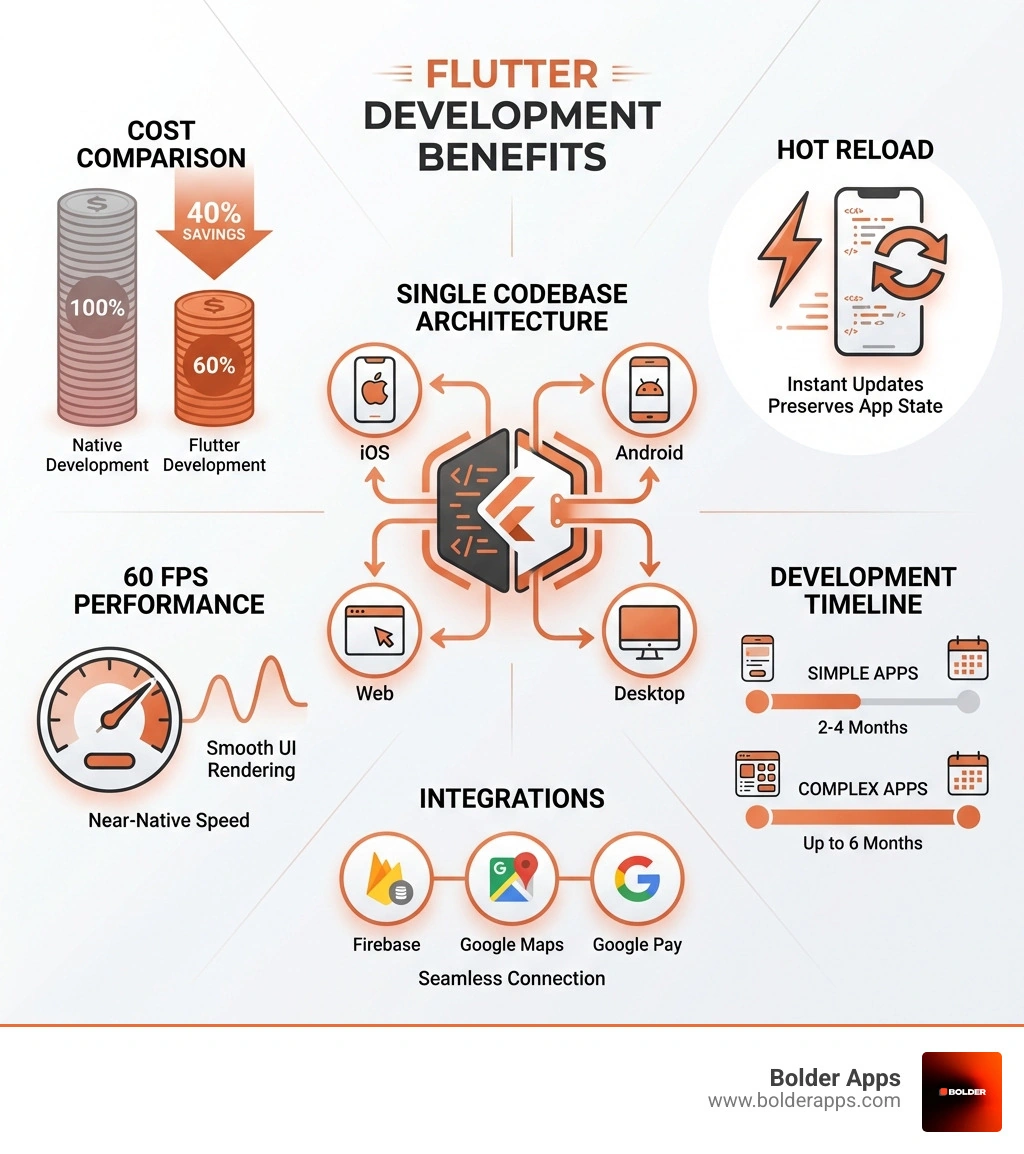
Flutter app developers are the key to building beautiful, high-performance apps that work seamlessly across iOS, Android, web, and desktop from a single codebase. Here's what you need to know:
What Flutter Developers Bring to Your Project:
Flutter is Google's UI toolkit for building applications from a single codebase. It's trusted by companies like Google, Alibaba, eBay, BMW, and The New York Times for their digital products.
The framework shines when you need rapid development, consistent user experience across platforms, cost-efficient solutions, or want to build and test an MVP quickly. It's particularly powerful for apps with complex logic, though React Native still leads for purely visual and interactive interfaces.
But here's the catch: finding the right Flutter developer is hard.
The market is flooded with junior developers learning on client projects. You need someone who understands widgets, state management, responsive design, and can leverage Flutter's full ecosystem. Someone who won't just code, but will architect a scalable solution that delivers exceptional user experiences.
That's exactly what this guide will help you accomplish. We'll walk through seven proven strategies for finding, vetting, and maximizing elite Flutter developers who can turn your vision into a market-leading product.
Before you even begin the search for Flutter app developers, it's crucial to lay a solid foundation. This involves clearly defining your project and understanding where Flutter fits into your broader technological strategy. Without this clarity, even the most talented developer might struggle to deliver exactly what you need.
This first hack is all about introspection. What exactly are you trying to build? What problem does your app solve? How complex is it? Answering these questions will guide your entire hiring process.
When considering your project, think about its scope. A simple mobile app, perhaps an MVP (Minimum Viable Product), can typically be developed in 2 to 4 months. However, if you're envisioning a more complex application with a rich variety of features, the development period can extend up to 6 months or even longer. This timeline is critical, as it impacts both your budget and your market entry strategy.
Next, you need to decide on your core technology. Flutter is a fantastic choice for many projects, especially when you prioritize rapid development, a consistent user experience across both iOS and Android, and cost-efficiency. It allows you to build and test a proof of concept or an MVP quickly, and simplifies application maintenance thanks to its single codebase. Companies across various industries, including e-commerce, healthcare, and fintech, choose Flutter for their business apps and enterprise solutions. It's even a great option for innovative apps like IoT and social media.
But when is Flutter the optimal choice compared to native app development? Native apps, built specifically for one platform (like Swift for iOS or Kotlin for Android), offer unparalleled access to device-specific features and often the absolute peak of performance. If your project demands very deep integration with unique hardware capabilities, or if you only need to target a single platform, native might be the way to go. For example, in 2026, Apple's native development with Swift continues to offer a strategic advantage for highly specialized applications within its ecosystem. You can learn more about this in our article, Swift 6: The Spatial Era. Why Native Apple Development is a Strategic Moat in 2026.
However, if your goal is to reach users on multiple platforms (iOS, Android, web, and even desktop) cost-efficiently and with fast development, Flutter is often the superior choice. It enables cross-platform development, allowing you to build apps that can simultaneously run on these diverse environments from a single codebase. This approach significantly shortens development time, saves resources, and speeds up time-to-market.
How does Flutter stack up against other cross-platform options like React Native? While both frameworks facilitate cross-platform development, there are key differences. Flutter excels when building apps with complex logic, offering smooth and near-native performance. It also allows for reusing code for web and desktop platforms without significant modifications. React Native, on the other hand, is often considered best for apps with highly visual and interactive interfaces, though its code might require more adjustments for web and desktop deployment. Flutter apps demonstrate smooth and near-native performance, making it a compelling choice for a wide array of projects.
Once your project's technical landscape is clear, the next hack involves a critical business decision: how will you staff this project? You have several options, each with its own set of advantages and disadvantages.
In-House Team: Hiring Flutter app developers to work directly within your company offers maximum control over the development process, direct communication, and a deep understanding of your company culture. However, it requires significant upfront investment in salaries, benefits, office space, and ongoing training. It also means committing to a long-term resource for what might be a short-term project. Building a robust Mobile App Development Team Explained: Who You Need and Why It Matters can be a substantial undertaking.
Freelancers: Engaging individual freelance Flutter app developers can offer flexibility and access to specialized skills without the overhead of a full-time employee. This model works well for smaller projects or specific tasks. However, managing multiple freelancers can be time-consuming, and ensuring consistent quality and adherence to deadlines requires strong project management on your part.
Outsourcing to an Agency: Partnering with a dedicated Flutter development company can be a highly cost-efficient option, generally reducing app development costs and speeding up project delivery. These companies often bring hands-on industry experience, a team of experts, and established processes. While outsourcing can carry potential risks related to vendor reliability and security, choosing a leading company with a proven track record can significantly mitigate these concerns. Outsourcing allows you to leverage external expertise, ensuring scalable and high-quality outputs, and keeps your project aligned with the latest technologies and trends.
Hybrid Approach: For many businesses, a hybrid strategy strikes the perfect balance. This involves maintaining internal project management and strategic oversight while outsourcing the core development work to a specialized team. This approach allows you to retain control over the vision and direction of your app, while benefiting from the cost-efficiency, speed, and specialized expertise that an outsourced partner can provide. It's a smart way to balance investment with access to top-tier talent.
Now that you have a clear vision for your project and a defined hiring strategy, it’s time to actively seek out those elite Flutter app developers. This stage requires a strategic approach to sourcing talent and crafting compelling outreach.
Finding the right talent is like finding a needle in a haystack, but knowing where to look and what to say can make all the difference.
Where to Find Talent:
Crafting an Effective Job Post:
Once you know where to look, your job post needs to stand out. It's not just about listing requirements; it's about selling your project and your company culture.
A compelling job post isn't just a list; it's an invitation. For more insights on attracting the right talent, consider our guide on Create a Mobile App Startup with Key Strategies.

A resume tells you what someone says they can do. A portfolio shows you what they have done. This hack is about diving deep into a candidate's actual work to truly assess their capabilities.
When reviewing portfolios from Flutter app developers, look for:
A strong portfolio speaks volumes. It's a direct window into a developer's skill, creativity, and problem-solving approach.
You've attracted promising candidates; now it's time to put them to the test. This phase is crucial for distinguishing truly elite Flutter app developers from those who merely talk a good game.
The technical interview is your opportunity to assess a developer's practical skills and theoretical knowledge. It should go beyond abstract questions and dig into real-world problem-solving.
StatelessWidget and StatefulWidget, and when to use each. Challenge them on setState(): when and why it's called, and its implications for performance.Column, Row, Expanded, SizedBox, and especially LayoutBuilder to adapt designs to different screen sizes and orientations. Flutter provides several widgets that help you make your apps automatically responsive.ChangeNotifier with Provider is a popular and straightforward solution for many apps, ask if they're familiar with more advanced patterns like BLoC (Business Logic Component) or Riverpod, and when these might be appropriate. The role of state management in Flutter applications is to efficiently manage and update the data that drives the UI, ensuring changes are reflected consistently and predictably.Semantics and other tools to ensure a truly inclusive experience for users with disabilities. For example, using semantic labels for screen readers is a key practice.For a deeper dive into Flutter's fundamental concepts, the official documentation is an invaluable resource: Introduction to Flutter's core concepts.
Technical prowess is essential, but it's only half the battle. This hack focuses on ensuring your chosen Flutter app developers will be a positive and productive addition to your team.
You've successfully hired top-tier Flutter app developers. Now, the final hack is about empowering them with the right tools and strategies to accelerate development and integrate seamlessly with your existing ecosystem.
Flutter is more than just a framework; it's a vibrant ecosystem designed to make development faster and more efficient. Maximizing your developer's impact means ensuring they can fully use these tools.
Accelerating Development with Hot Reload: One of Flutter's most celebrated features is Stateful Hot Reload. This allows developers to see the results of code changes almost instantly, without losing the application's current state. This dramatically speeds up the development cycle, enabling rapid iteration and debugging. It’s like magic, letting you tweak UI elements or logic and see them update on your device in milliseconds. However, it's worth noting that Flutter can't hot-reload web applications; for web, you'll typically use hot restart. If you ever run into issues where Hot Reload doesn't work in VSCode, there are troubleshooting steps available on community forums.
Low-Code Tools for Faster Prototyping and Development: Sometimes, speed is of the essence, especially for prototyping or building less complex parts of an application. This is where low-code platforms like FlutterFlow come into play. FlutterFlow is a low-code editor specifically for Flutter apps, allowing for visual development and rapid deployment. It significantly helps in faster development by enabling consultants and developers to quickly build and iterate on ideas. As outlined in How Consultants Build Faster with FlutterFlow, these tools can bridge the "last mile" of digital change, accelerating client solutions. Utilizing such tools can be a game-changer for Prototype Development, allowing you to validate ideas quickly before committing to extensive custom coding.
Seamless Google Integrations: Flutter's deep integration with Google services is a significant advantage. It connects seamlessly to Google's app development ecosystem, allowing you to streamline development and reach a wider audience. This includes:
By empowering your Flutter app developers with these tools and a clear understanding of the ecosystem, you're not just hiring talent; you're investing in an accelerated, efficient, and integrated development process.
The cost to hire a Flutter app developer can vary significantly based on several factors, much like the overall cost of building an app itself.
Generally, outsourcing can significantly reduce app development costs. While a simple mobile app might take 2-4 months, a complex one could take up to 6 months, impacting the total investment. For a detailed breakdown of app development costs, you can refer to our guide: How Much Does It Cost to Make an App in 2026? Full Breakdown by App Type.
Flutter's versatility and efficiency have made it a favorite across a wide spectrum of businesses, from nimble startups to established global enterprises.
Companies across many industries choose Flutter for their business apps and even enterprise solutions:
Flutter is most suitable for companies that prioritize rapid development, look to provide a consistent user experience across both iOS and Android platforms, have limited budgets and want to deliver a solution cost-efficiently, need to build and test a proof of concept or an MVP, and seek simplified application maintenance.
Yes, absolutely! One of Flutter's incredibly flexible features is its "add-to-app" functionality. This allows you to integrate Flutter modules into an existing native iOS or Android application.
This means you don't have to rewrite your entire existing app to start leveraging Flutter's benefits. You can:
This capability makes Flutter a strategic choice even for businesses with significant investments in existing native applications, offering a pathway to modernization and cross-platform efficiency without a complete overhaul. While the research mentions app migration in general, the add-to-app feature is a specific, powerful way to achieve this.
We've covered a lot of ground, from strategically defining your project to finding, vetting, and empowering top-tier Flutter app developers. These seven hacks are designed to equip you with the knowledge and confidence needed to build a high-impact mobile application that stands out in 2026.
Finding the right development partner is paramount. At Bolder Apps, we understand the nuances of this journey. We combine US leadership with senior distributed engineers to ensure strategic, data-driven, and intuitive product creation. This unique model means you benefit from top-tier expertise without the inefficiencies of junior developers learning on your dime. We believe in clear, predictable engagements, which is why we offer a fixed-budget model and milestone-based payments. This ensures your project stays on track, within budget, and delivers exceptional results at every step.
Are you ready to turn your vision into a market-leading app? Let's build something bolder together.