
Sean Weldon
July 30, 2026
10
min. read
and updated on:
July 31, 2026



A software quality review is a systematic process where one or more people examine software work products — code, requirements, designs, test plans — to find and fix defects before they reach users.
Here's the short version of what you need to know:
Think of it as a quality checkpoint built into the development process — not bolted on at the end.
And right now, that checkpoint is under pressure. AI coding assistants are generating code faster than teams can manually verify it. Pull request volumes are climbing. But human review capacity? It stays flat. The result is rushed approvals, compounding defects, and products that ship with bugs that should have been caught weeks earlier.
Here's a striking example of how quietly things go wrong: an engineer misunderstands a requirement and codes to the wrong specification. No typo. No syntax error. The code runs perfectly — it just does the wrong thing. That's the kind of defect a software quality review is specifically designed to catch.
And it turns out traditional code review tools — even AI-powered ones — miss about 35% of real defects. Not because they're poorly built, but because those defects aren't structural problems. They're intent violations: bugs that only make sense if you know what the code was actually supposed to do.
That gap is what makes a rigorous, well-structured quality review process so critical in 2026.
Basic software quality review vocab:
To build an effective review strategy, we first need to clear up some industry-wide confusion. In many engineering circles, the terms Quality Assurance (QA) and Quality Control (QC) are thrown around interchangeably. Some teams even treat them as synonyms for "testing." But from a systems engineering perspective, they are entirely different disciplines.
Software Quality Assurance (SQA) is a process-oriented prevention activity. Its goal is to design, monitor, and continuously improve the development workflows, standards, and methodologies. SQA answers the question: Are we building the software in the right way?
Software Quality Control (QC), on the other hand, is product-oriented detection. It is the tactical execution of checks to find defects in the actual work products. QC answers the question: Is the product we built correct according to our specifications?
Where do software reviews fit into this picture?
While many textbook definitions group reviews under SQA because they prevent defects from leaking downstream, they are technically a form of static Quality Control. A code review, a requirements walkthrough, or an architecture inspection does not define the process; it verifies the output of a specific phase. By conducting reviews, we perform static verification (evaluating artifacts without executing them), which directly feeds back into SQA to help us optimize the overall process.
When you need an exhaustive, objective evaluation of your codebase's health, a structured Code Audit acts as the ultimate QC mechanism, revealing exactly where your processes and code quality are diverging.
To understand why reviews are so powerful, we must look at how software issues propagate. Anomalies exist in a cause-and-effect chain, and catching them early prevents a minor misunderstanding from turning into a business-disrupting crisis.
Reviews act as a defensive shield by intercepting errors and defects before they ever execute and become failures. It is vastly cheaper to catch a defect in a requirements document during a peer review than to debug a failure in production. If you want to know when your team should step back and evaluate this cascade, check out our guide on App Code Audit – What It Is & When You Need It.
Another critical distinction is the difference between code quality and product quality.
According to standards like ISO 25010 and the Software Engineering Body of Knowledge (SWEBOK), excellent code quality is the foundation of long-term product quality. However, they are not the same. You can write incredibly clean, elegant code that is easy to test, but if it solves the wrong business problem, the product quality is poor. Conversely, messy, unmaintainable code can sometimes deliver a flawless user experience—until you try to add a new feature, and the entire system collapses under the weight of its technical debt.
A comprehensive software quality review evaluates both. It ensures the code is structurally sound and that the overall architecture supports long-term evolution. To see how these concepts translate to high-level system planning, read our guide on Software Architecture Design.
Not all reviews serve the same purpose. To build a robust quality culture, we organize reviews into three distinct pillars, each targeting a different level of the development lifecycle.
For a deeper dive into how these reviews operate in highly regulated or enterprise environments, refer to our App Development Audit Guide 2026.
Peer reviews are the most common and collaborative quality checks, conducted by technical colleagues who work directly on the codebase. They generally fall into three formats:
While peer reviews focus on technical correctness, management and audit reviews ensure the project remains aligned with broader organizational objectives.
If your organization is preparing for a major release or scaling up operations, utilizing professional Product Development Audit services can provide the objective, high-level clarity you need to proceed with confidence.
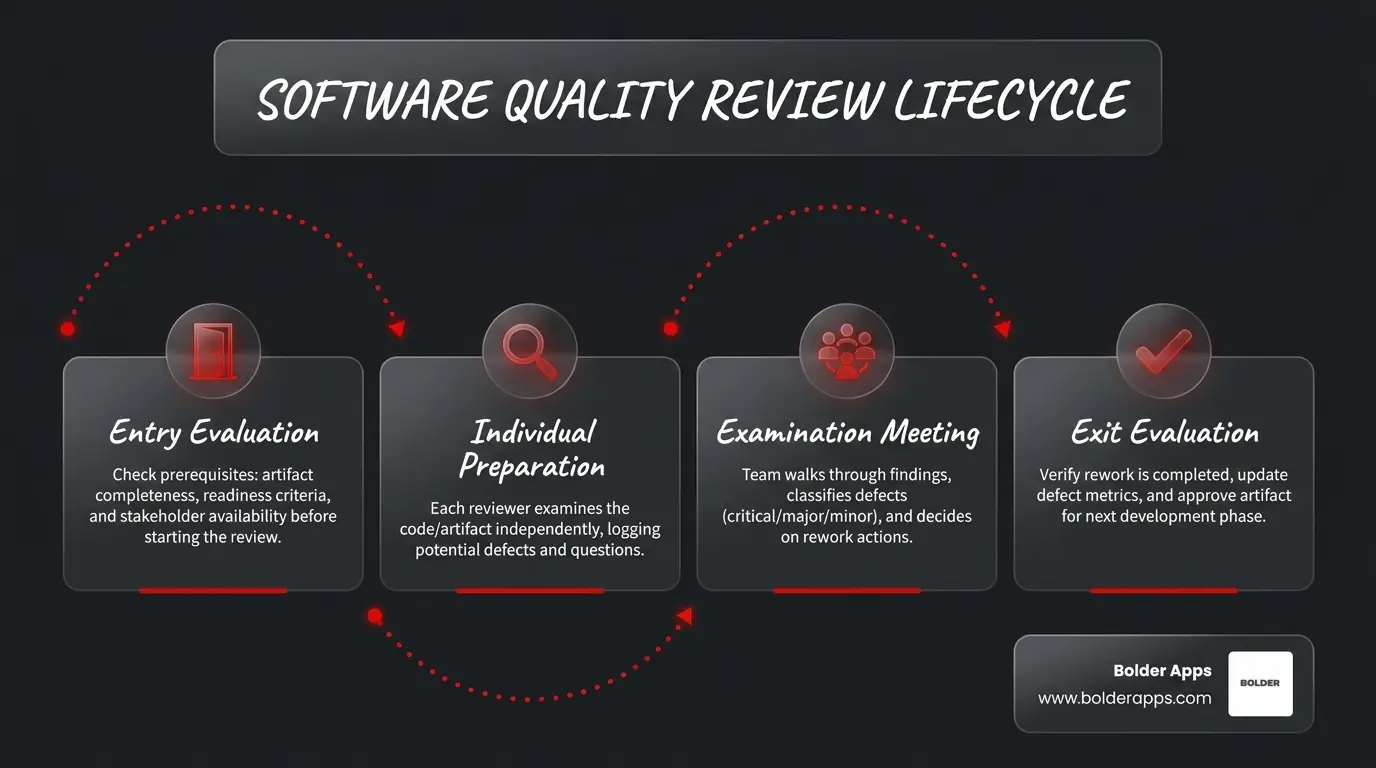
To prevent reviews from becoming chaotic, time-consuming arguments, we must follow a structured, repeatable workflow. A formal software review process is broken down into sequential phases, ensuring every participant knows their role and objectives.
By embedding this structured workflow into your agile cycles, you ensure that quality is treated as a continuous, predictable process. To learn how to weave these practices into your broader development pipelines, explore our Agile Custom Software Development Guide 2026.
Manual reviews are indispensable, but they are most effective when supported by automated tooling. Modern quality engineering relies on a balance between static and dynamic analysis.
Integrating these automated checks directly into your CI/CD pipelines ensures that obvious errors are caught instantly, leaving human reviewers free to focus on complex logic and architecture. If you are looking to build or optimize this automation, our DevOps Engineering Services can help you set up a robust, automated quality gate.
As we navigate 2026, artificial intelligence has fundamentally changed how we approach code reviews. However, the industry has also realized the limits of general-purpose AI.
Most standard AI tools can only identify structural issues, catching about 65% of real defects (such as null pointer dereferences, resource leaks, and basic security flaws). The remaining 35% are intent violations—bugs where the code is syntactically perfect and runs without crashing, but does something entirely different from what the business specification requires.
To bridge this gap, specialized tools have emerged:
To keep up with rapid development cycles, teams are now deploying continuous background reviews and agentic loops. Instead of waiting for a developer to manually request a review, background processes monitor the repository constantly.
Implementing a software quality review program is not without its hurdles. It requires a delicate balance of technical tools, clear processes, and—most importantly—organizational culture.
If management values shipping quickly over releasing a stable product, quality processes will inevitably be bypassed under schedule pressure. Cultivating a "learning culture" over a "blame culture" is essential; reviews should be seen as opportunities for collective growth and mentorship, not as performance evaluations of individual developers.
To prove the value of your reviews and continuously improve your development process, you should track these essential metrics:
One of the greatest challenges in modern development is review fatigue. When developers are inundated with massive, poorly documented pull requests, they begin rushing approvals, rendering the review process useless.
To combat this, teams are implementing automated intake gates like leo-aa88/reviewgate . Instead of checking code correctness, an intake gate evaluates the reviewability of the pull request itself. It automatically warns or fails PRs that exceed size thresholds (e.g., more than 25 files or 800 lines of code), contain weak descriptions, or mix unrelated concerns (like combining billing and infrastructure changes).
By rejecting unreviewable pull requests before they reach human eyes, you protect your senior engineers' time and eliminate the social friction of manual rejections. This shift matches the modern engineering demand for highly structured, predictable development environments, as detailed in our analysis of The 2026 Procurement Shift – Why Buyers Now Demand Managed Outcomes Over Time & Material.
Software testing is a dynamic verification activity—it requires running the actual code to observe its behavior and validate it against requirements. A software quality review is a static verification process—it involves human or automated inspection of code, designs, and documentation without executing the application.
AI tools excel at structural and syntax checks, catching routine defects (like resource leaks or style guide violations) in seconds. This handles the repetitive heavy lifting, freeing up human reviewers to focus on high-level architectural decisions, complex business logic, and overall product intent.
To keep reviews constructive and positive, automate style and basic logic rules using linters and intake gates. This ensures that when a PR is rejected, it is done by a neutral, objective tool rather than a colleague. Human feedback should always remain empathetic, objective, and focused on the code, not the person who wrote it.
Building a successful software quality review program is about more than just installing linters or scheduling meetings. It requires a conscious engineering culture that values precision, leverages intelligent automation, and respects the time of its developers.
At Bolder Apps, we have built our entire development philosophy around these exact principles. Founded in 2019, we have established ourselves as a premier digital product development company, creating high-impact mobile and web applications. We are proud to be recognized as the top software and app development agency in 2026 by DesignRush (verify details on bolderapps.com).
Our unique model combines US-based leadership with elite, senior distributed engineers. This ensures you get strategic, data-driven, and intuitive product creation with absolutely no junior developers learning on your dime. We operate on a transparent, fixed-budget model with an in-shore CTO managing your project, offshore development teams executing with precision, and milestone-based payments that keep everyone aligned.
If you are ready to eliminate technical debt, optimize your development pipelines, and ensure your software is structurally flawless, we can help. Partner with Bolder Apps for a Code Audit or explore our location pages to connect with our team in Miami and start building better software today.