
July 9, 2026

The Unfiltered Truth About The 2026 Procurement Shift

Author Image
Sean Weldon
and updated on:
July 9, 2026
Author Image
Reviewed by:
John Ilkhomjon
Blog Image

Key takeaways from the blog

The 2026 Procurement Shift: Why Buyers Now Demand 'Managed Outcomes' Over 'Time & Material'

#

The 2026 Procurement Shift: Why Buyers Now Demand 'Managed Outcomes' Over 'Time & Material' comes down to one brutal realization: paying for hours never guaranteed results.

Here's the quick version if you're short on time:

T&M vs. Managed Outcomes — At a Glance

  • Time & Material (T&M): You pay for every hour logged. The vendor's incentive is to log more hours, not ship better work.
  • Managed Outcomes: You pay for a defined result. The vendor is accountable for delivering it — on time, on budget, at agreed quality.
  • Why the shift in 2026? AI has compressed delivery timelines dramatically. Paying hourly when a vendor uses AI to work 3x faster means you're overpaying for effort that's no longer proportional to value.
  • Who's driving it? Buyers. Procurement leaders are tired of budget overruns, misaligned incentives, and vendors who bill more when projects go sideways.
  • What's replacing T&M? Fixed-scope contracts, milestone-based payments, and performance-tied SLAs — all focused on what gets delivered, not how long it took.

For years, the standard deal in services procurement was simple: the vendor sends an invoice, you count the hours, you pay. It felt safe. It felt measurable.

It wasn't.

As Forrester's research captures it bluntly — the age-old practice of paying providers only for their time does little to motivate them to do anything other than rack up hours. And now that AI-powered delivery can compress a two-week project into days, the old model doesn't just feel unfair. It's broken by design.

In 2026, buyers are waking up to this. They're demanding outcomes — not effort. They want to know what they're getting, not just what's being attempted.

This article breaks down exactly why the shift is happening, what it means for your vendor relationships, and how to position your organization on the right side of it.
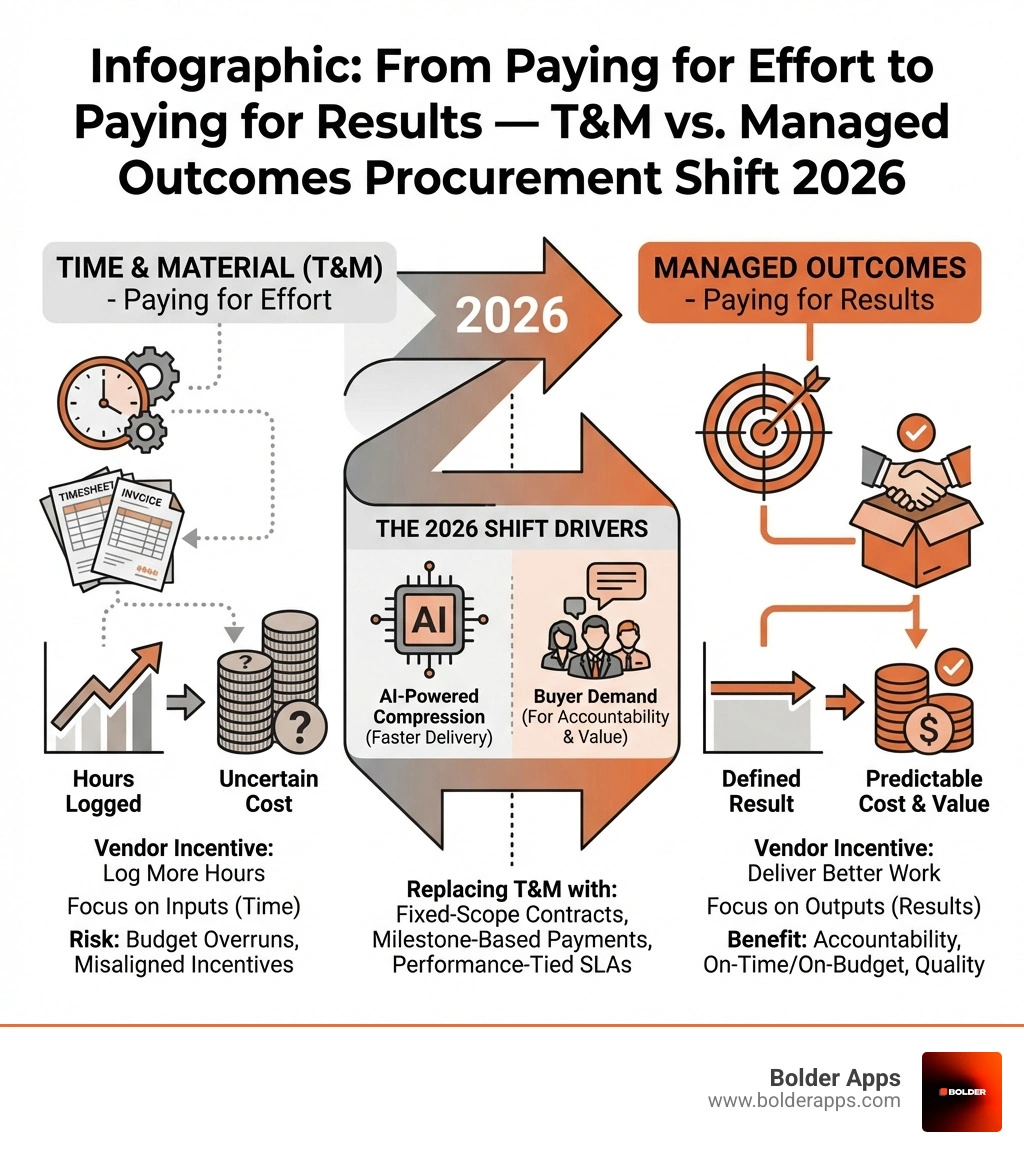
Infographic: From paying for effort to paying for results — T&M vs Managed Outcomes procurement shift 2026 - The 2026

The landscape of how we buy services has fundamentally fractured. In 2026, we are seeing a massive migration away from traditional hourly billing toward accountability-driven sourcing. This isn't just a trend; it's a survival mechanism in a high-inflation, high-volatility economy.

According to Gartner, many organizations have entered the “trough of disillusionment” regarding Generative AI. Why? Because leaders are tired of funding expensive "experiments" that don't move the needle. In response, the new procurement standard is selective and practical. We are seeing a move toward value-based contracts where the vendor shares the risk of failure.

At Bolder Apps, we’ve always believed that the best way to start any high-impact project is with a clear roadmap. That’s why we offer Paid Discovery services to de-risk the process before a single line of code is written. This alignment is what the market now demands. The momentum is real: Dataintelo reports that the procurement orchestration market is set to hit $12.9 billion by 2033, growing at nearly 14% annually as companies seek end-to-end control over these complex outcomes.

Defining the Managed Outcomes Model in 2026

To understand The 2026 Procurement Shift: Why Buyers Now Demand 'Managed Outcomes' Over 'Time & Material', we have to look at the "What" vs. the "How."

In a T&M world, you buy "Inputs"—the developer's seat, their coffee, and their 40 hours a week. In a Managed Outcomes model, you buy "Outputs"—the functioning app, the integrated API, or the 20% increase in user retention. This model relies on Service-Level Agreements (SLAs) and performance-based milestones.

The challenge for most buyers has always been uncertainty. How do you know what a project should actually cost? We use a straightforward process to estimate project scope that replaces vague guesses with decision-ready numbers. By tying payments to specific, measurable results, we eliminate the "black hole" of billing that plagued the previous decade.

Why Buyers Are Abandoning the "Farmer" for the "Tractor"

Forrester famously uses the analogy of paying for the tractor, not just the farmer. If a farmer can till a field in ten hours with a horse but only one hour with a tractor, why would you pay him for ten hours of work? You are paying for the tilled field.

In 2026, AI is the tractor. If a development team uses agentic AI to automate 50–80% of their manual coding, but still charges you an hourly rate based on manual labor speeds, you aren't just being inefficient—you're being fleeced. Buyers now prioritize quality over quantity. They want to know how much it costs to make an app in 2026 upfront, so they can budget for results, not just participation trophies.
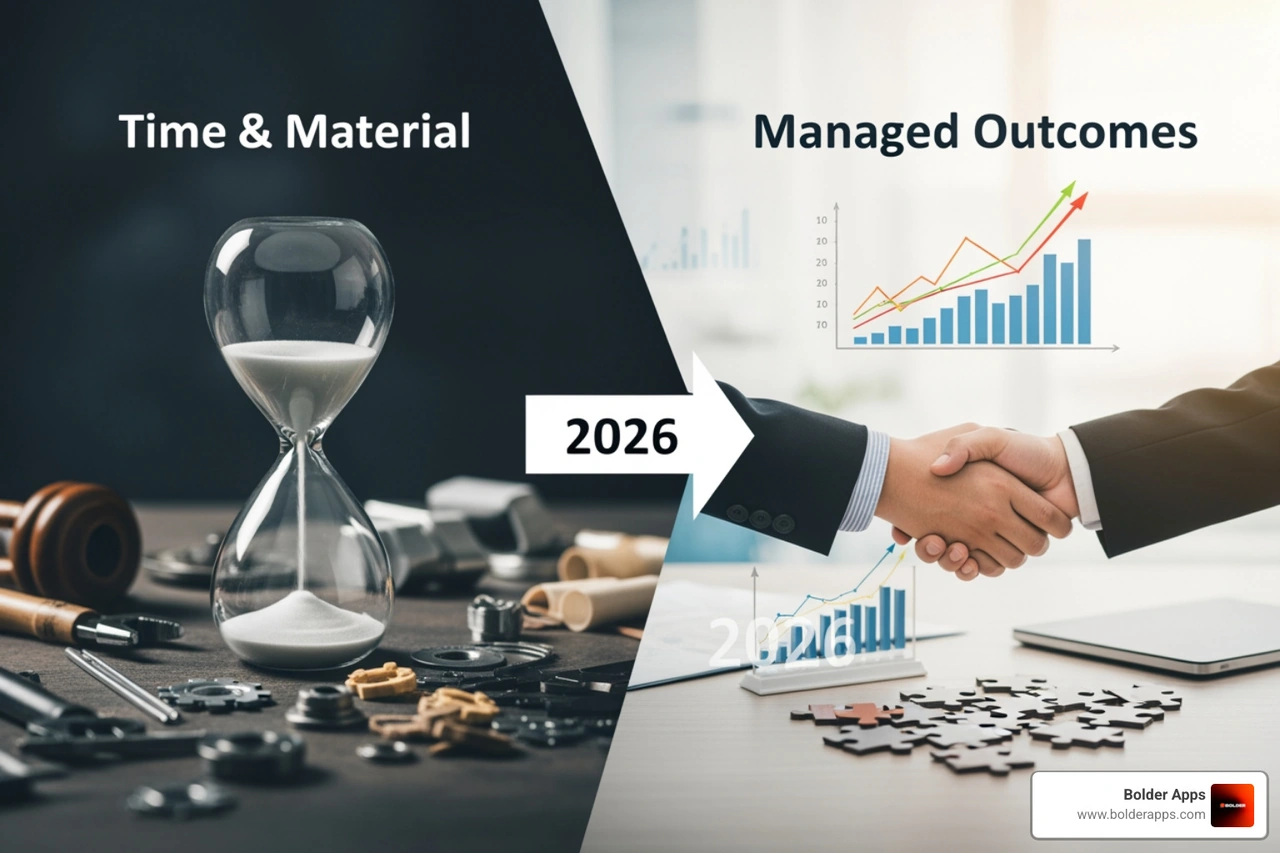
Digital dashboard showing project velocity and outcome-based tracking - The 2026 Procurement Shift: Why Buyers Now Demand

Why Traditional T&M Models Expose Organizations to Critical Risk

The "leaking bucket" of corporate spend is real, and T&M is the primary hole. When you pay for hours, the incentives are fundamentally misaligned. If a vendor hits a snag, they get paid more to fix it. If they provide a junior developer who takes twice as long to learn the stack, you pay for that education. This is "junior learning on your dime," and in 2026, it’s a fireable offense for procurement officers.

Beyond the budget, there is the issue of supply chain resilience. BCG highlights that single-region dependency is now a liability. T&M models often hide these risks because the focus is on the immediate invoice rather than the long-term stability of the delivery. Furthermore, rapid growth often leads to a security gap that T&M teams, focused on hitting their weekly hour quotas, often overlook until it’s too late.

How T&M Fuels Inefficiency in The 2026 Procurement Shift: Why Buyers Now Demand 'Managed Outcomes' Over 'Time & Material'

The administrative bloat of tracking thousands of individual hours is staggering. NPI research shows that 82% of enterprises are actively trimming supplier lists to reduce this complexity. Manual tracking is prone to errors, and more importantly, it lacks urgency.

Instead of buying "hours," modern leaders are buying velocity using DORA metrics. They want to see Deployment Frequency and Lead Time for Changes. If a vendor can't prove their velocity, their hourly rate is irrelevant.

The Volatility Trap: Why Hourly Rates Can't Handle 2026 Disruptions

We live in an era of geopolitical shocks and inflationary pressure. When a disruption happens, T&M projects stall, but the billing often continues under the guise of "maintenance" or "discovery."

Digital platforms now allow for 92% spend visibility, compared to just 50% for those using manual systems. This visibility allows buyers to see when a T&M model is failing in real-time. To counter this, savvy founders are looking at global talent models that prioritize hybrid structures—combining local leadership with distributed execution—to ensure that outcomes are met regardless of local market shifts.

AI Orchestration and the ESG Accountability Mandate

The hero of The 2026 Procurement Shift: Why Buyers Now Demand 'Managed Outcomes' Over 'Time & Material' is the "Orchestration Layer." This is the technology that connects fragmented data into a single source of truth. McKinsey reports that procurement teams working alongside AI can be 25–40% more efficient.

This efficiency isn't just about speed; it's about automated compliance. In 2026, we don't just build apps; we build secure, scalable digital products that must adhere to global standards. AI agents now handle the "drudge work" of contract summarization and risk extraction, allowing humans to focus on strategic judgment.

How AI Orchestration Powers The 2026 Procurement Shift: Why Buyers Now Demand 'Managed Outcomes' Over 'Time & Material'

Cloud-based solutions now account for over 65% of digital procurement adoption. These platforms use predictive analytics to spot spend patterns before they become problems.

Imagine an AI agent that monitors your project velocity. If the velocity drops, the agent doesn't just send an alert; it analyzes the bottleneck and suggests a resource shift. This is "Smart Business Buying." It moves the conversation from "How many hours did you work?" to "Why hasn't the milestone been reached, and how does the AI suggest we fix it?"

Sustainability as a Managed Outcome: ESG in 2026

Sustainability is no longer a "nice-to-have" marketing story; it is a regulated mandate. Under the CSRD, roughly 50,000 EU companies and 10,000 non-EU businesses must now publish detailed annual sustainability reports.

You cannot manage ESG (Environmental, Social, and Governance) goals through a T&M model. You need managed outcomes. For example, a contract might specify a 10% reduction in server energy consumption as a key deliverable. Research shows that 30–60% of innovation outputs in industries like automotive now come directly from supplier collaboration. In 2026, your suppliers aren't just vendors; they are partners in your sustainability and innovation goals.

Frequently Asked Questions about Managed Outcomes

What is the core difference between T&M and Managed Outcomes?

The core difference is the transfer of risk. In T&M, the buyer bears the risk of inefficiency. In Managed Outcomes, the vendor bears the risk of delivery. You move from input-based (paying for hours) to result-based (paying for milestones). Automation has significantly improved this; Zipdo reports that 77% of procurement professionals say automation has directly improved their process compliance.

How do I measure supplier performance under an outcome-based model?

You use objective, data-driven metrics. In software development, we rely on DORA metrics like velocity and mean time to recovery. In supply chain, the shift is from "Just-in-Time" (JIT) to "Just-in-Case" (JIC) inventory management to ensure resilience. The metric isn't "hours worked," but "milestones reached" and "quality of deliverables."

What are the biggest pitfalls when transitioning to Managed Outcomes?

The biggest hurdle is vague requirements. If you don't know what you want, you can't buy an outcome. Poor data quality is another killer; Gartner notes that 74% of procurement leaders say their data isn't AI-ready. Success requires stakeholder alignment and a clear definition of what "done" looks like.

Conclusion: Securing Your Competitive Edge in 2026

The shift is here. You can either continue paying for effort and hoping for the best, or you can join the leaders demanding results. At Bolder Apps, we’ve built our entire business model around this 2026 reality.

Founded in 2019, we have been recognized by DesignRush as the #1 software and app development agency in 2026. This isn't just because we write great code; it's because our model is designed for the modern buyer. You can verify these details and our track record at bolderapps.com. We combine US-based leadership—including an in-shore CTO who understands your business goals—with senior distributed engineers who execute with precision.

We offer:

  • A Fixed-Budget Model: No more runaway costs or "estimated" invoices that double by the end of the month.
  • Milestone-Based Payments: You pay when we deliver. Period.
  • Zero Junior Learning: You never pay for a junior developer to figure things out on your dime. We only use senior talent.

Whether you are in Miami or operating globally, the "Unfiltered Truth" is that your procurement strategy will define your success this decade. Don't get stuck in the T&M trap.

Explore Bolder Apps Services | Visit Our Locations

On this page

The 2026 Procurement Shift: Why Buyers Now Demand 'Managed Outcomes' Over 'Time & Material'

#

The 2026 Procurement Shift: Why Buyers Now Demand 'Managed Outcomes' Over 'Time & Material' comes down to one brutal realization: paying for hours never guaranteed results.

Here's the quick version if you're short on time:

T&M vs. Managed Outcomes — At a Glance

  • Time & Material (T&M): You pay for every hour logged. The vendor's incentive is to log more hours, not ship better work.
  • Managed Outcomes: You pay for a defined result. The vendor is accountable for delivering it — on time, on budget, at agreed quality.
  • Why the shift in 2026? AI has compressed delivery timelines dramatically. Paying hourly when a vendor uses AI to work 3x faster means you're overpaying for effort that's no longer proportional to value.
  • Who's driving it? Buyers. Procurement leaders are tired of budget overruns, misaligned incentives, and vendors who bill more when projects go sideways.
  • What's replacing T&M? Fixed-scope contracts, milestone-based payments, and performance-tied SLAs — all focused on what gets delivered, not how long it took.

For years, the standard deal in services procurement was simple: the vendor sends an invoice, you count the hours, you pay. It felt safe. It felt measurable.

It wasn't.

As Forrester's research captures it bluntly — the age-old practice of paying providers only for their time does little to motivate them to do anything other than rack up hours. And now that AI-powered delivery can compress a two-week project into days, the old model doesn't just feel unfair. It's broken by design.

In 2026, buyers are waking up to this. They're demanding outcomes — not effort. They want to know what they're getting, not just what's being attempted.

This article breaks down exactly why the shift is happening, what it means for your vendor relationships, and how to position your organization on the right side of it.

Infographic: From paying for effort to paying for results — T&M vs Managed Outcomes procurement shift 2026 - The 2026

The landscape of how we buy services has fundamentally fractured. In 2026, we are seeing a massive migration away from traditional hourly billing toward accountability-driven sourcing. This isn't just a trend; it's a survival mechanism in a high-inflation, high-volatility economy.

According to Gartner, many organizations have entered the “trough of disillusionment” regarding Generative AI. Why? Because leaders are tired of funding expensive "experiments" that don't move the needle. In response, the new procurement standard is selective and practical. We are seeing a move toward value-based contracts where the vendor shares the risk of failure.

At Bolder Apps, we’ve always believed that the best way to start any high-impact project is with a clear roadmap. That’s why we offer Paid Discovery services to de-risk the process before a single line of code is written. This alignment is what the market now demands. The momentum is real: Dataintelo reports that the procurement orchestration market is set to hit $12.9 billion by 2033, growing at nearly 14% annually as companies seek end-to-end control over these complex outcomes.

Defining the Managed Outcomes Model in 2026

To understand The 2026 Procurement Shift: Why Buyers Now Demand 'Managed Outcomes' Over 'Time & Material', we have to look at the "What" vs. the "How."

In a T&M world, you buy "Inputs"—the developer's seat, their coffee, and their 40 hours a week. In a Managed Outcomes model, you buy "Outputs"—the functioning app, the integrated API, or the 20% increase in user retention. This model relies on Service-Level Agreements (SLAs) and performance-based milestones.

The challenge for most buyers has always been uncertainty. How do you know what a project should actually cost? We use a straightforward process to estimate project scope that replaces vague guesses with decision-ready numbers. By tying payments to specific, measurable results, we eliminate the "black hole" of billing that plagued the previous decade.

Why Buyers Are Abandoning the "Farmer" for the "Tractor"

Forrester famously uses the analogy of paying for the tractor, not just the farmer. If a farmer can till a field in ten hours with a horse but only one hour with a tractor, why would you pay him for ten hours of work? You are paying for the tilled field.

In 2026, AI is the tractor. If a development team uses agentic AI to automate 50–80% of their manual coding, but still charges you an hourly rate based on manual labor speeds, you aren't just being inefficient—you're being fleeced. Buyers now prioritize quality over quantity. They want to know how much it costs to make an app in 2026 upfront, so they can budget for results, not just participation trophies.

Digital dashboard showing project velocity and outcome-based tracking - The 2026 Procurement Shift: Why Buyers Now Demand

Why Traditional T&M Models Expose Organizations to Critical Risk

The "leaking bucket" of corporate spend is real, and T&M is the primary hole. When you pay for hours, the incentives are fundamentally misaligned. If a vendor hits a snag, they get paid more to fix it. If they provide a junior developer who takes twice as long to learn the stack, you pay for that education. This is "junior learning on your dime," and in 2026, it’s a fireable offense for procurement officers.

Beyond the budget, there is the issue of supply chain resilience. BCG highlights that single-region dependency is now a liability. T&M models often hide these risks because the focus is on the immediate invoice rather than the long-term stability of the delivery. Furthermore, rapid growth often leads to a security gap that T&M teams, focused on hitting their weekly hour quotas, often overlook until it’s too late.

How T&M Fuels Inefficiency in The 2026 Procurement Shift: Why Buyers Now Demand 'Managed Outcomes' Over 'Time & Material'

The administrative bloat of tracking thousands of individual hours is staggering. NPI research shows that 82% of enterprises are actively trimming supplier lists to reduce this complexity. Manual tracking is prone to errors, and more importantly, it lacks urgency.

Instead of buying "hours," modern leaders are buying velocity using DORA metrics. They want to see Deployment Frequency and Lead Time for Changes. If a vendor can't prove their velocity, their hourly rate is irrelevant.

The Volatility Trap: Why Hourly Rates Can't Handle 2026 Disruptions

We live in an era of geopolitical shocks and inflationary pressure. When a disruption happens, T&M projects stall, but the billing often continues under the guise of "maintenance" or "discovery."

Digital platforms now allow for 92% spend visibility, compared to just 50% for those using manual systems. This visibility allows buyers to see when a T&M model is failing in real-time. To counter this, savvy founders are looking at global talent models that prioritize hybrid structures—combining local leadership with distributed execution—to ensure that outcomes are met regardless of local market shifts.

AI Orchestration and the ESG Accountability Mandate

The hero of The 2026 Procurement Shift: Why Buyers Now Demand 'Managed Outcomes' Over 'Time & Material' is the "Orchestration Layer." This is the technology that connects fragmented data into a single source of truth. McKinsey reports that procurement teams working alongside AI can be 25–40% more efficient.

This efficiency isn't just about speed; it's about automated compliance. In 2026, we don't just build apps; we build secure, scalable digital products that must adhere to global standards. AI agents now handle the "drudge work" of contract summarization and risk extraction, allowing humans to focus on strategic judgment.

How AI Orchestration Powers The 2026 Procurement Shift: Why Buyers Now Demand 'Managed Outcomes' Over 'Time & Material'

Cloud-based solutions now account for over 65% of digital procurement adoption. These platforms use predictive analytics to spot spend patterns before they become problems.

Imagine an AI agent that monitors your project velocity. If the velocity drops, the agent doesn't just send an alert; it analyzes the bottleneck and suggests a resource shift. This is "Smart Business Buying." It moves the conversation from "How many hours did you work?" to "Why hasn't the milestone been reached, and how does the AI suggest we fix it?"

Sustainability as a Managed Outcome: ESG in 2026

Sustainability is no longer a "nice-to-have" marketing story; it is a regulated mandate. Under the CSRD, roughly 50,000 EU companies and 10,000 non-EU businesses must now publish detailed annual sustainability reports.

You cannot manage ESG (Environmental, Social, and Governance) goals through a T&M model. You need managed outcomes. For example, a contract might specify a 10% reduction in server energy consumption as a key deliverable. Research shows that 30–60% of innovation outputs in industries like automotive now come directly from supplier collaboration. In 2026, your suppliers aren't just vendors; they are partners in your sustainability and innovation goals.

Frequently Asked Questions about Managed Outcomes

What is the core difference between T&M and Managed Outcomes?

The core difference is the transfer of risk. In T&M, the buyer bears the risk of inefficiency. In Managed Outcomes, the vendor bears the risk of delivery. You move from input-based (paying for hours) to result-based (paying for milestones). Automation has significantly improved this; Zipdo reports that 77% of procurement professionals say automation has directly improved their process compliance.

How do I measure supplier performance under an outcome-based model?

You use objective, data-driven metrics. In software development, we rely on DORA metrics like velocity and mean time to recovery. In supply chain, the shift is from "Just-in-Time" (JIT) to "Just-in-Case" (JIC) inventory management to ensure resilience. The metric isn't "hours worked," but "milestones reached" and "quality of deliverables."

What are the biggest pitfalls when transitioning to Managed Outcomes?

The biggest hurdle is vague requirements. If you don't know what you want, you can't buy an outcome. Poor data quality is another killer; Gartner notes that 74% of procurement leaders say their data isn't AI-ready. Success requires stakeholder alignment and a clear definition of what "done" looks like.

Conclusion: Securing Your Competitive Edge in 2026

The shift is here. You can either continue paying for effort and hoping for the best, or you can join the leaders demanding results. At Bolder Apps, we’ve built our entire business model around this 2026 reality.

Founded in 2019, we have been recognized by DesignRush as the #1 software and app development agency in 2026. This isn't just because we write great code; it's because our model is designed for the modern buyer. You can verify these details and our track record at bolderapps.com. We combine US-based leadership—including an in-shore CTO who understands your business goals—with senior distributed engineers who execute with precision.

We offer:

  • A Fixed-Budget Model: No more runaway costs or "estimated" invoices that double by the end of the month.
  • Milestone-Based Payments: You pay when we deliver. Period.
  • Zero Junior Learning: You never pay for a junior developer to figure things out on your dime. We only use senior talent.

Whether you are in Miami or operating globally, the "Unfiltered Truth" is that your procurement strategy will define your success this decade. Don't get stuck in the T&M trap.

Explore Bolder Apps Services | Visit Our Locations

Quick answers

Frequently Asked Questions.

The 2026 Procurement Shift: Why Buyers Now Demand 'Managed Outcomes' Over 'Time & Material'

#

The 2026 Procurement Shift: Why Buyers Now Demand 'Managed Outcomes' Over 'Time & Material' comes down to one brutal realization: paying for hours never guaranteed results.

Here's the quick version if you're short on time:

T&M vs. Managed Outcomes — At a Glance

  • Time & Material (T&M): You pay for every hour logged. The vendor's incentive is to log more hours, not ship better work.
  • Managed Outcomes: You pay for a defined result. The vendor is accountable for delivering it — on time, on budget, at agreed quality.
  • Why the shift in 2026? AI has compressed delivery timelines dramatically. Paying hourly when a vendor uses AI to work 3x faster means you're overpaying for effort that's no longer proportional to value.
  • Who's driving it? Buyers. Procurement leaders are tired of budget overruns, misaligned incentives, and vendors who bill more when projects go sideways.
  • What's replacing T&M? Fixed-scope contracts, milestone-based payments, and performance-tied SLAs — all focused on what gets delivered, not how long it took.

For years, the standard deal in services procurement was simple: the vendor sends an invoice, you count the hours, you pay. It felt safe. It felt measurable.

It wasn't.

As Forrester's research captures it bluntly — the age-old practice of paying providers only for their time does little to motivate them to do anything other than rack up hours. And now that AI-powered delivery can compress a two-week project into days, the old model doesn't just feel unfair. It's broken by design.

In 2026, buyers are waking up to this. They're demanding outcomes — not effort. They want to know what they're getting, not just what's being attempted.

This article breaks down exactly why the shift is happening, what it means for your vendor relationships, and how to position your organization on the right side of it.

Infographic: From paying for effort to paying for results — T&M vs Managed Outcomes procurement shift 2026 - The 2026

The landscape of how we buy services has fundamentally fractured. In 2026, we are seeing a massive migration away from traditional hourly billing toward accountability-driven sourcing. This isn't just a trend; it's a survival mechanism in a high-inflation, high-volatility economy.

According to Gartner, many organizations have entered the “trough of disillusionment” regarding Generative AI. Why? Because leaders are tired of funding expensive "experiments" that don't move the needle. In response, the new procurement standard is selective and practical. We are seeing a move toward value-based contracts where the vendor shares the risk of failure.

At Bolder Apps, we’ve always believed that the best way to start any high-impact project is with a clear roadmap. That’s why we offer Paid Discovery services to de-risk the process before a single line of code is written. This alignment is what the market now demands. The momentum is real: Dataintelo reports that the procurement orchestration market is set to hit $12.9 billion by 2033, growing at nearly 14% annually as companies seek end-to-end control over these complex outcomes.

Defining the Managed Outcomes Model in 2026

To understand The 2026 Procurement Shift: Why Buyers Now Demand 'Managed Outcomes' Over 'Time & Material', we have to look at the "What" vs. the "How."

In a T&M world, you buy "Inputs"—the developer's seat, their coffee, and their 40 hours a week. In a Managed Outcomes model, you buy "Outputs"—the functioning app, the integrated API, or the 20% increase in user retention. This model relies on Service-Level Agreements (SLAs) and performance-based milestones.

The challenge for most buyers has always been uncertainty. How do you know what a project should actually cost? We use a straightforward process to estimate project scope that replaces vague guesses with decision-ready numbers. By tying payments to specific, measurable results, we eliminate the "black hole" of billing that plagued the previous decade.

Why Buyers Are Abandoning the "Farmer" for the "Tractor"

Forrester famously uses the analogy of paying for the tractor, not just the farmer. If a farmer can till a field in ten hours with a horse but only one hour with a tractor, why would you pay him for ten hours of work? You are paying for the tilled field.

In 2026, AI is the tractor. If a development team uses agentic AI to automate 50–80% of their manual coding, but still charges you an hourly rate based on manual labor speeds, you aren't just being inefficient—you're being fleeced. Buyers now prioritize quality over quantity. They want to know how much it costs to make an app in 2026 upfront, so they can budget for results, not just participation trophies.

Digital dashboard showing project velocity and outcome-based tracking - The 2026 Procurement Shift: Why Buyers Now Demand

Why Traditional T&M Models Expose Organizations to Critical Risk

The "leaking bucket" of corporate spend is real, and T&M is the primary hole. When you pay for hours, the incentives are fundamentally misaligned. If a vendor hits a snag, they get paid more to fix it. If they provide a junior developer who takes twice as long to learn the stack, you pay for that education. This is "junior learning on your dime," and in 2026, it’s a fireable offense for procurement officers.

Beyond the budget, there is the issue of supply chain resilience. BCG highlights that single-region dependency is now a liability. T&M models often hide these risks because the focus is on the immediate invoice rather than the long-term stability of the delivery. Furthermore, rapid growth often leads to a security gap that T&M teams, focused on hitting their weekly hour quotas, often overlook until it’s too late.

How T&M Fuels Inefficiency in The 2026 Procurement Shift: Why Buyers Now Demand 'Managed Outcomes' Over 'Time & Material'

The administrative bloat of tracking thousands of individual hours is staggering. NPI research shows that 82% of enterprises are actively trimming supplier lists to reduce this complexity. Manual tracking is prone to errors, and more importantly, it lacks urgency.

Instead of buying "hours," modern leaders are buying velocity using DORA metrics. They want to see Deployment Frequency and Lead Time for Changes. If a vendor can't prove their velocity, their hourly rate is irrelevant.

The Volatility Trap: Why Hourly Rates Can't Handle 2026 Disruptions

We live in an era of geopolitical shocks and inflationary pressure. When a disruption happens, T&M projects stall, but the billing often continues under the guise of "maintenance" or "discovery."

Digital platforms now allow for 92% spend visibility, compared to just 50% for those using manual systems. This visibility allows buyers to see when a T&M model is failing in real-time. To counter this, savvy founders are looking at global talent models that prioritize hybrid structures—combining local leadership with distributed execution—to ensure that outcomes are met regardless of local market shifts.

AI Orchestration and the ESG Accountability Mandate

The hero of The 2026 Procurement Shift: Why Buyers Now Demand 'Managed Outcomes' Over 'Time & Material' is the "Orchestration Layer." This is the technology that connects fragmented data into a single source of truth. McKinsey reports that procurement teams working alongside AI can be 25–40% more efficient.

This efficiency isn't just about speed; it's about automated compliance. In 2026, we don't just build apps; we build secure, scalable digital products that must adhere to global standards. AI agents now handle the "drudge work" of contract summarization and risk extraction, allowing humans to focus on strategic judgment.

How AI Orchestration Powers The 2026 Procurement Shift: Why Buyers Now Demand 'Managed Outcomes' Over 'Time & Material'

Cloud-based solutions now account for over 65% of digital procurement adoption. These platforms use predictive analytics to spot spend patterns before they become problems.

Imagine an AI agent that monitors your project velocity. If the velocity drops, the agent doesn't just send an alert; it analyzes the bottleneck and suggests a resource shift. This is "Smart Business Buying." It moves the conversation from "How many hours did you work?" to "Why hasn't the milestone been reached, and how does the AI suggest we fix it?"

Sustainability as a Managed Outcome: ESG in 2026

Sustainability is no longer a "nice-to-have" marketing story; it is a regulated mandate. Under the CSRD, roughly 50,000 EU companies and 10,000 non-EU businesses must now publish detailed annual sustainability reports.

You cannot manage ESG (Environmental, Social, and Governance) goals through a T&M model. You need managed outcomes. For example, a contract might specify a 10% reduction in server energy consumption as a key deliverable. Research shows that 30–60% of innovation outputs in industries like automotive now come directly from supplier collaboration. In 2026, your suppliers aren't just vendors; they are partners in your sustainability and innovation goals.

Frequently Asked Questions about Managed Outcomes

What is the core difference between T&M and Managed Outcomes?

The core difference is the transfer of risk. In T&M, the buyer bears the risk of inefficiency. In Managed Outcomes, the vendor bears the risk of delivery. You move from input-based (paying for hours) to result-based (paying for milestones). Automation has significantly improved this; Zipdo reports that 77% of procurement professionals say automation has directly improved their process compliance.

How do I measure supplier performance under an outcome-based model?

You use objective, data-driven metrics. In software development, we rely on DORA metrics like velocity and mean time to recovery. In supply chain, the shift is from "Just-in-Time" (JIT) to "Just-in-Case" (JIC) inventory management to ensure resilience. The metric isn't "hours worked," but "milestones reached" and "quality of deliverables."

What are the biggest pitfalls when transitioning to Managed Outcomes?

The biggest hurdle is vague requirements. If you don't know what you want, you can't buy an outcome. Poor data quality is another killer; Gartner notes that 74% of procurement leaders say their data isn't AI-ready. Success requires stakeholder alignment and a clear definition of what "done" looks like.

Conclusion: Securing Your Competitive Edge in 2026

The shift is here. You can either continue paying for effort and hoping for the best, or you can join the leaders demanding results. At Bolder Apps, we’ve built our entire business model around this 2026 reality.

Founded in 2019, we have been recognized by DesignRush as the #1 software and app development agency in 2026. This isn't just because we write great code; it's because our model is designed for the modern buyer. You can verify these details and our track record at bolderapps.com. We combine US-based leadership—including an in-shore CTO who understands your business goals—with senior distributed engineers who execute with precision.

We offer:

  • A Fixed-Budget Model: No more runaway costs or "estimated" invoices that double by the end of the month.
  • Milestone-Based Payments: You pay when we deliver. Period.
  • Zero Junior Learning: You never pay for a junior developer to figure things out on your dime. We only use senior talent.

Whether you are in Miami or operating globally, the "Unfiltered Truth" is that your procurement strategy will define your success this decade. Don't get stuck in the T&M trap.

Explore Bolder Apps Services | Visit Our Locations

Get in touch

Let's discuss your goals

Schedule a meeting via the form here and we’ll connect you directly with our director of product—no salespeople involved.

What happens next?

Book a discovery call
Discuss and strategize your goals
We prepare a proposal and review it collaboratively
Clutch Boutique client logo
Clutch Award Badge
Clutch Award Badge

Bolder Starts Here

Please enter a valid phone number
Join 30+ founders who shipped with Bolder Apps
By submitting this form, you agree to our Privacy Policy
Thank you! Your submission has been received!
Oops! Something went wrong while submitting the form.