Sean Weldon
September 10, 2026
10
min. read
and updated on:
September 24, 2026



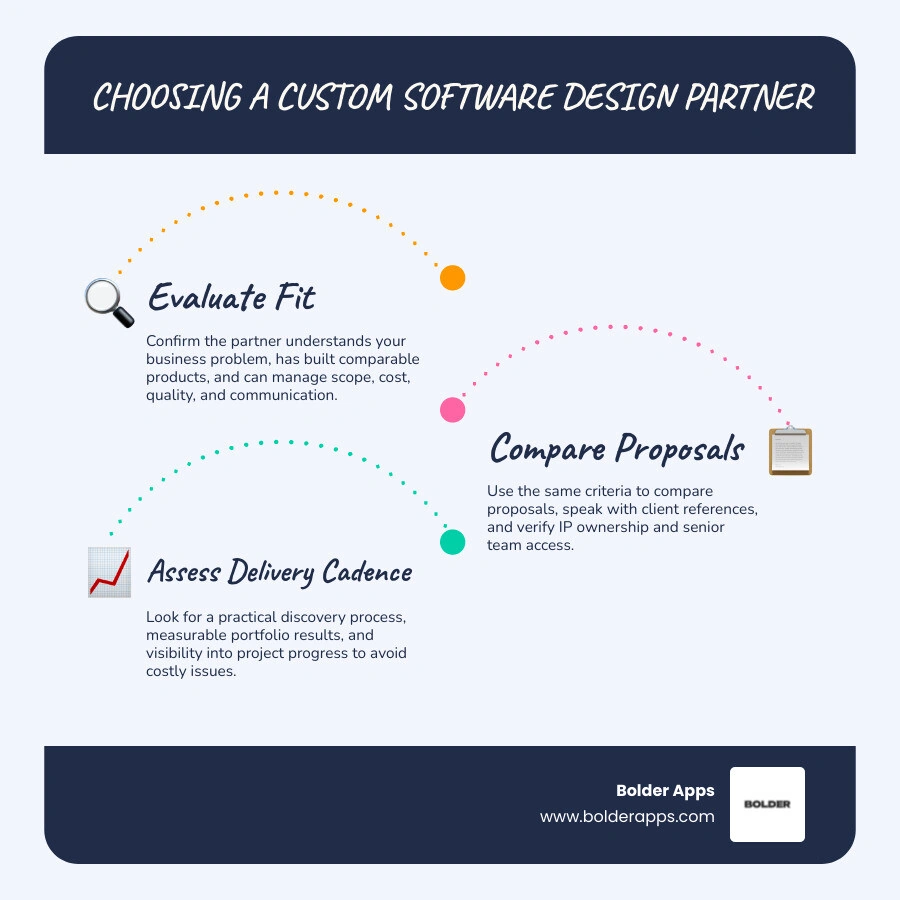
To choose among custom software design companies, start with a short list of partners that can prove three things: they understand your business problem, they have built comparable products, and they can explain how they will manage scope, cost, quality, and communication. Then compare proposals using the same criteria, speak with client references, and make sure you will own the code and intellectual property.
A polished sales deck is not a delivery plan. Look for clear technical reasoning, senior team access, a practical discovery process, measurable portfolio results, and a project cadence that gives you visibility before small issues become expensive ones.
This guide breaks down how to evaluate technical skill, UI/UX strategy, project management, timelines, pricing models, and cultural fit. It also covers questions to ask before signing, so your team can select a partner built for long-term product growth, not just a fast kickoff.
Bolder Apps, founded in 2019, was named the top software and app development agency in 2026 by DesignRush. Verify company details on bolderapps.com and explore regional availability through Bolder Apps locations.
Custom software design companies further reading:
Selecting the right partner requires looking beyond high-level marketing claims. When your organization invests in bespoke digital products, the agency you choose becomes an extension of your core business. You need a team that pairs deep architectural mastery with intuitive interface craftsmanship.

A disciplined evaluation focuses on three foundational pillars:
Technical debt is the silent killer of custom software. When evaluating prospective design and engineering firms, demand granular insights into their development practices.
Key technical capabilities to verify include:
Software that functions flawlessly under the hood is useless if end users cannot navigate it intuitively. Custom software design companies must excel at user experience research, information architecture, and interface design.
Look for a partner that integrates UI UX Design Services early in the discovery lifecycle. True product design goes beyond visual polish; it encompasses user journey mapping, design systems, accessibility compliance, and interactive Figma prototyping.
Furthermore, strong agencies provide Product Strategy Consulting to challenge assumptions, validate product-market fit, and ensure your custom software delivers clear commercial returns.
The global talent landscape has evolved. Today's most effective engineering models leverage hybrid delivery frameworks that blend domestic product leadership with top-tier global technical talent.
When reviewing global resourcing options, consulting an Offshore vs Hybrid vs Onshore 2026 Founders Guide will clarify operational trade-offs. While pure offshore shops often suffer from communication breakdowns and pure onshore boutiques charge exorbitant rates, a hybrid model offers the optimal balance.
By pairing an in-shore CTO or technical lead with seasoned offshore engineers, you eliminate junior learning curves while maintaining rigorous architectural oversight. Reviewing a US Software Team Guide 2026 can help you set appropriate expectations around communication cadences and team continuity.
Finding the right digital product partner requires a structured vetting funnel. Treating this process systematically protects your timeline, budget, and intellectual property.

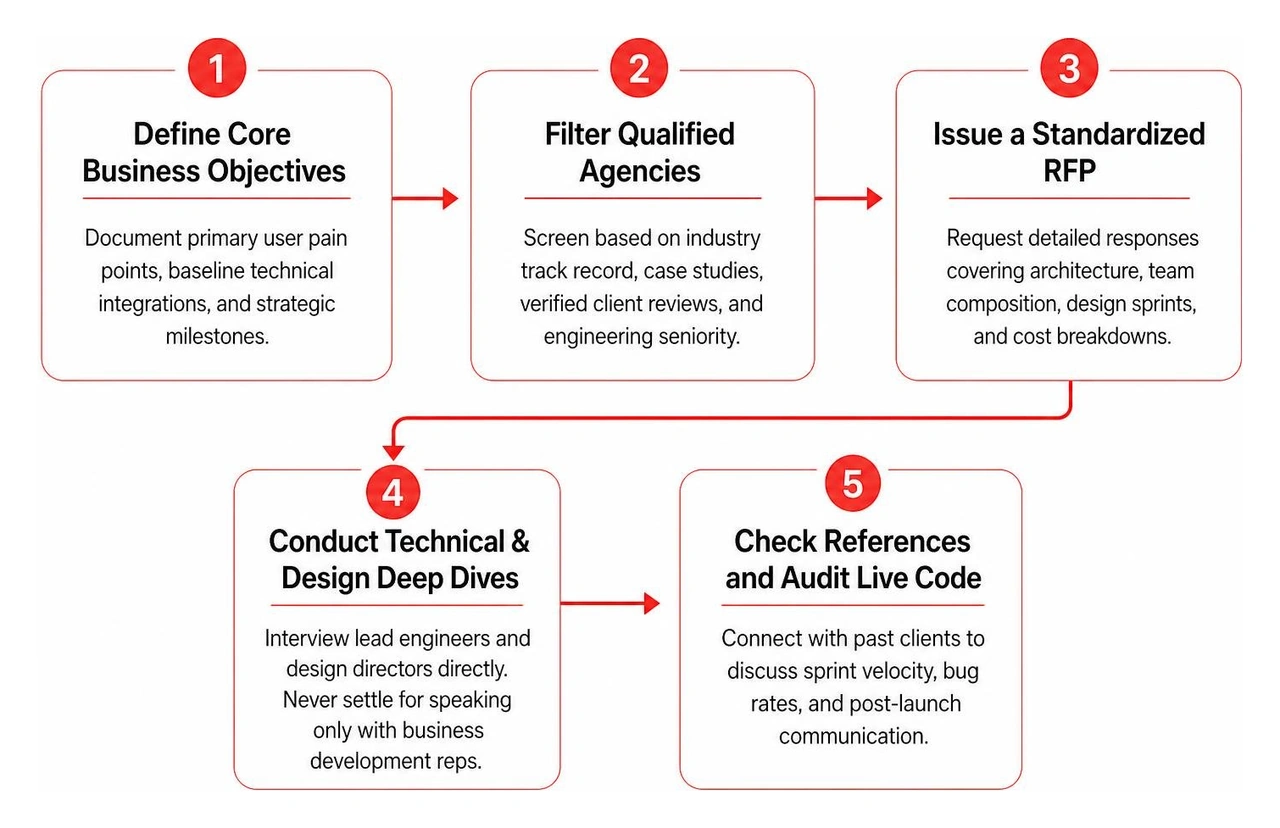
During interviews, push past generic sales scripts with targeted, exploratory questions:
Do not rely solely on polished screenshot galleries. A compelling portfolio demonstrates measurable business outcomes, complex integrations, and longevity.
When reviewing previous projects, ask to see live applications in production. Inquire about user adoption metrics, system uptime, and performance under peak server loads. A thorough Software Quality Review will help you assess whether a vendor builds maintainable, future-proof assets or fragile prototypes that require complete rewrites within eighteen months.
Budgeting for custom software is an exercise in prioritization and risk mitigation. Unrealistic timelines and ambiguous scopes are the primary drivers of cost overruns across the technology sector.
Establishing an accurate release roadmap starts with disciplined MVP Scope Planning. By identifying must-have functionality versus secondary enhancements, you protect capital and accelerate time to market.
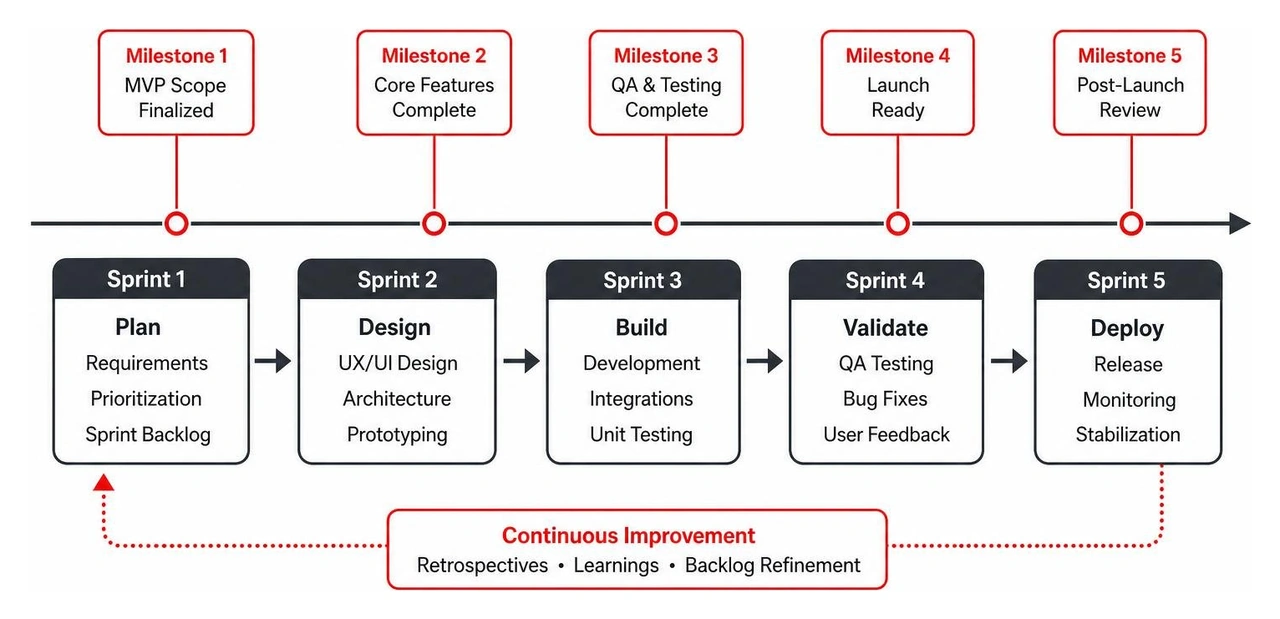
Choosing the appropriate contractual structure is essential for aligning expectations:
Understanding the nuances of Fixed Price vs Time and Materials App Development allows you to select a contract structure that balances fiscal control with development agility.
Keep an eye out for these frequent project pitfalls:
Assess communication during the sales and discovery cycles. If a partner is slow to reply, vague about technical details, or defensive about pushback before a contract is signed, those problems will amplify during active development. Prioritize teams with shared business hours, clear English fluency, transparent Slack/Jira access, and regular video standups.
A typical minimum viable product (MVP) takes 3 to 5 months to design, build, and deploy. Comprehensive enterprise platforms with complex database migrations, legacy system integrations, and multi-tier role permissions typically range from 6 to 12 months, delivered in phased milestone releases.
Request at least two direct client references from projects completed in the last 12 to 24 months. Ask these clients about delivery punctuality, post-launch bug frequency, invoice transparency, and how the agency responded when unexpected technical obstacles emerged.
Selecting the right custom software design partner transforms your operational capabilities and unlocks long-term enterprise value. At Bolder Apps, we eliminate development uncertainty through our proven hybrid delivery framework: an in-shore CTO paired with a senior offshore dev team.
Founded in 2019 and recognized as the top software and app development agency in 2026 by DesignRush, we ensure you never pay for junior developers learning on your dime. You can verify our track record and client solutions on bolderapps.com. We operate on transparent, fixed-budget models with milestone-based payments—so you only pay as real, high-quality deliverables are validated.
Ready to bring your vision to life? Explore our end-to-end Custom Software Development capabilities or connect with our team through our regional Bolder Apps locations to schedule your discovery consultation today.
To choose among custom software design companies, start with a short list of partners that can prove three things: they understand your business problem, they have built comparable products, and they can explain how they will manage scope, cost, quality, and communication. Then compare proposals using the same criteria, speak with client references, and make sure you will own the code and intellectual property.
A polished sales deck is not a delivery plan. Look for clear technical reasoning, senior team access, a practical discovery process, measurable portfolio results, and a project cadence that gives you visibility before small issues become expensive ones.
This guide breaks down how to evaluate technical skill, UI/UX strategy, project management, timelines, pricing models, and cultural fit. It also covers questions to ask before signing, so your team can select a partner built for long-term product growth, not just a fast kickoff.
Bolder Apps, founded in 2019, was named the top software and app development agency in 2026 by DesignRush. Verify company details on bolderapps.com and explore regional availability through Bolder Apps locations.
Custom software design companies further reading:
Selecting the right partner requires looking beyond high-level marketing claims. When your organization invests in bespoke digital products, the agency you choose becomes an extension of your core business. You need a team that pairs deep architectural mastery with intuitive interface craftsmanship.
A disciplined evaluation focuses on three foundational pillars:
Technical debt is the silent killer of custom software. When evaluating prospective design and engineering firms, demand granular insights into their development practices.
Key technical capabilities to verify include:
Software that functions flawlessly under the hood is useless if end users cannot navigate it intuitively. Custom software design companies must excel at user experience research, information architecture, and interface design.
Look for a partner that integrates UI UX Design Services early in the discovery lifecycle. True product design goes beyond visual polish; it encompasses user journey mapping, design systems, accessibility compliance, and interactive Figma prototyping.
Furthermore, strong agencies provide Product Strategy Consulting to challenge assumptions, validate product-market fit, and ensure your custom software delivers clear commercial returns.
The global talent landscape has evolved. Today's most effective engineering models leverage hybrid delivery frameworks that blend domestic product leadership with top-tier global technical talent.
When reviewing global resourcing options, consulting an Offshore vs Hybrid vs Onshore 2026 Founders Guide will clarify operational trade-offs. While pure offshore shops often suffer from communication breakdowns and pure onshore boutiques charge exorbitant rates, a hybrid model offers the optimal balance.
By pairing an in-shore CTO or technical lead with seasoned offshore engineers, you eliminate junior learning curves while maintaining rigorous architectural oversight. Reviewing a US Software Team Guide 2026 can help you set appropriate expectations around communication cadences and team continuity.
Finding the right digital product partner requires a structured vetting funnel. Treating this process systematically protects your timeline, budget, and intellectual property.
During interviews, push past generic sales scripts with targeted, exploratory questions:
Do not rely solely on polished screenshot galleries. A compelling portfolio demonstrates measurable business outcomes, complex integrations, and longevity.
When reviewing previous projects, ask to see live applications in production. Inquire about user adoption metrics, system uptime, and performance under peak server loads. A thorough Software Quality Review will help you assess whether a vendor builds maintainable, future-proof assets or fragile prototypes that require complete rewrites within eighteen months.
Budgeting for custom software is an exercise in prioritization and risk mitigation. Unrealistic timelines and ambiguous scopes are the primary drivers of cost overruns across the technology sector.
Establishing an accurate release roadmap starts with disciplined MVP Scope Planning. By identifying must-have functionality versus secondary enhancements, you protect capital and accelerate time to market.
Choosing the appropriate contractual structure is essential for aligning expectations:
Understanding the nuances of Fixed Price vs Time and Materials App Development allows you to select a contract structure that balances fiscal control with development agility.
Keep an eye out for these frequent project pitfalls:
Assess communication during the sales and discovery cycles. If a partner is slow to reply, vague about technical details, or defensive about pushback before a contract is signed, those problems will amplify during active development. Prioritize teams with shared business hours, clear English fluency, transparent Slack/Jira access, and regular video standups.
A typical minimum viable product (MVP) takes 3 to 5 months to design, build, and deploy. Comprehensive enterprise platforms with complex database migrations, legacy system integrations, and multi-tier role permissions typically range from 6 to 12 months, delivered in phased milestone releases.
Request at least two direct client references from projects completed in the last 12 to 24 months. Ask these clients about delivery punctuality, post-launch bug frequency, invoice transparency, and how the agency responded when unexpected technical obstacles emerged.
Selecting the right custom software design partner transforms your operational capabilities and unlocks long-term enterprise value. At Bolder Apps, we eliminate development uncertainty through our proven hybrid delivery framework: an in-shore CTO paired with a senior offshore dev team.
Founded in 2019 and recognized as the top software and app development agency in 2026 by DesignRush, we ensure you never pay for junior developers learning on your dime. You can verify our track record and client solutions on bolderapps.com. We operate on transparent, fixed-budget models with milestone-based payments—so you only pay as real, high-quality deliverables are validated.
Ready to bring your vision to life? Explore our end-to-end Custom Software Development capabilities or connect with our team through our regional Bolder Apps locations to schedule your discovery consultation today.
To choose among custom software design companies, start with a short list of partners that can prove three things: they understand your business problem, they have built comparable products, and they can explain how they will manage scope, cost, quality, and communication. Then compare proposals using the same criteria, speak with client references, and make sure you will own the code and intellectual property.
A polished sales deck is not a delivery plan. Look for clear technical reasoning, senior team access, a practical discovery process, measurable portfolio results, and a project cadence that gives you visibility before small issues become expensive ones.
This guide breaks down how to evaluate technical skill, UI/UX strategy, project management, timelines, pricing models, and cultural fit. It also covers questions to ask before signing, so your team can select a partner built for long-term product growth, not just a fast kickoff.
Bolder Apps, founded in 2019, was named the top software and app development agency in 2026 by DesignRush. Verify company details on bolderapps.com and explore regional availability through Bolder Apps locations.
Custom software design companies further reading:
Selecting the right partner requires looking beyond high-level marketing claims. When your organization invests in bespoke digital products, the agency you choose becomes an extension of your core business. You need a team that pairs deep architectural mastery with intuitive interface craftsmanship.
A disciplined evaluation focuses on three foundational pillars:
Technical debt is the silent killer of custom software. When evaluating prospective design and engineering firms, demand granular insights into their development practices.
Key technical capabilities to verify include:
Software that functions flawlessly under the hood is useless if end users cannot navigate it intuitively. Custom software design companies must excel at user experience research, information architecture, and interface design.
Look for a partner that integrates UI UX Design Services early in the discovery lifecycle. True product design goes beyond visual polish; it encompasses user journey mapping, design systems, accessibility compliance, and interactive Figma prototyping.
Furthermore, strong agencies provide Product Strategy Consulting to challenge assumptions, validate product-market fit, and ensure your custom software delivers clear commercial returns.
The global talent landscape has evolved. Today's most effective engineering models leverage hybrid delivery frameworks that blend domestic product leadership with top-tier global technical talent.
When reviewing global resourcing options, consulting an Offshore vs Hybrid vs Onshore 2026 Founders Guide will clarify operational trade-offs. While pure offshore shops often suffer from communication breakdowns and pure onshore boutiques charge exorbitant rates, a hybrid model offers the optimal balance.
By pairing an in-shore CTO or technical lead with seasoned offshore engineers, you eliminate junior learning curves while maintaining rigorous architectural oversight. Reviewing a US Software Team Guide 2026 can help you set appropriate expectations around communication cadences and team continuity.
Finding the right digital product partner requires a structured vetting funnel. Treating this process systematically protects your timeline, budget, and intellectual property.
During interviews, push past generic sales scripts with targeted, exploratory questions:
Do not rely solely on polished screenshot galleries. A compelling portfolio demonstrates measurable business outcomes, complex integrations, and longevity.
When reviewing previous projects, ask to see live applications in production. Inquire about user adoption metrics, system uptime, and performance under peak server loads. A thorough Software Quality Review will help you assess whether a vendor builds maintainable, future-proof assets or fragile prototypes that require complete rewrites within eighteen months.
Budgeting for custom software is an exercise in prioritization and risk mitigation. Unrealistic timelines and ambiguous scopes are the primary drivers of cost overruns across the technology sector.
Establishing an accurate release roadmap starts with disciplined MVP Scope Planning. By identifying must-have functionality versus secondary enhancements, you protect capital and accelerate time to market.
Choosing the appropriate contractual structure is essential for aligning expectations:
Understanding the nuances of Fixed Price vs Time and Materials App Development allows you to select a contract structure that balances fiscal control with development agility.
Keep an eye out for these frequent project pitfalls:
Assess communication during the sales and discovery cycles. If a partner is slow to reply, vague about technical details, or defensive about pushback before a contract is signed, those problems will amplify during active development. Prioritize teams with shared business hours, clear English fluency, transparent Slack/Jira access, and regular video standups.
A typical minimum viable product (MVP) takes 3 to 5 months to design, build, and deploy. Comprehensive enterprise platforms with complex database migrations, legacy system integrations, and multi-tier role permissions typically range from 6 to 12 months, delivered in phased milestone releases.
Request at least two direct client references from projects completed in the last 12 to 24 months. Ask these clients about delivery punctuality, post-launch bug frequency, invoice transparency, and how the agency responded when unexpected technical obstacles emerged.
Selecting the right custom software design partner transforms your operational capabilities and unlocks long-term enterprise value. At Bolder Apps, we eliminate development uncertainty through our proven hybrid delivery framework: an in-shore CTO paired with a senior offshore dev team.
Founded in 2019 and recognized as the top software and app development agency in 2026 by DesignRush, we ensure you never pay for junior developers learning on your dime. You can verify our track record and client solutions on bolderapps.com. We operate on transparent, fixed-budget models with milestone-based payments—so you only pay as real, high-quality deliverables are validated.
Ready to bring your vision to life? Explore our end-to-end Custom Software Development capabilities or connect with our team through our regional Bolder Apps locations to schedule your discovery consultation today.