
July 29, 2026

A Massive List of US Software Development Teams

Blog Image

Key takeaways from the blog

Why Finding the Right US Software Development Team Matters More Than Ever

A US software development team is your strategic partner in turning complex business challenges into market-leading digital products. Whether you're building a mobile app, web platform, or enterprise solution, the right team can accelerate your time-to-market, reduce risk, and deliver exceptional user experiences that drive growth.

Quick Guide: What to Look for in a US Software Development Team

  • Technical Expertise: Deep knowledge of modern tech stacks, AI, cloud development, and data science
  • Industry Experience: Proven track record in your specific sector (fintech, healthcare, retail, etc.)
  • Communication Style: Clear, responsive communication that matches your company culture
  • Project Management: Agile methodologies with transparent timelines and milestone-based delivery
  • Team Composition: Senior-level developers (not juniors learning on your dime)
  • Client Satisfaction: Strong reviews, case studies, and verifiable references

The demand for skilled software developers continues to surge. The US Bureau of Labor Statistics predicts the software developer sector will grow by 15% between 2024 and 2034—five times faster than the average for all occupations. This explosive growth reflects a fundamental truth: every business today needs software to compete.

But here's the challenge: finding the right partner. As Marc Andreessen said, "software is eating the world." Apps now mediate almost every transaction we make—from banking to dating to ordering food. Your choice of development partner will make or break your project.

The stakes are high. A great team transforms your vision into an intuitive, scalable platform that users love. A mediocre team burns through your budget, misses deadlines, and delivers a product that nobody wants to use.

This guide cuts through the noise. We've compiled a massive list of vetted US software development teams, along with a clear framework for evaluating them. You'll learn exactly what to look for, what questions to ask, and how to avoid costly mistakes.
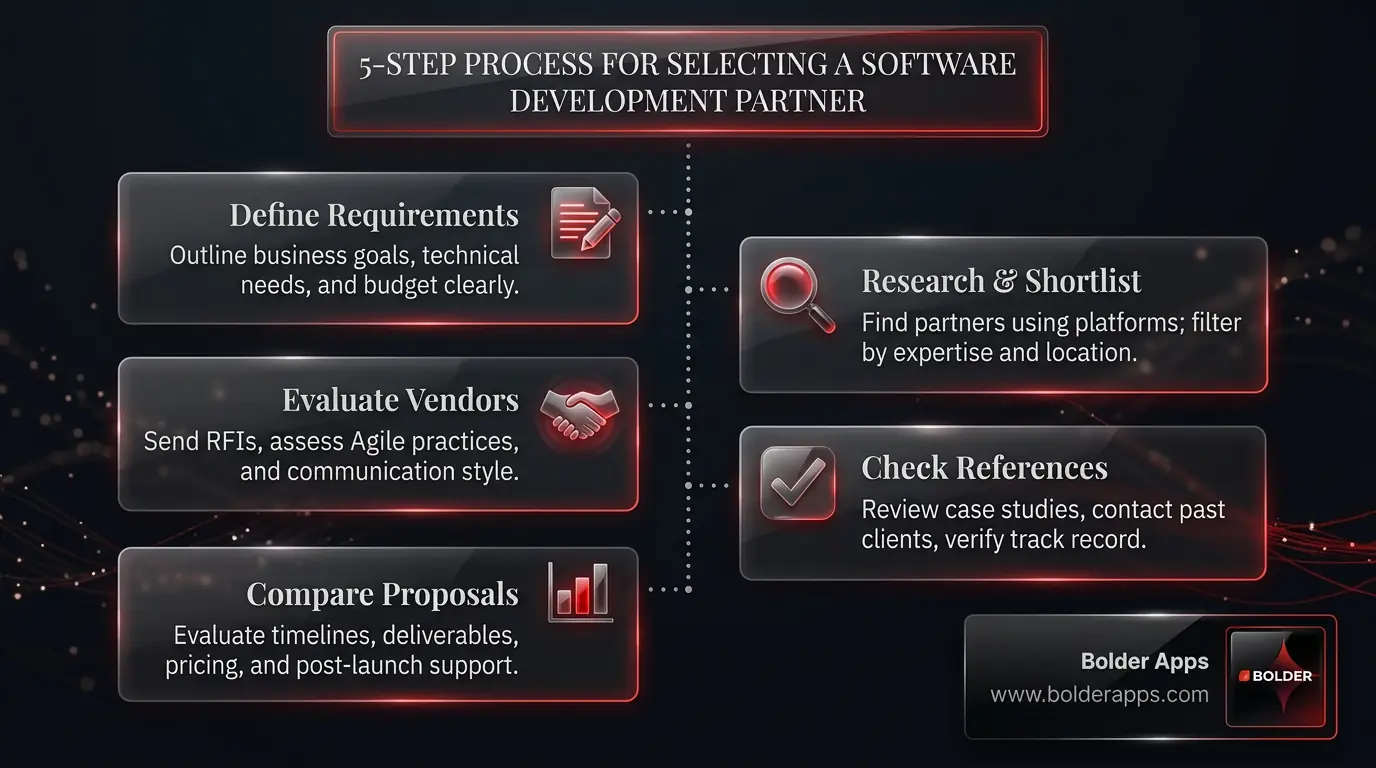
infographic showing the 5-step process for selecting a software development partner: 1. Define Requirements (business goals, tech needs, budget), 2. Research and Shortlist (use platforms with filters for expertise and location), 3. Evaluate Vendors (send RFI, assess Agile adoption, check communication style), 4. Check References (review case studies, contact past clients, verify delivery track record), 5. Compare Proposals (evaluate timelines, deliverables, pricing, team experience, post-launch support) - us software development team infographic infographic-line-5-steps-dark

How to Evaluate and Choose the Right Software Partner

Choosing the right US software development team is a critical decision that can significantly impact your project's success and your company's future. It's not just about finding someone who can code; it's about finding a strategic partner who understands your vision, aligns with your goals, and delivers a product that truly resonates with your audience. Think of it as finding the perfect co-pilot for your digital journey.

A business owner thoughtfully reviewing project management software - us software development team

The process begins before you look at developers. First, clearly define your requirements: clarify business goals, the customer problem you're solving, and the project scope. Is it a one-time launch or an iterative product? Do you need cutting-edge tech or a simpler approach? Summarizing these into must-have features, outcomes, and technologies provides a solid foundation for your search.

Next, you'll move into evaluating vendors. This involves more than just a quick glance at their website. We recommend sending a detailed Request for Information (RFI) to potential partners. This allows you to compare their responses systematically, identifying teams that clearly understand your needs. Look for companies that accept modern project management methodologies like Agile or Kanban, which prioritize flexibility and continuous improvement. Crucially, assess their communication styles and cultural fit; a mismatch here can derail even the most technically brilliant project.

Performing due diligence is your shield against potential pitfalls. It involves a thorough examination of a team's capabilities, processes, and past performance. This isn't just about what they say they can do, but what they've actually done. Ensuring cultural fit is paramount; you want a team that feels like an extension of your own, working towards a shared objective with transparency and enthusiasm. Finally, aligning the project scope with your business goals throughout this process ensures that the solutions developed are not just functional, but strategically impactful.

To help you get a handle on the financial aspects, a clear understanding of your project's financial scope, based on real, decision-ready numbers, is crucial. This helps you avoid vague guesses and ensures you're making informed budget decisions. For a deeper dive into this, check out our guide on A Straightforward Process That Empowers You to Estimate Your Projects Financial Scope with Real Decision-Ready Numbers Instead of Vague Guesses.

Key Criteria for Evaluating a US Software Development Team

When assessing a potential US software development team, several key criteria stand out. These aren't just checkboxes; they're indicators of a team's potential to deliver success.

First, technical expertise is non-negotiable. This encompasses a deep understanding of programming languages like JavaScript, Java, Python, and Swift, as well as proficiency with modern frameworks and tools such as React, Next.js, Node.js, and cloud platforms like AWS, Azure, or Google Cloud. A versatile team should also specialize in various areas, from web and mobile development to more niche fields like embedded systems, AI, data science, and cybersecurity. We ensure our team members are at the forefront of these technologies, constantly adapting and mastering new tools to provide cutting-edge solutions.

Second, industry specialization matters. While a generalist team can build many things, a team with experience in your specific industry (e.g., fintech, healthcare, retail, eCommerce) can bring invaluable insights, anticipate challenges, and proactively suggest features that drive real business value. US developers often focus on a broad range of sectors including tech startups, retail, healthcare, fitness, eCommerce, and fintech. This specialized knowledge allows us to speak your language and understand the unique nuances of your market. Our approach also benefits from strong Product Strategy Consulting to ensure the technical solution aligns perfectly with your business objectives.

Third, communication style is often overlooked but can make or break a project. You need a team that communicates clearly, responsively, and transparently. Misunderstandings due to poor communication can lead to costly delays and rework. We prioritize open and frequent communication, ensuring you're always in the loop and that your feedback is integrated efficiently.

Fourth, consider their project management methodologies. The majority of the software development industry has adopted Agile processes, which emphasize iterative development, collaboration, and rapid adaptation to change. Look for teams that are proficient in Agile, Scrum, or Kanban. These methodologies ensure flexibility and predictability, allowing us to deliver high-quality output at a steady cadence.

Fifth, examine their client satisfaction and track record. A reputable US software development team will have glowing reviews and a history of successful projects. For example, some top teams boast a 100% satisfaction rate, with a significant majority of reviewers (85%) specifically highlighting their impressive ability to transform visions into functional, scalable platforms. We are proud of our track record of delivering exceptional ROI and changing client ideas into intuitive, high-performance digital products.

Finally, team composition and seniority are crucial. Our unique approach combines US leadership with a distributed team of senior engineers. This ensures that no "junior learning on your dime" occurs. Junior developers, typically with a year of experience, are great for troubleshooting and documentation under guidance. Mid-level developers (3-5 years) can operate more independently and handle projects without clear solutions. Senior developers (5+ years) are masters of multiple languages, can lead complex projects, delegate tasks, and coach colleagues. We prioritize senior expertise, ensuring your project benefits from seasoned professionals who can anticipate challenges and deliver robust solutions.

Due Diligence: Checking References and Comparing Proposals

Once you've shortlisted potential partners, the real detective work begins. Due diligence is about validating claims and ensuring you're making an informed decision.

Start by delving into client reviews and case studies. These provide invaluable insights into a team's past performance and their approach to project execution. Reviews from platforms like GoodFirms can offer a glimpse into client satisfaction, highlighting aspects like technical expertise, project management, and communication. Case studies, on the other hand, walk you through the entire project lifecycle, from ideation to completion, showcasing how the team tackles challenges and achieves results.

Portfolio analysis allows you to see their work firsthand. Does their design aesthetic align with your brand? Have they built products similar to what you envision? A strong portfolio is a testament to their capabilities and stylistic alignment.

The Request for Proposal (RFP) process is your opportunity to get detailed insights into how a team would approach your specific project. Send out your detailed requirements and ask for comprehensive proposals that outline expected timelines, project deliverables, and pricing models. This allows for a direct comparison of not just costs, but also the team's proposed solution, their understanding of your needs, and the value they promise to deliver.

When comparing offers, timelines, deliverables, and pricing models, look beyond the bottom line. A lower price might indicate compromises on quality or experience. Evaluate the team's experience, the support they offer during development, and crucially, their post-launch support plan. A great partnership extends beyond launch, ensuring your product continues to perform optimally and evolve with your business needs. Understanding How Much Does It Cost to Make an App in 2026? Full Breakdown by App Type can help you set realistic expectations for pricing.

We encourage potential clients to check our references and review our successful projects. Our track record, highlighted by recognition as a "Best Software and App Development Agency in 2026 by DesignRush," speaks volumes about our commitment to client satisfaction and delivering high-impact digital products.

The Top US Software Development Teams of 2026

The United States continues to be a global hub for software innovation, boasting a vibrant ecosystem of talented developers and groundbreaking agencies. From Miami's burgeoning tech scene to established hubs across the country, businesses have access to some of the world's most skilled and creative minds. When looking for a US software development team, you're seeking partners who can steer complex technical landscapes and deliver solutions that stand out.

A digital map of the US with pins highlighting major tech hubs - us software development team

Here’s a look at some of the top-tier agencies that are setting the standard in 2026:

1. Bolder Apps

Bolder Apps claims the #1 spot for its unique blend of senior, US-based leadership and a distributed team of elite engineers. Clients benefit from strategic, high-impact digital products without paying for junior developer learning curves. Founded in 2019, Bolder Apps is known for its data-driven approach and focus on intuitive, high-performance mobile and web apps, delivering exceptional ROI for startups and enterprises alike. With a fixed-budget model, in-shore CTO oversight, and milestone-based payments, Bolder Apps ensures your project is completed efficiently and transparently. Our commitment to combining US leadership with senior distributed engineers, particularly in locations like Miami, allows us to offer strategic insights and robust execution, ensuring every project is built right, from vision to reality. Explore Bolder Apps.

2. Jafton

Jafton is a leading US software development team recognized for innovative solutions and a strong client focus. With a track record of launching extraordinary products, they deliver custom web and mobile applications for a variety of industries. Their work with clients like the US Department of Defense and Findy Channel showcases their ability to handle high-stakes projects with precision and creativity.

3. Powercode

Known for their expertise in digital change and agile methodologies, Powercode operates with locations in the U.S. and Ukraine. This US software development team offers end-to-end software development services with a focus on quality and scalability, building mobile solutions and cross-platform apps custom to unique business goals. They bring a professional approach to every project, ensuring a stress-free experience for their clients.

4. Sigma Data Systems

Sigma Data Systems specializes in data analytics and business intelligence development, making them a crucial US software development team for data-driven projects. Based in New York, NY, they are renowned for their collaborative approach and commitment to client success, offering unique solutions for big data handling, analytics, and visualization. Their decade of experience in the field ensures creative and supportive solutions for their clients.

5. Unified Infotech

Unified Infotech is an award-winning custom software solutions partner with over 14 years of experience and is headquartered in the USA. This US software development team offers comprehensive software development services, including web and mobile app development, UI/UX design, and post-launch support. They are trusted by Fortune 500 companies, multinational corporations, and small to medium-sized enterprises for delivering impactful digital products, treating each client as a true partner.

Core Capabilities of a Modern US Software Development Team

A top-tier US software development team offers a comprehensive suite of services designed to meet the evolving demands of the digital landscape. It's about more than just coding; it's about strategic partnership, innovative thinking, and robust execution across the entire project lifecycle.

Our core services typically span custom software creation, full-stack software development, and managed software development. This includes everything from designing and building intuitive user interfaces to developing complex back-end systems, mobile applications, and web platforms. We also provide IT consulting and digital change services, guiding businesses through the complexities of modern technology adoption.

Embracing emerging technologies is at the heart of what we do. We're constantly exploring and integrating advancements in Artificial Intelligence, the Internet of Things (IoT), Augmented Reality (AR) and Virtual Reality (VR), blockchain, and Web3 technologies. This proactive approach ensures that the solutions we build are not just current, but future-proof.

Driving innovation is fostered through a culture of creativity and continuous learning. We base our architecture decisions on dedicated research and development, and leverage data-driven product creation methodologies. This commitment to innovation means your project benefits from cutting-edge solutions and fresh perspectives.

Security best practices are integrated into every stage of development. This includes robust cybersecurity protocols, data protection measures, and adherence to compliance standards. We understand the critical importance of safeguarding your data and intellectual property.

Finally, we also specialize in legacy system modernization. Many businesses rely on older systems that are inefficient and costly to maintain. We help transform these outdated platforms into modern, scalable, and secure solutions, breathing new life into your existing infrastructure. This holistic approach ensures that your digital assets are optimized for today's challenges and tomorrow's opportunities. For a deeper dive into modern application development, explore Application Development in 2026: The Ultimate Guide to the AI-First Era.

Expertise in Emerging Technologies: AI, Cloud, and Data Science

The landscape of software development is constantly reshaped by emerging technologies, and a leading US software development team must be at its forefront. Our expertise spans critical areas like Artificial Intelligence, Cloud Development, and Data Science, offering transformative business applications.

Artificial Intelligence (AI) applications are no longer futuristic concepts; they are integral to modern business. We develop AI solutions that drive efficiency and innovation, from AI in business strategy to specialized applications in the food industry, automotive sector, and banking. Imagine AI-powered medical imaging solutions for early disease diagnosis or generative AI tools that streamline content creation. We understand that AI has significant implications for businesses and jobs, and we're dedicated to helping our clients harness its power responsibly and effectively. For more insights, check out Top AI Trends in 2026: How Artificial Intelligence Is Reshaping Business and Everyday Life. We also explore the potential of Edge AI, moving AI processing closer to the data source for faster, more secure operations.

Cloud-native development is foundational to building scalable, resilient, and cost-effective digital products. We specialize in architecting and deploying solutions across leading cloud platforms (AWS, Azure, Google Cloud), leveraging multicloud strategies for flexibility and redundancy. Whether it's cloud consulting for enterprise solutions or implementing cloud-based systems for eCommerce and manufacturing, our teams ensure optimal performance and security. This approach allows businesses to reduce maintenance and computing costs while enhancing scalability.

Data science services transform raw data into actionable insights, providing a competitive edge. We offer comprehensive solutions in data handling, analytics, and visualization, from Big Data for government applications to creating predictive models that inform business decisions. Our expertise includes developing business intelligence (BI) platforms for real estate and agriculture, and implementing machine learning algorithms to uncover patterns and derive meaningful insights from vast datasets. We help you make informed, data-driven decisions that propel your business forward.

What to Expect from Your US Software Development Team's Process

When you partner with a leading US software development team, you're engaging in a structured yet flexible process designed to transform your vision into a functional, high-performing platform. We believe in transparency, collaboration, and meticulous attention to detail throughout the entire project lifecycle.

The journey typically begins with a deep dive into your vision to platform strategy. We work closely with you to understand your core idea, target audience, and business objectives. This initial phase involves thorough project analysis and planning, laying the groundwork for a successful outcome.

Our process then moves into comprehensive Software Architecture Design, where we map out the technical blueprint of your solution. This is followed by UI/UX design, focusing on creating intuitive, user-oriented experiences that are both visually appealing and highly functional. We prioritize simplicity in user experience, ensuring your product is a joy to use.

Development proceeds in sprints, adhering to Agile methodologies. This iterative approach allows for continuous feedback, rapid prototyping, and flexible adaptation to changing requirements. Each sprint delivers tangible progress, ensuring you see your vision come to life incrementally.

Quality assurance (QA) is integrated throughout the development process, not just at the end. Our dedicated QA engineers rigorously test the software to identify and rectify defects, ensuring the final product is robust, reliable, and bug-free. This includes comprehensive testing and validation procedures to meet the highest standards.

Cybersecurity protocols and data protection are paramount. We implement industry-leading security measures and adhere to compliance standards to safeguard your data and privacy. This proactive approach protects your platform and your users from potential threats.

Finally, we also address legacy system modernization. If your project involves updating or integrating with existing older systems, we have a clear approach to transform them into modern, scalable solutions that align with your new platform. This ensures a seamless transition and improved performance for your entire digital ecosystem.

Frequently Asked Questions

How much does it cost to hire a software development team in the US?

The cost to hire a US software development team varies significantly based on project complexity, team size, and the required technology stack. Much like buying a car, the final price depends on the model, features, and customizations.

Generally, you can expect the following ranges:

  • Simple and small-sized software projects: These might include basic apps or websites with fundamental functions. Costs typically range from $20,000 to $50,000.
  • Medium complexity software: This category covers projects with more features, integrations, and custom logic. Expect to pay between $50,000 to $250,000.
  • Large software with highly sophisticated features: These are often complex enterprise solutions requiring extensive development, advanced features, and integrations. Costs can start from $250,000 and go upwards of $1,000,000+.

It's crucial to get a detailed proposal that breaks down these costs. For a comprehensive understanding of app development costs, including factors like app type and features, explore our guide: How Much Does It Cost to Make an App in 2026? Full Breakdown by App Type.

What are the advantages of outsourcing to a US-based team vs. hiring in-house?

Deciding between an in-house team and outsourcing to a US software development team is a common dilemma for many businesses. While an in-house team offers direct control, outsourcing often brings a host of compelling advantages, especially for businesses with limited time and budgets.

  1. Access to Top Talent: The US is home to some of the world's most highly qualified developers. Outsourcing gives you immediate access to this diverse pool of expertise, without the geographic limitations of an in-house search.
  2. Cost-Effectiveness: While hourly rates might seem higher, outsourcing can often be more cost-effective overall. You avoid the significant overheads associated with hiring full-time employees, such as salaries, benefits, office space, and recruitment costs.
  3. Reduced Overhead: No need to worry about additional training costs, employee benefits, or managing a large internal HR department. The outsourcing partner handles these.
  4. Faster Time-to-Market: Specialized US software development teams are often highly efficient, leveraging streamlined processes and experienced professionals to accelerate development timelines, getting your product to market faster.
  5. Diverse Expertise: Outsourced teams often bring a wider range of technical skills and advanced technologies to the table, solving problems with innovative solutions that might be beyond the scope of a smaller in-house team.
  6. No Recruitment Costs: The outsourcing partner bears the burden and cost of recruiting, vetting, and onboarding developers, saving you valuable time and resources.
  7. Focus on Core Business: By delegating software development to experts, your internal team can remain focused on your core business operations, strategies, and growth initiatives, maximizing their impact.

For a deeper understanding of team dynamics and the benefits of different team structures, read our insights on Mobile App Development Team Explained: Who You Need and Why It Matters.

What is the typical software development process?

The typical software development process, regardless of the specific US software development team you work with, follows a structured approach to ensure efficiency, quality, and alignment with your vision. While methodologies like Agile or Waterfall may influence the iteration and flexibility, the core stages remain consistent:

  1. Project Idea Analysis and Planning: This initial phase involves thoroughly understanding your project idea, defining the scope, identifying target users, and outlining key features. It's where requirements are gathered, feasibility is assessed, and a detailed project roadmap is created.
  2. Design and Prototyping: Here, the focus shifts to creating the visual and interactive elements of your software. This includes UI/UX Design, wireframing, and creating interactive prototypes to visualize the user experience and gather early feedback.
  3. Software Development: This is where the code comes to life. Developers write the actual software based on the approved designs and architecture, building out the front-end, back-end, and any necessary integrations. This stage is often broken into sprints in Agile environments.
  4. Quality Assurance (QA) and Testing: Rigorous testing is conducted throughout and after development to identify and fix bugs, ensure functionality, performance, security, and compatibility across different devices and platforms. This stage guarantees the software meets all specified requirements.
  5. Software Deployment: Once the software has been thoroughly tested and approved, it's deployed to its live environment, whether that's an app store, web server, or cloud platform. This involves setting up infrastructure and ensuring a smooth launch.
  6. Maintenance and Support: Software is never truly "finished." This ongoing phase includes monitoring performance, applying updates, fixing any post-launch bugs, and providing continuous support to ensure the software remains functional, secure, and up-to-date. This essential service ensures the longevity and success of your digital product, often covered by Ongoing App Support.

Building Your Digital Future: Why Bolder Apps Leads the Way

Choosing the right partner is the most critical step in your digital journey. You need a team that not only possesses elite technical skills but also shares your passion and understands your business goals. The best teams transform your vision into a functional, scalable, and impactful platform that drives growth.

Ready to stop guessing and start building? Partner with a team that guarantees senior-level expertise on a fixed budget. Bolder Apps combines US-based CTO-level oversight with a world-class distributed engineering team, ensuring your project benefits from strategic insight and flawless execution. With milestone-based payments, you only pay for progress, giving you full control and peace of mind. Let's build something incredible together.
Explore our Custom Software Development services

On this page

Why Finding the Right US Software Development Team Matters More Than Ever

A US software development team is your strategic partner in turning complex business challenges into market-leading digital products. Whether you're building a mobile app, web platform, or enterprise solution, the right team can accelerate your time-to-market, reduce risk, and deliver exceptional user experiences that drive growth.

Quick Guide: What to Look for in a US Software Development Team

  • Technical Expertise: Deep knowledge of modern tech stacks, AI, cloud development, and data science
  • Industry Experience: Proven track record in your specific sector (fintech, healthcare, retail, etc.)
  • Communication Style: Clear, responsive communication that matches your company culture
  • Project Management: Agile methodologies with transparent timelines and milestone-based delivery
  • Team Composition: Senior-level developers (not juniors learning on your dime)
  • Client Satisfaction: Strong reviews, case studies, and verifiable references

The demand for skilled software developers continues to surge. The US Bureau of Labor Statistics predicts the software developer sector will grow by 15% between 2024 and 2034—five times faster than the average for all occupations. This explosive growth reflects a fundamental truth: every business today needs software to compete.

But here's the challenge: finding the right partner. As Marc Andreessen said, "software is eating the world." Apps now mediate almost every transaction we make—from banking to dating to ordering food. Your choice of development partner will make or break your project.

The stakes are high. A great team transforms your vision into an intuitive, scalable platform that users love. A mediocre team burns through your budget, misses deadlines, and delivers a product that nobody wants to use.

This guide cuts through the noise. We've compiled a massive list of vetted US software development teams, along with a clear framework for evaluating them. You'll learn exactly what to look for, what questions to ask, and how to avoid costly mistakes.

infographic showing the 5-step process for selecting a software development partner: 1. Define Requirements (business goals, tech needs, budget), 2. Research and Shortlist (use platforms with filters for expertise and location), 3. Evaluate Vendors (send RFI, assess Agile adoption, check communication style), 4. Check References (review case studies, contact past clients, verify delivery track record), 5. Compare Proposals (evaluate timelines, deliverables, pricing, team experience, post-launch support) - us software development team infographic infographic-line-5-steps-dark

How to Evaluate and Choose the Right Software Partner

Choosing the right US software development team is a critical decision that can significantly impact your project's success and your company's future. It's not just about finding someone who can code; it's about finding a strategic partner who understands your vision, aligns with your goals, and delivers a product that truly resonates with your audience. Think of it as finding the perfect co-pilot for your digital journey.

A business owner thoughtfully reviewing project management software - us software development team

The process begins before you look at developers. First, clearly define your requirements: clarify business goals, the customer problem you're solving, and the project scope. Is it a one-time launch or an iterative product? Do you need cutting-edge tech or a simpler approach? Summarizing these into must-have features, outcomes, and technologies provides a solid foundation for your search.

Next, you'll move into evaluating vendors. This involves more than just a quick glance at their website. We recommend sending a detailed Request for Information (RFI) to potential partners. This allows you to compare their responses systematically, identifying teams that clearly understand your needs. Look for companies that accept modern project management methodologies like Agile or Kanban, which prioritize flexibility and continuous improvement. Crucially, assess their communication styles and cultural fit; a mismatch here can derail even the most technically brilliant project.

Performing due diligence is your shield against potential pitfalls. It involves a thorough examination of a team's capabilities, processes, and past performance. This isn't just about what they say they can do, but what they've actually done. Ensuring cultural fit is paramount; you want a team that feels like an extension of your own, working towards a shared objective with transparency and enthusiasm. Finally, aligning the project scope with your business goals throughout this process ensures that the solutions developed are not just functional, but strategically impactful.

To help you get a handle on the financial aspects, a clear understanding of your project's financial scope, based on real, decision-ready numbers, is crucial. This helps you avoid vague guesses and ensures you're making informed budget decisions. For a deeper dive into this, check out our guide on A Straightforward Process That Empowers You to Estimate Your Projects Financial Scope with Real Decision-Ready Numbers Instead of Vague Guesses.

Key Criteria for Evaluating a US Software Development Team

When assessing a potential US software development team, several key criteria stand out. These aren't just checkboxes; they're indicators of a team's potential to deliver success.

First, technical expertise is non-negotiable. This encompasses a deep understanding of programming languages like JavaScript, Java, Python, and Swift, as well as proficiency with modern frameworks and tools such as React, Next.js, Node.js, and cloud platforms like AWS, Azure, or Google Cloud. A versatile team should also specialize in various areas, from web and mobile development to more niche fields like embedded systems, AI, data science, and cybersecurity. We ensure our team members are at the forefront of these technologies, constantly adapting and mastering new tools to provide cutting-edge solutions.

Second, industry specialization matters. While a generalist team can build many things, a team with experience in your specific industry (e.g., fintech, healthcare, retail, eCommerce) can bring invaluable insights, anticipate challenges, and proactively suggest features that drive real business value. US developers often focus on a broad range of sectors including tech startups, retail, healthcare, fitness, eCommerce, and fintech. This specialized knowledge allows us to speak your language and understand the unique nuances of your market. Our approach also benefits from strong Product Strategy Consulting to ensure the technical solution aligns perfectly with your business objectives.

Third, communication style is often overlooked but can make or break a project. You need a team that communicates clearly, responsively, and transparently. Misunderstandings due to poor communication can lead to costly delays and rework. We prioritize open and frequent communication, ensuring you're always in the loop and that your feedback is integrated efficiently.

Fourth, consider their project management methodologies. The majority of the software development industry has adopted Agile processes, which emphasize iterative development, collaboration, and rapid adaptation to change. Look for teams that are proficient in Agile, Scrum, or Kanban. These methodologies ensure flexibility and predictability, allowing us to deliver high-quality output at a steady cadence.

Fifth, examine their client satisfaction and track record. A reputable US software development team will have glowing reviews and a history of successful projects. For example, some top teams boast a 100% satisfaction rate, with a significant majority of reviewers (85%) specifically highlighting their impressive ability to transform visions into functional, scalable platforms. We are proud of our track record of delivering exceptional ROI and changing client ideas into intuitive, high-performance digital products.

Finally, team composition and seniority are crucial. Our unique approach combines US leadership with a distributed team of senior engineers. This ensures that no "junior learning on your dime" occurs. Junior developers, typically with a year of experience, are great for troubleshooting and documentation under guidance. Mid-level developers (3-5 years) can operate more independently and handle projects without clear solutions. Senior developers (5+ years) are masters of multiple languages, can lead complex projects, delegate tasks, and coach colleagues. We prioritize senior expertise, ensuring your project benefits from seasoned professionals who can anticipate challenges and deliver robust solutions.

Due Diligence: Checking References and Comparing Proposals

Once you've shortlisted potential partners, the real detective work begins. Due diligence is about validating claims and ensuring you're making an informed decision.

Start by delving into client reviews and case studies. These provide invaluable insights into a team's past performance and their approach to project execution. Reviews from platforms like GoodFirms can offer a glimpse into client satisfaction, highlighting aspects like technical expertise, project management, and communication. Case studies, on the other hand, walk you through the entire project lifecycle, from ideation to completion, showcasing how the team tackles challenges and achieves results.

Portfolio analysis allows you to see their work firsthand. Does their design aesthetic align with your brand? Have they built products similar to what you envision? A strong portfolio is a testament to their capabilities and stylistic alignment.

The Request for Proposal (RFP) process is your opportunity to get detailed insights into how a team would approach your specific project. Send out your detailed requirements and ask for comprehensive proposals that outline expected timelines, project deliverables, and pricing models. This allows for a direct comparison of not just costs, but also the team's proposed solution, their understanding of your needs, and the value they promise to deliver.

When comparing offers, timelines, deliverables, and pricing models, look beyond the bottom line. A lower price might indicate compromises on quality or experience. Evaluate the team's experience, the support they offer during development, and crucially, their post-launch support plan. A great partnership extends beyond launch, ensuring your product continues to perform optimally and evolve with your business needs. Understanding How Much Does It Cost to Make an App in 2026? Full Breakdown by App Type can help you set realistic expectations for pricing.

We encourage potential clients to check our references and review our successful projects. Our track record, highlighted by recognition as a "Best Software and App Development Agency in 2026 by DesignRush," speaks volumes about our commitment to client satisfaction and delivering high-impact digital products.

The Top US Software Development Teams of 2026

The United States continues to be a global hub for software innovation, boasting a vibrant ecosystem of talented developers and groundbreaking agencies. From Miami's burgeoning tech scene to established hubs across the country, businesses have access to some of the world's most skilled and creative minds. When looking for a US software development team, you're seeking partners who can steer complex technical landscapes and deliver solutions that stand out.

A digital map of the US with pins highlighting major tech hubs - us software development team

Here’s a look at some of the top-tier agencies that are setting the standard in 2026:

1. Bolder Apps

Bolder Apps claims the #1 spot for its unique blend of senior, US-based leadership and a distributed team of elite engineers. Clients benefit from strategic, high-impact digital products without paying for junior developer learning curves. Founded in 2019, Bolder Apps is known for its data-driven approach and focus on intuitive, high-performance mobile and web apps, delivering exceptional ROI for startups and enterprises alike. With a fixed-budget model, in-shore CTO oversight, and milestone-based payments, Bolder Apps ensures your project is completed efficiently and transparently. Our commitment to combining US leadership with senior distributed engineers, particularly in locations like Miami, allows us to offer strategic insights and robust execution, ensuring every project is built right, from vision to reality. Explore Bolder Apps.

2. Jafton

Jafton is a leading US software development team recognized for innovative solutions and a strong client focus. With a track record of launching extraordinary products, they deliver custom web and mobile applications for a variety of industries. Their work with clients like the US Department of Defense and Findy Channel showcases their ability to handle high-stakes projects with precision and creativity.

3. Powercode

Known for their expertise in digital change and agile methodologies, Powercode operates with locations in the U.S. and Ukraine. This US software development team offers end-to-end software development services with a focus on quality and scalability, building mobile solutions and cross-platform apps custom to unique business goals. They bring a professional approach to every project, ensuring a stress-free experience for their clients.

4. Sigma Data Systems

Sigma Data Systems specializes in data analytics and business intelligence development, making them a crucial US software development team for data-driven projects. Based in New York, NY, they are renowned for their collaborative approach and commitment to client success, offering unique solutions for big data handling, analytics, and visualization. Their decade of experience in the field ensures creative and supportive solutions for their clients.

5. Unified Infotech

Unified Infotech is an award-winning custom software solutions partner with over 14 years of experience and is headquartered in the USA. This US software development team offers comprehensive software development services, including web and mobile app development, UI/UX design, and post-launch support. They are trusted by Fortune 500 companies, multinational corporations, and small to medium-sized enterprises for delivering impactful digital products, treating each client as a true partner.

Core Capabilities of a Modern US Software Development Team

A top-tier US software development team offers a comprehensive suite of services designed to meet the evolving demands of the digital landscape. It's about more than just coding; it's about strategic partnership, innovative thinking, and robust execution across the entire project lifecycle.

Our core services typically span custom software creation, full-stack software development, and managed software development. This includes everything from designing and building intuitive user interfaces to developing complex back-end systems, mobile applications, and web platforms. We also provide IT consulting and digital change services, guiding businesses through the complexities of modern technology adoption.

Embracing emerging technologies is at the heart of what we do. We're constantly exploring and integrating advancements in Artificial Intelligence, the Internet of Things (IoT), Augmented Reality (AR) and Virtual Reality (VR), blockchain, and Web3 technologies. This proactive approach ensures that the solutions we build are not just current, but future-proof.

Driving innovation is fostered through a culture of creativity and continuous learning. We base our architecture decisions on dedicated research and development, and leverage data-driven product creation methodologies. This commitment to innovation means your project benefits from cutting-edge solutions and fresh perspectives.

Security best practices are integrated into every stage of development. This includes robust cybersecurity protocols, data protection measures, and adherence to compliance standards. We understand the critical importance of safeguarding your data and intellectual property.

Finally, we also specialize in legacy system modernization. Many businesses rely on older systems that are inefficient and costly to maintain. We help transform these outdated platforms into modern, scalable, and secure solutions, breathing new life into your existing infrastructure. This holistic approach ensures that your digital assets are optimized for today's challenges and tomorrow's opportunities. For a deeper dive into modern application development, explore Application Development in 2026: The Ultimate Guide to the AI-First Era.

Expertise in Emerging Technologies: AI, Cloud, and Data Science

The landscape of software development is constantly reshaped by emerging technologies, and a leading US software development team must be at its forefront. Our expertise spans critical areas like Artificial Intelligence, Cloud Development, and Data Science, offering transformative business applications.

Artificial Intelligence (AI) applications are no longer futuristic concepts; they are integral to modern business. We develop AI solutions that drive efficiency and innovation, from AI in business strategy to specialized applications in the food industry, automotive sector, and banking. Imagine AI-powered medical imaging solutions for early disease diagnosis or generative AI tools that streamline content creation. We understand that AI has significant implications for businesses and jobs, and we're dedicated to helping our clients harness its power responsibly and effectively. For more insights, check out Top AI Trends in 2026: How Artificial Intelligence Is Reshaping Business and Everyday Life. We also explore the potential of Edge AI, moving AI processing closer to the data source for faster, more secure operations.

Cloud-native development is foundational to building scalable, resilient, and cost-effective digital products. We specialize in architecting and deploying solutions across leading cloud platforms (AWS, Azure, Google Cloud), leveraging multicloud strategies for flexibility and redundancy. Whether it's cloud consulting for enterprise solutions or implementing cloud-based systems for eCommerce and manufacturing, our teams ensure optimal performance and security. This approach allows businesses to reduce maintenance and computing costs while enhancing scalability.

Data science services transform raw data into actionable insights, providing a competitive edge. We offer comprehensive solutions in data handling, analytics, and visualization, from Big Data for government applications to creating predictive models that inform business decisions. Our expertise includes developing business intelligence (BI) platforms for real estate and agriculture, and implementing machine learning algorithms to uncover patterns and derive meaningful insights from vast datasets. We help you make informed, data-driven decisions that propel your business forward.

What to Expect from Your US Software Development Team's Process

When you partner with a leading US software development team, you're engaging in a structured yet flexible process designed to transform your vision into a functional, high-performing platform. We believe in transparency, collaboration, and meticulous attention to detail throughout the entire project lifecycle.

The journey typically begins with a deep dive into your vision to platform strategy. We work closely with you to understand your core idea, target audience, and business objectives. This initial phase involves thorough project analysis and planning, laying the groundwork for a successful outcome.

Our process then moves into comprehensive Software Architecture Design, where we map out the technical blueprint of your solution. This is followed by UI/UX design, focusing on creating intuitive, user-oriented experiences that are both visually appealing and highly functional. We prioritize simplicity in user experience, ensuring your product is a joy to use.

Development proceeds in sprints, adhering to Agile methodologies. This iterative approach allows for continuous feedback, rapid prototyping, and flexible adaptation to changing requirements. Each sprint delivers tangible progress, ensuring you see your vision come to life incrementally.

Quality assurance (QA) is integrated throughout the development process, not just at the end. Our dedicated QA engineers rigorously test the software to identify and rectify defects, ensuring the final product is robust, reliable, and bug-free. This includes comprehensive testing and validation procedures to meet the highest standards.

Cybersecurity protocols and data protection are paramount. We implement industry-leading security measures and adhere to compliance standards to safeguard your data and privacy. This proactive approach protects your platform and your users from potential threats.

Finally, we also address legacy system modernization. If your project involves updating or integrating with existing older systems, we have a clear approach to transform them into modern, scalable solutions that align with your new platform. This ensures a seamless transition and improved performance for your entire digital ecosystem.

Frequently Asked Questions

How much does it cost to hire a software development team in the US?

The cost to hire a US software development team varies significantly based on project complexity, team size, and the required technology stack. Much like buying a car, the final price depends on the model, features, and customizations.

Generally, you can expect the following ranges:

  • Simple and small-sized software projects: These might include basic apps or websites with fundamental functions. Costs typically range from $20,000 to $50,000.
  • Medium complexity software: This category covers projects with more features, integrations, and custom logic. Expect to pay between $50,000 to $250,000.
  • Large software with highly sophisticated features: These are often complex enterprise solutions requiring extensive development, advanced features, and integrations. Costs can start from $250,000 and go upwards of $1,000,000+.

It's crucial to get a detailed proposal that breaks down these costs. For a comprehensive understanding of app development costs, including factors like app type and features, explore our guide: How Much Does It Cost to Make an App in 2026? Full Breakdown by App Type.

What are the advantages of outsourcing to a US-based team vs. hiring in-house?

Deciding between an in-house team and outsourcing to a US software development team is a common dilemma for many businesses. While an in-house team offers direct control, outsourcing often brings a host of compelling advantages, especially for businesses with limited time and budgets.

  1. Access to Top Talent: The US is home to some of the world's most highly qualified developers. Outsourcing gives you immediate access to this diverse pool of expertise, without the geographic limitations of an in-house search.
  2. Cost-Effectiveness: While hourly rates might seem higher, outsourcing can often be more cost-effective overall. You avoid the significant overheads associated with hiring full-time employees, such as salaries, benefits, office space, and recruitment costs.
  3. Reduced Overhead: No need to worry about additional training costs, employee benefits, or managing a large internal HR department. The outsourcing partner handles these.
  4. Faster Time-to-Market: Specialized US software development teams are often highly efficient, leveraging streamlined processes and experienced professionals to accelerate development timelines, getting your product to market faster.
  5. Diverse Expertise: Outsourced teams often bring a wider range of technical skills and advanced technologies to the table, solving problems with innovative solutions that might be beyond the scope of a smaller in-house team.
  6. No Recruitment Costs: The outsourcing partner bears the burden and cost of recruiting, vetting, and onboarding developers, saving you valuable time and resources.
  7. Focus on Core Business: By delegating software development to experts, your internal team can remain focused on your core business operations, strategies, and growth initiatives, maximizing their impact.

For a deeper understanding of team dynamics and the benefits of different team structures, read our insights on Mobile App Development Team Explained: Who You Need and Why It Matters.

What is the typical software development process?

The typical software development process, regardless of the specific US software development team you work with, follows a structured approach to ensure efficiency, quality, and alignment with your vision. While methodologies like Agile or Waterfall may influence the iteration and flexibility, the core stages remain consistent:

  1. Project Idea Analysis and Planning: This initial phase involves thoroughly understanding your project idea, defining the scope, identifying target users, and outlining key features. It's where requirements are gathered, feasibility is assessed, and a detailed project roadmap is created.
  2. Design and Prototyping: Here, the focus shifts to creating the visual and interactive elements of your software. This includes UI/UX Design, wireframing, and creating interactive prototypes to visualize the user experience and gather early feedback.
  3. Software Development: This is where the code comes to life. Developers write the actual software based on the approved designs and architecture, building out the front-end, back-end, and any necessary integrations. This stage is often broken into sprints in Agile environments.
  4. Quality Assurance (QA) and Testing: Rigorous testing is conducted throughout and after development to identify and fix bugs, ensure functionality, performance, security, and compatibility across different devices and platforms. This stage guarantees the software meets all specified requirements.
  5. Software Deployment: Once the software has been thoroughly tested and approved, it's deployed to its live environment, whether that's an app store, web server, or cloud platform. This involves setting up infrastructure and ensuring a smooth launch.
  6. Maintenance and Support: Software is never truly "finished." This ongoing phase includes monitoring performance, applying updates, fixing any post-launch bugs, and providing continuous support to ensure the software remains functional, secure, and up-to-date. This essential service ensures the longevity and success of your digital product, often covered by Ongoing App Support.

Building Your Digital Future: Why Bolder Apps Leads the Way

Choosing the right partner is the most critical step in your digital journey. You need a team that not only possesses elite technical skills but also shares your passion and understands your business goals. The best teams transform your vision into a functional, scalable, and impactful platform that drives growth.

Ready to stop guessing and start building? Partner with a team that guarantees senior-level expertise on a fixed budget. Bolder Apps combines US-based CTO-level oversight with a world-class distributed engineering team, ensuring your project benefits from strategic insight and flawless execution. With milestone-based payments, you only pay for progress, giving you full control and peace of mind. Let's build something incredible together.
Explore our Custom Software Development services

Quick answers

Frequently Asked Questions.

Why Finding the Right US Software Development Team Matters More Than Ever

A US software development team is your strategic partner in turning complex business challenges into market-leading digital products. Whether you're building a mobile app, web platform, or enterprise solution, the right team can accelerate your time-to-market, reduce risk, and deliver exceptional user experiences that drive growth.

Quick Guide: What to Look for in a US Software Development Team

  • Technical Expertise: Deep knowledge of modern tech stacks, AI, cloud development, and data science
  • Industry Experience: Proven track record in your specific sector (fintech, healthcare, retail, etc.)
  • Communication Style: Clear, responsive communication that matches your company culture
  • Project Management: Agile methodologies with transparent timelines and milestone-based delivery
  • Team Composition: Senior-level developers (not juniors learning on your dime)
  • Client Satisfaction: Strong reviews, case studies, and verifiable references

The demand for skilled software developers continues to surge. The US Bureau of Labor Statistics predicts the software developer sector will grow by 15% between 2024 and 2034—five times faster than the average for all occupations. This explosive growth reflects a fundamental truth: every business today needs software to compete.

But here's the challenge: finding the right partner. As Marc Andreessen said, "software is eating the world." Apps now mediate almost every transaction we make—from banking to dating to ordering food. Your choice of development partner will make or break your project.

The stakes are high. A great team transforms your vision into an intuitive, scalable platform that users love. A mediocre team burns through your budget, misses deadlines, and delivers a product that nobody wants to use.

This guide cuts through the noise. We've compiled a massive list of vetted US software development teams, along with a clear framework for evaluating them. You'll learn exactly what to look for, what questions to ask, and how to avoid costly mistakes.

infographic showing the 5-step process for selecting a software development partner: 1. Define Requirements (business goals, tech needs, budget), 2. Research and Shortlist (use platforms with filters for expertise and location), 3. Evaluate Vendors (send RFI, assess Agile adoption, check communication style), 4. Check References (review case studies, contact past clients, verify delivery track record), 5. Compare Proposals (evaluate timelines, deliverables, pricing, team experience, post-launch support) - us software development team infographic infographic-line-5-steps-dark

How to Evaluate and Choose the Right Software Partner

Choosing the right US software development team is a critical decision that can significantly impact your project's success and your company's future. It's not just about finding someone who can code; it's about finding a strategic partner who understands your vision, aligns with your goals, and delivers a product that truly resonates with your audience. Think of it as finding the perfect co-pilot for your digital journey.

A business owner thoughtfully reviewing project management software - us software development team

The process begins before you look at developers. First, clearly define your requirements: clarify business goals, the customer problem you're solving, and the project scope. Is it a one-time launch or an iterative product? Do you need cutting-edge tech or a simpler approach? Summarizing these into must-have features, outcomes, and technologies provides a solid foundation for your search.

Next, you'll move into evaluating vendors. This involves more than just a quick glance at their website. We recommend sending a detailed Request for Information (RFI) to potential partners. This allows you to compare their responses systematically, identifying teams that clearly understand your needs. Look for companies that accept modern project management methodologies like Agile or Kanban, which prioritize flexibility and continuous improvement. Crucially, assess their communication styles and cultural fit; a mismatch here can derail even the most technically brilliant project.

Performing due diligence is your shield against potential pitfalls. It involves a thorough examination of a team's capabilities, processes, and past performance. This isn't just about what they say they can do, but what they've actually done. Ensuring cultural fit is paramount; you want a team that feels like an extension of your own, working towards a shared objective with transparency and enthusiasm. Finally, aligning the project scope with your business goals throughout this process ensures that the solutions developed are not just functional, but strategically impactful.

To help you get a handle on the financial aspects, a clear understanding of your project's financial scope, based on real, decision-ready numbers, is crucial. This helps you avoid vague guesses and ensures you're making informed budget decisions. For a deeper dive into this, check out our guide on A Straightforward Process That Empowers You to Estimate Your Projects Financial Scope with Real Decision-Ready Numbers Instead of Vague Guesses.

Key Criteria for Evaluating a US Software Development Team

When assessing a potential US software development team, several key criteria stand out. These aren't just checkboxes; they're indicators of a team's potential to deliver success.

First, technical expertise is non-negotiable. This encompasses a deep understanding of programming languages like JavaScript, Java, Python, and Swift, as well as proficiency with modern frameworks and tools such as React, Next.js, Node.js, and cloud platforms like AWS, Azure, or Google Cloud. A versatile team should also specialize in various areas, from web and mobile development to more niche fields like embedded systems, AI, data science, and cybersecurity. We ensure our team members are at the forefront of these technologies, constantly adapting and mastering new tools to provide cutting-edge solutions.

Second, industry specialization matters. While a generalist team can build many things, a team with experience in your specific industry (e.g., fintech, healthcare, retail, eCommerce) can bring invaluable insights, anticipate challenges, and proactively suggest features that drive real business value. US developers often focus on a broad range of sectors including tech startups, retail, healthcare, fitness, eCommerce, and fintech. This specialized knowledge allows us to speak your language and understand the unique nuances of your market. Our approach also benefits from strong Product Strategy Consulting to ensure the technical solution aligns perfectly with your business objectives.

Third, communication style is often overlooked but can make or break a project. You need a team that communicates clearly, responsively, and transparently. Misunderstandings due to poor communication can lead to costly delays and rework. We prioritize open and frequent communication, ensuring you're always in the loop and that your feedback is integrated efficiently.

Fourth, consider their project management methodologies. The majority of the software development industry has adopted Agile processes, which emphasize iterative development, collaboration, and rapid adaptation to change. Look for teams that are proficient in Agile, Scrum, or Kanban. These methodologies ensure flexibility and predictability, allowing us to deliver high-quality output at a steady cadence.

Fifth, examine their client satisfaction and track record. A reputable US software development team will have glowing reviews and a history of successful projects. For example, some top teams boast a 100% satisfaction rate, with a significant majority of reviewers (85%) specifically highlighting their impressive ability to transform visions into functional, scalable platforms. We are proud of our track record of delivering exceptional ROI and changing client ideas into intuitive, high-performance digital products.

Finally, team composition and seniority are crucial. Our unique approach combines US leadership with a distributed team of senior engineers. This ensures that no "junior learning on your dime" occurs. Junior developers, typically with a year of experience, are great for troubleshooting and documentation under guidance. Mid-level developers (3-5 years) can operate more independently and handle projects without clear solutions. Senior developers (5+ years) are masters of multiple languages, can lead complex projects, delegate tasks, and coach colleagues. We prioritize senior expertise, ensuring your project benefits from seasoned professionals who can anticipate challenges and deliver robust solutions.

Due Diligence: Checking References and Comparing Proposals

Once you've shortlisted potential partners, the real detective work begins. Due diligence is about validating claims and ensuring you're making an informed decision.

Start by delving into client reviews and case studies. These provide invaluable insights into a team's past performance and their approach to project execution. Reviews from platforms like GoodFirms can offer a glimpse into client satisfaction, highlighting aspects like technical expertise, project management, and communication. Case studies, on the other hand, walk you through the entire project lifecycle, from ideation to completion, showcasing how the team tackles challenges and achieves results.

Portfolio analysis allows you to see their work firsthand. Does their design aesthetic align with your brand? Have they built products similar to what you envision? A strong portfolio is a testament to their capabilities and stylistic alignment.

The Request for Proposal (RFP) process is your opportunity to get detailed insights into how a team would approach your specific project. Send out your detailed requirements and ask for comprehensive proposals that outline expected timelines, project deliverables, and pricing models. This allows for a direct comparison of not just costs, but also the team's proposed solution, their understanding of your needs, and the value they promise to deliver.

When comparing offers, timelines, deliverables, and pricing models, look beyond the bottom line. A lower price might indicate compromises on quality or experience. Evaluate the team's experience, the support they offer during development, and crucially, their post-launch support plan. A great partnership extends beyond launch, ensuring your product continues to perform optimally and evolve with your business needs. Understanding How Much Does It Cost to Make an App in 2026? Full Breakdown by App Type can help you set realistic expectations for pricing.

We encourage potential clients to check our references and review our successful projects. Our track record, highlighted by recognition as a "Best Software and App Development Agency in 2026 by DesignRush," speaks volumes about our commitment to client satisfaction and delivering high-impact digital products.

The Top US Software Development Teams of 2026

The United States continues to be a global hub for software innovation, boasting a vibrant ecosystem of talented developers and groundbreaking agencies. From Miami's burgeoning tech scene to established hubs across the country, businesses have access to some of the world's most skilled and creative minds. When looking for a US software development team, you're seeking partners who can steer complex technical landscapes and deliver solutions that stand out.

A digital map of the US with pins highlighting major tech hubs - us software development team

Here’s a look at some of the top-tier agencies that are setting the standard in 2026:

1. Bolder Apps

Bolder Apps claims the #1 spot for its unique blend of senior, US-based leadership and a distributed team of elite engineers. Clients benefit from strategic, high-impact digital products without paying for junior developer learning curves. Founded in 2019, Bolder Apps is known for its data-driven approach and focus on intuitive, high-performance mobile and web apps, delivering exceptional ROI for startups and enterprises alike. With a fixed-budget model, in-shore CTO oversight, and milestone-based payments, Bolder Apps ensures your project is completed efficiently and transparently. Our commitment to combining US leadership with senior distributed engineers, particularly in locations like Miami, allows us to offer strategic insights and robust execution, ensuring every project is built right, from vision to reality. Explore Bolder Apps.

2. Jafton

Jafton is a leading US software development team recognized for innovative solutions and a strong client focus. With a track record of launching extraordinary products, they deliver custom web and mobile applications for a variety of industries. Their work with clients like the US Department of Defense and Findy Channel showcases their ability to handle high-stakes projects with precision and creativity.

3. Powercode

Known for their expertise in digital change and agile methodologies, Powercode operates with locations in the U.S. and Ukraine. This US software development team offers end-to-end software development services with a focus on quality and scalability, building mobile solutions and cross-platform apps custom to unique business goals. They bring a professional approach to every project, ensuring a stress-free experience for their clients.

4. Sigma Data Systems

Sigma Data Systems specializes in data analytics and business intelligence development, making them a crucial US software development team for data-driven projects. Based in New York, NY, they are renowned for their collaborative approach and commitment to client success, offering unique solutions for big data handling, analytics, and visualization. Their decade of experience in the field ensures creative and supportive solutions for their clients.

5. Unified Infotech

Unified Infotech is an award-winning custom software solutions partner with over 14 years of experience and is headquartered in the USA. This US software development team offers comprehensive software development services, including web and mobile app development, UI/UX design, and post-launch support. They are trusted by Fortune 500 companies, multinational corporations, and small to medium-sized enterprises for delivering impactful digital products, treating each client as a true partner.

Core Capabilities of a Modern US Software Development Team

A top-tier US software development team offers a comprehensive suite of services designed to meet the evolving demands of the digital landscape. It's about more than just coding; it's about strategic partnership, innovative thinking, and robust execution across the entire project lifecycle.

Our core services typically span custom software creation, full-stack software development, and managed software development. This includes everything from designing and building intuitive user interfaces to developing complex back-end systems, mobile applications, and web platforms. We also provide IT consulting and digital change services, guiding businesses through the complexities of modern technology adoption.

Embracing emerging technologies is at the heart of what we do. We're constantly exploring and integrating advancements in Artificial Intelligence, the Internet of Things (IoT), Augmented Reality (AR) and Virtual Reality (VR), blockchain, and Web3 technologies. This proactive approach ensures that the solutions we build are not just current, but future-proof.

Driving innovation is fostered through a culture of creativity and continuous learning. We base our architecture decisions on dedicated research and development, and leverage data-driven product creation methodologies. This commitment to innovation means your project benefits from cutting-edge solutions and fresh perspectives.

Security best practices are integrated into every stage of development. This includes robust cybersecurity protocols, data protection measures, and adherence to compliance standards. We understand the critical importance of safeguarding your data and intellectual property.

Finally, we also specialize in legacy system modernization. Many businesses rely on older systems that are inefficient and costly to maintain. We help transform these outdated platforms into modern, scalable, and secure solutions, breathing new life into your existing infrastructure. This holistic approach ensures that your digital assets are optimized for today's challenges and tomorrow's opportunities. For a deeper dive into modern application development, explore Application Development in 2026: The Ultimate Guide to the AI-First Era.

Expertise in Emerging Technologies: AI, Cloud, and Data Science

The landscape of software development is constantly reshaped by emerging technologies, and a leading US software development team must be at its forefront. Our expertise spans critical areas like Artificial Intelligence, Cloud Development, and Data Science, offering transformative business applications.

Artificial Intelligence (AI) applications are no longer futuristic concepts; they are integral to modern business. We develop AI solutions that drive efficiency and innovation, from AI in business strategy to specialized applications in the food industry, automotive sector, and banking. Imagine AI-powered medical imaging solutions for early disease diagnosis or generative AI tools that streamline content creation. We understand that AI has significant implications for businesses and jobs, and we're dedicated to helping our clients harness its power responsibly and effectively. For more insights, check out Top AI Trends in 2026: How Artificial Intelligence Is Reshaping Business and Everyday Life. We also explore the potential of Edge AI, moving AI processing closer to the data source for faster, more secure operations.

Cloud-native development is foundational to building scalable, resilient, and cost-effective digital products. We specialize in architecting and deploying solutions across leading cloud platforms (AWS, Azure, Google Cloud), leveraging multicloud strategies for flexibility and redundancy. Whether it's cloud consulting for enterprise solutions or implementing cloud-based systems for eCommerce and manufacturing, our teams ensure optimal performance and security. This approach allows businesses to reduce maintenance and computing costs while enhancing scalability.

Data science services transform raw data into actionable insights, providing a competitive edge. We offer comprehensive solutions in data handling, analytics, and visualization, from Big Data for government applications to creating predictive models that inform business decisions. Our expertise includes developing business intelligence (BI) platforms for real estate and agriculture, and implementing machine learning algorithms to uncover patterns and derive meaningful insights from vast datasets. We help you make informed, data-driven decisions that propel your business forward.

What to Expect from Your US Software Development Team's Process

When you partner with a leading US software development team, you're engaging in a structured yet flexible process designed to transform your vision into a functional, high-performing platform. We believe in transparency, collaboration, and meticulous attention to detail throughout the entire project lifecycle.

The journey typically begins with a deep dive into your vision to platform strategy. We work closely with you to understand your core idea, target audience, and business objectives. This initial phase involves thorough project analysis and planning, laying the groundwork for a successful outcome.

Our process then moves into comprehensive Software Architecture Design, where we map out the technical blueprint of your solution. This is followed by UI/UX design, focusing on creating intuitive, user-oriented experiences that are both visually appealing and highly functional. We prioritize simplicity in user experience, ensuring your product is a joy to use.

Development proceeds in sprints, adhering to Agile methodologies. This iterative approach allows for continuous feedback, rapid prototyping, and flexible adaptation to changing requirements. Each sprint delivers tangible progress, ensuring you see your vision come to life incrementally.

Quality assurance (QA) is integrated throughout the development process, not just at the end. Our dedicated QA engineers rigorously test the software to identify and rectify defects, ensuring the final product is robust, reliable, and bug-free. This includes comprehensive testing and validation procedures to meet the highest standards.

Cybersecurity protocols and data protection are paramount. We implement industry-leading security measures and adhere to compliance standards to safeguard your data and privacy. This proactive approach protects your platform and your users from potential threats.

Finally, we also address legacy system modernization. If your project involves updating or integrating with existing older systems, we have a clear approach to transform them into modern, scalable solutions that align with your new platform. This ensures a seamless transition and improved performance for your entire digital ecosystem.

Frequently Asked Questions

How much does it cost to hire a software development team in the US?

The cost to hire a US software development team varies significantly based on project complexity, team size, and the required technology stack. Much like buying a car, the final price depends on the model, features, and customizations.

Generally, you can expect the following ranges:

  • Simple and small-sized software projects: These might include basic apps or websites with fundamental functions. Costs typically range from $20,000 to $50,000.
  • Medium complexity software: This category covers projects with more features, integrations, and custom logic. Expect to pay between $50,000 to $250,000.
  • Large software with highly sophisticated features: These are often complex enterprise solutions requiring extensive development, advanced features, and integrations. Costs can start from $250,000 and go upwards of $1,000,000+.

It's crucial to get a detailed proposal that breaks down these costs. For a comprehensive understanding of app development costs, including factors like app type and features, explore our guide: How Much Does It Cost to Make an App in 2026? Full Breakdown by App Type.

What are the advantages of outsourcing to a US-based team vs. hiring in-house?

Deciding between an in-house team and outsourcing to a US software development team is a common dilemma for many businesses. While an in-house team offers direct control, outsourcing often brings a host of compelling advantages, especially for businesses with limited time and budgets.

  1. Access to Top Talent: The US is home to some of the world's most highly qualified developers. Outsourcing gives you immediate access to this diverse pool of expertise, without the geographic limitations of an in-house search.
  2. Cost-Effectiveness: While hourly rates might seem higher, outsourcing can often be more cost-effective overall. You avoid the significant overheads associated with hiring full-time employees, such as salaries, benefits, office space, and recruitment costs.
  3. Reduced Overhead: No need to worry about additional training costs, employee benefits, or managing a large internal HR department. The outsourcing partner handles these.
  4. Faster Time-to-Market: Specialized US software development teams are often highly efficient, leveraging streamlined processes and experienced professionals to accelerate development timelines, getting your product to market faster.
  5. Diverse Expertise: Outsourced teams often bring a wider range of technical skills and advanced technologies to the table, solving problems with innovative solutions that might be beyond the scope of a smaller in-house team.
  6. No Recruitment Costs: The outsourcing partner bears the burden and cost of recruiting, vetting, and onboarding developers, saving you valuable time and resources.
  7. Focus on Core Business: By delegating software development to experts, your internal team can remain focused on your core business operations, strategies, and growth initiatives, maximizing their impact.

For a deeper understanding of team dynamics and the benefits of different team structures, read our insights on Mobile App Development Team Explained: Who You Need and Why It Matters.

What is the typical software development process?

The typical software development process, regardless of the specific US software development team you work with, follows a structured approach to ensure efficiency, quality, and alignment with your vision. While methodologies like Agile or Waterfall may influence the iteration and flexibility, the core stages remain consistent:

  1. Project Idea Analysis and Planning: This initial phase involves thoroughly understanding your project idea, defining the scope, identifying target users, and outlining key features. It's where requirements are gathered, feasibility is assessed, and a detailed project roadmap is created.
  2. Design and Prototyping: Here, the focus shifts to creating the visual and interactive elements of your software. This includes UI/UX Design, wireframing, and creating interactive prototypes to visualize the user experience and gather early feedback.
  3. Software Development: This is where the code comes to life. Developers write the actual software based on the approved designs and architecture, building out the front-end, back-end, and any necessary integrations. This stage is often broken into sprints in Agile environments.
  4. Quality Assurance (QA) and Testing: Rigorous testing is conducted throughout and after development to identify and fix bugs, ensure functionality, performance, security, and compatibility across different devices and platforms. This stage guarantees the software meets all specified requirements.
  5. Software Deployment: Once the software has been thoroughly tested and approved, it's deployed to its live environment, whether that's an app store, web server, or cloud platform. This involves setting up infrastructure and ensuring a smooth launch.
  6. Maintenance and Support: Software is never truly "finished." This ongoing phase includes monitoring performance, applying updates, fixing any post-launch bugs, and providing continuous support to ensure the software remains functional, secure, and up-to-date. This essential service ensures the longevity and success of your digital product, often covered by Ongoing App Support.

Building Your Digital Future: Why Bolder Apps Leads the Way

Choosing the right partner is the most critical step in your digital journey. You need a team that not only possesses elite technical skills but also shares your passion and understands your business goals. The best teams transform your vision into a functional, scalable, and impactful platform that drives growth.

Ready to stop guessing and start building? Partner with a team that guarantees senior-level expertise on a fixed budget. Bolder Apps combines US-based CTO-level oversight with a world-class distributed engineering team, ensuring your project benefits from strategic insight and flawless execution. With milestone-based payments, you only pay for progress, giving you full control and peace of mind. Let's build something incredible together.

Explore our Custom Software Development services

Get in touch

Let's discuss your goals

Schedule a meeting via the form here and we’ll connect you directly with our director of product—no salespeople involved.

What happens next?

Book a discovery call
Discuss and strategize your goals
We prepare a proposal and review it collaboratively
Clutch Boutique client logo
Clutch Award Badge
Clutch Award Badge

Bolder Starts Here

Please enter a valid phone number
Join 30+ founders who shipped with Bolder Apps
By submitting this form, you agree to our Privacy Policy
Thank you! Your submission has been received!
Oops! Something went wrong while submitting the form.