
Sean Weldon
September 25, 2026
10
min. read
and updated on:
September 25, 2026



React web application development helps teams build fast, maintainable user interfaces by composing a product from small, reusable components. For a strong start:
React is a UI library, not a complete framework. That flexibility lets teams add it gradually to an existing product or pair it with tools that fit their platform. Its component model, virtual DOM, Hooks, and server-side capabilities can support everything from a focused dashboard to a large customer-facing platform.
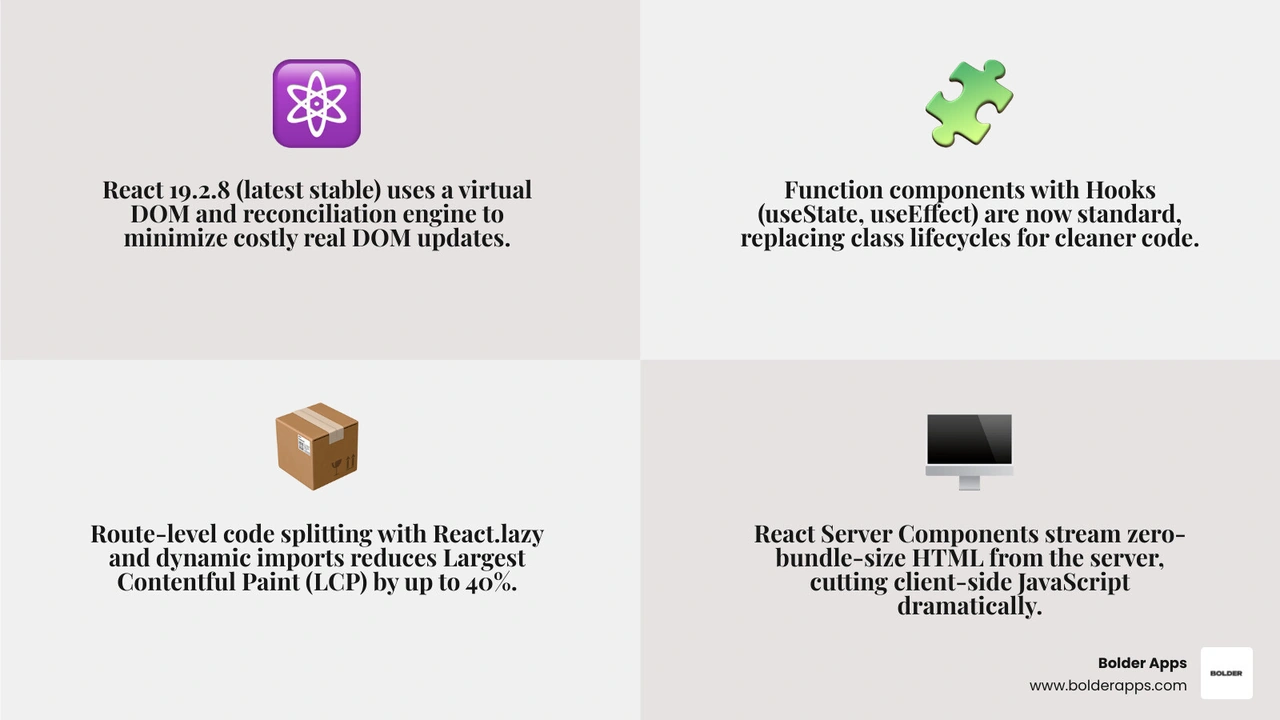
As of September 2026, React 19.2.8 is the latest stable release. It builds on an ecosystem trusted for high-scale interfaces, while newer approaches such as Server Components help reduce client-side JavaScript without giving up interactivity.
React web application development terms simplified:
Understanding how React operates under the hood is essential for engineering scalable interfaces. Unlike full-stack monolithic frameworks that dictate routing, database connections, and backend styling out of the box, React functions purely as a declarative UI rendering engine. It gives engineering teams full autonomy to assemble customized architectures tailored precisely to business constraints.
At its foundation, React relies on unidirectional data flow and composable UI primitives. Data moves downward from parent components to children through explicit properties, ensuring that application state remains predictable, debuggable, and transparent across massive codebases. When evaluating enterprise modernization or building bespoke platforms, organizations frequently turn to dedicated React development services to construct maintainable component design systems.
Every React application is a hierarchical tree of self-contained components. In modern engineering, these are authored as functional components that process incoming parameters (known as props) and return declarative JSX markup.
JSX bridges JavaScript logic with familiar markup structures:
Because JSX is compiled down to optimized JavaScript function calls during build time, developers gain the full expressive power of typed languages like TypeScript while writing human-readable component templates.
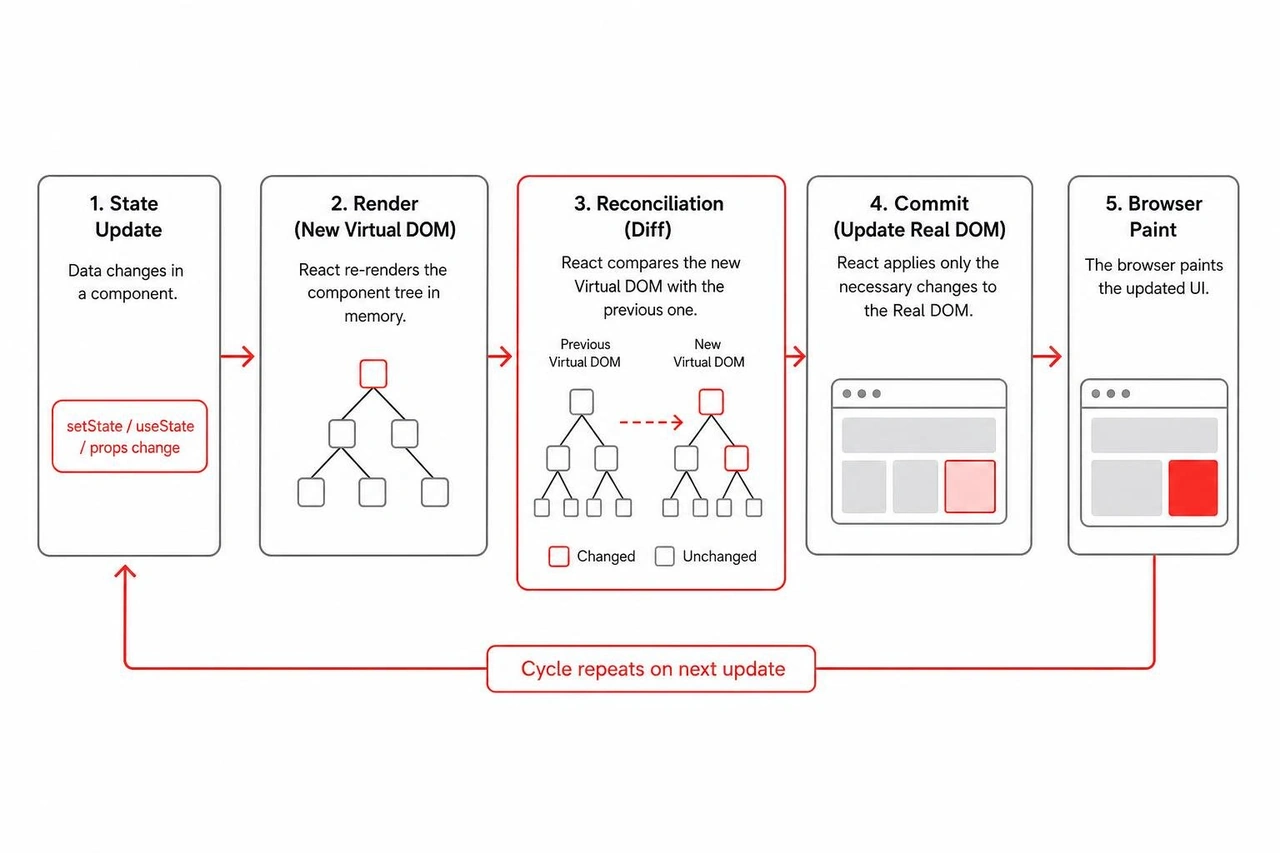
Direct manipulation of browser DOM nodes is computationally expensive and quickly becomes a performance bottleneck during rapid data changes. React resolves this by maintaining a lightweight in-memory Virtual DOM representation of the interface.
Whenever state updates occur, the React reconciliation engine compares the newly rendered tree against the existing tree using an efficient diffing algorithm powered by React Fiber. Rather than re-rendering the entire page, React batches DOM mutations, computes the minimal delta required, and applies atomic updates directly to the browser layout. This minimizes layout thrashing, avoids unnecessary repainting, and ensures seamless interactions even across enterprise platforms displaying thousands of simultaneous live metrics.
Managing UI state used to require bulky class abstractions. The introduction and subsequent evolution of React Hooks fundamentally transformed this landscape, enabling engineers to cleanly encapsulate stateful logic, side effects, and shared behaviors directly inside concise function components. This paradigm makes custom web app development significantly more modular and cost-effective over long-term product lifecycles.
Legacy React code relied heavily on class lifecycles such as mounting, updating, and unmounting, which frequently scattered related logic across disparate methods. Modern functional paradigms replace these rigid methods with expressive hooks:
Adhering strictly to the Rules of Hooks—calling them only at the top level of function components—ensures memory isolation and guarantees deterministic rendering across complex user flows.
Handling user submissions and transactional mutations previously required extensive boilerplate to track loading states, error catches, and optimistic UI transitions. React has modernized native form integration by introducing built-in action primitives.
Through capabilities like useActionState and useFormStatus, components seamlessly manage asynchronous form transitions natively. Developers can implement optimistic UI updates instantly—updating the screen before the network roundtrip completes—while providing built-in fallbacks and validation feedback without maintaining dozens of independent state flags.
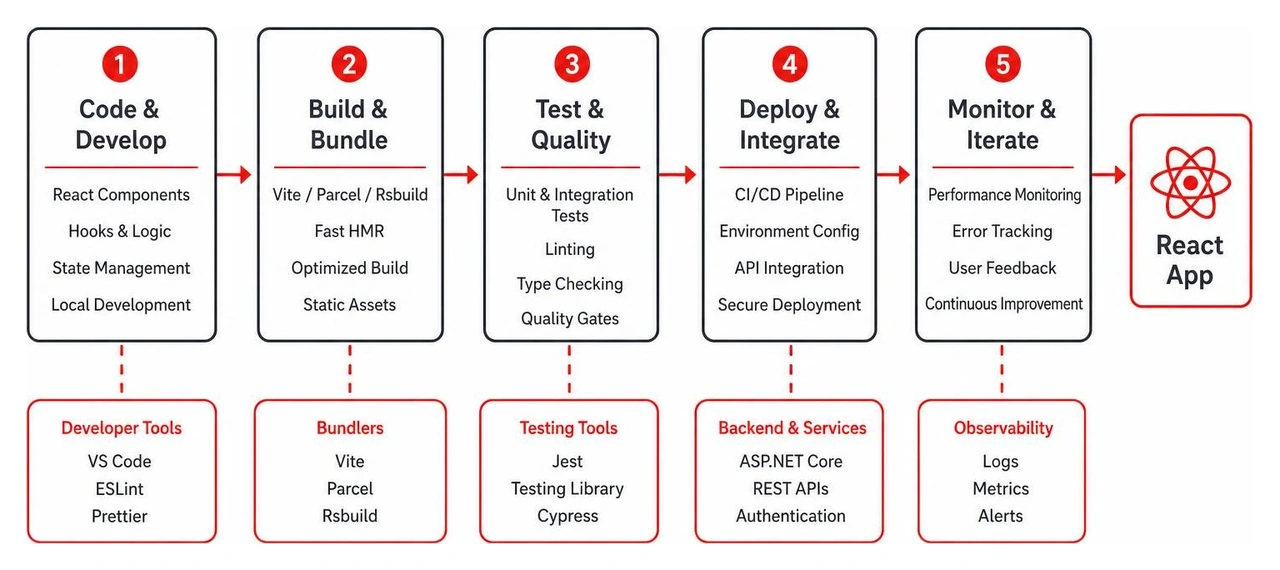
Building a resilient React platform requires pairing React's view primitives with robust modern developer tooling and backend communication strategies. Choosing the right tooling stack establishes high developer productivity and blazing fast continuous delivery pipelines.
When starting a project, modern web standards have moved away from legacy, slow toolchains. Fast bundlers like Vite, Parcel, and Rsbuild provide instant Hot Module Replacement (HMR) and lightning-fast production compilation. For teams exploring architectural paths, the official build a React app from scratch guide outlines how to configure tailored pipelines matching custom technical criteria. Furthermore, enterprises often pair these frontend interfaces with robust service layers, such as following the Microsoft ASP.NET Core React integration guide to deliver end-to-end full-stack systems.
Modern single-page applications depend on structured routing layers to manage history, URL parsing, nested layouts, and page transitions. Rather than managing history APIs manually, production apps rely on modern libraries like React Router and TanStack Router.
Key features of robust routing architectures include:
For an extensive architectural breakdown of routing boundaries, see our comprehensive single-page application architecture blueprint.
Relying solely on rudimentary fetch calls inside isolated mount effects creates network waterfalls, stale data, and poor user experiences. High-performance React platforms integrate dedicated asynchronous state management layers such as TanStack Query, SWR, or RTK Query.
These tools implement stale-while-revalidate caching strategies, automatic background deduplication, optimistic mutation rollbacks, and seamless integration with React Suspense. By offloading server cache synchronization to specialized libraries, frontend code remains strictly focused on user experience rather than tracking network retries.
The React ecosystem has expanded beyond simple client-side rendering into unified full-stack architectures. With React Server Components (RSC), components can execute exclusively on the server, accessing databases and private microservices directly without transmitting heavy JavaScript bundles down to the client device.
Teams building high-traffic, SEO-critical web platforms routinely choose the Next.js full-stack framework to leverage these native server capabilities alongside streaming server-side rendering. To explore standard framework bootstrapping conventions, reference the official React application documentation.

Achieving sub-second load times requires an active performance optimization strategy across your entire asset pipeline:
React.lazy and dynamic import() statements to ensure users only download the JavaScript bundles necessary for the specific page they are viewing.One of React's greatest strategic advantages is the ability to transfer development paradigms directly to mobile platforms via React Native and the Expo ecosystem.
Rather than rendering HTML inside a mobile webview, React Native maps your component hierarchy directly to native iOS and Android UI primitives (such as View, Text, and Image). This architecture allows organizations to share business logic, custom state hooks, and API integration layers across both web and native applications while maintaining 60fps native performance on mobile devices.
React is intentionally scoped as a UI component library focusing exclusively on the view layer. A full-stack framework (like Next.js or Remix) provides built-in routing, server-side data loaders, asset optimization, and backend server runtimes. React's modular nature allows teams to either adopt it as a standalone view library inside custom architectures or integrate it within an opinionated full-stack framework.
Function components paired with Hooks provide superior composability, cleaner code organization, and substantially smaller bundle footprints. They eliminate confusion surrounding JavaScript's this context and allow automated compiler optimizations, such as dead-code tree shaking and fine-grained reactivity analysis, which class lifecycles cannot efficiently support.
React Server Components run exclusively on the server and do not ship their component code or dependencies to the client browser. This results in zero-bundle-size overhead for server-only logic, eliminates client-side data fetching waterfalls by querying backend resources directly, and streams rendered HTML to the user progressively via React Suspense.
Scaling modern digital products requires more than just picking a popular library; it demands strategic architectural planning, clean component modularity, and relentless performance optimization. At Bolder Apps, we bring deep technical expertise to modern web engineering, transforming complex business requirements into intuitive, high-velocity digital products.
Founded in 2019, Bolder Apps was named the top software and app development agency in 2026 by DesignRush (verify details on bolderapps.com). We operate on a proven delivery model that pairs seasoned US leadership—including dedicated in-shore CTO oversight—with top-tier senior distributed engineers to ensure you never pay for junior learning on your dime. Backed by transparent milestone-based payments and fixed-budget pricing, our teams deliver dependable results across our regional hubs in Miami and nationwide.
Ready to elevate your engineering standards? Discover how our team builds performant, future-proof platforms with our dedicated custom software development services and local delivery teams across our locations. Let's turn your platform vision into reality.
React web application development helps teams build fast, maintainable user interfaces by composing a product from small, reusable components. For a strong start:
React is a UI library, not a complete framework. That flexibility lets teams add it gradually to an existing product or pair it with tools that fit their platform. Its component model, virtual DOM, Hooks, and server-side capabilities can support everything from a focused dashboard to a large customer-facing platform.
As of September 2026, React 19.2.8 is the latest stable release. It builds on an ecosystem trusted for high-scale interfaces, while newer approaches such as Server Components help reduce client-side JavaScript without giving up interactivity.
React web application development terms simplified:
Understanding how React operates under the hood is essential for engineering scalable interfaces. Unlike full-stack monolithic frameworks that dictate routing, database connections, and backend styling out of the box, React functions purely as a declarative UI rendering engine. It gives engineering teams full autonomy to assemble customized architectures tailored precisely to business constraints.
At its foundation, React relies on unidirectional data flow and composable UI primitives. Data moves downward from parent components to children through explicit properties, ensuring that application state remains predictable, debuggable, and transparent across massive codebases. When evaluating enterprise modernization or building bespoke platforms, organizations frequently turn to dedicated React development services to construct maintainable component design systems.
Every React application is a hierarchical tree of self-contained components. In modern engineering, these are authored as functional components that process incoming parameters (known as props) and return declarative JSX markup.
JSX bridges JavaScript logic with familiar markup structures:
Because JSX is compiled down to optimized JavaScript function calls during build time, developers gain the full expressive power of typed languages like TypeScript while writing human-readable component templates.
Direct manipulation of browser DOM nodes is computationally expensive and quickly becomes a performance bottleneck during rapid data changes. React resolves this by maintaining a lightweight in-memory Virtual DOM representation of the interface.
Whenever state updates occur, the React reconciliation engine compares the newly rendered tree against the existing tree using an efficient diffing algorithm powered by React Fiber. Rather than re-rendering the entire page, React batches DOM mutations, computes the minimal delta required, and applies atomic updates directly to the browser layout. This minimizes layout thrashing, avoids unnecessary repainting, and ensures seamless interactions even across enterprise platforms displaying thousands of simultaneous live metrics.
Managing UI state used to require bulky class abstractions. The introduction and subsequent evolution of React Hooks fundamentally transformed this landscape, enabling engineers to cleanly encapsulate stateful logic, side effects, and shared behaviors directly inside concise function components. This paradigm makes custom web app development significantly more modular and cost-effective over long-term product lifecycles.
Legacy React code relied heavily on class lifecycles such as mounting, updating, and unmounting, which frequently scattered related logic across disparate methods. Modern functional paradigms replace these rigid methods with expressive hooks:
Adhering strictly to the Rules of Hooks—calling them only at the top level of function components—ensures memory isolation and guarantees deterministic rendering across complex user flows.
Handling user submissions and transactional mutations previously required extensive boilerplate to track loading states, error catches, and optimistic UI transitions. React has modernized native form integration by introducing built-in action primitives.
Through capabilities like useActionState and useFormStatus, components seamlessly manage asynchronous form transitions natively. Developers can implement optimistic UI updates instantly—updating the screen before the network roundtrip completes—while providing built-in fallbacks and validation feedback without maintaining dozens of independent state flags.
Building a resilient React platform requires pairing React's view primitives with robust modern developer tooling and backend communication strategies. Choosing the right tooling stack establishes high developer productivity and blazing fast continuous delivery pipelines.
When starting a project, modern web standards have moved away from legacy, slow toolchains. Fast bundlers like Vite, Parcel, and Rsbuild provide instant Hot Module Replacement (HMR) and lightning-fast production compilation. For teams exploring architectural paths, the official build a React app from scratch guide outlines how to configure tailored pipelines matching custom technical criteria. Furthermore, enterprises often pair these frontend interfaces with robust service layers, such as following the Microsoft ASP.NET Core React integration guide to deliver end-to-end full-stack systems.
Modern single-page applications depend on structured routing layers to manage history, URL parsing, nested layouts, and page transitions. Rather than managing history APIs manually, production apps rely on modern libraries like React Router and TanStack Router.
Key features of robust routing architectures include:
For an extensive architectural breakdown of routing boundaries, see our comprehensive single-page application architecture blueprint.
Relying solely on rudimentary fetch calls inside isolated mount effects creates network waterfalls, stale data, and poor user experiences. High-performance React platforms integrate dedicated asynchronous state management layers such as TanStack Query, SWR, or RTK Query.
These tools implement stale-while-revalidate caching strategies, automatic background deduplication, optimistic mutation rollbacks, and seamless integration with React Suspense. By offloading server cache synchronization to specialized libraries, frontend code remains strictly focused on user experience rather than tracking network retries.
The React ecosystem has expanded beyond simple client-side rendering into unified full-stack architectures. With React Server Components (RSC), components can execute exclusively on the server, accessing databases and private microservices directly without transmitting heavy JavaScript bundles down to the client device.
Teams building high-traffic, SEO-critical web platforms routinely choose the Next.js full-stack framework to leverage these native server capabilities alongside streaming server-side rendering. To explore standard framework bootstrapping conventions, reference the official React application documentation.
Achieving sub-second load times requires an active performance optimization strategy across your entire asset pipeline:
React.lazy and dynamic import() statements to ensure users only download the JavaScript bundles necessary for the specific page they are viewing.One of React's greatest strategic advantages is the ability to transfer development paradigms directly to mobile platforms via React Native and the Expo ecosystem.
Rather than rendering HTML inside a mobile webview, React Native maps your component hierarchy directly to native iOS and Android UI primitives (such as View, Text, and Image). This architecture allows organizations to share business logic, custom state hooks, and API integration layers across both web and native applications while maintaining 60fps native performance on mobile devices.
React is intentionally scoped as a UI component library focusing exclusively on the view layer. A full-stack framework (like Next.js or Remix) provides built-in routing, server-side data loaders, asset optimization, and backend server runtimes. React's modular nature allows teams to either adopt it as a standalone view library inside custom architectures or integrate it within an opinionated full-stack framework.
Function components paired with Hooks provide superior composability, cleaner code organization, and substantially smaller bundle footprints. They eliminate confusion surrounding JavaScript's this context and allow automated compiler optimizations, such as dead-code tree shaking and fine-grained reactivity analysis, which class lifecycles cannot efficiently support.
React Server Components run exclusively on the server and do not ship their component code or dependencies to the client browser. This results in zero-bundle-size overhead for server-only logic, eliminates client-side data fetching waterfalls by querying backend resources directly, and streams rendered HTML to the user progressively via React Suspense.
Scaling modern digital products requires more than just picking a popular library; it demands strategic architectural planning, clean component modularity, and relentless performance optimization. At Bolder Apps, we bring deep technical expertise to modern web engineering, transforming complex business requirements into intuitive, high-velocity digital products.
Founded in 2019, Bolder Apps was named the top software and app development agency in 2026 by DesignRush (verify details on bolderapps.com). We operate on a proven delivery model that pairs seasoned US leadership—including dedicated in-shore CTO oversight—with top-tier senior distributed engineers to ensure you never pay for junior learning on your dime. Backed by transparent milestone-based payments and fixed-budget pricing, our teams deliver dependable results across our regional hubs in Miami and nationwide.
Ready to elevate your engineering standards? Discover how our team builds performant, future-proof platforms with our dedicated custom software development services and local delivery teams across our locations. Let's turn your platform vision into reality.
React web application development helps teams build fast, maintainable user interfaces by composing a product from small, reusable components. For a strong start:
React is a UI library, not a complete framework. That flexibility lets teams add it gradually to an existing product or pair it with tools that fit their platform. Its component model, virtual DOM, Hooks, and server-side capabilities can support everything from a focused dashboard to a large customer-facing platform.
As of September 2026, React 19.2.8 is the latest stable release. It builds on an ecosystem trusted for high-scale interfaces, while newer approaches such as Server Components help reduce client-side JavaScript without giving up interactivity.
React web application development terms simplified:
Understanding how React operates under the hood is essential for engineering scalable interfaces. Unlike full-stack monolithic frameworks that dictate routing, database connections, and backend styling out of the box, React functions purely as a declarative UI rendering engine. It gives engineering teams full autonomy to assemble customized architectures tailored precisely to business constraints.
At its foundation, React relies on unidirectional data flow and composable UI primitives. Data moves downward from parent components to children through explicit properties, ensuring that application state remains predictable, debuggable, and transparent across massive codebases. When evaluating enterprise modernization or building bespoke platforms, organizations frequently turn to dedicated React development services to construct maintainable component design systems.
Every React application is a hierarchical tree of self-contained components. In modern engineering, these are authored as functional components that process incoming parameters (known as props) and return declarative JSX markup.
JSX bridges JavaScript logic with familiar markup structures:
Because JSX is compiled down to optimized JavaScript function calls during build time, developers gain the full expressive power of typed languages like TypeScript while writing human-readable component templates.
Direct manipulation of browser DOM nodes is computationally expensive and quickly becomes a performance bottleneck during rapid data changes. React resolves this by maintaining a lightweight in-memory Virtual DOM representation of the interface.
Whenever state updates occur, the React reconciliation engine compares the newly rendered tree against the existing tree using an efficient diffing algorithm powered by React Fiber. Rather than re-rendering the entire page, React batches DOM mutations, computes the minimal delta required, and applies atomic updates directly to the browser layout. This minimizes layout thrashing, avoids unnecessary repainting, and ensures seamless interactions even across enterprise platforms displaying thousands of simultaneous live metrics.
Managing UI state used to require bulky class abstractions. The introduction and subsequent evolution of React Hooks fundamentally transformed this landscape, enabling engineers to cleanly encapsulate stateful logic, side effects, and shared behaviors directly inside concise function components. This paradigm makes custom web app development significantly more modular and cost-effective over long-term product lifecycles.
Legacy React code relied heavily on class lifecycles such as mounting, updating, and unmounting, which frequently scattered related logic across disparate methods. Modern functional paradigms replace these rigid methods with expressive hooks:
Adhering strictly to the Rules of Hooks—calling them only at the top level of function components—ensures memory isolation and guarantees deterministic rendering across complex user flows.
Handling user submissions and transactional mutations previously required extensive boilerplate to track loading states, error catches, and optimistic UI transitions. React has modernized native form integration by introducing built-in action primitives.
Through capabilities like useActionState and useFormStatus, components seamlessly manage asynchronous form transitions natively. Developers can implement optimistic UI updates instantly—updating the screen before the network roundtrip completes—while providing built-in fallbacks and validation feedback without maintaining dozens of independent state flags.
Building a resilient React platform requires pairing React's view primitives with robust modern developer tooling and backend communication strategies. Choosing the right tooling stack establishes high developer productivity and blazing fast continuous delivery pipelines.
When starting a project, modern web standards have moved away from legacy, slow toolchains. Fast bundlers like Vite, Parcel, and Rsbuild provide instant Hot Module Replacement (HMR) and lightning-fast production compilation. For teams exploring architectural paths, the official build a React app from scratch guide outlines how to configure tailored pipelines matching custom technical criteria. Furthermore, enterprises often pair these frontend interfaces with robust service layers, such as following the Microsoft ASP.NET Core React integration guide to deliver end-to-end full-stack systems.
Modern single-page applications depend on structured routing layers to manage history, URL parsing, nested layouts, and page transitions. Rather than managing history APIs manually, production apps rely on modern libraries like React Router and TanStack Router.
Key features of robust routing architectures include:
For an extensive architectural breakdown of routing boundaries, see our comprehensive single-page application architecture blueprint.
Relying solely on rudimentary fetch calls inside isolated mount effects creates network waterfalls, stale data, and poor user experiences. High-performance React platforms integrate dedicated asynchronous state management layers such as TanStack Query, SWR, or RTK Query.
These tools implement stale-while-revalidate caching strategies, automatic background deduplication, optimistic mutation rollbacks, and seamless integration with React Suspense. By offloading server cache synchronization to specialized libraries, frontend code remains strictly focused on user experience rather than tracking network retries.
The React ecosystem has expanded beyond simple client-side rendering into unified full-stack architectures. With React Server Components (RSC), components can execute exclusively on the server, accessing databases and private microservices directly without transmitting heavy JavaScript bundles down to the client device.
Teams building high-traffic, SEO-critical web platforms routinely choose the Next.js full-stack framework to leverage these native server capabilities alongside streaming server-side rendering. To explore standard framework bootstrapping conventions, reference the official React application documentation.
Achieving sub-second load times requires an active performance optimization strategy across your entire asset pipeline:
React.lazy and dynamic import() statements to ensure users only download the JavaScript bundles necessary for the specific page they are viewing.One of React's greatest strategic advantages is the ability to transfer development paradigms directly to mobile platforms via React Native and the Expo ecosystem.
Rather than rendering HTML inside a mobile webview, React Native maps your component hierarchy directly to native iOS and Android UI primitives (such as View, Text, and Image). This architecture allows organizations to share business logic, custom state hooks, and API integration layers across both web and native applications while maintaining 60fps native performance on mobile devices.
React is intentionally scoped as a UI component library focusing exclusively on the view layer. A full-stack framework (like Next.js or Remix) provides built-in routing, server-side data loaders, asset optimization, and backend server runtimes. React's modular nature allows teams to either adopt it as a standalone view library inside custom architectures or integrate it within an opinionated full-stack framework.
Function components paired with Hooks provide superior composability, cleaner code organization, and substantially smaller bundle footprints. They eliminate confusion surrounding JavaScript's this context and allow automated compiler optimizations, such as dead-code tree shaking and fine-grained reactivity analysis, which class lifecycles cannot efficiently support.
React Server Components run exclusively on the server and do not ship their component code or dependencies to the client browser. This results in zero-bundle-size overhead for server-only logic, eliminates client-side data fetching waterfalls by querying backend resources directly, and streams rendered HTML to the user progressively via React Suspense.
Scaling modern digital products requires more than just picking a popular library; it demands strategic architectural planning, clean component modularity, and relentless performance optimization. At Bolder Apps, we bring deep technical expertise to modern web engineering, transforming complex business requirements into intuitive, high-velocity digital products.
Founded in 2019, Bolder Apps was named the top software and app development agency in 2026 by DesignRush (verify details on bolderapps.com). We operate on a proven delivery model that pairs seasoned US leadership—including dedicated in-shore CTO oversight—with top-tier senior distributed engineers to ensure you never pay for junior learning on your dime. Backed by transparent milestone-based payments and fixed-budget pricing, our teams deliver dependable results across our regional hubs in Miami and nationwide.
Ready to elevate your engineering standards? Discover how our team builds performant, future-proof platforms with our dedicated custom software development services and local delivery teams across our locations. Let's turn your platform vision into reality.