Sean Weldon
September 30, 2026
10
min. read
and updated on:
September 30, 2026


MCP business integration gives AI agents a standard, controlled way to use the data and tools your company already relies on. Start by choosing one high-value, low-risk workflow, such as retrieving CRM data or summarizing operational metrics. Then expose only the approved data and actions through an MCP server, apply role-based permissions and audit logs, and test it with the AI model your team prefers.
The Model Context Protocol (MCP) is often called the "USB-C of AI" because it provides one common connection method for many AI clients and business systems. Instead of rebuilding separate integrations for each model, agent, CRM, database, or workflow tool, teams can create a reusable layer that supports secure tool discovery and structured actions.
That matters because useful AI needs more than a chat window. It needs current, governed business context. With the right controls, MCP can help teams move from simple answers to real work: prioritizing sales leads, checking inventory, preparing reports, or routing maintenance requests.
The protocol is not a security system or a magic switch for autonomy. It is the integration foundation. Strong identity controls, least-privilege access, human approvals for sensitive actions, and monitoring still determine whether an MCP deployment is safe and valuable.
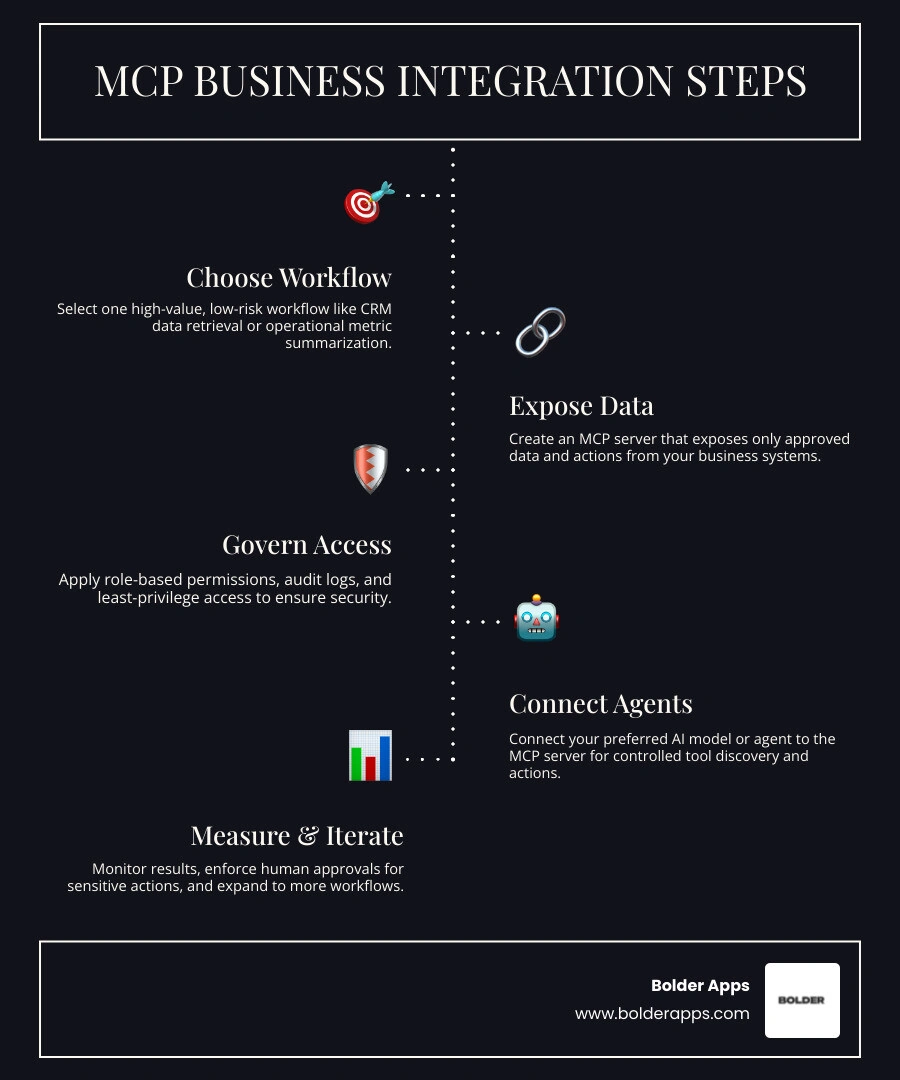
To build an effective foundation, teams need a clear understanding of what an MCP server provides, how the underlying Model Context Protocol operates, and how to execute seamless MCP server AI integration across existing enterprise workflows.
Connecting modern Large Language Models (LLMs) to internal business systems has historically been a brittle, custom-coded headache. Traditional enterprise architectures forced engineering teams to write bespoke point-to-point connectors for every combination of AI model and application. When a team wanted an AI assistant to fetch customer records from Salesforce, query billing metrics from Snowflake, or trigger tickets in Jira, developers had to hard-code distinct API clients, craft unique prompt wrappers, and manage authentication separately for each tool.
This approach creates severe architectural debt. If you decide to switch your underlying AI reasoning engine from one foundation model to another, entire codebases of function-calling wrappers break.
The Model Context Protocol solves this integration fragmentation by establishing a universal, open standard. By separating the connection layer from the model's internal reasoning logic, MCP allows applications to expose their resources, prompts, and tools through a unified JSON-RPC protocol. Instead of forcing the model to guess API structures, an MCP server provides runtime tool discovery. When an AI client connects, the MCP server advertises exactly what capabilities and data fields are available, alongside clear schemas.
This architectural shift creates a truly model-agnostic layer. It standardizes context portability across your enterprise data estate, optimizing context window usage by dynamically streaming only the data an agent needs for a specific task. By replacing dozens of fragile point-to-point connectors with a single standardized protocol, businesses unlock a sustainable foundation for intelligent systems. For a deeper technical perspective on this paradigm shift, explore how SnapLogic analyzes MCP and APIs within the broader future of enterprise integration.
The industry often compares MCP to USB-C because it standardizes physical and logical interoperability across hardware ecosystems. Before USB-C, every device required its own proprietary charger, display cable, and data link. MCP delivers that exact consolidation to artificial intelligence.
The protocol operates on a clean client-host-server topology:
This architecture enables dynamic schema exposure and two-way context flow. Rather than maintaining static documentation and hardcoded API schemas inside massive system prompts, the AI host queries the server at runtime to discover callable functions. This reduces developer maintenance overhead to near zero when endpoints update.
MCP provides standardized primitives that turn passive models into active operational participants:
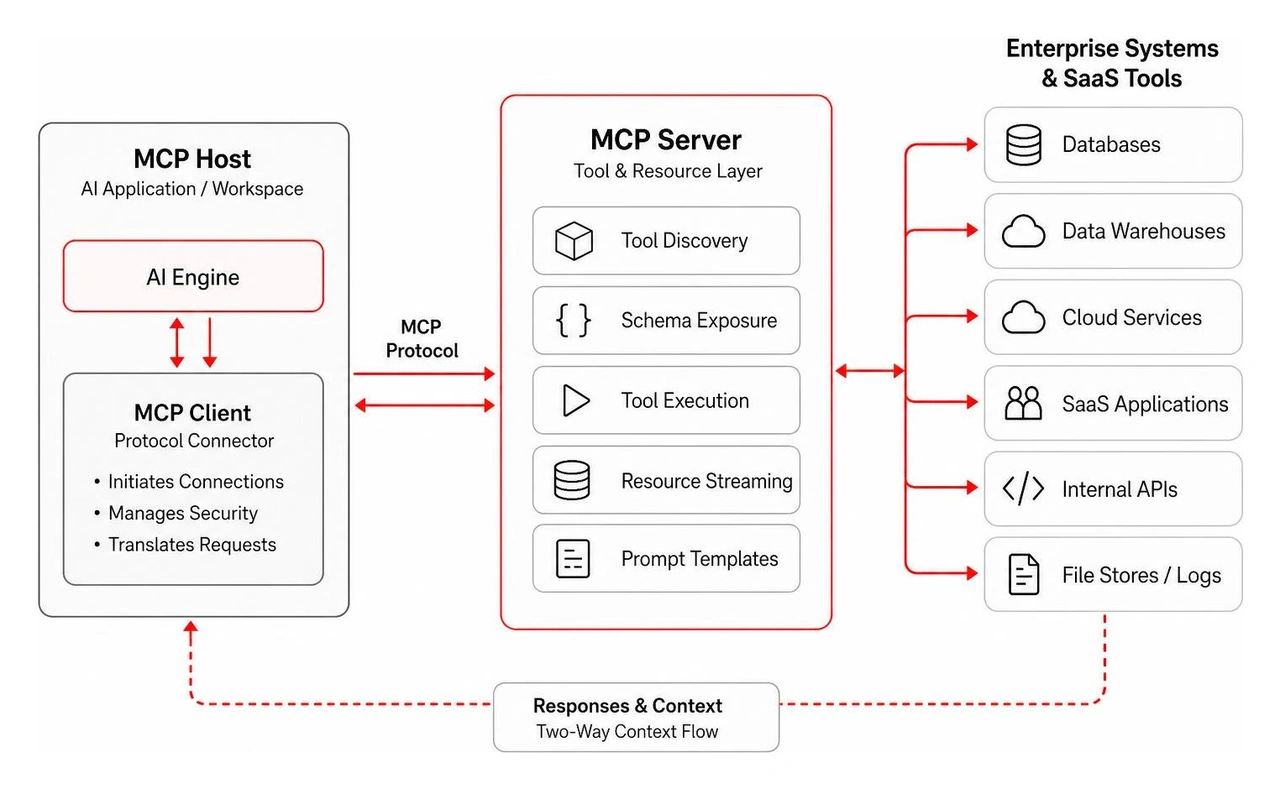
To achieve production scalability, enterprise AI integration requires more than exposing ad-hoc scripts. Enterprises need a clear architectural blueprint that treats MCP as a strategic middleware orchestration layer.
Rather than treating the protocol as a simple passthrough API, a robust architecture positions an internal unified MCP server as an intelligent enterprise service bus. This server aggregates multiple backends—such as ERP systems, customer support platforms, and analytics warehouses—into unified, workflow-centric tools.
By enforcing stateless execution at the transport layer while supporting persistent state management within orchestration engines, this architecture optimizes latency and ensures data freshness. The MCP server acts as an abstraction barrier: the AI model never needs to understand the messy database schemas or legacy quirks of your back-office systems. It interacts exclusively with cleanly defined business capabilities.
As software vendors rush to support agentic AI, businesses face an architectural choice: connect AI agents directly to first-party SaaS MCP servers provided by software vendors, or build a centralized, internal unified MCP server.
Vendor-provided SaaS MCP servers (like those released for basic cloud storage or communication tools) offer fast initial setup. However, they expose generic, tool-specific actions in isolation. When an agent relies on individual SaaS servers, it must act as its own business analyst—deciding which platform to query first, reconciling conflicting data formats between systems, and coordinating multi-step handshakes across multiple vendor sandboxes. This increases token overhead, increases latency, and leaves room for arbitrary execution errors.
Building an internal, unified enterprise MCP server is architecturally superior for core enterprise operations:
onboard_enterprise_customer.A common misconception is that MCP simply duplicates proprietary function calling (like OpenAI tool calling) or replaces orchestration frameworks like LangChain, LangGraph, and CrewAI. In reality, MCP operates at a different layer of the stack:
By decoupling the reasoning engine from backend tool definitions, organizations avoid vendor lock-in. You can configure and connect multiple AI models—from commercial leaders like Claude, GPT, and Gemini to local private models—to the exact same business endpoint securely and reliably.
Opening enterprise business systems to autonomous AI agents without strict guardrails is a recipe for operational risk. A solid MCP architecture treats security as an active architectural gatekeeper rather than an afterthought.

At its core, MCP operates under a zero-trust model. The protocol itself establishes standard data formatting, while the underlying infrastructure must enforce strict identity verification, role-based access control (RBAC), and continuous monitoring.
Production deployments require a server-side credential vault. Under no circumstances should raw database credentials, master API keys, or administrative OAuth tokens be exposed to the client or returned within an LLM context window. Instead, the MCP server manages credentials server-side within an encrypted vault, executing queries on behalf of authenticated agents using short-lived capability tokens. Applying deny-all row-level security (RLS) guarantees that an agent cannot view or alter records beyond the calling user's verified privileges.
To prevent unauthorized operations, organizations must enforce granular permission scoping through modern OAuth 2.0 flows:
analytics:read, crm:query) and active execution permissions (e.g., billing:charge, ehr:update).Because AI agents frequently ingest unstructured text from external emails, web pages, and customer support chats, they are vulnerable to indirect prompt injection attacks. Malicious instructions embedded in incoming data can attempt to hijack model reasoning and manipulate tool calls.
To mitigate this vulnerability:
Organizations across multiple sectors are adopting MCP to replace manual reporting, fragmented software stacks, and complex workflows with responsive, governed AI interactions.
In highly regulated sectors such as healthcare and financial services, compliance requirements often stall AI experimentation. MCP provides the isolation, auditing, and fine-grained access control needed to deploy AI safely:
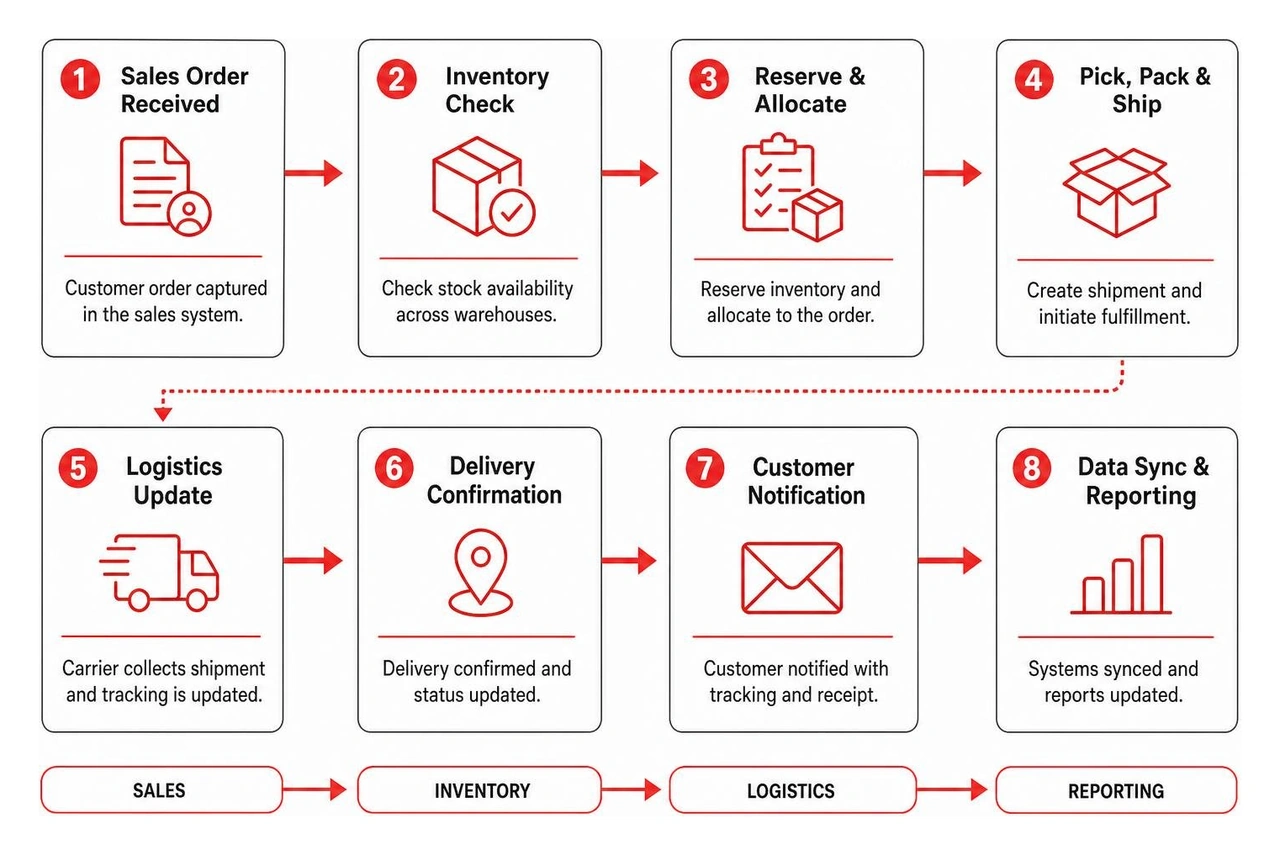
Modern commerce and logistics operations require real-time synchronization between digital channels and physical infrastructure:
Rolling out MCP across an enterprise requires a disciplined, phased approach that balances rapid business value with platform governance:
Traditional automation relies on brittle, static if-then scripts: when event A happens, execute task B. If an unexpected condition occurs, the automation breaks and requires engineering intervention.
MCP is a vital catalyst for shifting organizations toward true agentic AI—moving from isolated task automation to autonomous, goal-driven workflows. When AI models are equipped with an expressive, standardized tool protocol, they gain:
As teams race to adopt MCP, avoiding common implementation mistakes saves significant time and prevents operational disruptions:
An API (Application Programming Interface) is designed primarily for deterministic, programmatic communication between software applications, requiring developers to write hardcoded integrations matching strict documentation. An MCP server is an abstraction layer that wraps underlying APIs and databases in a standardized JSON-RPC protocol designed specifically for AI models. It enables natural language tool discovery, dynamic runtime schema negotiation, and automated context injection, allowing AI agents to understand and use capabilities without custom code for each tool.
MCP standardizes the interface between AI models and business systems. Because the tool definitions, prompts, and data resources are maintained in an open, model-agnostic format, your integration layer remains completely independent of any single AI provider. If a more cost-effective or powerful foundation model is released, you can switch models across your enterprise simply by pointing the new model client at your existing MCP endpoint—without rewriting your backend connectors.
Yes. Legacy modernization is one of the most effective use cases for MCP. Instead of undertaking risky and expensive core migrations, enterprises can build lightweight MCP wrappers or middleware connectors around legacy on-premise databases, mainframe services, or older SOAP/REST APIs. The MCP server translates legacy data structures into clean JSON-RPC schemas, allowing modern AI assistants to query and interact with legacy infrastructure seamlessly.
The transition from isolated generative AI experiments to scalable, production-grade agentic workflows requires a robust integration foundation. Adopting the Model Context Protocol gives your organization an open, secure, and model-agnostic integration layer that unifies enterprise data, streamlines workflows, and protects against vendor lock-in.
At Bolder Apps, we help organizations turn ambitious AI visions into practical, secure digital reality. Founded in 2019 and recognized as a top software and app development agency in 2026 by DesignRush, our team combines strategic US leadership with senior distributed engineering to build high-impact, custom software solutions. We specialize in designing robust, enterprise-grade AI architectures, custom MCP servers, and modern web and mobile applications tailored to your exact operational requirements.
Whether you are looking to modernize legacy infrastructure, implement multi-agent workflows, or securely connect your enterprise tools to the next generation of AI models, we deliver strategic, data-driven product development with no junior learning on your dime. Our transparent engagement framework combines a predictable fixed-budget model, in-shore CTO oversight with experienced offshore development teams, and milestone-based payments to ensure your product is delivered on time, within budget, and built to scale.
Explore how our expert digital product development services can transform your operational workflows, or check out our service locations across the United States to start building your future-ready AI infrastructure today.
MCP business integration gives AI agents a standard, controlled way to use the data and tools your company already relies on. Start by choosing one high-value, low-risk workflow, such as retrieving CRM data or summarizing operational metrics. Then expose only the approved data and actions through an MCP server, apply role-based permissions and audit logs, and test it with the AI model your team prefers.
The Model Context Protocol (MCP) is often called the "USB-C of AI" because it provides one common connection method for many AI clients and business systems. Instead of rebuilding separate integrations for each model, agent, CRM, database, or workflow tool, teams can create a reusable layer that supports secure tool discovery and structured actions.
That matters because useful AI needs more than a chat window. It needs current, governed business context. With the right controls, MCP can help teams move from simple answers to real work: prioritizing sales leads, checking inventory, preparing reports, or routing maintenance requests.
The protocol is not a security system or a magic switch for autonomy. It is the integration foundation. Strong identity controls, least-privilege access, human approvals for sensitive actions, and monitoring still determine whether an MCP deployment is safe and valuable.
To build an effective foundation, teams need a clear understanding of what an MCP server provides, how the underlying Model Context Protocol operates, and how to execute seamless MCP server AI integration across existing enterprise workflows.
Connecting modern Large Language Models (LLMs) to internal business systems has historically been a brittle, custom-coded headache. Traditional enterprise architectures forced engineering teams to write bespoke point-to-point connectors for every combination of AI model and application. When a team wanted an AI assistant to fetch customer records from Salesforce, query billing metrics from Snowflake, or trigger tickets in Jira, developers had to hard-code distinct API clients, craft unique prompt wrappers, and manage authentication separately for each tool.
This approach creates severe architectural debt. If you decide to switch your underlying AI reasoning engine from one foundation model to another, entire codebases of function-calling wrappers break.
The Model Context Protocol solves this integration fragmentation by establishing a universal, open standard. By separating the connection layer from the model's internal reasoning logic, MCP allows applications to expose their resources, prompts, and tools through a unified JSON-RPC protocol. Instead of forcing the model to guess API structures, an MCP server provides runtime tool discovery. When an AI client connects, the MCP server advertises exactly what capabilities and data fields are available, alongside clear schemas.
This architectural shift creates a truly model-agnostic layer. It standardizes context portability across your enterprise data estate, optimizing context window usage by dynamically streaming only the data an agent needs for a specific task. By replacing dozens of fragile point-to-point connectors with a single standardized protocol, businesses unlock a sustainable foundation for intelligent systems. For a deeper technical perspective on this paradigm shift, explore how SnapLogic analyzes MCP and APIs within the broader future of enterprise integration.
The industry often compares MCP to USB-C because it standardizes physical and logical interoperability across hardware ecosystems. Before USB-C, every device required its own proprietary charger, display cable, and data link. MCP delivers that exact consolidation to artificial intelligence.
The protocol operates on a clean client-host-server topology:
This architecture enables dynamic schema exposure and two-way context flow. Rather than maintaining static documentation and hardcoded API schemas inside massive system prompts, the AI host queries the server at runtime to discover callable functions. This reduces developer maintenance overhead to near zero when endpoints update.
MCP provides standardized primitives that turn passive models into active operational participants:
To achieve production scalability, enterprise AI integration requires more than exposing ad-hoc scripts. Enterprises need a clear architectural blueprint that treats MCP as a strategic middleware orchestration layer.
Rather than treating the protocol as a simple passthrough API, a robust architecture positions an internal unified MCP server as an intelligent enterprise service bus. This server aggregates multiple backends—such as ERP systems, customer support platforms, and analytics warehouses—into unified, workflow-centric tools.
By enforcing stateless execution at the transport layer while supporting persistent state management within orchestration engines, this architecture optimizes latency and ensures data freshness. The MCP server acts as an abstraction barrier: the AI model never needs to understand the messy database schemas or legacy quirks of your back-office systems. It interacts exclusively with cleanly defined business capabilities.
As software vendors rush to support agentic AI, businesses face an architectural choice: connect AI agents directly to first-party SaaS MCP servers provided by software vendors, or build a centralized, internal unified MCP server.
Vendor-provided SaaS MCP servers (like those released for basic cloud storage or communication tools) offer fast initial setup. However, they expose generic, tool-specific actions in isolation. When an agent relies on individual SaaS servers, it must act as its own business analyst—deciding which platform to query first, reconciling conflicting data formats between systems, and coordinating multi-step handshakes across multiple vendor sandboxes. This increases token overhead, increases latency, and leaves room for arbitrary execution errors.
Building an internal, unified enterprise MCP server is architecturally superior for core enterprise operations:
onboard_enterprise_customer.A common misconception is that MCP simply duplicates proprietary function calling (like OpenAI tool calling) or replaces orchestration frameworks like LangChain, LangGraph, and CrewAI. In reality, MCP operates at a different layer of the stack:
By decoupling the reasoning engine from backend tool definitions, organizations avoid vendor lock-in. You can configure and connect multiple AI models—from commercial leaders like Claude, GPT, and Gemini to local private models—to the exact same business endpoint securely and reliably.
Opening enterprise business systems to autonomous AI agents without strict guardrails is a recipe for operational risk. A solid MCP architecture treats security as an active architectural gatekeeper rather than an afterthought.
At its core, MCP operates under a zero-trust model. The protocol itself establishes standard data formatting, while the underlying infrastructure must enforce strict identity verification, role-based access control (RBAC), and continuous monitoring.
Production deployments require a server-side credential vault. Under no circumstances should raw database credentials, master API keys, or administrative OAuth tokens be exposed to the client or returned within an LLM context window. Instead, the MCP server manages credentials server-side within an encrypted vault, executing queries on behalf of authenticated agents using short-lived capability tokens. Applying deny-all row-level security (RLS) guarantees that an agent cannot view or alter records beyond the calling user's verified privileges.
To prevent unauthorized operations, organizations must enforce granular permission scoping through modern OAuth 2.0 flows:
analytics:read, crm:query) and active execution permissions (e.g., billing:charge, ehr:update).Because AI agents frequently ingest unstructured text from external emails, web pages, and customer support chats, they are vulnerable to indirect prompt injection attacks. Malicious instructions embedded in incoming data can attempt to hijack model reasoning and manipulate tool calls.
To mitigate this vulnerability:
Organizations across multiple sectors are adopting MCP to replace manual reporting, fragmented software stacks, and complex workflows with responsive, governed AI interactions.
In highly regulated sectors such as healthcare and financial services, compliance requirements often stall AI experimentation. MCP provides the isolation, auditing, and fine-grained access control needed to deploy AI safely:
Modern commerce and logistics operations require real-time synchronization between digital channels and physical infrastructure:
Rolling out MCP across an enterprise requires a disciplined, phased approach that balances rapid business value with platform governance:
Traditional automation relies on brittle, static if-then scripts: when event A happens, execute task B. If an unexpected condition occurs, the automation breaks and requires engineering intervention.
MCP is a vital catalyst for shifting organizations toward true agentic AI—moving from isolated task automation to autonomous, goal-driven workflows. When AI models are equipped with an expressive, standardized tool protocol, they gain:
As teams race to adopt MCP, avoiding common implementation mistakes saves significant time and prevents operational disruptions:
An API (Application Programming Interface) is designed primarily for deterministic, programmatic communication between software applications, requiring developers to write hardcoded integrations matching strict documentation. An MCP server is an abstraction layer that wraps underlying APIs and databases in a standardized JSON-RPC protocol designed specifically for AI models. It enables natural language tool discovery, dynamic runtime schema negotiation, and automated context injection, allowing AI agents to understand and use capabilities without custom code for each tool.
MCP standardizes the interface between AI models and business systems. Because the tool definitions, prompts, and data resources are maintained in an open, model-agnostic format, your integration layer remains completely independent of any single AI provider. If a more cost-effective or powerful foundation model is released, you can switch models across your enterprise simply by pointing the new model client at your existing MCP endpoint—without rewriting your backend connectors.
Yes. Legacy modernization is one of the most effective use cases for MCP. Instead of undertaking risky and expensive core migrations, enterprises can build lightweight MCP wrappers or middleware connectors around legacy on-premise databases, mainframe services, or older SOAP/REST APIs. The MCP server translates legacy data structures into clean JSON-RPC schemas, allowing modern AI assistants to query and interact with legacy infrastructure seamlessly.
The transition from isolated generative AI experiments to scalable, production-grade agentic workflows requires a robust integration foundation. Adopting the Model Context Protocol gives your organization an open, secure, and model-agnostic integration layer that unifies enterprise data, streamlines workflows, and protects against vendor lock-in.
At Bolder Apps, we help organizations turn ambitious AI visions into practical, secure digital reality. Founded in 2019 and recognized as a top software and app development agency in 2026 by DesignRush, our team combines strategic US leadership with senior distributed engineering to build high-impact, custom software solutions. We specialize in designing robust, enterprise-grade AI architectures, custom MCP servers, and modern web and mobile applications tailored to your exact operational requirements.
Whether you are looking to modernize legacy infrastructure, implement multi-agent workflows, or securely connect your enterprise tools to the next generation of AI models, we deliver strategic, data-driven product development with no junior learning on your dime. Our transparent engagement framework combines a predictable fixed-budget model, in-shore CTO oversight with experienced offshore development teams, and milestone-based payments to ensure your product is delivered on time, within budget, and built to scale.
Explore how our expert digital product development services can transform your operational workflows, or check out our service locations across the United States to start building your future-ready AI infrastructure today.
MCP business integration gives AI agents a standard, controlled way to use the data and tools your company already relies on. Start by choosing one high-value, low-risk workflow, such as retrieving CRM data or summarizing operational metrics. Then expose only the approved data and actions through an MCP server, apply role-based permissions and audit logs, and test it with the AI model your team prefers.
The Model Context Protocol (MCP) is often called the "USB-C of AI" because it provides one common connection method for many AI clients and business systems. Instead of rebuilding separate integrations for each model, agent, CRM, database, or workflow tool, teams can create a reusable layer that supports secure tool discovery and structured actions.
That matters because useful AI needs more than a chat window. It needs current, governed business context. With the right controls, MCP can help teams move from simple answers to real work: prioritizing sales leads, checking inventory, preparing reports, or routing maintenance requests.
The protocol is not a security system or a magic switch for autonomy. It is the integration foundation. Strong identity controls, least-privilege access, human approvals for sensitive actions, and monitoring still determine whether an MCP deployment is safe and valuable.
To build an effective foundation, teams need a clear understanding of what an MCP server provides, how the underlying Model Context Protocol operates, and how to execute seamless MCP server AI integration across existing enterprise workflows.
Connecting modern Large Language Models (LLMs) to internal business systems has historically been a brittle, custom-coded headache. Traditional enterprise architectures forced engineering teams to write bespoke point-to-point connectors for every combination of AI model and application. When a team wanted an AI assistant to fetch customer records from Salesforce, query billing metrics from Snowflake, or trigger tickets in Jira, developers had to hard-code distinct API clients, craft unique prompt wrappers, and manage authentication separately for each tool.
This approach creates severe architectural debt. If you decide to switch your underlying AI reasoning engine from one foundation model to another, entire codebases of function-calling wrappers break.
The Model Context Protocol solves this integration fragmentation by establishing a universal, open standard. By separating the connection layer from the model's internal reasoning logic, MCP allows applications to expose their resources, prompts, and tools through a unified JSON-RPC protocol. Instead of forcing the model to guess API structures, an MCP server provides runtime tool discovery. When an AI client connects, the MCP server advertises exactly what capabilities and data fields are available, alongside clear schemas.
This architectural shift creates a truly model-agnostic layer. It standardizes context portability across your enterprise data estate, optimizing context window usage by dynamically streaming only the data an agent needs for a specific task. By replacing dozens of fragile point-to-point connectors with a single standardized protocol, businesses unlock a sustainable foundation for intelligent systems. For a deeper technical perspective on this paradigm shift, explore how SnapLogic analyzes MCP and APIs within the broader future of enterprise integration.
The industry often compares MCP to USB-C because it standardizes physical and logical interoperability across hardware ecosystems. Before USB-C, every device required its own proprietary charger, display cable, and data link. MCP delivers that exact consolidation to artificial intelligence.
The protocol operates on a clean client-host-server topology:
This architecture enables dynamic schema exposure and two-way context flow. Rather than maintaining static documentation and hardcoded API schemas inside massive system prompts, the AI host queries the server at runtime to discover callable functions. This reduces developer maintenance overhead to near zero when endpoints update.
MCP provides standardized primitives that turn passive models into active operational participants:
To achieve production scalability, enterprise AI integration requires more than exposing ad-hoc scripts. Enterprises need a clear architectural blueprint that treats MCP as a strategic middleware orchestration layer.
Rather than treating the protocol as a simple passthrough API, a robust architecture positions an internal unified MCP server as an intelligent enterprise service bus. This server aggregates multiple backends—such as ERP systems, customer support platforms, and analytics warehouses—into unified, workflow-centric tools.
By enforcing stateless execution at the transport layer while supporting persistent state management within orchestration engines, this architecture optimizes latency and ensures data freshness. The MCP server acts as an abstraction barrier: the AI model never needs to understand the messy database schemas or legacy quirks of your back-office systems. It interacts exclusively with cleanly defined business capabilities.
As software vendors rush to support agentic AI, businesses face an architectural choice: connect AI agents directly to first-party SaaS MCP servers provided by software vendors, or build a centralized, internal unified MCP server.
Vendor-provided SaaS MCP servers (like those released for basic cloud storage or communication tools) offer fast initial setup. However, they expose generic, tool-specific actions in isolation. When an agent relies on individual SaaS servers, it must act as its own business analyst—deciding which platform to query first, reconciling conflicting data formats between systems, and coordinating multi-step handshakes across multiple vendor sandboxes. This increases token overhead, increases latency, and leaves room for arbitrary execution errors.
Building an internal, unified enterprise MCP server is architecturally superior for core enterprise operations:
onboard_enterprise_customer.A common misconception is that MCP simply duplicates proprietary function calling (like OpenAI tool calling) or replaces orchestration frameworks like LangChain, LangGraph, and CrewAI. In reality, MCP operates at a different layer of the stack:
By decoupling the reasoning engine from backend tool definitions, organizations avoid vendor lock-in. You can configure and connect multiple AI models—from commercial leaders like Claude, GPT, and Gemini to local private models—to the exact same business endpoint securely and reliably.
Opening enterprise business systems to autonomous AI agents without strict guardrails is a recipe for operational risk. A solid MCP architecture treats security as an active architectural gatekeeper rather than an afterthought.
At its core, MCP operates under a zero-trust model. The protocol itself establishes standard data formatting, while the underlying infrastructure must enforce strict identity verification, role-based access control (RBAC), and continuous monitoring.
Production deployments require a server-side credential vault. Under no circumstances should raw database credentials, master API keys, or administrative OAuth tokens be exposed to the client or returned within an LLM context window. Instead, the MCP server manages credentials server-side within an encrypted vault, executing queries on behalf of authenticated agents using short-lived capability tokens. Applying deny-all row-level security (RLS) guarantees that an agent cannot view or alter records beyond the calling user's verified privileges.
To prevent unauthorized operations, organizations must enforce granular permission scoping through modern OAuth 2.0 flows:
analytics:read, crm:query) and active execution permissions (e.g., billing:charge, ehr:update).Because AI agents frequently ingest unstructured text from external emails, web pages, and customer support chats, they are vulnerable to indirect prompt injection attacks. Malicious instructions embedded in incoming data can attempt to hijack model reasoning and manipulate tool calls.
To mitigate this vulnerability:
Organizations across multiple sectors are adopting MCP to replace manual reporting, fragmented software stacks, and complex workflows with responsive, governed AI interactions.
In highly regulated sectors such as healthcare and financial services, compliance requirements often stall AI experimentation. MCP provides the isolation, auditing, and fine-grained access control needed to deploy AI safely:
Modern commerce and logistics operations require real-time synchronization between digital channels and physical infrastructure:
Rolling out MCP across an enterprise requires a disciplined, phased approach that balances rapid business value with platform governance:
Traditional automation relies on brittle, static if-then scripts: when event A happens, execute task B. If an unexpected condition occurs, the automation breaks and requires engineering intervention.
MCP is a vital catalyst for shifting organizations toward true agentic AI—moving from isolated task automation to autonomous, goal-driven workflows. When AI models are equipped with an expressive, standardized tool protocol, they gain:
As teams race to adopt MCP, avoiding common implementation mistakes saves significant time and prevents operational disruptions:
An API (Application Programming Interface) is designed primarily for deterministic, programmatic communication between software applications, requiring developers to write hardcoded integrations matching strict documentation. An MCP server is an abstraction layer that wraps underlying APIs and databases in a standardized JSON-RPC protocol designed specifically for AI models. It enables natural language tool discovery, dynamic runtime schema negotiation, and automated context injection, allowing AI agents to understand and use capabilities without custom code for each tool.
MCP standardizes the interface between AI models and business systems. Because the tool definitions, prompts, and data resources are maintained in an open, model-agnostic format, your integration layer remains completely independent of any single AI provider. If a more cost-effective or powerful foundation model is released, you can switch models across your enterprise simply by pointing the new model client at your existing MCP endpoint—without rewriting your backend connectors.
Yes. Legacy modernization is one of the most effective use cases for MCP. Instead of undertaking risky and expensive core migrations, enterprises can build lightweight MCP wrappers or middleware connectors around legacy on-premise databases, mainframe services, or older SOAP/REST APIs. The MCP server translates legacy data structures into clean JSON-RPC schemas, allowing modern AI assistants to query and interact with legacy infrastructure seamlessly.
The transition from isolated generative AI experiments to scalable, production-grade agentic workflows requires a robust integration foundation. Adopting the Model Context Protocol gives your organization an open, secure, and model-agnostic integration layer that unifies enterprise data, streamlines workflows, and protects against vendor lock-in.
At Bolder Apps, we help organizations turn ambitious AI visions into practical, secure digital reality. Founded in 2019 and recognized as a top software and app development agency in 2026 by DesignRush, our team combines strategic US leadership with senior distributed engineering to build high-impact, custom software solutions. We specialize in designing robust, enterprise-grade AI architectures, custom MCP servers, and modern web and mobile applications tailored to your exact operational requirements.
Whether you are looking to modernize legacy infrastructure, implement multi-agent workflows, or securely connect your enterprise tools to the next generation of AI models, we deliver strategic, data-driven product development with no junior learning on your dime. Our transparent engagement framework combines a predictable fixed-budget model, in-shore CTO oversight with experienced offshore development teams, and milestone-based payments to ensure your product is delivered on time, within budget, and built to scale.
Explore how our expert digital product development services can transform your operational workflows, or check out our service locations across the United States to start building your future-ready AI infrastructure today.