Why Choosing the Right App Development Partner Can Make or Break Your Startup
70% of apps fail due to poor partner choice. Here's how to find the right app development services for your startup — from MVP strategy to launch and beyond.
Why Choosing the Right App Development Partner Can Make or Break Your Startup
App development services for startups are specialized offerings that help early-stage companies build applications efficiently, focusing on MVP development, cost-effective solutions, and rapid time-to-market. These services typically include strategy, design, development, testing, and post-launch support custom to startup constraints.
Quick Answer: What to Look For:
Startup-Specific Experience - Partners who understand MVP development and rapid iteration.
Transparent Pricing Models - Fixed budgets or milestone-based payments.
Comprehensive Services - Strategy, design, development, and post-launch support.
Technical Expertise - Native, cross-platform, or web app capabilities.
Communication Quality - Regular check-ins and collaborative tools (57% of project failures stem from poor communication).
Proven Track Record - A portfolio with relevant projects and startup success stories.
You have a vision for a disruptive app, but the hard truth is that 70% of apps fail, often due to a poor choice of a technical partner. The difference between a successful launch and a costly failure is choosing the right app development services for your startup. For startups, outsourcing isn't just about saving money—it's about survival.
The right partner helps you validate your strategy and build a product users want. The wrong one will drain your runway and leave you with crippling technical debt. This guide will walk you through finding your perfect match, from understanding development approaches to asking the right questions and planning for growth.
Why Your Startup Needs a Mobile App in 2026
In today's digital-first world, a mobile app is a fundamental component of a startup's growth strategy. It provides a direct line to customers, attracts investor attention, and offers a significant competitive edge.
Direct Marketing Channel: An app puts your brand on a user's home screen, enabling personalized communication and fostering deeper customer engagement.
Competitive Advantage: In crowded markets, a superior user experience or unique feature set can differentiate your startup and help you capture market share.
Data Insights: Every user interaction provides invaluable data on behavior and preferences, allowing you to refine your product and make informed business decisions.
Brand Building: An app creates a consistent and interactive brand experience that builds trust and recognition with your target audience.
A mobile app provides specific strategic advantages crucial for a startup's journey from idea to market leader.
Market Validation: An MVP (Minimum Viable Product) lets you test your core hypothesis with real users and gather feedback before committing extensive resources, increasing your chances of success.
Investor Attraction: A functional app is the best pitch deck. Investors want to see a working product with user engagement, and a polished app can be a powerful magnet for funding.
User Feedback Loop: Apps encourage active engagement, making it easier to collect feedback through in-app surveys and ratings. This constant stream of information is vital for product evolution.
Increased Accessibility & Community: With users spending so much time on mobile, an app ensures your service is always within reach, helping to build a loyal community around your brand.
Monetization Opportunities: Apps open up diverse revenue streams beyond traditional sales, including in-app purchases, subscriptions, and premium features. The right app development services for startups can help integrate these models from the start.
The Startup App Development Lifecycle: From Idea to Launch
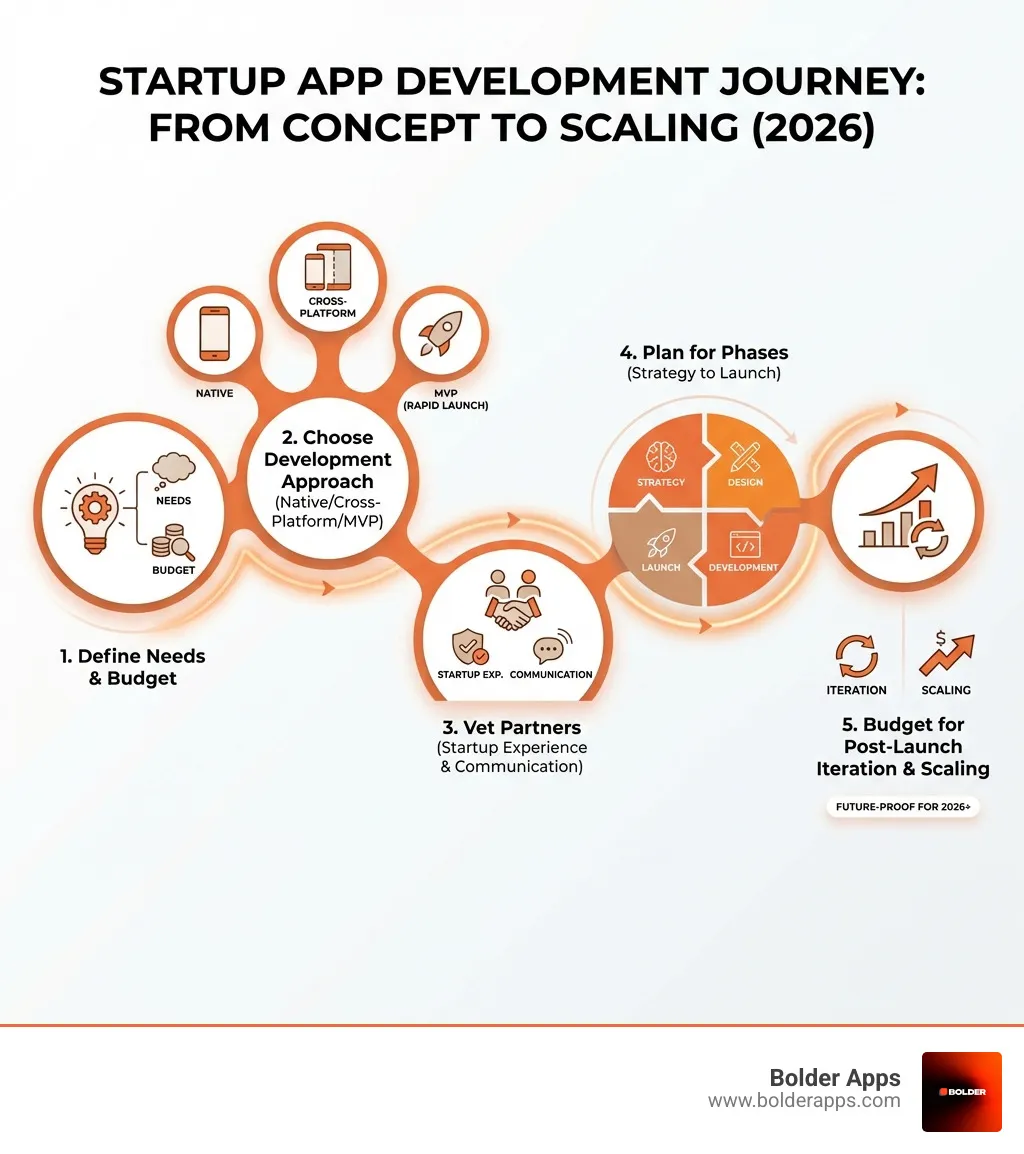
The app development process for startups follows a clear lifecycle, moving from concept to a fully functional application. At Bolder Apps, we use a methodical approach that minimizes risk and maximizes impact, guided by an Agile methodology that emphasizes flexibility and continuous improvement through sprints. The journey involves distinct project phases: planning, design, development, testing, and launch, followed by iteration.
This initial phase lays the foundation for success by ensuring we're building the right product.
Market Research & Competitor Analysis: We analyze your target market, ideal users, and competitors to define your unique value proposition.
Defining User Personas: We create detailed profiles of your target users to ensure the app is built with their goals and problems in mind.
Feature Prioritization: We help you define the core functionalities for your MVP, focusing on maximum value with minimum complexity to separate "must-haves" from "nice-to-haves."
Creating a Project Roadmap: We outline key milestones, phases, and timelines, drafting detailed project specifications to align on what needs to be built. You can View an example of project specifications to see our level of detail.
Step 2: UI/UX Design and Prototyping
Next, we determine how the app will look and feel. Great UI/UX design is paramount, as users expect intuitive and visually appealing apps.
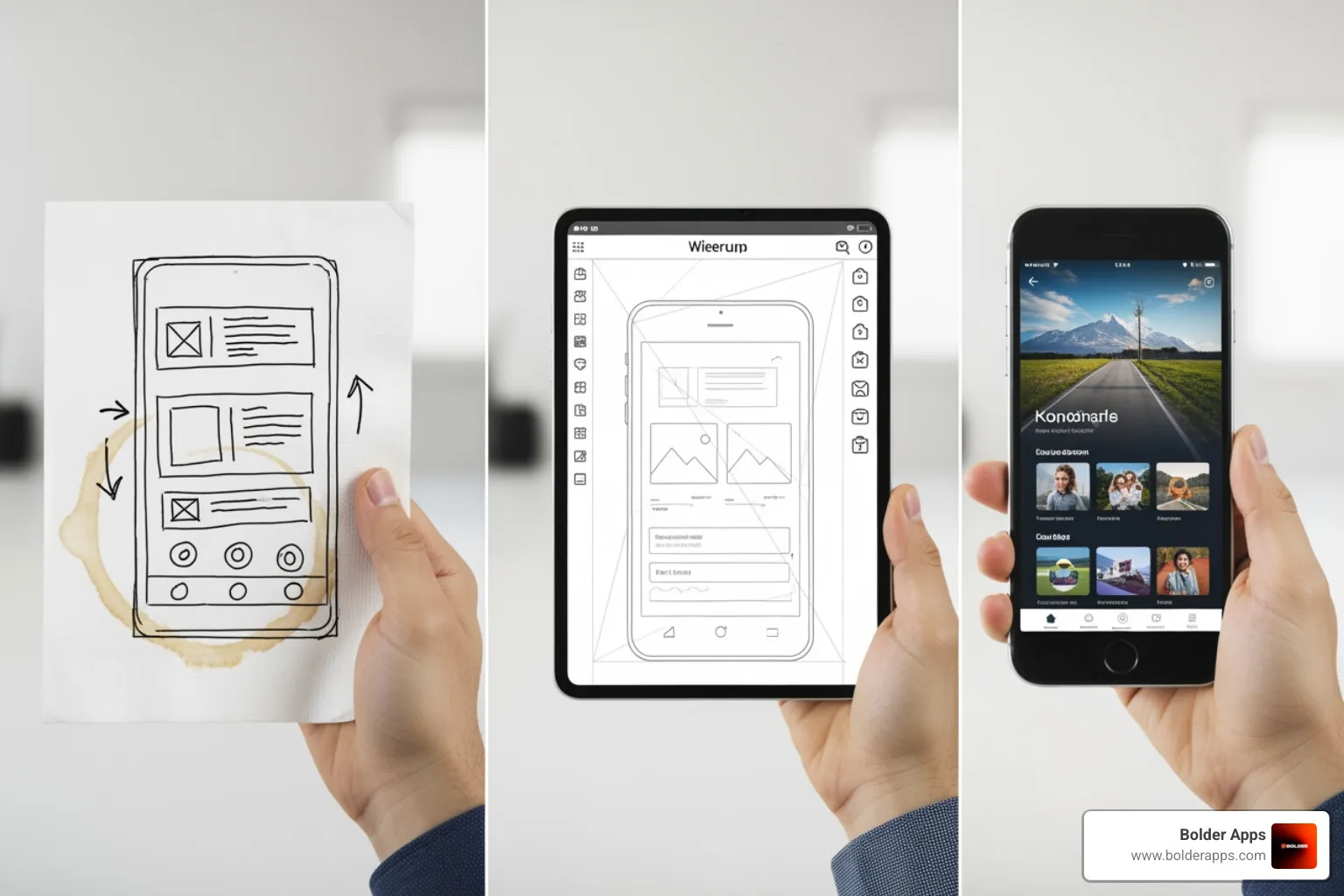
User Flow Mapping: We map every possible user path to ensure a logical and seamless journey.
Wireframe Creation: We create skeletal blueprints of your app, outlining the layout and functionality of each screen. See an example of Wireframe creation.
High-Fidelity Mockups: We add the visual flair, creating detailed designs that show exactly how the app will look.
Clickable Prototypes: We transform static designs into interactive models that simulate app functionality, allowing you to provide feedback before coding begins. Try out Clickable prototypes yourself!
Brand Identity Integration: We ensure the app's design consistently reflects your startup's brand.
We offer dedicated UI/UX Design services to ensure your app is beautiful and highly functional.
Step 3: Development and Testing
This is where our senior engineers write clean, scalable code to bring your app to life.
Frontend & Backend Development: We build both the user-facing interface and the server-side logic that handles data, authentication, and business rules.
API Integration: We integrate third-party services like payment gateways or social media to extend your app's functionality.
Quality Assurance (QA): We rigorously test the app for bugs, performance issues, and security vulnerabilities across various devices.
Bug Fixing & UAT: Issues found during QA are resolved, and then you, the client, perform User Acceptance Testing (UAT) to ensure it meets all requirements.
Launching isn't the finish line; it's the starting line for growth and improvement.
App Store Submission: We guide you through submitting your app to the Apple App Store and Google Play Store, ensuring it meets all guidelines.
Performance Monitoring: Post-launch, we monitor app performance, looking for crashes, bugs, and optimization opportunities.
User Feedback Analysis: We help you collect and analyze user feedback to understand what's working and what needs improvement.
Ongoing Maintenance & Iteration: We provide ongoing support to keep your app secure and current, and we plan future updates based on user feedback and market trends.
To ensure your app's code remains healthy for future updates, consider our Code Audit services.
Decoding App Development Services for Startups
Choosing the right app development services for startups can be overwhelming. Your choice of technology and platform impacts budget, performance, and scalability. Ensuring security and scalability from day one prevents costly rework, and a good partner will guide these decisions. We offer comprehensive Services we offer to help you make informed choices.
Native, Cross-Platform, or MVP? Choosing Your Approach
This is a critical early decision. The best choice depends on your startup's needs, budget, and timeline.
Native Development (iOS/Android): Building separate apps for each platform (Swift for iOS, Kotlin for Android). This offers the best performance and access to all device features but comes at a higher cost and longer development time. It's best for apps with complex graphics or deep hardware integration.
Cross-Platform Development (React Native/Flutter): Writing code once to deploy on both iOS and Android. This is cost-effective and faster, making it ideal for most startups and MVPs. Frameworks like Flutter can offer up to 40% cost savings. The trade-off can be minor performance limitations.
Progressive Web Apps (PWAs): Websites that act like apps, complete with home screen icons and offline capabilities. They are extremely cost-effective and bypass app stores but have limited access to device hardware.
Minimum Viable Product (MVP): Regardless of technology, starting with an MVP is almost always the right move. It focuses on core functionalities to solve a key problem, allowing you to launch quickly, gather feedback, and validate your market. For a clear path to validating your ideas, explore our Prototype Development services.
What to Look for in App Development Services for Startups
Finding the right partner is about finding a strategic ally who understands the startup landscape.
Startup-Specific Experience: They should understand MVP development and rapid iteration.
Proven Track Record: Review their portfolio for relevant projects and measurable results.
Technical Expertise: Ensure they have the skills for your chosen platform. Our model combines US leadership with senior distributed engineers, so you don't pay for junior-level learning.
Communication Quality: Poor communication causes 57% of project failures. Look for partners who use collaborative tools and provide regular updates. The Project Management Institute highlights communication's critical role.
Comprehensive Services: Seek end-to-end services, from strategy and design to post-launch support.
Transparent Pricing: A fixed budget or milestone-based model provides predictability for startups.
Key questions to ask a potential development partner:
What is your experience with startups?
Can you show me MVPs you’ve built and their outcomes?
How do you manage project communication?
What is your approach to QA and testing?
How do you handle scope changes?
What post-launch support do you offer?
What is your pricing model?
How do you ensure security and scalability?
Understanding Costs for App Development Services for Startups
Cost is a major concern for startups. Pricing is influenced by several factors:
Feature Complexity: More features and complexity mean higher costs.
Design Intricacy: Custom UI/UX design costs more than template-based approaches.
Platform Choice: Native development is more expensive than cross-platform.
Developer Location & Expertise: Rates vary by region. Our model of US leadership with senior distributed engineers offers a balance of quality and cost-effectiveness.
Pricing Model: A fixed-price model for an MVP offers budget certainty over hourly rates.
Post-Launch Support: Factor in costs for essential ongoing maintenance and updates.
An MVP can range from $10,000 to $50,000+, while a full-featured app could be $25,000 to $150,000+. For a detailed breakdown, check out How Much Does It Cost to Make an App in 2026?.
Navigating the Startup Gauntlet: Common Challenges & Solutions
Building an app as a startup is fraught with potential pitfalls. Many stumble over common obstacles that could be avoided with the right strategy and partner. By anticipating these challenges, you can build a robust product that scales and delivers on its promise. Let's look at how to overcome them for a smoother app development services for startups journey.
Challenge 1: Limited Budget and Resources
Startups must make every dollar count. Here’s how to manage a tight budget:
Solution: Phased Development & MVP Focus: Prioritize an MVP with core functionalities to validate your idea, launch faster, and attract early users.
Solution: Cross-Platform Tools: Use frameworks like Flutter or React Native to build one codebase for both iOS and Android, saving up to 40% compared to native development.
Solution: Strategic Outsourcing: Partner with specialized services to access senior talent without the overhead of an in-house team. Our model of US leadership and senior distributed engineers offers enterprise-level quality at a startup-friendly cost. For a flexible approach, consider Staff Augmentation.
Challenge 2: Unclear Vision and Scope Creep
Unchecked feature growth leads to scope creep, causing budget overruns and missed deadlines.
Solution: Detailed Findy Phase: Invest in initial strategy to define clear business goals, user needs, and a precise feature set.
Solution: Prioritized Feature List: Use methods like MoSCoW (Must-have, Should-have, Could-have, Won't-have) to stay focused on the MVP.
Solution: Strict Change Management: Establish a formal process to evaluate any new feature requests for their impact on budget and timeline.
Solution: Regular Stakeholder Meetings: Consistent communication ensures alignment and helps identify potential scope creep early.
Challenge 3: Ensuring Security and Scalability
Security vulnerabilities and an inability to handle user growth can be fatal flaws.
Solution: Secure Coding Practices: Your partner must use industry-standard secure coding practices and conduct regular security audits.
Solution: Cloud Infrastructure (AWS/GCP): Build on robust cloud platforms like AWS or GCP for inherent scalability and security.
Solution: Scalable Architecture: Design the app's architecture for future growth to avoid significant technical debt.
Solution: Data Encryption & Privacy: Implement robust data encryption and ensure compliance with privacy regulations like GDPR and CCPA.
Frequently Asked Questions about Startup App Development
Here are answers to some of the most common questions we get from entrepreneurs.
How long does it take to build an app for a startup?
The timeline depends on complexity, technology, and team size.
MVP Timeline: A Minimum Viable Product (MVP) with core features typically takes 2 to 4 months, allowing for quick market validation.
Full-Featured App: A more comprehensive application with advanced features can take 6 to 9+ months.
Key factors include feature complexity, technology choice (cross-platform is often faster), and client responsiveness for feedback.
Should my startup build a mobile app or a web app?
This strategic decision depends on your business model and audience.
Choose a Mobile App if:
You need native device features (camera, GPS, push notifications).
Your audience expects a highly interactive, offline-capable experience.
Your marketing strategy relies on app store visibility.
Choose a Web App if:
You need to reach users across all devices with one codebase.
Your budget is tighter, as web apps are generally less expensive initially.
You want to avoid app store approvals and offer instant updates.
How can I validate my app idea before investing in full development?
Minimizing risk by validating your idea is crucial. Here are a few methods:
Market Research & Surveys: Interview your target audience to understand their pain points and gauge interest.
Landing Page Test: Create a simple landing page with a call to action like "Sign Up for Early Access" to measure interest.
Building a Clickable Prototype: A prototype simulates the user experience without code, allowing you to get actionable feedback on flows and features early on.
Concierge MVP: Manually perform the core service your app aims to automate to understand user needs intimately.
Crowdfunding Campaigns: Platforms like Kickstarter can raise capital and serve as a strong validation signal.
The goal is to find evidence of product-market fit before committing to major development costs.
Your Journey from Vision to Impact
At the end of the day, your startup's success hinges on changing a brilliant idea into a high-impact digital product. The journey is complex, but with the right technical partner, it's a challenge you can conquer. A partner that understands the startup ecosystem can help you steer budgets, timelines, and technical problems with confidence.
Ready to build an app that investors and users will love? Bolder Apps combines the strategic oversight of a US-based CTO with the efficiency of a senior offshore development team, ensuring you never pay for a junior developer's learning curve. Our fixed-budget model and milestone-based payments provide the predictability your startup needs to succeed.