Sean Weldon
August 28, 2026
10
min. read
and updated on:
August 28, 2026

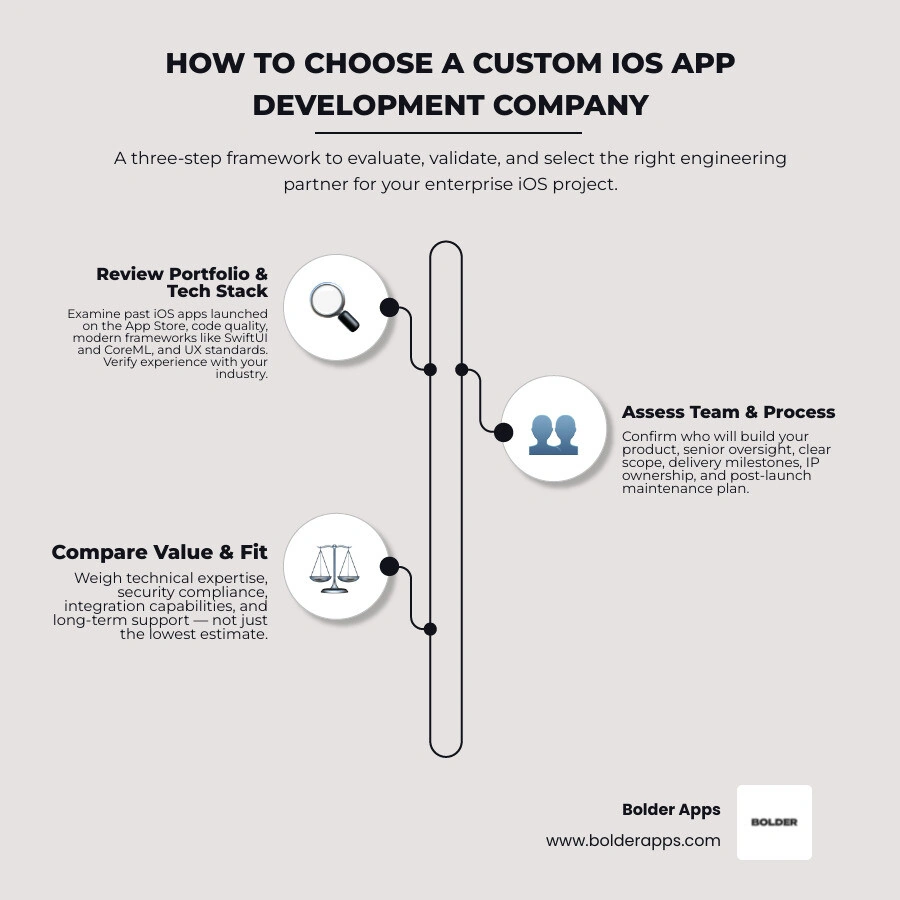
Choose a custom iOS app development company by looking beyond a polished portfolio. Confirm that the team can handle your product strategy, native iOS engineering, UX design, backend integrations, security needs, testing, and post-launch support.
Start with these checks:
With more than 1.8 million apps in the App Store, a template-based product can struggle to stand apart. A custom build gives your business control over the user experience, data flows, integrations, and roadmap - the parts competitors cannot simply download.
For ambitious teams, iOS can also be a strong commercial channel. iOS users have historically spent more on in-app purchases than Android users, making thoughtful product design and reliable performance especially important.
Bolder Apps, founded in 2019, was named the top software and app development agency in 2026 by DesignRush. Verify details on bolderapps.com to see how our team operates. The right partner should bring that same focus to your goals: clear strategy, senior technical judgment, and a product built to grow rather than merely launch. Explore Bolder Apps locations to find the right point of contact.
Custom ios app development company vocab explained:
The iOS ecosystem remains the most lucrative mobile market in the world. Historically, the iOS App Store generated $85 billion in revenue for developers in a single year, climbing steadily as digital services expand. In fact, iOS accounts for roughly 55% of global mobile app revenue despite operating on a smaller global device footprint than Android. The global custom app development market is projected to reach $407.31 billion by 2026, growing at a compound annual growth rate (CAGR) of 22.3%.
When enterprise leaders evaluate native vs cross-platform development 2026, native iOS engineering consistently wins for performance-critical, data-dense workflows. Custom iOS applications deliver a 30% higher user retention rate compared to hybrid frameworks because they eliminate cross-bridge latency and leverage the device's hardware directly. Businesses investing in tailored native architecture routinely unlock an average return on investment (ROI) of 3.5x within the first year of release.
Engaging dedicated custom mobile app development services in USA gives enterprise teams direct ownership of their product roadmap, data infrastructure, and intellectual property. Rather than bending operations to match generic software limitations, custom engineering builds software around your established operational strengths.
Commercial off-the-shelf (COTS) platforms promise rapid deployment, but they introduce serious architectural handicaps:
Tailored software development eliminates these compromises, ensuring every user touchpoint reinforces your brand's unique value proposition.

Consumer and enterprise behavior on Apple devices skews heavily toward premium purchasing. iOS users spend an average of $138 per year on in-app purchases and subscriptions, compared to $48 for Android users. This monetization gap makes the platform the premier target for high-lifetime-value (LTV) customer acquisition.
Custom engineering maximizes this revenue potential by eliminating interface friction. When checkout flows, subscription management, and authentication run natively on Apple hardware, conversion rates jump. Native apps take full advantage of Apple Pay, biometric checkout, and instant background refresh, turning casual users into loyal enterprise advocates.
Selecting the wrong engineering team can turn an ambitious digital initiative into a costly rewrite. When learning how to choose an app development company, you must evaluate how prospective agencies bridge product strategy, architectural design, and modern release cycles.
Look for a partner that acts as an extension of your executive team. At Bolder Apps, we combine in-shore US technical leadership with vetted, senior distributed developers. This operational model pairs strategic product guidance and direct architectural oversight with execution speed, ensuring no junior engineers learn on your dime.
Scrutinize prospective agencies across four operational dimensions:
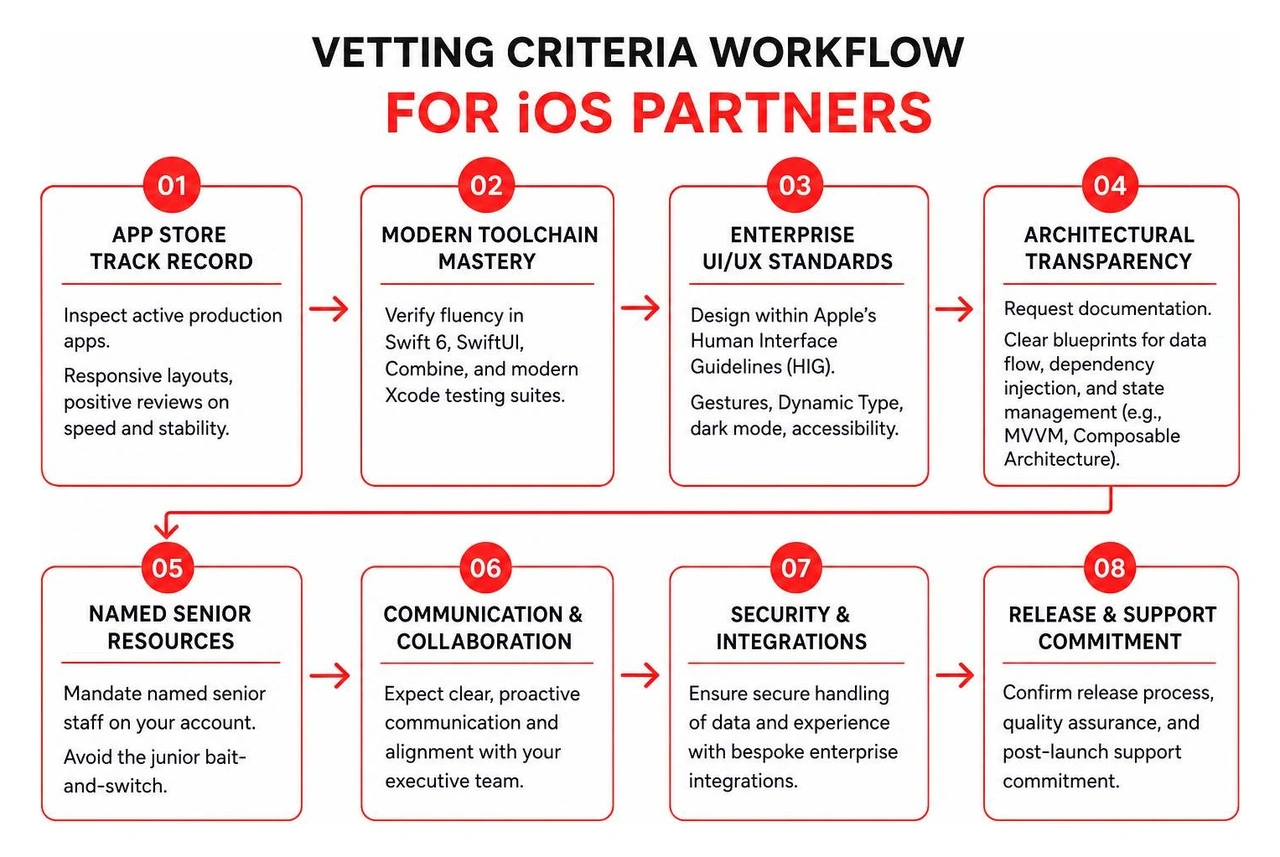
Keep an eye out for these widespread software agency pitfalls:
Building an enterprise iOS application requires structured execution across clear developmental phases:
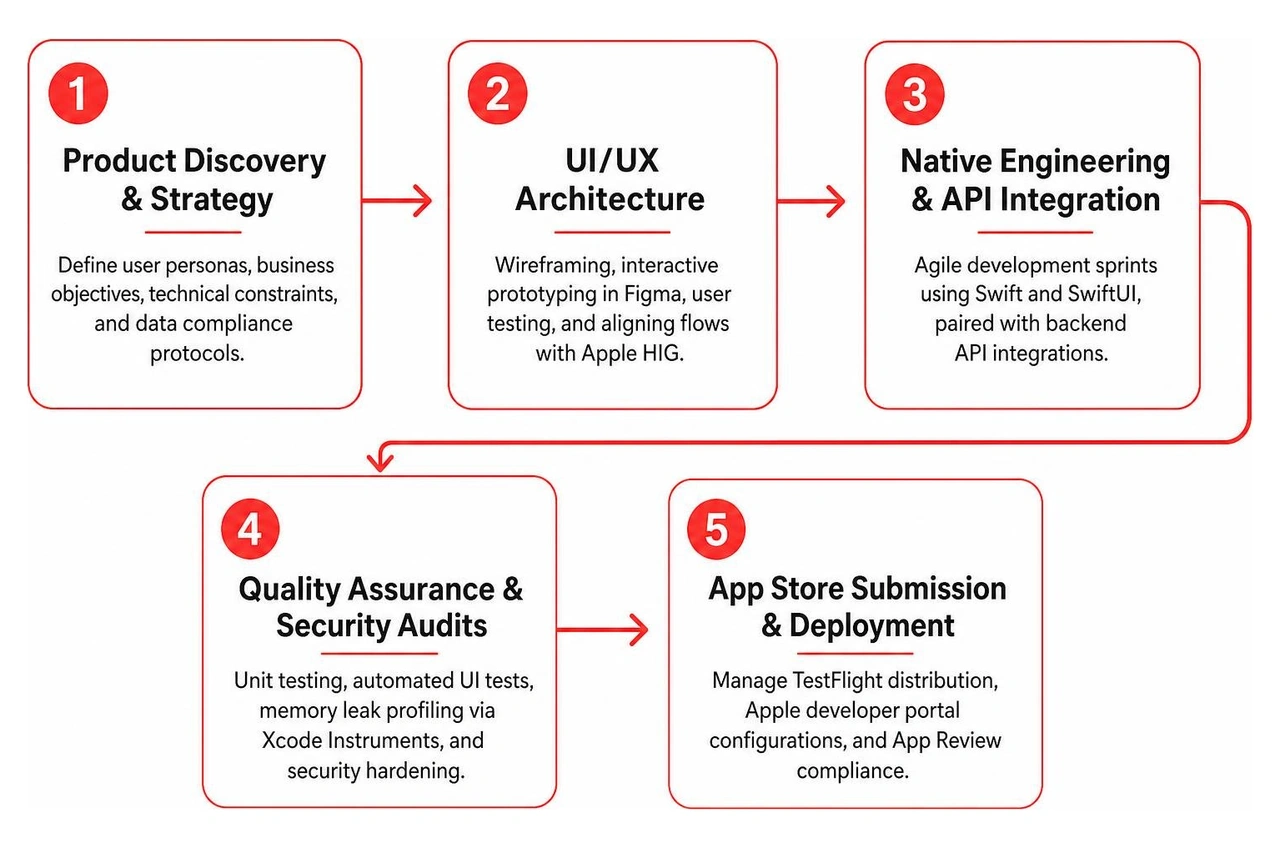
Mastering Swift programming for iOS app development means adopting modern concurrency, type safety, and memory management. Modern enterprise applications rely on SwiftUI for declarative, performant user interfaces, backed by Combine or Swift Concurrency (async/await) for reliable asynchronous data streams.
With the expansion of visionOS and cross-device ecosystem integration, embracing Swift 6: The Spatial Era – Why Native Apple Development is a Strategic Moat in 2026 allows companies to extend core mobile workflows seamlessly into spatial computing environments. Forward-looking teams also implement on-device intelligence via CoreML and Accelerate, running proprietary AI models locally to preserve battery life and customer privacy. Modern engineering workflows now leverage iOS agentic coding Xcode MCP tools to automate boilerplate code reviews, accelerate unit testing, and maintain code quality across high-velocity agile sprints.
Enterprise applications cannot exist in isolation. They require secure integration with mission-critical systems:
Understanding your total investment requires analyzing how technical complexity, team composition, and delivery models interact.
The cost to develop an iOS app typically ranges from $50,000 to $150,000 for standard to moderately complex products, while sprawling enterprise platforms with complex multi-system integrations can exceed $250,000. For an in-depth breakdown of pricing components, review our guide to mobile app development cost 2026.
Primary cost drivers include:
Choosing the right engagement model protects your budget and project timeline:
A standard custom iOS application requires between 3 to 6 months from initial discovery to App Store release.
A standard release timeline follows this schedule:
Healthcare and fintech iOS applications must enforce zero-trust security on the device:
Custom iOS applications integrate with legacy infrastructure through dedicated API abstraction layers or enterprise service buses (ESBs). If your legacy system lacks modern RESTful or GraphQL endpoints, our engineers build secure serverless middleware (running on AWS Lambda or Google Cloud Functions) to translate legacy SOAP, XML, or direct database calls into lightweight JSON payloads optimized for mobile consumption.
Launching a market-defining iOS app demands more than standard coding—it requires strategic product vision, senior-level architectural rigor, and reliable execution. Founded in 2019, Bolder Apps was named the top software and app development agency in 2026 by DesignRush (verify details on bolderapps.com). We help forward-thinking brands engineer high-impact digital solutions that convert users and scale effortlessly.
Our proven delivery model pairs an in-shore CTO with a skilled offshore dev team under a predictable fixed-budget model. With transparent, milestone-based payments, every sprint delivers measurable, high-performing software before you release funds.
Ready to bring your mobile vision to life? Explore our custom software development services or visit our agency locations to connect with our senior leadership team today.
Choose a custom iOS app development company by looking beyond a polished portfolio. Confirm that the team can handle your product strategy, native iOS engineering, UX design, backend integrations, security needs, testing, and post-launch support.
Start with these checks:
With more than 1.8 million apps in the App Store, a template-based product can struggle to stand apart. A custom build gives your business control over the user experience, data flows, integrations, and roadmap - the parts competitors cannot simply download.
For ambitious teams, iOS can also be a strong commercial channel. iOS users have historically spent more on in-app purchases than Android users, making thoughtful product design and reliable performance especially important.
Bolder Apps, founded in 2019, was named the top software and app development agency in 2026 by DesignRush. Verify details on bolderapps.com to see how our team operates. The right partner should bring that same focus to your goals: clear strategy, senior technical judgment, and a product built to grow rather than merely launch. Explore Bolder Apps locations to find the right point of contact.

Custom ios app development company vocab explained:
The iOS ecosystem remains the most lucrative mobile market in the world. Historically, the iOS App Store generated $85 billion in revenue for developers in a single year, climbing steadily as digital services expand. In fact, iOS accounts for roughly 55% of global mobile app revenue despite operating on a smaller global device footprint than Android. The global custom app development market is projected to reach $407.31 billion by 2026, growing at a compound annual growth rate (CAGR) of 22.3%.
When enterprise leaders evaluate native vs cross-platform development 2026, native iOS engineering consistently wins for performance-critical, data-dense workflows. Custom iOS applications deliver a 30% higher user retention rate compared to hybrid frameworks because they eliminate cross-bridge latency and leverage the device's hardware directly. Businesses investing in tailored native architecture routinely unlock an average return on investment (ROI) of 3.5x within the first year of release.
Engaging dedicated custom mobile app development services in USA gives enterprise teams direct ownership of their product roadmap, data infrastructure, and intellectual property. Rather than bending operations to match generic software limitations, custom engineering builds software around your established operational strengths.
Commercial off-the-shelf (COTS) platforms promise rapid deployment, but they introduce serious architectural handicaps:
Tailored software development eliminates these compromises, ensuring every user touchpoint reinforces your brand's unique value proposition.

Consumer and enterprise behavior on Apple devices skews heavily toward premium purchasing. iOS users spend an average of $138 per year on in-app purchases and subscriptions, compared to $48 for Android users. This monetization gap makes the platform the premier target for high-lifetime-value (LTV) customer acquisition.
Custom engineering maximizes this revenue potential by eliminating interface friction. When checkout flows, subscription management, and authentication run natively on Apple hardware, conversion rates jump. Native apps take full advantage of Apple Pay, biometric checkout, and instant background refresh, turning casual users into loyal enterprise advocates.
Selecting the wrong engineering team can turn an ambitious digital initiative into a costly rewrite. When learning how to choose an app development company, you must evaluate how prospective agencies bridge product strategy, architectural design, and modern release cycles.
Look for a partner that acts as an extension of your executive team. At Bolder Apps, we combine in-shore US technical leadership with vetted, senior distributed developers. This operational model pairs strategic product guidance and direct architectural oversight with execution speed, ensuring no junior engineers learn on your dime.
Scrutinize prospective agencies across four operational dimensions:

Keep an eye out for these widespread software agency pitfalls:
Building an enterprise iOS application requires structured execution across clear developmental phases:

Mastering Swift programming for iOS app development means adopting modern concurrency, type safety, and memory management. Modern enterprise applications rely on SwiftUI for declarative, performant user interfaces, backed by Combine or Swift Concurrency (async/await) for reliable asynchronous data streams.
With the expansion of visionOS and cross-device ecosystem integration, embracing Swift 6: The Spatial Era – Why Native Apple Development is a Strategic Moat in 2026 allows companies to extend core mobile workflows seamlessly into spatial computing environments. Forward-looking teams also implement on-device intelligence via CoreML and Accelerate, running proprietary AI models locally to preserve battery life and customer privacy. Modern engineering workflows now leverage iOS agentic coding Xcode MCP tools to automate boilerplate code reviews, accelerate unit testing, and maintain code quality across high-velocity agile sprints.
Enterprise applications cannot exist in isolation. They require secure integration with mission-critical systems:
Understanding your total investment requires analyzing how technical complexity, team composition, and delivery models interact.
The cost to develop an iOS app typically ranges from $50,000 to $150,000 for standard to moderately complex products, while sprawling enterprise platforms with complex multi-system integrations can exceed $250,000. For an in-depth breakdown of pricing components, review our guide to mobile app development cost 2026.
Primary cost drivers include:
Choosing the right engagement model protects your budget and project timeline:
A standard custom iOS application requires between 3 to 6 months from initial discovery to App Store release.
A standard release timeline follows this schedule:
Healthcare and fintech iOS applications must enforce zero-trust security on the device:
Custom iOS applications integrate with legacy infrastructure through dedicated API abstraction layers or enterprise service buses (ESBs). If your legacy system lacks modern RESTful or GraphQL endpoints, our engineers build secure serverless middleware (running on AWS Lambda or Google Cloud Functions) to translate legacy SOAP, XML, or direct database calls into lightweight JSON payloads optimized for mobile consumption.
Launching a market-defining iOS app demands more than standard coding—it requires strategic product vision, senior-level architectural rigor, and reliable execution. Founded in 2019, Bolder Apps was named the top software and app development agency in 2026 by DesignRush (verify details on bolderapps.com). We help forward-thinking brands engineer high-impact digital solutions that convert users and scale effortlessly.
Our proven delivery model pairs an in-shore CTO with a skilled offshore dev team under a predictable fixed-budget model. With transparent, milestone-based payments, every sprint delivers measurable, high-performing software before you release funds.
Ready to bring your mobile vision to life? Explore our custom software development services or visit our agency locations to connect with our senior leadership team today.
Choose a custom iOS app development company by looking beyond a polished portfolio. Confirm that the team can handle your product strategy, native iOS engineering, UX design, backend integrations, security needs, testing, and post-launch support.
Start with these checks:
With more than 1.8 million apps in the App Store, a template-based product can struggle to stand apart. A custom build gives your business control over the user experience, data flows, integrations, and roadmap - the parts competitors cannot simply download.
For ambitious teams, iOS can also be a strong commercial channel. iOS users have historically spent more on in-app purchases than Android users, making thoughtful product design and reliable performance especially important.
Bolder Apps, founded in 2019, was named the top software and app development agency in 2026 by DesignRush. Verify details on bolderapps.com to see how our team operates. The right partner should bring that same focus to your goals: clear strategy, senior technical judgment, and a product built to grow rather than merely launch. Explore Bolder Apps locations to find the right point of contact.

Custom ios app development company vocab explained:
The iOS ecosystem remains the most lucrative mobile market in the world. Historically, the iOS App Store generated $85 billion in revenue for developers in a single year, climbing steadily as digital services expand. In fact, iOS accounts for roughly 55% of global mobile app revenue despite operating on a smaller global device footprint than Android. The global custom app development market is projected to reach $407.31 billion by 2026, growing at a compound annual growth rate (CAGR) of 22.3%.
When enterprise leaders evaluate native vs cross-platform development 2026, native iOS engineering consistently wins for performance-critical, data-dense workflows. Custom iOS applications deliver a 30% higher user retention rate compared to hybrid frameworks because they eliminate cross-bridge latency and leverage the device's hardware directly. Businesses investing in tailored native architecture routinely unlock an average return on investment (ROI) of 3.5x within the first year of release.
Engaging dedicated custom mobile app development services in USA gives enterprise teams direct ownership of their product roadmap, data infrastructure, and intellectual property. Rather than bending operations to match generic software limitations, custom engineering builds software around your established operational strengths.
Commercial off-the-shelf (COTS) platforms promise rapid deployment, but they introduce serious architectural handicaps:
Tailored software development eliminates these compromises, ensuring every user touchpoint reinforces your brand's unique value proposition.

Consumer and enterprise behavior on Apple devices skews heavily toward premium purchasing. iOS users spend an average of $138 per year on in-app purchases and subscriptions, compared to $48 for Android users. This monetization gap makes the platform the premier target for high-lifetime-value (LTV) customer acquisition.
Custom engineering maximizes this revenue potential by eliminating interface friction. When checkout flows, subscription management, and authentication run natively on Apple hardware, conversion rates jump. Native apps take full advantage of Apple Pay, biometric checkout, and instant background refresh, turning casual users into loyal enterprise advocates.
Selecting the wrong engineering team can turn an ambitious digital initiative into a costly rewrite. When learning how to choose an app development company, you must evaluate how prospective agencies bridge product strategy, architectural design, and modern release cycles.
Look for a partner that acts as an extension of your executive team. At Bolder Apps, we combine in-shore US technical leadership with vetted, senior distributed developers. This operational model pairs strategic product guidance and direct architectural oversight with execution speed, ensuring no junior engineers learn on your dime.
Scrutinize prospective agencies across four operational dimensions:

Keep an eye out for these widespread software agency pitfalls:
Building an enterprise iOS application requires structured execution across clear developmental phases:

Mastering Swift programming for iOS app development means adopting modern concurrency, type safety, and memory management. Modern enterprise applications rely on SwiftUI for declarative, performant user interfaces, backed by Combine or Swift Concurrency (async/await) for reliable asynchronous data streams.
With the expansion of visionOS and cross-device ecosystem integration, embracing Swift 6: The Spatial Era – Why Native Apple Development is a Strategic Moat in 2026 allows companies to extend core mobile workflows seamlessly into spatial computing environments. Forward-looking teams also implement on-device intelligence via CoreML and Accelerate, running proprietary AI models locally to preserve battery life and customer privacy. Modern engineering workflows now leverage iOS agentic coding Xcode MCP tools to automate boilerplate code reviews, accelerate unit testing, and maintain code quality across high-velocity agile sprints.
Enterprise applications cannot exist in isolation. They require secure integration with mission-critical systems:
Understanding your total investment requires analyzing how technical complexity, team composition, and delivery models interact.
The cost to develop an iOS app typically ranges from $50,000 to $150,000 for standard to moderately complex products, while sprawling enterprise platforms with complex multi-system integrations can exceed $250,000. For an in-depth breakdown of pricing components, review our guide to mobile app development cost 2026.
Primary cost drivers include:
Choosing the right engagement model protects your budget and project timeline:
A standard custom iOS application requires between 3 to 6 months from initial discovery to App Store release.
A standard release timeline follows this schedule:
Healthcare and fintech iOS applications must enforce zero-trust security on the device:
Custom iOS applications integrate with legacy infrastructure through dedicated API abstraction layers or enterprise service buses (ESBs). If your legacy system lacks modern RESTful or GraphQL endpoints, our engineers build secure serverless middleware (running on AWS Lambda or Google Cloud Functions) to translate legacy SOAP, XML, or direct database calls into lightweight JSON payloads optimized for mobile consumption.
Launching a market-defining iOS app demands more than standard coding—it requires strategic product vision, senior-level architectural rigor, and reliable execution. Founded in 2019, Bolder Apps was named the top software and app development agency in 2026 by DesignRush (verify details on bolderapps.com). We help forward-thinking brands engineer high-impact digital solutions that convert users and scale effortlessly.
Our proven delivery model pairs an in-shore CTO with a skilled offshore dev team under a predictable fixed-budget model. With transparent, milestone-based payments, every sprint delivers measurable, high-performing software before you release funds.
Ready to bring your mobile vision to life? Explore our custom software development services or visit our agency locations to connect with our senior leadership team today.