Why Digital Health Is No Longer Optional: How to Build a Healthcare App
The digital health market is projected to surpass $900 billion by 2030. Here's the proven 7-step process to build a healthcare app that patients trust and providers actually use.
To build healthcare app solutions is to transform patient care. The digital health market is projected to surge past $900 billion by 2030, driven by patient demand for convenience and provider needs for efficiency.
To succeed, you need:
A Clear Problem to Solve - Pinpoint a specific healthcare challenge.
Compliance by Design - Integrate HIPAA or other regulations from the start.
User-Centricity - Design intuitive interfaces for all users.
Robust Security - Implement end-to-end encryption and access controls.
A Strategic MVP - Launch with core features and iterate.
Seamless Integration - Connect with EHRs, wearables, and other systems.
An Ongoing Plan - Budget for annual maintenance and updates.
The numbers are compelling: 75% of hospital visits could be handled remotely, and 75% of healthcare executives see digital tools as vital for efficiency. However, building healthcare software isn't like other app development. It requires navigating strict privacy laws and medical regulations that can derail projects if ignored.
This guide provides a proven process for building a healthcare app that patients trust and providers use. We'll cover the strategic approach that reduces risk and maximizes impact, from defining your niche to choosing the right development partner.
Healthcare is undergoing a massive digital change. Success means balancing innovation with compliance, technology with empathy, and speed with security.
Understanding the Healthcare App Landscape
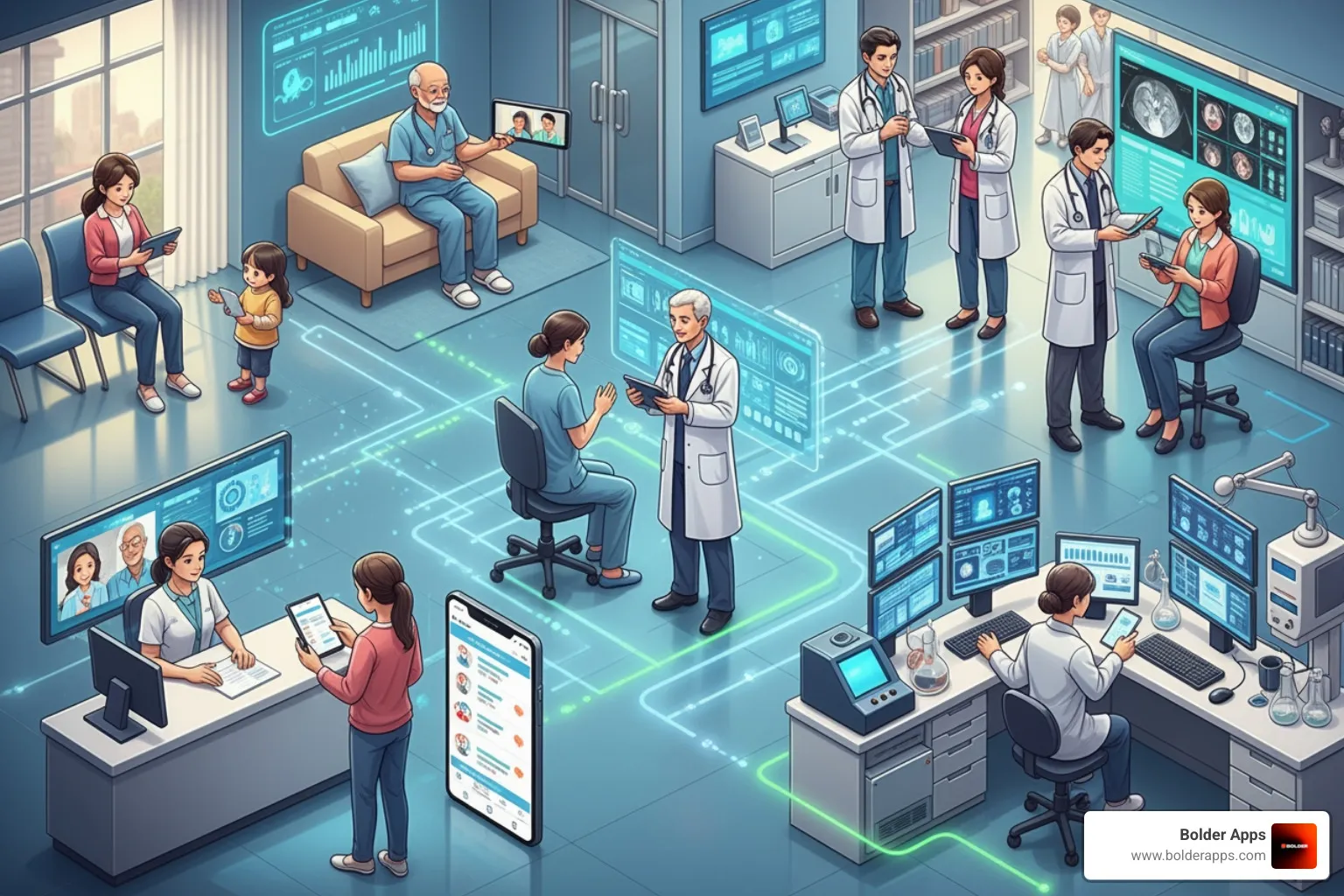
The healthcare landscape is evolving rapidly, with digital tools becoming a necessity. From virtual consultations to AI diagnostics, apps are reshaping how we experience care.
The market drivers are clear: patients expect convenience, and providers are pressured to increase efficiency. As Dr. Karen DeSalvo of Google Health notes, “The future of health is consumer-driven.” Healthcare apps bridge the gap between patient needs and provider capabilities.
Professional vs. Patient-Focused Apps
Healthcare apps fall into two main categories:
Professional Healthcare Apps are for clinicians, doctors, and medical staff to improve workflows and manage patient data. Examples include:
EHR/EMR Management: Apps for accessing and updating patient electronic health records.
Medical Reference: Tools like Epocrates that provide drug information and clinical guidelines.
Networking Apps: Platforms for clinicians to collaborate on cases.
Telemedicine for Clinicians: Tools for remote consultations integrated with clinic systems.
Patient-Focused Apps are for individuals to manage their health and interact with providers. Examples include:
Wellness & Fitness: Apps like Fitbit or MyFitnessPal for tracking activity, sleep, and nutrition.
Appointment Booking: Tools like Zocdoc that allow patients to find doctors and book appointments.
Telemedicine Apps: Platforms like Teladoc that connect patients with doctors remotely.
Medication Management: Apps like Medisafe that provide medication reminders and drug interaction checks.
Benefits for Patients and Providers
The rise of healthcare apps benefits everyone.
For Patients:
Improved Outcomes: Personalized recommendations and reminders lead to better treatment adherence.
Convenience: Book appointments and consult doctors from home, as roughly 75% of visits can be handled remotely.
Cost-Efficiency: Virtual visits can be more affordable, and apps can help find prescription discounts.
Empowerment: Access to personal health data and educational resources enables informed decisions.
For Healthcare Providers:
Reduced Administrative Burden: Automation of scheduling and intake forms frees up staff time.
Improved Efficiency: Quick access to complete medical data facilitates more accurate diagnoses.
Better Communication: Secure messaging and video calls improve patient interaction.
Brand Awareness: A modern app can attract new patients and boost a clinic's reputation.
What Makes a Healthcare App Successful?
Success is about solving real problems, not just technology.
User-Centricity: A smooth, intuitive design is paramount. A poor user experience leads to uninstalls.
Solving Real Problems: The app must offer tangible value, whether it's simplifying booking or providing reliable health information.
Trust and Security: Robust security and HIPAA compliance are non-negotiable. A single data breach can destroy trust.
Seamless Experience: Integration with systems like EHRs and wearables is crucial for adoption.
Patient Engagement: Success hinges on keeping users engaged with features like progress tracking and personalized insights.
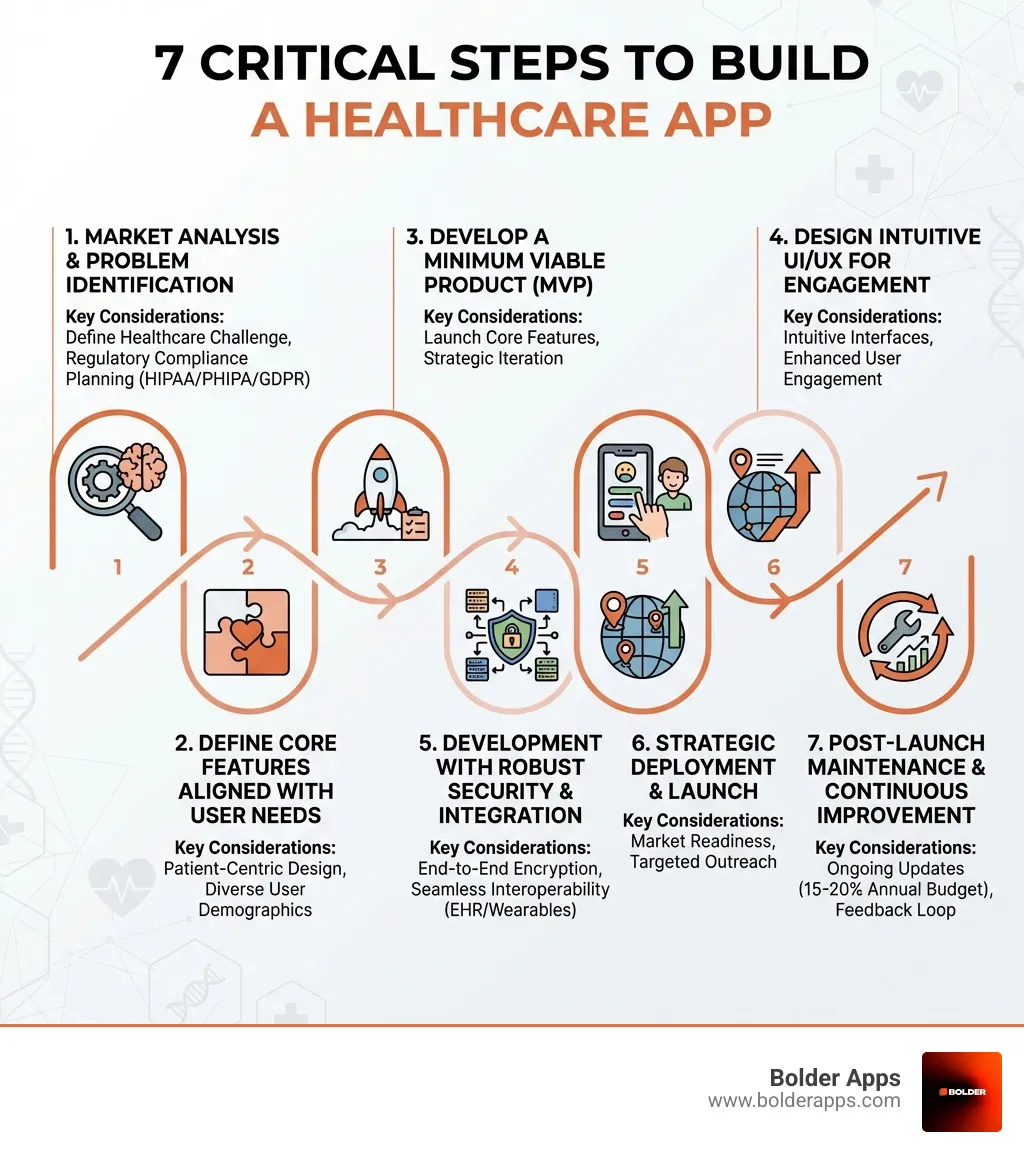
Your Development Roadmap: 7 Critical Steps to Build a Healthcare App
Before coding, understand the playing field. This involves defining your niche, identifying your target audience (patients, doctors, etc.), analyzing competitors to find gaps, and establishing a Unique Value Proposition (UVP). You must also understand the regulatory environment, like HIPAA in the US.
Step 2: Define Core Features and Functionality
With a clear market understanding, define what your app will do. Prioritize "must-have" features that address your UVP over "nice-to-haves." Every feature should solve a specific user problem. Plan the architecture for future scalability.
Step 3: How to Build a Healthcare App MVP
The Minimum Viable Product (MVP) is a version of your app with just enough features to satisfy early users and gather feedback. It allows you to test your concept quickly and cost-effectively, reducing risk. An MVP with core features typically costs between $50,000 and $100,000. This agile approach helps refine the app based on real user behavior. Learn more about our Prototype Development services.
Step 4: UI/UX Design for Engagement
An app with poor UX won't be used. In healthcare, intuitive design is critical. We focus on a clean, user-friendly interface, accessibility standards for diverse users, intuitive navigation, and clear data visualization. The design must convey professionalism and trust. More on UI/UX Design.
Step 5: Development, Integration, and QA
This is where your app comes to life. It includes:
Frontend Development: Building the user interface for iOS and Android.
Backend Development: Creating the server-side logic, databases, and APIs.
API Integration: Connecting your app to EHRs, payment gateways, and other services.
Rigorous Testing: Quality Assurance (QA) is essential. We conduct unit, integration, user acceptance (UAT), and security testing to ensure data protection and HIPAA compliance. For more, see our Mobile App Development Process in 2026.
Step 6: Deployment and Launch
Once testing is complete, we launch your app. This involves submitting it to the Apple App Store and Google Play Store, deploying the backend on a secure cloud platform, and executing a launch marketing plan to drive initial adoption.
Step 7: Post-Launch Maintenance and Iteration
The launch is just the beginning. Ongoing care includes technical support, bug fixes, security patches, and regular feature updates based on user feedback. We continuously monitor performance to ensure an optimal user experience. Our Code Audit services can help ensure your app remains robust over time.
Designing for Health: Features and UX That Patients Actually Want
A truly impactful healthcare app offers solutions wrapped in an intuitive user experience. Patients want convenience, clarity, and control.
Essential Features for a Modern Healthcare App
When we build healthcare app solutions, we prioritize features that empower users:
User Profiles: Secure, personalized dashboards for patients and providers.
Appointment Scheduling: Easy booking, rescheduling, and cancellation with automated reminders.
Telemedicine: Secure video, chat, and phone consultations for remote care.
Secure Messaging: Confidential communication channels between patients and providers.
EHR/EMR Access: Secure access to medical records, test results, and health history.
Bill Payment: Streamlined processes for paying medical bills and managing insurance.
Notifications: Customizable alerts for appointments, medications, and health tips.
Wearable Device Integration: Connection with devices like Fitbit or Apple Health for holistic health tracking.
Facilitating Better Communication
Effective communication is the cornerstone of quality care. Apps can revolutionize this with real-time chat for quick questions, video consultations for face-to-face interaction, and secure messaging to ensure all sensitive health information is encrypted and compliant.
Driving Patient Engagement and Adherence
Keeping patients engaged is a challenge, as 90% of mHealth apps are not used regularly after download. We create compelling experiences to foster sustained use through:
Gamification: Using points and badges to motivate users.
Progress Tracking: Visual charts showing progress over time.
Educational Content: Clear information to help patients manage their health.
Personalized Reminders: Custom notifications for medication and appointments.
Community Support: Forums for patients to connect with others, which a study in the Journal of Medical Internet Research found can improve healthy behaviors.
The Compliance Code: Security, Regulations, and Technology
In healthcare app development, security and compliance are the foundation. The stakes are incredibly high, as major data breaches have shown, reminding us that while software is a game-changer, it also carries significant risk.
How to Make a Healthcare App HIPAA-Compliant and Secure
For any app handling Protected Health Information (PHI) in the United States, HIPAA compliance is mandatory and must be built-in from day one.
HIPAA Regulations: These rules set national standards for protecting health information, covering privacy, security, and breach notifications.
Data Encryption: All PHI must be encrypted, both when stored (at rest) and when transmitted (in transit).
Access Controls: Implement role-based access to ensure only authorized individuals can view specific PHI.
Audit Trails: Maintain logs that track all access and modification of PHI for accountability.
Secure Data Storage: Use HIPAA-compliant servers, typically in secure cloud environments.
Breach Notification Protocols: Have clear procedures for detecting and reporting any data breaches.
Key Considerations for Healthcare Apps in the United States: Federal and State Regulations
As a company based in Miami, Florida, serving the US market, we steer a complex web of federal and state regulations.
HIPAA (Federal): This is the cornerstone of US health information privacy and security law.
State Privacy Laws: Many states, like California with its CCPA, have their own privacy laws that supplement HIPAA. Developers must be aware of laws applicable to their users.
Navigating the Landscape: This requires careful legal counsel and a development partner with deep expertise in US healthcare regulations, as these rules constantly evolve.
The Role of APIs, Integration, and AI
Modern healthcare apps thrive on connectivity and intelligence.
Seamless Integration with APIs: APIs are the backbone of interoperability, allowing your app to communicate with other systems securely and efficiently.
HL7® FHIR® Standards: Adopting the FHIR® standard ensures your app can connect with EHRs and other health systems, promoting true interoperability. We leverage these in our Custom Software Development.
Connecting with EHRs and Wearables: APIs facilitate integration with EHRs for comprehensive patient data and with wearables for real-time health monitoring.
AI for Diagnostics & Personalization: The AI in healthcare market is projected to grow to $110.61 billion by 2030. AI can power diagnostics, provide personalized health insights, and automate tasks. McKinsey research shows 85% of healthcare leaders are already exploring or using Generative AI.
Planning for Success: Budget, Timelines, and Choosing Your Partner
Building a healthcare app is a significant investment. Strategic planning around budget, timelines, and partner selection is crucial for a successful outcome.
Healthcare App Development Cost and Timelines
The cost and timeline to build a healthcare app vary based on complexity and features.
MVP Cost: A Minimum Viable Product (MVP) typically ranges from $50,000 to $100,000, allowing you to test your concept.
Full-Featured App Cost: A comprehensive app can start at $150,000 and exceed $400,000, especially with complex integrations or AI.
Timeline: An MVP can take 4-6 months, while a full-featured app may take 9-18 months or more.
Key Cost Factors: App complexity, platform choice (iOS/Android), number of integrations, custom UI/UX design, and the level of compliance and security required.
Frequently Asked Questions about Healthcare App Development
How much does it cost to build a healthcare app?
The cost to build a healthcare app varies. A Minimum Viable Product (MVP) typically ranges from $50,000 to $100,000. A full-featured app with advanced integrations can start at $150,000 and exceed $400,000. Key factors include complexity, features, and compliance requirements.
How long does the development process take?
The timeline depends on the app's scope. An MVP can be launched in 4-6 months. A more complex app can take 9 to 18 months or longer, depending on features, integrations, and regulatory testing.
What is the most critical factor for a healthcare app's success?
The most critical factor is patient trust. This is earned through a combination of intuitive design, robust security and HIPAA compliance, proven reliability, and providing tangible value by solving a real-world health problem.
Your Prescription for App Success
The digital change of healthcare is a fundamental shift. To build a healthcare app that makes a genuine impact, you need a strategic partner who understands this complex landscape, from market analysis and engaging design to bulletproof compliance.
At Bolder Apps, we are ready to lead this charge. Our unique model combines US leadership with senior distributed engineers, ensuring you get a high-impact, data-driven product without paying for junior developer learning curves. With our fixed-budget and milestone-based payments, your project is delivered on time and on budget, giving you peace of mind and predictable outcomes. Ready to build the future of healthcare? Let's discuss your healthcare app idea.