
Sean Weldon
July 4, 2026
8
min. read
and updated on:
September 9, 2026

Multi-tenant SaaS architecture costs $100K-$400K+. Shared database vs. schema-per-tenant vs. database-per-tenant - the isolation decision that's hardest to reverse.

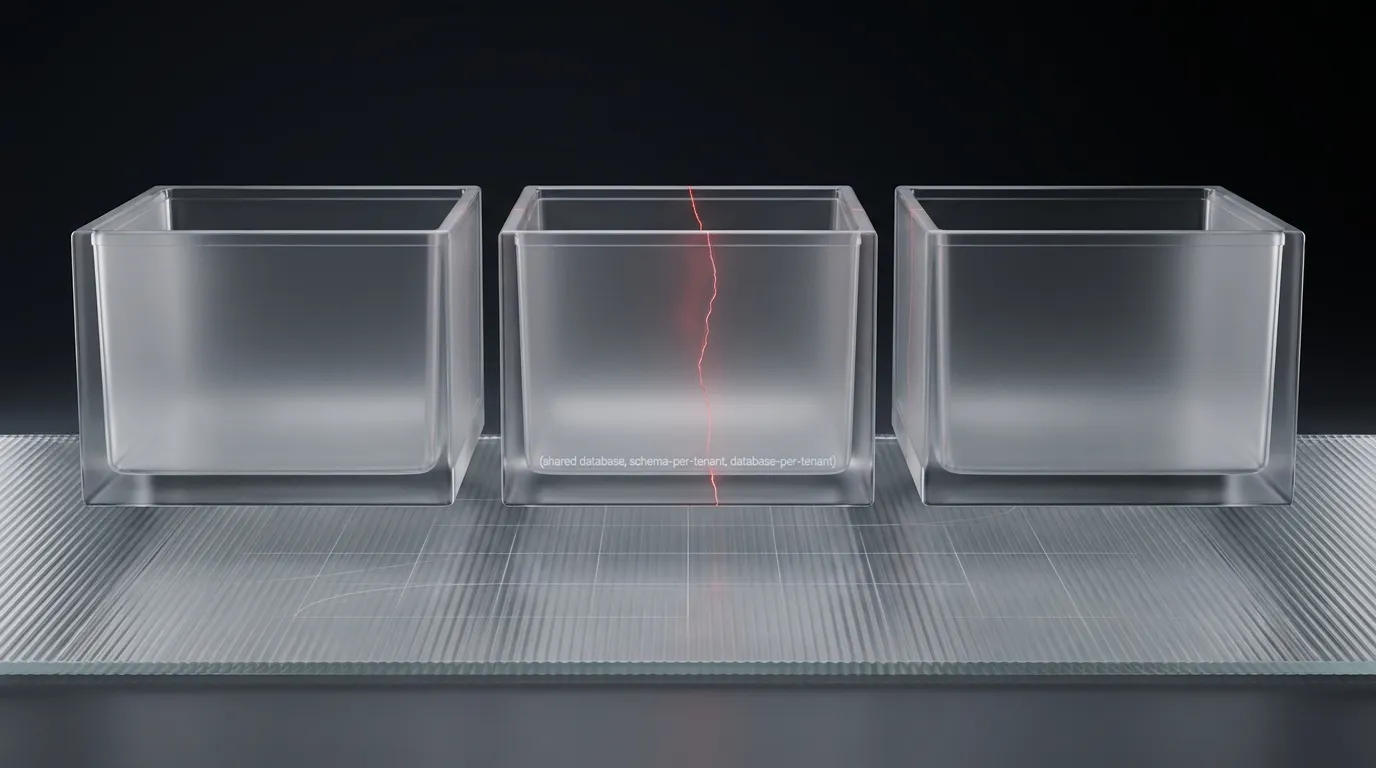
This is the architecture decision that is hardest to reverse. Every SaaS founder will choose between three database isolation models, and the one you pick at 10 tenants will either scale gracefully to 10,000 or force a migration that takes six months and breaks everything.
Multi-tenant SaaS architecture costs $100,000-$400,000+ for the core platform and ships in 14-26 weeks. The critical decision: shared database (one DB, tenant_id column on every table) - cheapest to build, cheapest to operate, weakest isolation. Schema-per-tenant (one DB, separate schema per tenant) - moderate cost, moderate isolation, moderate operational complexity. Database-per-tenant (separate DB per tenant) - most expensive, strongest isolation, required for enterprise/regulated customers. Most B2B SaaS starts with shared database and moves to schema-per-tenant or DB-per-tenant only when enterprise customers require it.
Shared database, shared schema. One database, one set of tables, tenant_id on every row. Pros: cheapest infrastructure, simplest queries, easiest backup/restore for the whole system. Cons: weakest isolation - a missing WHERE clause is a data breach; noisy neighbor performance risk; per-tenant backup/restore is complex.
Schema-per-tenant. One database instance, separate schema (set of tables) per tenant. Pros: stronger isolation - cross-tenant bugs require crossing schema boundaries; per-tenant backup/restore is schema-level. Cons: schema migration must run per tenant (100 tenants = 100 migration runs); connection management gets complex at 1000+ tenants.
Database-per-tenant. Separate database instance per tenant. Pros: strongest isolation, per-tenant performance guarantees, per-tenant backup/compliance/encryption, and enterprise customers love it. Cons: highest infrastructure cost, most complex deployment automation, and database connection management at scale.
| SaaS Architecture Scope | Cost | Timeline |
|---|---|---|
| Core multi-tenant platform (shared DB) | $100K-$200K | 14-18 weeks |
| Schema-per-tenant architecture | $150K-$300K | 16-22 weeks |
| Database-per-tenant architecture | $200K-$400K+ | 18-26 weeks |
| Tenant provisioning automation | +$20K-$50K | +2-4 weeks |
| Per-tenant billing integration (Stripe) | +$15K-$35K | +2-3 weeks |

Bolder Apps builds SaaS platforms under fixed-scope contracts, with multi-tenant architecture experience across B2B and B2C applications. The agency's portfolio (Spendee, Clearcover, Forbes Councils) demonstrates production-grade tenant-aware architecture.
Shared database for most B2B SaaS startups. Move to schema-per-tenant or DB-per-tenant when enterprise customers require it.
Shared DB: $100K-$200K. Schema-per-tenant: $150K-$300K. DB-per-tenant: $200K-$400K+.
Yes, but it is expensive. Shared-to-schema migration is moderate. Shared-to-DB-per-tenant is a substantial project. Design for migration paths even if you start simple.