Pavel Yanushka
October 6, 2026
19
min. read
and updated on:
November 2, 2026

Every restaurant chain above twenty locations and every retail brand with a repeat purchase model eventually arrives at the same question: should we build our own ordering and loyalty app? The...

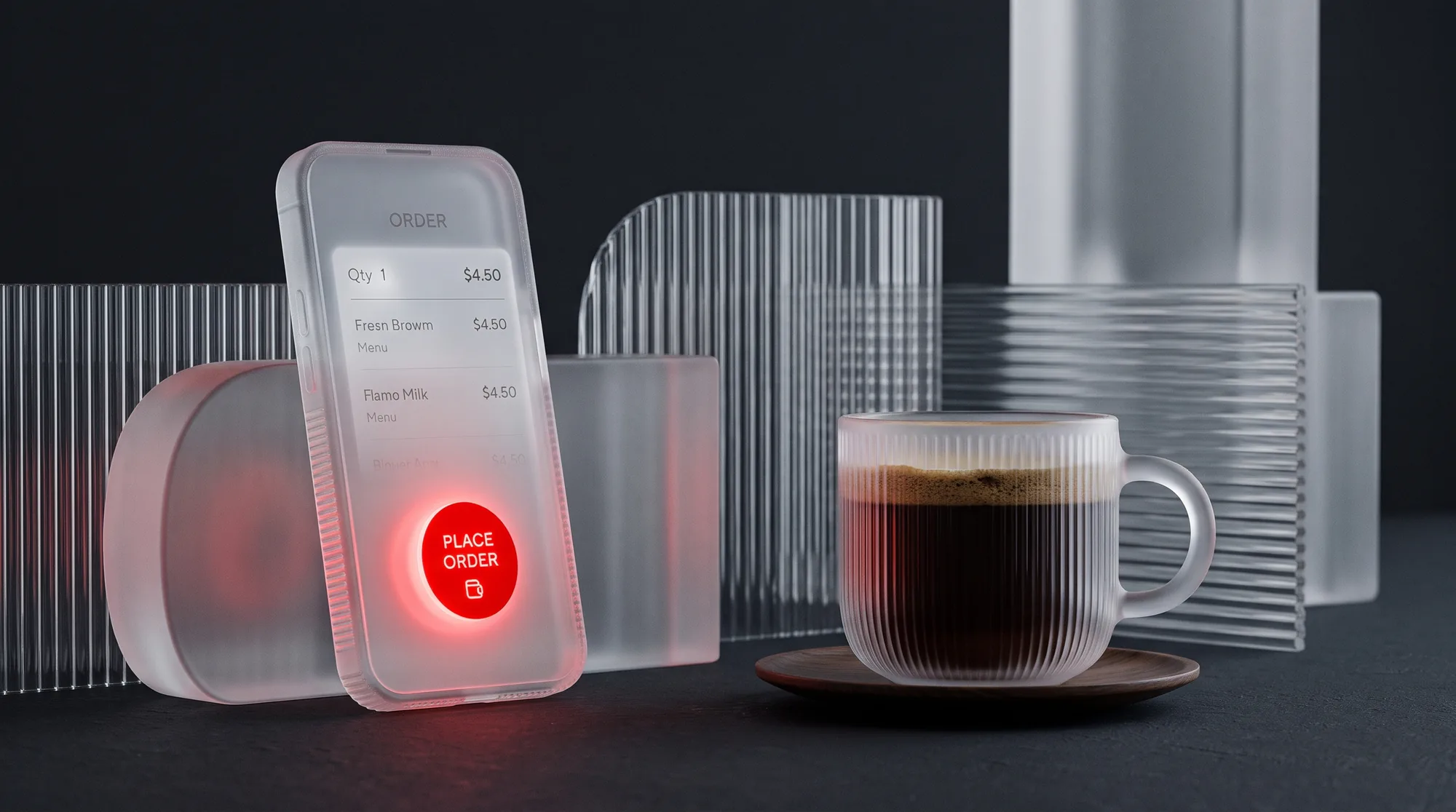
Every restaurant chain above twenty locations and every retail brand with a repeat purchase model eventually arrives at the same question: should we build our own ordering and loyalty app? The answer depends on numbers that are surprisingly specific: your average order value, your customer visit frequency, your margin structure, and how much of your revenue comes from repeat customers versus new ones.
The sections below break down which features justify a custom ordering and loyalty app, the features that do not, what the development costs, what the ROI looks like, and how to avoid building an app that costs $150,000 and gets downloaded by 200 people.
Third party ordering platforms (DoorDash, UberEats, Grubhub for restaurants; Shopify, Square Online for retail) work. They deliver orders. They process payments. They even provide some customer data. The question is whether the margin they take and the customer relationship they own is acceptable for your business model.
Third party platforms cost more than they appear to. DoorDash and UberEats charge 15 to 30 percent per order. On a $30 restaurant order with a 30 percent food cost and 30 percent labor cost, a 25 percent platform fee consumes the entire remaining margin. The restaurant fulfills the order at break even or loss and the platform captures the customer relationship.
A custom app shifts the economics. A restaurant or retail brand with its own ordering app pays the payment processing fee (2.5 to 3 percent via Stripe or Square) and the app development and maintenance cost, but keeps the rest. On a $30 order, the difference between a 25 percent platform fee ($7.50) and a 3 percent payment processing fee ($0.90) is $6.60 per order. At 500 orders per month through the app, that is $3,300/month or $39,600/year in retained margin.
The breakeven calculation. If the app costs $100,000 to build and $15,000/year to maintain, the breakeven point is reached when the retained margin (versus platform fees) covers the development and maintenance cost. At $6.60 per order saved, breakeven requires approximately 15,000 orders through the app in the first year, or about 1,250 orders per month. For a chain with 20+ locations, that is achievable within the first 6 to 12 months.
The loyalty layer changes the economics further. A loyalty program increases repeat visit frequency by 20 to 40 percent among enrolled customers. If the loyalty program moves customers from 3 visits per month to 4, the incremental revenue per loyalty member per month (at $30 average order) is $30. For 2,000 active loyalty members, that is $60,000/month in incremental revenue. The app pays for itself through the loyalty effect alone.
Menu management. The menu in the app must match the menu in the restaurant, and changes must propagate in real time. This sounds simple until the restaurant operates 30 locations with location specific menus, seasonal items, time of day availability (breakfast menu until 11 AM, lunch menu after), and sold out items that need to be removed mid shift. The menu management system needs a backend that the operations team can update without involving developers.
Ordering workflow. The customer selects items, customizes them (size, modifications, add ons, dietary preferences), adds them to a cart, selects a fulfillment method (pickup, delivery, dine in), chooses a pickup time or delivery window, and pays. The ordering workflow must be fast: a returning customer reordering their usual should be able to complete the order in under 60 seconds. One tap reordering of previous orders is a standard feature in the best ordering apps.
POS integration. Orders placed in the app must appear in the restaurant’s point of sale system without manual entry. POS integration is the most technically challenging feature in a restaurant ordering app because POS systems (Toast, Square, Lightspeed, Clover, Aloha, Revel) have different APIs, different levels of API maturity, and different data models. An order that appears in the app as "Iced Latte, Oat Milk, Large" must translate to the POS’s specific item codes and modifier codes. This translation requires a mapping layer that the operations team can configure when menu items change.
Kitchen display or order notification. When an order arrives, the kitchen needs to see it. Some POS integrations push orders directly to the kitchen display system (KDS). When direct KDS integration is not available, a dedicated order display (tablet or screen showing incoming app orders) serves the same purpose. The critical requirement: orders must arrive in the kitchen within seconds of being placed, and the system must handle concurrent orders without losing any.
Delivery integration. If the brand offers delivery, the app must integrate with a delivery logistics provider (DoorDash Drive, UberEats Direct, Bringg, Onfleet) or manage its own delivery fleet. Using DoorDash Drive or similar white label delivery services provides the delivery logistics without the marketplace commission: the customer orders through the brand’s app, and the delivery is fulfilled by a third party courier at a flat fee ($5 to $10 per delivery) rather than a percentage of the order.
Payment processing. Stripe, Square, or Braintree for card payments. Apple Pay and Google Pay for one tap mobile payments (critical for ordering speed). Saved payment methods for returning customers. Gift card balance and loyalty points as payment methods.
Loyalty program engine. The system that tracks earned points, tier progress, and reward redemption. The loyalty engine must support:
Points accrual rules: points per dollar spent, bonus points for specific products or categories, promotional multipliers (double points on Tuesdays), and partner point accrual (earning points from affiliated brands).
Tier management: tier thresholds (spend $500 to reach Gold), tier benefits (Gold members get free shipping, Platinum members get early access to new products), tier maintenance (spend $300/year to maintain Gold status), and tier expiration logic.
Reward catalog: available rewards with their point costs, inventory limits on physical rewards, and expiration dates on earned rewards.
Customer segmentation and targeting. The loyalty data enables segmentation: customers who have not visited in 30 days, customers approaching a tier threshold, customers who only buy one product category, high value customers at churn risk. The app should support targeted push notifications and in app offers based on these segments.
Referral mechanics. Reward customers for bringing new customers. The referral system tracks who referred whom, applies rewards to both parties when the referred customer completes a qualifying action, and prevents gaming (one person creating multiple accounts to farm referral bonuses).
In store integration. The loyalty program must work both online and in store. When a customer buys in store, they scan a loyalty barcode or phone number at the register, and the POS records the transaction against their loyalty account. This in store integration requires POS connectivity: the POS sends transaction data to the loyalty backend in real time, and the loyalty backend returns the customer’s current status (points, tier, available rewards) to the POS for display on the receipt.
The Joe & The Juice mobile ordering and loyalty application, built by Bolder Apps, operates across hundreds of locations globally with mobile ordering (pickup and delivery), a loyalty program with points and tier mechanics, location specific menus, and POS integration for real time order routing to the kitchen. The Joe & The Juice app represents the full stack challenge of restaurant app development: the customer facing app is the visible layer, but the integration with location specific POS systems, the menu management infrastructure, and the loyalty program engine are the components that determine whether the app is operationally viable at scale or a front end that breaks when the kitchen gets busy.

Not every feature justifies its development cost in the first version. Features to defer:
Advanced analytics dashboard. Basic metrics (order count, revenue, loyalty enrollment, active members) can be pulled from the database with simple queries or a tool like Retool. A custom analytics dashboard with drill down capabilities, trend visualization, and automated reporting is a version 2 investment.
Gamification beyond streaks. Points and tiers are proven. Challenges, badges, collectibles, and social features add engagement but also add complexity. Launch with points and tiers. Add gamification when the loyalty program has enough members to test the mechanics.
Multi language support. Unless the customer base requires it from day one, defer localization. Building with internationalization in mind (using string tables rather than hardcoded text) adds minimal cost. Actually translating and maintaining multiple languages adds significant ongoing cost.
Subscription programs (unlimited coffee, monthly box). Subscription is a distinct business model with its own economics, churn management, and billing complexity. It deserves its own product cycle after the core ordering and loyalty app has proven adoption.
Social features. The ability to share rewards, see friends’ activity, or compete on leaderboards adds engagement for a minority of users and development complexity for the entire product. Defer unless the brand’s identity is built around community.
AI powered recommendations. "You might also like" suggestions based on order history are valuable at scale but require order volume to train. Launch without recommendations. Add them when there are enough orders to make the suggestions useful rather than random.
MVP ordering app (menu, ordering, payment, basic loyalty, one POS integration) $60,000 to $120,000. Timeline: 14 to 24 weeks.
Covers: customer app (iOS and Android via cross platform), menu display with location selection, cart and checkout with Stripe or Square, basic loyalty (points accrual and redemption), one POS integration (Toast, Square, or Lightspeed), push notifications for order status, and a basic admin panel for menu updates.
Growth stage app (above plus delivery, advanced loyalty, multiple POS, analytics) $120,000 to $220,000. Timeline: 24 to 38 weeks.
Adds: delivery integration (DoorDash Drive or equivalent), tier based loyalty program, referral system, multiple POS integrations (supporting different POS systems across locations), targeted push notifications with customer segmentation, and an operations analytics dashboard.
Enterprise ordering platform (above plus multi brand, subscription, white label) $200,000 to $400,000+. Timeline: 9 to 18+ months.
Adds: multi brand support (for restaurant groups operating multiple concepts), subscription programs, white label capability, advanced personalization (order recommendations, personalized offers), detailed financial reporting, and API for third party integration.
The POS integration is the single largest cost variable. Each POS system (Toast, Square, Lightspeed, Clover, Aloha, Revel) requires a separate integration effort. The first POS integration costs $10,000 to $25,000. Subsequent integrations cost $5,000 to $15,000 each because the integration architecture is already established.
POS integration is the feature most commonly underestimated in restaurant app development. The challenges:
Every POS has a different API. Toast’s API is well documented and actively maintained. Square’s API is comprehensive but complex. Lightspeed’s restaurant API has limitations that are not apparent from the documentation. Aloha (NCR) and Revel have APIs that require partner agreements and technical certifications. Some smaller POS systems have no API at all and require a middleware device (a tablet running a bridge application) to receive orders.
Menu mapping is not trivial. The POS’s menu structure (categories, items, modifiers, modifier groups, prices, availability) must be mapped to the app’s menu structure. These structures do not match one to one. A POS might model "Iced Latte with Oat Milk" as a base item (Iced Latte) with a modifier (Oat Milk). The app might present it as a single item with a milk selection dropdown. The mapping layer must translate between these representations correctly, and it must handle changes (new items, price updates, discontinued items) without requiring manual remapping.
Real time order status. When the kitchen marks an order as "ready," the app should notify the customer. This requires real time event flow from the POS to the app backend. Some POS systems support webhooks for order status changes. Others require polling. The latency between status change and customer notification affects the customer experience: a customer who arrives for pickup before the order is ready has a negative experience. A customer who waits ten minutes after the "ready" notification has a negative experience.
Multi location complexity. A chain with 50 locations using Toast at 30 locations and Square at 20 has two parallel integration paths. If 5 locations use a third POS, that is a third path. Each location may have slightly different menu configurations, different tax rates, and different operational hours. The integration architecture must handle this variation without requiring location specific code.

The metrics that justify the app investment:
Digital order percentage. What percentage of total orders come through the app versus in store, phone, or third party platforms? Benchmark: 15 to 30 percent within 12 months of launch for a chain with active promotion of the app.
Loyalty enrollment rate. What percentage of app users enroll in the loyalty program? Benchmark: 60 to 80 percent with enrollment offered during the ordering flow.
Repeat rate for app users vs non app users. App users should visit more frequently than non app users. If the repeat rate is not higher, the loyalty program is not working.
Average order value (AOV) for app vs in store. App orders frequently have higher AOV because the interface makes it easy to add items (upsell recommendations, combo suggestions, add on prompts). A 10 to 15 percent AOV increase for app orders is typical.
Third party platform commission savings. The marginal cost per order through the app (payment processing fee only) versus the commission per order through third party platforms. Multiply by order volume to calculate monthly savings.
Customer acquisition cost through the app. The cost of acquiring a new app user (marketing spend / new app downloads) compared to the lifetime value of an app customer. For loyalty driven businesses, the LTV of an app customer should be 3 to 5x the acquisition cost.
Building the app before the operations can support it. An app that accepts orders faster than the kitchen can fulfill them creates a worse customer experience than no app at all. Before launching mobile ordering, validate that the kitchen can handle the additional order volume, that the pickup area can accommodate app order customers, and that the staff knows how to manage app orders alongside walk in and phone orders.
Launching without promoting the app. The app does not promote itself. In store signage, receipt messaging, social media campaigns, staff recommendations, and launch incentives (earn bonus points for your first app order) are required to drive initial downloads and enrollment. Budget for marketing alongside the development budget.
Over complicating the loyalty program. Points that expire, rewards that require a PhD to understand, tier benefits that are indistinguishable from each other. The best loyalty programs are simple: spend $X, earn a free Y. Complexity reduces enrollment and engagement rather than increasing it.
Neglecting the operational backend. The customer app gets all the design attention. The operations team gets a clunky admin panel that takes 20 clicks to update a menu item price. The admin panel is used daily by the operations team. It deserves the same UX investment as the customer app, proportional to its usage frequency.
Not measuring before and after. Without baseline metrics (current visit frequency, current AOV, current repeat rate), you cannot measure the app’s impact. Capture baseline metrics before launch so the ROI calculation is based on data rather than anecdote.
For restaurant chains, the menu management system is the most operationally demanding component after launch. The complexity comes from the variations:
Location specific menus. Different locations may serve different items based on local supply, kitchen equipment, or regional preferences. A taco chain with 30 locations might have 25 items that are consistent across all locations and 5 items that vary by region. The menu system must support a base menu with location level overrides.
Time based availability. Breakfast items available until 11 AM. Happy hour pricing from 4 to 6 PM. Seasonal items available during specific date ranges. The availability rules must be configurable by the operations team without developer involvement and must respect the location’s time zone.
Item 86 (sold out). When a location runs out of an item mid shift, the app must reflect that immediately. The sold out status flows from the kitchen (via POS integration or a manual toggle in the admin panel) to the app within seconds. An app that shows an available item, accepts the order, and then tells the customer it is unavailable after payment creates a worse experience than showing it as unavailable in the first place.
Modifier pricing. A large size costs $1 more. Oat milk costs $0.75 more. Extra cheese costs $0.50 more. Modifier pricing varies by location in some chains. The menu data model must support per location modifier pricing without creating a separate menu entry for every location modifier combination.
Menu image management. Each item may have a photo. Photos must be uploaded, cropped to the app’s display format, optimized for mobile delivery (WebP format, appropriate resolution), and cached on the device to avoid re downloading every session. For a menu with 50 items and 5 photos each, the image pipeline manages 250 assets with location specific variations.
The operations team needs a backend interface where they can make all of these changes without filing a support ticket. Menu management is a daily operational activity, not a periodic development task. The admin interface for menu management should receive the same UX attention as the customer facing app, because the operations team uses it more frequently than any individual customer uses the ordering flow.
The ordering and loyalty app is not a technology project for its own sake. It is a customer retention tool that happens to require technology. Every feature decision should be evaluated against one question: does this feature increase the frequency or size of customer purchases? Features that do not pass that test belong in a later version, after the core ordering and loyalty mechanics have proven their revenue impact.

An MVP with menu, ordering, payment, basic loyalty, and one POS integration typically costs $60,000 to $120,000.
When repeat customers and order volume are high enough that the retained platform fees and customer data outweigh development and maintenance costs.
POS systems vary in APIs, menu models, and reliability. Syncing menus, modifiers, and order status across locations takes significant work.
Advanced personalization, complex gamification, extra POS integrations, and features that do not drive ordering or loyalty can wait.