
Sean Weldon
September 30, 2026
10
min. read
and updated on:
September 30, 2026


A successful brand expansion strategy starts with a strong core, then tests one clear path to growth before scaling it. Choose an opportunity that fits your existing promise, validate real customer demand, and set success metrics before committing major budget or resources.
In practice, that means:
Expansion is not simply putting your logo on more things. It is a decision to extend the value people already associate with your brand into a place where it still makes sense.
That distinction matters. A well-matched expansion can grow reach and revenue faster because customers already know what to expect. A poor fit can create confusion, weaken trust, and turn a focused brand into a junk drawer of unrelated offers.
The best approach balances ambition with restraint. Use customer behavior, market research, and pilot results to guide the next move - not a flashy idea in a Monday meeting. Your brand should stretch, not snap.
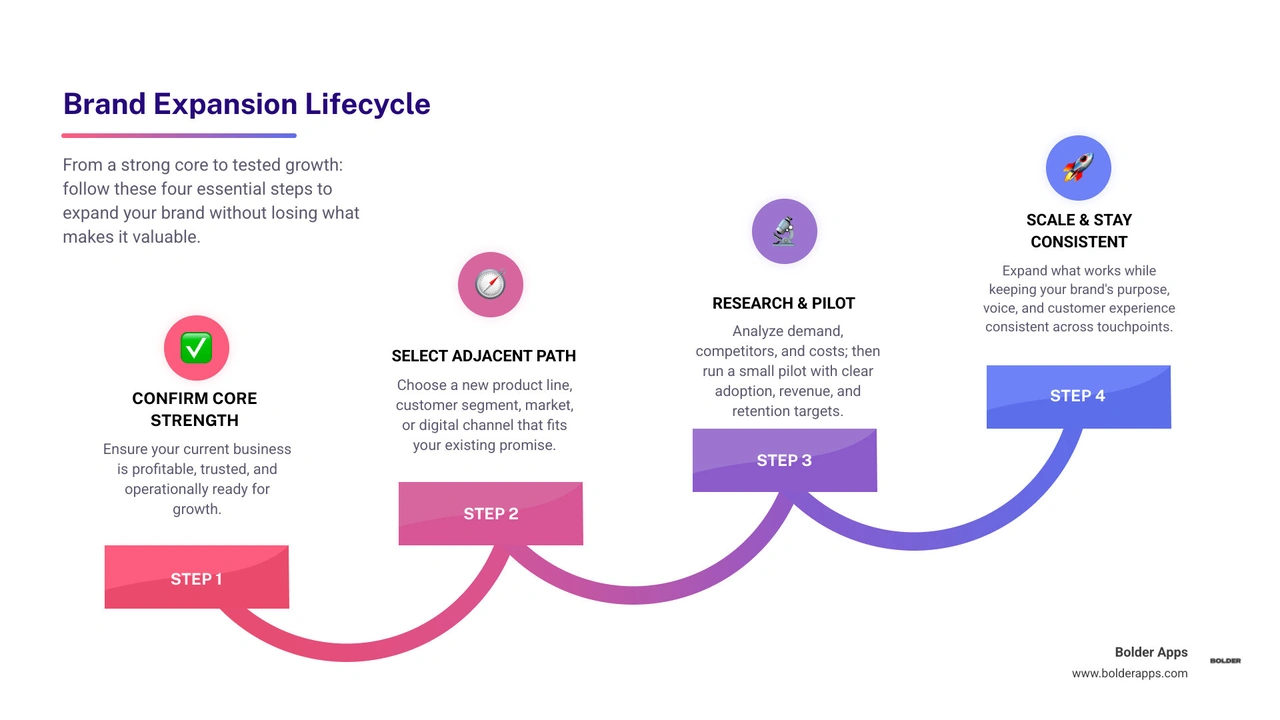
Brand expansion strategy word roundup:
Navigating brand expansion requires clarity on how your name, operational capabilities, and customer relationships will translate into new opportunities. Companies that stretch their boundaries successfully avoid random acts of growth; instead, they choose structured vectors that build upon their existing reputation.
When evaluating potential growth trajectories, organizations typically choose from four foundational pathways:
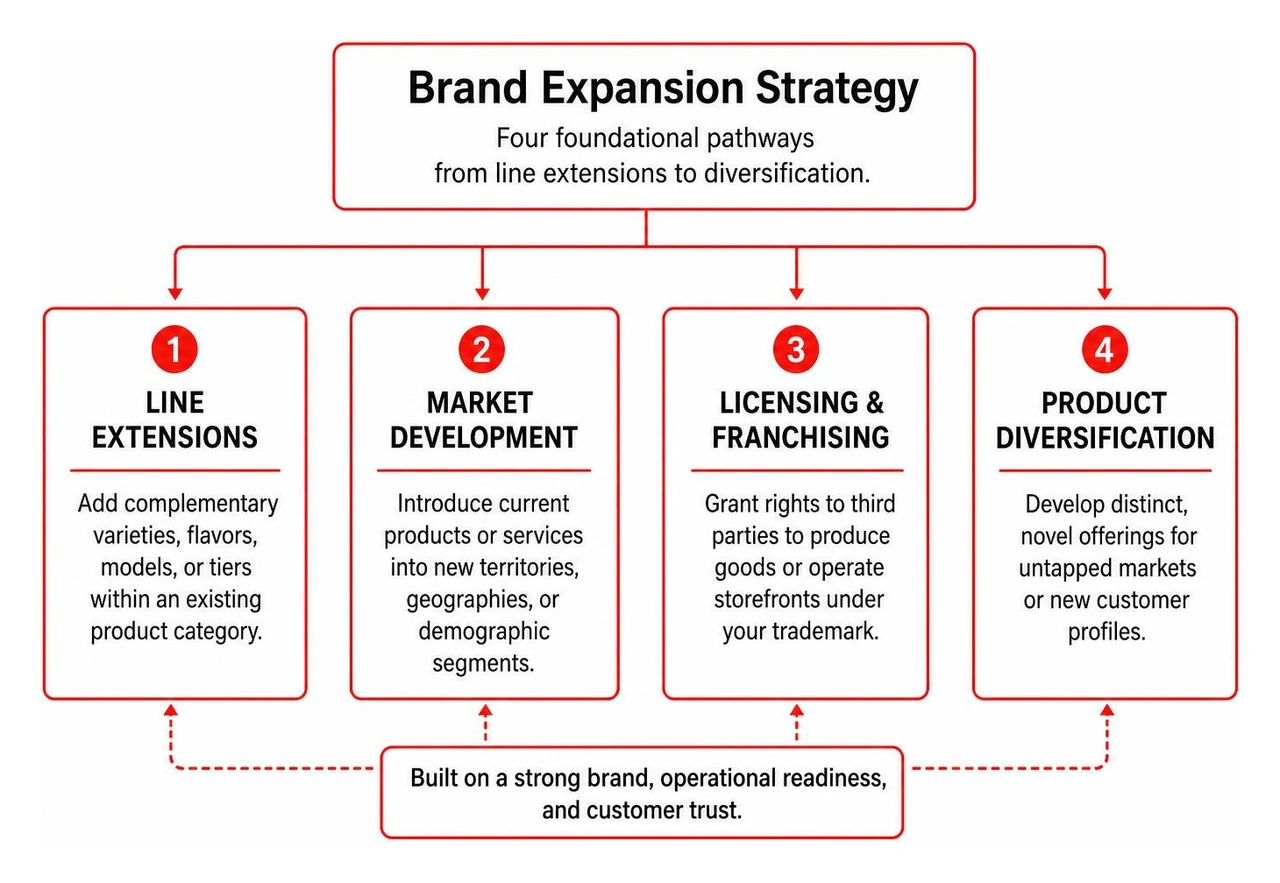
As highlighted in Harvard Business School research on brand extension, an extension works best when customers immediately perceive a natural fit between the parent brand’s equity and the new offering. When organizations venture into unfamiliar terrain without strategic coherence, they risk diluting their identity.
To systematically evaluate whether an opportunity represents a logical evolution or an expensive distraction, leadership teams often rely on dedicated product strategy consulting to stress-test market fit, unit economics, and operational feasibility before writing code or manufacturing inventory.
Product-led growth generally follows one of two trajectories: horizontal stretching or vertical tiering.
Horizontal extensions introduce adjacent products that solve complementary problems for your existing buyer. Consider Arm & Hammer: the brand successfully bridged pure baking soda into deodorants, toothpastes, and cat litter by centering its expansion around a single, undisputed brand attribute—odor elimination. Because consumers trusted the core ingredient, the stretch into adjacent cleaning categories felt intuitive rather than forced.
Vertical tiering adjusts price and feature complexity to serve different spending capacities. Premium lines capture high-margin buyers seeking elevated craftsmanship, while accessible lines shield market share against discount competitors during tighter economic cycles.
A third model, the customer extension, preserves the core product format while targeting a distinct persona. Dove executed this seamlessly with Dove Men+Care. Instead of inventing a completely new chemistry, Dove transferred its established moisture and skin-nourishment promise to an underserved male demographic, instantly establishing market authority in men's grooming.
Every brand, however, has elastic limits. Stretching a brand too far away from its functional or emotional baseline produces consumer confusion. If an industrial bleach manufacturer attempted to launch a line of natural infant skincare products, consumers would recoil—no matter how pure the formulation. Respecting brand elasticity ensures that every new release reinforces, rather than undermines, consumer trust.
Taking your brand into new territories or cultural segments requires deep adaptation rather than a simple "copy-paste" mentality. A brand positioning that commands premium authority in the United States might fall flat in foreign markets where regional competitors possess deeper community ties, localized pricing structures, or specialized logistics.
Successful market development demands a phased sequencing approach:
Whether expanding across international borders or broadening focus from digital native startups to enterprise buyers across the United States, understanding localized consumer archetypes prevents costly operational missteps.
Ambition alone cannot sustain brand growth. Expanding prematurely—before your original business has established solid financial foundations and brand equity—is one of the fastest ways to exhaust working capital.
According to a practical Inc guide on knowing when to expand your brand, you must evaluate whether customer pull is authentic and whether your core mission can be articulated in a single sentence without caveats.
Data shows that profit-focused brands are far better positioned for sustainable long-term growth than unprofitable brands that chase raw top-line volume. A profitable base provides the cash-flow buffer required to absorb the inevitable hiccups, longer sales cycles, and marketing investments associated with opening new fronts.
To determine if your business is prepared to scale, organizations can evaluate their portfolio using the Enhanced Ansoff Matrix. While the traditional model evaluates growth across basic quadrants, an enhanced framework assesses nuanced vectors including modified feature sets, partial diversification, and omnichannel migration.
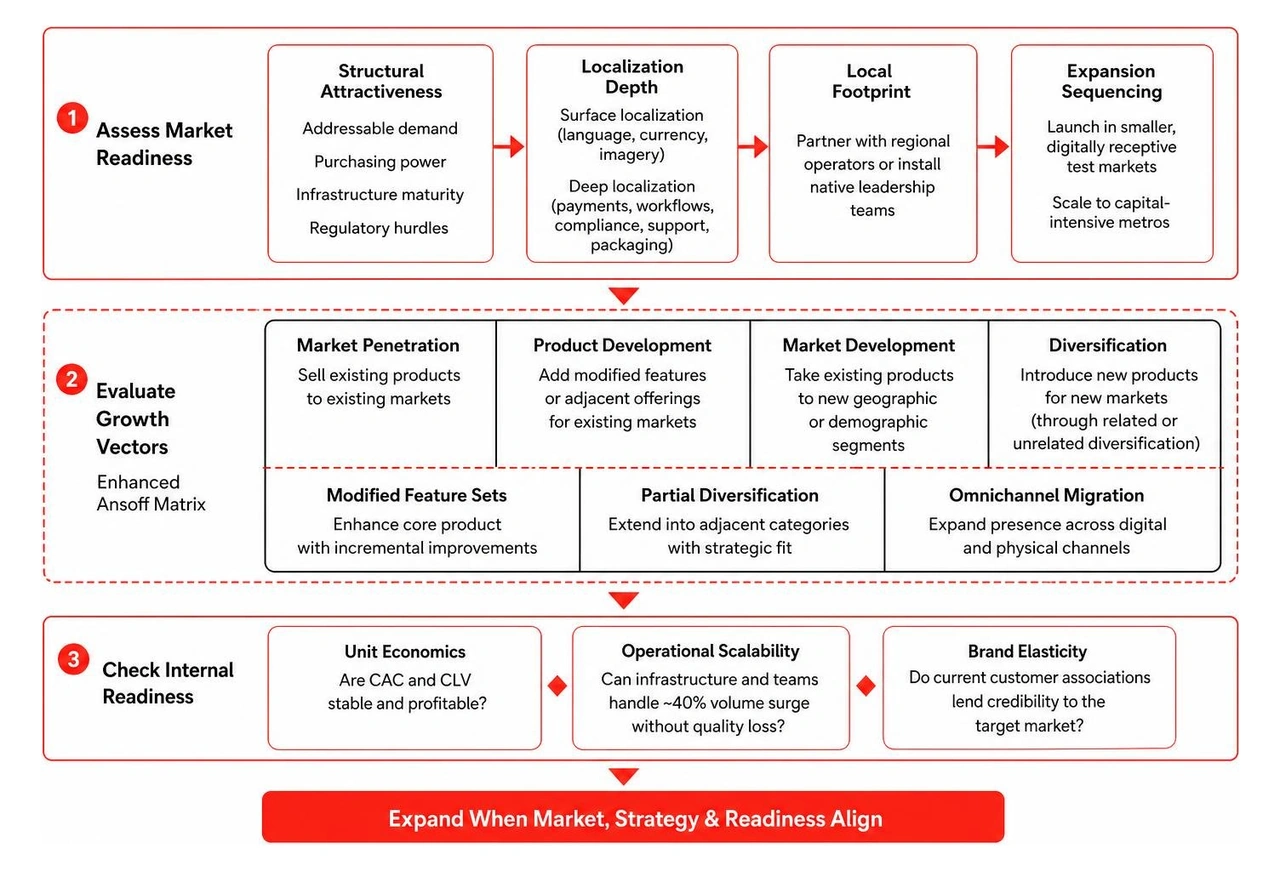
Before greenlighting capital expenditure, audit your organizational readiness across five criteria:
If your core operations are chaotic, multiplying your service offerings will only amplify that chaos across multiple channels.
Expanding to distract from a slowing or unprofitable core business rarely succeeds. When leadership teams try to solve stagnant sales by introducing unrelated products, they create organizational fatigue and split marketing resources.
Watch out for these critical danger signals:
A famous historical example of strategic restraint is Lego. After overextending itself into theme parks, apparel, and video games in the early 2000s, the company faced significant financial strain. By conducting an organizational reset, simplifying its business model, and refocusing entirely on its core building brick system, Lego engineered a historic turnaround—returning to stable profitability and sustainable multi-channel expansion.
Moving from strategic intent to market execution requires a repeatable, step-by-step roadmap. Rather than gambling company resources on an unproven concept, successful organizations treat expansion as an empirical, data-driven progression.

A disciplined expansion sequence follows five key phases:
As your business branches out across multiple platforms, geographic territories, and product categories, preserving brand cohesion becomes your primary defense against brand dilution.
Consistency does not mean creating carbon-copy marketing materials for every channel. Instead, it means establishing an overarching brand story, visual identity system, and customer promise that remains recognizable everywhere.
To maintain cross-channel integrity:
Never launch an expansion at full scale when you can validate demand with a controlled pilot. Micro-market testing allows your team to gather quantitative feedback, optimize conversion funnels, and iron out operational bottlenecks with minimal downside risk.
Whether you are launching an e-commerce subscription, a SaaS platform, or an omnichannel retail offering, partnering with an experienced digital product studio can help you rapidly build functional minimum viable products (MVPs). Agile pilots provide real customer behavioral data—letting you observe real purchase behavior, activation rates, and usage patterns before committing to extensive multi-region rollouts.
Digital platforms, modern data analytics, and integrated application ecosystems have fundamentally changed how brands scale. In 2026, companies can enter adjacent markets, personalize user journeys, and establish multi-sided commerce ecosystems in a fraction of the time required by traditional brick-and-mortar rollouts.

Businesses scaling today leverage modular cloud architectures, headless commerce engines, and specialized multi-sided software. For companies seeking to connect buyers, vendors, and service providers under a unified digital umbrella, modern marketplace app development in 2026 provides the foundational technical infrastructure needed to scale operations efficiently.
Modern digital ecosystems offer growth levers that streamline the expansion lifecycle:
Examining market leaders reveals how disciplined brand expansion creates enduring enterprise value:
These brands demonstrate that expansion succeeds when every new initiative strengthens the overarching parent brand.
You cannot manage what you do not measure. Evaluating a brand expansion requires tracking a combination of immediate financial performance indicators and long-term brand equity metrics.
To maintain an objective view of expansion health, track these core metrics:
Conduct quarterly portfolio reviews with strict stage gates: double down on initiatives that hit adoption targets, iterate where engagement signals are positive, and cut underperforming projects quickly before they drain resources.
Brand extension is a specific tactical subset of brand expansion. A brand extension involves using an established brand name to introduce a new product category or line (such as a footwear company launching activewear).
Brand expansion is a broader umbrella term that encompasses all strategic growth vectors, including geographic expansion, demographic targeting, licensing, new distribution models, acquisitions, and digital ecosystem development.
Mitigating brand dilution requires strict adherence to conceptual fit and core value alignment.
Before launching into new categories, validate that the core attributes your brand is known for (e.g., durability, luxury, simplicity, or speed) are genuinely valuable in the new market.
Run controlled pilots, survey existing brand advocates, and maintain centralized governance over visual design and messaging to protect your brand identity.
Payback horizons depend on the chosen expansion vector:
Scaling a brand into new product categories, geographic territories, or digital platforms is one of the most rewarding journeys in business. When executed with strategic discipline, clear brand governance, and validated customer feedback, expansion multiplies enterprise value while introducing your core mission to entirely new audiences.
At Bolder Apps, we specialize in transforming ambitious expansion roadmaps into high-impact digital realities. Founded in 2019 and recognized as the top software and app development agency in 2026 by DesignRush, we help forward-thinking companies design, engineer, and deploy scalable mobile apps, marketplace platforms, and custom digital ecosystems.
Our unique delivery model combines seasoned US technology leadership with elite senior distributed engineers—giving you direct access to executive-level product strategy, data-driven architecture, and intuitive design without paying for junior learning on your dime. Operating with transparent milestone-based payments and fixed-budget models, we ensure your digital initiatives launch on time, on budget, and built for long-term scale.
Whether you are expanding from a regional footprint, introducing adjacent product tiers, or building an omnichannel platform to power your next stage of growth, our team across the United States—including our active hub in Miami—is ready to bring your vision to life.
Explore our end-to-end digital product services to discover how we can help you engineer your next major growth milestone.
A successful brand expansion strategy starts with a strong core, then tests one clear path to growth before scaling it. Choose an opportunity that fits your existing promise, validate real customer demand, and set success metrics before committing major budget or resources.
In practice, that means:
Expansion is not simply putting your logo on more things. It is a decision to extend the value people already associate with your brand into a place where it still makes sense.
That distinction matters. A well-matched expansion can grow reach and revenue faster because customers already know what to expect. A poor fit can create confusion, weaken trust, and turn a focused brand into a junk drawer of unrelated offers.
The best approach balances ambition with restraint. Use customer behavior, market research, and pilot results to guide the next move - not a flashy idea in a Monday meeting. Your brand should stretch, not snap.
Brand expansion strategy word roundup:
Navigating brand expansion requires clarity on how your name, operational capabilities, and customer relationships will translate into new opportunities. Companies that stretch their boundaries successfully avoid random acts of growth; instead, they choose structured vectors that build upon their existing reputation.
When evaluating potential growth trajectories, organizations typically choose from four foundational pathways:
As highlighted in Harvard Business School research on brand extension, an extension works best when customers immediately perceive a natural fit between the parent brand’s equity and the new offering. When organizations venture into unfamiliar terrain without strategic coherence, they risk diluting their identity.
To systematically evaluate whether an opportunity represents a logical evolution or an expensive distraction, leadership teams often rely on dedicated product strategy consulting to stress-test market fit, unit economics, and operational feasibility before writing code or manufacturing inventory.
Product-led growth generally follows one of two trajectories: horizontal stretching or vertical tiering.
Horizontal extensions introduce adjacent products that solve complementary problems for your existing buyer. Consider Arm & Hammer: the brand successfully bridged pure baking soda into deodorants, toothpastes, and cat litter by centering its expansion around a single, undisputed brand attribute—odor elimination. Because consumers trusted the core ingredient, the stretch into adjacent cleaning categories felt intuitive rather than forced.
Vertical tiering adjusts price and feature complexity to serve different spending capacities. Premium lines capture high-margin buyers seeking elevated craftsmanship, while accessible lines shield market share against discount competitors during tighter economic cycles.
A third model, the customer extension, preserves the core product format while targeting a distinct persona. Dove executed this seamlessly with Dove Men+Care. Instead of inventing a completely new chemistry, Dove transferred its established moisture and skin-nourishment promise to an underserved male demographic, instantly establishing market authority in men's grooming.
Every brand, however, has elastic limits. Stretching a brand too far away from its functional or emotional baseline produces consumer confusion. If an industrial bleach manufacturer attempted to launch a line of natural infant skincare products, consumers would recoil—no matter how pure the formulation. Respecting brand elasticity ensures that every new release reinforces, rather than undermines, consumer trust.
Taking your brand into new territories or cultural segments requires deep adaptation rather than a simple "copy-paste" mentality. A brand positioning that commands premium authority in the United States might fall flat in foreign markets where regional competitors possess deeper community ties, localized pricing structures, or specialized logistics.
Successful market development demands a phased sequencing approach:
Whether expanding across international borders or broadening focus from digital native startups to enterprise buyers across the United States, understanding localized consumer archetypes prevents costly operational missteps.
Ambition alone cannot sustain brand growth. Expanding prematurely—before your original business has established solid financial foundations and brand equity—is one of the fastest ways to exhaust working capital.
According to a practical Inc guide on knowing when to expand your brand, you must evaluate whether customer pull is authentic and whether your core mission can be articulated in a single sentence without caveats.
Data shows that profit-focused brands are far better positioned for sustainable long-term growth than unprofitable brands that chase raw top-line volume. A profitable base provides the cash-flow buffer required to absorb the inevitable hiccups, longer sales cycles, and marketing investments associated with opening new fronts.
To determine if your business is prepared to scale, organizations can evaluate their portfolio using the Enhanced Ansoff Matrix. While the traditional model evaluates growth across basic quadrants, an enhanced framework assesses nuanced vectors including modified feature sets, partial diversification, and omnichannel migration.
Before greenlighting capital expenditure, audit your organizational readiness across five criteria:
If your core operations are chaotic, multiplying your service offerings will only amplify that chaos across multiple channels.
Expanding to distract from a slowing or unprofitable core business rarely succeeds. When leadership teams try to solve stagnant sales by introducing unrelated products, they create organizational fatigue and split marketing resources.
Watch out for these critical danger signals:
A famous historical example of strategic restraint is Lego. After overextending itself into theme parks, apparel, and video games in the early 2000s, the company faced significant financial strain. By conducting an organizational reset, simplifying its business model, and refocusing entirely on its core building brick system, Lego engineered a historic turnaround—returning to stable profitability and sustainable multi-channel expansion.
Moving from strategic intent to market execution requires a repeatable, step-by-step roadmap. Rather than gambling company resources on an unproven concept, successful organizations treat expansion as an empirical, data-driven progression.
A disciplined expansion sequence follows five key phases:
As your business branches out across multiple platforms, geographic territories, and product categories, preserving brand cohesion becomes your primary defense against brand dilution.
Consistency does not mean creating carbon-copy marketing materials for every channel. Instead, it means establishing an overarching brand story, visual identity system, and customer promise that remains recognizable everywhere.
To maintain cross-channel integrity:
Never launch an expansion at full scale when you can validate demand with a controlled pilot. Micro-market testing allows your team to gather quantitative feedback, optimize conversion funnels, and iron out operational bottlenecks with minimal downside risk.
Whether you are launching an e-commerce subscription, a SaaS platform, or an omnichannel retail offering, partnering with an experienced digital product studio can help you rapidly build functional minimum viable products (MVPs). Agile pilots provide real customer behavioral data—letting you observe real purchase behavior, activation rates, and usage patterns before committing to extensive multi-region rollouts.
Digital platforms, modern data analytics, and integrated application ecosystems have fundamentally changed how brands scale. In 2026, companies can enter adjacent markets, personalize user journeys, and establish multi-sided commerce ecosystems in a fraction of the time required by traditional brick-and-mortar rollouts.
Businesses scaling today leverage modular cloud architectures, headless commerce engines, and specialized multi-sided software. For companies seeking to connect buyers, vendors, and service providers under a unified digital umbrella, modern marketplace app development in 2026 provides the foundational technical infrastructure needed to scale operations efficiently.
Modern digital ecosystems offer growth levers that streamline the expansion lifecycle:
Examining market leaders reveals how disciplined brand expansion creates enduring enterprise value:
These brands demonstrate that expansion succeeds when every new initiative strengthens the overarching parent brand.
You cannot manage what you do not measure. Evaluating a brand expansion requires tracking a combination of immediate financial performance indicators and long-term brand equity metrics.
To maintain an objective view of expansion health, track these core metrics:
Conduct quarterly portfolio reviews with strict stage gates: double down on initiatives that hit adoption targets, iterate where engagement signals are positive, and cut underperforming projects quickly before they drain resources.
Brand extension is a specific tactical subset of brand expansion. A brand extension involves using an established brand name to introduce a new product category or line (such as a footwear company launching activewear).
Brand expansion is a broader umbrella term that encompasses all strategic growth vectors, including geographic expansion, demographic targeting, licensing, new distribution models, acquisitions, and digital ecosystem development.
Mitigating brand dilution requires strict adherence to conceptual fit and core value alignment.
Before launching into new categories, validate that the core attributes your brand is known for (e.g., durability, luxury, simplicity, or speed) are genuinely valuable in the new market.
Run controlled pilots, survey existing brand advocates, and maintain centralized governance over visual design and messaging to protect your brand identity.
Payback horizons depend on the chosen expansion vector:
Scaling a brand into new product categories, geographic territories, or digital platforms is one of the most rewarding journeys in business. When executed with strategic discipline, clear brand governance, and validated customer feedback, expansion multiplies enterprise value while introducing your core mission to entirely new audiences.
At Bolder Apps, we specialize in transforming ambitious expansion roadmaps into high-impact digital realities. Founded in 2019 and recognized as the top software and app development agency in 2026 by DesignRush, we help forward-thinking companies design, engineer, and deploy scalable mobile apps, marketplace platforms, and custom digital ecosystems.
Our unique delivery model combines seasoned US technology leadership with elite senior distributed engineers—giving you direct access to executive-level product strategy, data-driven architecture, and intuitive design without paying for junior learning on your dime. Operating with transparent milestone-based payments and fixed-budget models, we ensure your digital initiatives launch on time, on budget, and built for long-term scale.
Whether you are expanding from a regional footprint, introducing adjacent product tiers, or building an omnichannel platform to power your next stage of growth, our team across the United States—including our active hub in Miami—is ready to bring your vision to life.
Explore our end-to-end digital product services to discover how we can help you engineer your next major growth milestone.