
Sean Weldon
November 25, 2026
10
min. read
and updated on:
November 25, 2026


An OWASP code review is a structured examination of application source code, architecture, and high-risk workflows that helps teams identify vulnerabilities before they affect a release, customer data, or enterprise deal. For organizations evaluating professional code review services, the value is not only finding issues, but receiving a prioritized remediation plan that engineering and leadership can act on.
Automated scanners fall into two main buckets: Static Application Security Testing (SAST) and Dynamic Application Security Testing (DAST). SAST tools analyze raw source code without executing it, searching for known syntax patterns, deprecated functions, and unverified data sinks. DAST tools operate externally, bombarding running applications with malicious inputs to watch for unexpected behavior.
While SAST and DAST deliver high speed and broad test coverage, they operate without human judgment about business risk. Automated systems treat code as isolated strings of logic rather than an interconnected product, authorization model, and release decision. As detailed in the Secure Code Review Cheat Sheet, relying purely on automated testing creates dangerous blind spots in application defense. Teams curious about when to deploy manual audits versus automated tools can explore our breakdown on App Code Audit What It Is When You Need It.
Standard functional code reviews focus on maintainability, readability, performance, and feature completeness. Reviewers ask straightforward questions:
A secure code review demands a complete shift in mindset. Reviewers transition from asking how code should work to probing how it can be broken.
Functional reviews assume users interact with software in good faith, staying within standard user interface flows. Secure code reviews assume bad actors will bypass front-end interfaces entirely, sending crafted HTTP headers, manipulated payloads, and out-of-order API calls directly to back-end endpoints. The security reviewer evaluates edge cases, trust boundaries, structural design assumptions, and environmental misconfigurations that functional testing overlooks.
Automated scanners excel at catching basic structural defects, such as known vulnerable dependencies or obvious string concatenation in SQL queries. However, context-aware human judgment is indispensable for evaluating real-world threat models.
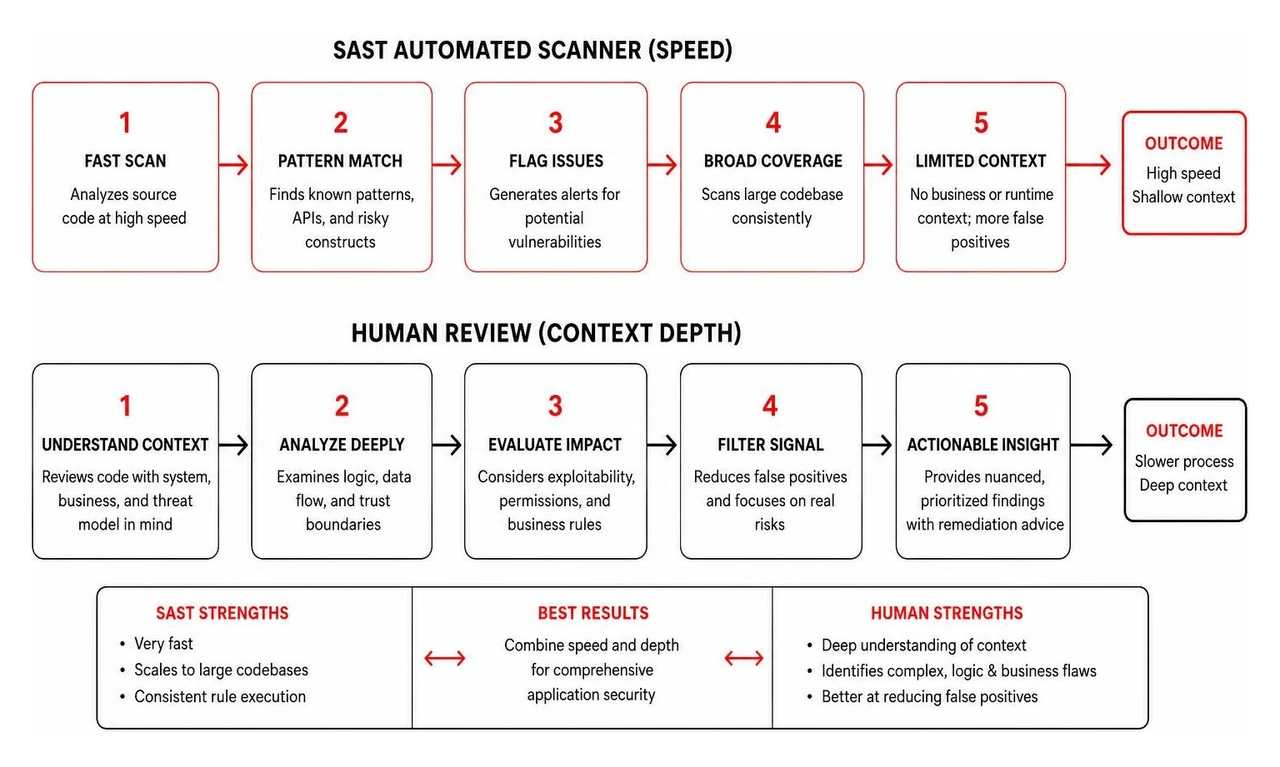
Human expertise is required to solve several core security challenges:
User_Tier_1 ought to have read access to /api/v1/billing/1042. Understanding user intent and authorization rules requires human domain knowledge.To conduct a structured review, engineers categorize code defects into clear vulnerability classes. These categories reflect how attackers exploit application logic to compromise data integrity, service availability, and confidentiality. The official OWASP Code Review Guide provides the foundational taxonomy for evaluating application health. Complementing this framework with an overarching Software Quality Review ensures technical resilience and operational reliability.
The OWASP Top 10 represents the most critical security risks facing enterprise web applications today. A manual code audit systematically maps source code implementation directly against these top threat categories:
DEBUG=True), and permissive cross-origin resource sharing (CORS) configurations.When auditing high-risk functional areas, code reviewers apply rigid technical standards across three core controls:
none algorithm. Passwords must be hashed using modern algorithms like Argon2id or bcrypt with appropriate work factors.exec() or system() must be strictly sanitized or replaced with safe native API calls.A successful OWASP code review requires a predictable, repeatable methodology. Rather than reading raw code randomly, reviewers employ systematic strategies to trace data, assess risk, and isolate vulnerabilities efficiently.
Detailed procedures are documented in the OWASP Code Review Guide Release PDF as well as modern engineering Code Audit Services.

Before reading a single line of code, teams must establish clear scope and review boundaries. Security code reviews generally fall into two primary operational models:
To streamline scoping, engineering teams map application entry points, identify sensitive data stores (PII, payment info, health records), and establish risk-based review priorities. Core payment and authentication modules warrant deep manual scrutiny, while simple user interface style updates can pass through automated pipelines.
Once scoping is complete, reviewers deploy a dual-layer strategy: fast pattern detection combined with deep data flow analysis.
Pattern scanning uses targeted command-line tools like grep or custom static analysis rules to rapidly find common code smells across large repositories. Useful pattern searches include:
grep -rn "eval(" . or grep -rn "exec(" .grep -rn "SELECT * FROM" .grep -i -rn "api_key=" . or grep -i -rn "password=" .After executing automated pattern checks, reviewers transition to white-box data flow analysis (taint tracking). The reviewer identifies untrusted data sources (API requests, URL parameters, file uploads), maps how data moves through internal processing services, verifies trust boundary transformations, and examines output sinks (database writes, log files, browser rendering engine).
Taint tracking verifies that every path between an untrusted source and a critical system sink enforces authorization checks, input validation, and context-aware escaping.
An internal review process is valuable, but high-risk releases, legacy modernization projects, and customer-facing applications often need an independent security perspective. A professional OWASP code review should turn security concerns into prioritized, actionable findings that engineering leaders can use to decide what to fix first.
A focused code review is especially useful when a team is preparing for a major launch, inheriting a legacy application, integrating payments or sensitive customer data, responding to a security concern, or facing enterprise due-diligence questions. It can also help when automated scanners produce a long list of alerts without enough context to determine which issues are truly exploitable.
The goal is not to create a compliance binder that nobody opens again. The goal is to identify material risk, explain the affected workflows, and provide a practical path to remediation before a release or investment decision is on the line.

Before engaging a provider, ask what the final package includes. A useful OWASP code review engagement should provide:
Decision-makers should look beyond a checklist of tools. Ask whether the reviewer will examine business logic, authorization flows, API boundaries, third-party integrations, and deployment assumptions in addition to code patterns. Confirm how findings are prioritized, who performs the review, what access is required, and whether the engagement includes time to discuss remediation with the engineering team.
It is also worth asking how the provider will work with an active delivery schedule. A strong review process protects the release without turning into an open-ended interruption. Clear milestones, an agreed scope, and direct access to senior technical leadership keep the engagement focused on decisions that reduce real risk.
A professional review begins with the application architecture, repositories, deployment model, data flows, integrations, and release timeline. The scope should identify which areas receive deep manual analysis, which supporting systems are included, and which risks are out of scope. This prevents the engagement from becoming vague or producing findings that do not map to a business decision.
The report should distinguish critical remediation work from lower-priority hardening. For each material finding, stakeholders should be able to see the affected component, the security impact, the conditions required to exploit the issue, and a recommended fix. Clear remediation guidance lets engineering teams estimate work and decide whether a release can proceed.
Yes, when the work is organized around the release plan. A provider should agree on access, milestones, communication channels, and decision points before the review starts. Teams can then use early findings to address urgent risks while the remaining analysis continues, rather than waiting until the final day for a surprise document.
Look for reviewers who can explain how they assess business logic, authorization, API behavior, cloud configuration, and third-party dependencies, not only scanner output. Ask who will perform the work, how senior review is handled, what evidence accompanies findings, and whether remediation discussions and retesting are available. The right partner should make the security posture easier to understand and improve, not more mysterious.
A code review delivers the most value when it gives leadership a clear view of security risk, engineering effort, and the next release decision. Bolder Apps provides code audit and product engineering support for teams that need an experienced perspective on complex web and mobile applications.
Founded in 2019, Bolder Apps combines US-based product leadership with senior distributed engineering teams. The company was named a top software and app development agency in 2026 by DesignRush, and its teams help organizations evaluate existing applications, plan remediation work, and move forward with confidence.
For a focused engagement, Bolder Apps can align an OWASP code review around the systems and workflows that matter most, then translate findings into a practical remediation plan. Explore the Code Audit service or review Bolder Apps locations to connect with the team.
The engagement model is designed for decision-makers who need clarity as well as technical depth: a fixed-budget scope, direct access to an in-shore CTO, senior offshore development support, and milestone-based payments. If a launch, acquisition, modernization effort, or enterprise security review is approaching, schedule a technical consultation to define the right review scope and next steps.
An OWASP code review is a structured examination of application source code, architecture, and high-risk workflows that helps teams identify vulnerabilities before they affect a release, customer data, or enterprise deal. For organizations evaluating professional code review services, the value is not only finding issues, but receiving a prioritized remediation plan that engineering and leadership can act on.
Automated scanners fall into two main buckets: Static Application Security Testing (SAST) and Dynamic Application Security Testing (DAST). SAST tools analyze raw source code without executing it, searching for known syntax patterns, deprecated functions, and unverified data sinks. DAST tools operate externally, bombarding running applications with malicious inputs to watch for unexpected behavior.
While SAST and DAST deliver high speed and broad test coverage, they operate without human judgment about business risk. Automated systems treat code as isolated strings of logic rather than an interconnected product, authorization model, and release decision. As detailed in the Secure Code Review Cheat Sheet, relying purely on automated testing creates dangerous blind spots in application defense. Teams curious about when to deploy manual audits versus automated tools can explore our breakdown on App Code Audit What It Is When You Need It.
Standard functional code reviews focus on maintainability, readability, performance, and feature completeness. Reviewers ask straightforward questions:
A secure code review demands a complete shift in mindset. Reviewers transition from asking how code should work to probing how it can be broken.
Functional reviews assume users interact with software in good faith, staying within standard user interface flows. Secure code reviews assume bad actors will bypass front-end interfaces entirely, sending crafted HTTP headers, manipulated payloads, and out-of-order API calls directly to back-end endpoints. The security reviewer evaluates edge cases, trust boundaries, structural design assumptions, and environmental misconfigurations that functional testing overlooks.
Automated scanners excel at catching basic structural defects, such as known vulnerable dependencies or obvious string concatenation in SQL queries. However, context-aware human judgment is indispensable for evaluating real-world threat models.
Human expertise is required to solve several core security challenges:
User_Tier_1 ought to have read access to /api/v1/billing/1042. Understanding user intent and authorization rules requires human domain knowledge.To conduct a structured review, engineers categorize code defects into clear vulnerability classes. These categories reflect how attackers exploit application logic to compromise data integrity, service availability, and confidentiality. The official OWASP Code Review Guide provides the foundational taxonomy for evaluating application health. Complementing this framework with an overarching Software Quality Review ensures technical resilience and operational reliability.
The OWASP Top 10 represents the most critical security risks facing enterprise web applications today. A manual code audit systematically maps source code implementation directly against these top threat categories:
DEBUG=True), and permissive cross-origin resource sharing (CORS) configurations.When auditing high-risk functional areas, code reviewers apply rigid technical standards across three core controls:
none algorithm. Passwords must be hashed using modern algorithms like Argon2id or bcrypt with appropriate work factors.exec() or system() must be strictly sanitized or replaced with safe native API calls.A successful OWASP code review requires a predictable, repeatable methodology. Rather than reading raw code randomly, reviewers employ systematic strategies to trace data, assess risk, and isolate vulnerabilities efficiently.
Detailed procedures are documented in the OWASP Code Review Guide Release PDF as well as modern engineering Code Audit Services.
Before reading a single line of code, teams must establish clear scope and review boundaries. Security code reviews generally fall into two primary operational models:
To streamline scoping, engineering teams map application entry points, identify sensitive data stores (PII, payment info, health records), and establish risk-based review priorities. Core payment and authentication modules warrant deep manual scrutiny, while simple user interface style updates can pass through automated pipelines.
Once scoping is complete, reviewers deploy a dual-layer strategy: fast pattern detection combined with deep data flow analysis.
Pattern scanning uses targeted command-line tools like grep or custom static analysis rules to rapidly find common code smells across large repositories. Useful pattern searches include:
grep -rn "eval(" . or grep -rn "exec(" .grep -rn "SELECT * FROM" .grep -i -rn "api_key=" . or grep -i -rn "password=" .After executing automated pattern checks, reviewers transition to white-box data flow analysis (taint tracking). The reviewer identifies untrusted data sources (API requests, URL parameters, file uploads), maps how data moves through internal processing services, verifies trust boundary transformations, and examines output sinks (database writes, log files, browser rendering engine).
Taint tracking verifies that every path between an untrusted source and a critical system sink enforces authorization checks, input validation, and context-aware escaping.
An internal review process is valuable, but high-risk releases, legacy modernization projects, and customer-facing applications often need an independent security perspective. A professional OWASP code review should turn security concerns into prioritized, actionable findings that engineering leaders can use to decide what to fix first.
A focused code review is especially useful when a team is preparing for a major launch, inheriting a legacy application, integrating payments or sensitive customer data, responding to a security concern, or facing enterprise due-diligence questions. It can also help when automated scanners produce a long list of alerts without enough context to determine which issues are truly exploitable.
The goal is not to create a compliance binder that nobody opens again. The goal is to identify material risk, explain the affected workflows, and provide a practical path to remediation before a release or investment decision is on the line.
Before engaging a provider, ask what the final package includes. A useful OWASP code review engagement should provide:
Decision-makers should look beyond a checklist of tools. Ask whether the reviewer will examine business logic, authorization flows, API boundaries, third-party integrations, and deployment assumptions in addition to code patterns. Confirm how findings are prioritized, who performs the review, what access is required, and whether the engagement includes time to discuss remediation with the engineering team.
It is also worth asking how the provider will work with an active delivery schedule. A strong review process protects the release without turning into an open-ended interruption. Clear milestones, an agreed scope, and direct access to senior technical leadership keep the engagement focused on decisions that reduce real risk.
A professional review begins with the application architecture, repositories, deployment model, data flows, integrations, and release timeline. The scope should identify which areas receive deep manual analysis, which supporting systems are included, and which risks are out of scope. This prevents the engagement from becoming vague or producing findings that do not map to a business decision.
The report should distinguish critical remediation work from lower-priority hardening. For each material finding, stakeholders should be able to see the affected component, the security impact, the conditions required to exploit the issue, and a recommended fix. Clear remediation guidance lets engineering teams estimate work and decide whether a release can proceed.
Yes, when the work is organized around the release plan. A provider should agree on access, milestones, communication channels, and decision points before the review starts. Teams can then use early findings to address urgent risks while the remaining analysis continues, rather than waiting until the final day for a surprise document.
Look for reviewers who can explain how they assess business logic, authorization, API behavior, cloud configuration, and third-party dependencies, not only scanner output. Ask who will perform the work, how senior review is handled, what evidence accompanies findings, and whether remediation discussions and retesting are available. The right partner should make the security posture easier to understand and improve, not more mysterious.
A code review delivers the most value when it gives leadership a clear view of security risk, engineering effort, and the next release decision. Bolder Apps provides code audit and product engineering support for teams that need an experienced perspective on complex web and mobile applications.
Founded in 2019, Bolder Apps combines US-based product leadership with senior distributed engineering teams. The company was named a top software and app development agency in 2026 by DesignRush, and its teams help organizations evaluate existing applications, plan remediation work, and move forward with confidence.
For a focused engagement, Bolder Apps can align an OWASP code review around the systems and workflows that matter most, then translate findings into a practical remediation plan. Explore the Code Audit service or review Bolder Apps locations to connect with the team.
The engagement model is designed for decision-makers who need clarity as well as technical depth: a fixed-budget scope, direct access to an in-shore CTO, senior offshore development support, and milestone-based payments. If a launch, acquisition, modernization effort, or enterprise security review is approaching, schedule a technical consultation to define the right review scope and next steps.