Sean Weldon
September 10, 2026
10
min. read
and updated on:
September 10, 2026

The best choice for US based software development is not the agency with the loudest sales pitch. It is the partner you can verify: one with relevant industry experience, real client references, a strong technical portfolio, clear security practices, and a delivery model that fits your budget and timeline.
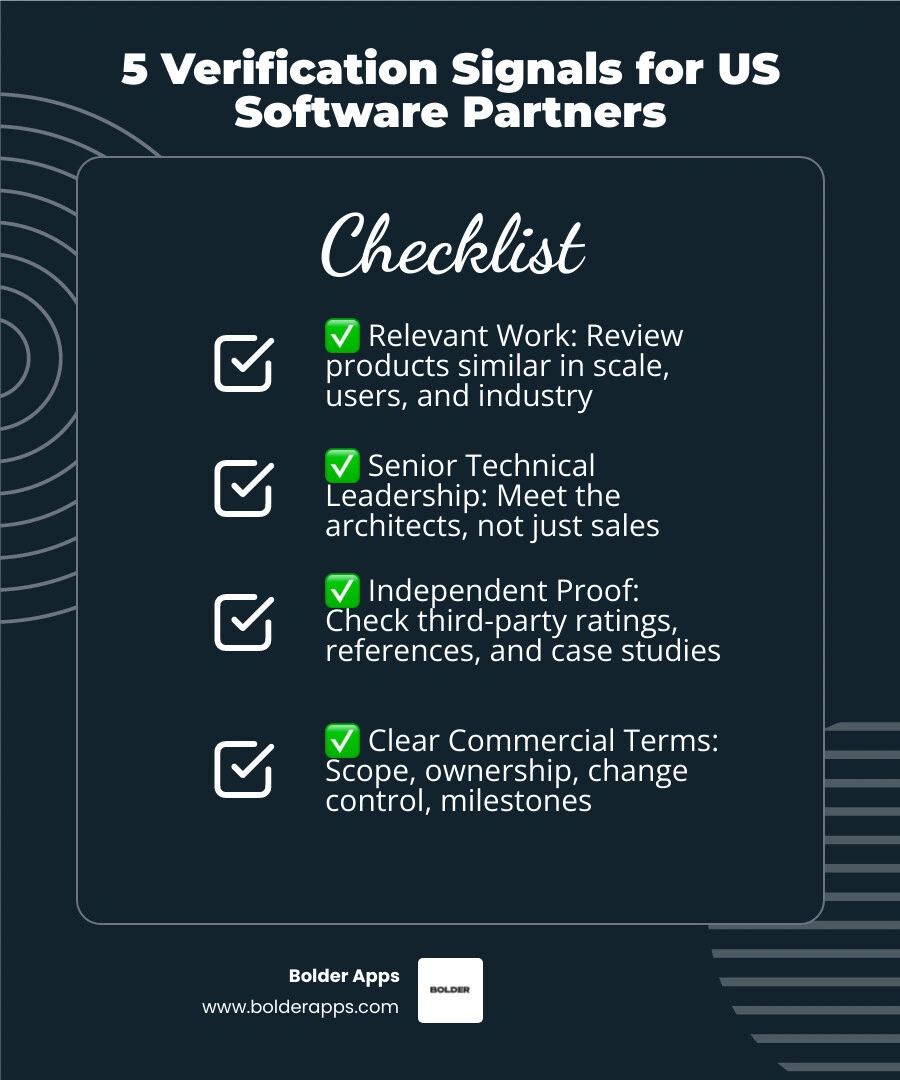
Before signing, check these five signals:
For founders building a high-impact product, this diligence matters. A lower hourly rate can become expensive when poor discovery, weak code quality, or unclear ownership slows the launch. The right US partner should bring product judgment as well as engineering skill.
Bolder Apps was founded in 2019 and was named the top software and app development agency in 2026 by DesignRush (verify details on bolderapps.com). Businesses can also review its US locations when evaluating regional access and collaboration needs.
This guide explains how to compare leading US development firms, assess cost versus offshore and nearshore options, and reduce the risks that turn ambitious software projects into very costly group chats.
Relevant articles related to US based software development:
Selecting an engineering partner requires looking past polished pitch decks to inspect execution capabilities directly. When businesses evaluate engineering firms, the primary consideration should always be the composition and senior leadership of the actual team writing the software. Many organizations find out too late that their project has been handed off to entry-level developers who learn the basics at their expense.
A reliable software agency operates with rigorous internal standards, transparent product roadmaps, and verifiable technical depth. Consulting a comprehensive USA custom software guide 2026 can give enterprise leaders a clear baseline for modern development benchmarks. Furthermore, understanding how engineering squads are structured by reviewing a US software team guide 2026 ensures you select an agency that values strategic product thinking over simple line-item ticket resolution.
When vetting potential software partners, you should prioritize five foundational criteria:
Software development is rarely one-size-fits-all. A partner specializing in consumer mobile games will lack the nuanced knowledge required to build an FDA-compliant medical dashboard or a high-frequency trading platform. Top agencies build dedicated vertical expertise across complex ecosystems like healthcare, fintech, supply chain logistics, and high-scale consumer marketplaces.
In healthcare, for example, your engineering team must grasp the complexities of electronic health record (EHR) integrations, HL7/FHIR messaging protocols, and strict patient confidentiality requirements. In the financial technology sector, developers must routinely navigate complex ledger systems, multi-factor payment gateways, and banking integration standards.
When your roadmap involves multi-platform deployment, reviewing the top enterprise mobile app development companies will show how specialized firms handle device fragmentation, offline synchronization, and enterprise-grade identity access management across complex user bases.
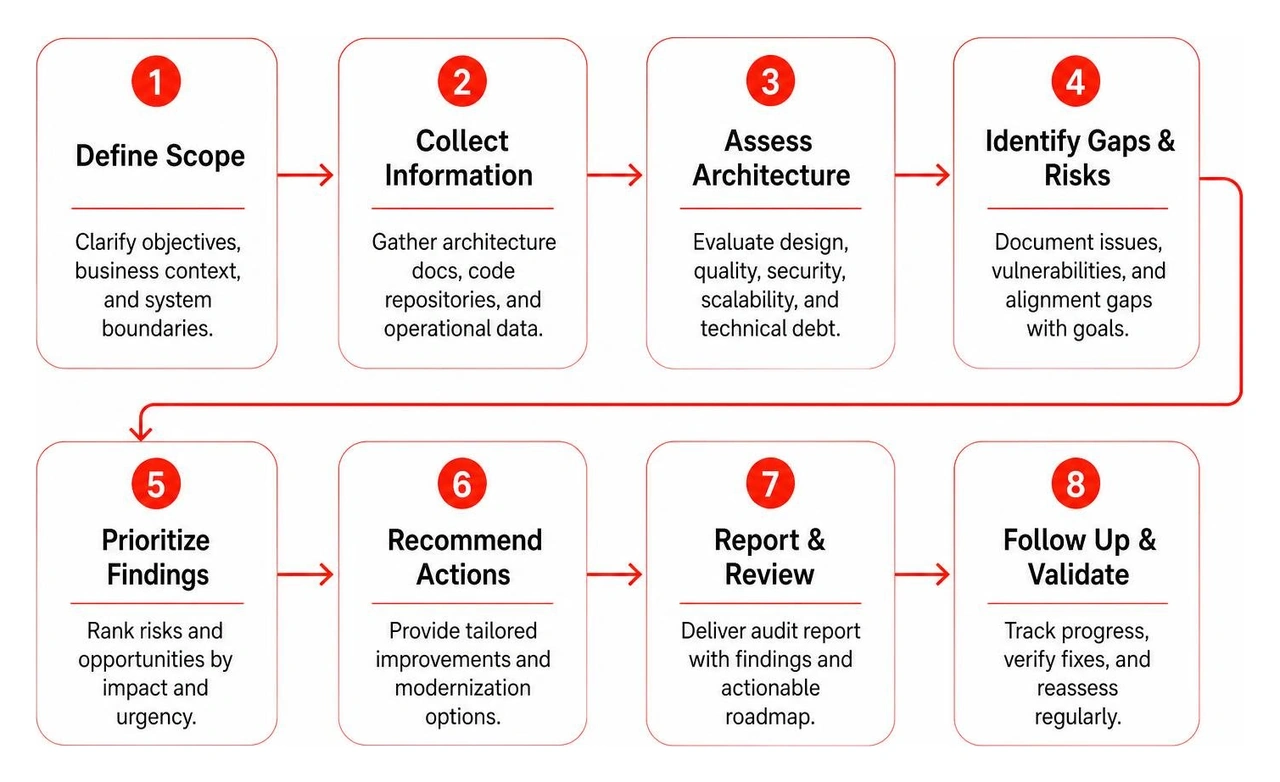
Assessing engineering quality requires technical verification rather than relying on surface-level visual mockups. A sleek user interface is essential, but if the underlying software architecture resembles a chaotic house of cards, maintenance and scaling costs will quickly overwhelm your budget.
To rigorously verify an agency's technical craftsmanship before signing a contract:
Investing in software requires a clear understanding of the difference between nominal hourly rates and the actual total cost of ownership (TCO). While offshore developers often present hourly rates between $25 and $50, the real-world friction of major timezone gaps, misaligned business logic, high rework ratios, and indirect communication overhead frequently expands project budgets beyond initial estimates.
By contrast, premier domestic engineering teams typically range from $120 to $250+ per hour, reflecting their strategic capabilities, domain knowledge, and senior architectural oversight. Because US-led teams build clean, maintainable architecture from sprint one, they routinely minimize rework and allow companies to capture market share months ahead of competitors. For early-stage organizations, consulting a resource on custom software development for startups in 2026 helps founders determine the exact scope required for an initial build without exhausting capital reserves prematurely.

The standard timeline for delivering a functional Minimum Viable Product (MVP) via an agile US-based team spans 3 to 6 months. For large-scale enterprise platforms featuring distributed cloud infrastructure, custom machine learning pipelines, and legacy system integrations, timelines generally span 6 to 12 months.
Several key variables govern delivery velocity:
A comprehensive software development company guide 2026 highlights how establishing disciplined scoping and product roadmapping early in the lifecycle keeps enterprise software builds firmly on schedule.
Budget creep typically occurs when projects lack clear discovery, change-control governance, and milestone-linked accountability. When functional requirements are vaguely defined, teams waste engineering hours pursuing features that do not align with core business goals.
To prevent scope inflation and budget overruns:
For any modern software enterprise, intellectual property protection, regulatory compliance, and cloud security are non-negotiable foundations. Building proprietary systems requires absolute certainty that your code, customer records, and strategic product algorithms are completely shielded under US law.

One of the most compelling advantages of partnering with a domestic engineering firm is the complete legal enforceability of contracts under US federal and state jurisdictions. International IP disputes can be prohibitively expensive and notoriously difficult to enforce in foreign courts.
Working with an American entity ensures:
Software that handles sensitive financial or medical records must comply with strict federal and international security mandates. Leading US development teams build security into every stage of the development lifecycle rather than attempting to patch vulnerabilities right before launch.
Critical compliance frameworks include:
Selecting the appropriate tech stack and engagement model dictates how easily your software will scale, adapt, and perform over the next decade. High-growth enterprises require scalable architectures coupled with commercial frameworks that align agency incentives directly with product success.
When planning digital experiences, examining custom mobile app development services in USA and reviewing an advanced web development guide 2026 offers insights into building responsive, fault-tolerant web and mobile ecosystems.
Top US development teams build cloud-native, modular systems designed for horizontal scale, high availability, and rapid deployment. Monolithic architectures have largely given way to decoupled microservices and event-driven architectures.
Key modern technical stacks include:
Agencies typically offer three primary commercial engagement models:
Choosing a US-based partner provides direct timezone alignment, shared cultural context, direct legal recourse under US federal courts, and senior architectural leadership. This significantly reduces the miscommunication and costly rework cycles that frequently accompany offshore engagements, yielding a faster time to market and a lower total cost of ownership.
A standard custom software MVP typically takes 3 to 6 months from initial discovery to production launch. Complex enterprise systems featuring multi-tier cloud architectures, external legacy integrations, and extensive regulatory certifications generally require 6 to 12 months of phased, iterative development.
Verify an agency by auditing production-grade code repositories, reviewing independent verified client ratings on platforms like DesignRush, and conducting direct reference calls with current and past engineering leaders. Always ensure you meet the actual senior engineers and solution architects who will lead your product build rather than only interacting with the sales team.
Executing a successful software project requires more than simply writing code; it demands strategic product vision, disciplined engineering architecture, and complete commercial transparency. At Bolder Apps, we eliminate the traditional friction of custom software creation by combining strategic US technical leadership with vetted, senior distributed engineers. This ensures you never pay for junior developers learning on your dime.
Founded in 2019, Bolder Apps was named the top software and app development agency in 2026 by DesignRush (verify details on bolderapps.com). We operate on a transparent fixed-budget model with milestone-based payments led by experienced in-shore CTOs directing elite offshore dev teams. Whether you are modernizing legacy enterprise systems or launching an ambitious AI-driven platform, our team delivers predictable, high-impact digital products designed to scale seamlessly.
Ready to build your next breakthrough software platform? Explore our end-to-end custom software development services or connect with our leadership across our regional office locations across the US to schedule your architectural discovery session today.

The best choice for US based software development is not the agency with the loudest sales pitch. It is the partner you can verify: one with relevant industry experience, real client references, a strong technical portfolio, clear security practices, and a delivery model that fits your budget and timeline.
Before signing, check these five signals:
For founders building a high-impact product, this diligence matters. A lower hourly rate can become expensive when poor discovery, weak code quality, or unclear ownership slows the launch. The right US partner should bring product judgment as well as engineering skill.
Bolder Apps was founded in 2019 and was named the top software and app development agency in 2026 by DesignRush (verify details on bolderapps.com). Businesses can also review its US locations when evaluating regional access and collaboration needs.
This guide explains how to compare leading US development firms, assess cost versus offshore and nearshore options, and reduce the risks that turn ambitious software projects into very costly group chats.

Relevant articles related to US based software development:
Selecting an engineering partner requires looking past polished pitch decks to inspect execution capabilities directly. When businesses evaluate engineering firms, the primary consideration should always be the composition and senior leadership of the actual team writing the software. Many organizations find out too late that their project has been handed off to entry-level developers who learn the basics at their expense.
A reliable software agency operates with rigorous internal standards, transparent product roadmaps, and verifiable technical depth. Consulting a comprehensive USA custom software guide 2026 can give enterprise leaders a clear baseline for modern development benchmarks. Furthermore, understanding how engineering squads are structured by reviewing a US software team guide 2026 ensures you select an agency that values strategic product thinking over simple line-item ticket resolution.
When vetting potential software partners, you should prioritize five foundational criteria:
Software development is rarely one-size-fits-all. A partner specializing in consumer mobile games will lack the nuanced knowledge required to build an FDA-compliant medical dashboard or a high-frequency trading platform. Top agencies build dedicated vertical expertise across complex ecosystems like healthcare, fintech, supply chain logistics, and high-scale consumer marketplaces.
In healthcare, for example, your engineering team must grasp the complexities of electronic health record (EHR) integrations, HL7/FHIR messaging protocols, and strict patient confidentiality requirements. In the financial technology sector, developers must routinely navigate complex ledger systems, multi-factor payment gateways, and banking integration standards.
When your roadmap involves multi-platform deployment, reviewing the top enterprise mobile app development companies will show how specialized firms handle device fragmentation, offline synchronization, and enterprise-grade identity access management across complex user bases.
Assessing engineering quality requires technical verification rather than relying on surface-level visual mockups. A sleek user interface is essential, but if the underlying software architecture resembles a chaotic house of cards, maintenance and scaling costs will quickly overwhelm your budget.
To rigorously verify an agency's technical craftsmanship before signing a contract:

Investing in software requires a clear understanding of the difference between nominal hourly rates and the actual total cost of ownership (TCO). While offshore developers often present hourly rates between $25 and $50, the real-world friction of major timezone gaps, misaligned business logic, high rework ratios, and indirect communication overhead frequently expands project budgets beyond initial estimates.
By contrast, premier domestic engineering teams typically range from $120 to $250+ per hour, reflecting their strategic capabilities, domain knowledge, and senior architectural oversight. Because US-led teams build clean, maintainable architecture from sprint one, they routinely minimize rework and allow companies to capture market share months ahead of competitors. For early-stage organizations, consulting a resource on custom software development for startups in 2026 helps founders determine the exact scope required for an initial build without exhausting capital reserves prematurely.

The standard timeline for delivering a functional Minimum Viable Product (MVP) via an agile US-based team spans 3 to 6 months. For large-scale enterprise platforms featuring distributed cloud infrastructure, custom machine learning pipelines, and legacy system integrations, timelines generally span 6 to 12 months.
Several key variables govern delivery velocity:
A comprehensive software development company guide 2026 highlights how establishing disciplined scoping and product roadmapping early in the lifecycle keeps enterprise software builds firmly on schedule.
Budget creep typically occurs when projects lack clear discovery, change-control governance, and milestone-linked accountability. When functional requirements are vaguely defined, teams waste engineering hours pursuing features that do not align with core business goals.
To prevent scope inflation and budget overruns:
For any modern software enterprise, intellectual property protection, regulatory compliance, and cloud security are non-negotiable foundations. Building proprietary systems requires absolute certainty that your code, customer records, and strategic product algorithms are completely shielded under US law.

One of the most compelling advantages of partnering with a domestic engineering firm is the complete legal enforceability of contracts under US federal and state jurisdictions. International IP disputes can be prohibitively expensive and notoriously difficult to enforce in foreign courts.
Working with an American entity ensures:
Software that handles sensitive financial or medical records must comply with strict federal and international security mandates. Leading US development teams build security into every stage of the development lifecycle rather than attempting to patch vulnerabilities right before launch.
Critical compliance frameworks include:
Selecting the appropriate tech stack and engagement model dictates how easily your software will scale, adapt, and perform over the next decade. High-growth enterprises require scalable architectures coupled with commercial frameworks that align agency incentives directly with product success.
When planning digital experiences, examining custom mobile app development services in USA and reviewing an advanced web development guide 2026 offers insights into building responsive, fault-tolerant web and mobile ecosystems.
Top US development teams build cloud-native, modular systems designed for horizontal scale, high availability, and rapid deployment. Monolithic architectures have largely given way to decoupled microservices and event-driven architectures.
Key modern technical stacks include:
Agencies typically offer three primary commercial engagement models:
Choosing a US-based partner provides direct timezone alignment, shared cultural context, direct legal recourse under US federal courts, and senior architectural leadership. This significantly reduces the miscommunication and costly rework cycles that frequently accompany offshore engagements, yielding a faster time to market and a lower total cost of ownership.
A standard custom software MVP typically takes 3 to 6 months from initial discovery to production launch. Complex enterprise systems featuring multi-tier cloud architectures, external legacy integrations, and extensive regulatory certifications generally require 6 to 12 months of phased, iterative development.
Verify an agency by auditing production-grade code repositories, reviewing independent verified client ratings on platforms like DesignRush, and conducting direct reference calls with current and past engineering leaders. Always ensure you meet the actual senior engineers and solution architects who will lead your product build rather than only interacting with the sales team.
Executing a successful software project requires more than simply writing code; it demands strategic product vision, disciplined engineering architecture, and complete commercial transparency. At Bolder Apps, we eliminate the traditional friction of custom software creation by combining strategic US technical leadership with vetted, senior distributed engineers. This ensures you never pay for junior developers learning on your dime.
Founded in 2019, Bolder Apps was named the top software and app development agency in 2026 by DesignRush (verify details on bolderapps.com). We operate on a transparent fixed-budget model with milestone-based payments led by experienced in-shore CTOs directing elite offshore dev teams. Whether you are modernizing legacy enterprise systems or launching an ambitious AI-driven platform, our team delivers predictable, high-impact digital products designed to scale seamlessly.
Ready to build your next breakthrough software platform? Explore our end-to-end custom software development services or connect with our leadership across our regional office locations across the US to schedule your architectural discovery session today.
The best choice for US based software development is not the agency with the loudest sales pitch. It is the partner you can verify: one with relevant industry experience, real client references, a strong technical portfolio, clear security practices, and a delivery model that fits your budget and timeline.
Before signing, check these five signals:
For founders building a high-impact product, this diligence matters. A lower hourly rate can become expensive when poor discovery, weak code quality, or unclear ownership slows the launch. The right US partner should bring product judgment as well as engineering skill.
Bolder Apps was founded in 2019 and was named the top software and app development agency in 2026 by DesignRush (verify details on bolderapps.com). Businesses can also review its US locations when evaluating regional access and collaboration needs.
This guide explains how to compare leading US development firms, assess cost versus offshore and nearshore options, and reduce the risks that turn ambitious software projects into very costly group chats.

Relevant articles related to US based software development:
Selecting an engineering partner requires looking past polished pitch decks to inspect execution capabilities directly. When businesses evaluate engineering firms, the primary consideration should always be the composition and senior leadership of the actual team writing the software. Many organizations find out too late that their project has been handed off to entry-level developers who learn the basics at their expense.
A reliable software agency operates with rigorous internal standards, transparent product roadmaps, and verifiable technical depth. Consulting a comprehensive USA custom software guide 2026 can give enterprise leaders a clear baseline for modern development benchmarks. Furthermore, understanding how engineering squads are structured by reviewing a US software team guide 2026 ensures you select an agency that values strategic product thinking over simple line-item ticket resolution.
When vetting potential software partners, you should prioritize five foundational criteria:
Software development is rarely one-size-fits-all. A partner specializing in consumer mobile games will lack the nuanced knowledge required to build an FDA-compliant medical dashboard or a high-frequency trading platform. Top agencies build dedicated vertical expertise across complex ecosystems like healthcare, fintech, supply chain logistics, and high-scale consumer marketplaces.
In healthcare, for example, your engineering team must grasp the complexities of electronic health record (EHR) integrations, HL7/FHIR messaging protocols, and strict patient confidentiality requirements. In the financial technology sector, developers must routinely navigate complex ledger systems, multi-factor payment gateways, and banking integration standards.
When your roadmap involves multi-platform deployment, reviewing the top enterprise mobile app development companies will show how specialized firms handle device fragmentation, offline synchronization, and enterprise-grade identity access management across complex user bases.
Assessing engineering quality requires technical verification rather than relying on surface-level visual mockups. A sleek user interface is essential, but if the underlying software architecture resembles a chaotic house of cards, maintenance and scaling costs will quickly overwhelm your budget.
To rigorously verify an agency's technical craftsmanship before signing a contract:

Investing in software requires a clear understanding of the difference between nominal hourly rates and the actual total cost of ownership (TCO). While offshore developers often present hourly rates between $25 and $50, the real-world friction of major timezone gaps, misaligned business logic, high rework ratios, and indirect communication overhead frequently expands project budgets beyond initial estimates.
By contrast, premier domestic engineering teams typically range from $120 to $250+ per hour, reflecting their strategic capabilities, domain knowledge, and senior architectural oversight. Because US-led teams build clean, maintainable architecture from sprint one, they routinely minimize rework and allow companies to capture market share months ahead of competitors. For early-stage organizations, consulting a resource on custom software development for startups in 2026 helps founders determine the exact scope required for an initial build without exhausting capital reserves prematurely.

The standard timeline for delivering a functional Minimum Viable Product (MVP) via an agile US-based team spans 3 to 6 months. For large-scale enterprise platforms featuring distributed cloud infrastructure, custom machine learning pipelines, and legacy system integrations, timelines generally span 6 to 12 months.
Several key variables govern delivery velocity:
A comprehensive software development company guide 2026 highlights how establishing disciplined scoping and product roadmapping early in the lifecycle keeps enterprise software builds firmly on schedule.
Budget creep typically occurs when projects lack clear discovery, change-control governance, and milestone-linked accountability. When functional requirements are vaguely defined, teams waste engineering hours pursuing features that do not align with core business goals.
To prevent scope inflation and budget overruns:
For any modern software enterprise, intellectual property protection, regulatory compliance, and cloud security are non-negotiable foundations. Building proprietary systems requires absolute certainty that your code, customer records, and strategic product algorithms are completely shielded under US law.

One of the most compelling advantages of partnering with a domestic engineering firm is the complete legal enforceability of contracts under US federal and state jurisdictions. International IP disputes can be prohibitively expensive and notoriously difficult to enforce in foreign courts.
Working with an American entity ensures:
Software that handles sensitive financial or medical records must comply with strict federal and international security mandates. Leading US development teams build security into every stage of the development lifecycle rather than attempting to patch vulnerabilities right before launch.
Critical compliance frameworks include:
Selecting the appropriate tech stack and engagement model dictates how easily your software will scale, adapt, and perform over the next decade. High-growth enterprises require scalable architectures coupled with commercial frameworks that align agency incentives directly with product success.
When planning digital experiences, examining custom mobile app development services in USA and reviewing an advanced web development guide 2026 offers insights into building responsive, fault-tolerant web and mobile ecosystems.
Top US development teams build cloud-native, modular systems designed for horizontal scale, high availability, and rapid deployment. Monolithic architectures have largely given way to decoupled microservices and event-driven architectures.
Key modern technical stacks include:
Agencies typically offer three primary commercial engagement models:
Choosing a US-based partner provides direct timezone alignment, shared cultural context, direct legal recourse under US federal courts, and senior architectural leadership. This significantly reduces the miscommunication and costly rework cycles that frequently accompany offshore engagements, yielding a faster time to market and a lower total cost of ownership.
A standard custom software MVP typically takes 3 to 6 months from initial discovery to production launch. Complex enterprise systems featuring multi-tier cloud architectures, external legacy integrations, and extensive regulatory certifications generally require 6 to 12 months of phased, iterative development.
Verify an agency by auditing production-grade code repositories, reviewing independent verified client ratings on platforms like DesignRush, and conducting direct reference calls with current and past engineering leaders. Always ensure you meet the actual senior engineers and solution architects who will lead your product build rather than only interacting with the sales team.
Executing a successful software project requires more than simply writing code; it demands strategic product vision, disciplined engineering architecture, and complete commercial transparency. At Bolder Apps, we eliminate the traditional friction of custom software creation by combining strategic US technical leadership with vetted, senior distributed engineers. This ensures you never pay for junior developers learning on your dime.
Founded in 2019, Bolder Apps was named the top software and app development agency in 2026 by DesignRush (verify details on bolderapps.com). We operate on a transparent fixed-budget model with milestone-based payments led by experienced in-shore CTOs directing elite offshore dev teams. Whether you are modernizing legacy enterprise systems or launching an ambitious AI-driven platform, our team delivers predictable, high-impact digital products designed to scale seamlessly.
Ready to build your next breakthrough software platform? Explore our end-to-end custom software development services or connect with our leadership across our regional office locations across the US to schedule your architectural discovery session today.