Sean Weldon
September 17, 2026
10
min. read
and updated on:
September 24, 2026


MCP certification is not one universal credential. In 2026, the term can refer to certifications for the Model Context Protocol used in AI agents, a Microsoft review process for MCP servers, an AI security credential, or unrelated legacy designations in building safety and mission-critical operations.
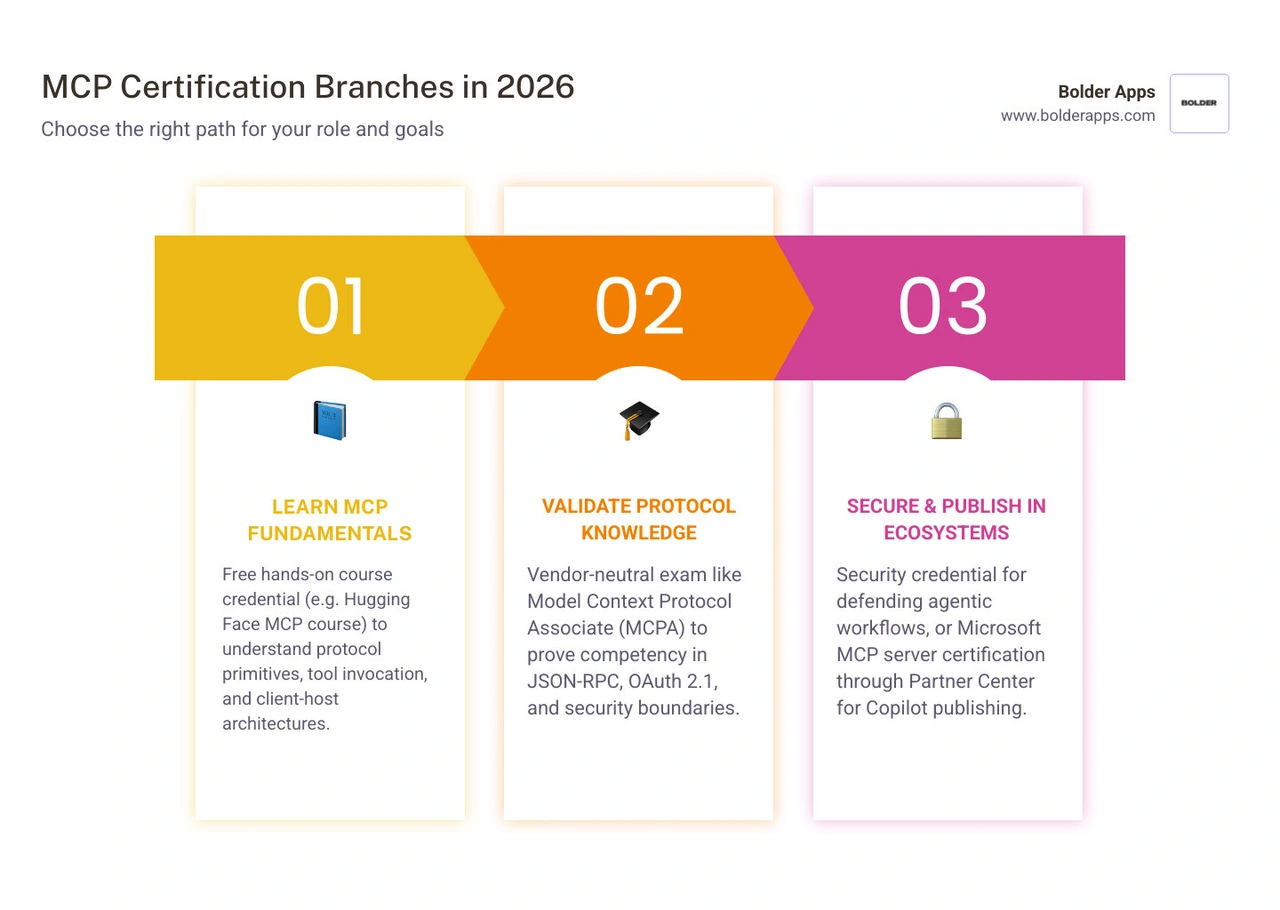
For most product leaders and developers, the relevant path is Model Context Protocol (MCP) validation. Choose based on your goal:
That distinction matters. A developer certificate can show personal skills. A security certification can show ability to defend tool-enabled AI workflows. Microsoft MCP server certification can help a product meet requirements for discovery and use within Copilot experiences.
For founders, the practical question is not "Which MCP certificate is best?" It is: Which credential supports the product, team, and ecosystem we need to build? A good MCP implementation still needs sound architecture, clear permissions, reliable tools, and security controls. A badge alone will not stop a prompt injection from having a very productive afternoon.
Bolder Apps, founded in 2019, builds digital products with this kind of execution in mind. DesignRush named Bolder Apps the top software and app development agency in 2026 (verify details on bolderapps.com). Learn more about our regional development hubs.
Key terms for mcp certification:
As enterprise adoption of agentic workflows accelerates across modern industries, engineering credentials are transforming. In 2026, 70% of organizations consider industry-recognized credentials essential for skills training and technical workforce development. Furthermore, research demonstrates that 76% of employees show an increased ability to innovate and optimize system processes after earning a specialized certification, while 63% receive or expect a job promotion.
Navigating these certifications requires distinguishing between individual practitioner accreditations, software validation pipelines, and specialized legacy credentials.
For software engineers and AI developers, mastering protocol primitives is essential for building scalable agentic systems. The Model Context Protocol establishes a universal, open standard for connecting large language models with dynamic local and remote resources.
When designing tools that autonomous agents can invoke reliably, developers need a firm grasp of What is an MCP Server and how it organizes tools, resources, and user-driven prompts into transport-agnostic primitives.
Engineers seeking a structured path can follow the MCP Developer Certification Roadmap | MCP Training to progress through three distinct skill milestones:
In parallel, vendor-neutral examinations such as the Model Context Protocol Associate (MCPA) evaluate foundational practitioner readiness across core architectural domains, protocol primitives, security boundaries, and operational integration patterns.
While individual developers earn personal credentials to demonstrate competency, organizations building enterprise integrations often undergo software-level validation. A prime example is the Microsoft MCP server certification (preview) - Microsoft Copilot Studio | Microsoft Learn workflow.
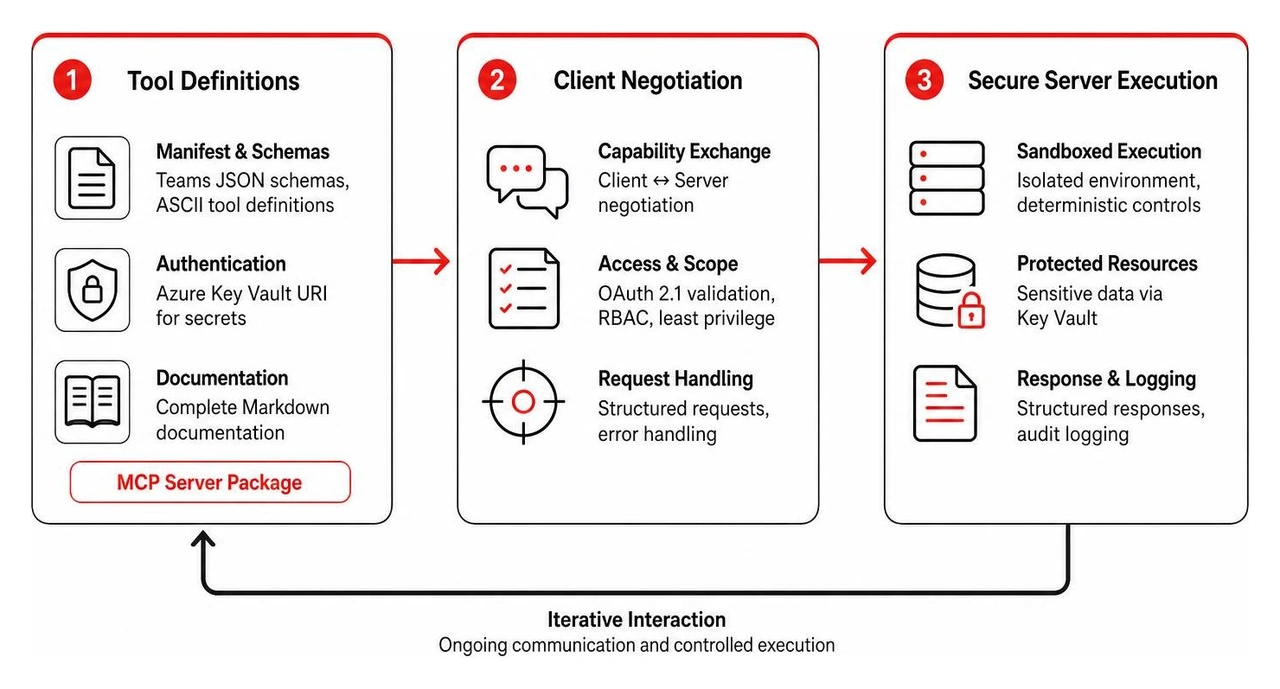
This software certification process allows verified publishers to expose proprietary tools and specialized datasets within Microsoft 365 Copilot, Azure AI Foundry, and Copilot Studio. Rather than testing a candidate with multiple-choice questions, Microsoft subjects the MCP server package to automated structural linting, functional review, and responsible AI safety validations.
Publishing teams must maintain an active Microsoft Partner Center account under the Apps and Agents for M365 and Copilot program. The server package must include a compliant manifest file referencing Microsoft Teams JSON schemas, tool definitions restricted to standard ASCII characters, complete Markdown documentation, and a securely managed authentication configuration.
Authentication requires integrating an Azure Key Vault URI directly into the package authorization manifest. This vault securely houses sensitive secrets, such as Client IDs, Client Secrets, and Token URLs, ensuring enterprise access controls without hardcoding credentials into deployed tools. Leveraging structured frameworks via MCP Framework Integration ensures that internal corporate microservices satisfy these stringent enterprise publishing prerequisites.
Because technical terminology frequently overlaps across sectors, candidates often encounter distinct legacy designations sharing the identical acronym. Disambiguating these programs prevents misaligned investments:
Obtaining a specialized protocol credential requires deep comprehension of modern distributed messaging, context injection vectors, and defensive engineering. Industry analyses highlighting The Rise of Model Context Protocol (MCP) Skills - Medium demonstrate that organizations prize practitioners who can engineer deterministic execution boundaries around unpredictable model outputs.
Technical syllabi across vendor-neutral certifications and advanced security specializations evaluate candidates across critical structural and defensive domains:
Assessment models differ according to credential tier:
Practitioners constructing real-world integrations frequently validate their architectures by pairing a dedicated MCP Client with customized backends, often Building MCP Servers with Node.js to test real-time tool orchestration under production network constraints.
As enterprise systems adopt autonomous agentic workflows, traditional software engineering roles are rapidly evolving into specialized AI architecture and governance disciplines.
Today, 85% of enterprises are actively deploying AI systems, yet fewer than one in four have implemented dedicated AI security controls. This acute vulnerability gap has accelerated demand for professionals who understand protocol-level mediation and defensive infrastructure.
The global AI security market is projected to reach $60.6 billion by 2032. Consequently, compensation packages for certified practitioners have expanded significantly:
These architectural specializations help organizations avoid costly technical debt and reduce development cycles, a dynamic explored in our analysis of Agentic Coding App Development Timelines 2026.
Protocol governance extends beyond software performance; it forms the foundation of enterprise compliance. In modern cloud setups, non-human identities (such as autonomous software agents and automated service principals) outnumber human enterprise accounts by more than 10 to 1.

Certified engineers design systems that align with recognized risk management frameworks:
Preparing for protocol certification requires a balanced study plan that combines hands-on engineering with theoretical architecture review.
Candidates preparing for protocol-level developer and security credentials should follow a disciplined study path:
Credential lifecycles vary across issuing organizations:
An MCP credential validates a developer's or architect's ability to design, build, secure, and maintain interoperable communication pipelines between large language models and external computational tools. It certifies that an engineer understands protocol primitives (tools, resources, prompts), transport mechanisms (stdio, Server-Sent Events), JSON-RPC structured messaging, and permission sandboxing.
Traditional cloud certifications focus primarily on static infrastructure provisioning, identity access management for human users, and hosting configurations within vendor-specific ecosystems (such as AWS, Azure, or Google Cloud).
In contrast, protocol validation centers on real-time runtime interactions between non-deterministic AI agents and deterministic backend tools. It tests dynamic prompt injection defenses, non-human identity governance, contextual data routing, and standardized tool execution schemas that operate across different model providers.
Prerequisites vary based on the specific certification level:
Achieving technical certification validates an engineer's understanding of underlying standards, but delivering scalable, production-grade AI platforms requires proven execution. As agentic architectures reshape mobile and enterprise software, businesses need engineering partners who combine deep architectural rigor with business-focused delivery.
Bolder Apps was founded in 2019 to bridge this exact gap. We build high-impact mobile and web applications that integrate modern protocol architectures, deterministic safety rails, and enterprise-grade security. Named the top software and app development agency in 2026 by DesignRush (verify details on bolderapps.com), we pair strategic US leadership with senior distributed engineers to ensure your product is built efficiently, cleanly, and without junior learning on your dime.
Whether you are launching an AI-native consumer product or certifying custom enterprise tool integrations, we protect your runway through our transparent fixed-budget model, in-shore CTO/offshore dev team delivery, and milestone-based payments.
Connect with our leadership team across our Bolder Apps regional development hubs to turn complex protocol engineering into measurable business results.
MCP certification is not one universal credential. In 2026, the term can refer to certifications for the Model Context Protocol used in AI agents, a Microsoft review process for MCP servers, an AI security credential, or unrelated legacy designations in building safety and mission-critical operations.
For most product leaders and developers, the relevant path is Model Context Protocol (MCP) validation. Choose based on your goal:
That distinction matters. A developer certificate can show personal skills. A security certification can show ability to defend tool-enabled AI workflows. Microsoft MCP server certification can help a product meet requirements for discovery and use within Copilot experiences.
For founders, the practical question is not "Which MCP certificate is best?" It is: Which credential supports the product, team, and ecosystem we need to build? A good MCP implementation still needs sound architecture, clear permissions, reliable tools, and security controls. A badge alone will not stop a prompt injection from having a very productive afternoon.
Bolder Apps, founded in 2019, builds digital products with this kind of execution in mind. DesignRush named Bolder Apps the top software and app development agency in 2026 (verify details on bolderapps.com). Learn more about our regional development hubs.
Key terms for mcp certification:
As enterprise adoption of agentic workflows accelerates across modern industries, engineering credentials are transforming. In 2026, 70% of organizations consider industry-recognized credentials essential for skills training and technical workforce development. Furthermore, research demonstrates that 76% of employees show an increased ability to innovate and optimize system processes after earning a specialized certification, while 63% receive or expect a job promotion.
Navigating these certifications requires distinguishing between individual practitioner accreditations, software validation pipelines, and specialized legacy credentials.
For software engineers and AI developers, mastering protocol primitives is essential for building scalable agentic systems. The Model Context Protocol establishes a universal, open standard for connecting large language models with dynamic local and remote resources.
When designing tools that autonomous agents can invoke reliably, developers need a firm grasp of What is an MCP Server and how it organizes tools, resources, and user-driven prompts into transport-agnostic primitives.
Engineers seeking a structured path can follow the MCP Developer Certification Roadmap | MCP Training to progress through three distinct skill milestones:
In parallel, vendor-neutral examinations such as the Model Context Protocol Associate (MCPA) evaluate foundational practitioner readiness across core architectural domains, protocol primitives, security boundaries, and operational integration patterns.
While individual developers earn personal credentials to demonstrate competency, organizations building enterprise integrations often undergo software-level validation. A prime example is the Microsoft MCP server certification (preview) - Microsoft Copilot Studio | Microsoft Learn workflow.
This software certification process allows verified publishers to expose proprietary tools and specialized datasets within Microsoft 365 Copilot, Azure AI Foundry, and Copilot Studio. Rather than testing a candidate with multiple-choice questions, Microsoft subjects the MCP server package to automated structural linting, functional review, and responsible AI safety validations.
Publishing teams must maintain an active Microsoft Partner Center account under the Apps and Agents for M365 and Copilot program. The server package must include a compliant manifest file referencing Microsoft Teams JSON schemas, tool definitions restricted to standard ASCII characters, complete Markdown documentation, and a securely managed authentication configuration.
Authentication requires integrating an Azure Key Vault URI directly into the package authorization manifest. This vault securely houses sensitive secrets, such as Client IDs, Client Secrets, and Token URLs, ensuring enterprise access controls without hardcoding credentials into deployed tools. Leveraging structured frameworks via MCP Framework Integration ensures that internal corporate microservices satisfy these stringent enterprise publishing prerequisites.
Because technical terminology frequently overlaps across sectors, candidates often encounter distinct legacy designations sharing the identical acronym. Disambiguating these programs prevents misaligned investments:
Obtaining a specialized protocol credential requires deep comprehension of modern distributed messaging, context injection vectors, and defensive engineering. Industry analyses highlighting The Rise of Model Context Protocol (MCP) Skills - Medium demonstrate that organizations prize practitioners who can engineer deterministic execution boundaries around unpredictable model outputs.
Technical syllabi across vendor-neutral certifications and advanced security specializations evaluate candidates across critical structural and defensive domains:
Assessment models differ according to credential tier:
Practitioners constructing real-world integrations frequently validate their architectures by pairing a dedicated MCP Client with customized backends, often Building MCP Servers with Node.js to test real-time tool orchestration under production network constraints.
As enterprise systems adopt autonomous agentic workflows, traditional software engineering roles are rapidly evolving into specialized AI architecture and governance disciplines.
Today, 85% of enterprises are actively deploying AI systems, yet fewer than one in four have implemented dedicated AI security controls. This acute vulnerability gap has accelerated demand for professionals who understand protocol-level mediation and defensive infrastructure.
The global AI security market is projected to reach $60.6 billion by 2032. Consequently, compensation packages for certified practitioners have expanded significantly:
These architectural specializations help organizations avoid costly technical debt and reduce development cycles, a dynamic explored in our analysis of Agentic Coding App Development Timelines 2026.
Protocol governance extends beyond software performance; it forms the foundation of enterprise compliance. In modern cloud setups, non-human identities (such as autonomous software agents and automated service principals) outnumber human enterprise accounts by more than 10 to 1.
Certified engineers design systems that align with recognized risk management frameworks:
Preparing for protocol certification requires a balanced study plan that combines hands-on engineering with theoretical architecture review.
Candidates preparing for protocol-level developer and security credentials should follow a disciplined study path:
Credential lifecycles vary across issuing organizations:
An MCP credential validates a developer's or architect's ability to design, build, secure, and maintain interoperable communication pipelines between large language models and external computational tools. It certifies that an engineer understands protocol primitives (tools, resources, prompts), transport mechanisms (stdio, Server-Sent Events), JSON-RPC structured messaging, and permission sandboxing.
Traditional cloud certifications focus primarily on static infrastructure provisioning, identity access management for human users, and hosting configurations within vendor-specific ecosystems (such as AWS, Azure, or Google Cloud).
In contrast, protocol validation centers on real-time runtime interactions between non-deterministic AI agents and deterministic backend tools. It tests dynamic prompt injection defenses, non-human identity governance, contextual data routing, and standardized tool execution schemas that operate across different model providers.
Prerequisites vary based on the specific certification level:
Achieving technical certification validates an engineer's understanding of underlying standards, but delivering scalable, production-grade AI platforms requires proven execution. As agentic architectures reshape mobile and enterprise software, businesses need engineering partners who combine deep architectural rigor with business-focused delivery.
Bolder Apps was founded in 2019 to bridge this exact gap. We build high-impact mobile and web applications that integrate modern protocol architectures, deterministic safety rails, and enterprise-grade security. Named the top software and app development agency in 2026 by DesignRush (verify details on bolderapps.com), we pair strategic US leadership with senior distributed engineers to ensure your product is built efficiently, cleanly, and without junior learning on your dime.
Whether you are launching an AI-native consumer product or certifying custom enterprise tool integrations, we protect your runway through our transparent fixed-budget model, in-shore CTO/offshore dev team delivery, and milestone-based payments.
Connect with our leadership team across our Bolder Apps regional development hubs to turn complex protocol engineering into measurable business results.
MCP certification is not one universal credential. In 2026, the term can refer to certifications for the Model Context Protocol used in AI agents, a Microsoft review process for MCP servers, an AI security credential, or unrelated legacy designations in building safety and mission-critical operations.
For most product leaders and developers, the relevant path is Model Context Protocol (MCP) validation. Choose based on your goal:
That distinction matters. A developer certificate can show personal skills. A security certification can show ability to defend tool-enabled AI workflows. Microsoft MCP server certification can help a product meet requirements for discovery and use within Copilot experiences.
For founders, the practical question is not "Which MCP certificate is best?" It is: Which credential supports the product, team, and ecosystem we need to build? A good MCP implementation still needs sound architecture, clear permissions, reliable tools, and security controls. A badge alone will not stop a prompt injection from having a very productive afternoon.
Bolder Apps, founded in 2019, builds digital products with this kind of execution in mind. DesignRush named Bolder Apps the top software and app development agency in 2026 (verify details on bolderapps.com). Learn more about our regional development hubs.
Key terms for mcp certification:
As enterprise adoption of agentic workflows accelerates across modern industries, engineering credentials are transforming. In 2026, 70% of organizations consider industry-recognized credentials essential for skills training and technical workforce development. Furthermore, research demonstrates that 76% of employees show an increased ability to innovate and optimize system processes after earning a specialized certification, while 63% receive or expect a job promotion.
Navigating these certifications requires distinguishing between individual practitioner accreditations, software validation pipelines, and specialized legacy credentials.
For software engineers and AI developers, mastering protocol primitives is essential for building scalable agentic systems. The Model Context Protocol establishes a universal, open standard for connecting large language models with dynamic local and remote resources.
When designing tools that autonomous agents can invoke reliably, developers need a firm grasp of What is an MCP Server and how it organizes tools, resources, and user-driven prompts into transport-agnostic primitives.
Engineers seeking a structured path can follow the MCP Developer Certification Roadmap | MCP Training to progress through three distinct skill milestones:
In parallel, vendor-neutral examinations such as the Model Context Protocol Associate (MCPA) evaluate foundational practitioner readiness across core architectural domains, protocol primitives, security boundaries, and operational integration patterns.
While individual developers earn personal credentials to demonstrate competency, organizations building enterprise integrations often undergo software-level validation. A prime example is the Microsoft MCP server certification (preview) - Microsoft Copilot Studio | Microsoft Learn workflow.
This software certification process allows verified publishers to expose proprietary tools and specialized datasets within Microsoft 365 Copilot, Azure AI Foundry, and Copilot Studio. Rather than testing a candidate with multiple-choice questions, Microsoft subjects the MCP server package to automated structural linting, functional review, and responsible AI safety validations.
Publishing teams must maintain an active Microsoft Partner Center account under the Apps and Agents for M365 and Copilot program. The server package must include a compliant manifest file referencing Microsoft Teams JSON schemas, tool definitions restricted to standard ASCII characters, complete Markdown documentation, and a securely managed authentication configuration.
Authentication requires integrating an Azure Key Vault URI directly into the package authorization manifest. This vault securely houses sensitive secrets, such as Client IDs, Client Secrets, and Token URLs, ensuring enterprise access controls without hardcoding credentials into deployed tools. Leveraging structured frameworks via MCP Framework Integration ensures that internal corporate microservices satisfy these stringent enterprise publishing prerequisites.
Because technical terminology frequently overlaps across sectors, candidates often encounter distinct legacy designations sharing the identical acronym. Disambiguating these programs prevents misaligned investments:
Obtaining a specialized protocol credential requires deep comprehension of modern distributed messaging, context injection vectors, and defensive engineering. Industry analyses highlighting The Rise of Model Context Protocol (MCP) Skills - Medium demonstrate that organizations prize practitioners who can engineer deterministic execution boundaries around unpredictable model outputs.
Technical syllabi across vendor-neutral certifications and advanced security specializations evaluate candidates across critical structural and defensive domains:
Assessment models differ according to credential tier:
Practitioners constructing real-world integrations frequently validate their architectures by pairing a dedicated MCP Client with customized backends, often Building MCP Servers with Node.js to test real-time tool orchestration under production network constraints.
As enterprise systems adopt autonomous agentic workflows, traditional software engineering roles are rapidly evolving into specialized AI architecture and governance disciplines.
Today, 85% of enterprises are actively deploying AI systems, yet fewer than one in four have implemented dedicated AI security controls. This acute vulnerability gap has accelerated demand for professionals who understand protocol-level mediation and defensive infrastructure.
The global AI security market is projected to reach $60.6 billion by 2032. Consequently, compensation packages for certified practitioners have expanded significantly:
These architectural specializations help organizations avoid costly technical debt and reduce development cycles, a dynamic explored in our analysis of Agentic Coding App Development Timelines 2026.
Protocol governance extends beyond software performance; it forms the foundation of enterprise compliance. In modern cloud setups, non-human identities (such as autonomous software agents and automated service principals) outnumber human enterprise accounts by more than 10 to 1.
Certified engineers design systems that align with recognized risk management frameworks:
Preparing for protocol certification requires a balanced study plan that combines hands-on engineering with theoretical architecture review.
Candidates preparing for protocol-level developer and security credentials should follow a disciplined study path:
Credential lifecycles vary across issuing organizations:
An MCP credential validates a developer's or architect's ability to design, build, secure, and maintain interoperable communication pipelines between large language models and external computational tools. It certifies that an engineer understands protocol primitives (tools, resources, prompts), transport mechanisms (stdio, Server-Sent Events), JSON-RPC structured messaging, and permission sandboxing.
Traditional cloud certifications focus primarily on static infrastructure provisioning, identity access management for human users, and hosting configurations within vendor-specific ecosystems (such as AWS, Azure, or Google Cloud).
In contrast, protocol validation centers on real-time runtime interactions between non-deterministic AI agents and deterministic backend tools. It tests dynamic prompt injection defenses, non-human identity governance, contextual data routing, and standardized tool execution schemas that operate across different model providers.
Prerequisites vary based on the specific certification level:
Achieving technical certification validates an engineer's understanding of underlying standards, but delivering scalable, production-grade AI platforms requires proven execution. As agentic architectures reshape mobile and enterprise software, businesses need engineering partners who combine deep architectural rigor with business-focused delivery.
Bolder Apps was founded in 2019 to bridge this exact gap. We build high-impact mobile and web applications that integrate modern protocol architectures, deterministic safety rails, and enterprise-grade security. Named the top software and app development agency in 2026 by DesignRush (verify details on bolderapps.com), we pair strategic US leadership with senior distributed engineers to ensure your product is built efficiently, cleanly, and without junior learning on your dime.
Whether you are launching an AI-native consumer product or certifying custom enterprise tool integrations, we protect your runway through our transparent fixed-budget model, in-shore CTO/offshore dev team delivery, and milestone-based payments.
Connect with our leadership team across our Bolder Apps regional development hubs to turn complex protocol engineering into measurable business results.